
Life, 1890-08-14 · page 4 of 14
Life — August 14, 1890 — page 4: what you’re looking at
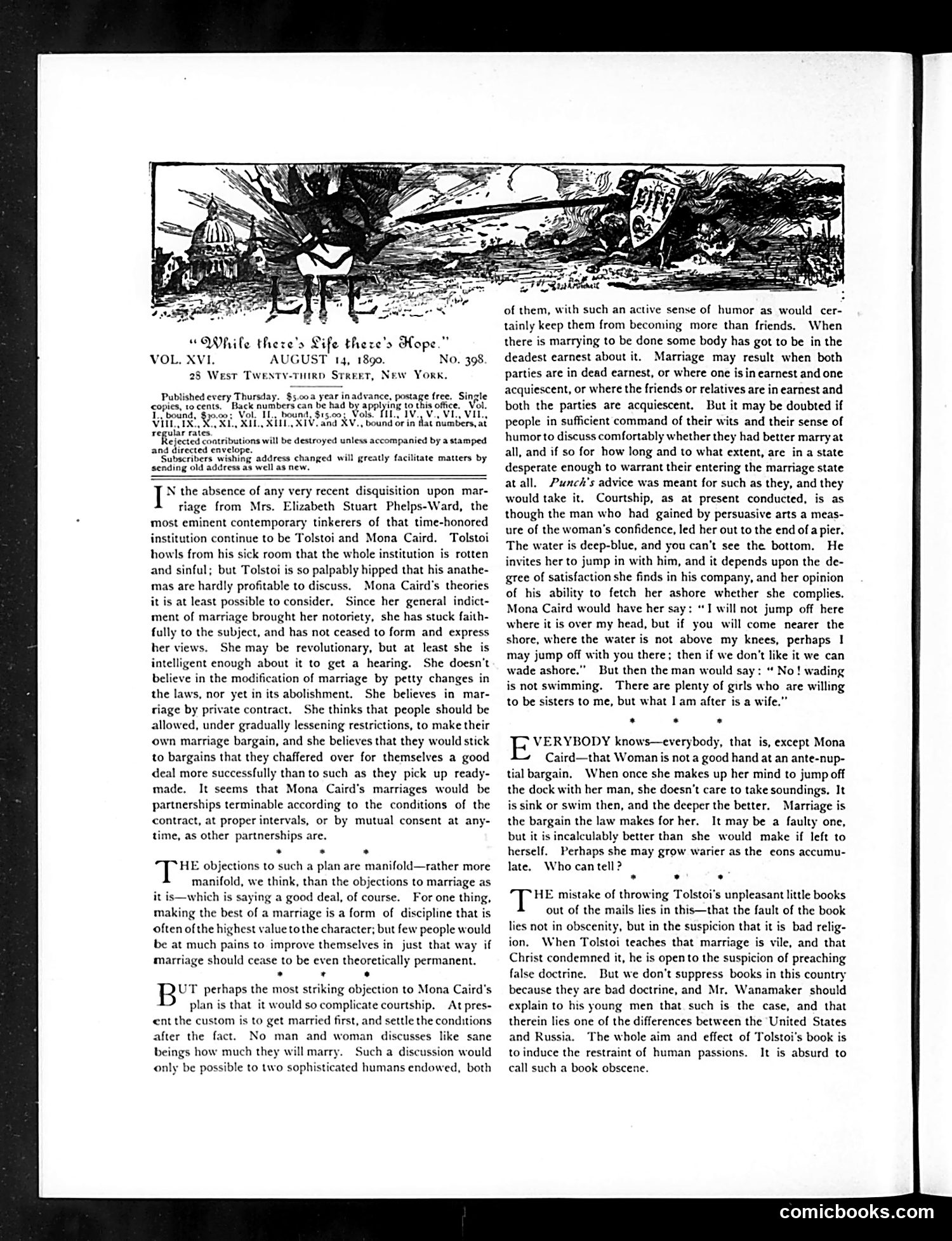
What you’re looking at
The page is primarily text rather than a political cartoon. The masthead shows this is **Life magazine, Vol. XVI, No. 408**, published August 14, 1890, from New York. The article discusses **marriage and divorce reform**, specifically criticizing **Mona Caird's** theories on matrimony. Caird apparently advocated for easier dissolution of marriage contracts and reducing legal restrictions on unions. The author argues against her positions, particularly objecting to her proposal that courtship discussions precede marriage vows—viewing this as impractical and complicating established social custom. The piece also briefly addresses **Tolstoy's controversial books**, suggesting American readers shouldn't dismiss them as obscene simply because Russian religious doctrine condemns them. This reflects 1890s debates over women's rights, marriage law reform, and literary censorship.
📄 Transcribed text from this page (OCR, searchable)
Machine-transcribed from the original scan — historical spelling and the odd misread are preserved.
“While there's Life there's Hope.” VOL. XVI. AUGUST 14, 1890. 28 West Twenty-riirp Street, New York. Published every Thursday. $5.00 year in advance, postage free. Single is office. Vol. 0.09; Vol, IL, hound, $15.00; Vols. f11.. 1V., V., VIL, VIL, (XI, XIL, NUL, X1Viand XV., bound or in dat humbers, at opies, tocents. “Back numbers can be had by applying to 1,, bound, ViIL IX, regular rates. ejected contributions will be destroyed untess accompanied by a stamped and directed envelope. Subscribers wishing address changed will greatly facilitate matters by sending old address as well as new. | fa the absence of any very recent disquisition upon mar- riage from Mrs. Elizabeth Stuart Phelps-Ward, the most eminent contemporary tinkerers of that time-honored institution continue to be Tolstoi and Mona Caird. Tolstoi howls from his sick room that the whole institution is rotten and sinful; but Tolstoi is so palpably hipped that his anathe- mas are hardly profitable to discuss. Mona Caird’s theories it is at least possible to consider, Since her general indict- ment of marriage brought her notoriety, she has stuck faith- fully to the subject, and has not ceased to form and express her views. She may be revolutionary, but at least she is intelligent enough about it to get a hearing. She doesn’t believe in the modification of marriage by petty changes in the laws, nor yet in its abolishment. She believes in mar- riage by private contract. She thinks that people should be allowed, under gradually lessening restrictions, to make their own marriage bargain, and she believes that they would stick to bargains that they chaffered over for themselves a good deal more successfully than to such as they pick up ready- made, It seems that Mona Caird’s marriages would be partnerships terminable according to the conditions of the contract, at proper intervals, or by mutual consent at any- time, as other partnerships are. . . . THe objections to such a plan are manifold—rather more manifold, we think, than the objections to marriage as it is—which is saying a good deal, of course. For one thing, making the best of a marriage is a form of discipline that is often ofthe highest value tothe character; but few people would be at much pains to improve themselves in just that way if marriage should cease to be even theoretically permanent. . ' . UT perhaps the most striking objection to Mona Caird's plan is that it would so complicate courtship. At pres- ent the custom is to get married first, and settle the conditions after the t. No man and woman discusses like sane beings how much they will marry. Such a discussion would only be possible to two sophisticated humans endowed, both of them, with such an active sense of humor as would cer- tainly keep them from becoming more than friends. When there is marrying to be done some body has got to be in the deadest earnest about it. Marriage may result when both parties are in dead earnest, or where one isin earnest and one acquiescent, or where the friends or relatives are in earnest and both the parties are acquiescent, But it may be doubted if people in sufficient command of their wits and their sense of humor to discuss comfortably whether they had better marry at all, and if so for how long and to what extent, are in a state desperate enough to warrant their entering the marriage state atall. Punch's advice was meant for such as they, and they would take it, Courtship, as at present conducted, is as though the man who had gained by persuasive arts a meas- ure of the woman's confidence, led her out to the end of a pier. The water is deep-blue, and you can’t see the bottom. He invites her to jump in with him, and it depends upon the de- gree of satisfaction she finds in his company, and her opinion of his ability to fetch her ashore whether she complies. Mona Caird would have her say: “I will not jump off here where it is over my head, but if you will come nearer the shore, where the water is not above my knees, perhaps | may jump off with you there; then if we don’t like it we can wade ashore,” But then the man would say: “ No! wading is not swimming. There are plenty of girls who are willing to be sisters to me, but what | am after is a wife.” VER vBoDY knows—everybody, that is, except Mona Caird—that Woman is nota good hand at an ante-nup- tial bargain. When once she makes up her mind to jump off the dock with her man, she doesn’t care to take soundings. It is sink or swim then, and the deeper the better. Marriage is the bargain the law makes for her. It may be a faulty one, but it is incalculably better than she would make if left to herself. Perhaps she may grow warier as the eons accumu- late. Who can tell? HE mistake of throwing Tolstoi’s unpleasant little books out of the mails lies in this—that the fault of the book lies not in obscenity, but in the suspicion that it is bad relig- ion. When Tolstoi teaches that marriage is vile, and that Christ condemned it, he is open to the suspicion of preaching false doctrine, But we don’t suppress books in this country because they are bad doctrine, and Mr. Wanamaker should explain to his young men that such is the case, and that therein lies one of the differences between the United States and Russia. The whole aim and effect of Tolstoi’s book is to induce the restraint of human passions. It is absurd to call such a book obscene. comicbooks.com