
A complete issue · 18 pages · 1890
Life — May 29, 1890
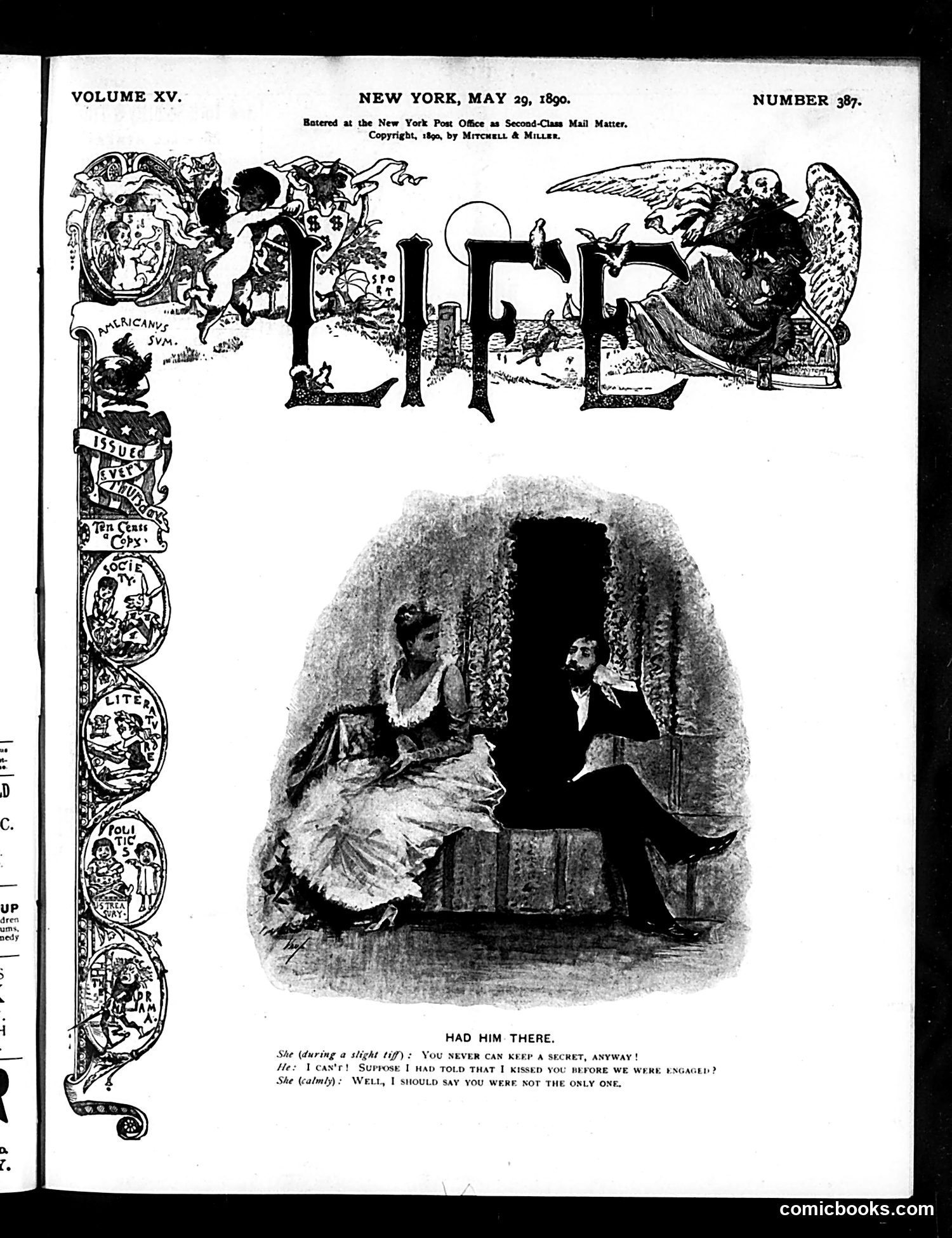
This illustration depicts a domestic quarrel between a man and woman. The caption presents their exchange as a witty riposte: the man accuses the woman of keeping secrets ("You never can keep a secret, anyway!"), she responds that she can't suppose she told him about a previous kiss before their engagement, and he retorts that she "should say you were not the only one." The humor rests on the double standard of the era—the man's implied previous romantic encounters are acceptable, while a woman's are scandalous. The cartoon satirizes male hypocrisy about female virtue and fidelity, presenting the woman's sharp comeback as scoring a rhetorical victory ("Had Him There") in this battle of marital wits.
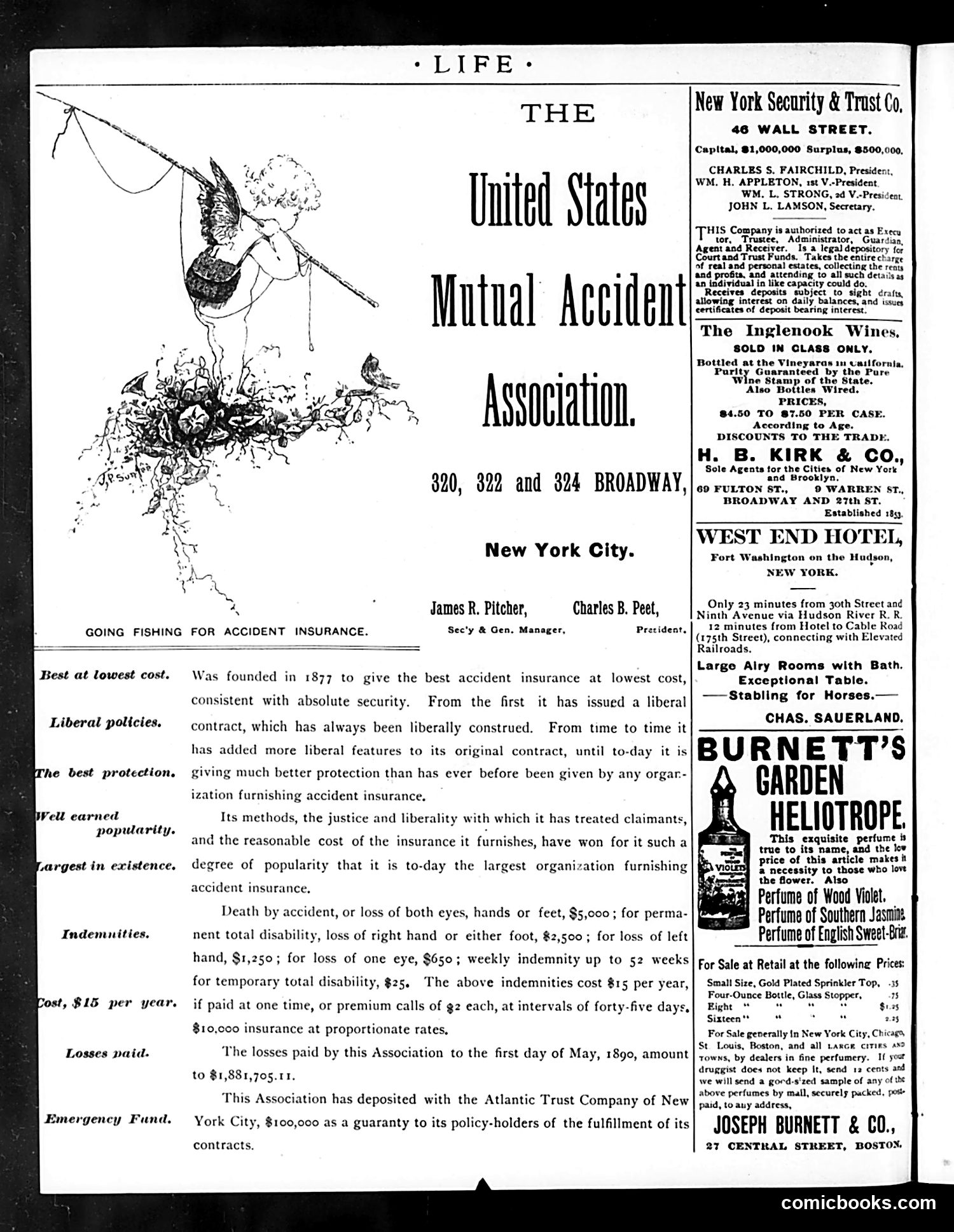
The cartoon depicts a cherub or cupid figure using a fishing rod to catch what appears to be a nest or tangle of objects from below—likely representing accident claims or insurance disputes. The satire mocks the United States Mutual Accident Association's business model. The playful metaphor suggests the company "fishes" for accidents and claims as a way to generate business, rather than genuinely protecting people. The cherub (symbolizing innocence or naïveté) performing this task implies that customers are being manipulated or deceived. The facing page's detailed insurance terms and conditions—listing specific indemnities for various injuries and death—reinforce the satire: the company profits by setting strict, limited payouts for accidents while collecting premiums.
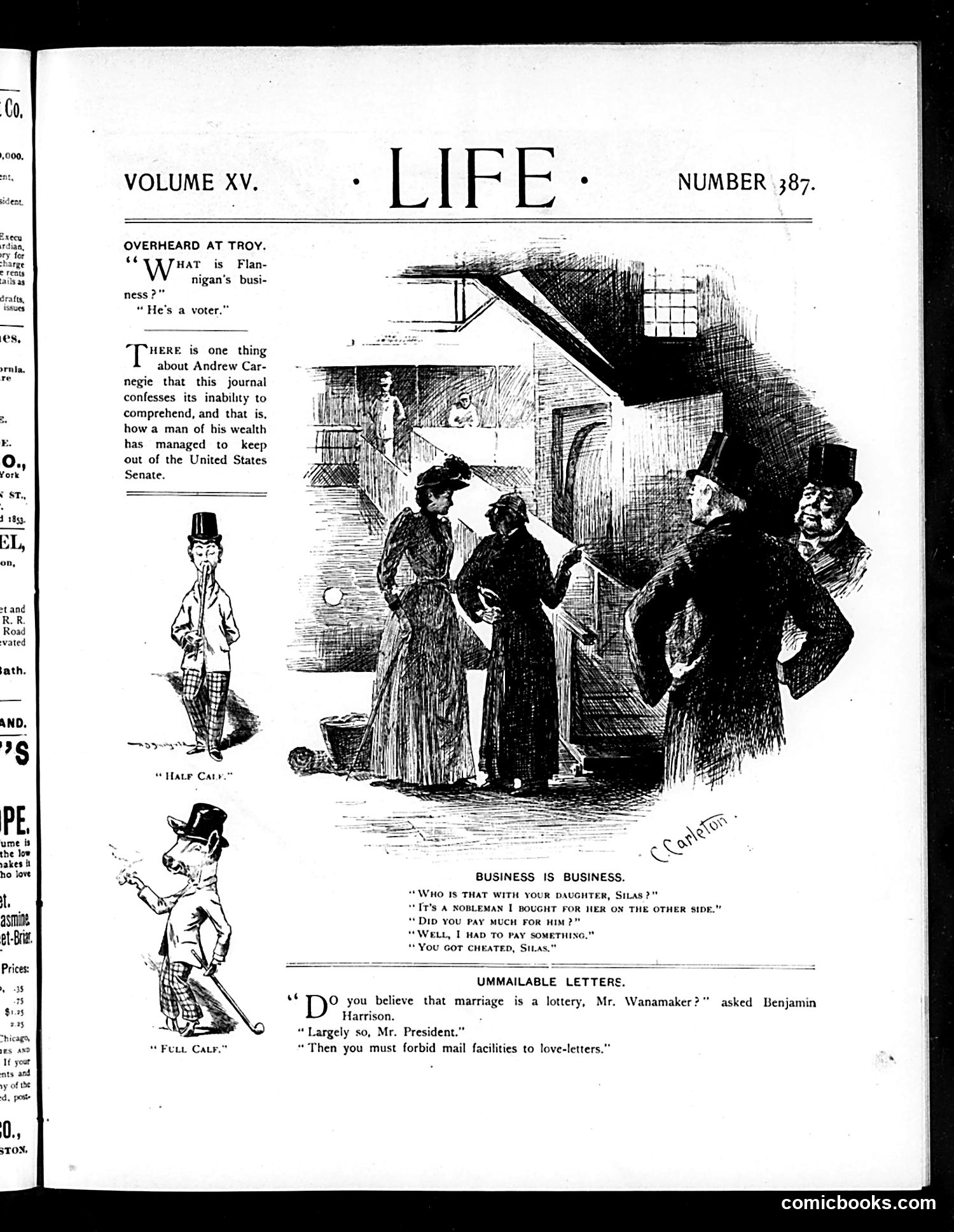
This page from *Life* magazine (Volume XV, Number 387) contains political and social satire targeting wealthy industrialists and their influence. The main cartoon "Business is Business" depicts what appears to be a wealthy businessman (labeled "Silas") negotiating to marry off his daughter to a nobleman for money, treating matrimony as a business transaction. The dialogue satirizes how the ultra-wealthy view marriage as commerce rather than romance. The smaller cartoons labeled "Half Calf" and "Full Calf" appear to be satirical character studies, likely mocking social types or political figures of the era. The opening section critiques Andrew Carnegie's influence in American politics, specifically questioning how a wealthy businessman managed to keep someone out of the U.S. Senate—suggesting concern about plutocratic control of government. The "Unmailable Letters" section provides additional satirical commentary on contemporary social attitudes.
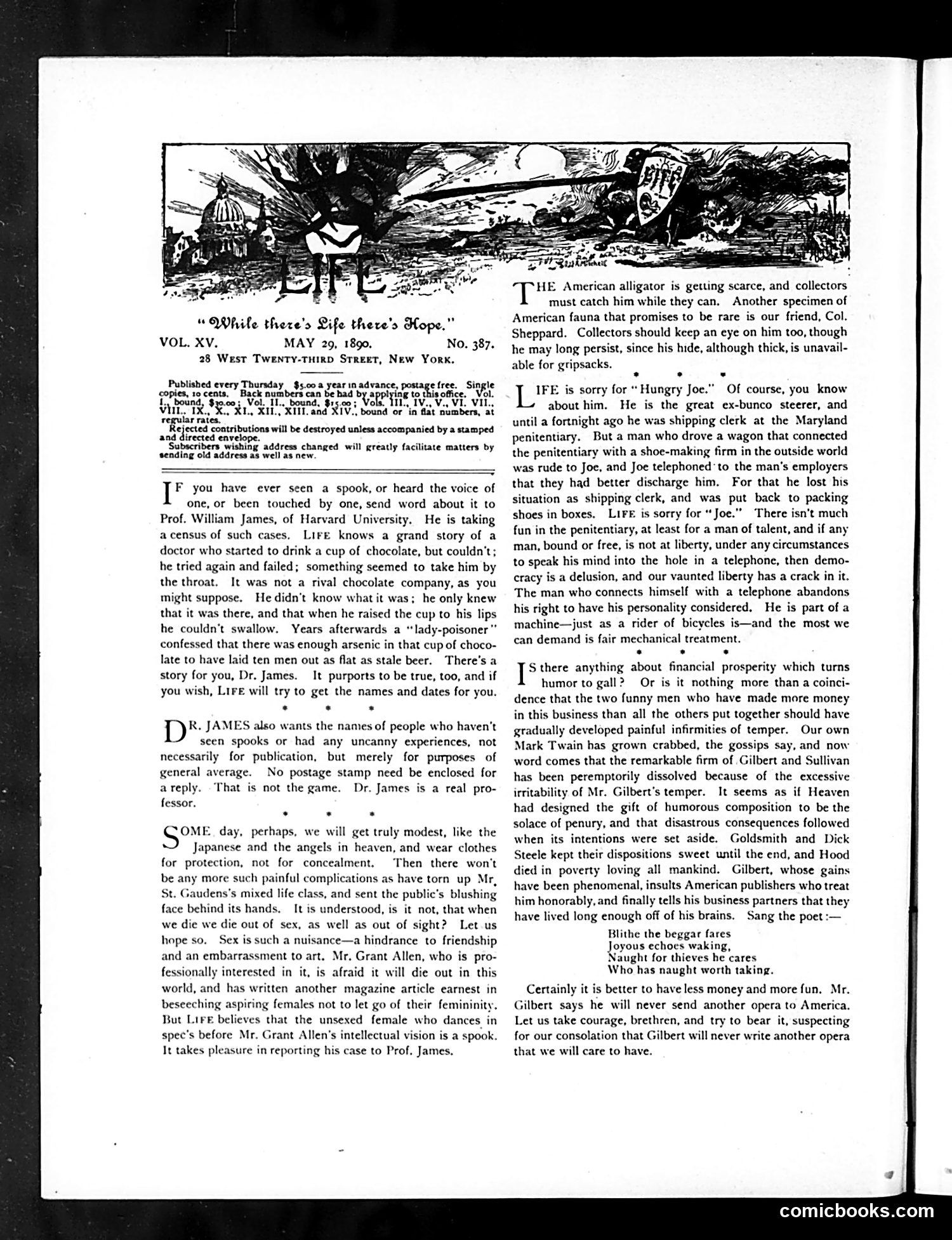
**The Cartoon:** The masthead illustration depicts a dramatic classical scene with architectural elements (a domed building, possibly representing government or civilization) alongside natural wilderness imagery. The phrase "While there's Life there's Hope" serves as the magazine's motto. **The Content:** This page contains editorial commentary rather than political cartoons. The editors discuss: 1. **American alligators** becoming scarce due to collection 2. **"Hungry Joe,"** a penitentiary inmate who lost his job at a shoe factory and reportedly sabotaged his employment 3. **Criticism of two humorists** (likely referring to Gilbert and Sullivan, mentioned later) whose temperamental personalities contrasted with their financial success 4. **A plea for modesty** in public life and arts The satire targets human vanity, institutional absurdity, and artistic pretension rather than specific political figures.
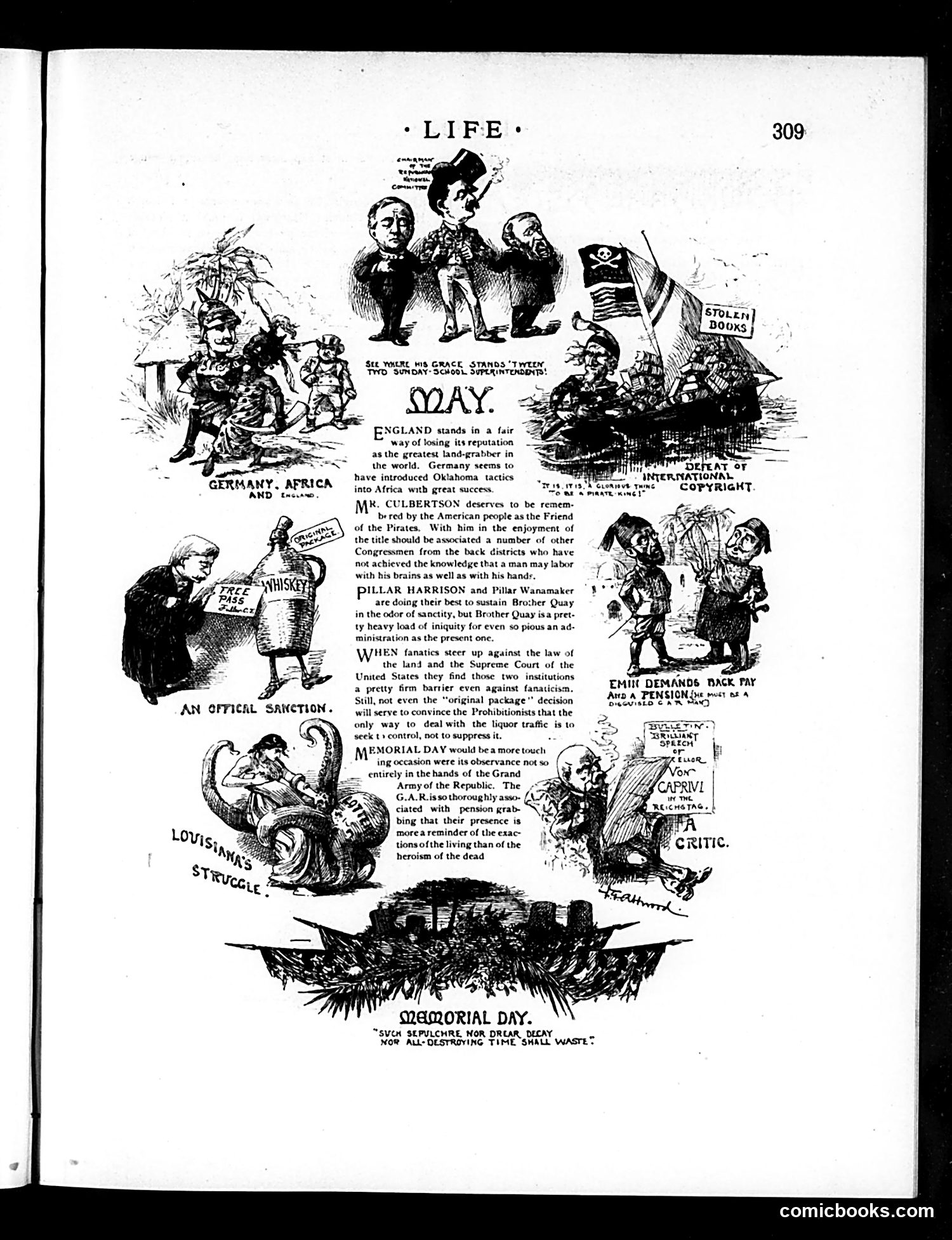
This page contains multiple editorial cartoons critiquing early 20th-century American politics and international affairs. **"Germany, Africa and ___"** (top left): Satirizes German colonial ambitions in Africa, depicted as land-grabbing tactics. **"An Official Sanction"** (left): Shows someone applying a "Free Whiskey" label, likely mocking Prohibition enforcement inconsistencies or political corruption enabling alcohol sales despite the ban. **"Louisiana Struggle"** (bottom left): References unspecified Louisiana political conflict, shown as an octopus—likely representing entrenched political power or corruption. **"Pirate of International Copyright"** (right): Depicts book theft, criticizing inadequate copyright protections. **"Emil Demands Back Pay"** (bottom right): Unclear without more context. **"Memorial Day"** (bottom): Questions whether Memorial Day observance genuinely honors the dead or wastes time. The page reflects Progressive Era skepticism toward government institutions and international conduct.
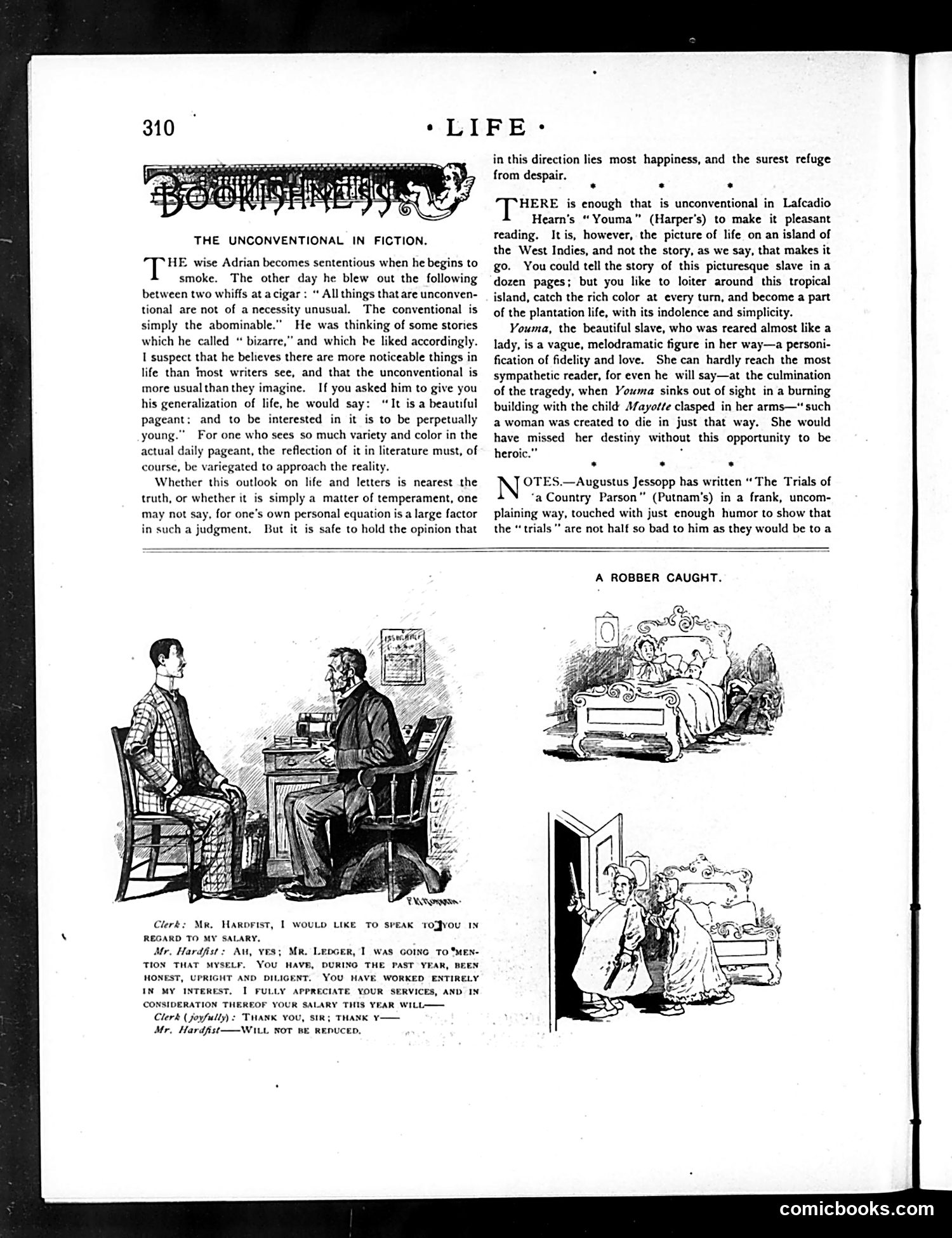
This page contains literary commentary rather than political satire. The top section discusses "The Unconventional in Fiction," praising Adrian's unconventional approach and praising a work called "Youma" set in the West Indies, featuring a character described as a melodramatic enslaved woman who dies heroically. The bottom section, titled "A Robber Caught," shows a humorous office dialogue between a clerk and Mr. Hardist. The clerk asks to speak about his reduced salary; Mr. Hardist responds that he's been "mercifully" allowed to keep his position, given the clerk's "entire interest" in his job, and promises no further salary reduction—a patronizing response that treats basic employment consideration as magnanimous generosity. The accompanying sketches appear to illustrate domestic scenes, though their specific connection to the dialogue remains unclear.
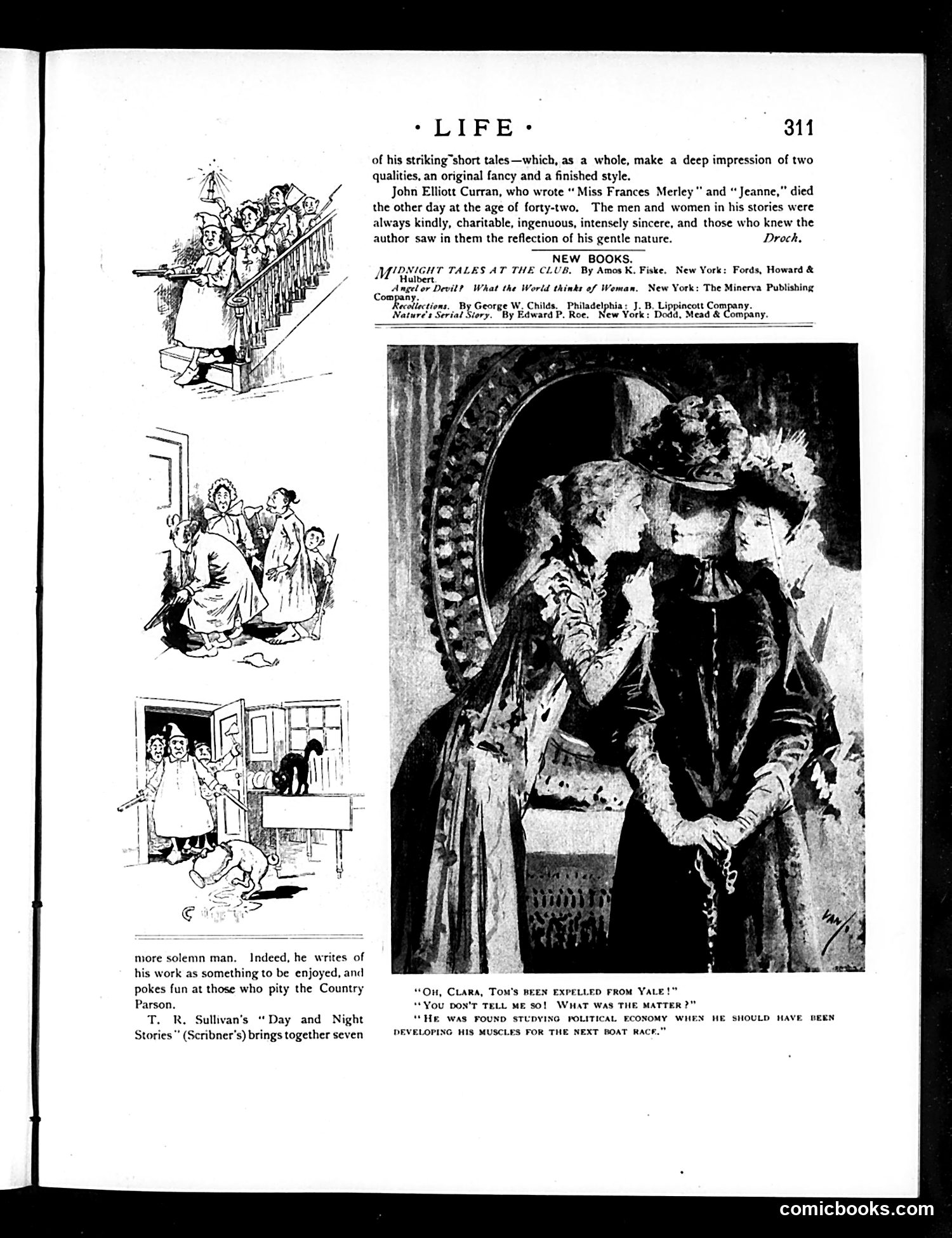
This page combines literary reviews with an illustration. The main image shows what appears to be a social scene with elegantly dressed figures in period costume, likely illustrating a story or review. The text discusses John Elliott Curran's short stories, praising his "original fancy and finished style," and notes the author's recent death at forty-two. It reviews several new books, including works on topics like "What the World Thinks of Woman" and "Nature's Serial Story." Below are three small line-drawn illustrations depicting domestic or social scenes—typical satirical vignettes of American life that were common in Life magazine. The specific literary references and new book titles mentioned are historical but lack clear satirical political commentary visible in this excerpt.
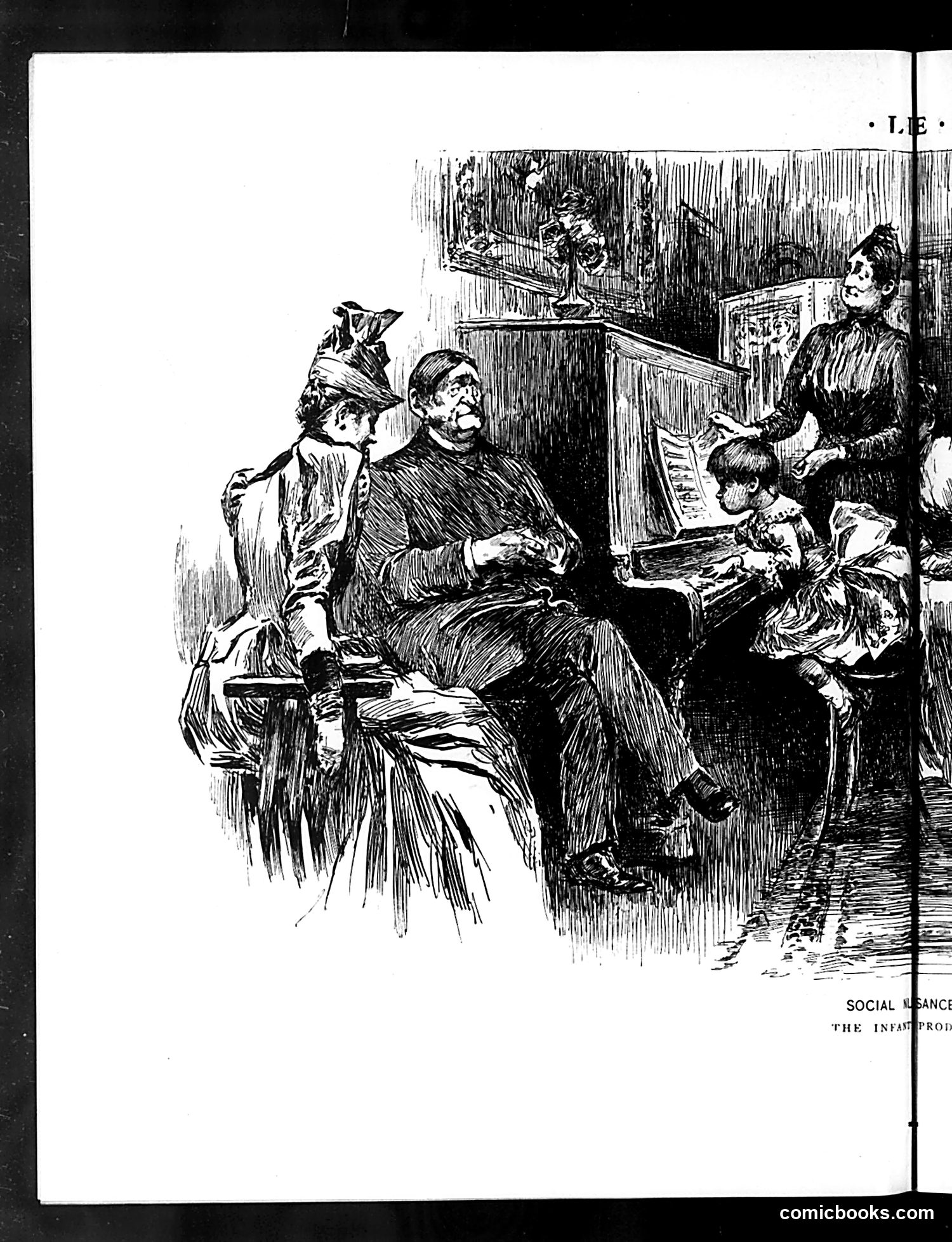
This page appears to be from Life magazine's "Social Science" or similar section (partial text visible: "SOCIAL...ANCE / THE INFANT PROD..."). The sketch depicts an interior domestic scene with several figures: two men in conversation on the left (one wearing a hat), and on the right, a woman with children near what appears to be a piano or musical instrument. The art style is characteristic of late 19th or early 20th-century satirical illustration. Without clearer OCR text or a visible title, the specific satire remains unclear. However, the composition suggests commentary on social class, domestic life, or family relationships typical of Life magazine's satirical focus during this period. The gathering suggests either a social visit or music lesson scenario.
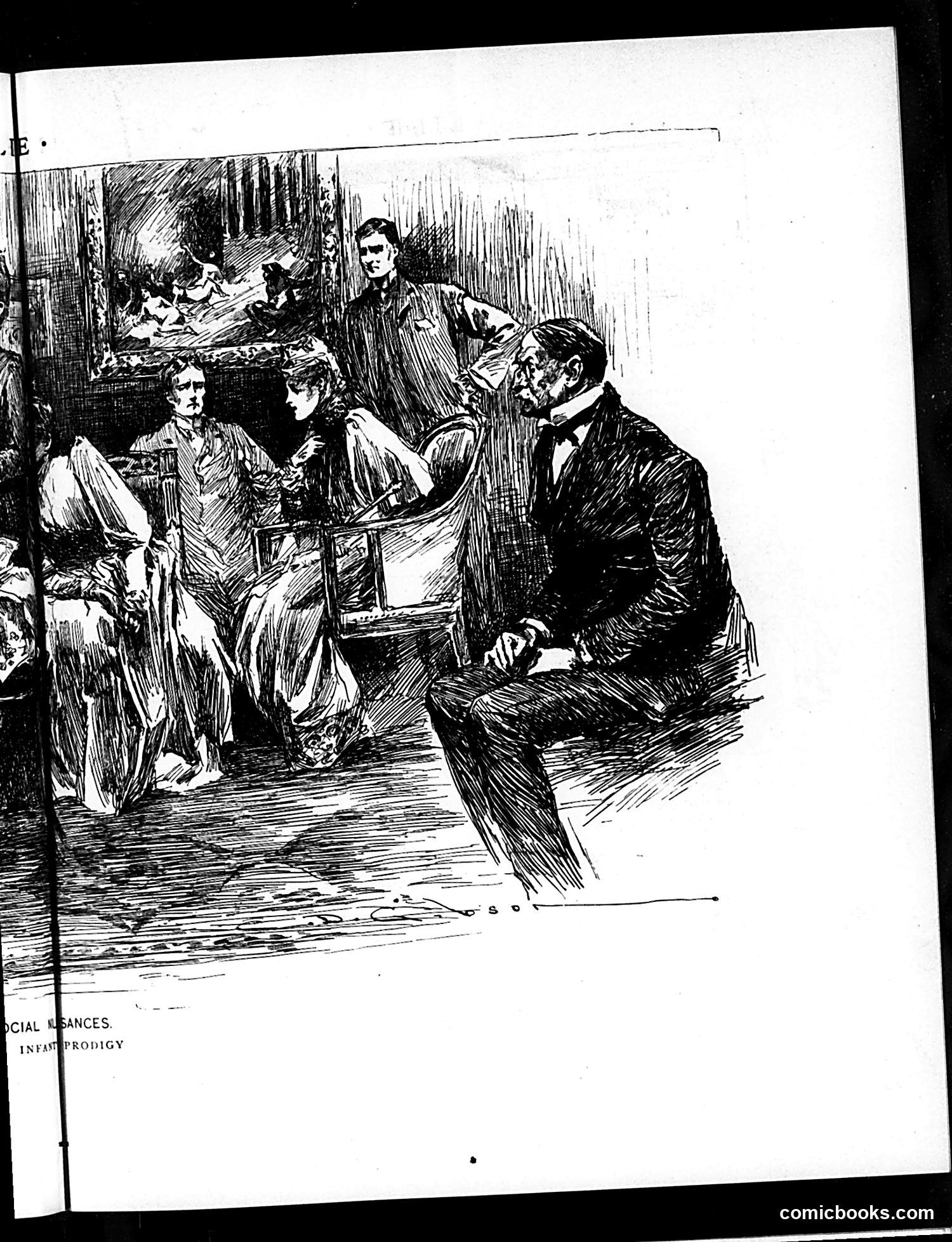
This sketch depicts a social gathering or dance scene, likely satirizing high society entertainments. The composition shows several well-dressed figures in what appears to be an interior venue, with a man in formal attire prominently seated in the foreground observing the scene. The caption "Infant Prodigy" suggests the satire concerns a young performer being showcased in adult social circles—possibly mocking either the pretentiousness of displaying child performers at elite gatherings, or the absurdity of treating a child's achievements as remarkable within sophisticated society. The sketch's style and composition are typical of *Life* magazine's social commentary, using exaggerated line work to convey irony about class, ambition, and cultural pretension in Gilded Age America.
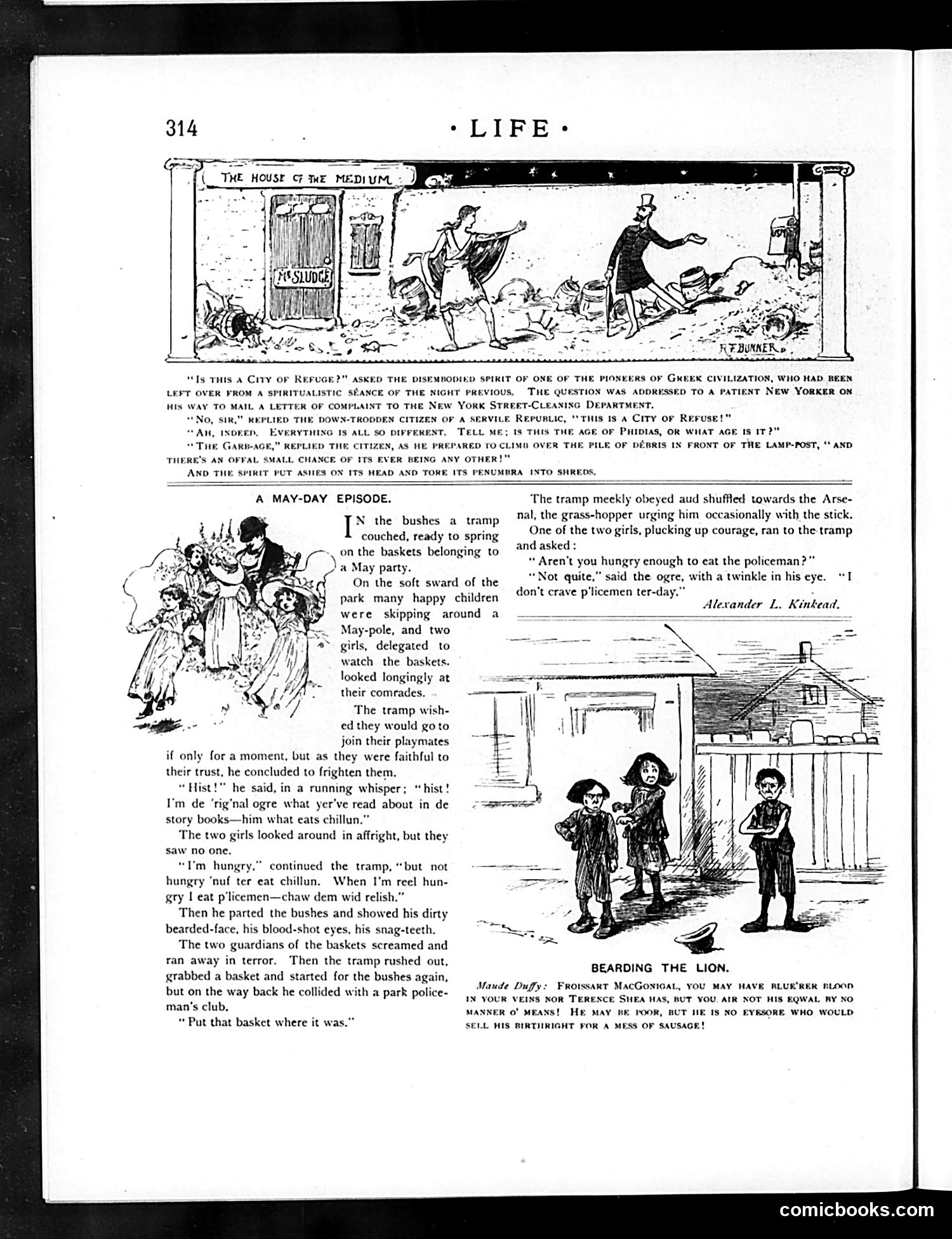
The top cartoon satirizes spiritualism and séances—popular among the wealthy during this era. A disembodied spirit (appearing disheveled) is questioned by a smug "medium" and well-dressed clients about whether New York has become a "city of refuge" for the poor. The spirit's frustrated response mocks both spiritualism's pretensions and society's indifference to urban poverty and homelessness. The bottom story "A May-Day Episode" depicts a vagrant ("tramp") encountering children at a May-pole celebration. His hunger and desperation terrify them; he's portrayed as rough and menacing ("blood-shot eyes," "snag-teeth"). The narrative critiques both working-class desperation and the social distance between poverty and genteel society, using the children's fear to highlight class anxiety of the era.
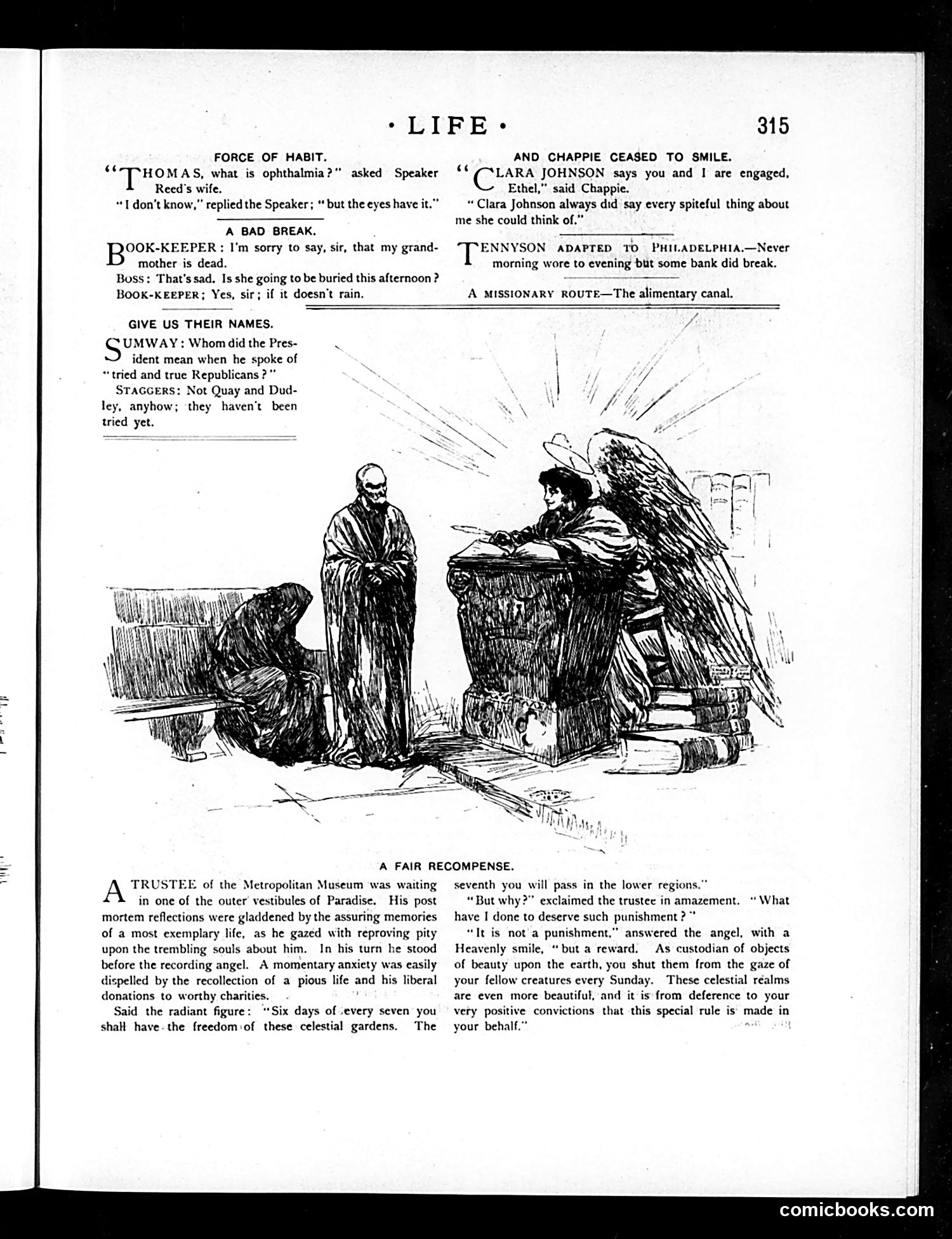
This cartoon depicts an angel addressing a man (identified as "a trustee of the Metropolitan Museum") in a celestial setting. The satire concerns charitable donations and moral reward. The angel ironically tells the trustee that despite his "pious life" and museum donations, he will only reach the "lower regions" of Paradise. The twist: the angel explains this isn't punishment but *reward*—he'll enjoy six days weekly freedom in "celestial gardens" to escape his fellow wealthy donors. The satire mocks how the wealthy use charitable giving to pursue social status while their actual moral character remains questionable, and suggests even in heaven, the truly virtuous would prefer to avoid their company.
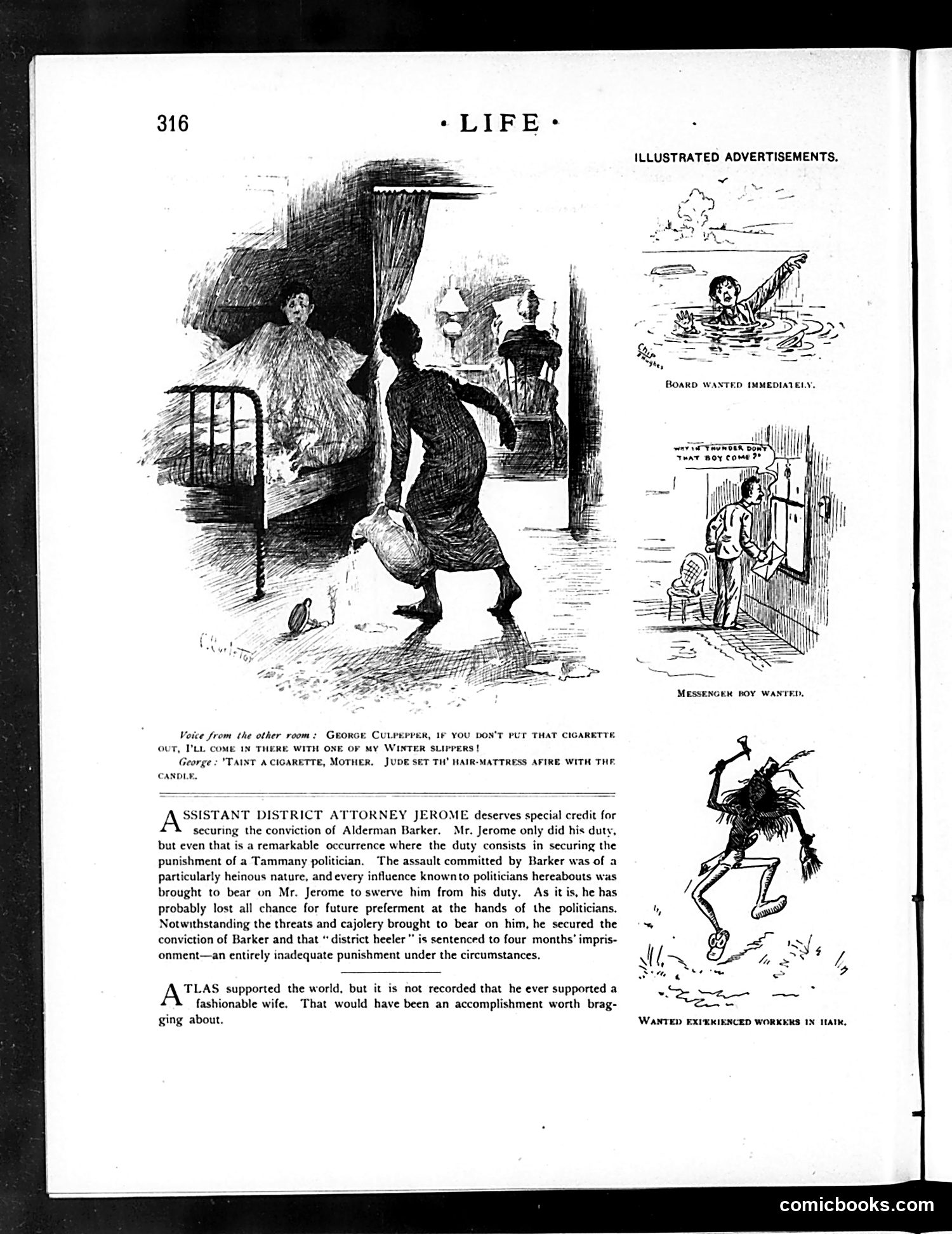
This *Life* magazine page contains satirical commentary on Gilded Age corruption and domestic humor. **Main cartoon (left):** A humorous domestic scene where a man named George is caught smoking indoors, then deflects blame by claiming his brother Jude set the hair mattress on fire with a candle—a joke about male irresponsibility and creative excuse-making. **Political commentary (center text):** The piece praises Assistant District Attorney Jerome for convicting Alderman Barker despite "Tammany" (the corrupt Democratic political machine controlling New York City) pressure. It suggests Jerome's conviction of a "district heeler" (low-level political operative) for assault is so rare that it deserves special recognition—and that Jerome has likely damaged his own career by actually doing his job honestly. The final comment mocks Atlas/mythology, implying supporting a fashionable wife would be harder than supporting the world. **Advertisements (right):** Small illustrated want-ads typical of the era: "Board Wasted Immediately," "Messenger Boy Wanted," "Wanted Experienced Workers in Hair."
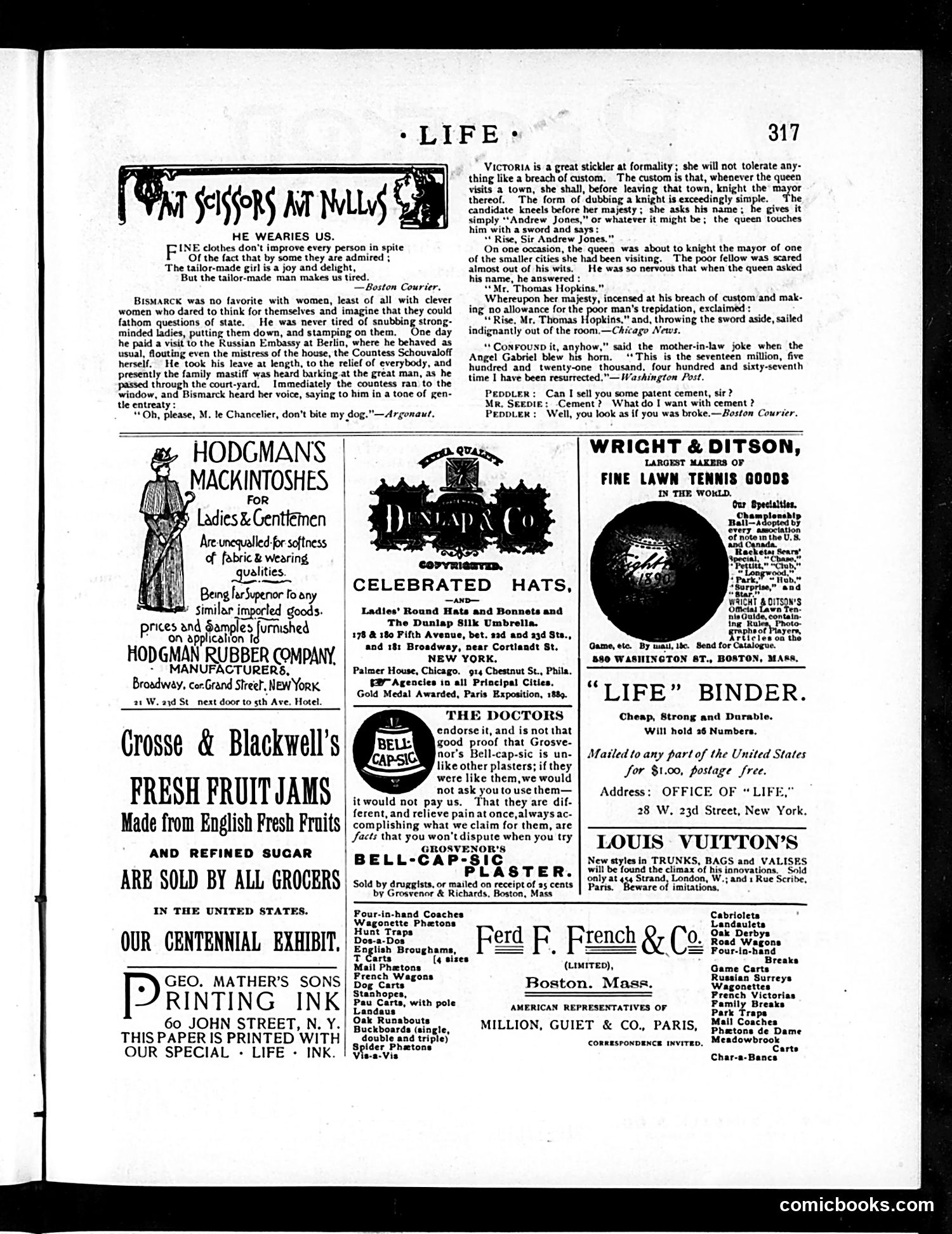
This page contains three humorous anecdotes satirizing rigid formality and social pretension: 1. **"He Wearies Us"** mocks the "tailor-made man"—a man whose expensive, fashionable clothing doesn't improve his actual character or substance. The satire suggests appearance-obsessed masculinity is tiresome. 2. **The Bismarck anecdote** ridicules the famous Prussian chancellor through a joke: when his barking at a dog annoyed him, the Countess sarcastically told him "don't bite my dog," mocking his notorious rudeness. 3. **The Queen Victoria anecdote** satirizes rigid protocol. A nervous mayor responds "Mr. Thomas Hopkins" instead of just "Andrew Jones" when knighted, and the Queen angrily knights him as "Mr."—refusing the proper title—as punishment for the breach of custom. The joke mocks excessive formality that punishes human nervousness. The remaining content is **period advertisements** (mackintoshes, jams, printing ink, hats, patent medicines) typical of 1890s Life magazine.
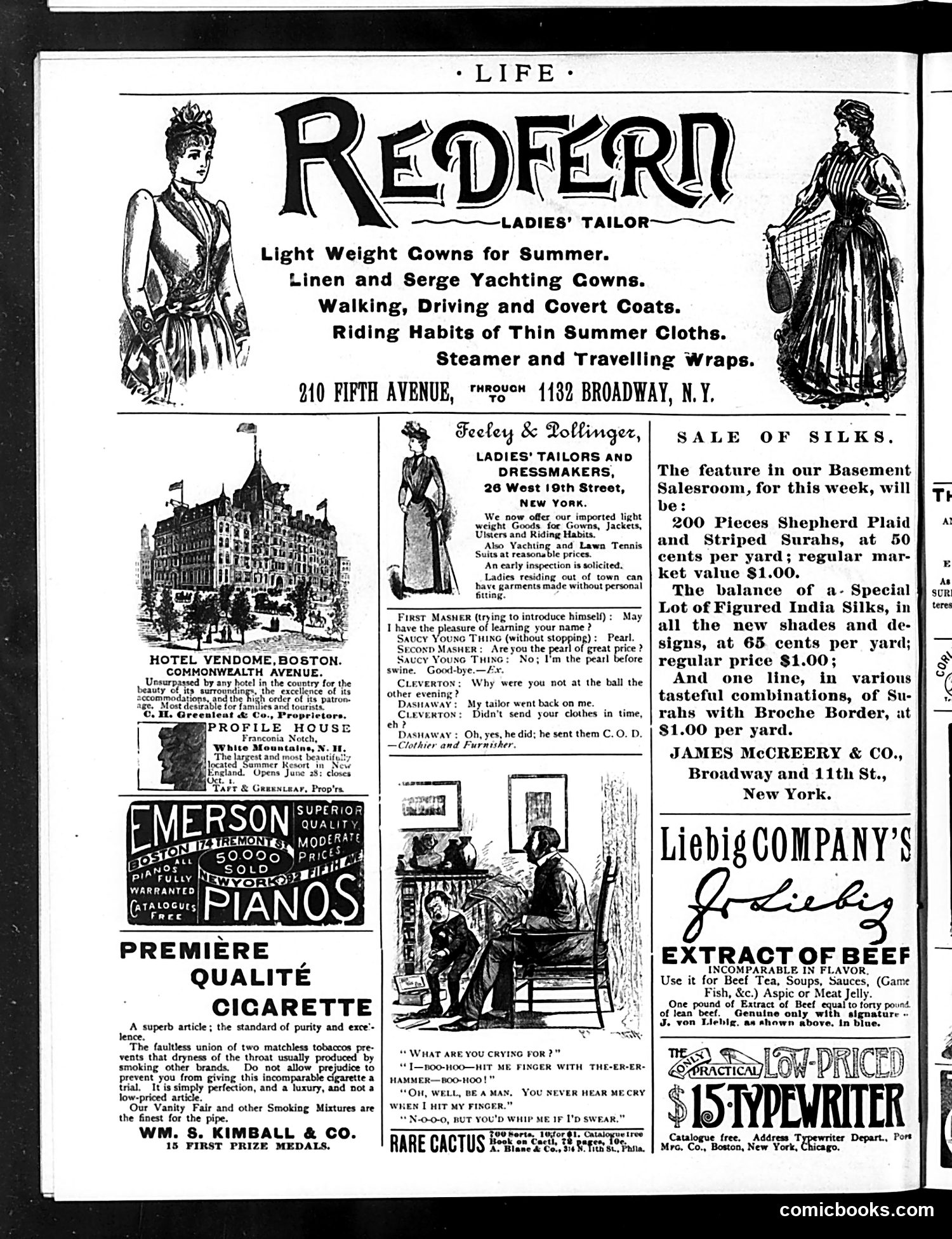
This is primarily an **advertising page** from Life magazine, with one small satirical dialogue comic embedded among the ads. The main cartoon (center) is titled **"What Are You Crying For?"** It depicts a humorous domestic exchange: a child cries after hitting his finger, and when the father offers sympathy, the child responds that the father would whip him if he swore—implying the child wants to curse but is restrained by parental discipline. The joke targets Victorian-era parenting: it satirizes both the child's frustration with restricted expression and the father's contradictory logic (sympathizing with pain while forbidding its natural verbal release). The rest of the page features period fashion and product advertisements: Redfern Ladies' Tailor, Emerson Pianos, Liebig's Extract of Beef, a $15 typewriter, and various silk sales—typical of early 1900s Life magazine content aimed at affluent readers.
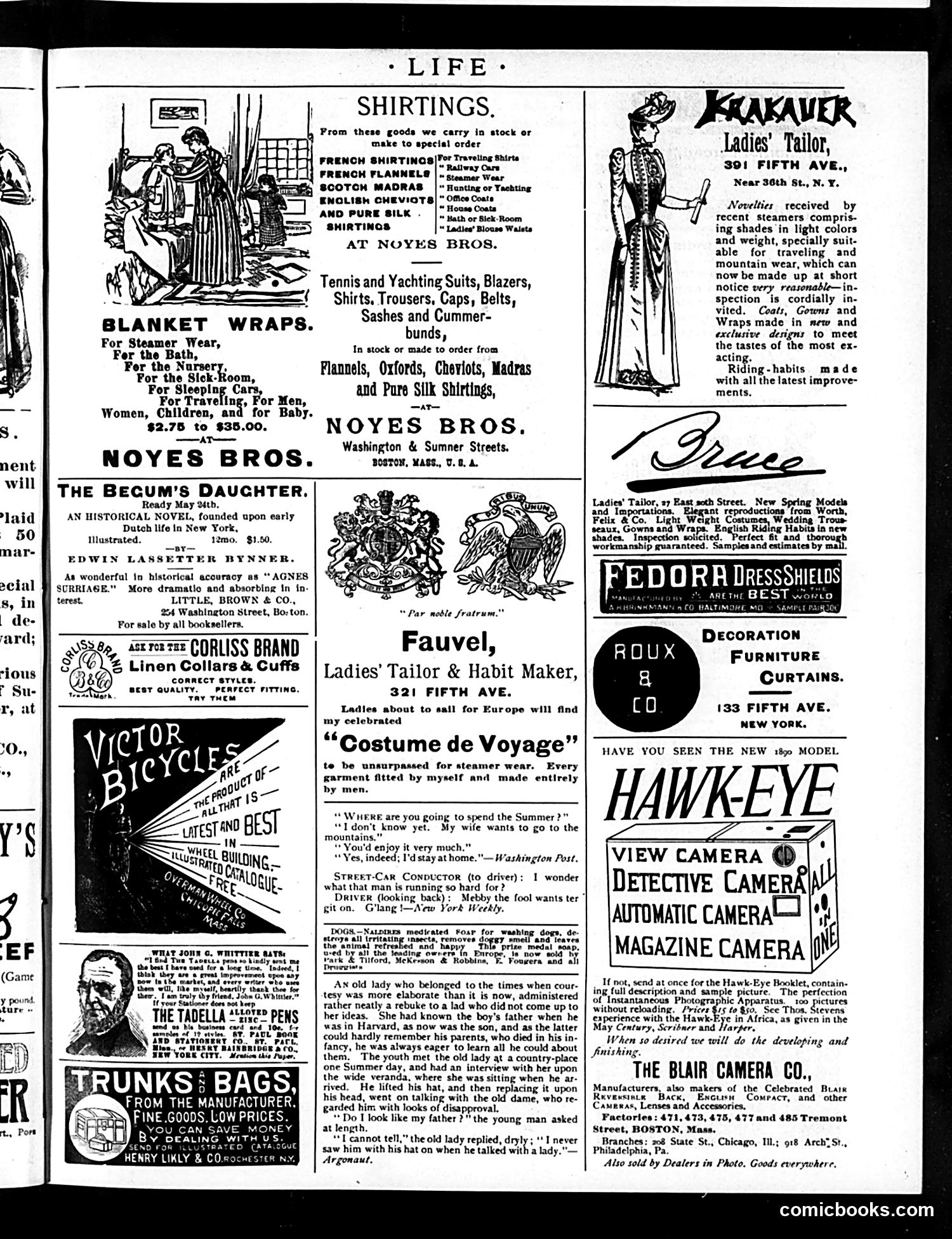
This is primarily an **advertising page** from Life magazine, circa 1890s, with minimal editorial cartoon content. The page showcases period clothing retailers and manufacturers targeting affluent, leisure-class consumers. The advertisements emphasize **summer travel wear**—shirtings, blazers, yachting suits, and steamer clothes for wealthy individuals taking European vacations and visiting mountain resorts. Multiple tailors advertise "costume de voyage" (traveling costume) services. The few short humorous pieces are genteel jokes: a man preferring to stay home rather than join his wife's mountain vacation; a street-car driver chasing someone; and an anecdote about a young man being rebuked for wearing his hat indoors during conversation—a breach of Victorian etiquette. The page reflects **Gilded Age consumer culture** targeting the leisured classes who could afford expensive travel clothing and custom tailoring. No political satire or significant historical references are evident.
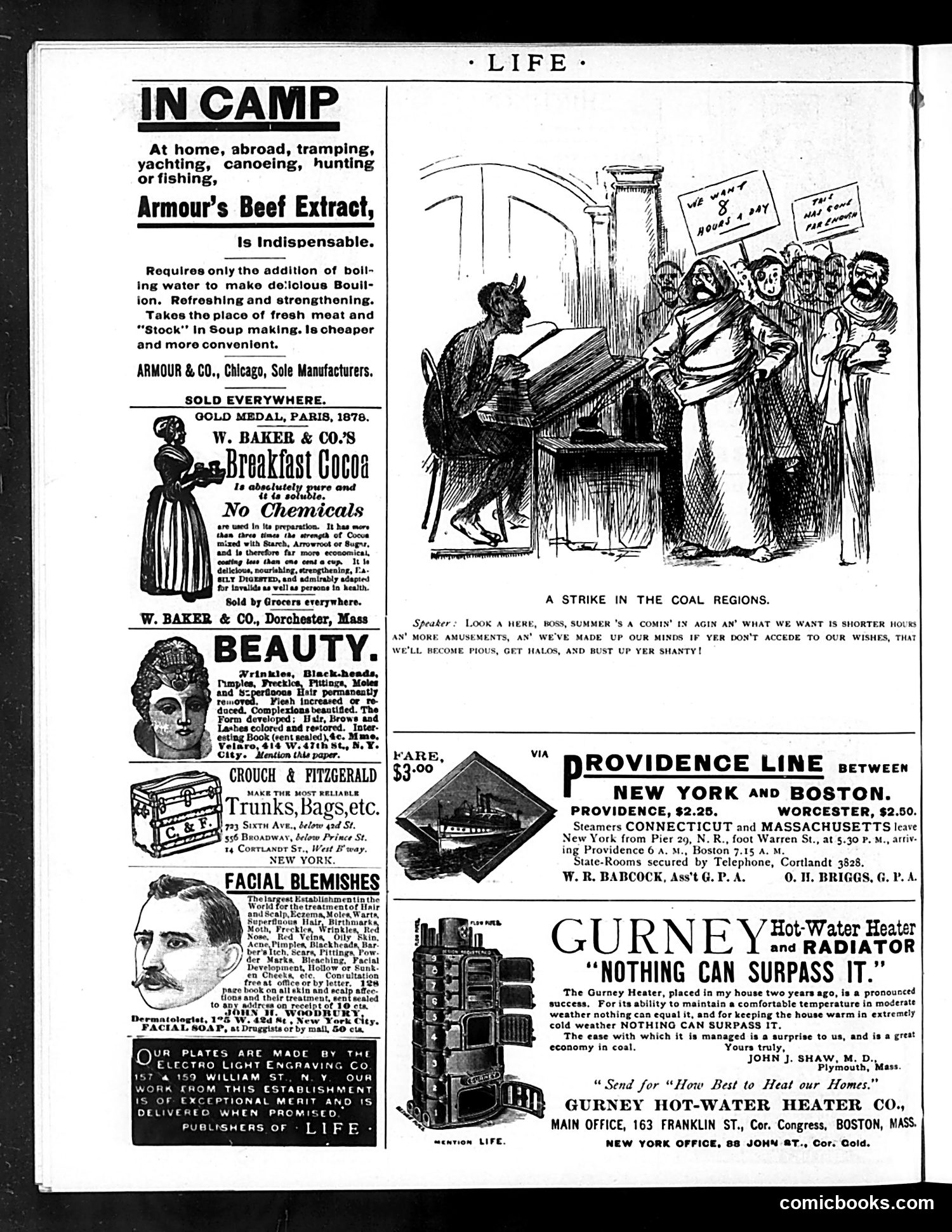
This cartoon satirizes labor strikes in American coal mines. A group of striking workers (depicted with exaggerated caricatured features typical of 19th-century satirical art) present demands to their boss, who sits at a desk. The speaker demands shorter hours and "more amusements." The satire mocks the strikers' stated grievances by suggesting their real threat is absurd: they'll "become pious, get halos, and bust up yer shanty"—implying workers are dishonest, irreligious, and destructive. The cartoon's dismissive tone reflects management's perspective, portraying strikers as unreasonable and their demands as petty rather than legitimate labor concerns. The page is primarily advertisements; this cartoon represents Life magazine's editorial stance on contemporary labor unrest, likely from the late 1800s when coal strikes were frequent and contentious.
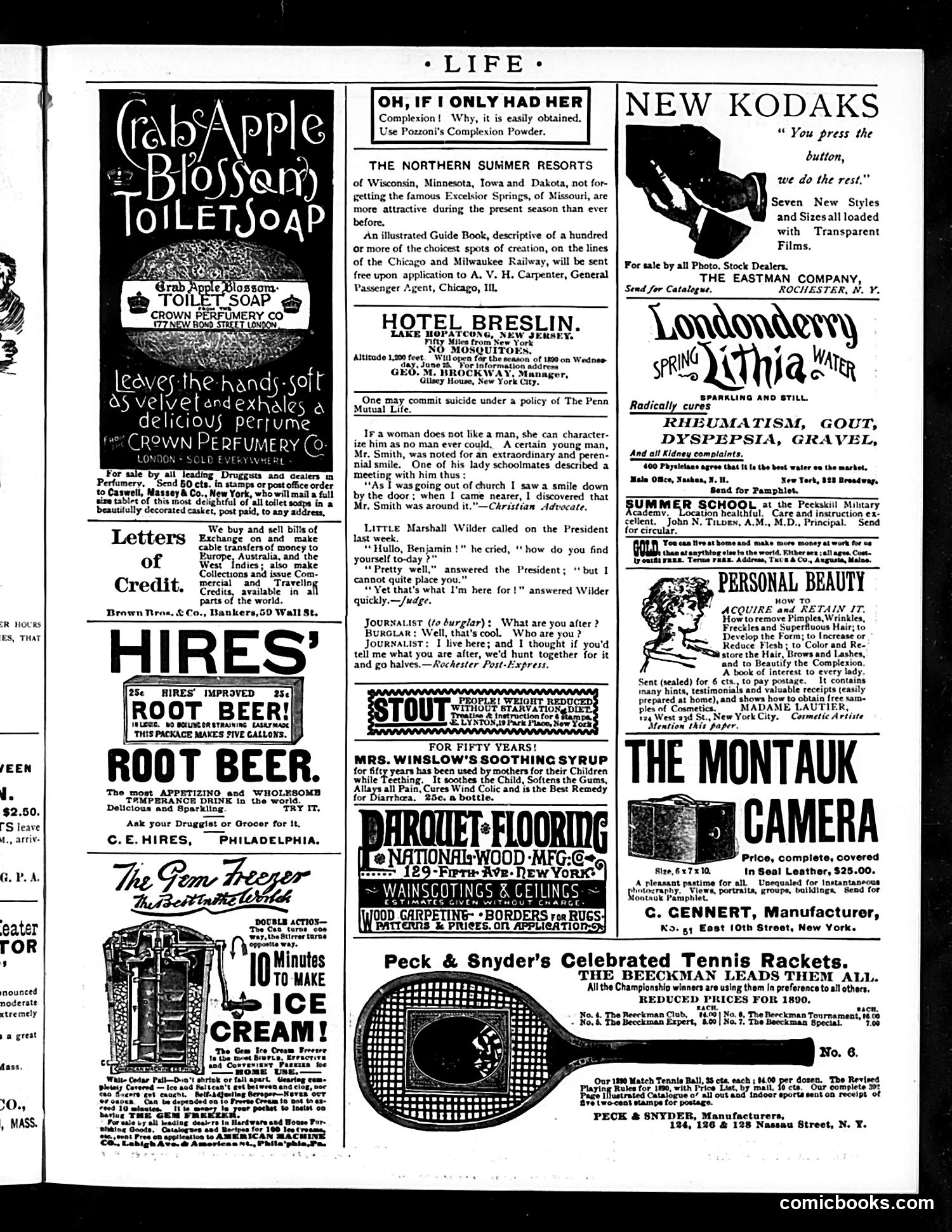
This page is primarily **advertising**, not political satire. It consists of late 19th-century product advertisements with minimal editorial content. The few non-advertising items include brief humorous anecdotes: 1. A joke about Mr. Smith's perpetual smile being so prominent that a woman describes seeing "a smile down by the door" before recognizing him. 2. A quip where young comedian Marshall Wilder visits President Benjamin Harrison, saying "that's what I'm here for" when the President can't place him—a mild wordplay joke. 3. A journalist-and-burglar joke where they agree to "hunt together" for valuables. These are lightweight humor pieces typical of the era, not political commentary. The page primarily advertises patent medicines, root beer, toilet soap, hotels, and cameras—products targeting middle-class consumers of the period. There is no identifiable political cartoon or satire present.
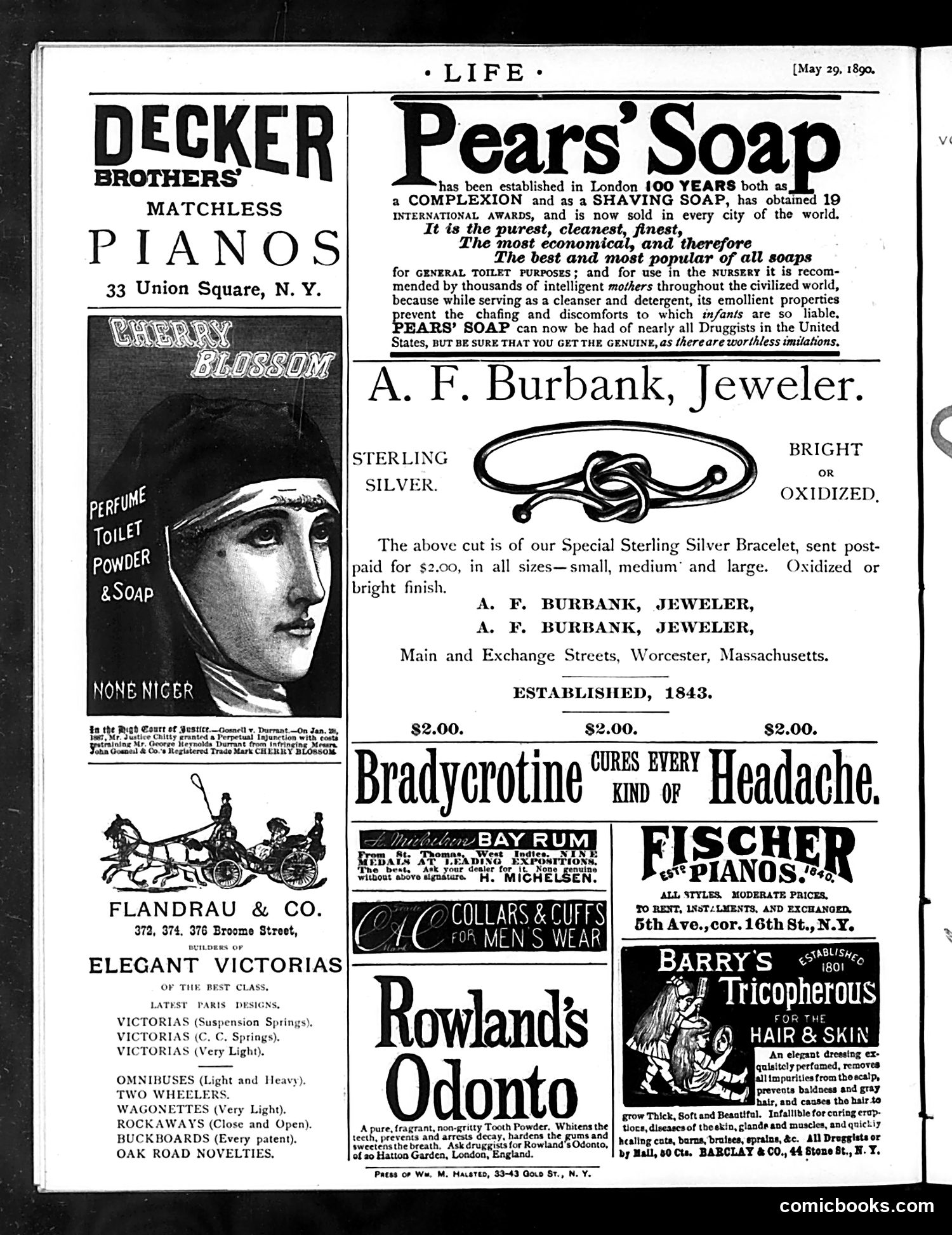
This is predominantly a **commercial advertising page** from Life magazine (May 29, 1890), containing no political cartoons or satire. The page features period product advertisements including: - **Decker Brothers Pianos** and **Cherry Blossom Perfume/Toilet Powder/Soap** (left column) - **Pears' Soap** (center-top): prominently advertises its 100-year London heritage, 19 international awards, and suitability for infants, while warning against counterfeit versions - **A.F. Burbank Jeweler** (center): offers sterling silver bracelets at $2.00 - **Flandrau & Co.** (left): Victorian carriages and omnibuses - **Various other products**: Bradycrotine headache cure, Bay Rum hair tonic, C&C Collars, Rowland's Odonto tooth powder, Fischer Pianos, and Barry's Tricopherous hair/skin treatment (right) The imagery is purely commercial—decorative illustrations supporting product claims. No satire, political content, or caricature is present. This represents typical late-19th-century American magazine advertising practices.