
Life, 1890-05-29 · page 4 of 18
Life — May 29, 1890 — page 4: what you’re looking at
What you’re looking at
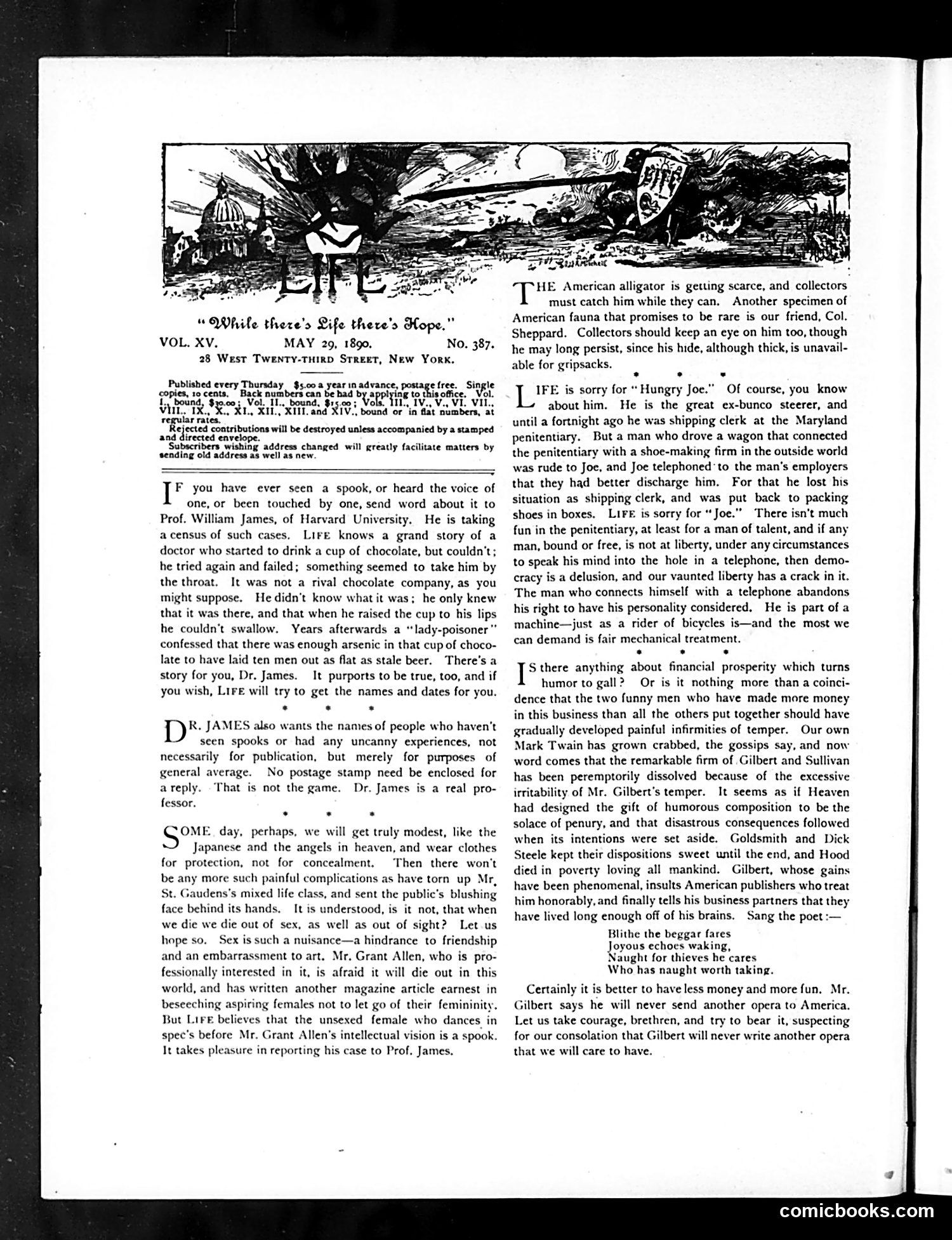
**The Cartoon:** The masthead illustration depicts a dramatic classical scene with architectural elements (a domed building, possibly representing government or civilization) alongside natural wilderness imagery. The phrase "While there's Life there's Hope" serves as the magazine's motto. **The Content:** This page contains editorial commentary rather than political cartoons. The editors discuss: 1. **American alligators** becoming scarce due to collection 2. **"Hungry Joe,"** a penitentiary inmate who lost his job at a shoe factory and reportedly sabotaged his employment 3. **Criticism of two humorists** (likely referring to Gilbert and Sullivan, mentioned later) whose temperamental personalities contrasted with their financial success 4. **A plea for modesty** in public life and arts The satire targets human vanity, institutional absurdity, and artistic pretension rather than specific political figures.
📄 Transcribed text from this page (OCR, searchable)
Machine-transcribed from the original scan — historical spelling and the odd misread are preserved.
“While there's Sipe there's Hope.” VOL. XV. MAY 29, 1890. No. 387. 28 West Twenty-tTHIRD Street, New York. Published every Thursday $5.00 a fear ta advance, postage § ince ore, 2 Cents, ” Back numbers can be be sppiae aie 00 ; sao Val si, IV, ve SE vite $39.00; Vol. I1.. rt wax, SON KIL NTE aad NiVs bound or 'in Wat bambers, ai rates. ejected contributions will be destroyed unless accompanied by a stamped and directed envel Subscribers: wishing address changed will greatly facilitate matters by sending old address as well as new. F you have ever seen a spook, or heard the voice of one, or been touched by one, send word about it to Prof. William James, of Harvard University. He is taking acensus of such cases. Lire knows a grand story of a doctor who started to drink a cup of chocolate, but couldn't; he tried again and failed; something seemed to take him by the throat. It was not a rival chocolate company, as you might suppose. He didn’t know what it was; he only knew that it was there, and that when he raised the cup to his lips he couldn't swallow. Years afterwards a “lady-poisoner” confessed that there was enough arsenic in that cup of choco- late to have laid ten men out as flat as stale beer. There’s a story for you, Dr. James. It purports to be true, too, and if you wish, Lire will try to get the names and dates for you. R. JAMES also wants the names of people who haven't seen spooks or had any uncanny experiences, not necessarily for publication, but merely for purposes of general average. No postage stamp need be enclosed for areply. ‘That is not the game. Dr. James is a real pro- fessor. . . . > OME. day, perhaps, we will get truly modest, like the Japanese and the angels in heaven, and wear clothes for protection, not for concealment. ‘Then there won't be any more such painful complications as have torn up Mr, St, Gaudens’s mixed life class, and sent the public's blushing face behind its hands. It is understood, is it not, that when we die we die out of sex, as well as out of sight? Let us hope so. Sex is such a nuisance—a hindrance to friendship and an embarrassment to art. Mr. Grant Allen, who is pro- fessionally interested in it, is afraid it will die out in this world, and has written another magazine article earnest in beseeching aspiring females not to let go of their femininity. But Lire believes that the unsexed female who dances in spec's before Mr. Grant Allen’s intellectual vision is a spook. It takes pleasure in reporting his case to Prof. James. HE American alligator is getting scarce, and collectors must catch him while they can, Another specimen of American fauna that promises to be rare is our friend, Col. Sheppard. Collectors should keep an eye on him too, though he may long persist, since his hide, although thick, is unavail- able for gripsacks. ° . IFE is sorry for “ Hungry Joe.” Of course, you know about him. He is the great ex-bunco steerer, and until a fortnight ago he was shipping clerk at the Maryland penitentiary. But a man who drove a wagon that connected the penitentiary with a shoe-making firm in the outside world was rude to Joe, and Joe telephoned to the man’s employers that they had better discharge him. For that he lost his situation as shipping clerk, and was put back to packing shoes in boxes. LIFE is sorry for “Joe.” There isn’t much fun in the penitentiary, at least for a man of talent, and if any man, bound or free, is not at liberty, under any circumstances to speak his mind into the hole in a telephone, then demo- cracy is a delusion, and our vaunted liberty has a crack in it. The man who connects himself with a telephone abandons his right to have his personality considered. He is part of a machine—just as a rider of bicycles is—and the most we can demand is fair mechanical treatment. . . . Sthere anything about financial prosperity which turns humor to gall? Or is it nothing more than a coinci- dence that the two funny men who have made more money in this business than all the others put together should have gradually developed painful infirmities of temper. Our own Mark Twain has grown crabbed, the gossips say, and now word comes that the remarkable firm of Gilbert and Sullivan has been peremptorily dissolved because of the excessive irritability of Mr. Gilbert's temper. It seems as if Heaven had designed the gift of humorous composition to be the solace of penury, and that disastrous consequences followed when its intentions were set aside. Goldsmith and Dick Steele kept their dispositions sweet until the end, and Hood died in poverty loving all mankind. Gilbert, whose gains have been phenomenal, insults American publishers who treat him honorably, and finally tells his business partners that they have lived long enough off of his brains. Sang the poet :— Blithe the beggar fares Joyous echocs waking, Naught for thieves he cares Who has naught worth taking. Certainly it is better to have less money and more fun. Mr. Gilbert says he will never send another opera to America. Let us take courage, brethren, and try to bear it, suspecting for our consolation that Gilbert will never write another opera that we will care to have. comicbooks.com