
A complete issue · 18 pages · 1890
Life — May 8, 1890
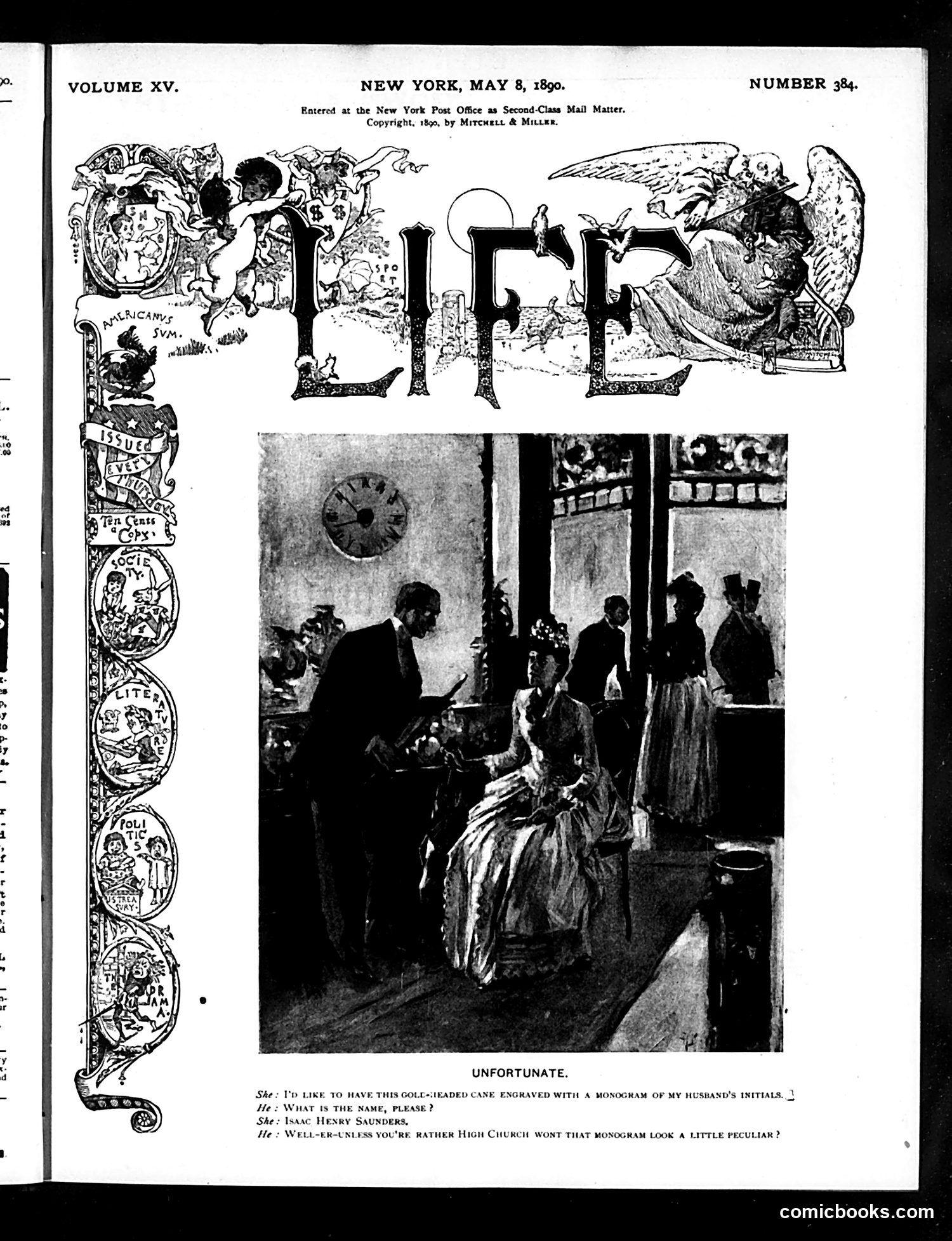
This page features a single cartoon titled "Unfortunate" depicting a social scene in what appears to be an upper-class interior (note the clock and formal windows). The humor centers on a woman's embarrassment: she's asked a man to engrave a golf-headed cane with her husband's initials, but the man revealed to be "Isaac Henry Saunders" — suggesting the woman may have made an inappropriate personal request or social misstep. The punchline involves the man's response about whether High Church (a Anglican religious faction) would approve of the monogram design, implying the initials might look "peculiar" or improper — likely a play on social awkwardness and religious propriety concerns typical of 1890s New York society satire. The cartoon mocks upper-class social pretension and the anxiety surrounding proper etiquette.
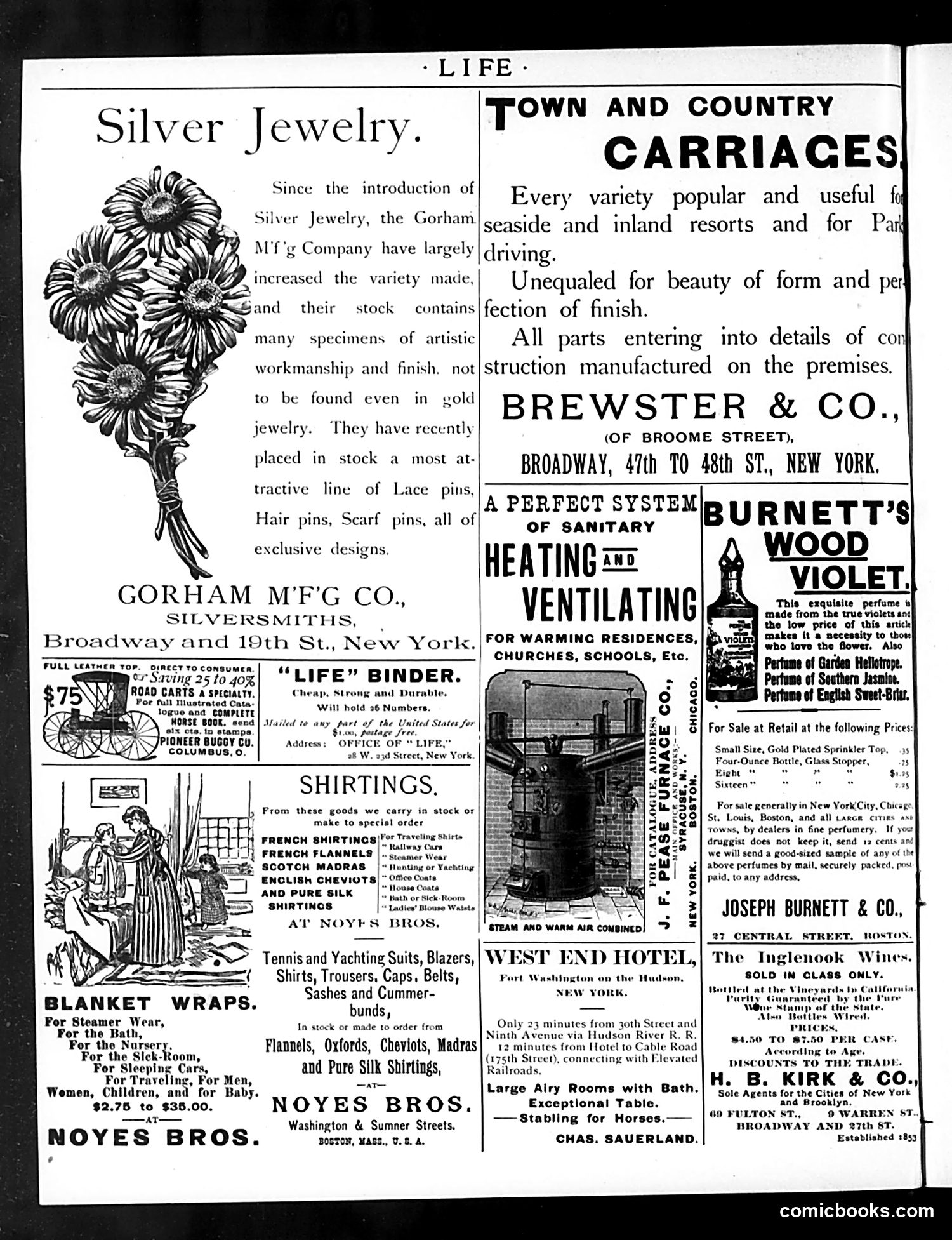
This page is **primarily advertising**, not editorial content or satire. The visible illustrations are commercial advertisements rather than political cartoons. The left side features ads for silver jewelry (Gorham Mfg Co.), a "Life" binder, blanket wraps, and shirtings by Noyes Bros. The right side advertises carriages (Brewster & Co.), heating/ventilation systems, Burnett's Wood Violet perfume, and wines from H. B. Kirk & Co. The decorative illustrations—flowers, a woman at a loom, and interior scenes—are generic commercial artwork meant to sell products to affluent readers. There is no apparent political satire, social commentary, or recognizable caricature of public figures on this page. It's simply a product advertisement section from a late 19th or early 20th-century magazine.
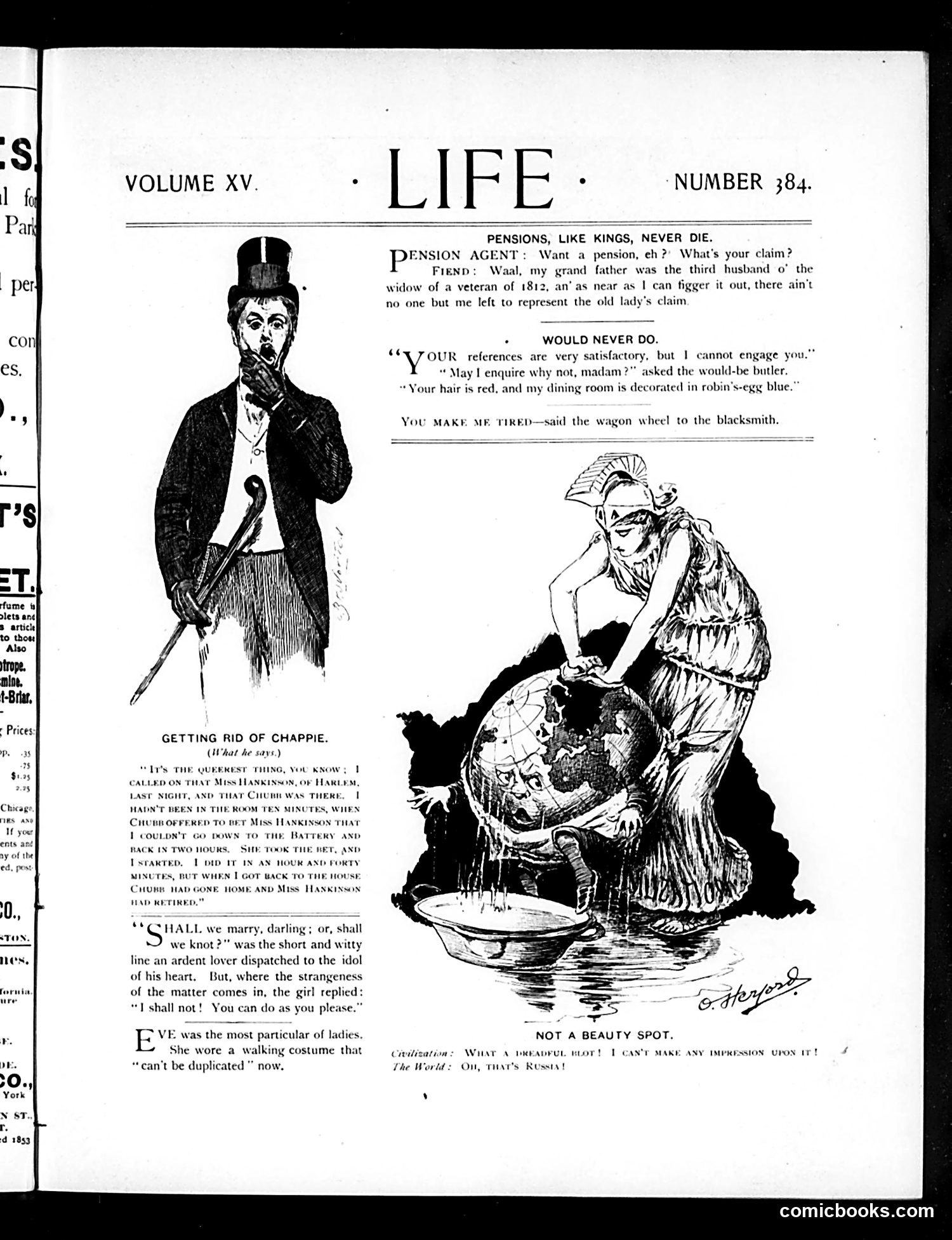
This page contains three satirical vignettes about Victorian-era social conventions: 1. **"Pensions, Like Kings, Never Die"** mocks pension claims, where a woman claims to be the widow of an 1812 veteran—likely exaggerating or fabricating her connection to receive benefits. 2. **"Getting Rid of Chappie"** satirizes romantic entanglements, depicting someone attempting to end an unwanted relationship through deception (offering betting odds to a rival suitor). 3. **"Not a Beauty Spot"** shows a woman attempting cosmetic deception, with dialogue about a "dreadful dirt" that cannot improve appearances—mocking women's use of beauty patches or makeup to mask flaws. The cartoons collectively ridicule social pretense, false claims, romantic manipulation, and vanity among the Victorian upper classes.
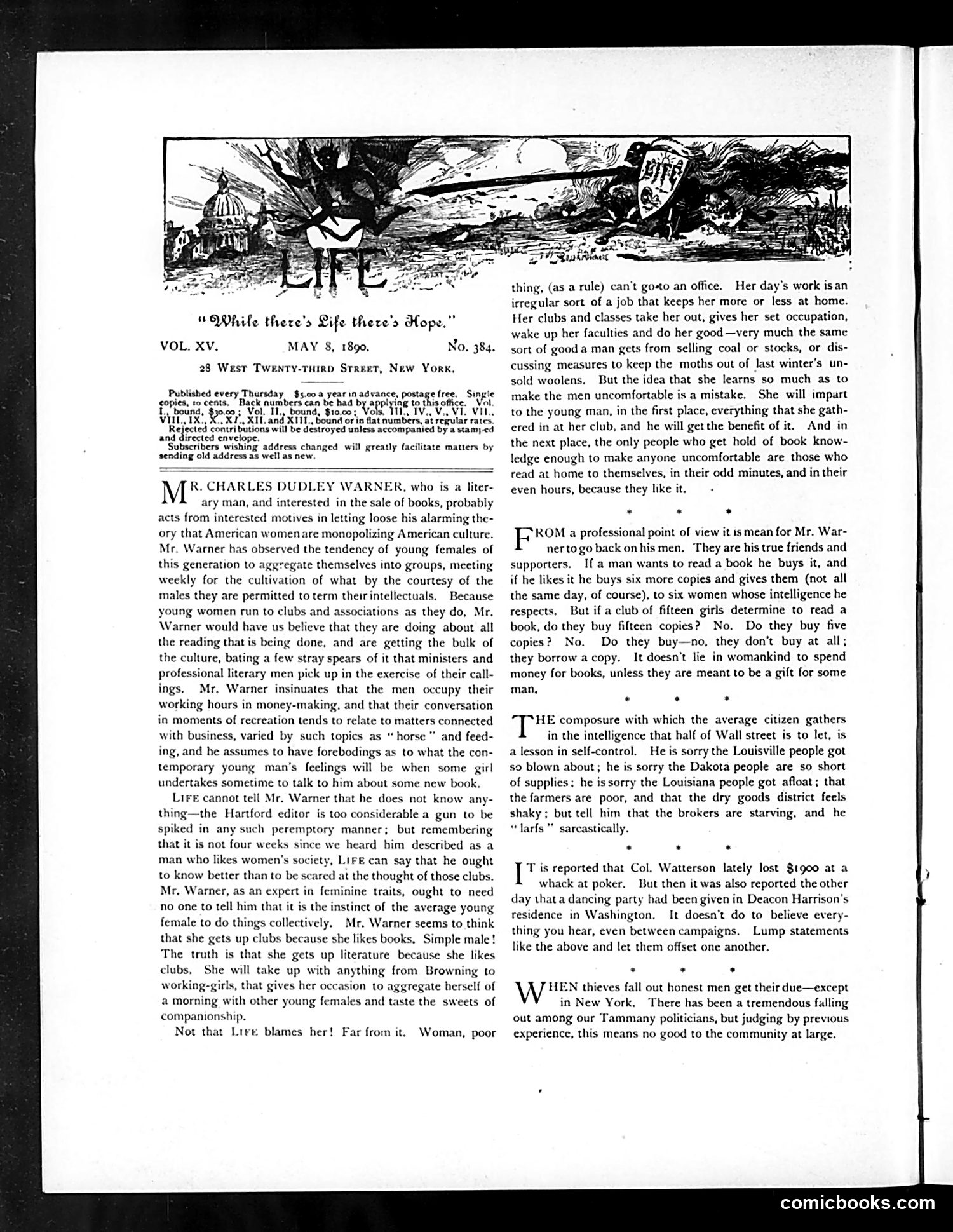
The page contains no political cartoon. Instead, it features editorial commentary on women's reading habits and club culture, responding to Charles Dudley Warner's concerns about American women monopolizing literature. The article satirizes Warner's complaint that women's clubs are consuming books without buying them—borrowing instead of purchasing. The editors defend women's reading groups, arguing they foster intellectual engagement rather than frivolous consumption. The commentary also mocks Wall Street's self-pitying attitude about economic troubles, and includes a brief note about Col. Watterson losing money at poker during a Washington party. The piece is primarily social satire about class, gender, and reading culture rather than political commentary.
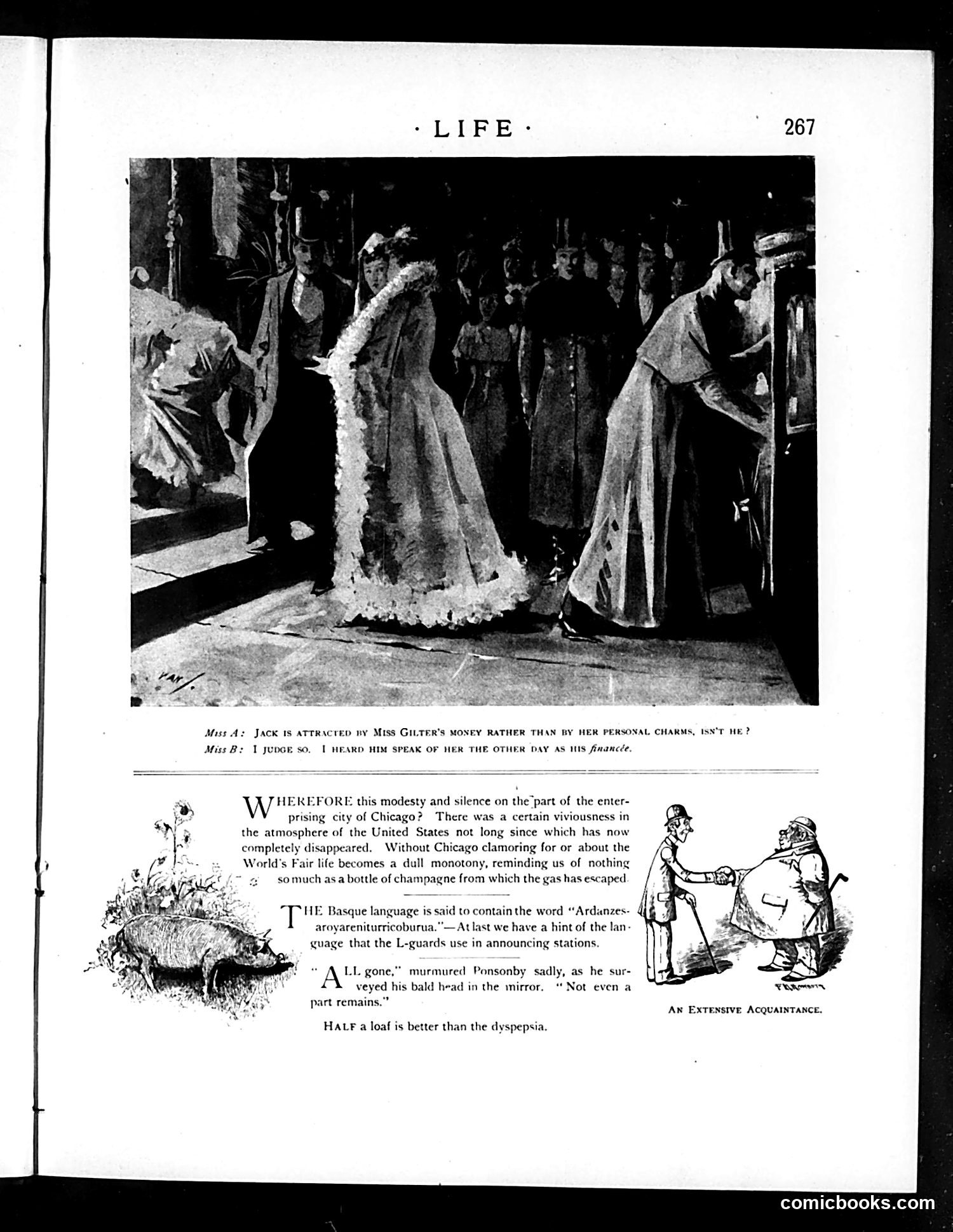
This page combines a photograph and satirical text mocking Chicago's pretensions following the 1893 World's Fair. **The photograph** shows an elegant social gathering with a woman in an elaborate white gown—captioned with dialogue about "Jack" being attracted to Miss Gilter's money rather than her personal charms. **The satirical text** critiques Chicago's newfound sophistication, comparing its post-Fair atmosphere to "stale champagne with escaped gas." It suggests the city's vivacious character has disappeared. **The Basque language reference** appears to mock exotic pretension, while **"An Extensive Acquaintance"** cartoon (lower right) shows two figures, likely satirizing social climbing or dubious relationships. The overall point: Chicago's gilded-age wealth and social aspiration are hollow and temporary—mere affectation masking underlying vulgarity.
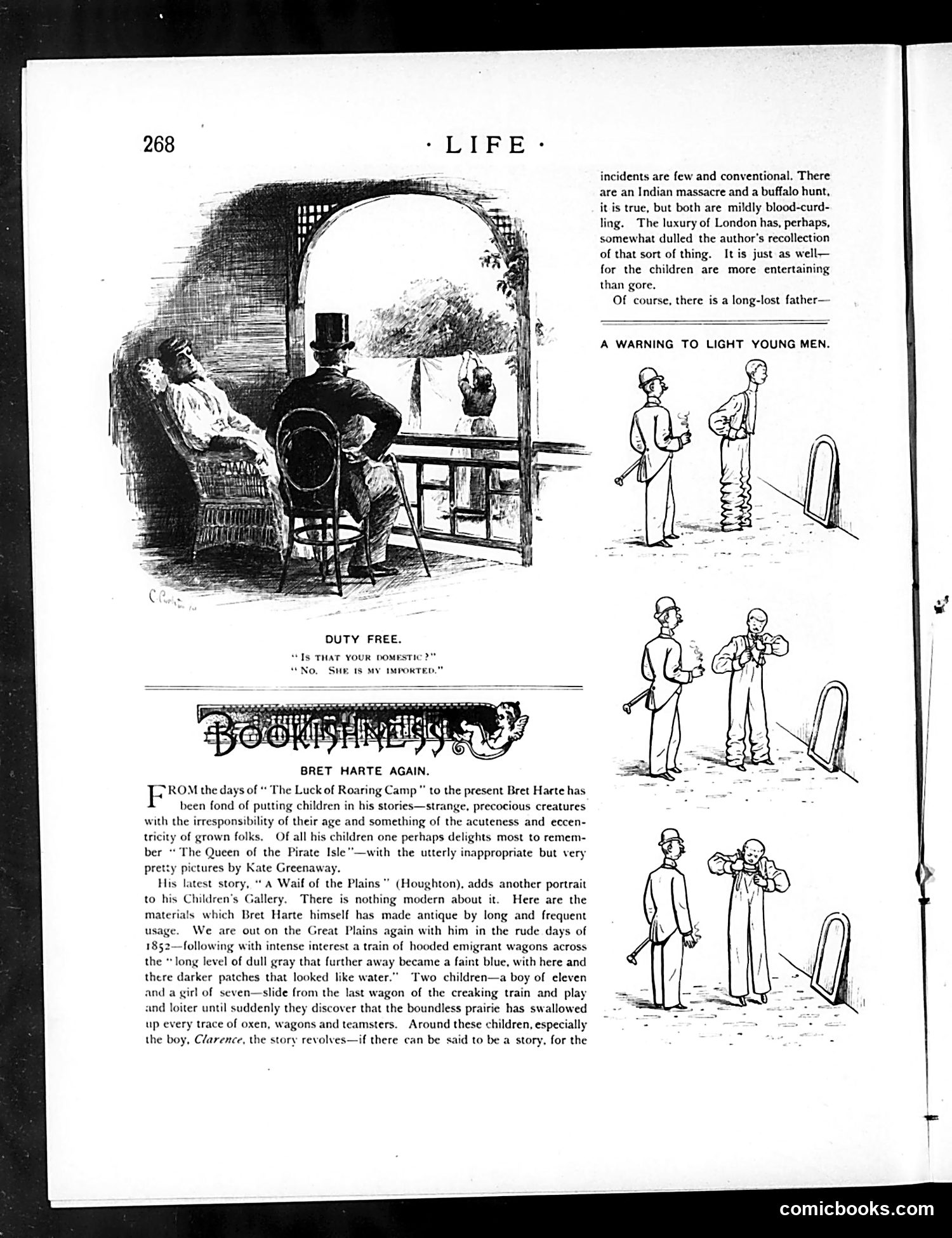
**"Duty Free"** (top cartoon): Shows a man in a top hat viewing a woman through a window. The caption reads "Is that your domestic?" / "No. She is my imported." This satirizes the Victorian upper class's preference for European (imported) servants over domestic help, suggesting fashion-consciousness and social pretension about household staff origins. **"A Warning to Light Young Men"** (right panel): Sequential illustrations depict a young man progressively copying another's mannerisms and posture while holding a cane. The satire warns against thoughtless imitation of fashionable peers—mocking how young men slavishly adopt the affectations and style of those they admire without developing their own character. Both mock Victorian social vanity and conformity.
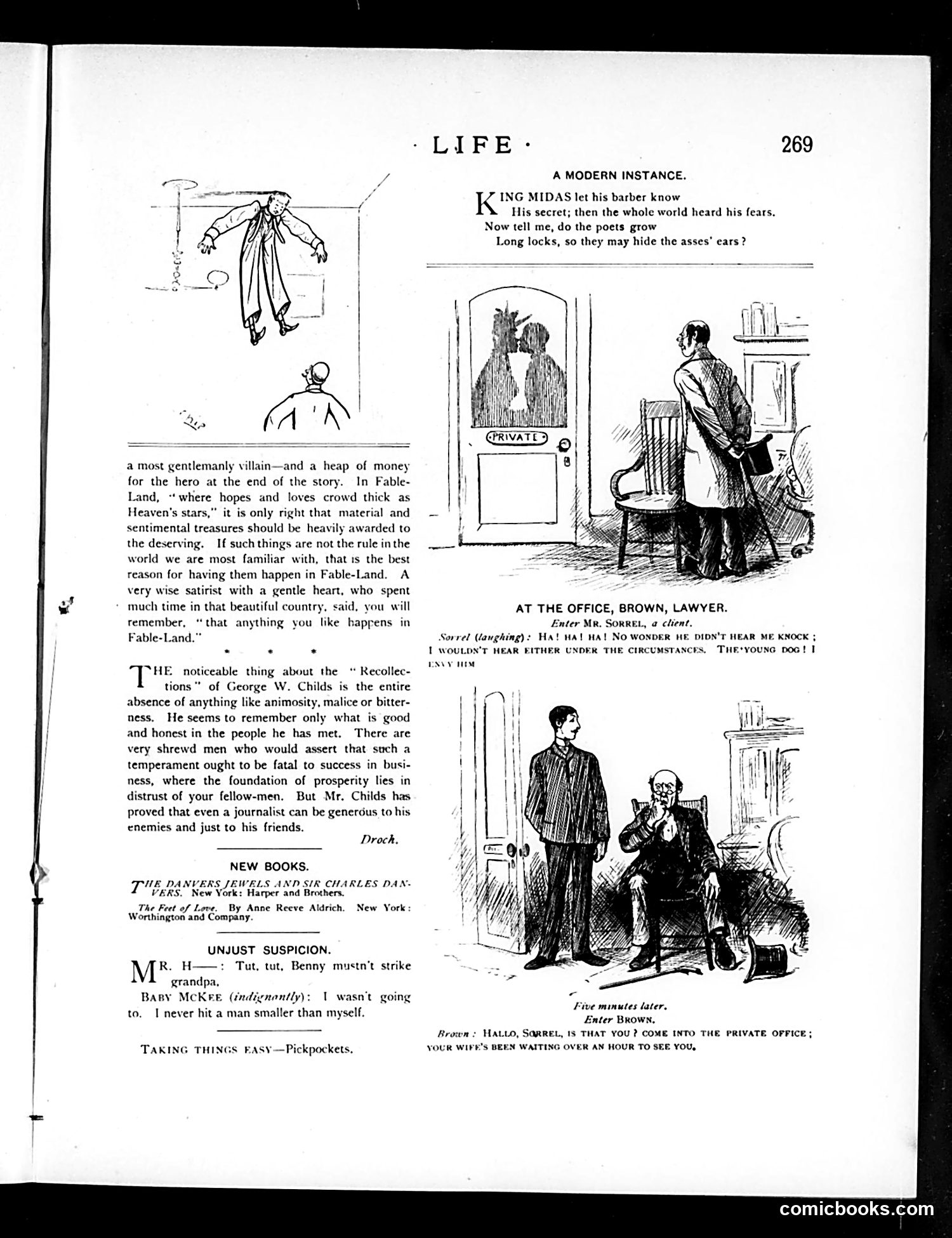
This page contains three satirical pieces about lawyers and dishonesty: **"A Modern Instance"** (top) parodies the King Midas legend, suggesting a modern equivalent where a lawyer's barber learns secrets—implying lawyers hide scandalous information. **"At the Office, Brown, Lawyer"** (middle) depicts a client meeting a lawyer, with the joke that the client won't hear the lawyer knock due to being distracted—suggesting lawyers are sneaky or unwelcome visitors. **"Unjust Suspicion"** and **"Taking Things Easy"** (bottom) continue lawyer mockery: one depicts a grandfather-grandson exchange about not hitting smaller men, while another references pickpockets—implying lawyers are thieves or dishonest. The overall theme satirizes lawyers as untrustworthy, secretive, and morally questionable figures in American society. This reflects early 20th-century skepticism toward the legal profession.
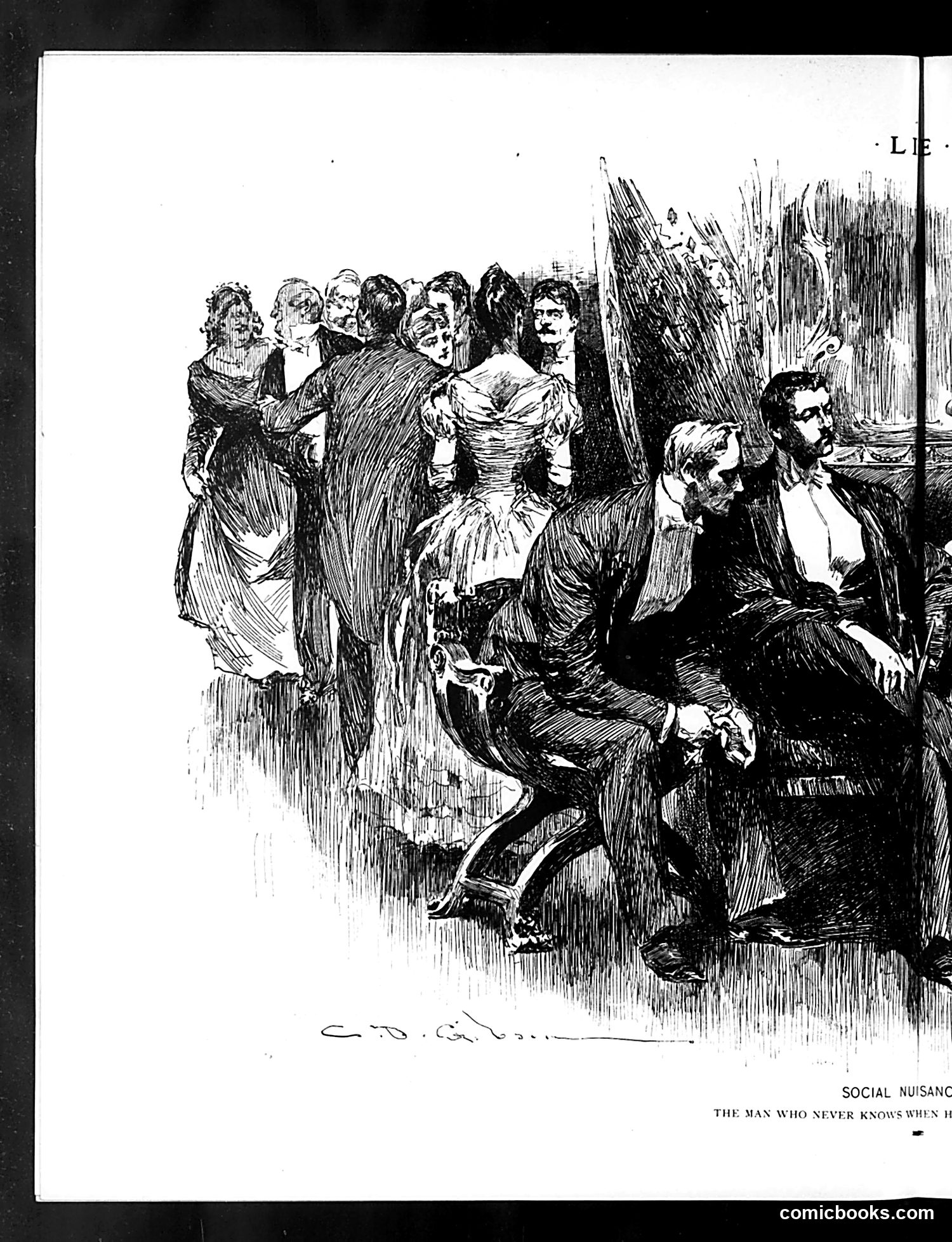
This satirical illustration depicts a social scenario common to the era's etiquette concerns. A well-dressed man sits prominently in the foreground while a woman in an elegant ball gown stands nearby, seemingly trying to end their interaction. Behind them, other formally-dressed guests appear to be engaged in conversation, creating a contrast with the awkward pair. The cartoon's title mocks a particular social type: a man oblivious to social cues indicating he should leave. His persistence in remaining—despite apparent disinterest from those around him—represents a breach of Victorian-era social conventions regarding polite disengagement. The satire targets those lacking social awareness or consideration for others' comfort, a recurring Life magazine theme about modern manners and social failures.
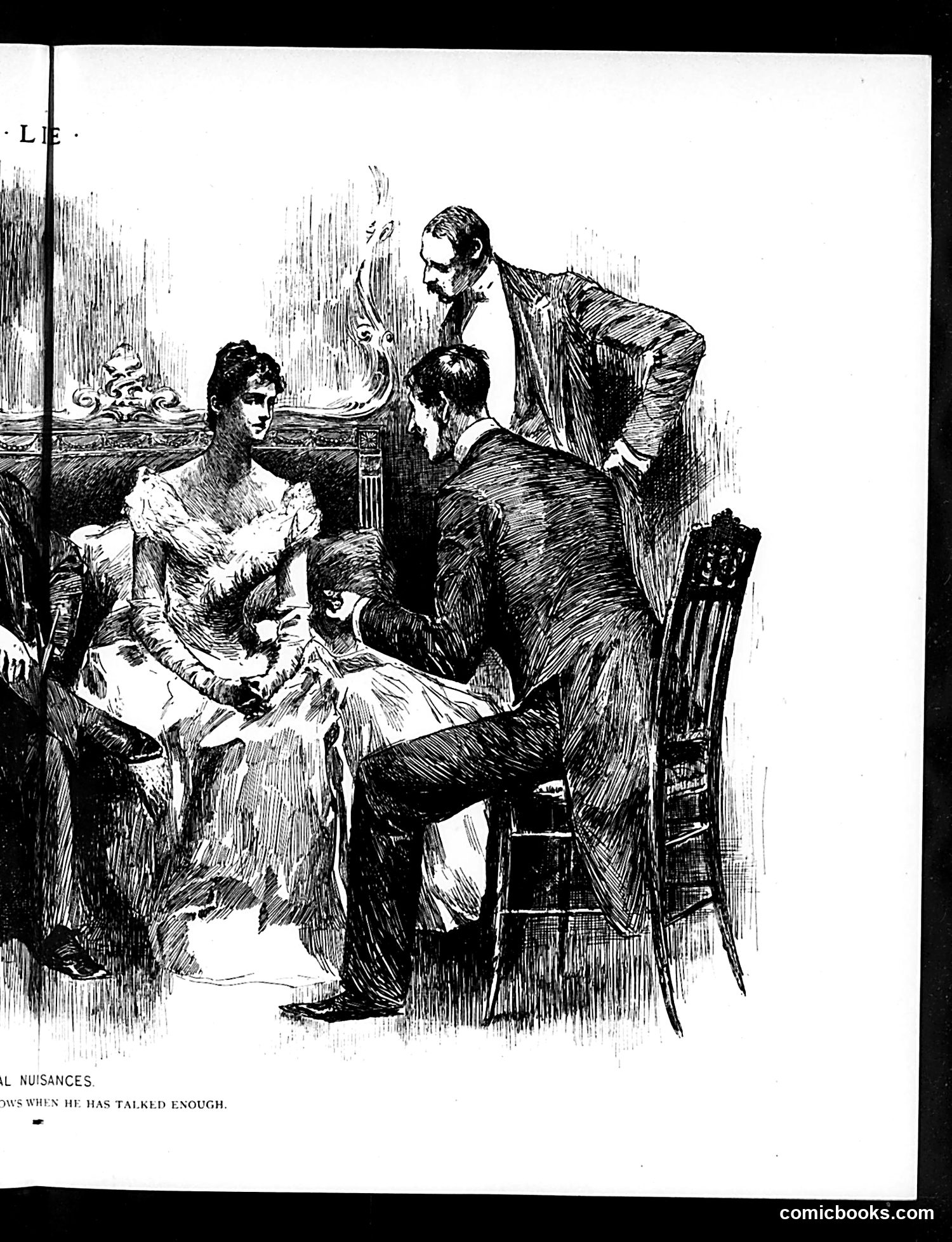
This is a satirical illustration depicting a social scene of upper-class or elite society, likely from the late 19th or early 20th century. The caption reads "Shows when he has talked enough," suggesting commentary on tedious conversationalists in high society. The image shows a well-dressed man seated while three other formally-dressed men stand around him in what appears to be a drawing room. The satire appears to target the social convention of polite conversation—specifically mocking men who dominate social gatherings with excessive talking. The "nuisance" being satirized is the bore or self-important talker whom polite society must endure. This reflects Life magazine's recurring theme of poking fun at elite social pretensions and behavioral absurdities.
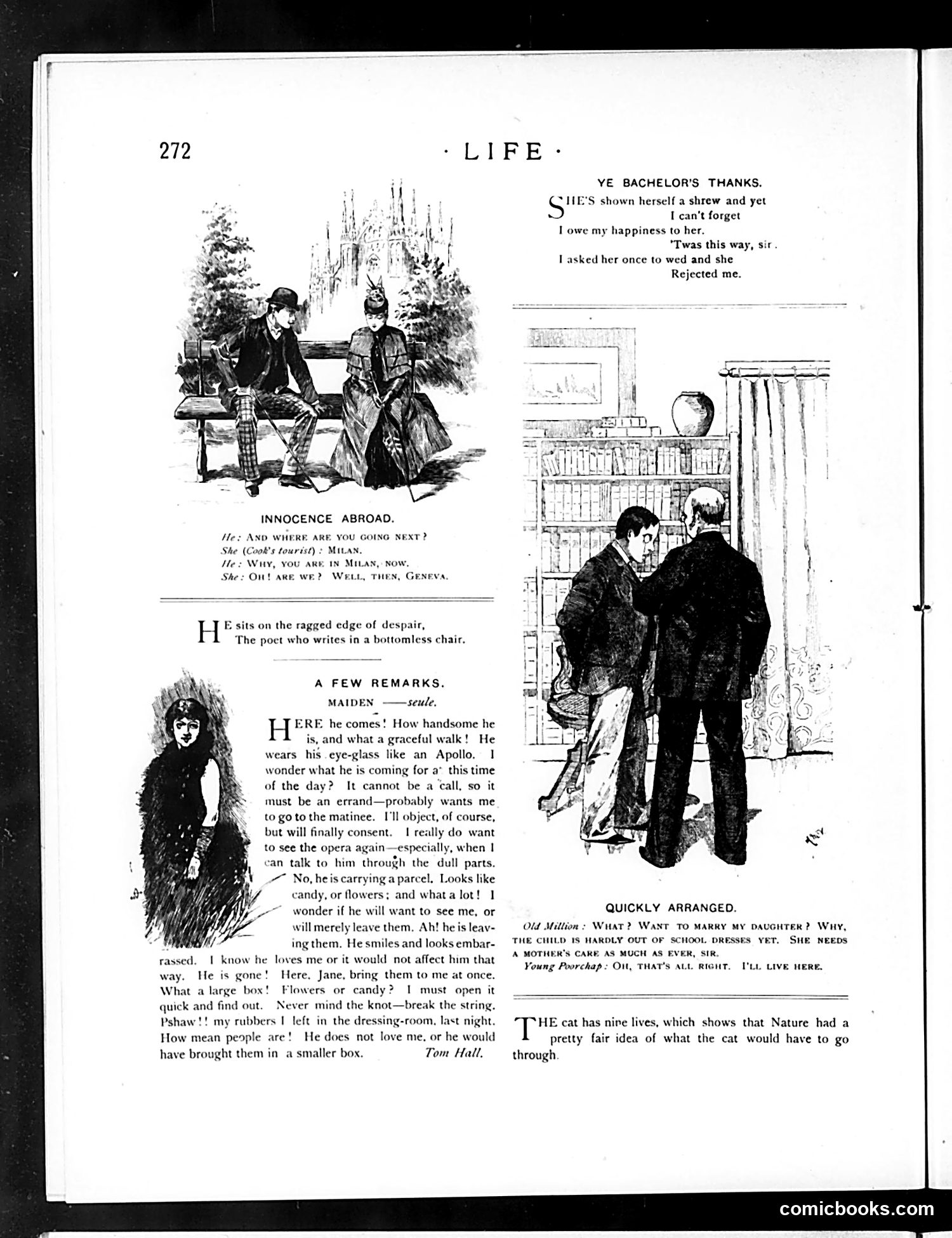
This page contains four separate satirical pieces typical of Life's humor: 1. **"Innocence Abroad"**: A sketch of two travelers discussing their itinerary, poking fun at naive American tourists abroad. 2. **"Ye Bachelor's Thanks"**: A poem about a man rejected when proposing marriage, expressing gratitude that she proved a "shrew." 3. **"A Few Remarks"**: A maiden's extended monologue about an attractive suitor arriving—gossiping about his appearance, speculating on his intentions, and imagining romantic scenarios. The humor derives from her internal contradictions and scattered thoughts. 4. **"Quickly Arranged"**: A brief domestic scene where a mother resolves her daughter's living situation by having her move in with a young man. 5. **"The cat has nine lives..."**: An opening line for another piece (cut off). The overall tone satirizes romantic conventions, social pretensions, and domestic life of the era.
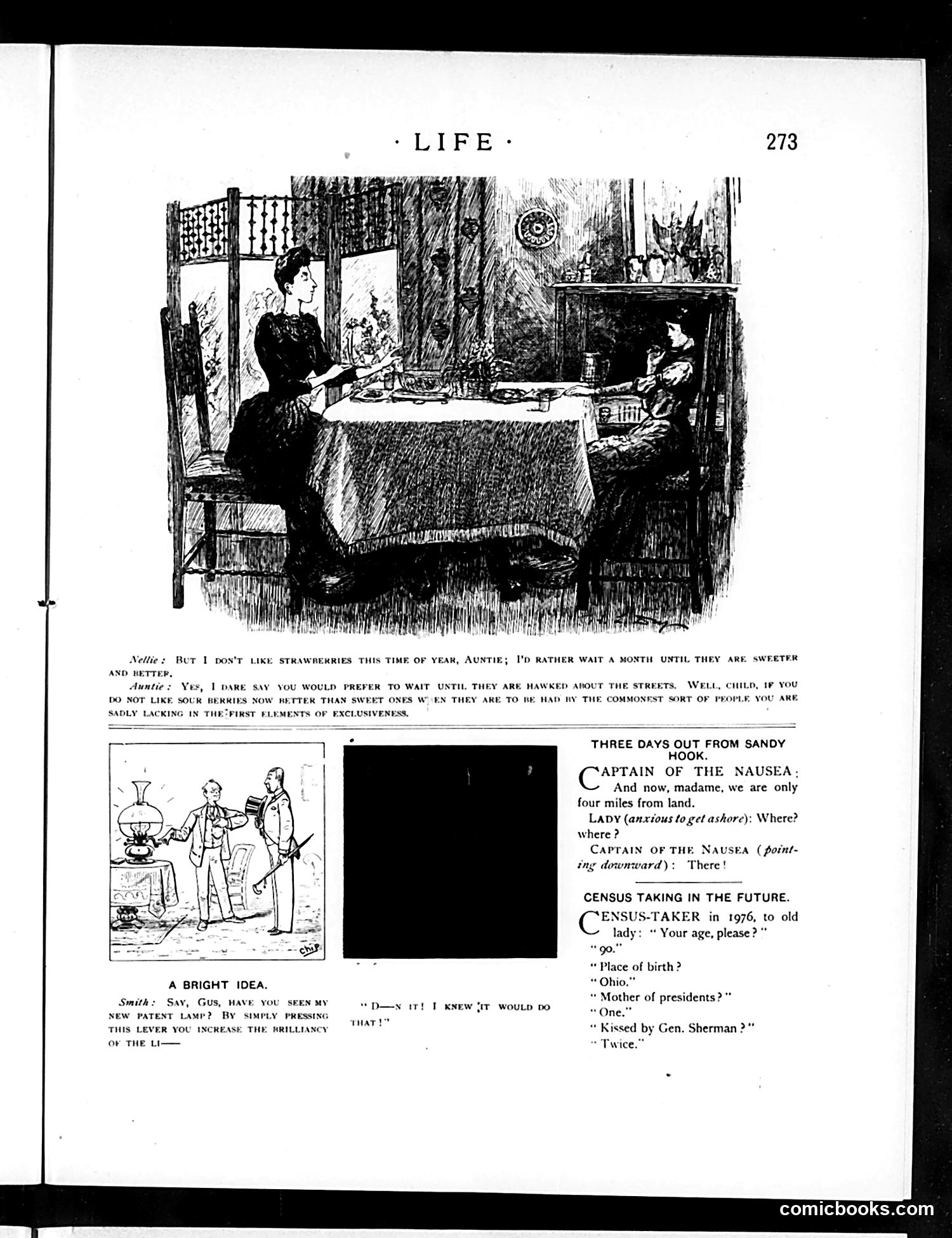
**Top Cartoon:** A domestic scene showing a woman (labeled "Nellie") refusing to buy strawberries, arguing they're not yet in season and taste poor. Her aunt ("Auntie") counters that waiting means missing them entirely, and worse—the poorest people will buy them first, making them unfashionable. This satirizes snobbish consumer anxiety about social status and timing—the upper classes' concern with appearing refined by consuming only the "right" foods at the "right" moments. **"A Bright Idea" Cartoon:** A man proudly demonstrates a patent lamp to two observers, claiming a simple lever increases its brilliance. The satire likely mocks frivolous inventions or self-deluded entrepreneurs pitching obviously worthless contraptions. **Bottom Section:** Three brief comedic snippets including a census-taker's exchanges and nautical dialogue.
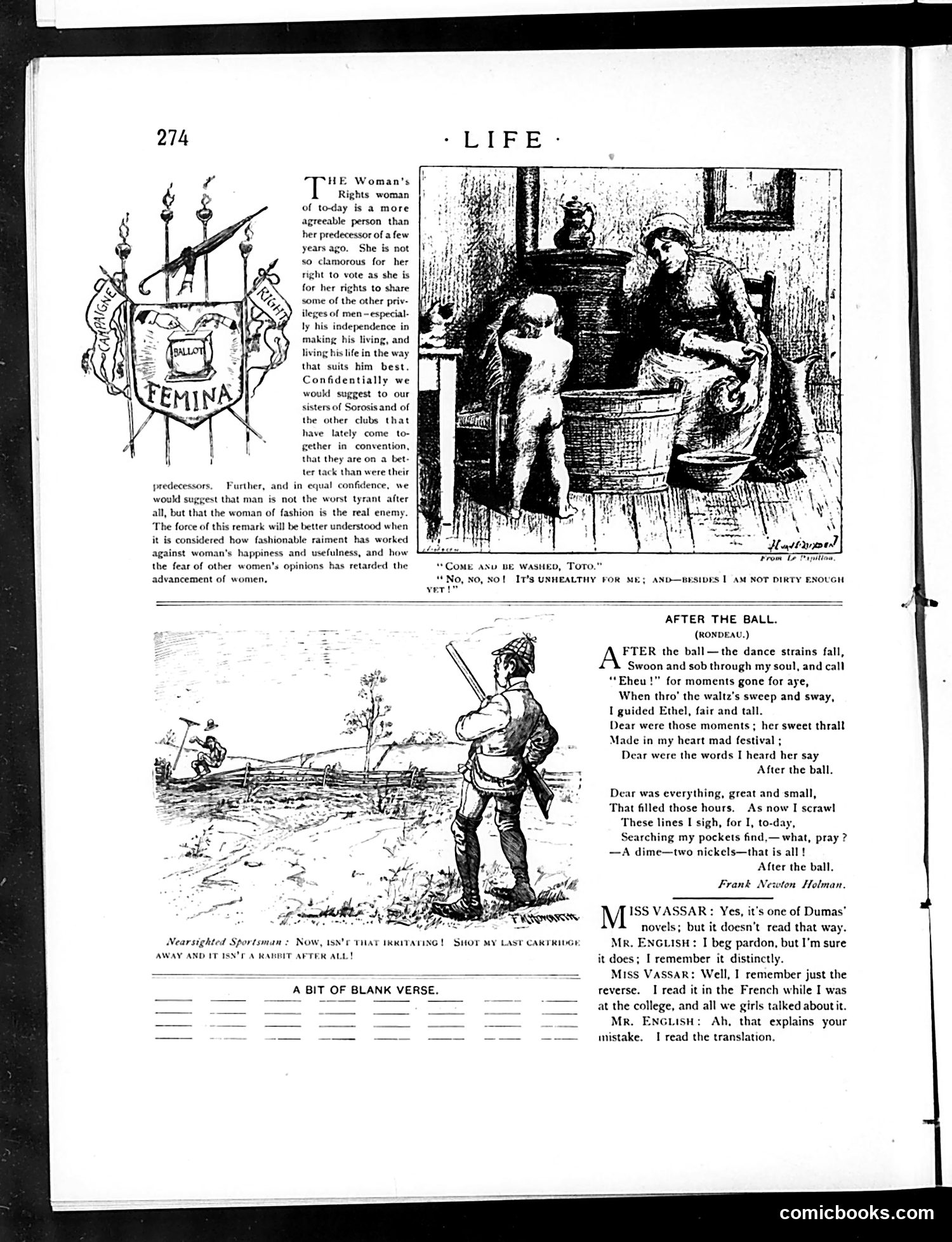
**Main Content:** The page features editorial commentary on women's rights advocates, arguing that modern feminists are more reasonable than earlier suffragists because they now focus on economic independence rather than voting rights. The author claims fashion—not men—is women's real enemy, as concern for appearance and others' opinions hinders women's progress. **Cartoons:** 1. **"Come and be Washed, Toto"**: Shows women at a bathing scene; the humor likely involves class commentary or hygiene standards of the era. 2. **"Nearsighted Sportsman"**: A hunter mistakes his shot, with comedic miscommunication between characters about what was actually hit. 3. **"After the Ball" (poem)**: A sentimental rondeau about a young man reminiscing over a dance with "Ethel," ending with the punchline that he's now broke—only has "a dime—two nickels." 4. **Miss Vassar/Mr. English dialogue**: Gentle satire about a Vassar-educated woman and an Englishman debating a Dumas novel, with the joke hinging on reading the original French versus the translation.
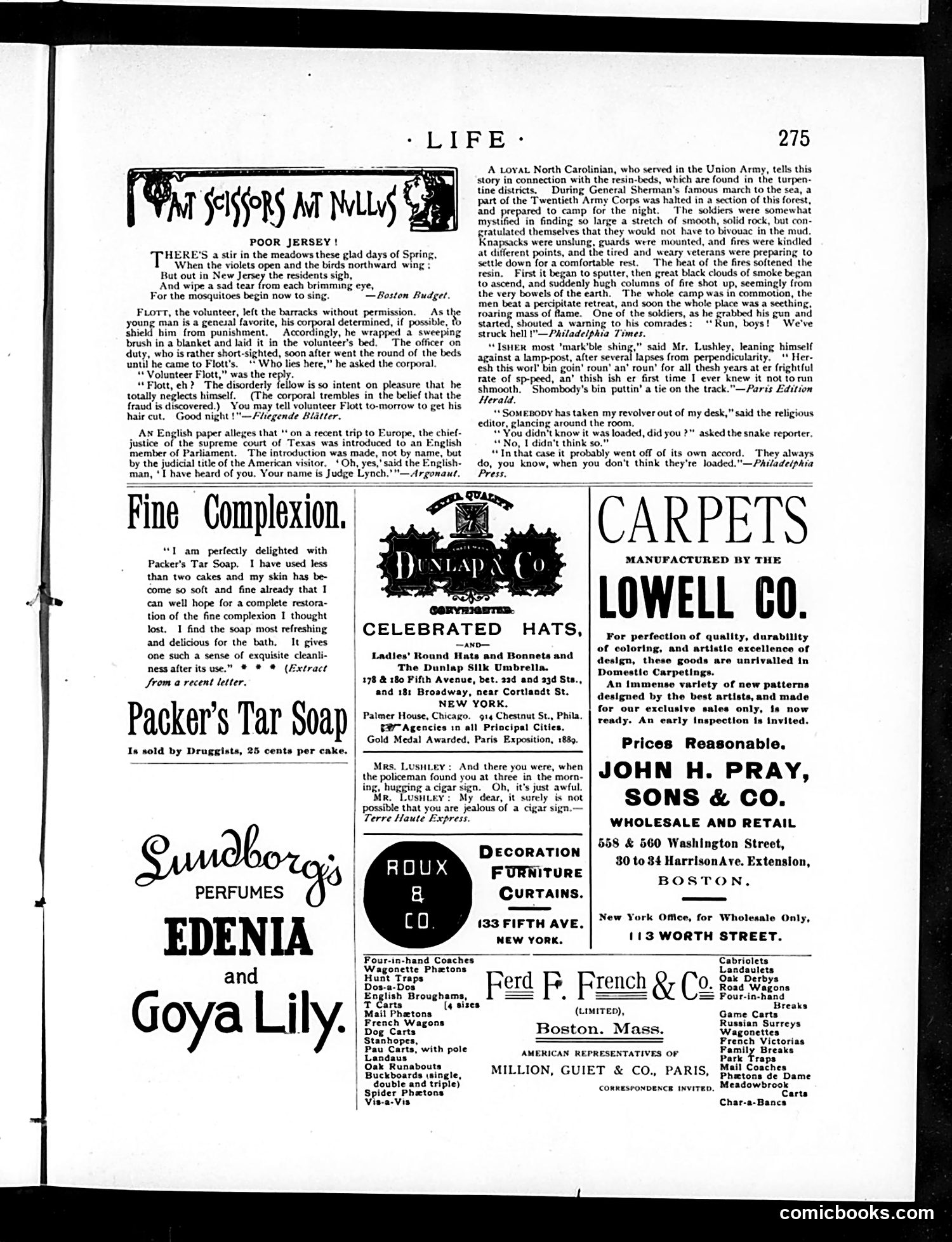
This page contains several brief humorous anecdotes typical of *Life* magazine's satirical style: **"Poor Jersey"** mocks New Jersey residents who celebrate spring's arrival only to face the annual mosquito season—a recurring regional complaint. **"Flott at Nullys"** describes a clever military deception: a corporal hides an absent soldier by substituting a brush in his bed. The short-sighted officer fails to notice and merely orders a haircut, rewarding the deception through incompetence. **The Texas Judge Lynch story** plays on the coincidence of introducing a Texas Chief Justice to a British MP, with the Englishman joking the American's "name" must be "Judge Lynch"—a dark reference to lynch mobs and frontier justice, implying Texas's reputation for extrajudicial violence. **The resin-beds anecdote** humorously describes Sherman's troops accidentally camping on flammable turpentine forest resin, which ignites from their campfires, creating spectacular chaos. The remaining brief jokes involve a drunk commenting on Earth's rotation and an editor's loaded revolver. The page is primarily advertisements for soaps, perfumes, carpets, and hats.
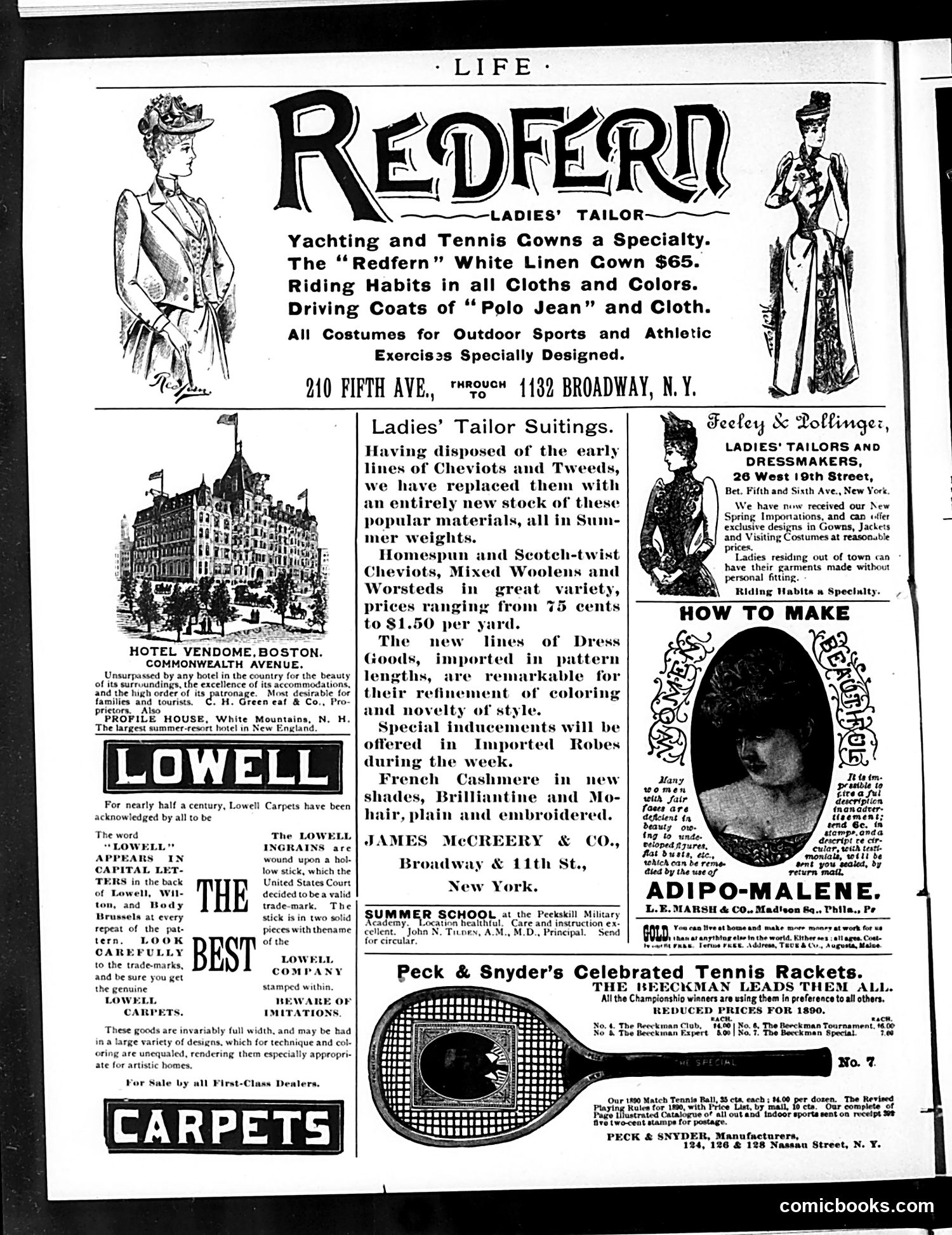
This page is primarily **advertising**, not satire or political commentary. It showcases late-19th-century commercial establishments targeting affluent readers. The ads feature: - **Redfern** and other ladies' tailors specializing in fashionable sportswear (yachting, tennis, riding habits)—reflecting the era's new athletic activities for wealthy women - **Hotel Vendome** (Boston) and Peekskill Military Academy—luxury accommodations and institutions - **Lowell Carpets**—emphasizing their trademark and authentic quality against counterfeit imitations - **Peck & Snyder's Tennis Rackets**—capitalizing on the tennis boom, mentioning "championship winners" - **Adipo-Malene**—a weight-loss product The page reflects **Gilded Age consumer culture**: leisure activities (sports, travel), brand-consciousness, and concerns about counterfeit goods. There are no identifiable political cartoons or satirical figures—this is straightforward commercial messaging to the magazine's wealthy readership.
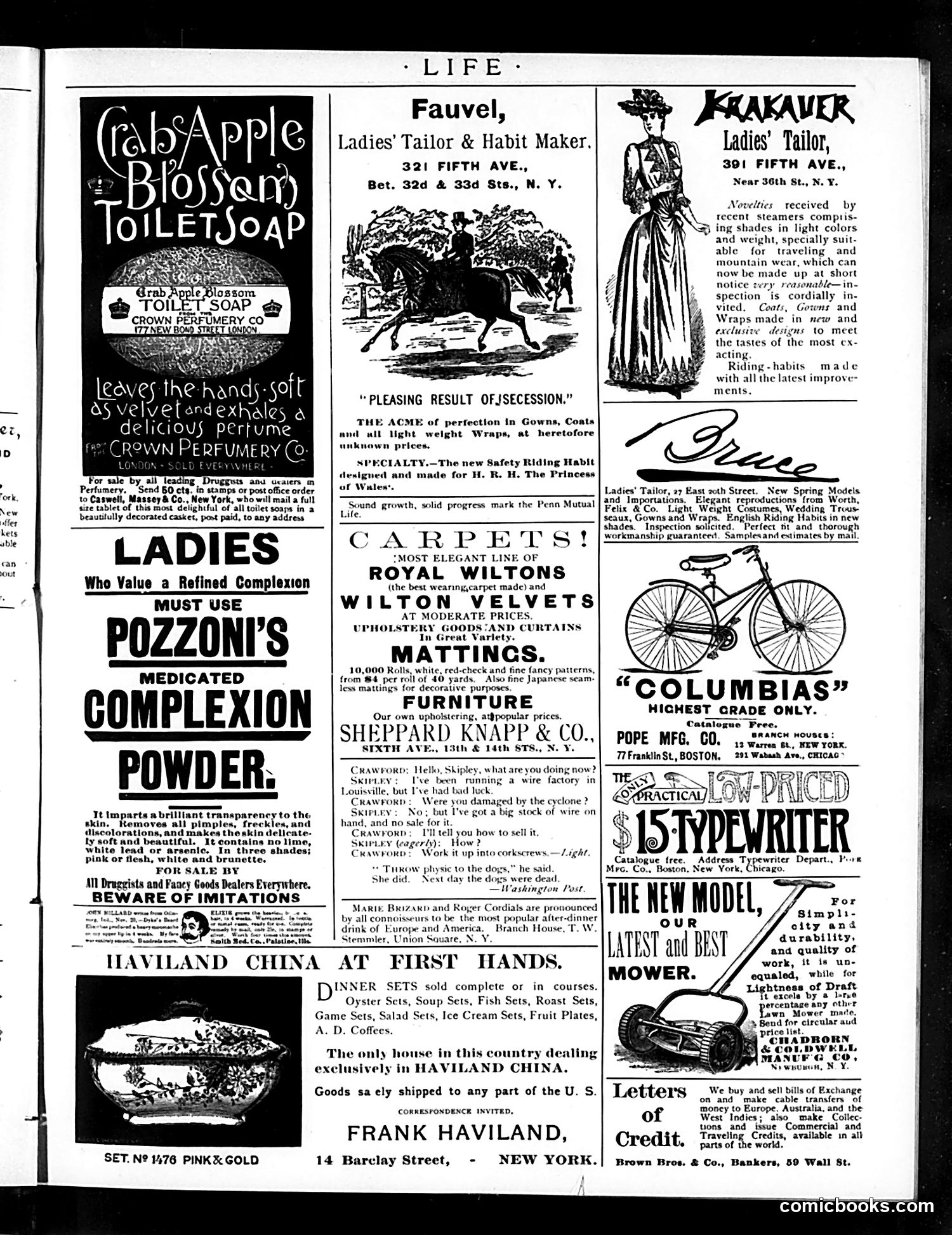
This is primarily an **advertising page** from Life magazine, not a satirical cartoon page. However, it does contain one **humorous dialogue** between two characters—Crawford and Shipley—discussing a wire factory business failure. The joke appears to reference the economic panic or recession of the period (the ad for Penn Mutual Life mentions "Sound growth, solid progress" suggesting economic uncertainty). Shipley has unsold wire inventory from a Louisville factory. Crawford's solution—to twist the wire into corkscrews and sell it as a novelty item—is absurd. The punchline's dark humor comes from the workers actually trying this scheme, only to have the dogs die from the corkscrews, making the product worthless and dangerous. The page is otherwise filled with advertisements for ladies' tailoring, soap, complexion powder, china, carpets, bicycles, and typewriters—typical turn-of-the-century consumer goods aimed at middle and upper-class readers.
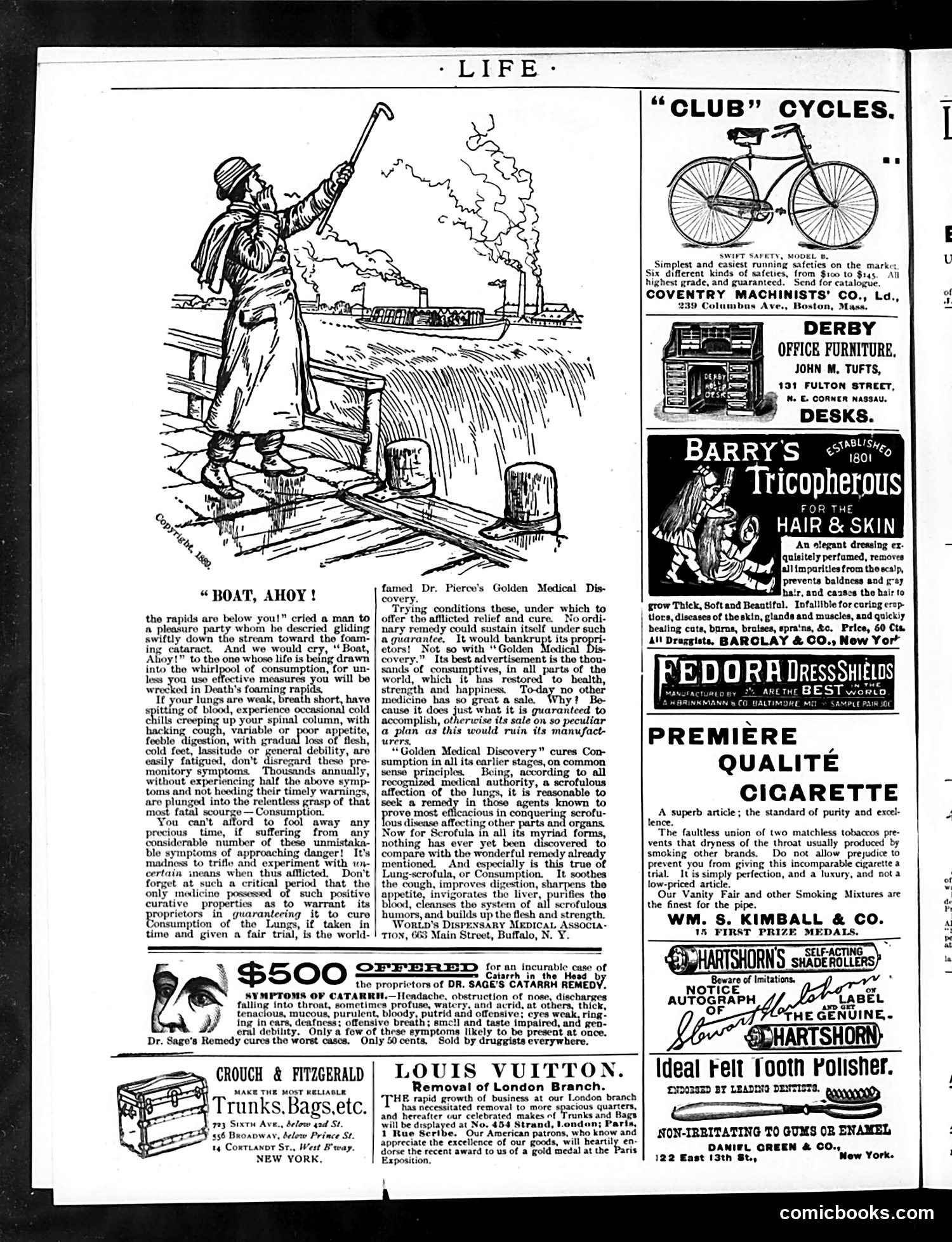
The main illustration shows a man warning a pleasure party in a boat approaching dangerous rapids—a visual metaphor for the medical danger of consumption (tuberculosis). The caption "Boat, Ahoy!" frames the warning message. This is **advertisement-as-editorial content**, common in period Life magazines. The "cartoon" is actually promotional material for Dr. Pierce's Golden Medical Discovery, a patent medicine claiming to cure consumption. The rapids represent consumption's deadly progression; the man issuing warnings represents medical authority. The satire, if present, is subtle: Life published this as legitimate content while also selling advertising space to competing remedies (Dr. Sage's Catarrh Remedy appears below). The page demonstrates how 19th-century magazines blurred editorial and advertising—readers couldn't always distinguish legitimate medical advice from marketing copy for unproven patent medicines. The referenced symptoms (spitting blood, weakness, cough) were indeed consumption's actual signs, lending the advertisement false medical credibility.
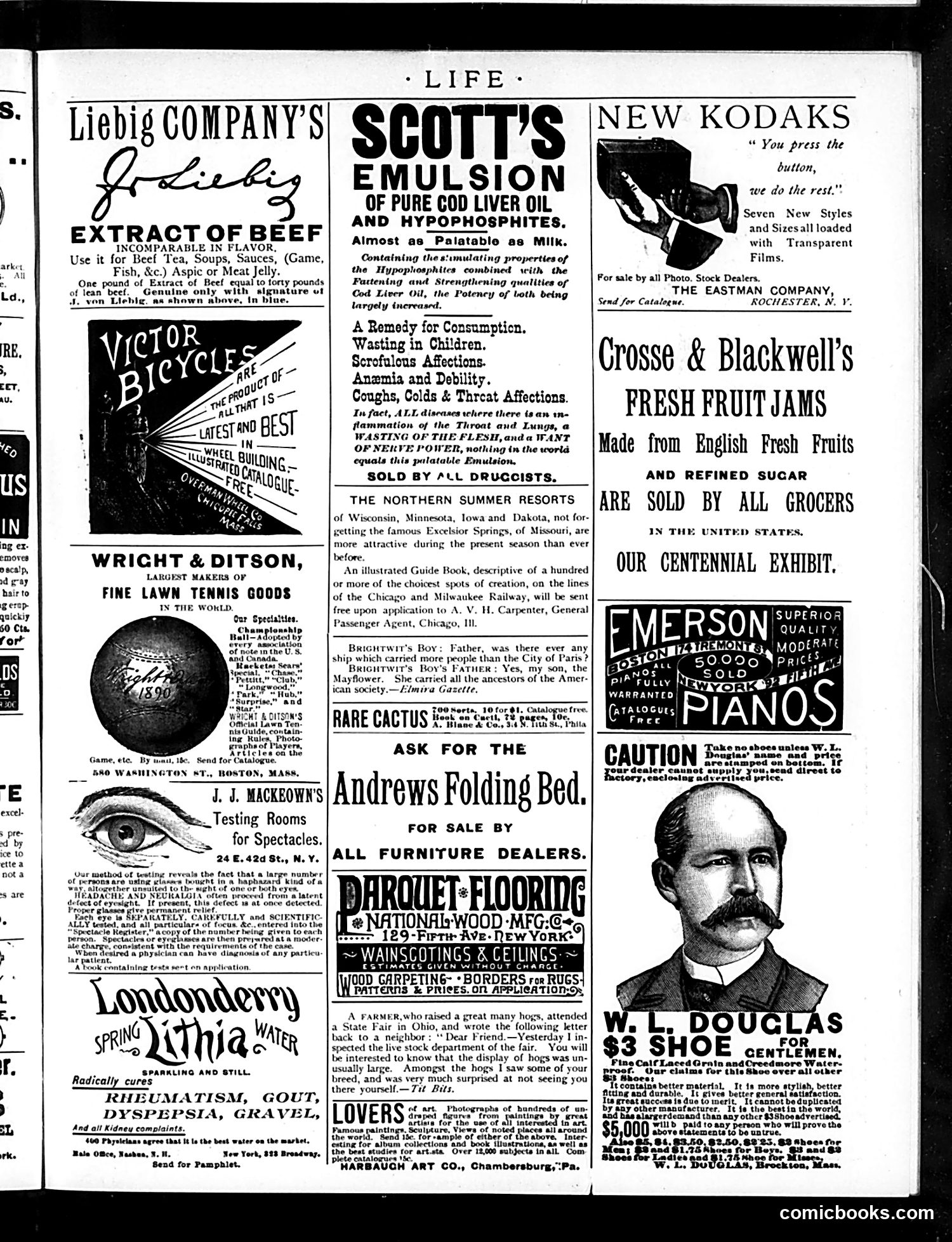
This is primarily a **product advertisement page** from Life magazine, featuring various consumer goods (beef extract, bicycles, emulsions, pianos, shoes, furniture) with minimal editorial content. The one **cartoon/joke** visible is the "Brightwit's Boy" exchange: A child asks his father whether any ship carried more people than the City of Paris (a famous contemporary steamship). The father responds that yes—the Mayflower did, because it carried "all the ancestors of the American society." The humor is **satirical social commentary**: it's a jab at American pretension and class anxiety. The joke suggests that Americans obsessed with the Mayflower and their "ancestry" are actually descended from ordinary people. It mocks the snobbish value placed on being descended from the Pilgrims—implying such ancestry claims are exaggerated or absurd. The page itself is otherwise straightforward commercial content typical of period magazines.
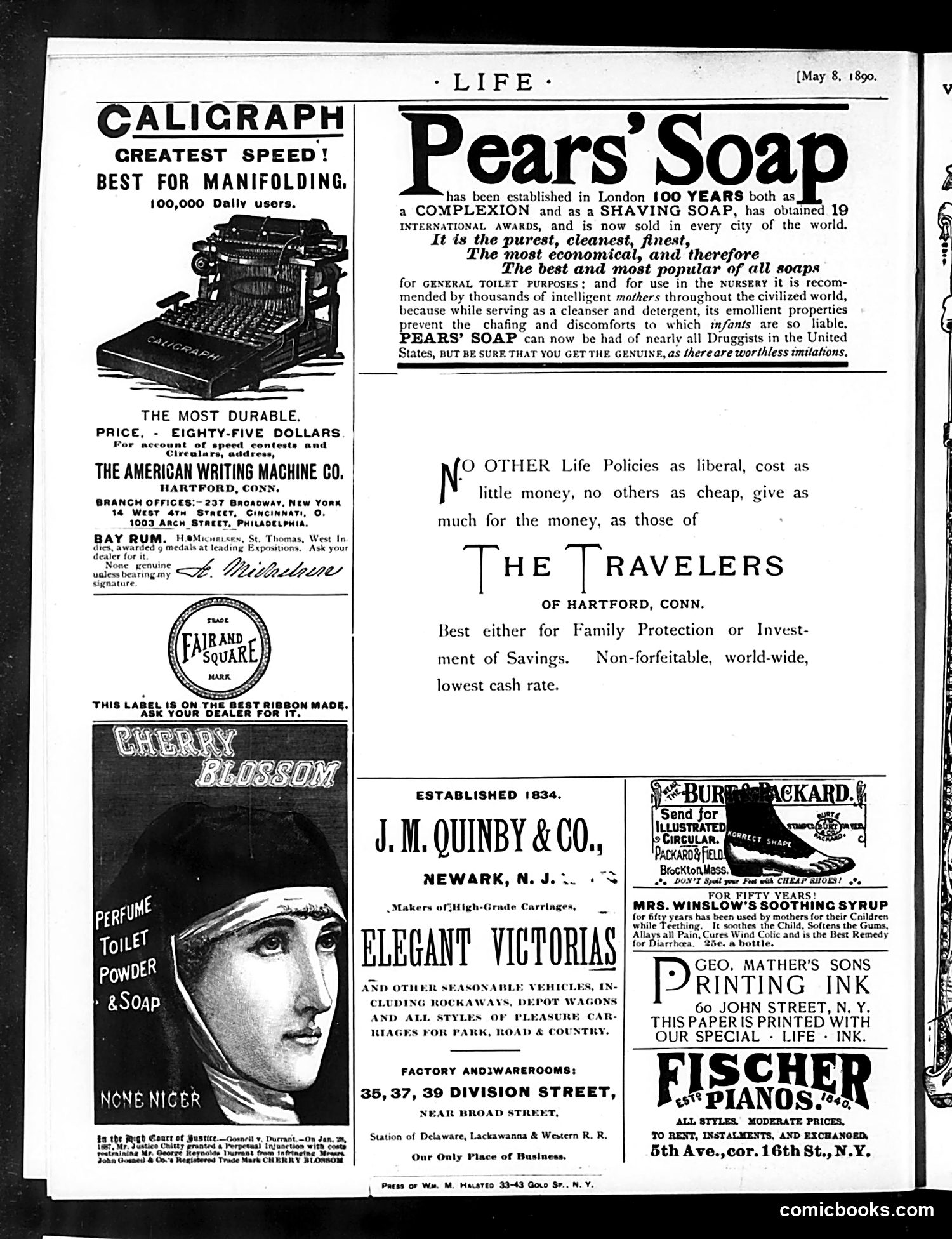
This page is primarily **advertising**, not satirical content. It contains commercial notices for various products and services typical of the 1890s: **Notable advertisements include:** - Caligraph typewriter (emphasizing speed and durability at $85) - Pears' Soap (prominently featuring its 100-year London history and 19 international awards) - The Travelers insurance company (Hartford, Connecticut) - J.M. Quinby & Co. carriage manufacturers (Newark) - Mrs. Winslow's Soothing Syrup (a patent medicine for teething children) - Fischer Pianos and printing services The page reflects late-Victorian commercial culture, emphasizing product longevity, international prestige, and family utility. There is no visible political cartoon or satirical commentary—this appears to be a standard advertising section from *Life* magazine's commercial pages.