
Life, 1890-05-08 · page 6 of 18
Life — May 8, 1890 — page 6: what you’re looking at
What you’re looking at
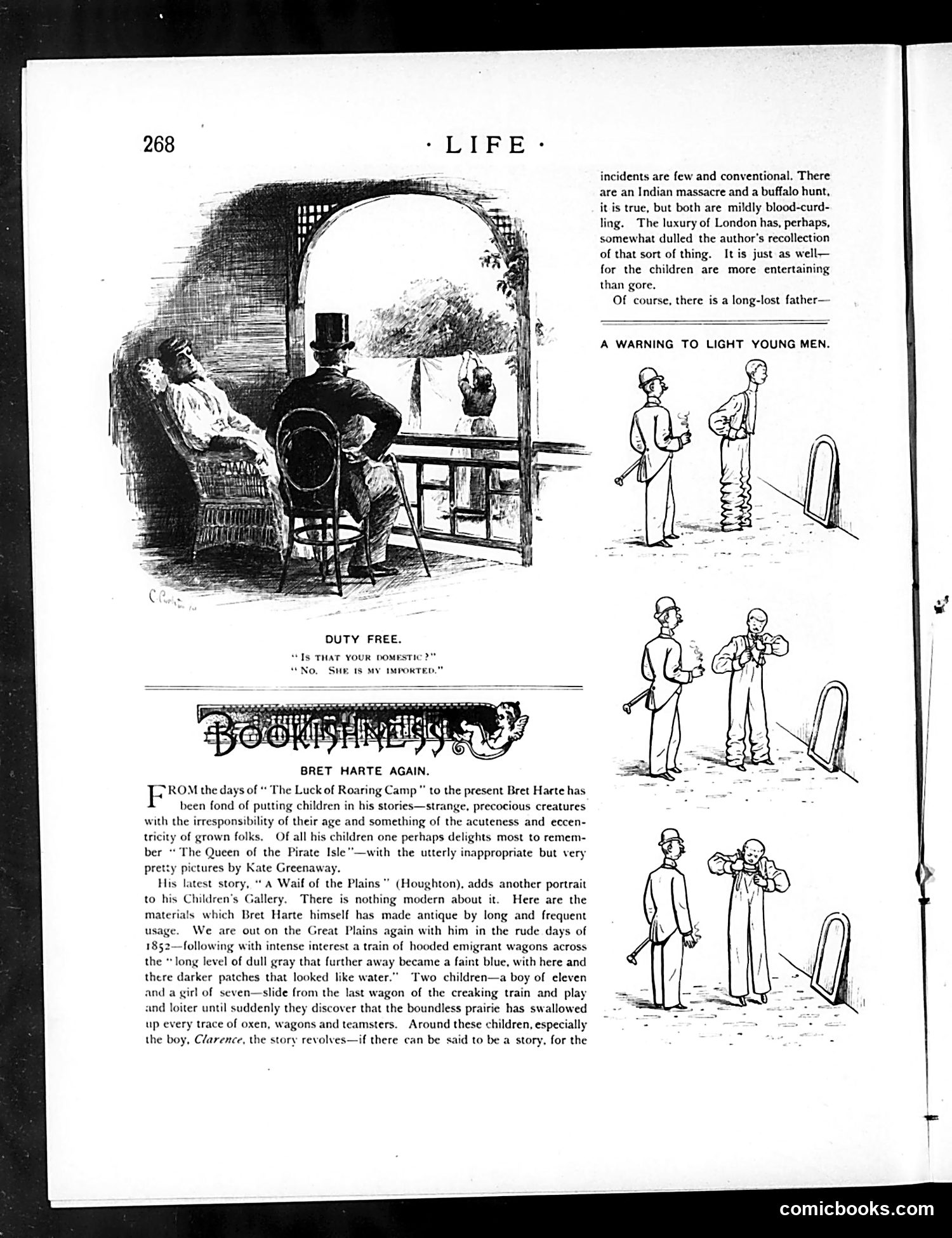
**"Duty Free"** (top cartoon): Shows a man in a top hat viewing a woman through a window. The caption reads "Is that your domestic?" / "No. She is my imported." This satirizes the Victorian upper class's preference for European (imported) servants over domestic help, suggesting fashion-consciousness and social pretension about household staff origins. **"A Warning to Light Young Men"** (right panel): Sequential illustrations depict a young man progressively copying another's mannerisms and posture while holding a cane. The satire warns against thoughtless imitation of fashionable peers—mocking how young men slavishly adopt the affectations and style of those they admire without developing their own character. Both mock Victorian social vanity and conformity.
📄 Transcribed text from this page (OCR, searchable)
Machine-transcribed from the original scan — historical spelling and the odd misread are preserved.
incidents are few and conventional. There are an Indian massacre and a buffalo hunt, it is true, but both are mildly blood-curd- ling. The luxury of London has, perhaps, somewhat dulled the author's recollection of that sort of thing. It is just as well— for the children are more entertaining than gore. Of course, there is a long-lost father— A WARNING TO LIGHT YOUNG MEN. DUTY FREE. Is THAT YOUR poMESTIC >" SUE Is MY IMPORTED BRET HARTE AGAIN. F ROM the days of * The Luck of Roaring Camp " to the present Bret Harte has been fond of putting children in his stories—strange, precocious creatures with the irresponsibility of their age and something of the acuteness and eccen- tricity of grown folks. Of all his children one perhaps delights most to remem- ber The Queen of the Pirate Isle"—with the utterly inappropriate but very pretty pictures by Kate Greenaway. His latest story, “A Waif of the Plains” (Houghton), adds another portrait to his Children’s Gallery. There is nothing modern about it. Here are the materials which Bret Harte himself has made antique by long and frequent usage. We are out on the Great Plains again with him in the rude days of 1852—following with intense interest a train of hooded emigrant wagons across the “long level of dull gray that further away became a faint blue, with here and there darker patches that looked like water.” Two children—a boy of eleven and a girl of seven—slide from the last wagon of the creaking train and play and loiter until suddenly they discover that the boundless prairie has swallowed up every trace of oxen, wagons and teamsters. Around these children, especially the boy, Clarence, the story revolves—if there can be said to be a story, for the comicbooks.com