
Life, 1890-05-08 · page 4 of 18
Life — May 8, 1890 — page 4: what you’re looking at
What you’re looking at
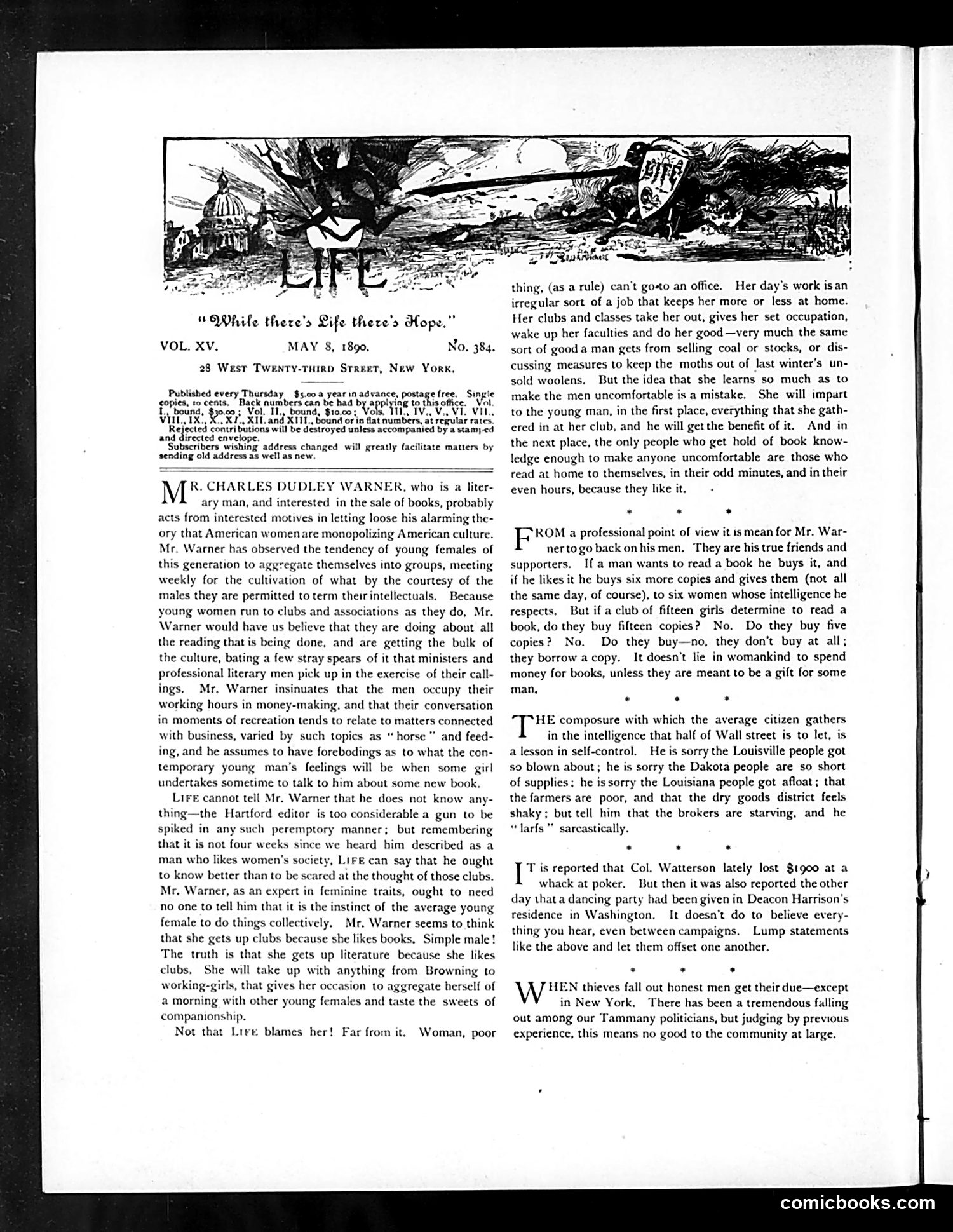
The page contains no political cartoon. Instead, it features editorial commentary on women's reading habits and club culture, responding to Charles Dudley Warner's concerns about American women monopolizing literature. The article satirizes Warner's complaint that women's clubs are consuming books without buying them—borrowing instead of purchasing. The editors defend women's reading groups, arguing they foster intellectual engagement rather than frivolous consumption. The commentary also mocks Wall Street's self-pitying attitude about economic troubles, and includes a brief note about Col. Watterson losing money at poker during a Washington party. The piece is primarily social satire about class, gender, and reading culture rather than political commentary.
📄 Transcribed text from this page (OCR, searchable)
Machine-transcribed from the original scan — historical spelling and the odd misread are preserved.
“Mhile there's Life there's Hope.” VOL. XV. MAY 8, 1890, 28 West Twenty-tTHirp Street, New York, No. 384. Published every Thursday $5.00 a year in advance, postage free. Single s. Back numbers can be had Dyappiying to thisofice. | V ols. III, d Vol. IL., bound, $10.00 ; IV., V., VI. VIL, T., XL. and X11, Bound or in fat numbers, at regular rates, tributions will be destroyed unless accompanied by a stamyed and directed envelope. : Subscribers wishing address changed will greatly facilitate matters by sending old address as well as new. R. CHARLES DUDLEY WARNER, who is a liter- ary man, and interested in the sale of books, probably ts from interested motives in letting loose his alarming the- ory that American women are monopolizing American culture. Mr. Warner has observed the tendency of young females of this generation to aggregate themselves into groups, meeting weekly for the cultivation of what by the courtesy of the males they are permitted to term their intellectuals, Because young women run to clubs and associations as they do, Mr. Warner would have us believe that they are doing about all the reading that is being done, and are getting the bulk of the culture, bating a few stray spears of it that ministers and professional literary men pick up in the exercise of their call- ings. Mr. Warner insinuates that the men occupy their working hours in money-making, and that their conversation in moments of recreation tends to relate to matters connected with business, varied by such topics as “ horse" and feed- ing, and he assumes to have forebodings as to what the con- temporary young man’s feelings will be when some girl undertakes sometime to talk to him about some new book. Lire cannot tell Mr. Warner that he does not know any- thing—the Hartford editor is too considerable a gun to be spiked in any such peremptory manner; but remembering that it is not four weeks since we heard him described as a man who likes women's society, LiF n say that he ought to know better than to be scared at the thought of those clubs. Mr, Warner, as an expert in feminine traits, ought to need no one to tell him that it is the instinct of the average young female to do things collectively. Mr, Warner seems to think that she gets up clubs because she likes books. Simple male! The truth is that she gets up literature because she likes clubs. She will take up with anything from Browning to working-girls, that gives her occasion to aggregate herself of a morning with other young females and taste the sweets of companionship. Not that Lire blames her! Far from it. Woman, poor thing, (as a rule) can’t gosto an office. Her day's work isan irregular sort of a job that keeps her more or less at home. Her clubs and classes take her out, gives her set occupation, wake up her faculties and do her good—very much the same sort of good a man gets from selling coal or stocks, or di cussing measures to keep the moths out of last winter's un- sold woolens. But the idea that she learns so much as to make the men uncomfortable is a mistake. She will impart to the young man, in the first place, everything that she gath- ered in at her club, and he will get the benefit of it. And in the next place, the only people who get hold of book know- ledge enough to make anyone uncomfortable are those who read at home to themselves, in their odd minutes, and in their even hours, because they like it. . . . ROM a professional point of view it 1s mean for Mr. War- nertogo back on his men. They are his true friends and supporters. If a man wants to read a book he buys it, and if he likes it he buys six more copies and gives them (not all the same day, of course), to six women whose intelligence he respects. But if a club of fifteen girls determine to read a book, do they buy fifteen copies? No. Do they buy five copies? No. Do they buy—no, they don’t buy at all; they borrow a copy. It doesn’t lie in womankind to spend money for books, unless they are meant to be a gift for some man, . . . HE composure with which the average citizen gathers in the intelligence that half of Wall street is to let, is a lesson in self-control. He is sorry the Louisville people got so blown about; he is sorry the Dakota people are so short of supplies; he is sorry the Louisiana people got afloat; that the farmers are poor, and that the dry goods district feels shaky; but tell him that the brokers are starving, and he larfs "sarcastically. T is reported that Col. Watterson lately lost $1900 at a whack at poker. But then it was also reported the other day that a dancing party had been given in Deacon Harrison's residence in Washington. It doesn’t do to believe every- thing you hear, even between campaigns. Lump statements like the above and let them offset one another. . . . W H thieves fall out honest men get their due—except in New York. There has been a tremendous falling out among our ‘Tammany politicians, but judging by previous experience, this means no good to the community at large. comicbooks.com