
A complete issue · 18 pages · 1890
Life — April 24, 1890
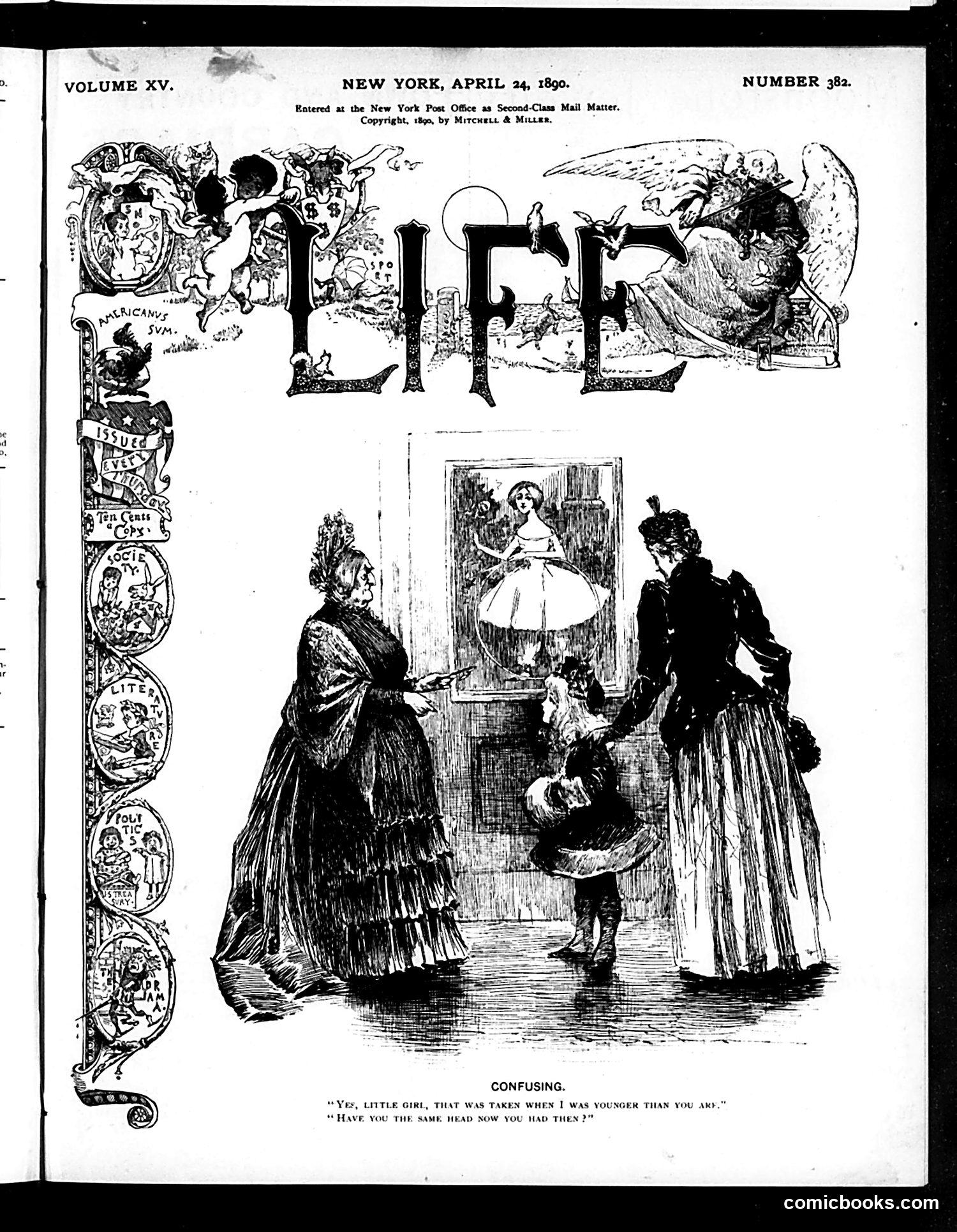
This 1890 Life magazine cartoon satirizes confusion about age and appearance. Two well-dressed women are examining a portrait of a young woman while speaking to a small child. The caption reads: "Yes, little girl, that was taken when I was younger than you are." "Have you the same head now you had then?" The joke appears to target women's use of cosmetics, beauty treatments, or other appearance-altering methods that make their current appearance dramatically different from their younger portraits. By the 1880s-90s, such concerns about women's cosmetic practices and vanity were common satirical subjects. The "confusing" title emphasizes the bewilderment caused by the stark contrast between the portrait and the woman's present appearance.
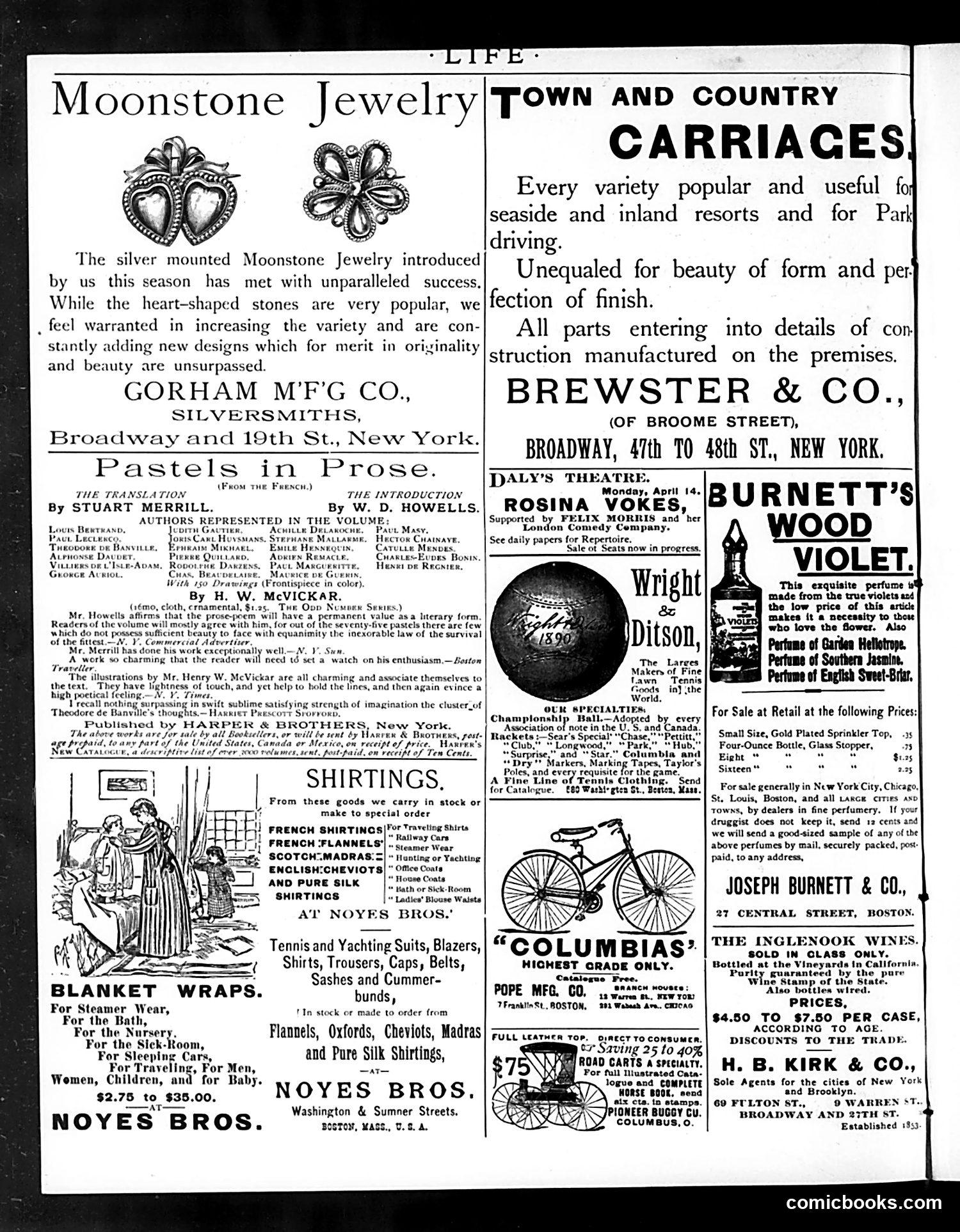
This page is primarily **advertising**, not editorial or satirical content. The main visual element is an illustration for **Noyes Bros. Shirtings** featuring women in Victorian-era dress examining fabric. The image appears to be a straightforward commercial advertisement showing fashionable women considering textiles, with no apparent satirical intent—it's simply marketing men's and women's clothing items like shirtings, blanket wraps, and undergarments. The rest of the page contains various period advertisements for jewelry (Gorham Mfg. Co.), carriages (Brewster & Co.), theater performances, bicycles (Columbia), perfume (Burnett's Wood Violet), and wines. **There is no political cartoon or satire present.** This is a standard commercial page from Life magazine's advertising section.
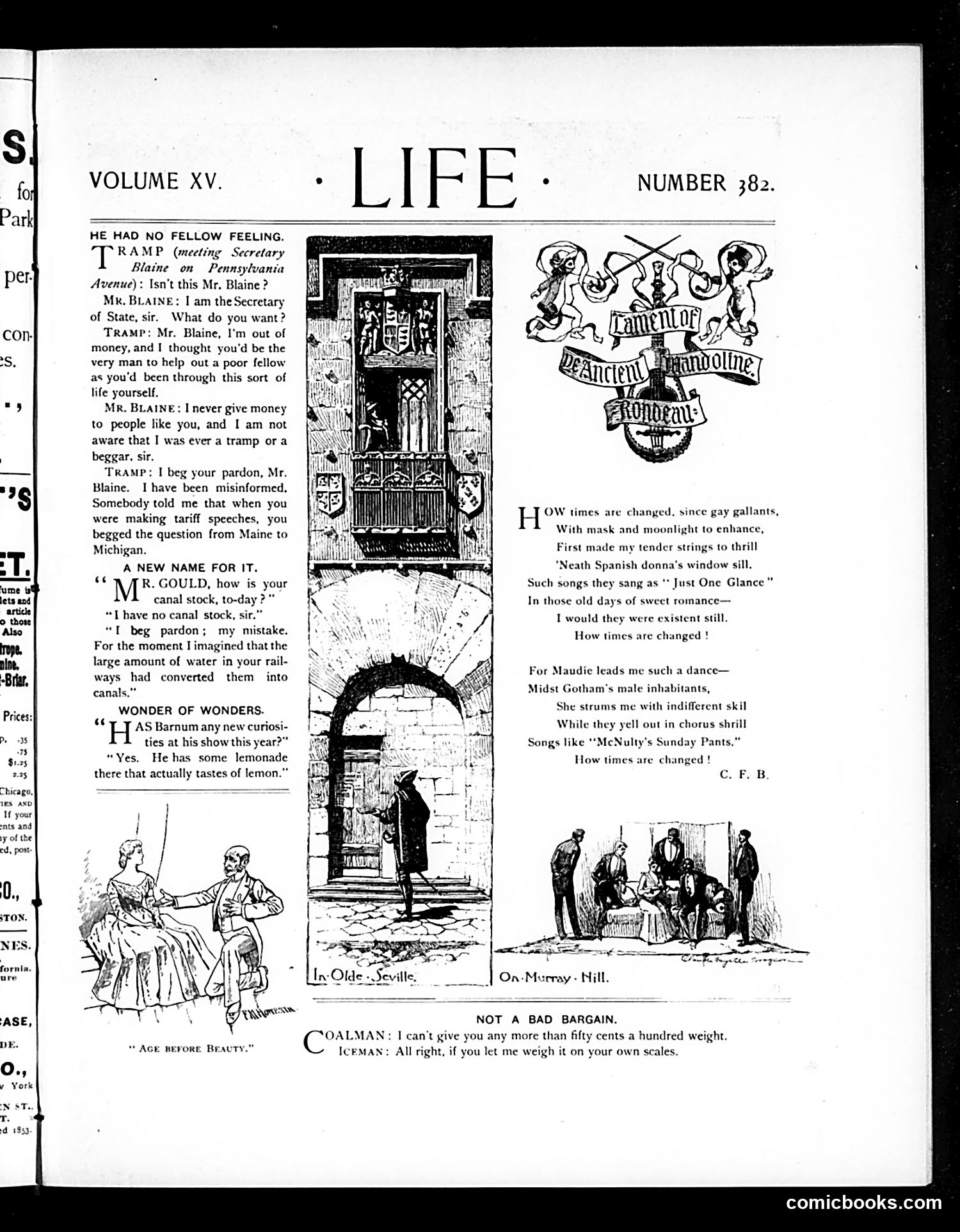
This page contains several humorous sketches and dialogues typical of early 20th-century satirical humor: **Top Left**: A dialogue between a "Tramp" and "Secretary of State on Pennsylvania Avenue" mocks class differences—the poor man asks for money while the wealthy official refuses, dismissing him as a beggar. **Center**: Architectural sketches labeled "In Olde Seville" and "On Murray Hill" appear to contrast old European versus modern American settings, likely satirizing contemporary architectural tastes. **Bottom**: The poem "How times are changed" nostalgically contrasts old romantic traditions (Spanish serenades, moonlight) with modern courtship, referencing contemporary song titles like "McNally's Sunday Pants." **"Not a Bad Bargain"**: A coal merchant and iceman haggle over pricing, a working-class economic joke. The overall tone reflects period-specific concerns about modernization, class, and changing social customs.
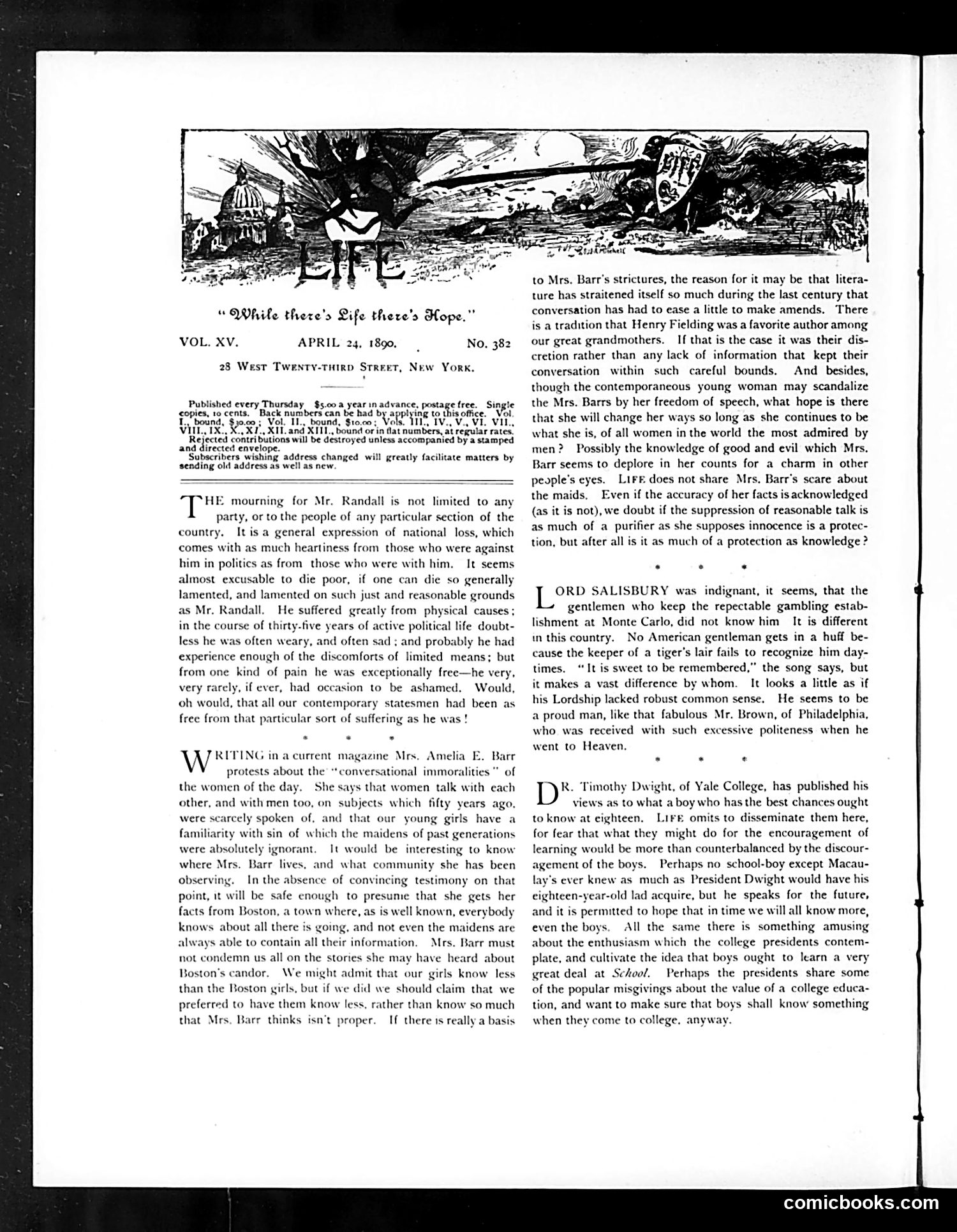
The masthead cartoon depicts a classical allegorical female figure (representing "Life" or Hope) in a landscape with classical architecture, accompanying the motto "While there's Life there's Hope." The page contains three editorial commentary pieces: 1. **On Mr. Randall's death**: Mourning a politician who suffered "thirty-five years of active political life," noting his weariness and freedom from "particular sort of suffering." 2. **On Mrs. Amelia E. Barr's writings**: Satirizing her claims about women's "conversational immoralities," questioning her authority while defending women's right to speak freely. 3. **On Dr. Timothy Dwight**: Mocking his recommendations about what eighteen-year-old boys should learn, with skepticism about colleges properly educating students. The commentary is typical satirical social criticism of the era.
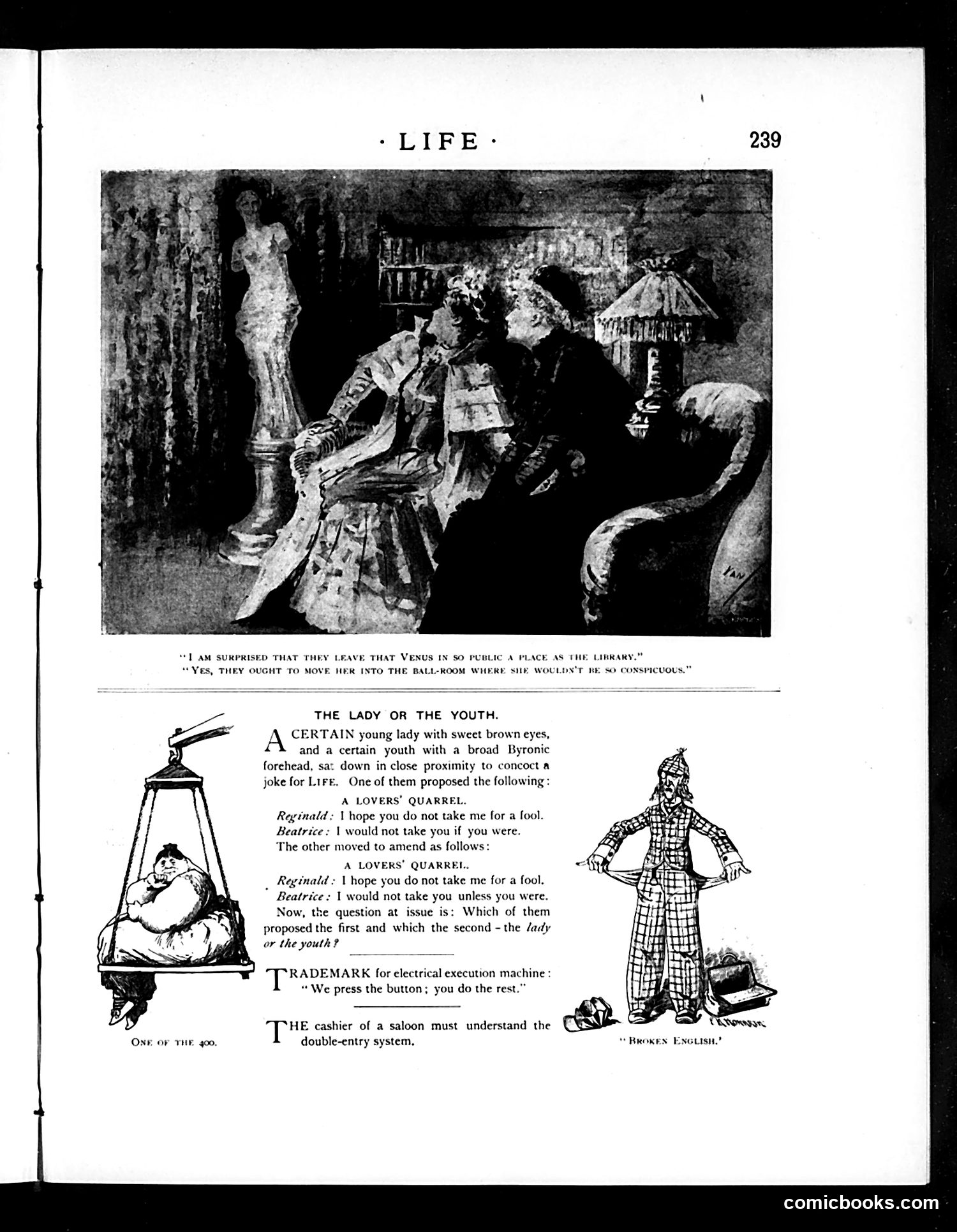
This page from *Life* magazine contains three separate humorous pieces: 1. **Top illustration**: A social scene satirizing art appreciation, with the caption joking that a Venus statue shouldn't be displayed in a library where it would be "conspicuous"—implying the nude artwork was considered inappropriate for public spaces. 2. **"The Lady or the Youth"**: A logic puzzle where a young woman and man exchange witty insults disguised as compliments. The joke hinges on whether the woman or man proposed each version, testing readers' logical reasoning while poking fun at romantic banter and flirtation conventions. 3. **Brief jokes** about an electrical execution machine, saloon accounting practices, and "Brooke's English"—all disconnected one-liners typical of *Life*'s humor format from this era. The page emphasizes social propriety, gender dynamics, and wordplay humor.
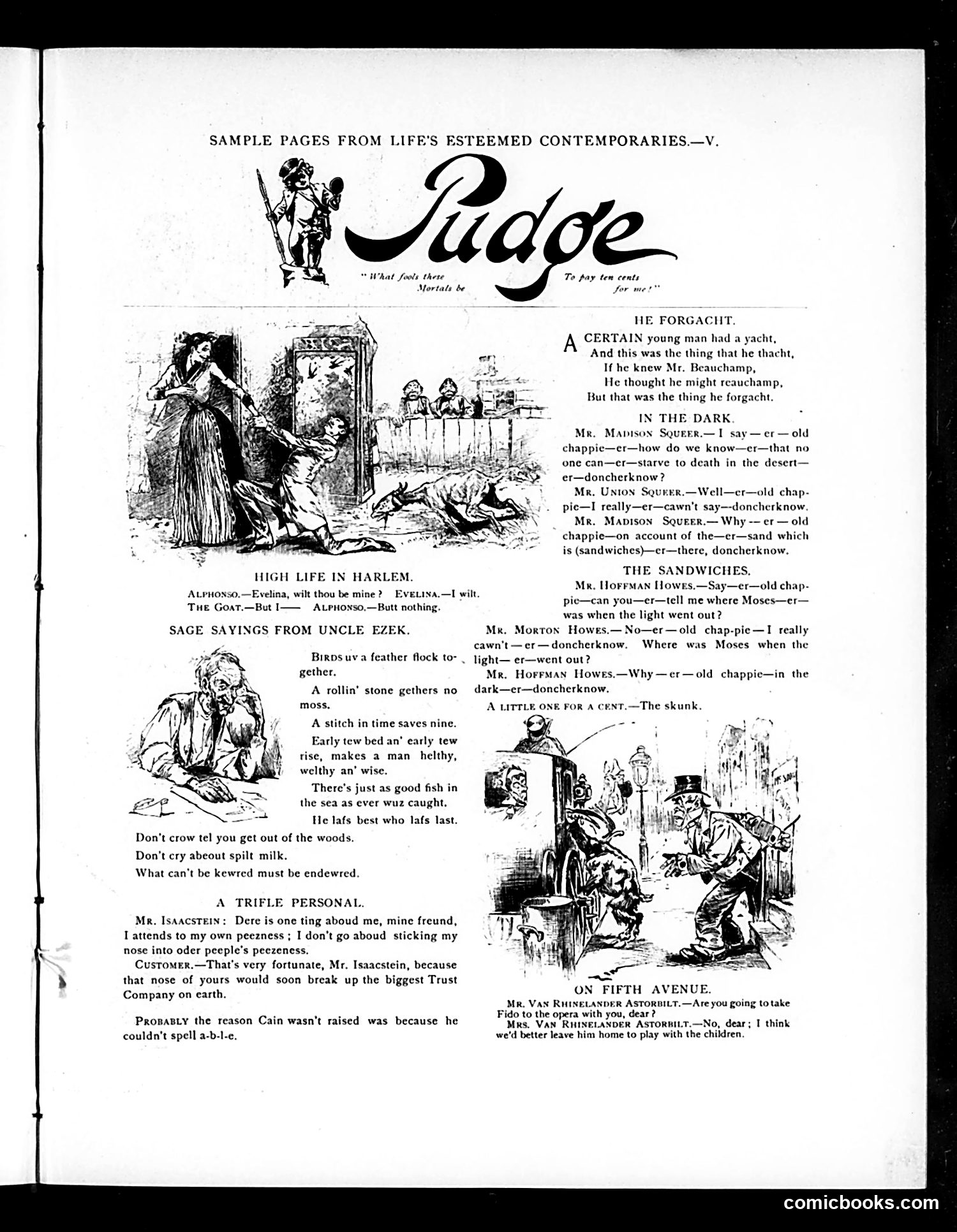
This page from Life's satirical column "Pudge" contains several humor sections mocking social pretension and absurdity: **"High Life in Harlem"** depicts a romantic scene poking fun at aspirational behavior in Harlem's African American community. **"Sage Sayings from Uncle Ezek"** presents folk wisdom through a caricatured elderly figure—likely a minstrel-show stereotype—offering homespun proverbs about hard work and common sense. **"A Trifle Personal"** mocks wealthy businessman Mr. Isacstein for his nose, suggesting it threatens the largest "Trust Company on earth"—satirizing both ethnic stereotyping and monopoly capitalism concerns of the era. **"On Fifth Avenue"** jokes about opera-going pretensions among New York's wealthy. The page reflects early 20th-century satirical humor targeting both immigrant communities and nouveau-riche affectations.
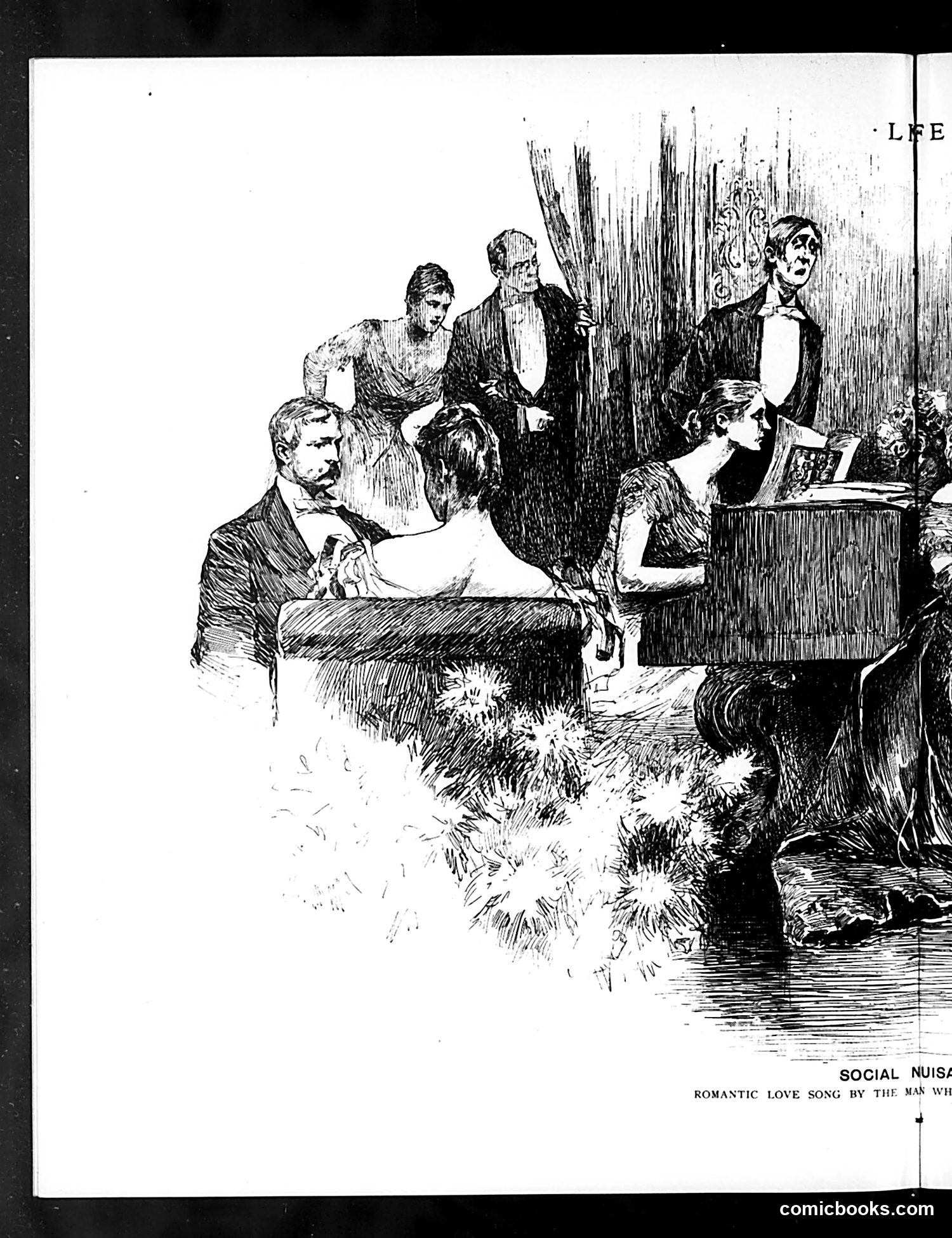
This appears to be a satirical illustration from *Life* magazine depicting a social scene titled "Social Nuisance" with a subtitle referencing "Romantic Love Song by the Man Wh[o]..." (text cut off). The cartoon shows an elegant indoor gathering with well-dressed figures in formal attire. A man seated at left plays piano while a woman sits nearby, seemingly performing or listening. Other elegantly-dressed guests stand in the background, appearing somewhat uncomfortable or dismayed. The satire likely targets the disruption caused by amateur musical performances at social gatherings—a common Victorian-era irritation. The "romantic love song" reference suggests the performer is subjecting guests to sentimental music against their will. The guests' expressions and body language convey their displeasure at this unwanted entertainment, making this a humorous critique of social obtrusiveness.
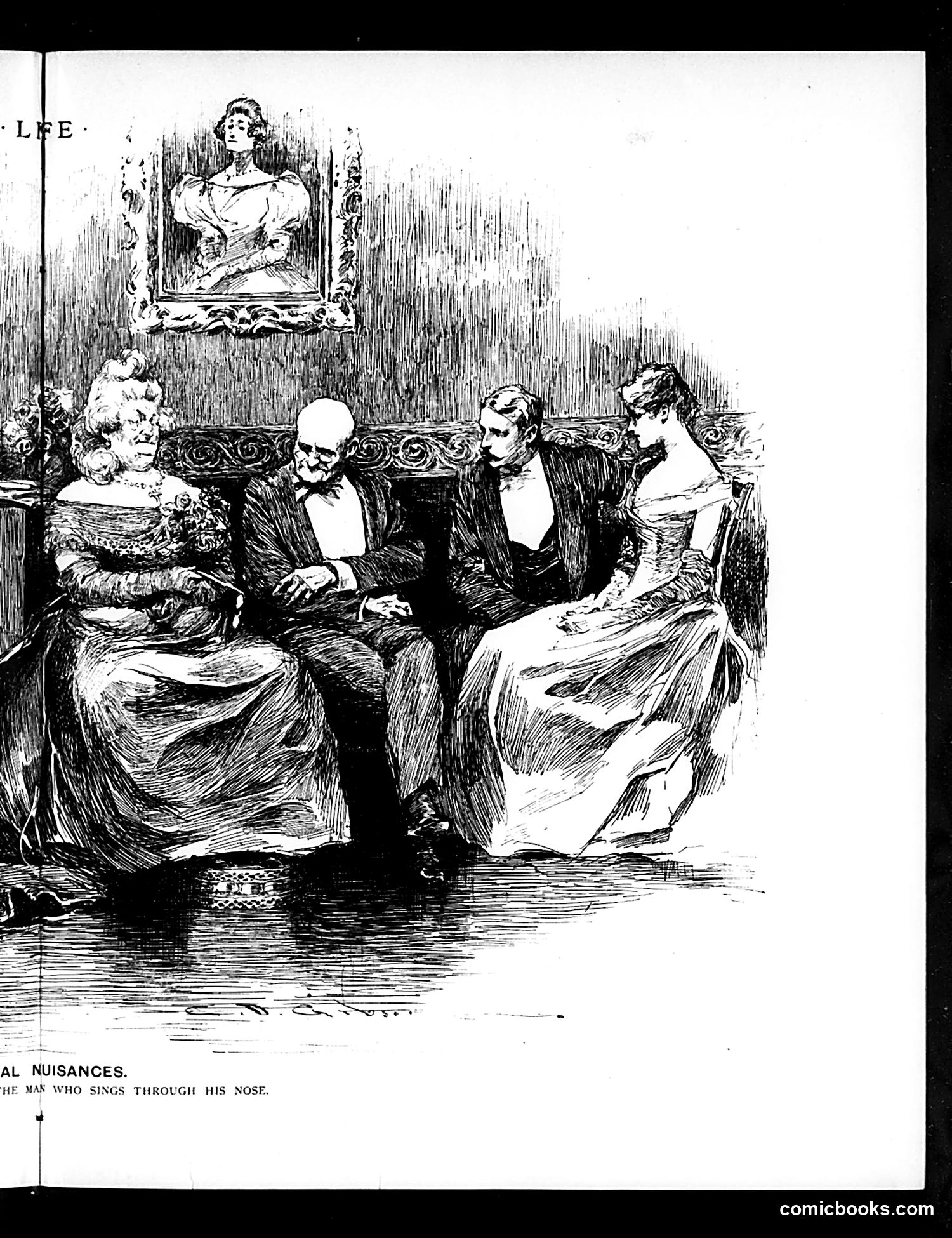
This is a satirical illustration depicting a common social annoyance of the era. The caption identifies the subject as someone who sings through his nose—a habit apparently considered a notable breach of etiquette in refined company. The scene shows an elegant drawing room or parlor where four well-dressed people (three men in evening wear and a woman in formal dress) are gathered. Their body language and expressions suggest they are enduring the performance with varying degrees of displeasure or resignation—a commentary on how social conventions often force people to tolerate annoying behavior politely rather than object openly. This appears part of a "Social Nuisances" series mocking various irritating behaviors in polite society, using humor to critique both the offenders and the awkward social conventions that enable their annoying habits.
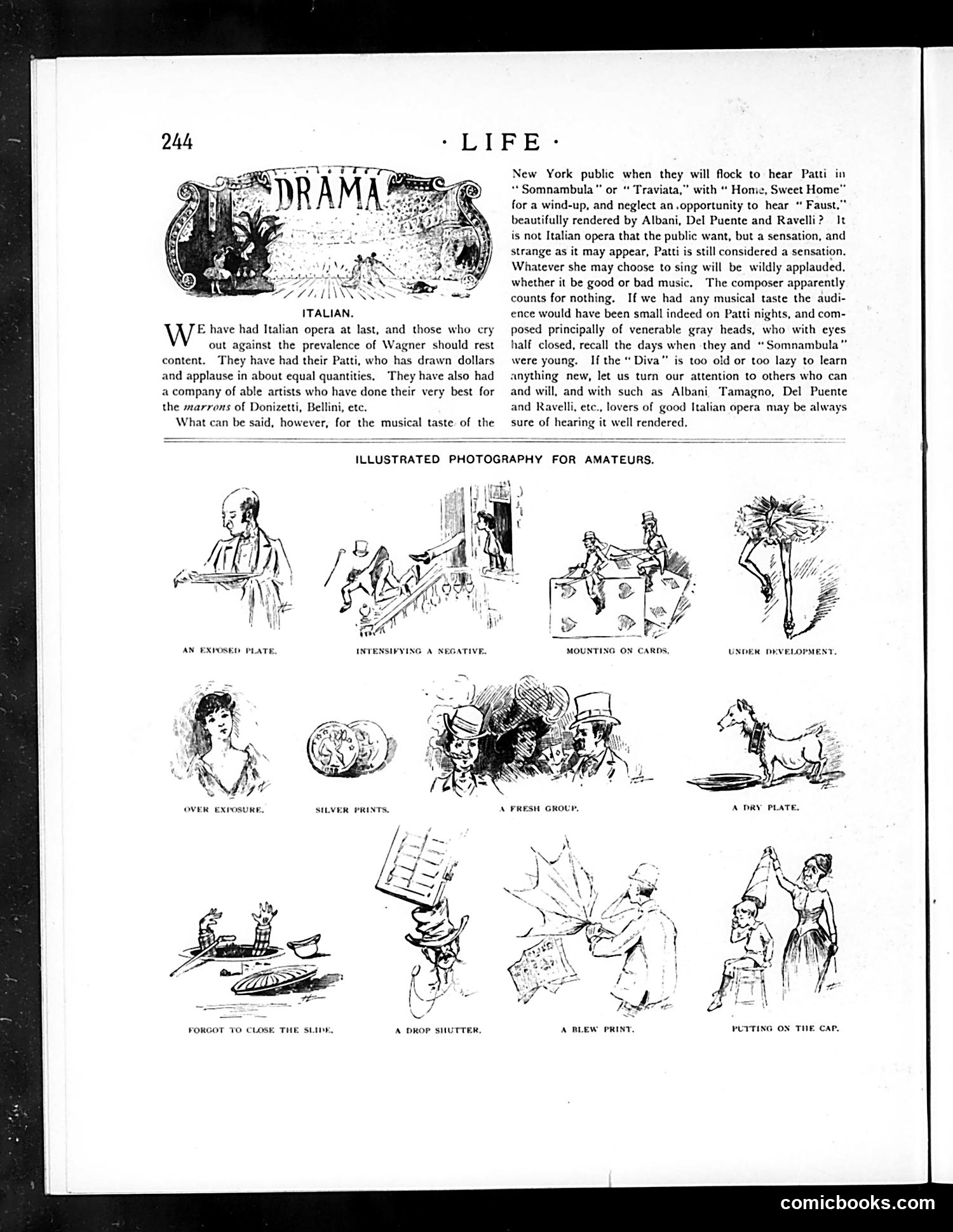
This page contains two distinct sections: **Top section ("Italian Drama"):** A brief essay defending Italian opera against Wagner's dominance. It mentions past Italian opera stars and advocates for performers like Albani, Tamagno, Del Puente, and Ravelli, arguing audiences should appreciate well-rendered Italian opera. **Bottom section ("Illustrated Photography for Amateurs"):** A humorous instructional guide showing common photography mistakes through cartoon illustrations—overexposed plates, intensifying negatives, mounting errors, underdeveloped prints, silver prints issues, fresh groups, dry plates, forgotten slide closures, drop shutters, blown prints, and improper cap placement. This is instructional satire: the cartoons mock amateur photographers' frequent blunders in an era when photography was becoming accessible to the general public. Each labeled illustration demonstrates a different way the process could fail.
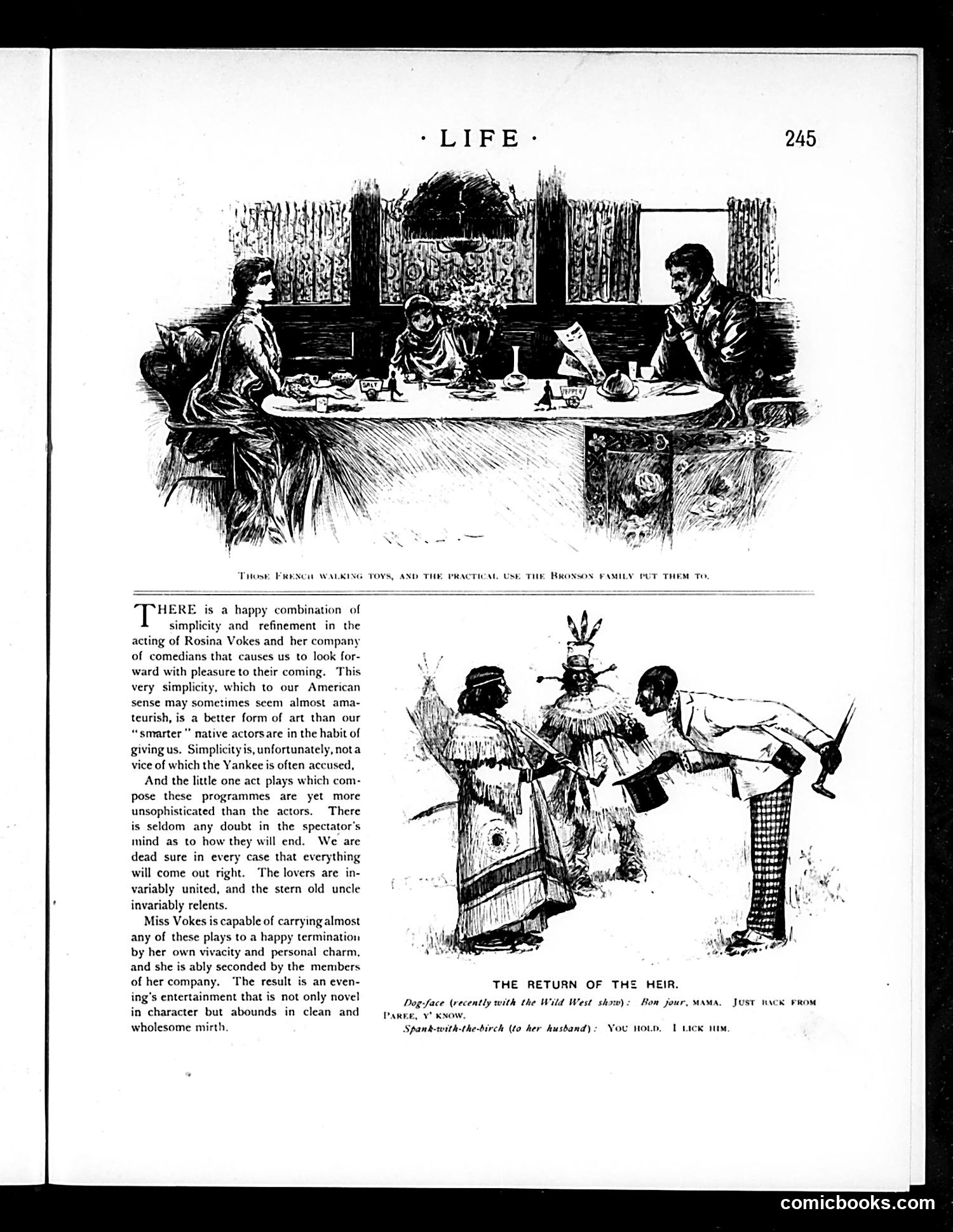
This page from *Life* magazine discusses actress **Rosina Vokes** and her theatrical company. The top illustration shows a formal dinner scene, while the lower illustration depicts "The Return of the Heir"—apparently a theatrical scene involving Wild West costuming. The text praises Vokes for combining "simplicity and refinement" in her acting, contrasting her approach favorably with the "smarter" affectations of native-born American actors. The author suggests her company brings "clean and wholesome mirth" to audiences. The satire appears to critique American theatrical conventions by favorably comparing a foreign (likely British) actress's naturalistic style to the overacted, pretentious mannerisms common in American theater of the period. The Wild West theatrical scene illustrates popular entertainment themes of that era.
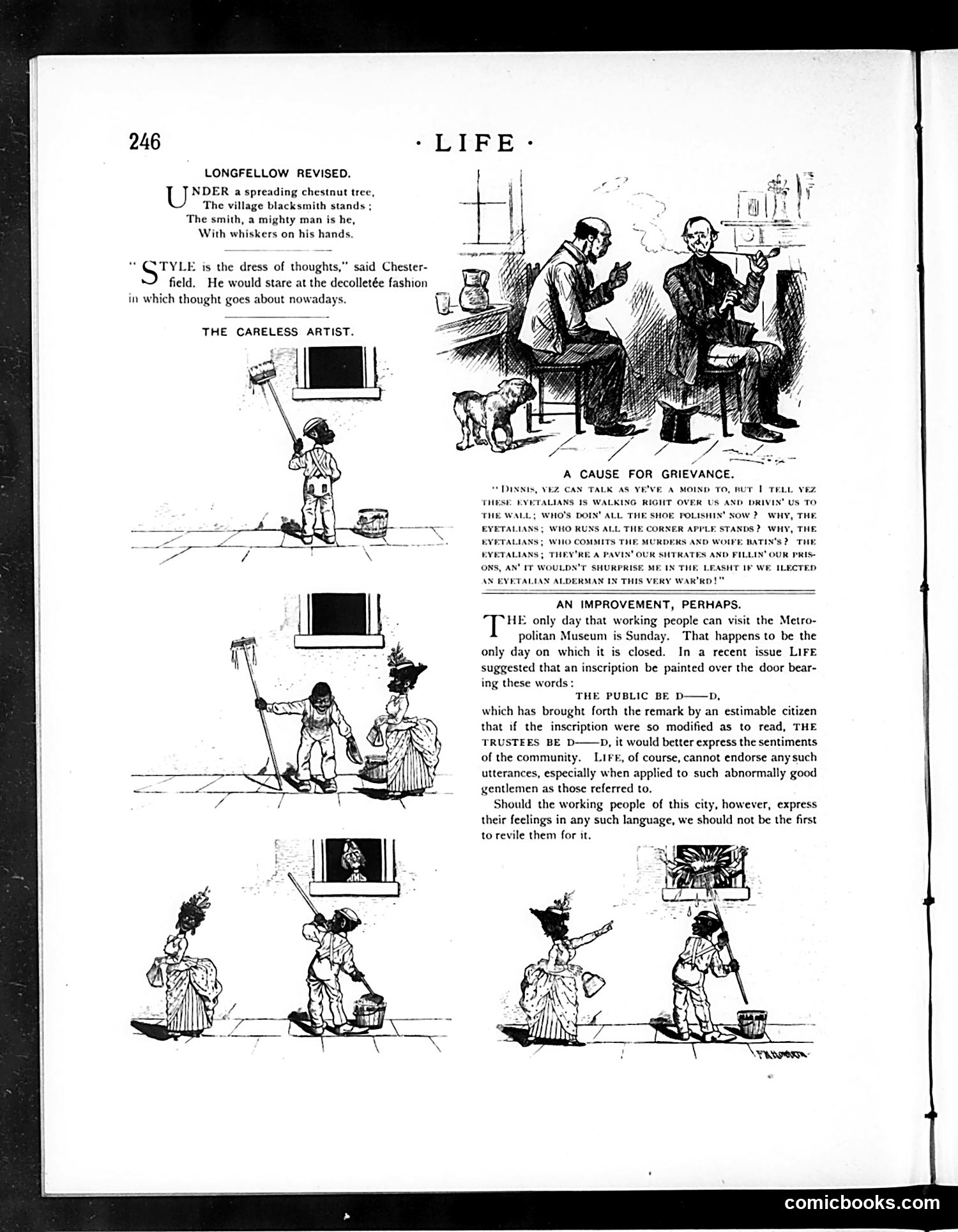
This page contains three separate satirical pieces: **"Longfellow Revised"** mocks careless writing by altering Longfellow's famous poem—changing "mighty man" to "mighty man is he, / With whiskers on his hands" (nonsensical). **"The Careless Artist"** shows a painter repeatedly missing his canvas, satirizing incompetence. **"A Cause for Grievance"** reproduces anti-Italian immigrant stereotyping—a working-class speaker complains that Italian immigrants dominate shoeshine, fruit vending, and allegedly commit crimes. It's vitriolic xenophobic dialect humor common to the era, expressing nativist resentment. **"An Improvement, Perhaps"** criticizes the Metropolitan Museum's hours: working people can only visit Sundays, when it's closed. The piece sarcastically suggests changing "The Public Be Damned" to "The Trustees Be Damned," implying museum leadership disregards workers' access while claiming to endorse workers' right to express frustration—itself ironic mockery.
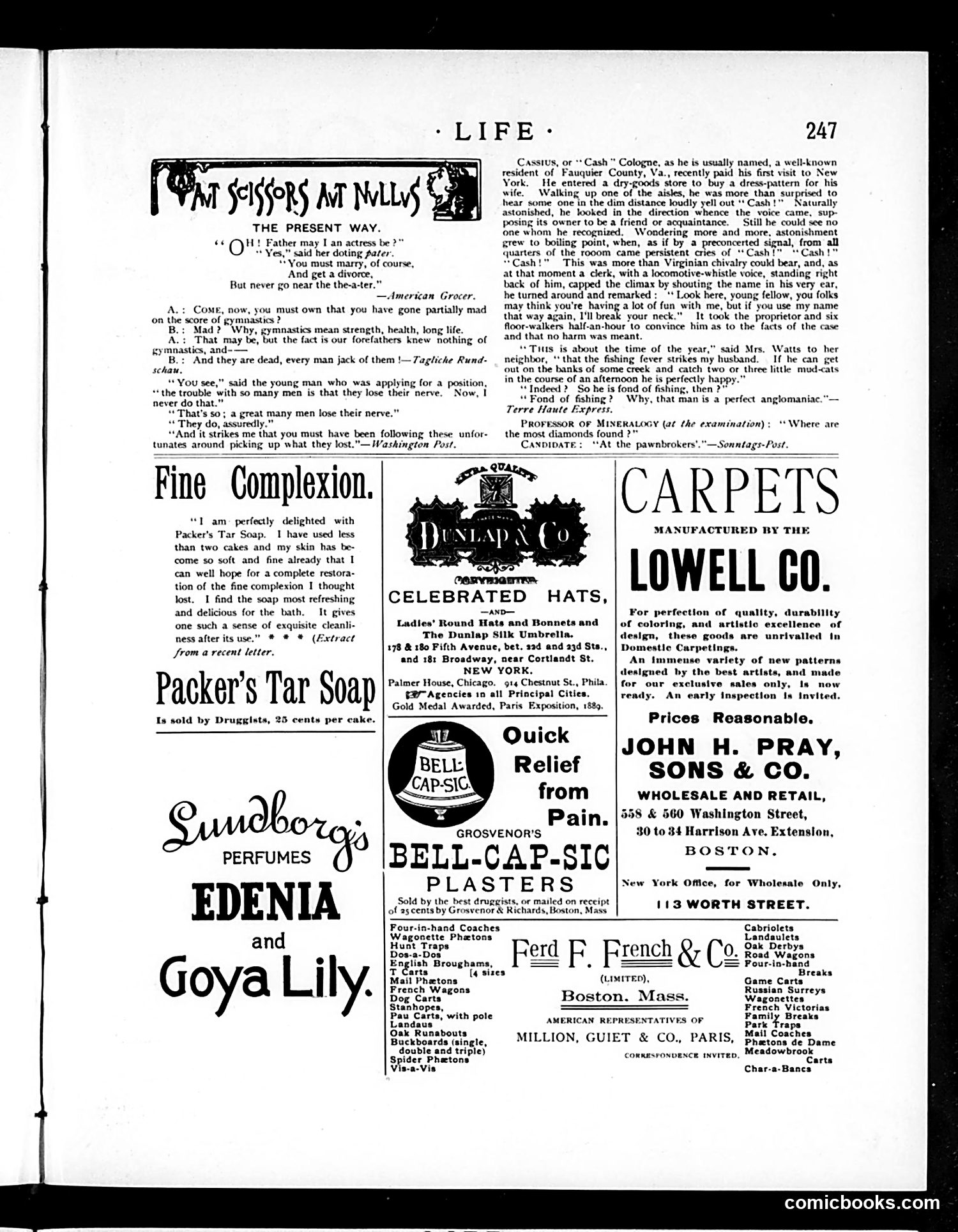
This is primarily **an advertising page** with several short humorous anecdotes at the top. The opening story lampoons a Virginia gentleman named "Cash" Cologne who visits New York and becomes enraged when salespeople repeatedly shout his name—apparently a common store practice (likely meaning "cash" as in payment). The satire mocks both rural Southern unfamiliarity with urban customs and the clashing of provincial sensibilities with city life. The remaining brief jokes address contemporary social concerns: an actress-aspiring daughter whose father forbids theater (satirizing parental hypocrisy), the gymnastics craze, nervous men, a man mistaking a clerk's shout for his name, and an examination joke about diamonds being "found" at pawnbrokers (implying poverty/pawned jewelry). The page is dominated by period product advertisements—soap, perfumes, hats, plasters—typical of Life's revenue model. The satirical content serves mainly as editorial filler between ads.
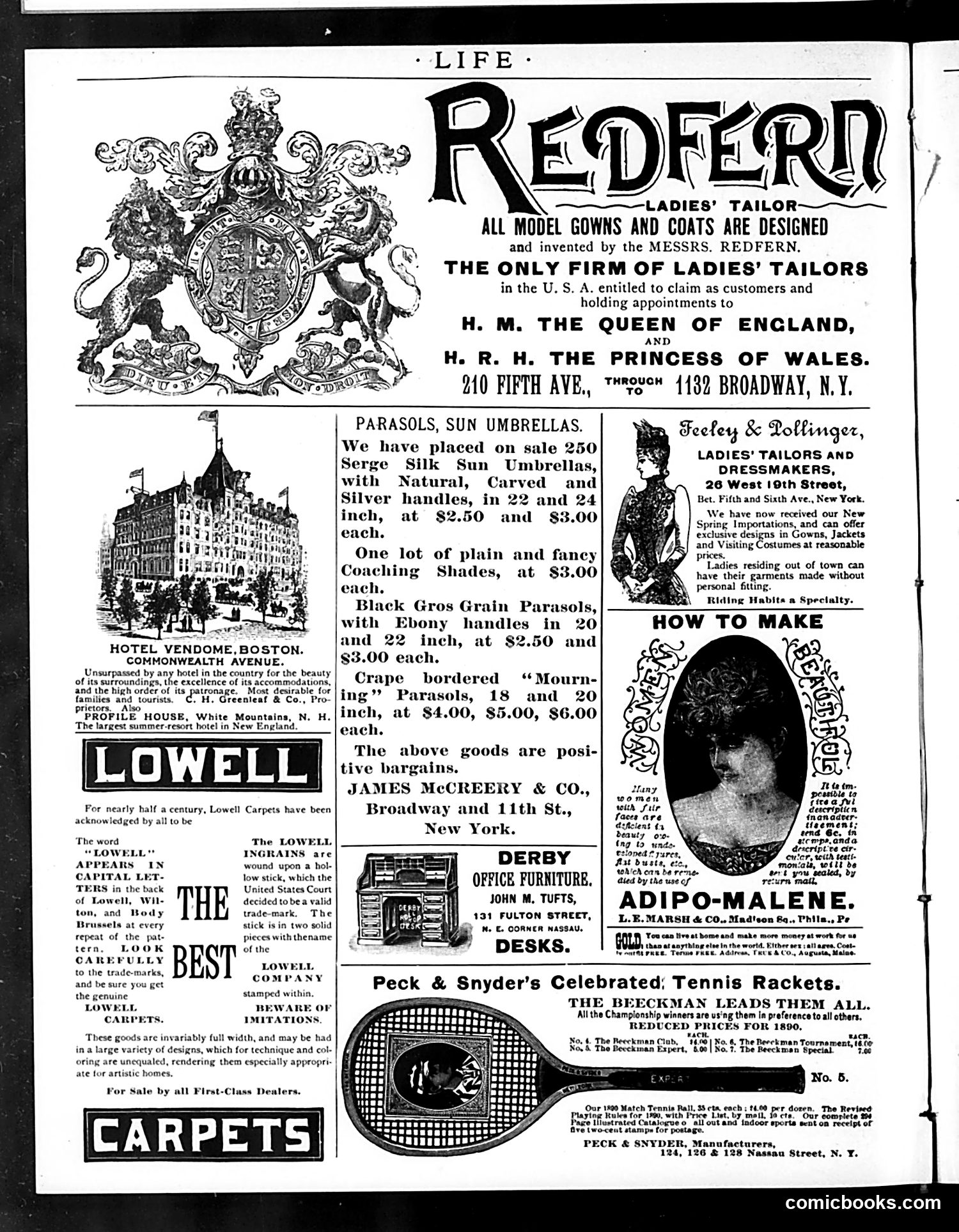
This is primarily an **advertising page** from Life magazine, not a satirical cartoon. The page contains commercial advertisements for luxury goods and services typical of the 1890s American upper class. **Notable advertisements include:** - **Redfern**: A ladies' tailor claiming to be "the only firm" with appointments to the Queen of England and Princess of Wales—a status symbol emphasizing British royal connections - **Lowell Carpets**: Competing for legitimacy through trademark registration and repeated branding - **Hotel Vendôme, Boston**: Luxury hospitality - **James McCreery & Co.**: Department store parasols and umbrellas - **Peck & Snyder**: Tennis rackets claiming championship endorsements - **Derby Office Furniture and Adipo-Malene**: Various luxury/health products The page reflects Gilded Age consumer culture, where American merchants leveraged European prestige (particularly British royal patronage) and celebrity endorsements to market expensive goods to wealthy readers. There is no political satire visible—it's straightforward commercial messaging.
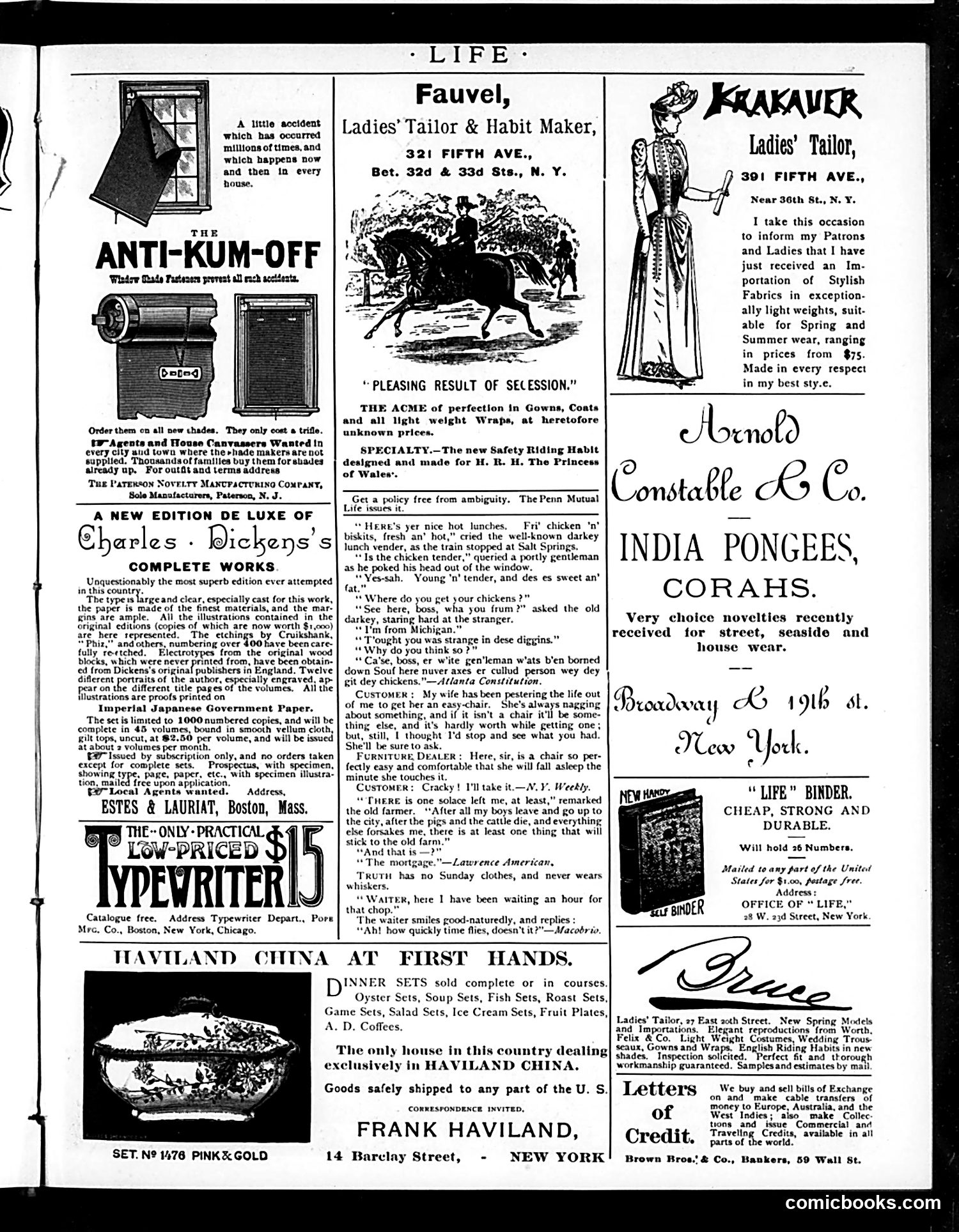
This is primarily **an advertising page** with one embedded cartoon/joke. The main satirical content is the anecdote titled **"Pleasing Result of Secession,"** which presents a dialogue between a Northern white traveler from Michigan and a Black lunch vendor at a Southern train stop. The "joke" relies on a racist stereotype: the vendor assumes any white Northerner wouldn't ask a Black person where they source their chickens, implying Southerners have different (presumably exploitative or underhanded) practices regarding Black labor. The humor targets both regions—mocking Southern racial attitudes while presenting the vendor as crude. This reflects post-Civil War sectional tensions and deeply offensive racial assumptions common in late 19th-century American publications. The rest of the page contains period advertisements for women's clothing, typewriters, china, and books—typical of Life's mixed editorial-commercial format.
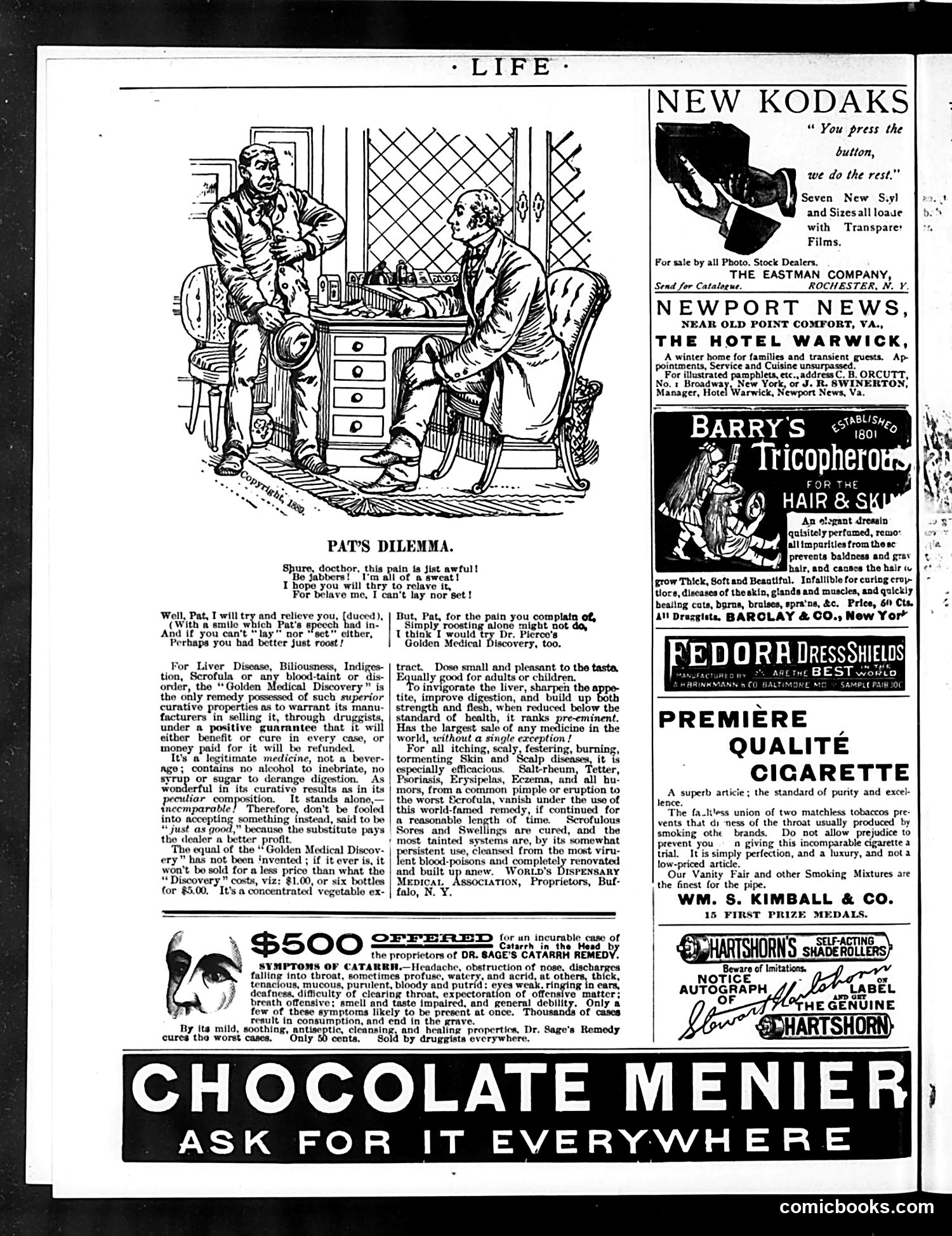
This cartoon satirizes patent medicine marketing common in the 1890s-1900s. "Pat," depicted with Irish caricature features, complains to a doctor about severe pain. The doctor responds with a knowing smile, suggesting Pat simply "roost" (rest) instead—then plugs Dr. Pierce's "Golden Medical Discovery." The joke mocks the era's dubious medical remedies: the doctor cynically implies Pat's ailment may be self-inflicted or exaggerated, yet still recommends an unproven patent medicine. The text below extensively advertises this product as a cure-all for liver disease, scrofula, skin conditions, and digestive issues—claims typical of fraudulent tonics. The satire critiques how such "medicines" were aggressively marketed despite lacking scientific validation, and how even medical professionals apparently endorsed them. Pat's working-class Irish dialect adds another layer: these products often targeted vulnerable populations with extravagant health promises.
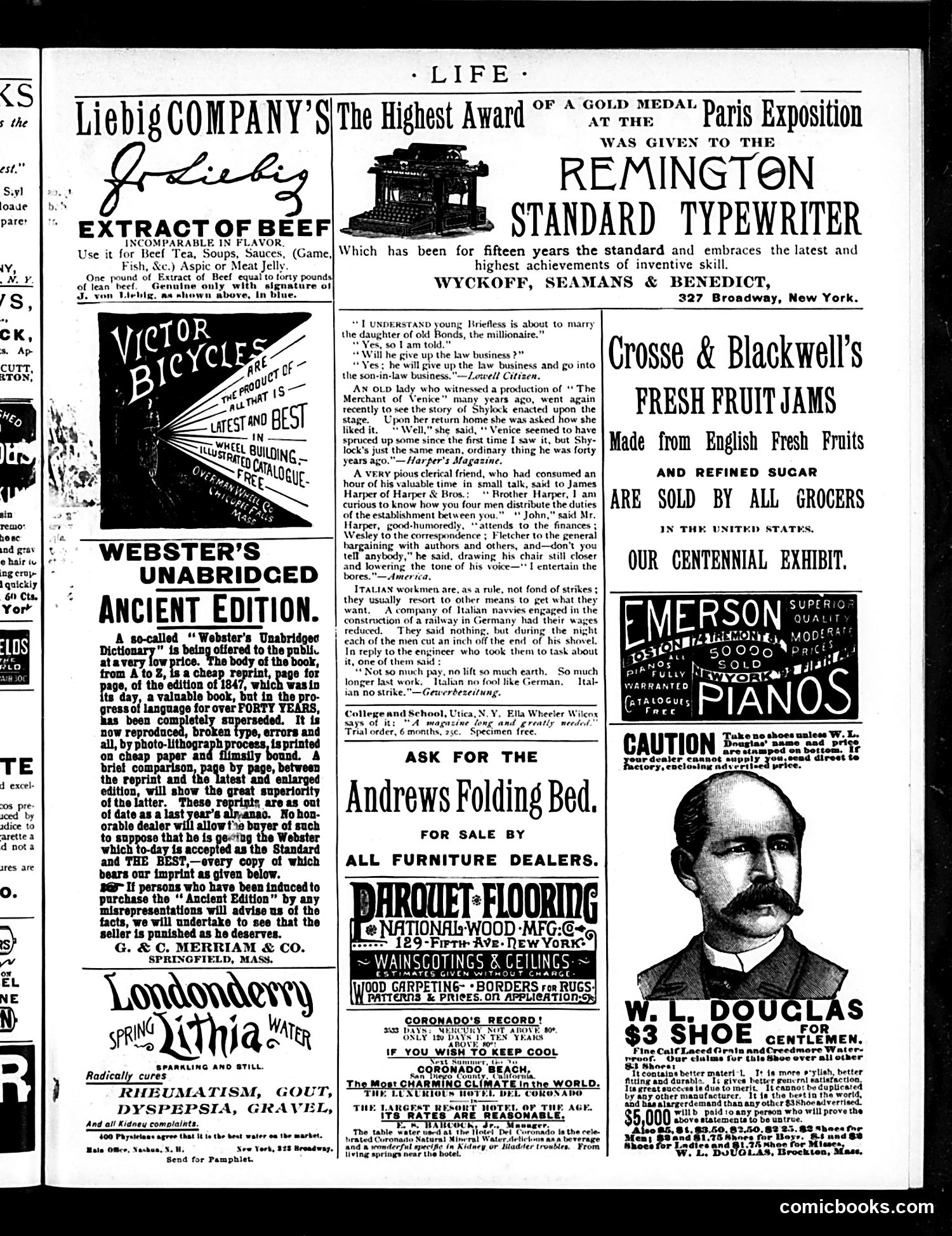
This is primarily an **advertising page** from Life magazine, not a political cartoon. The page contains commercial advertisements for various products—Liebig's Extract of Beef, Victor Bicycles, Webster's Dictionary, Remington Typewriters, and others—interspersed with brief humorous anecdotes. The few jokes present are mild social commentary rather than satire: - A quip about a young lawyer marrying a millionaire's daughter and switching from law practice to "son-in-law business" - An elderly woman's memory of Venice from seeing *The Merchant of Venice* years earlier - A story about Italian railway workers who protest wage cuts by secretly shortening their shovels by one inch These represent **gentle, everyday humor** about marriage, memory, and labor relations—typical of Life's light satirical tone. There are no identifiable political figures or pointed social critique. The page reflects late 19th-century concerns: labor disputes, commercial competition, and class differences, but treats them with humor rather than outrage.
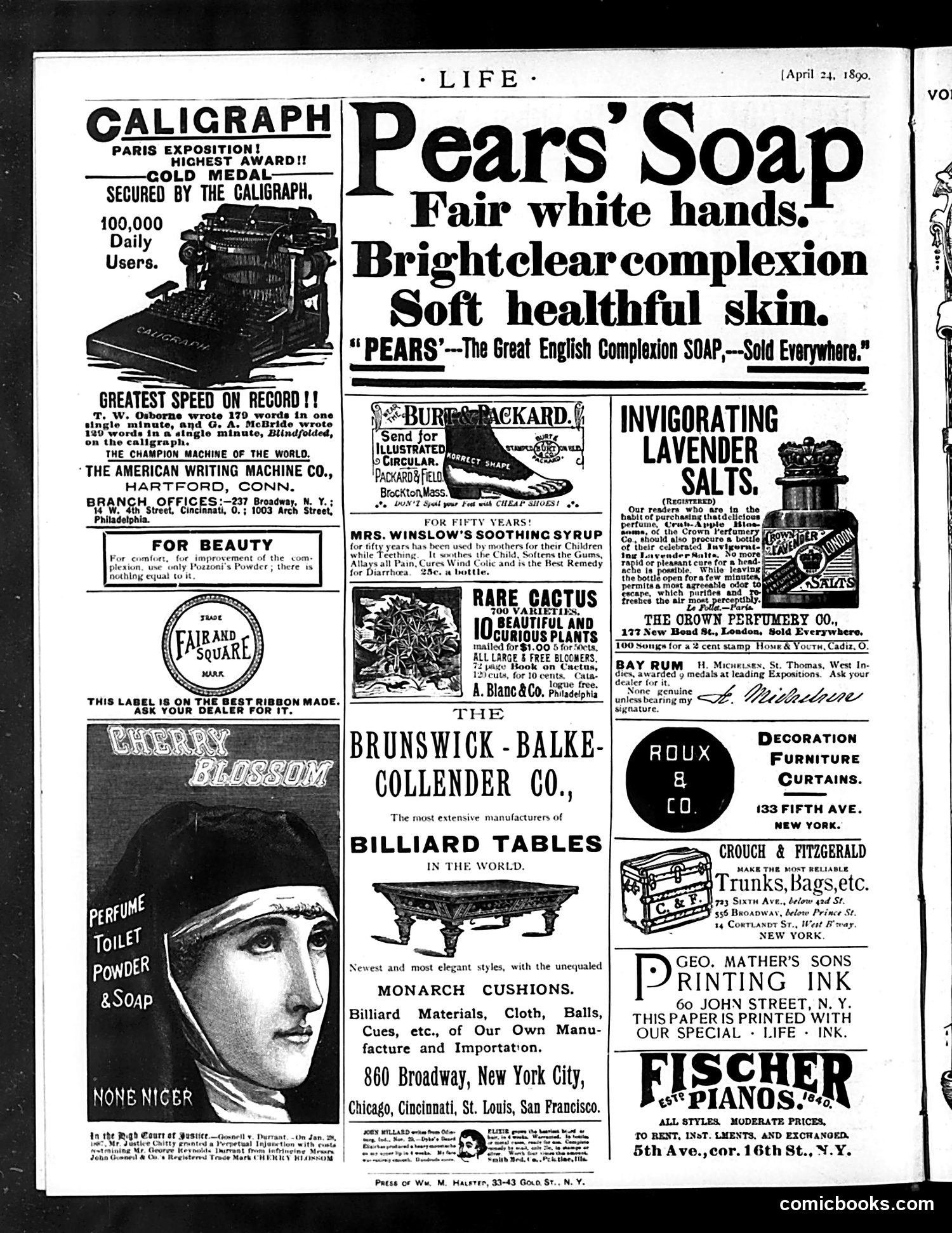
This page is primarily **advertising**, not editorial cartoon or satire. It consists entirely of commercial advertisements typical of the 1890s era. The ads include period products now historically notable: Pears' Soap (emphasizing "fair white hands" and "bright clear complexion"—reflecting era racial beauty standards); Mrs. Winslow's Soothing Syrup for infants; the Caligraph typewriter; and various luxury goods (pianos, billiard tables, trunks). The only illustration with possible satirical intent is **"Cherry Blossom"** perfume/toilet powder, featuring a woman's profile labeled "NONE NICER"—likely a racial reference contemporary to this era, though the exact satirical point is unclear from context alone. The page demonstrates how Life magazine supported itself through advertising while also revealing 1890s consumer culture, product claims, and social attitudes around beauty and race that would strike modern readers as offensive.