
Life, 1890-04-24 · page 6 of 18
Life — April 24, 1890 — page 6: what you’re looking at
A restored page from Life, 1890-04-24. Page through the whole issue in the reader above.
📄 Transcribed text from this page (OCR, searchable)
Machine-transcribed from the original scan — historical spelling and the odd misread are preserved.
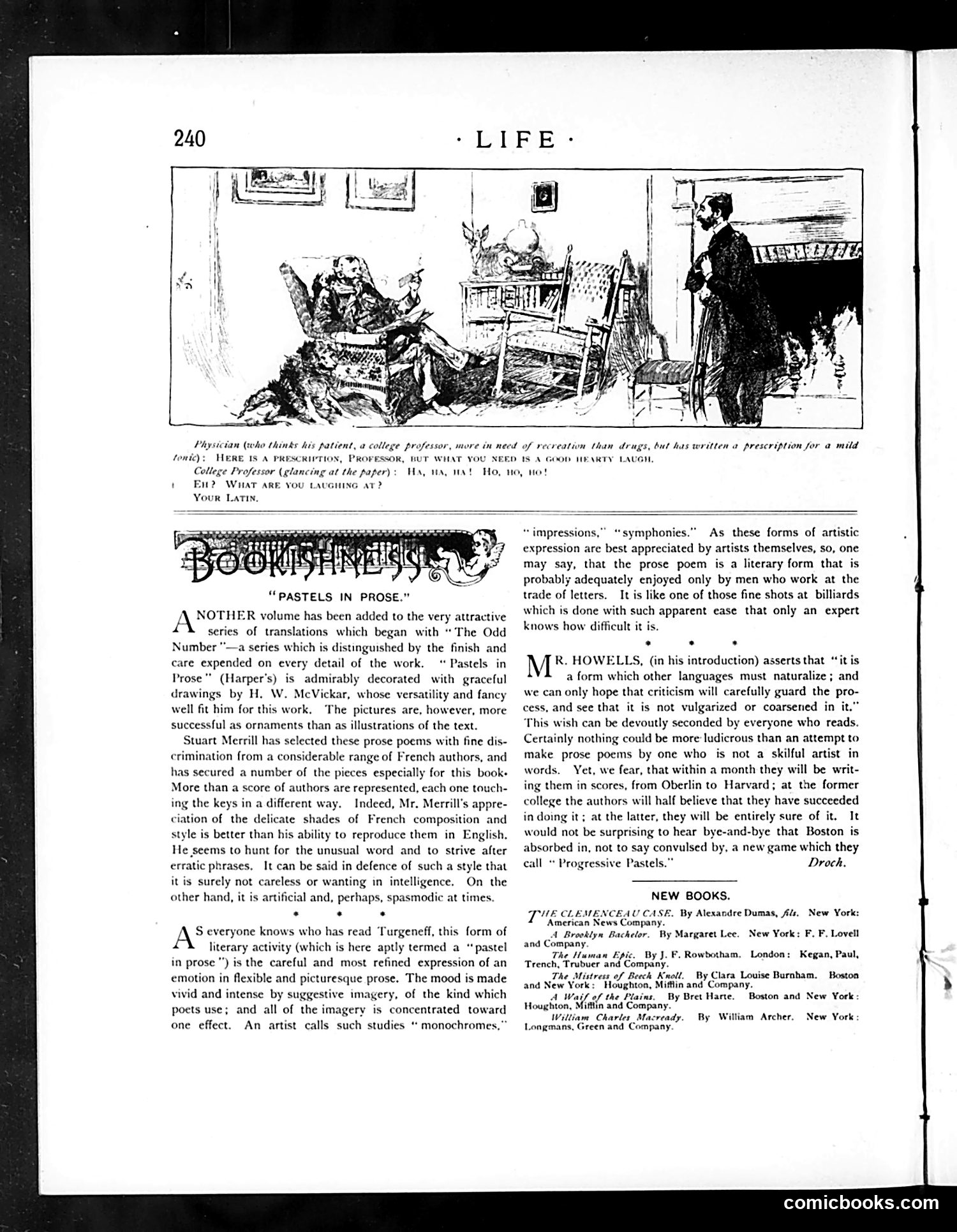
Physician (who thinks his patient, a college professor, more in need of recreation than drug: HERE IS A PRESCRIPTION, PROFESSOR, KUT WHAT YOU NEED IS 4 Ho, 10, Wo! tonic): College Professor (glancing at the paper) : En? Wuat are you Lavciinc at? Your Latin, Ha, tay at but has written a prescription for a mild {Ob HEARTY LAUGH. “PASTELS IN PROSE.” JA DOTRER volume has been added to the very attractive he Odd distinguished by the finish and ¢ expended on every detail of the work. “Pastels in Prose" (Harper's) is admirably decorated with graceful drawings by H. W. McVickar, whose versatility and fancy well fit him for this work, The pictures are, however, more successful as ornaments than as illustrations of the text. Stuart Merrill has selected these prose poems with fine dis- ion from a considerable range of French authors, and has secured a number of the pieces especially for this book More than a score of authors are represented, each one touch- ing the keys in a different way. Indeed, Mr. Merrill's appre- ation of the delicate shades of French composition and style is better than his ability to reproduce them in English. He seems to hunt for the unusual word and to strive after erratic phrases. It can be said in defence of such a style that itis surely not careless or wanting in intelligence. On the other hand, it is artificial and, perhaps, spasmodic at times. series of translations which began with * Number "—a series which i: . . . S everyone knows who has read Turgeneff, this form of literary activity (which is here aptly termed a “pastel in prose’) is the careful and most refined expression of an emotion in flexible and picturesque prose. The mood is made vivid and intense by suggestive imagery, of the kind which poets use; and all of the imagery is concentrated toward one effect. An artist calls such studies “ monochromes,” “ impression: symphonies.” As these forms of artistic expression are best appreciated by artists themselves, so, one may say, that the prose poem is a literary form that is probably adequately enjoyed only by men who work at the trade of letters. It is like one of those fine shots at billiards which is done with such apparent ease that only an expert knows how difficult it is. . . . N R. HOWELLS, (in his introduction) asserts that ‘it is a form which other languages must naturalize ; and we can only hope that criticism will carefully guard the pro- cess, and see that it is not vulgarized or coarsened in it.” This wish can be devoutly seconded by everyone who reads. Certainly nothing could be more: ludicrous than an attempt to make prose poems by one who is not a skilful artist in words. Yet, we fear, that within a month they will be writ- ing them in scores, from Oberlin to Harvard; at the former college the authors will half believe that they have succeeded in doing it; at the latter, they will be entirely sure of it. It would not be surprising to hear bye-and-bye that Boston is absorbed in, not to say convulsed by, a new game which they call “ Progressive Pastels.” Droch. NEW BOOKS. TUE & ENCEAU CASE. By Alexandre Dumas, Als. American News Company. A Brooklyn Bachelor. By Margaret Lee. New York: F. F. Lovell and Company. The Human Epic. By J.P. Rowbotham, London: Trench, Trubuer and Company. The Mistress of Beech Kroll. By Clara Louise Burnham. Boston and New York: Houghton, Mifflin and Company. A Waif of the Plains, By Bret Harte, Boston and New York Houghton, Mitfiin and Company. William Charles Macready. By Longmans, Green and Company. New York: Kegan, Paul, William Archer. New York : comicbooks.com