
Life, 1890-04-24 · page 4 of 18
Life — April 24, 1890 — page 4: what you’re looking at
What you’re looking at
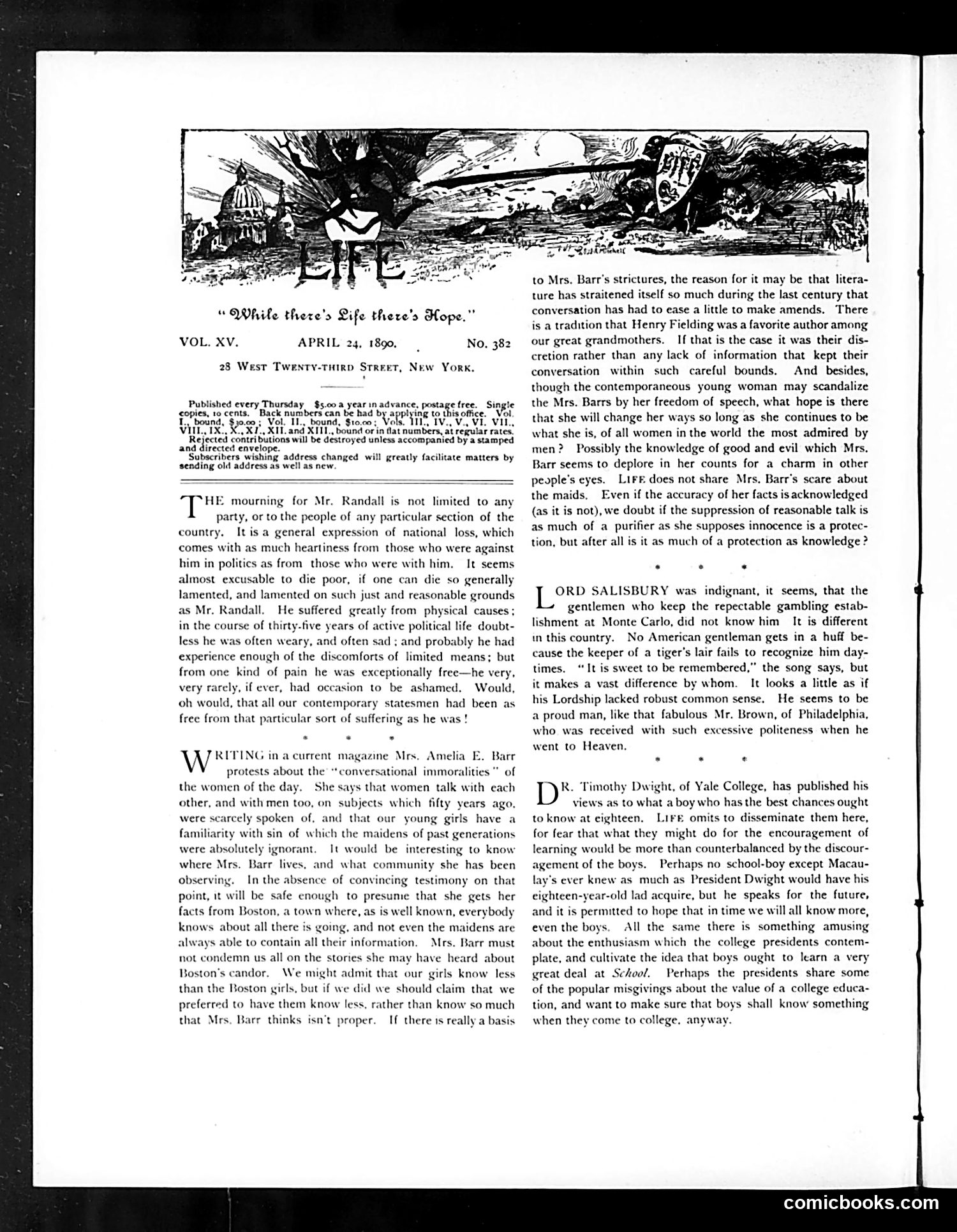
The masthead cartoon depicts a classical allegorical female figure (representing "Life" or Hope) in a landscape with classical architecture, accompanying the motto "While there's Life there's Hope." The page contains three editorial commentary pieces: 1. **On Mr. Randall's death**: Mourning a politician who suffered "thirty-five years of active political life," noting his weariness and freedom from "particular sort of suffering." 2. **On Mrs. Amelia E. Barr's writings**: Satirizing her claims about women's "conversational immoralities," questioning her authority while defending women's right to speak freely. 3. **On Dr. Timothy Dwight**: Mocking his recommendations about what eighteen-year-old boys should learn, with skepticism about colleges properly educating students. The commentary is typical satirical social criticism of the era.
📄 Transcribed text from this page (OCR, searchable)
Machine-transcribed from the original scan — historical spelling and the odd misread are preserved.
“While there's Life there's Hope.” VOL. XV. APRIL 24, 1890, No. 382 28 West Twenty-tiirp Street, New York. Published every Thursday $5.00 a year in advance, postage free. Single goles, 10 cents, "Back numbers can be had by applying to thisoffice. Vol T., bound, Vol Il, bound, Stoo; Vols, His 1V., Ve VE, VIL, VII J ind XIII. Bound or in flat numbers, at regular rates. Rejected contributions will be destroyed unless accompanied by a stamped and directed envelope. Subscribers wishing address changed will greatly facilitate matters by sending old address as well as new. T! = mourning for Mr. Randall is not limited to any party, or to the people of any particular section of the country, Itis a general expression of national loss, which comes with as much heartiness from those who were against him in politics as from those who were with him. It seems almost excusable to die poor, if one can die so generally lamented, and lamented on such just and reasonable grounds as Mr. Randall. He suffered greatly from physical causes; in the course of thirty-five years of active political life doubt- less he was often weary, and often sad ; and probably he had experience enough of the discomforts of limited means; but from one kind of pain he was exceptionally free—he very, very rarely, if ever, had occasion to be ashamed. Would, oh would, that all our contemporary statesmen had been as free from that particular sort of suffering as he was ! RITING ina current magazine Mrs. Amelia E. Barr protests about the “conversational immoralities ” of the women of the day. other, and with men too, on subjects which fifty years ago, were scarcely spoken of, and that our young girls have a familiarity with sin of which the maidens of past generations were absolutely ignorant. It would be interesting to know where Mrs, Barr lives, and what community she She says that women talk with cach been observing. Inthe absence of convincing testimony on that point, it will be safe enough to presume that she gets her facts from Boston, a town where, as is well known, everybody knows about all there is going, and not even the maidens are always able to contain all their information. Mrs. Barr must not condemn us all on the stories she may have heard about Boston's candor. We might admit that our girls know less than the Boston girls, but if we did we should claim that we preferred to have them know less, rather than know so much that Mrs, Barr thinks isn’t proper. If there 1s really a basis to Mrs. Barr's strictures, the reason for it may be that litera- ture has straitened itself so much during the last century that conversation has had to ease a little to make amends. There is a tradition that Henry Fielding was a favorite author among our great grandmothers. If that is the case it was their dis- cretion rather than any lack of information that kept their conversation within such careful bounds. And_ besides, though the contemporaneous young woman may scandalize the Mrs. Barrs by her freedom of speech, what hope is there that she will change her ways so long as she continues to be what she is, of all women in the world the most admired by men? Possibly the knowledge of good and evil which Mrs. Barr seems to deplore in her counts for a charm in other people's eyes. LIFE does not share Mrs. Barr's scare about the maids. Even if the accuracy of her facts is acknowledged (as it is not), we doubt if the suppression of reasonable talk is as much of a purifier as she supposes innocence is a protec- tion, but after all is it as much of a protection as knowledge ? ORD SALISBURY was indignant, it seems, that the gentlemen who keep the repectable gambling estab- lishment at Monte Carlo, did not know him It is different in this country. No American gentleman gets in a huff be- cause the keeper of a tiger's lair fails to recognize him day- times. “It is sweet to be remembered,” the song says, but it makes a vast difference by whom. It looks a little as if his Lordship lacked robust common sense, He seems to be a proud man, like that fabulous Mr. Brown, of Philadelphia, who was received with such excessive politeness when he went to Heaven. R. Timothy Dwight, of Yale College, has published his views as to what a boy who has the best chances ought to know at eighteen, Lire omits to disseminate them here, for fear that what they might do for the encouragement of learning would be more than counterbalanced by the discour- agement of the boys. Perhaps no school-boy except Macau- lay’s ever knew as much as President Dwight would have his cightcen-year-old lad acquire, but he speaks for the future, and it is permitted to hope that in time we will all know more, even the boys. All the same there is something amusing about the enthusiasm which the college presidents contem- plate, and cultivate the idea that boys ought to learn a very great deal at School, Perhaps the presidents share some of the popular misgivings about the value of a college educa- tion, and want to make sure that boys shall know something when they come to college, comicbooks.com