
A complete issue · 14 pages · 1890
Life — April 3, 1890
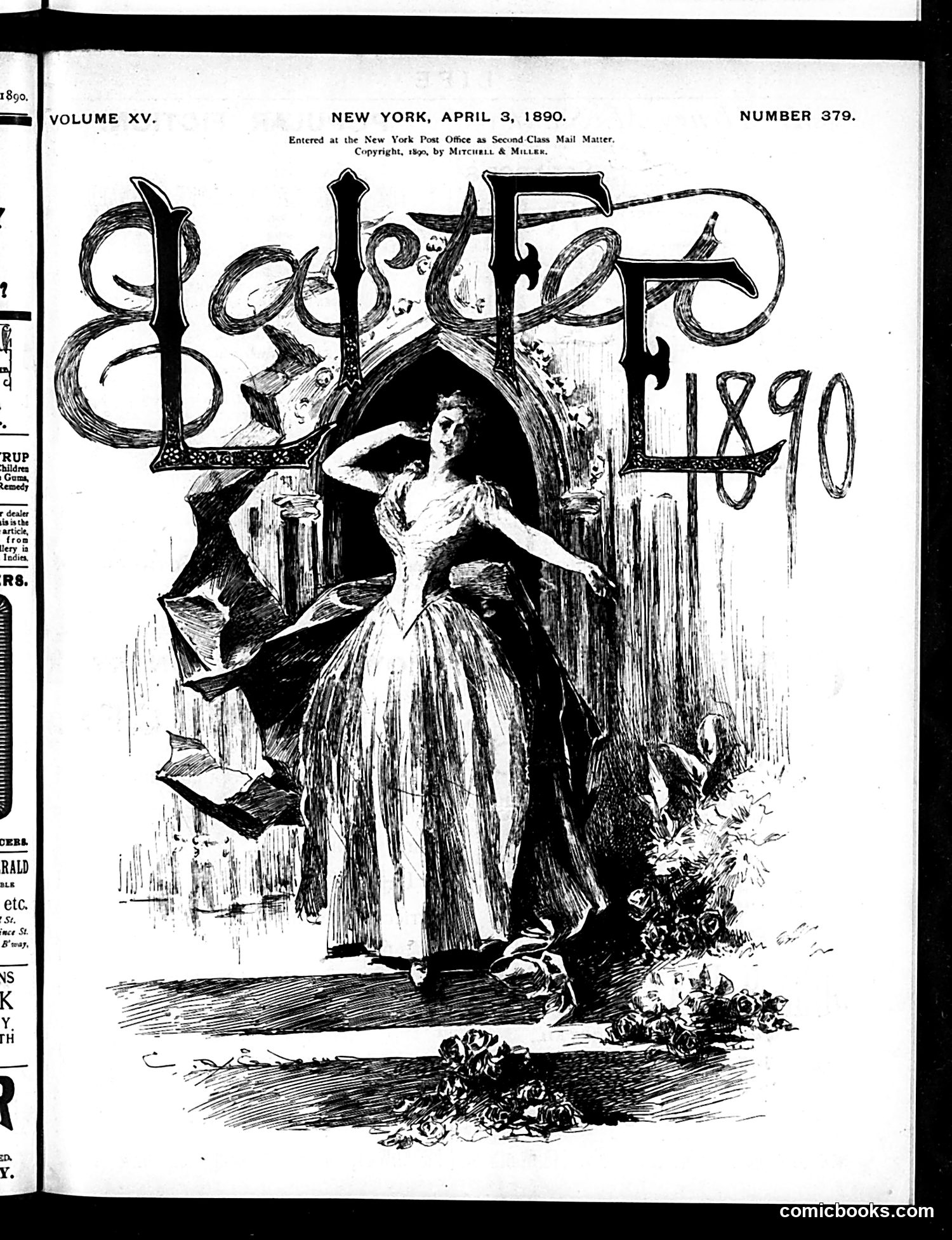
This is a cover illustration for *Life* magazine's Easter 1890 issue. The decorative typography spells "Easter 1890" in ornate letters surrounding a classical female figure in flowing robes, standing in an arched doorway. She holds one arm raised gracefully while the other rests at her side. Flowers are scattered at her feet. The image appears to be a straightforward seasonal illustration rather than political satire—a common approach for holiday-themed magazine covers of the period. The classical styling and allegorical female figure were typical Victorian-era aesthetic choices for depicting springtime renewal and religious observance. No specific political figures or contentious social commentary appears evident from the visual elements.
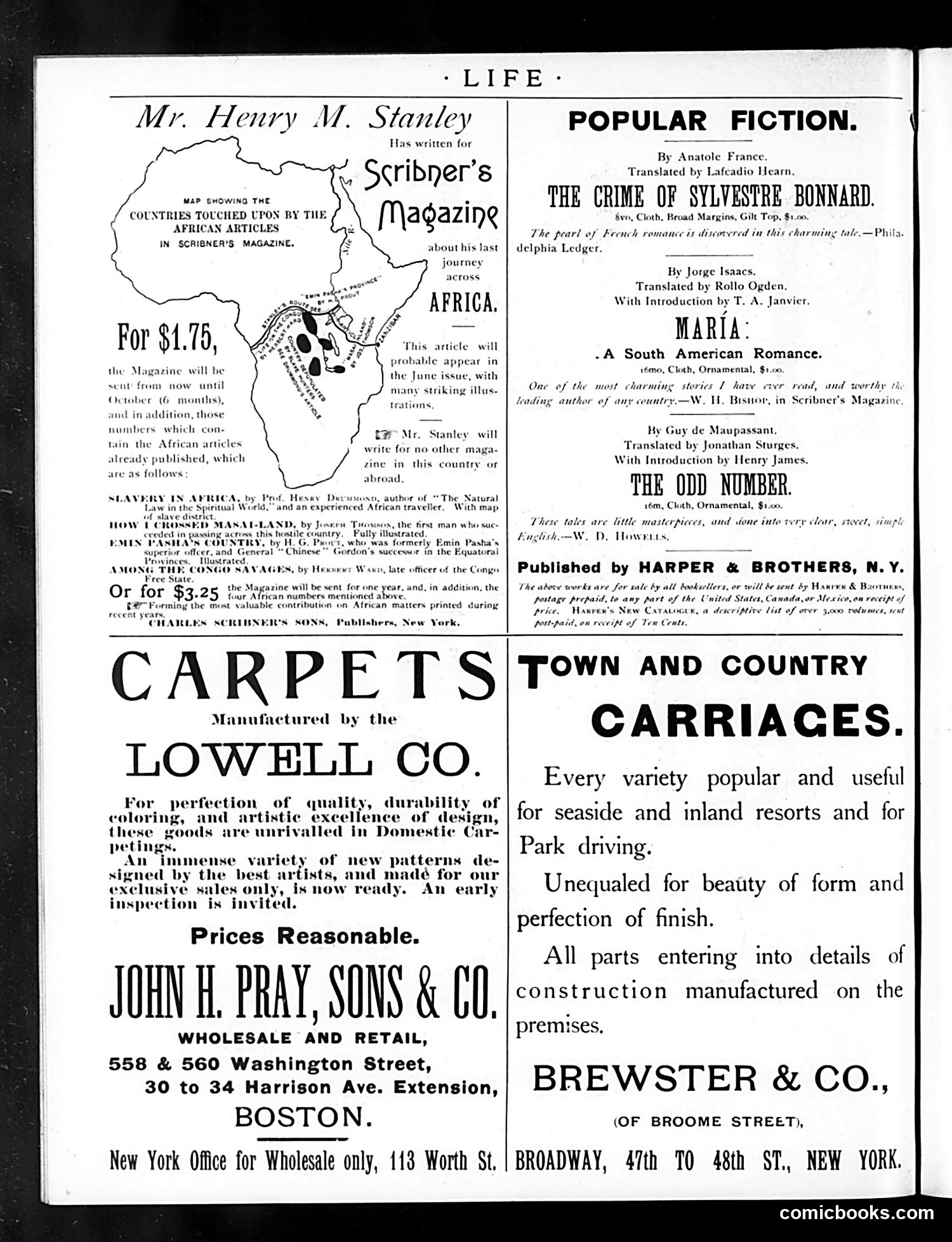
This page is **primarily advertising**, not satire or political commentary. It contains: 1. **Top left**: An advertisement for *Scribner's Magazine*, promoting Henry M. Stanley's African articles with a map showing "Countries Touched by the African Articles." The ad costs $1.75 for a subscription. 2. **Center/Right**: Book advertisements from Harper & Brothers, promoting fiction titles including works by Anatole France, Jorge Isaacs, and Guy de Maupassant. 3. **Bottom**: Commercial advertisements for carpets (Lowell Co.), carriages (Brewster & Co.), and related products. The page represents typical late-19th-century magazine advertising and editorial promotion rather than satirical or political content. There are no discernible cartoons, caricatures, or social commentary present.
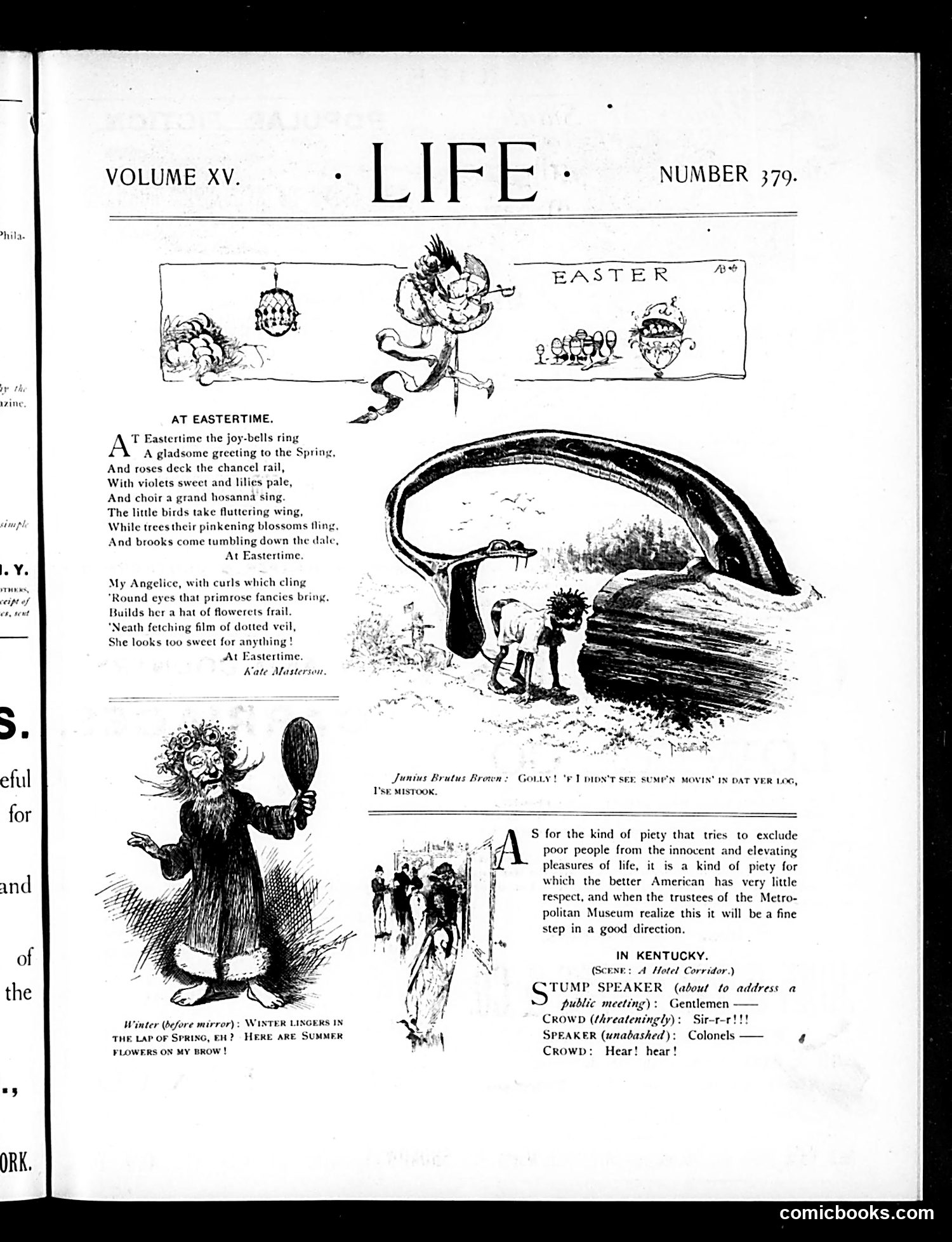
This Easter-themed page from LIFE magazine (Volume XV, Number 379) contains seasonal poetry and illustrations rather than political satire. The top features "At Eastertime," a poem celebrating spring flowers and church bells. Below that is a humorous illustration captioned with dialogue between "Junior Brutus Brown" and what appears to be a dog near a log, with Brown claiming he hasn't seen "Sump's movin'" in "dat ver log" — suggesting crude dialect humor. The lower left shows a character labeled "Winter (before mirror)" with the caption "Winter lingers in the lap of spring, eh? Here are summer flowers on my brow!" — a seasonal metaphor about spring's arrival. The bottom section titled "In Kentucky" depicts a stump speaker addressing a crowd, referencing political speech-making traditions, though specifics remain unclear.
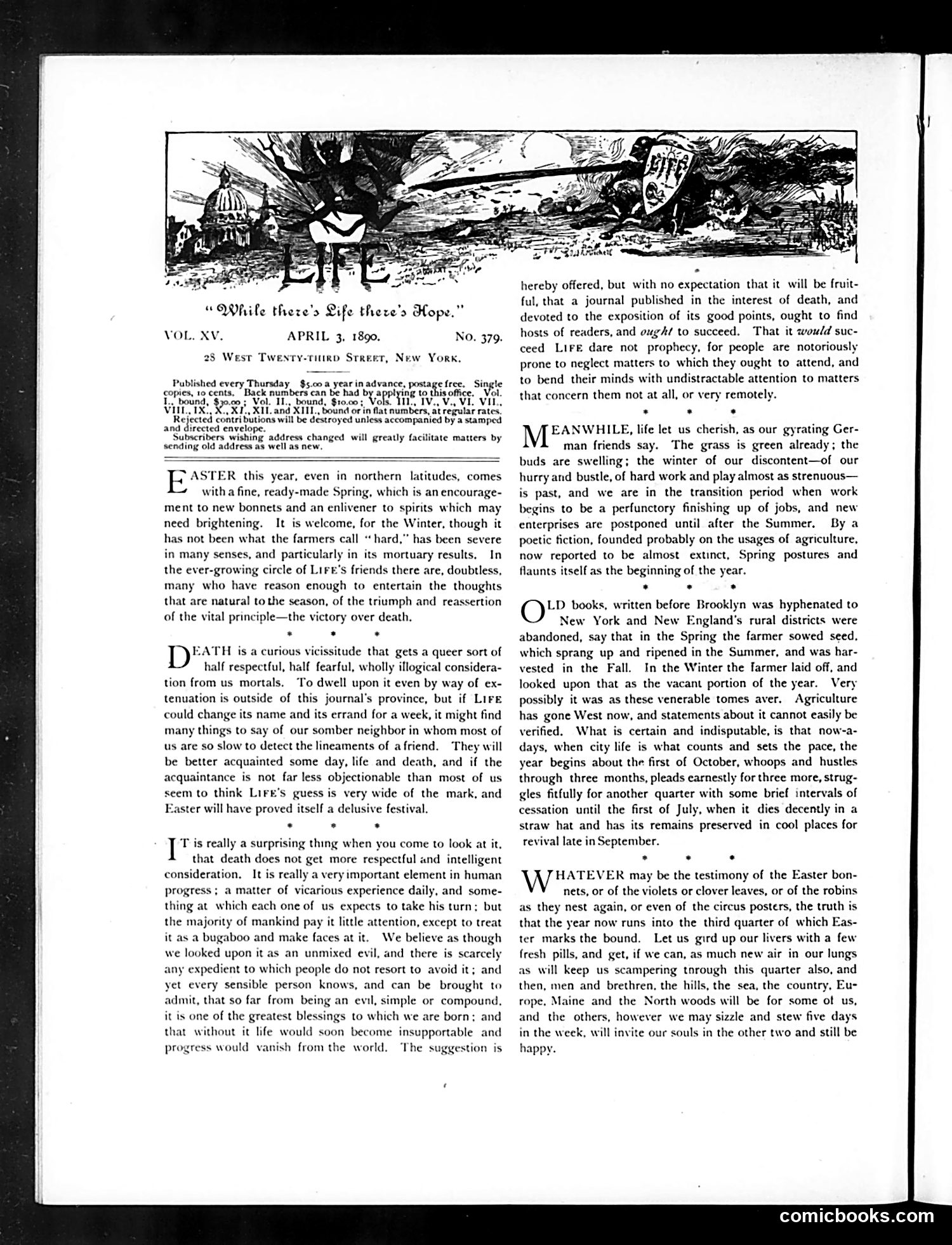
The masthead illustration depicts a landscape with classical and modern elements—a dome (possibly representing government or culture), industrial structures, and a gravestone or monument. The caption reads "While there's Life there's Hope," suggesting themes of resilience and renewal. The editorial content focuses on Easter's arrival in spring, discussing death, progress, and human experience. The text emphasizes that death and life are important subjects often neglected, and that acknowledging mortality strengthens society. The piece advocates for contemplating "the victory of death" while celebrating spring's renewal. The magazine appears primarily devoted to philosophical and seasonal reflection rather than specific political satire. No identifiable caricatures or named public figures appear in the visible text.
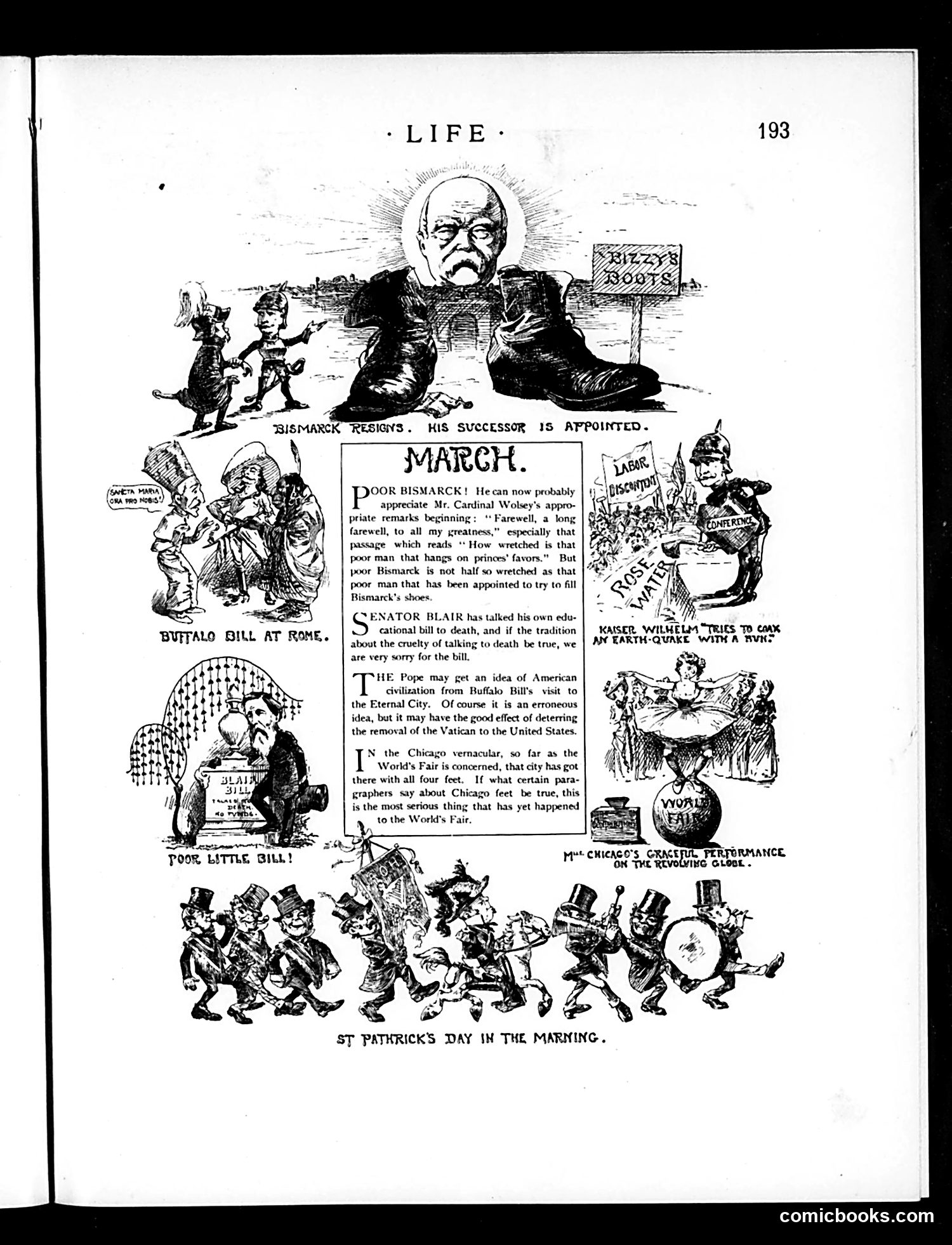
This page satirizes German Chancellor Otto von Bismarck's resignation and succession. The large caricatured head at top represents Bismarck; the oversized boots labeled "Bizzy's Boots" reference his political dominance being difficult to fill. The central text mocks Cardinal Wolsey's farewell speech, comparing Bismarck's successor (likely Kaiser Wilhelm II) to someone inheriting impossible shoes. Side cartoons reference contemporary events: Buffalo Bill's Rome visit, Chicago's World's Fair (with a jab about the city's "graceful performance"), and Senator Blair's education bill proposal. The bottom panel shows St. Patrick's Day revelry. The satire criticizes the challenge of replacing Bismarck's iron-fisted leadership while poking fun at various American and international figures and events of the period.
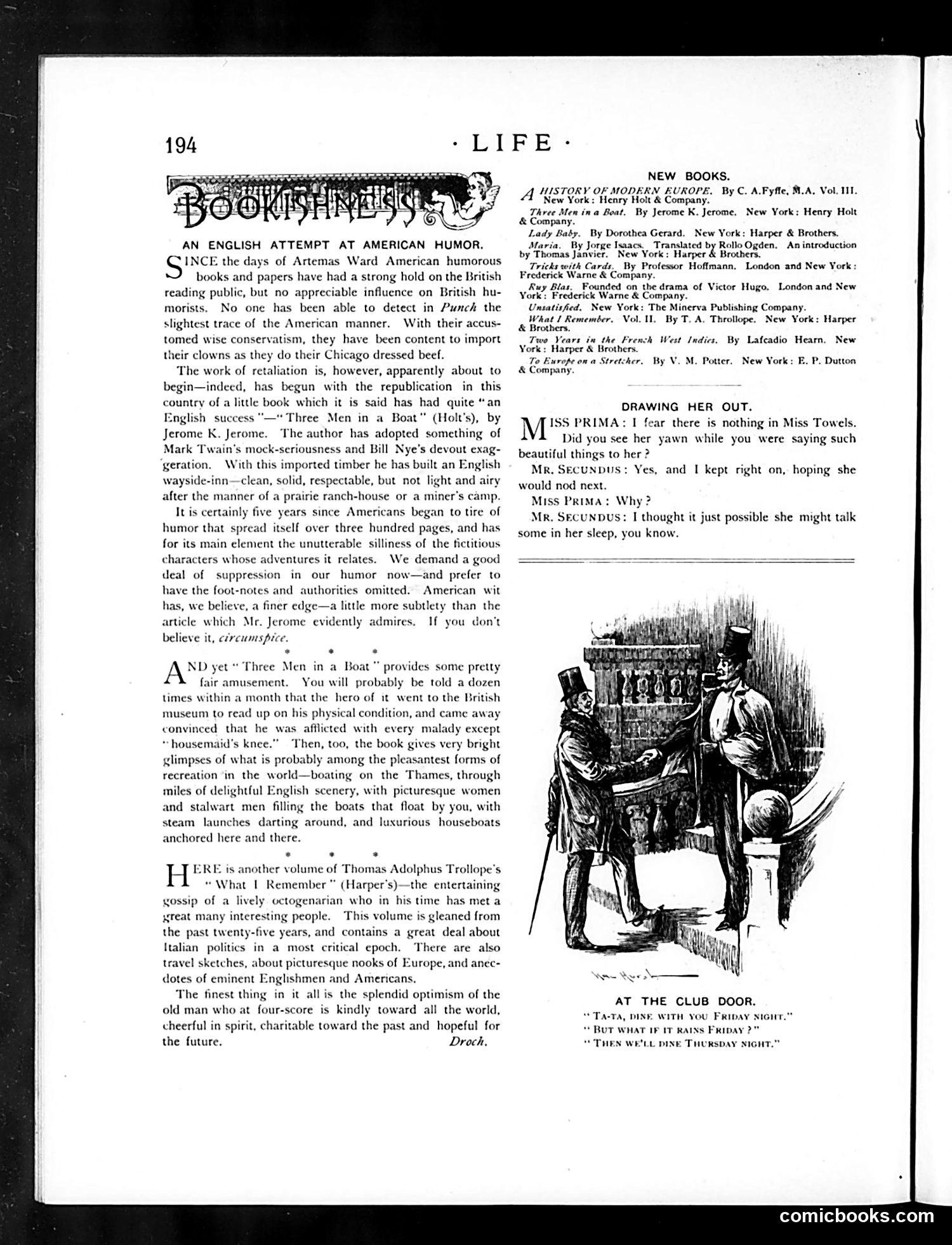
This page contains two distinct elements: **Left column:** A book review essay discussing Jerome K. Jerome's "Three Men in a Boat," praising it as successful English humor and comparing it favorably to American humorous writing. The reviewer argues American humor lacks subtlety compared to British wit. **Right side:** A cartoon titled "AT THE CLUB DOOR" depicting two men at a club entrance. One man (in a top hat, appearing to be a club member) tells another (appearing to be seeking entry): "Ta-ta, dine with you Friday night." / "But what if it rains Friday?" / "Then we'll dine Thursday night." The joke satirizes the absurdity of wealthy club members' casual attitude toward scheduling—they casually reschedule social obligations based on weather, suggesting both the frivolousness of upper-class leisure and the presumption that social plans are infinitely flexible for the privileged.
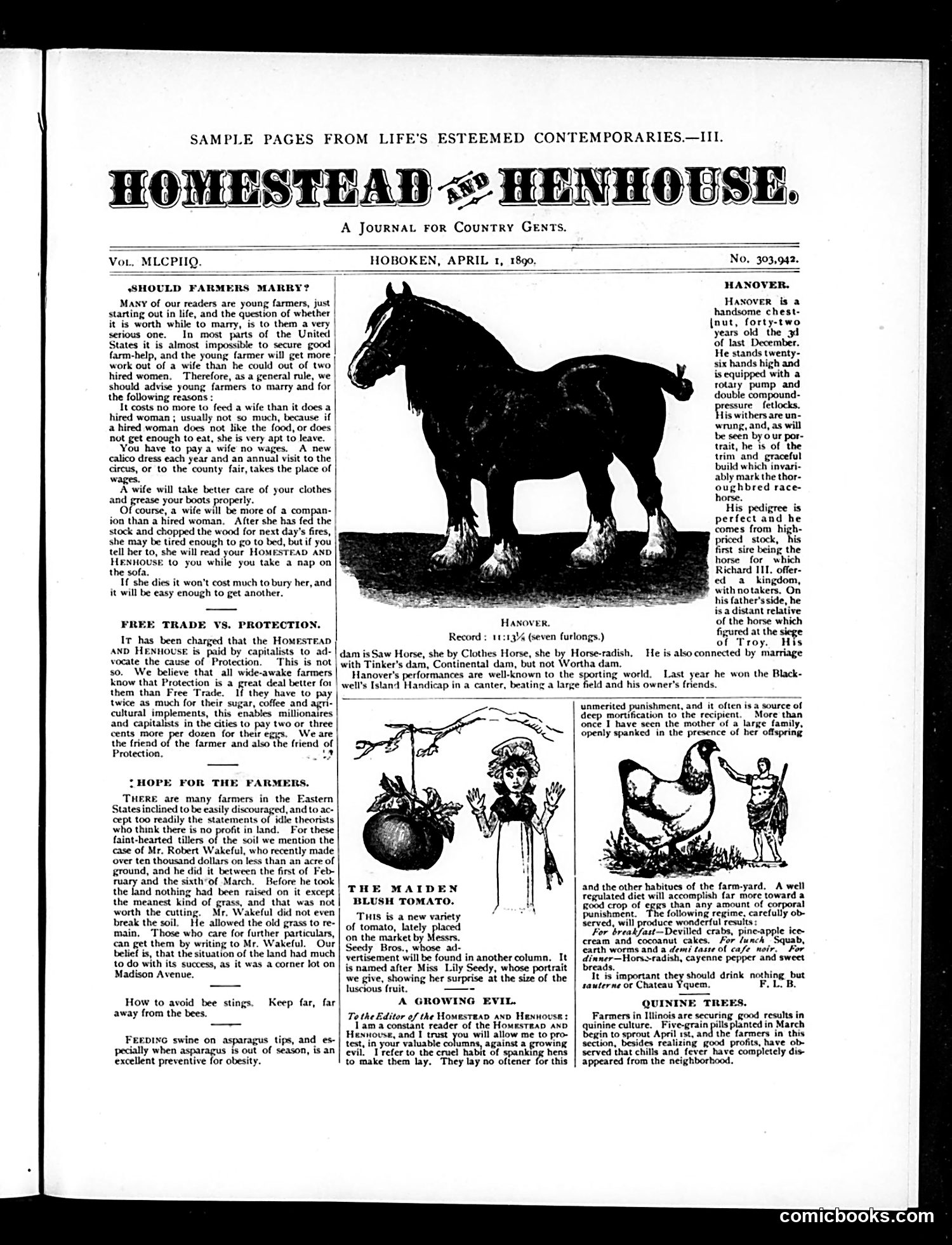
This is primarily **agricultural/lifestyle content**, not political satire. The page features: 1. **"Should Farmers Marry?"** — A practical advice column arguing marriage benefits farmers more than hiring labor, as wives provide domestic care and companionship. 2. **Hanover Horse** — A portrait and pedigree of a thoroughbred racehorse, appealing to wealthy rural landowners. 3. **"The Maiden Blush Tomato"** — Advertisement for a new tomato variety. 4. **Various farming advice** — On topics like preventing bee stings and avoiding animal cruelty. The page targets the magazine's "country gents" audience with a mix of gentle humor, agricultural innovation, and practical guidance. The tone is earnest rather than satirical—reflecting Life's dual identity as both satirical publication and lifestyle magazine for the affluent.
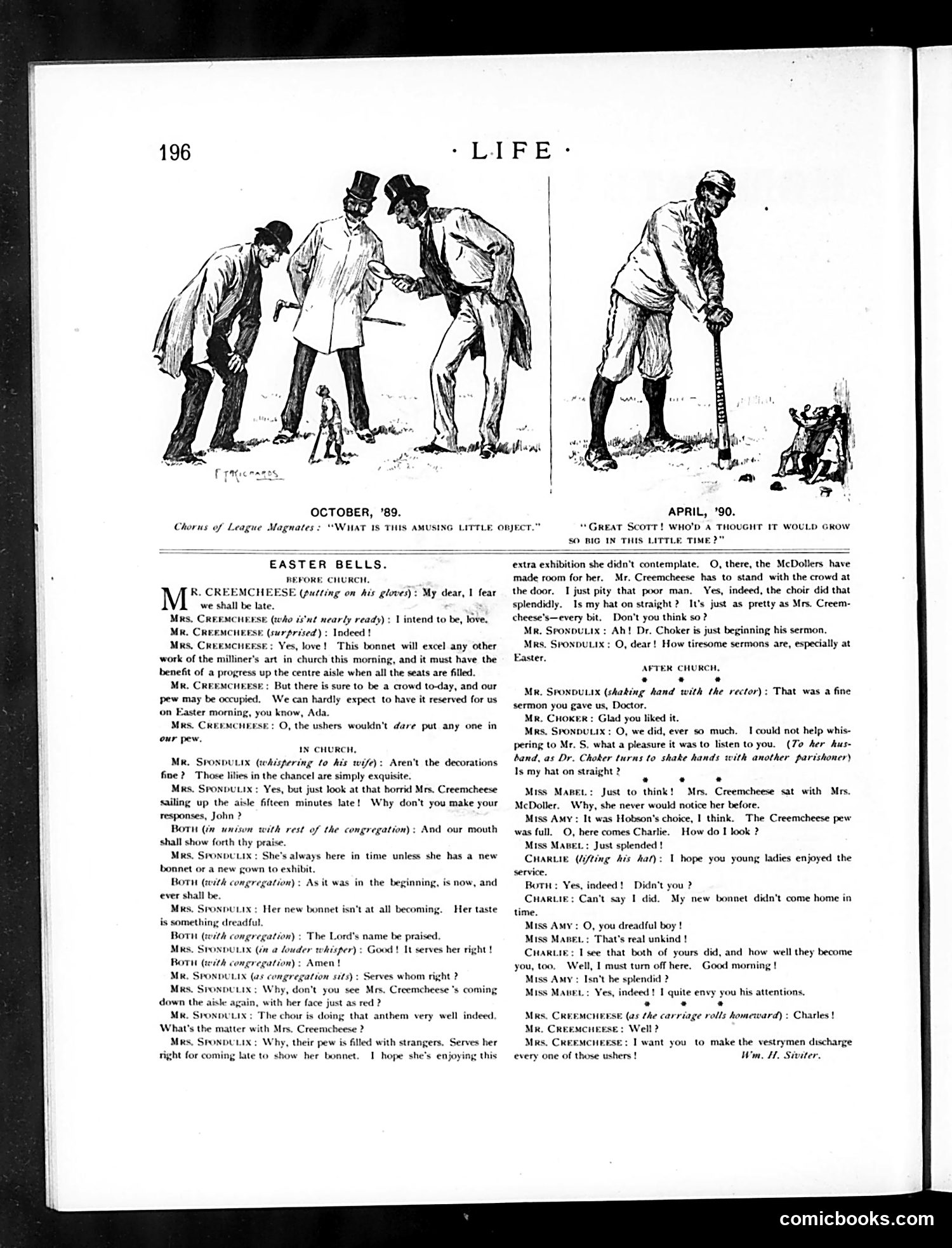
This page contains two satirical cartoons separated by a theatrical sketch titled "Easter Bells." **Top Cartoons:** - **Left (October '89):** Shows well-dressed men examining a tiny figure, captioned "What is this amusing little object?" — likely satirizing how wealthy society views poor or working-class people as curiosities rather than equals. - **Right (April '90):** Depicts a man with a young child, asking "Great Scott! Who'd have thought it would grow so big in this little time?" — appears to mock the rapid growth of something (possibly a social problem or political issue) over six months. **"Easter Bells" Sketch:** A church dialogue satirizing Easter bonnets, social pretension, and the gap between religious devotion and fashionable display among wealthy parishioners. The page exemplifies *Life* magazine's focus on class commentary and social hypocrisy in 1880s-90s America.
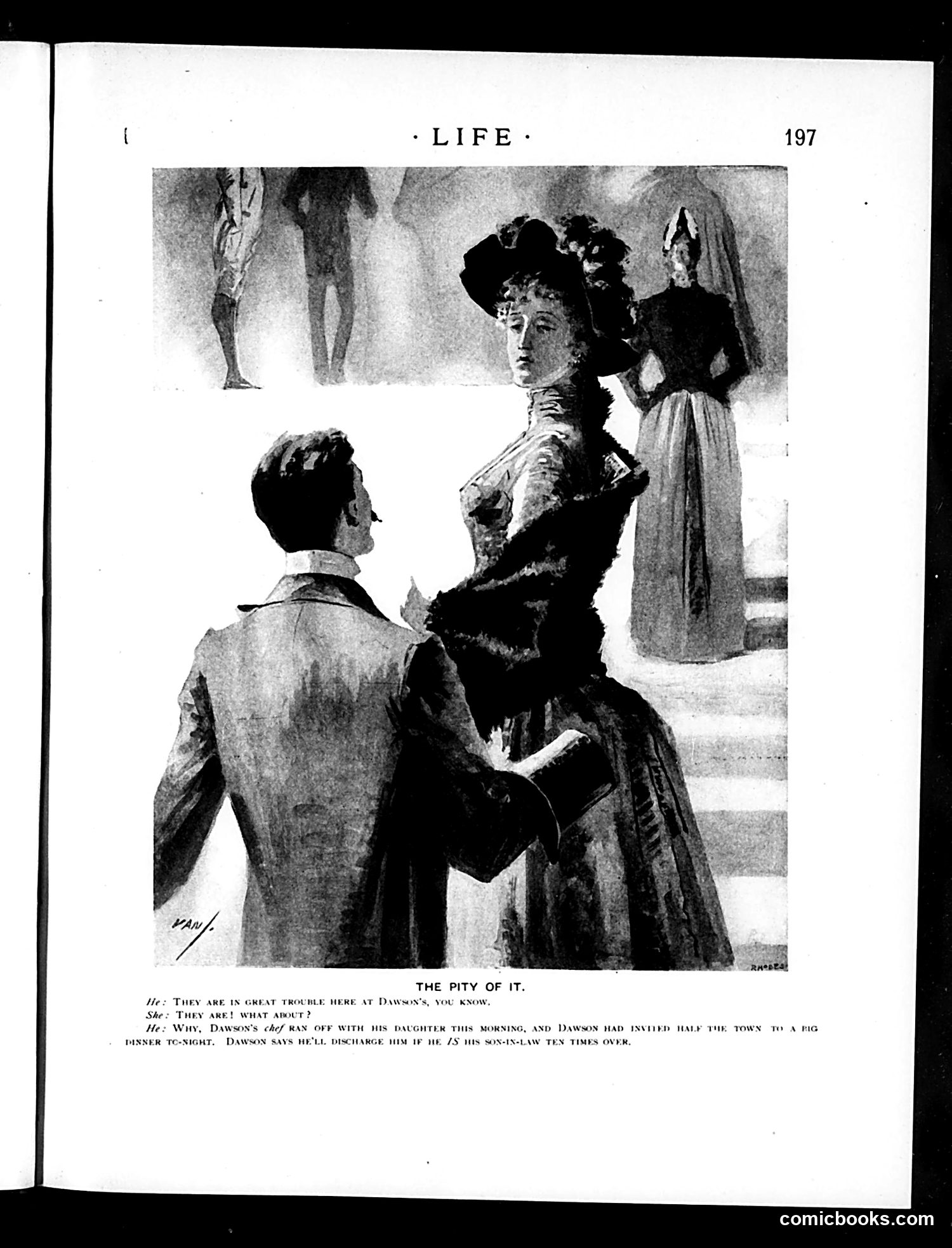
This illustration depicts a social scandal involving a man named Dawson. According to the caption, Dawson's chef has run off with his daughter that morning, and Dawson has invited half the town to a dinner party tonight—unaware of the situation. The joke mocks the awkwardness and embarrassment Dawson will face when guests learn about the scandal, particularly the elopement involving his daughter. The cartoon satirizes Victorian-era social pretense: Dawson's determination to proceed with the dinner party despite the family crisis represents the period's emphasis on maintaining appearances regardless of personal disaster. The title "The Pity of It" underscores the sympathy for Dawson's predicament—the humiliation he'll endure when his secret becomes public.
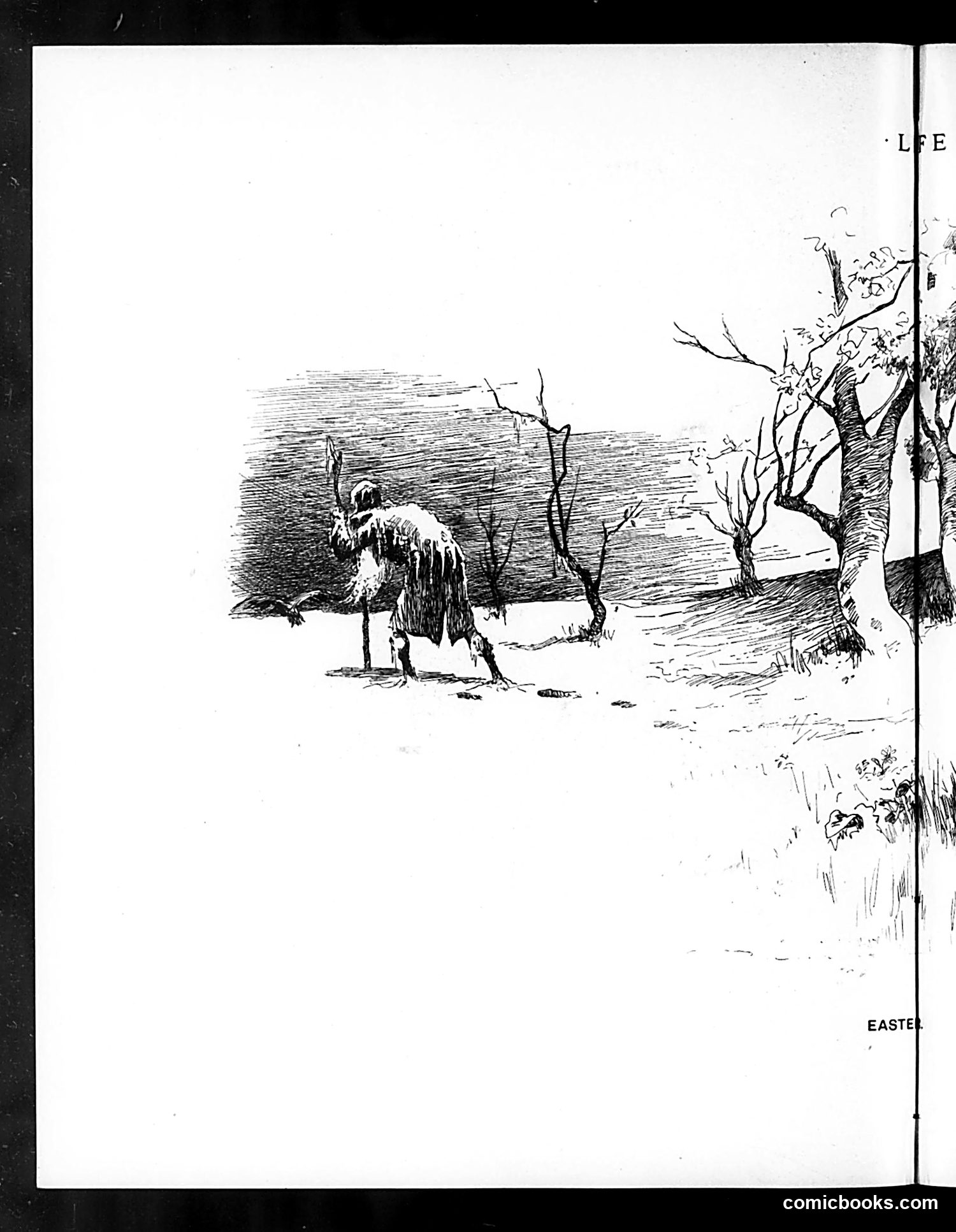
This appears to be an illustration from Life magazine showing a solitary figure standing in a desolate landscape. The figure wears ragged clothing and appears hunched or dejected, positioned among bare, twisted trees near what looks like a body of water. The barren environment and the figure's posture suggest hardship or deprivation. Without clearer OCR text or publication date visible on this page, I cannot definitively identify the specific political or social commentary intended. The stark, desolate imagery could reference economic hardship, war aftermath, or social displacement—common themes in early-to-mid 20th century satirical magazines. However, determining the precise historical reference or satirical target requires additional context not clearly legible in this reproduction.
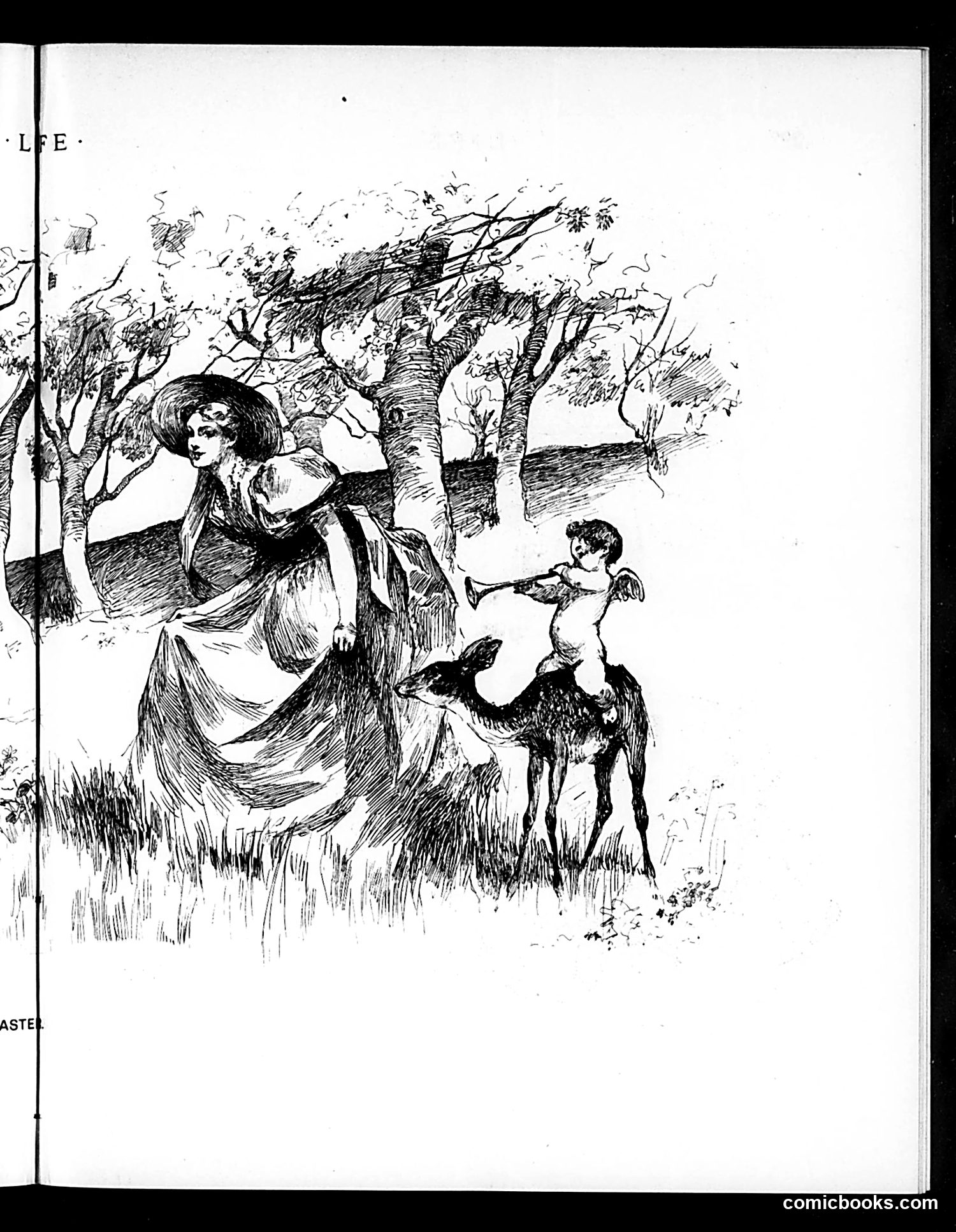
This is a single illustration titled "LIFE" depicting a romanticized pastoral scene. A woman in flowing classical drapery reclines beneath windswept trees, while a cherubic child or cupid figure sits on what appears to be a goat beside her. The artistic style—pen and ink with detailed cross-hatching—is characteristic of early-to-mid 20th century magazine illustration. Without additional OCR text or caption visible on this page, the specific satirical message is unclear. The allegorical imagery (classical woman, cherub, idealized nature setting) suggests this may represent an abstract concept like "Life," "Nature," "Innocence," or "Pastoral Ideals," but the exact subject and any political or social commentary cannot be determined from the image alone.
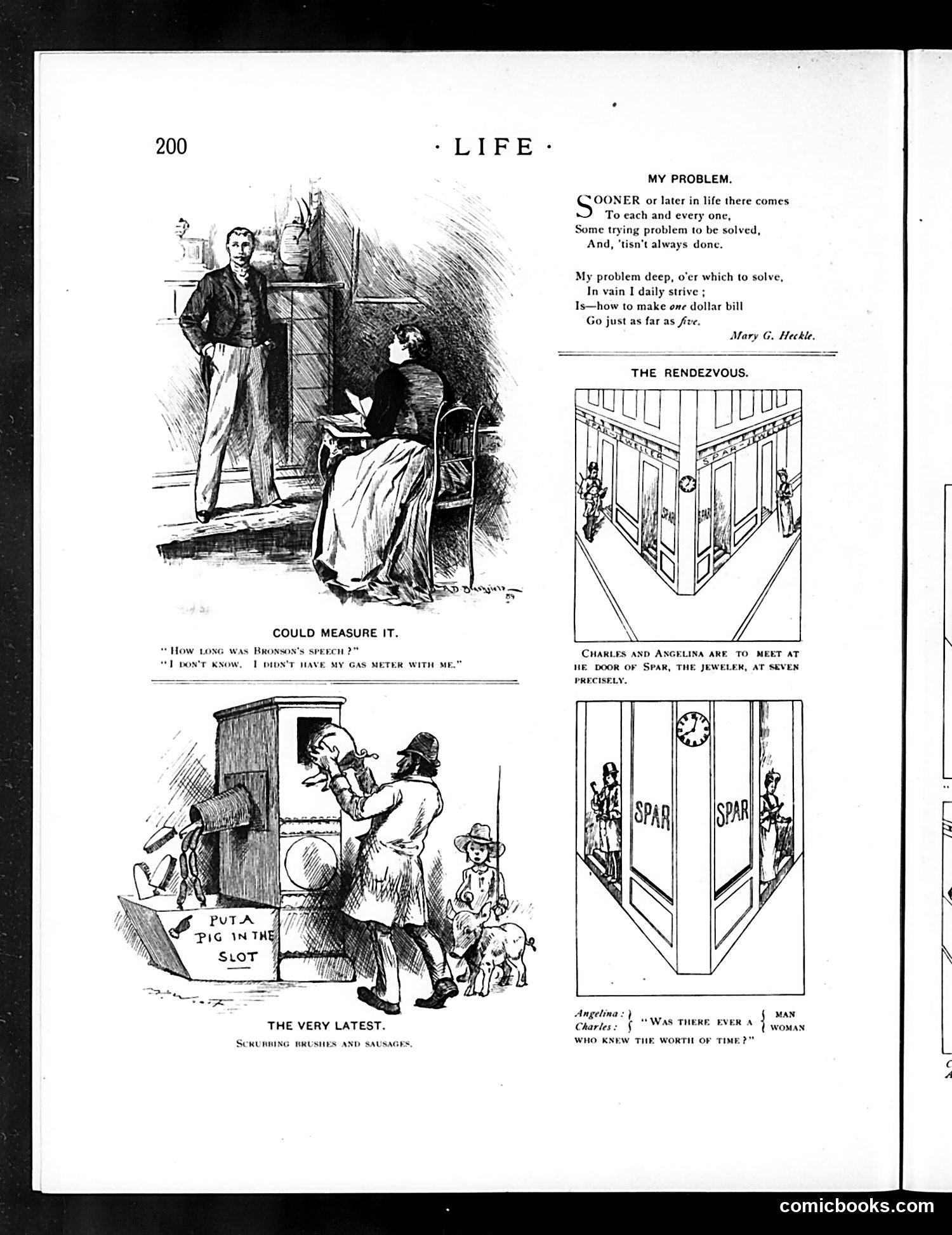
This page contains three separate satirical pieces from Life magazine: **"My Problem"** (top): A poem by Mary G. Heckle humorously complaining about personal finances—making one dollar stretch as far as five. This reflects widespread economic anxiety, likely from the early 20th century. **"Could Measure It"** (middle): A joke about measuring a speech's length. Someone asks how long "Bronson's speech" was; the reply is they didn't have a gas meter to measure it—implying the speech was tedious and interminable. Gas meters measure consumption over time, so this is a pun equating boring speech-length with measurable utility. **"The Rendezvous"** and **"The Very Latest"** (right): Appear to be romantic/social comedy strips about a meeting at a jeweler's shop and observations about time and relationships. The page satirizes common frustrations: financial struggles, tedious public speaking, and romantic punctuality—all relatable concerns for contemporary readers that retain their humor across time.
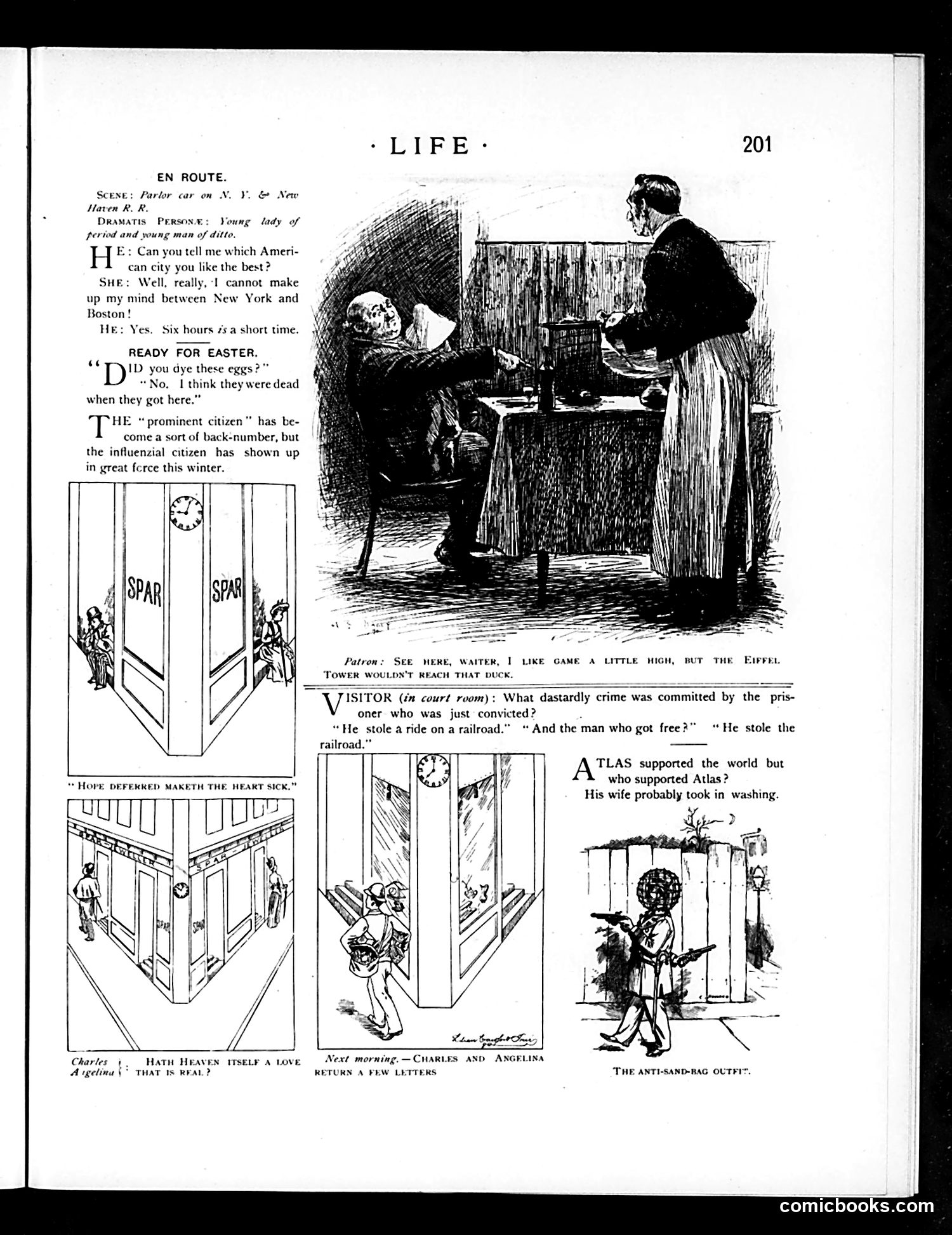
This page collects multiple short jokes and cartoons typical of *Life* magazine's satirical humor. Key themes: **"En Route"**: A young couple on a train discuss American cities. The joke's humor relies on the artificiality of polite conversation—the woman can't decide between New York and Boston despite them being only six hours apart, implying shallow tourist preferences. **"Ready for Easter"**: A dark joke about Easter eggs that "were dead when they got here"—likely referencing spoiled or rotten eggs, a common domestic complaint. **"The Prominent Citizen"**: Social commentary noting that the old-fashioned "prominent citizen" type has been replaced by the "influenzial citizen"—a pun playing on "influential" and possibly referencing the 1918 flu pandemic's social disruption. **Railroad theft joke**: Cynical commentary on justice—a poor man stealing a train ride gets convicted while a wealthy railroad company steals from the public with impunity. **Atlas cartoon**: A domestic humor joke about the mythological titan; his wife does laundry to support them both—mocking both classical allusions and women's unpaid labor.
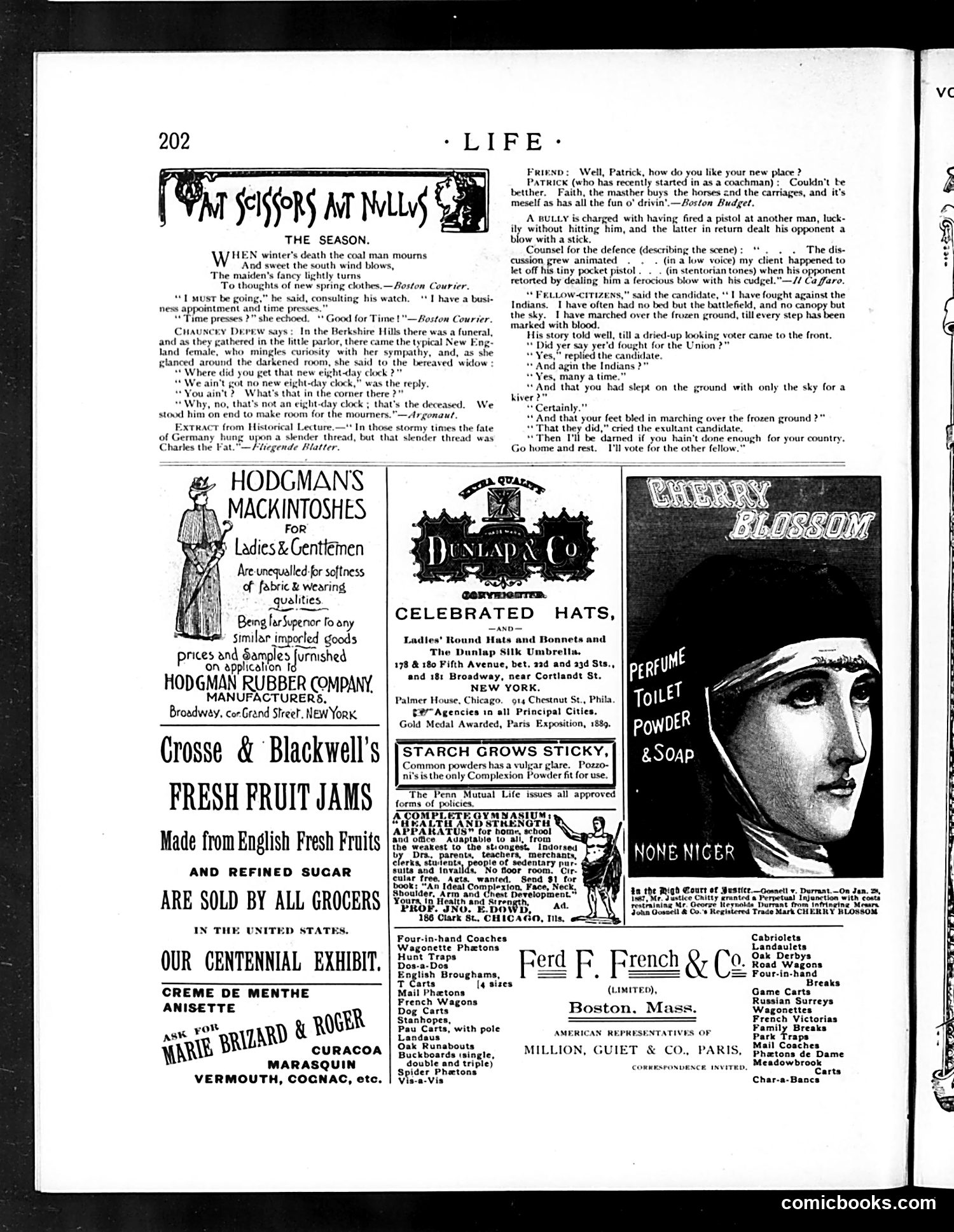
This page contains primarily **humorous anecdotes and advertisements** rather than political cartoons. The main content consists of short joke pieces poking fun at American social types and regional characters. The central anecdote satirizes a **political candidate** who boasts extravagantly about Civil War service—sleeping on frozen ground, fighting Indians, bleeding feet—only to be undercut by a shrewd voter who exposes the logical inconsistency: if he fought *both* for the Union *and* against Indians simultaneously, he's either lying or exaggerating. The voter's deadpan conclusion—"I'll vote for the other fellow"—mocks the bloated rhetoric of political campaigning and candidates' tendency to embellish war records for sympathy votes. The page's other brief jokes target **New England female gossips** and Irish servants, relying on period ethnic humor and stereotypes about regional character types. The surrounding **advertisements** (Hodgman Mackintoshes, Dunlap Hats, Crosse & Blackwell jams) are typical of Life's commercial content from this era.