
Life, 1890-04-03 · page 6 of 14
Life — April 3, 1890 — page 6: what you’re looking at
What you’re looking at
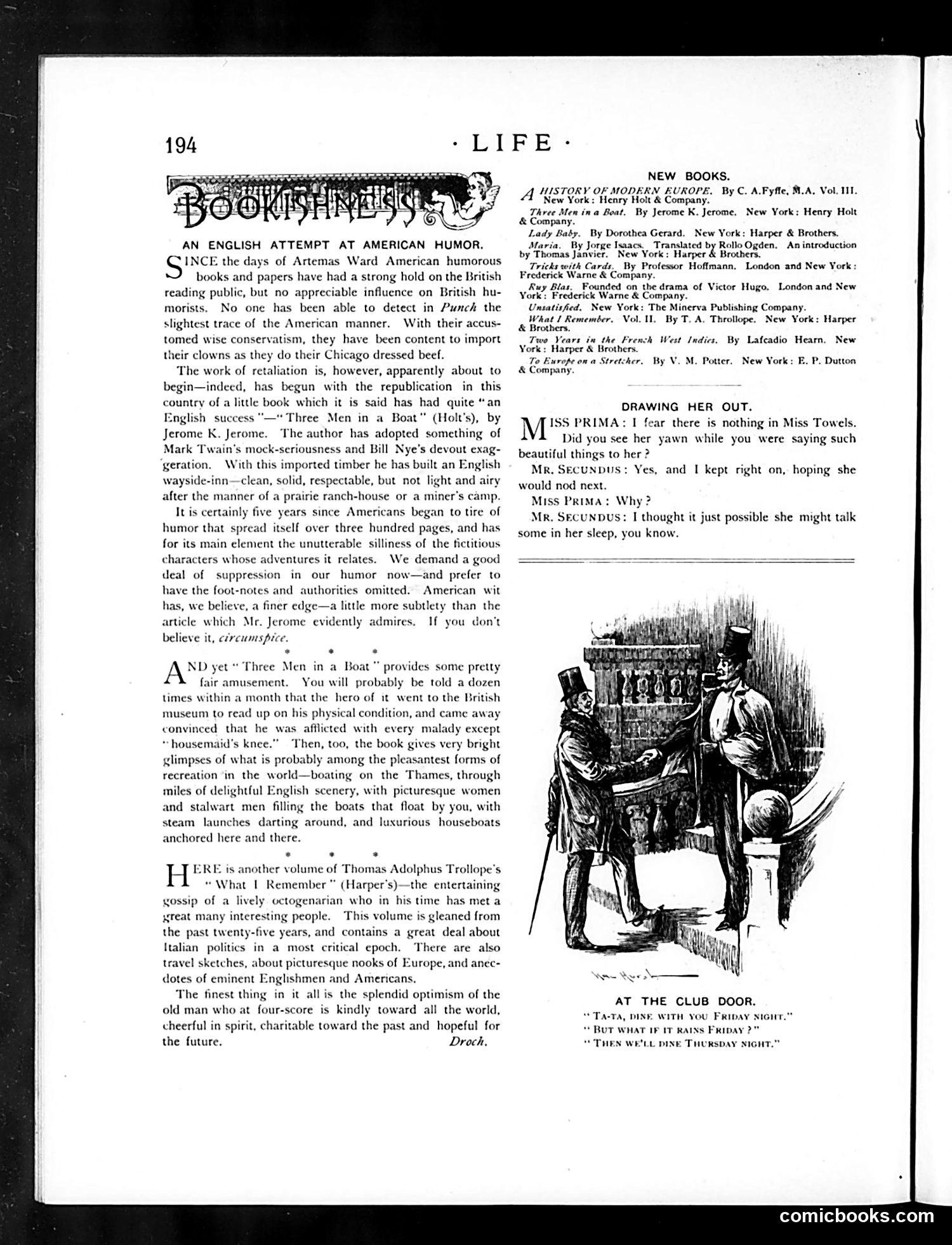
This page contains two distinct elements: **Left column:** A book review essay discussing Jerome K. Jerome's "Three Men in a Boat," praising it as successful English humor and comparing it favorably to American humorous writing. The reviewer argues American humor lacks subtlety compared to British wit. **Right side:** A cartoon titled "AT THE CLUB DOOR" depicting two men at a club entrance. One man (in a top hat, appearing to be a club member) tells another (appearing to be seeking entry): "Ta-ta, dine with you Friday night." / "But what if it rains Friday?" / "Then we'll dine Thursday night." The joke satirizes the absurdity of wealthy club members' casual attitude toward scheduling—they casually reschedule social obligations based on weather, suggesting both the frivolousness of upper-class leisure and the presumption that social plans are infinitely flexible for the privileged.
📄 Transcribed text from this page (OCR, searchable)
Machine-transcribed from the original scan — historical spelling and the odd misread are preserved.
AN ENGLISH ATTEMPT AT AMERICAN HUMOR. ~ INCE the days of Artemas Ward American humorous books and papers have had a strong hold on the British reading public, but no appreciable influence on British hu- morists. No one has been able to detect in Punch the slightest trace of the American manner. With their accus- tomed wise conservatism, they have been content to import their clowns as they do their Chicago dressed beef. The work of retaliation is, however, apparently about to begin—indeed, has begun with the republication in this country of a little book which it is said has had quite “an English success "—" Three Men in a Boat" (Holt’s), by Jerome K. Jerome. The author has adopted something of Mark eriousness and Bill Nye's devout exag- geration. With this imported timber he has built an English wayside-inn—clean, solid, respectable, but not light and airy after the manner of a prairie ranch-house or a miner's camp. Pwain's moc! It is certainly five years since Americans began to tire of humor that spread itself over three hundred pages, and has for its main element the unutterable silliness of the fictitious characters whose adventures it relates. We demand a good deal of suppression in our humor now—and prefer to have the foot-notes and authorities omitted. American wit has, we believe, a finer edge—a little more subtlety than the article which Mr. Jerome evidently admires. If you don’t believe it, céreumspice. . . . ND yet“ Three Men in a Boat” provides some pretty fair amusement. You will probably be told a dozen times within a month that the hero of it went to the British museum to read up on his physical condition, z convinced that he was afflicted with every malady except *housemaid’s knee.” ‘Then, too, the book gives very bright glimpses of what is probably among the pleasantest forms of recreation ‘in the world—boating on the Thames, through miles of delightful English scenery, with picturesque women and stalwart men filling the boats that float by you, with steam launches darting around, and luxurious houseboats anchored here and there. . . . ERE is another volume of Thomas Adolphus Trollope’s “What I Remember” (Harper’s)—the entertaining rian who in his time has met a xreat many interesting people. This volume is gleaned from the past twenty-five years, and contains a great deal about Italian politics in a most critical epoch. There are also travel sketches, about picturesque nooks of Europe, and anec- dotes of eminent Englishmen and Americans. The finest thing in it all is the splendid optimism of the old man who at four-score is kindly toward all the world, cheerful in spirit, charitable toward the past and hopeful for the future. Droch, gossip of a lively octogen NEW BOOKS. HISTORY OF MODERN EUROPE, By C. A.Fyfie, M.A, Vol. 111. New York: Henry Holt & Company. Three Men ina Boat. By Jerome K. Jerome, & Company. Lady Baby. By Dorothea Gerard. New York: Harper & Brothers. Maria. By Jorge Isaacs, Translated by Rollo Ogden. An introduction by Thomas Janvier. New York: Harper & Brothers. Tricks with Cards. By Professor Hoffmann, London and New York : Frederick Warne & Company. Ruy Blas, Founded on the drama of Victor Hugo. York: Frederick Warne & Company. Unsatisfied. New York: The Minerva Publishing Company. What I Remember, Nol. U1. By T. A. Throtlope, New Yori & Brothers. Two Years in the French West Indies. York: Harper & Brothe To Europe on a Stretcher. & Company. New York: Henry Holt London and New : Harper By Lafcadio Hearn. New By V. M. Potter. New York: E. P. Dutton DRAWING HER OUT. M's PRIMA: I fear there is nothing in Miss Towels. Did you see her yawn while you were saying such beautiful things to her ? Mr, SEcUNDUS: Yes, and I kept right on, hoping she would nod next. Miss Prima: Why ? Mr. SECUNDUS: I thought it just possible she might talk some in her sleep, you know. AT THE CLUB DOOR. “Ta-Ta, DINE WITH YOU Fripay Nici,” “BUT WHAT IF IT RAINS FRIDAY?” “THEN WE'LL DINE THURSDAY NIGHT.” comicbooks.com