
Life, 1890-04-03 · page 4 of 14
Life — April 3, 1890 — page 4: what you’re looking at
What you’re looking at
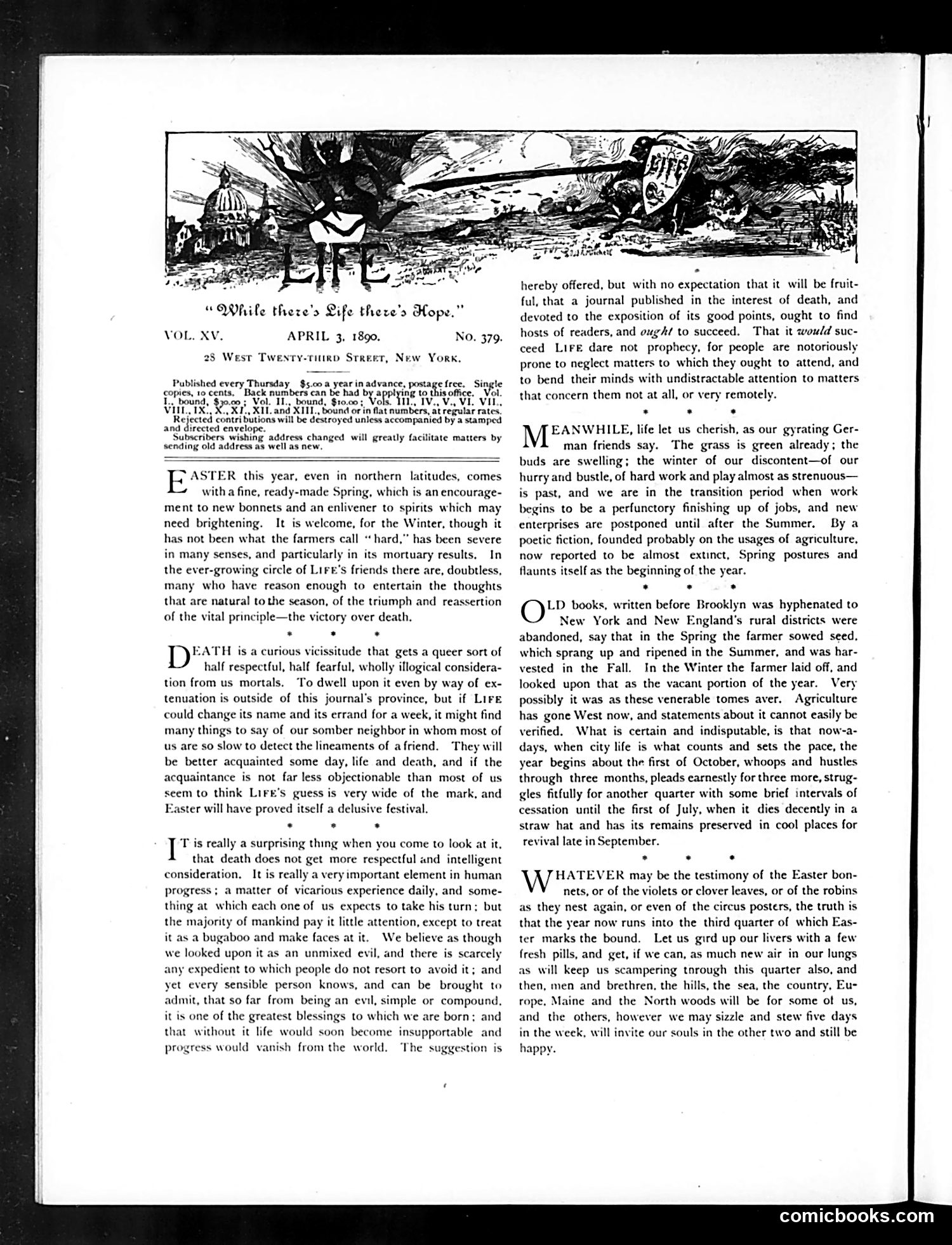
The masthead illustration depicts a landscape with classical and modern elements—a dome (possibly representing government or culture), industrial structures, and a gravestone or monument. The caption reads "While there's Life there's Hope," suggesting themes of resilience and renewal. The editorial content focuses on Easter's arrival in spring, discussing death, progress, and human experience. The text emphasizes that death and life are important subjects often neglected, and that acknowledging mortality strengthens society. The piece advocates for contemplating "the victory of death" while celebrating spring's renewal. The magazine appears primarily devoted to philosophical and seasonal reflection rather than specific political satire. No identifiable caricatures or named public figures appear in the visible text.
📄 Transcribed text from this page (OCR, searchable)
Machine-transcribed from the original scan — historical spelling and the odd misread are preserved.
“While there's Life there's Hope.” XV. APRIL 3. 1890. No. 379. 23 West Twenty-riirp Srreet, New York, Published every Thursday $5.00 a year in advance, postage free. Single copies. 19 cents. "Back numbers can be had by applying to thisoffice. Vol 1, bound, $3000; Vol IL, bound, $10.00; Vols Illy IV., Ve, Vi. VIL. VIIT., IX, X., XT. XII and XTIL., Bound or in flat numbers, at regular rates. Rejected contri butions will be destroyed unless accompanied by a stamped and directed envelope. Subscribers wishing address changed will greatly facilitate matters by sending old address as well as new, 4 ASTER this year, even in northern latitudes, comes witha fine, ready-made Spring, which is an encourage- ment to new bonnets and an enlivener to spirits which may need brightening. It is welcome, for the Winter, though it has not been what the farmers call “hard,” has been severe in many senses, and particularly in its mortuary results. In the ever-growing circle of Lire’s friends there are, doubtless, many who have reason enough to entertain the thoughts that are natural to the season, of the triumph and reassertion of the vital principle—the victory over death, EATH is a curious vicissitude that gets a queer sort of half respectful, half fearful, wholly illogical considera- tion from us mortals. ‘To dwell upon it even by way of ex- tenuation is outside of this journal's province, but if LiFe could change its name and its errand for a week, it might find many things to say of our somber neighbor in whom most of us are so slow to detect the lineaments of afriend. They will be better acquainted some day, life and death, and if the acquaintance is not far less objectionable than most of us seem to think Lire’s guess is very wide of the mark, and Easter will have proved itself a delusive festival. T is really a surprising thing when you come to look at it, that death does not get more respectful and intelligent consideration, It is really a very important element in human progress ; a matter of vicarious experience daily, and some- thing at which each one of us expects to take his turn; but the majority of mankind pay it little attention, except to treat it as a bugaboo and make faces at it. We believ though we looked upon it as an unmixed evil, and there is scarcely any expedient to which people do not resort to avoid it; and yet every sensible person knows, and can be brought to admit, that so far from being an evil, simple or compound, it is one of the greatest blessings to which we are born; and that without it life would soon become insupportable and progress would vanish from the world. ‘The suggestion is hereby offered, but with no expectation that it will be fruit- ful, that a journal published in the interest of death, and devoted to the exposition of its good points, ought to find hosts of readers, and ough? to succeed. That it would suc- ceed Lire dare not prophecy, for people are notoriously prone to neglect matters to which they ought to attend, and to bend their minds with undistractable attention to matters that concern them not at all, or very remotely. EANWHILE, life let us cherish, as our gyrating Ger- man friends say. The grass is green already; the buds are swelling; the winter of our discontent—of our hurry and bustle, of hard work and play almost as strenuous— is past, and we are in the transition period when work begins to be a perfunctory finishing up of jobs, and new enterprises are postponed until after the Summer. By a poetic fiction, founded probably on the usages of agriculture, now reported to be almost extinct, Spring postures and flaunts itself as the beginning of the year. . . . LD books, written before Brooklyn was hyphenated to New York and New England's rural districts were abandoned, say that in the Spring the farmer sowed seed. which sprang up and ripened in the Summer, and was har- vested in the Fall. In the Winter the farmer laid off, and looked upon that as the vacant portion of the year. Very possibly it was as these venerable tomes aver. Agriculture has gone West now, and statements about it cannot easily be verified. What is certain and indisputable, is that now-a- days, when city life is what counts and sets the pace, the year begins about the first of October, whoops and hustles through three months, pleads earnestly for three more, strug- gles fitfully for another quarter with some brief intervals of cessation until the first of July, when it dies decently in a straw hat and has its remains preserved in cool places for revival late in September. . . . HATEV may be the testimony of the Easter bon- nets, or of the violets or clover leaves, or of the robins as they nest again, or even of the circus posters, the truth is that the year now runs into the third quarter of which Eas- ter marks the bound. Let us gird up our livers with a few fresh pills, and get, if we can, as much new air in our lungs as will keep us scampering tnrough this quarter also, and then, men and brethren, the hills, the sea, the country, Eu- rope, Maine and the North woods will be for some of us, and the others, however we may sizzle and stew five days in the week, will invite our souls in the other two and still be happy. comicbooks.com