
A complete issue · 20 pages · 1890
Life — March 27, 1890
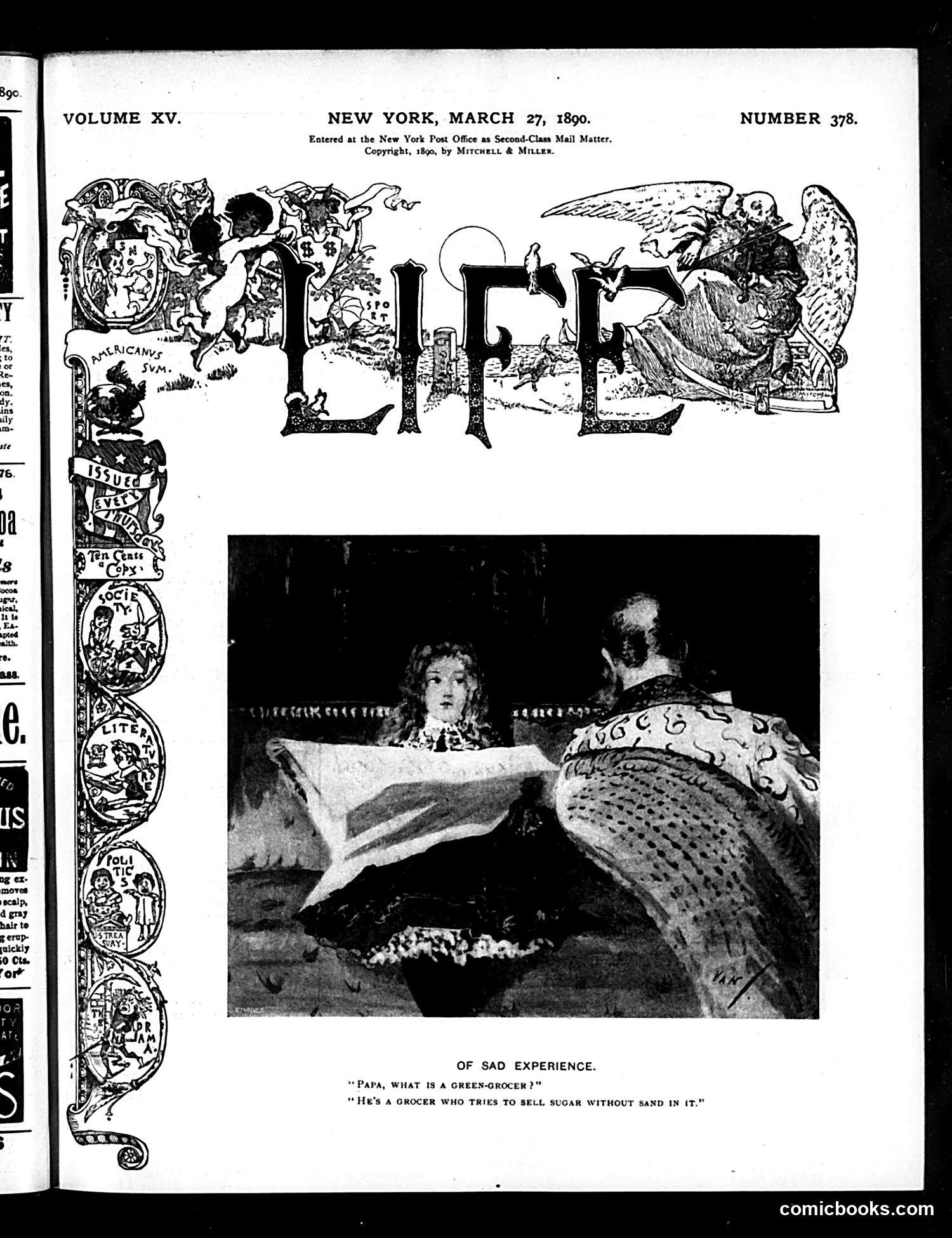
This page features a humorous illustration titled "Of Sad Experience" depicting what appears to be a domestic scene. The caption reads: "Papa, what is a green-grocer?" with the response: "He's a grocer who tries to sell sugar without sand in it." The joke is a commentary on common commercial fraud of the 1890s. Grocers routinely adulturated goods—adding sand to sugar, chalk to flour, and other cheap fillers to increase weight and profit. The father's sardonic definition suggests that an honest grocer (one selling pure sugar without sand) is such a rarity as to be nearly fictional, implying this practice was widespread and accepted as normal business. The ornate left border contains decorative vignettes typical of Life's design aesthetic.
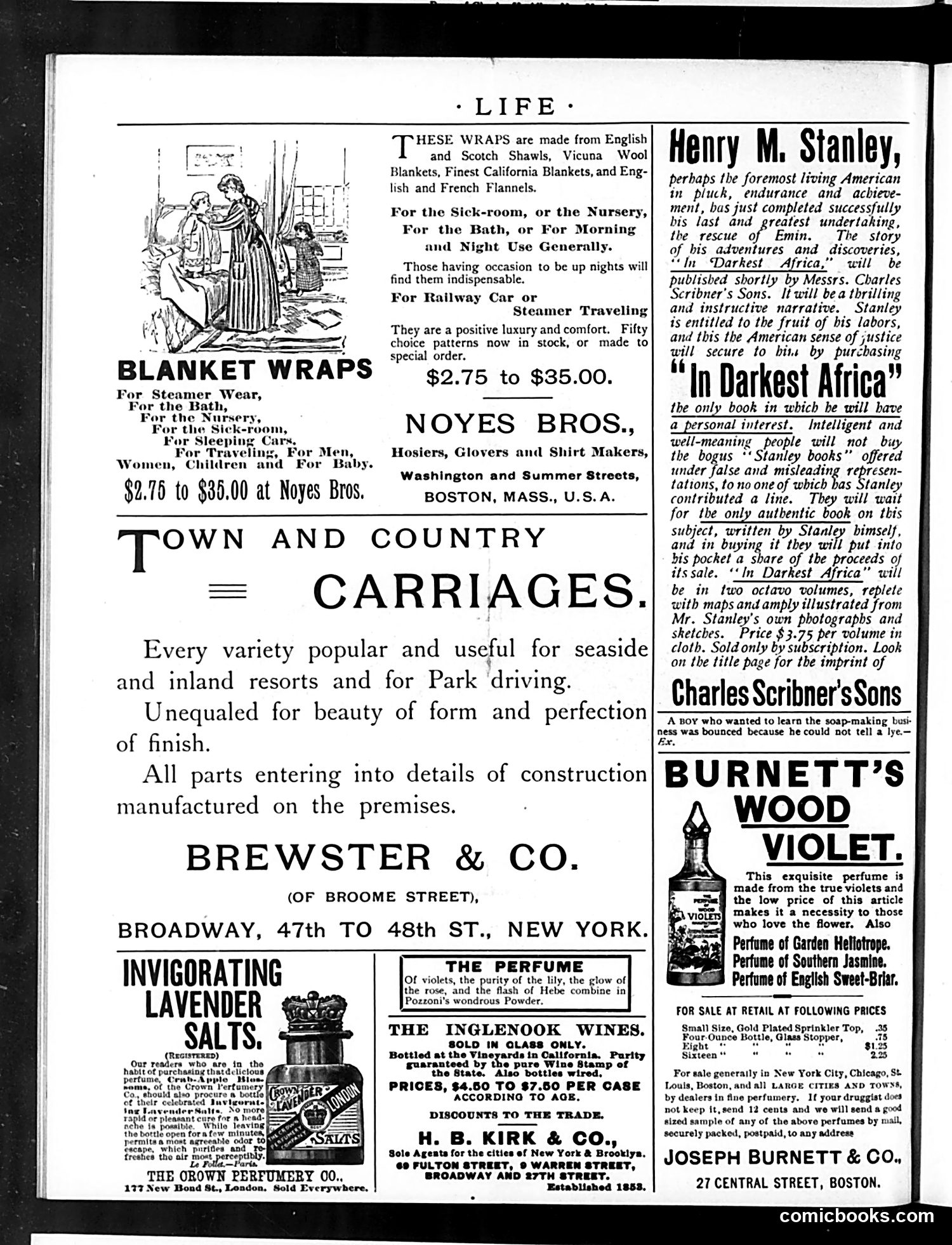
This page is **primarily advertisements** with minimal editorial content. The main cartoon (upper left) shows a domestic scene with a woman and child, illustrating "Blanket Wraps" sold by Noyes Bros. of Boston—marketed for sick rooms, nurseries, baths, and travel. The advertisements promote Victorian-era luxury goods: carriages by Brewster & Co., perfumes (Burnett's Wood Violet), wines (Inglenook), and lavender salts. One ad notably features Henry M. Stanley's book "In Darkest Africa," positioning it as the only authentic account of his African expeditions, contrasting it against spurious "Stanley books." The page reflects late 19th-century consumer culture and advertising practices, with no discernible political satire or social commentary beyond typical product marketing.
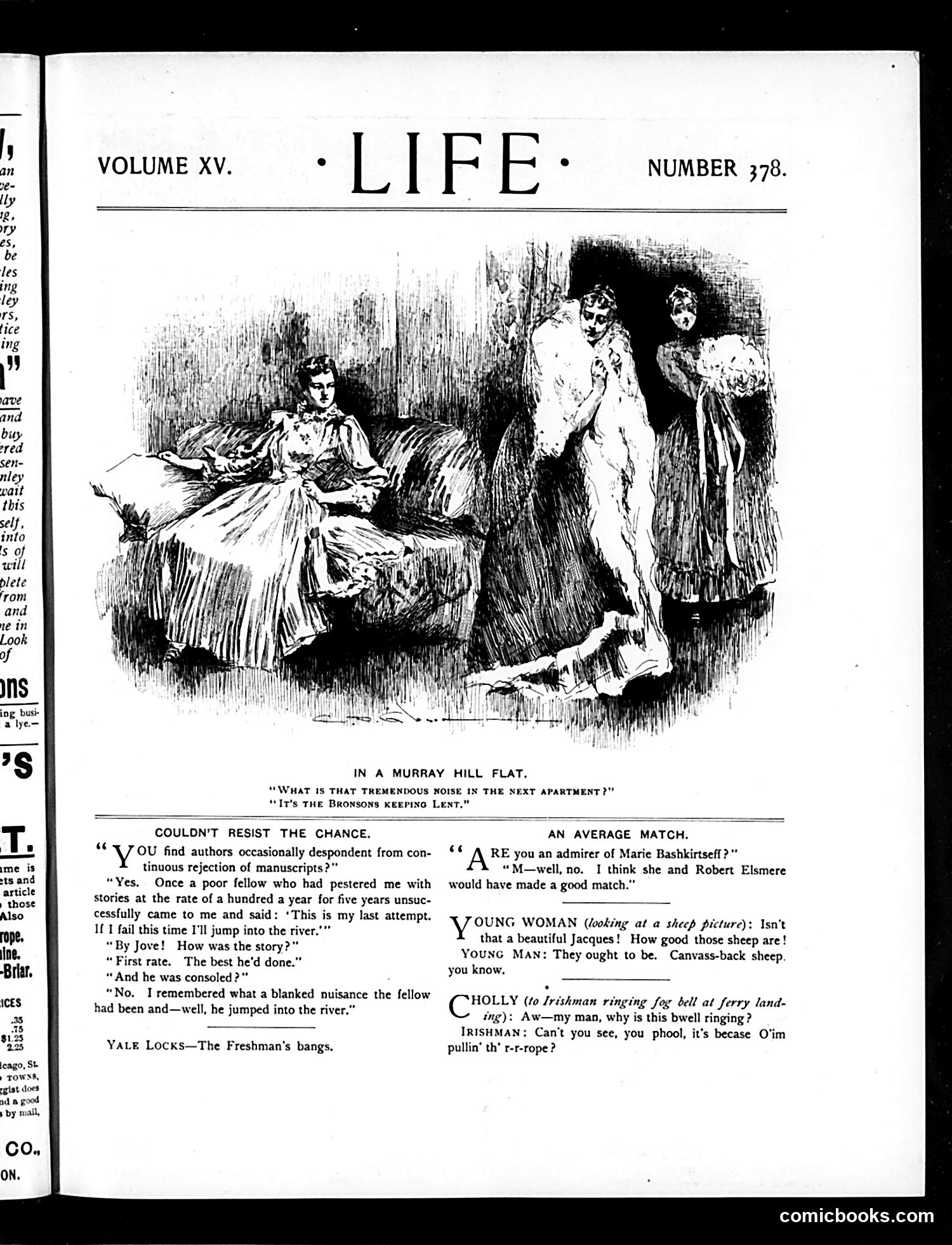
This page from *Life* magazine (Volume XV, Number 278) contains three humor sections rather than political cartoons. The top illustration depicts a domestic scene in a Murray Hill apartment where residents complain about noise from neighbors "keeping Lent"—a joke about religious observance creating disturbance. Below are three brief comedic pieces: "Couldn't Resist the Chance" mocks struggling authors who persist despite repeated rejections; "An Average Match" satirizes a conversation about Marie Bashkirtseff (a famous 19th-century diarist), suggesting unsuitable romantic pairings; and "Yale Locks" contains Irish dialect humor about a freshman's slang. The humor relies on wordplay, social observation, and period-specific references rather than political commentary. The content reflects early-20th-century American satirical magazine conventions.
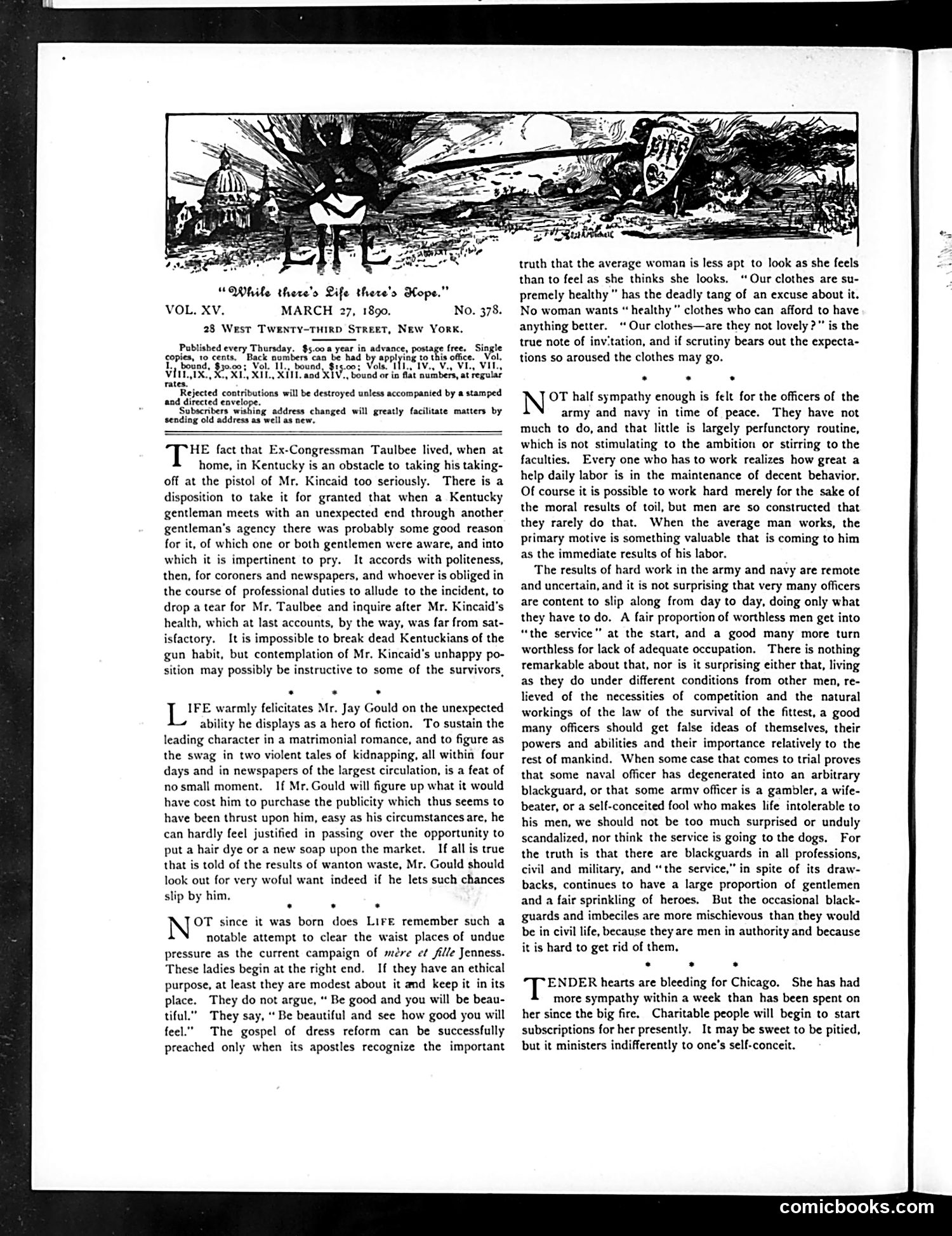
The masthead illustration depicts a chaotic scene with a large figure dominating a landscape, seemingly representing "Life" itself personified. The crude, expressionistic style is typical of Life's satirical approach. The page's main content consists of editorial commentary rather than comic strips. Articles discuss: - **Ex-Congressman Taubee's shooting incident** involving Mr. Kincaid in Kentucky—a violent confrontation between gentlemen that Life uses to critique the dueling/shooting culture among politicians - **Dress reform debates** criticizing both overly restrictive women's fashion and reform advocates' moral preaching - **Army/Navy officer conduct**, questioning whether officers deserve sympathy for perceived hardships or moral failings The satire targets hypocrisy in American politics, fashion moralism, and military culture. Specific figures are referenced but lack sufficient context to identify precisely from the text alone.
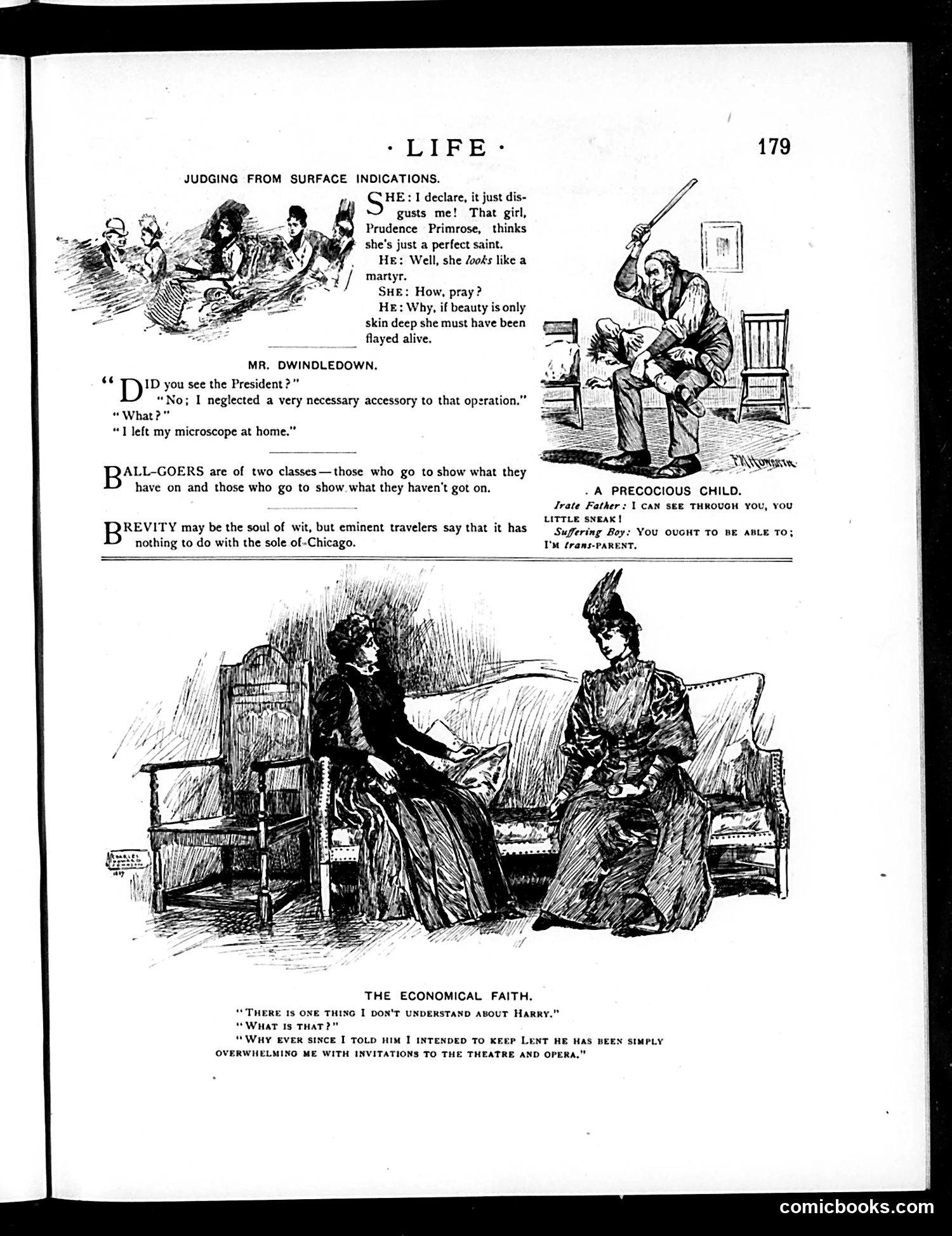
This satirical page contains three unrelated humor pieces typical of early 20th-century Life magazine: 1. **"Judging from Surface Indications"**: A dialogue mocking shallow judgment of character. A man claims a woman "looks like a martyr," but jokes she's only "skin deep" beautiful—implying if beauty is superficial, her virtue must be too. 2. **"Mr. Dwinoledown"**: A brief joke about someone neglecting to bring a microscope to see the President, suggesting the President is impossibly small or insignificant. 3. **"The Economical Faith"**: A domestic scene where a wife explains she keeps her husband "overwhelmed" with theater and opera invitations to prevent him from spending money elsewhere—satirizing financial manipulation in marriage. The humor targets vanity, political ineffectiveness, and marital economics.
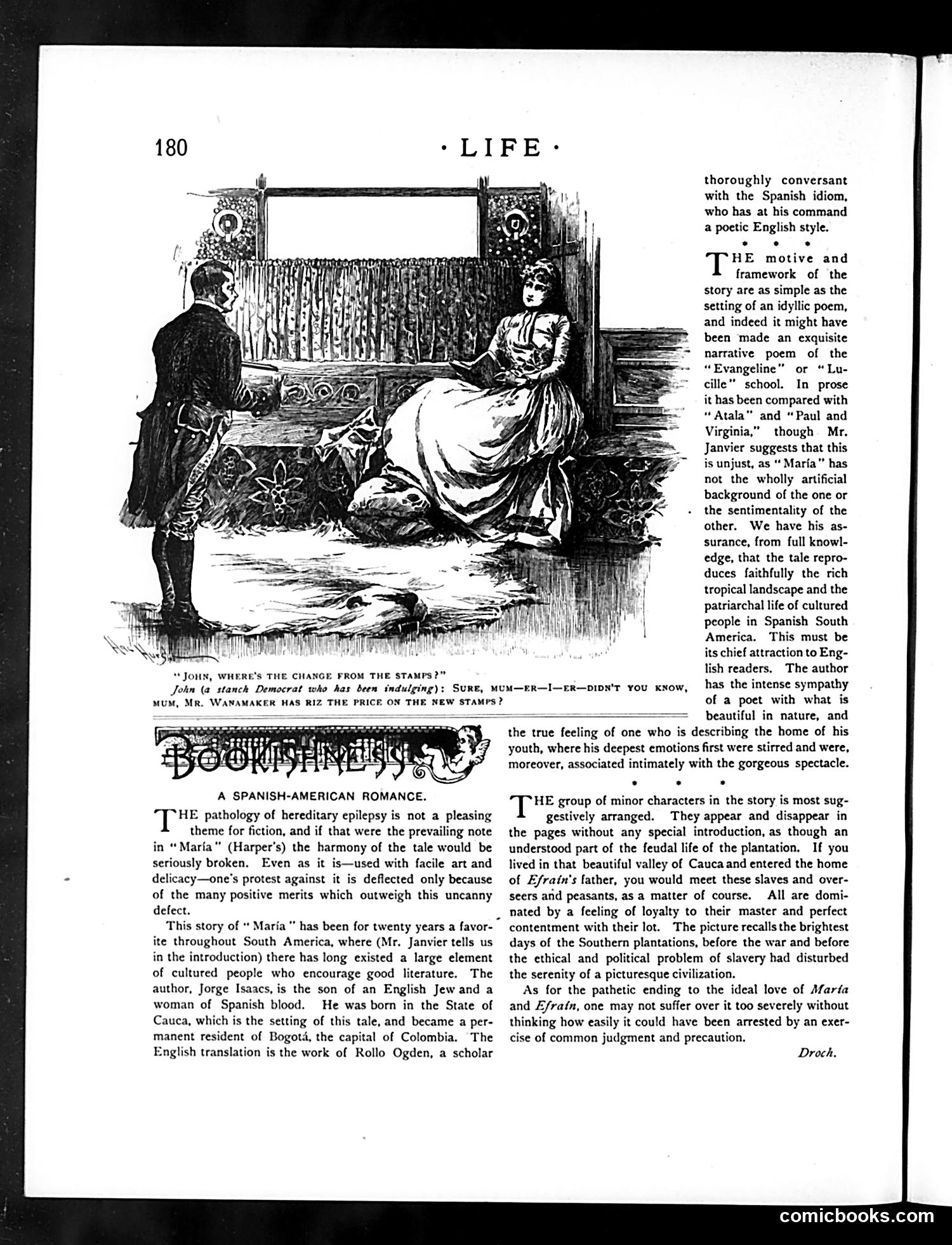
The main illustration depicts a domestic scene with a man and woman in an interior setting, accompanying a book review of "Maria: A Spanish-American Romance" by Jorge Isaacs, translated by Rollo Ogden. The caption below the illustration contains a joke: "John, where's the change from the stamps?" with a response about stamps and their price, suggesting domestic humor about household finances and a character named "M. Wammacker" who apparently controls stamp pricing. The text discusses the novel's literary merits, its tropical South American setting, and themes of plantation life. The page is primarily a literary review rather than political satire, examining how the book depicts Spanish colonial culture and its portrayal of slavery's ethical implications.
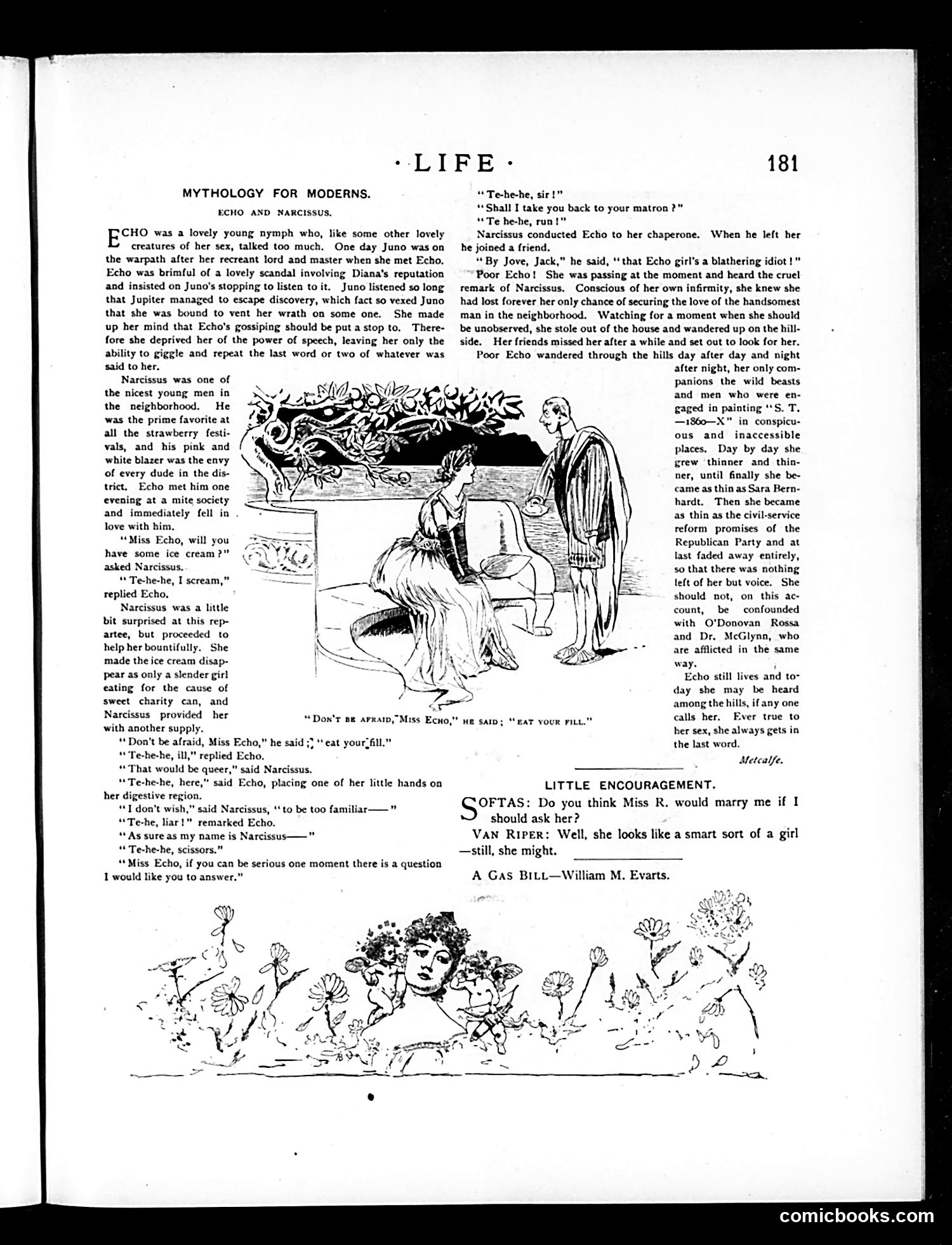
This page retells the classical myth of Echo and Narcissus with contemporary satirical commentary. The story describes Echo, a nymph who lost her voice after angering Juno, falling in love with the vain Narcissus. The right column contains a biting political allegory: Echo represents the Republican Party and civil-service reform movement, which has "faded away entirely" like the mythological character—reduced to having "nothing left of her but voice." This satirizes how Republican reform efforts have become ineffectual and voiceless compared to stronger political forces. The illustration shows the classical scene of Narcissus at a pool. The satire suggests early-1900s American political exhaustion with reform movements that promised much but delivered little lasting change.
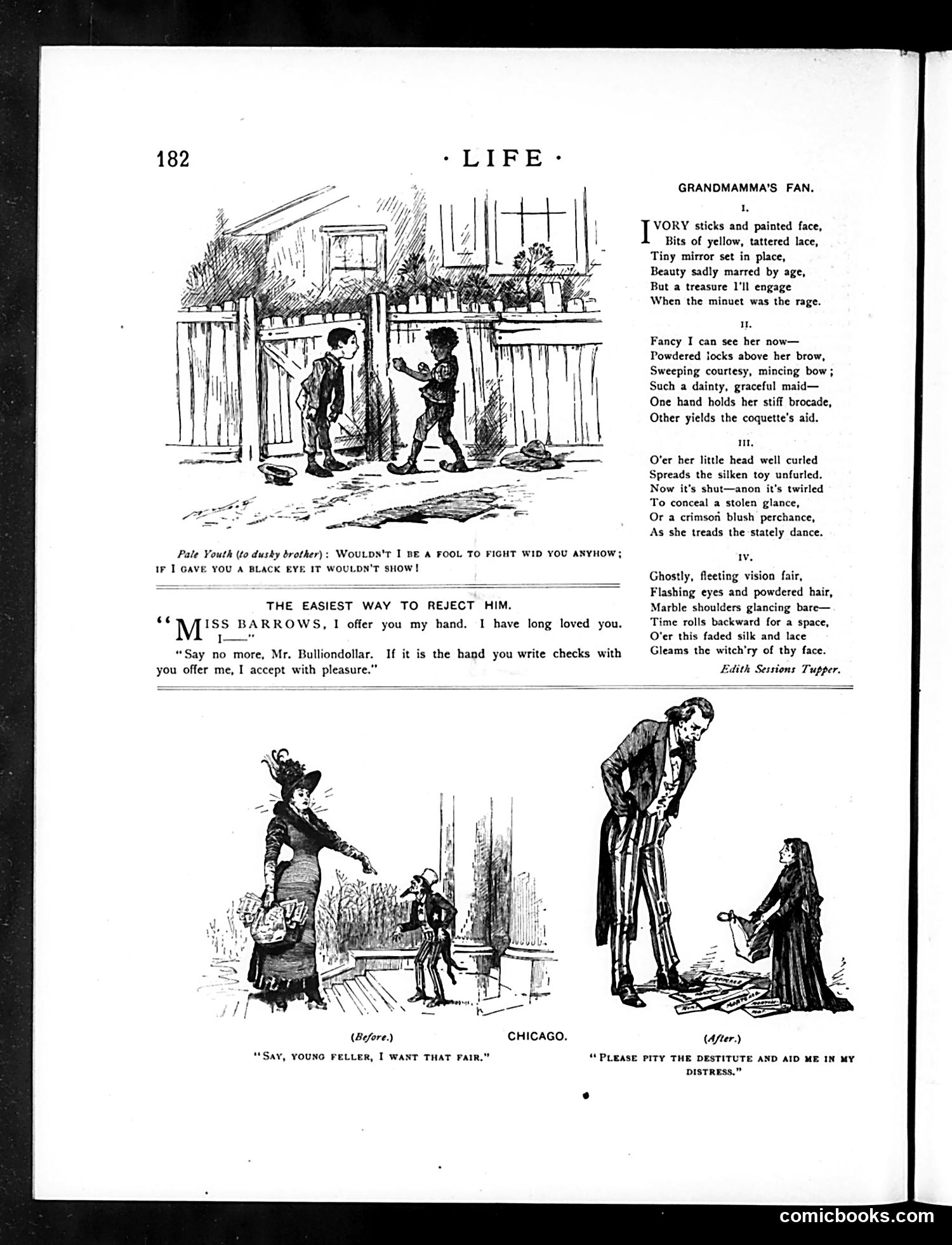
This page contains three distinct satirical pieces about courtship and marriage rejection: 1. **"Grandmamma's Fan"** (poem by Edith Sessions Tupper): A nostalgic poem about an elderly woman's decorative fan, contrasting her youthful beauty with present age. 2. **"The Easiest Way to Reject Him"**: A dialogue where Miss Barrows rejects a suitor's marriage proposal by noting she'll accept his hand only if it comes with financial security (checks), not sentiment. The satire mocks both fortune-hunting and romantic pretense. 3. **Two illustrations** labeled "Before" and "After" depicting courtship scenarios in Chicago, showing contrasting male propositions—one gallant, one desperate—satirizing different social classes' approaches to romance. The overall theme critiques Victorian-era courtship conventions and financial motivations underlying marriage proposals.
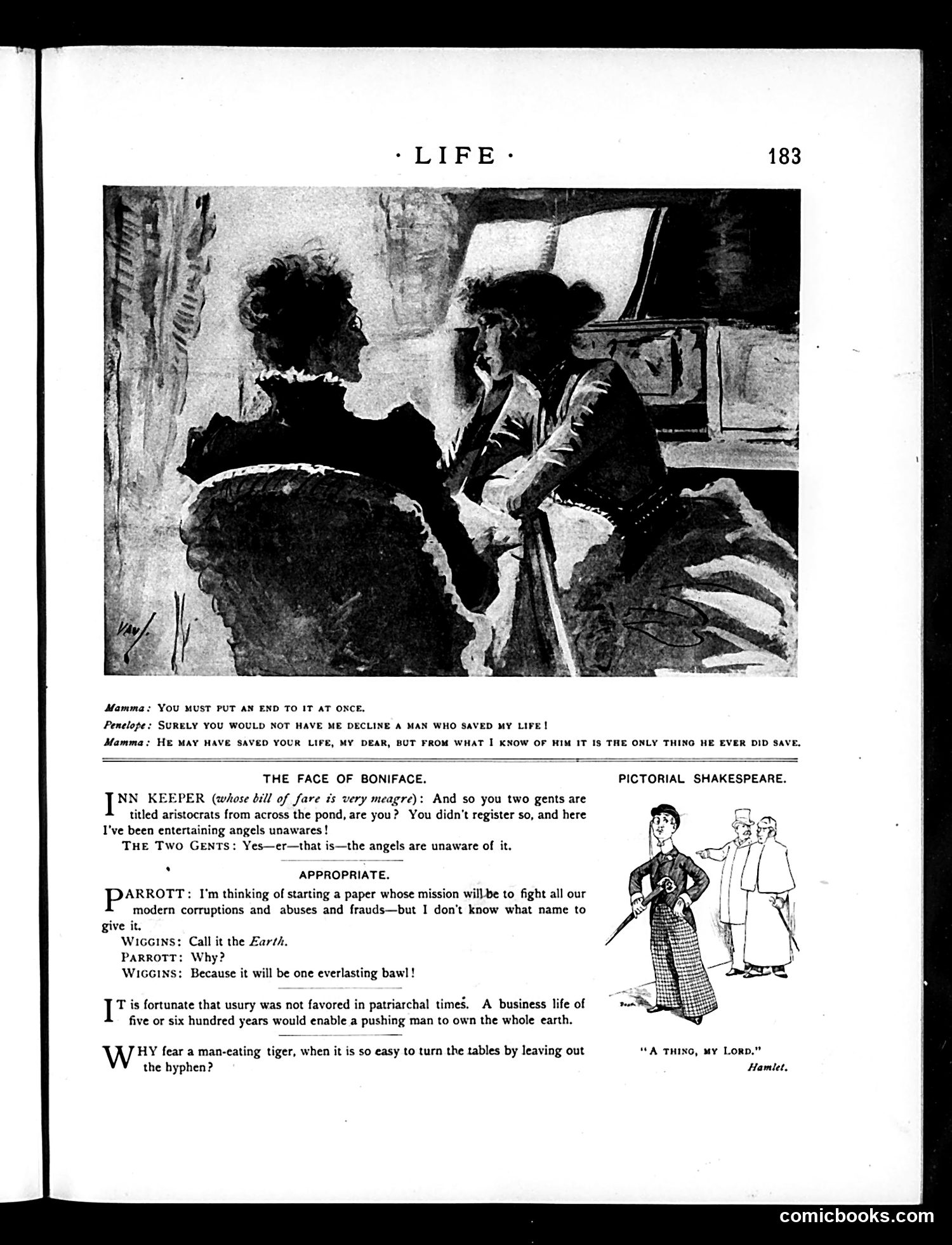
This page from *Life* magazine contains satirical commentary on contemporary social issues. The top photograph shows a domestic scene with dialogue about declining a man's offer of assistance, suggesting commentary on gender roles and economic dependence. Below are three separate sections: "The Face of Boniface" mocks an innkeeper character unaware he's entertaining aristocrats; "Appropriate" satirizes Parrott and Wiggins discussing a newspaper to fight "modern corruptions and abuses," with Wiggins suggesting naming it "the *Earth*" for permanence—apparently ridiculing grandiose reformist schemes; and a final quote from *Hamlet* about man-eating tigers and hyphens, the meaning of which remains unclear without additional context. The cartoons target pretension, naïveté, and ineffectual reform efforts.
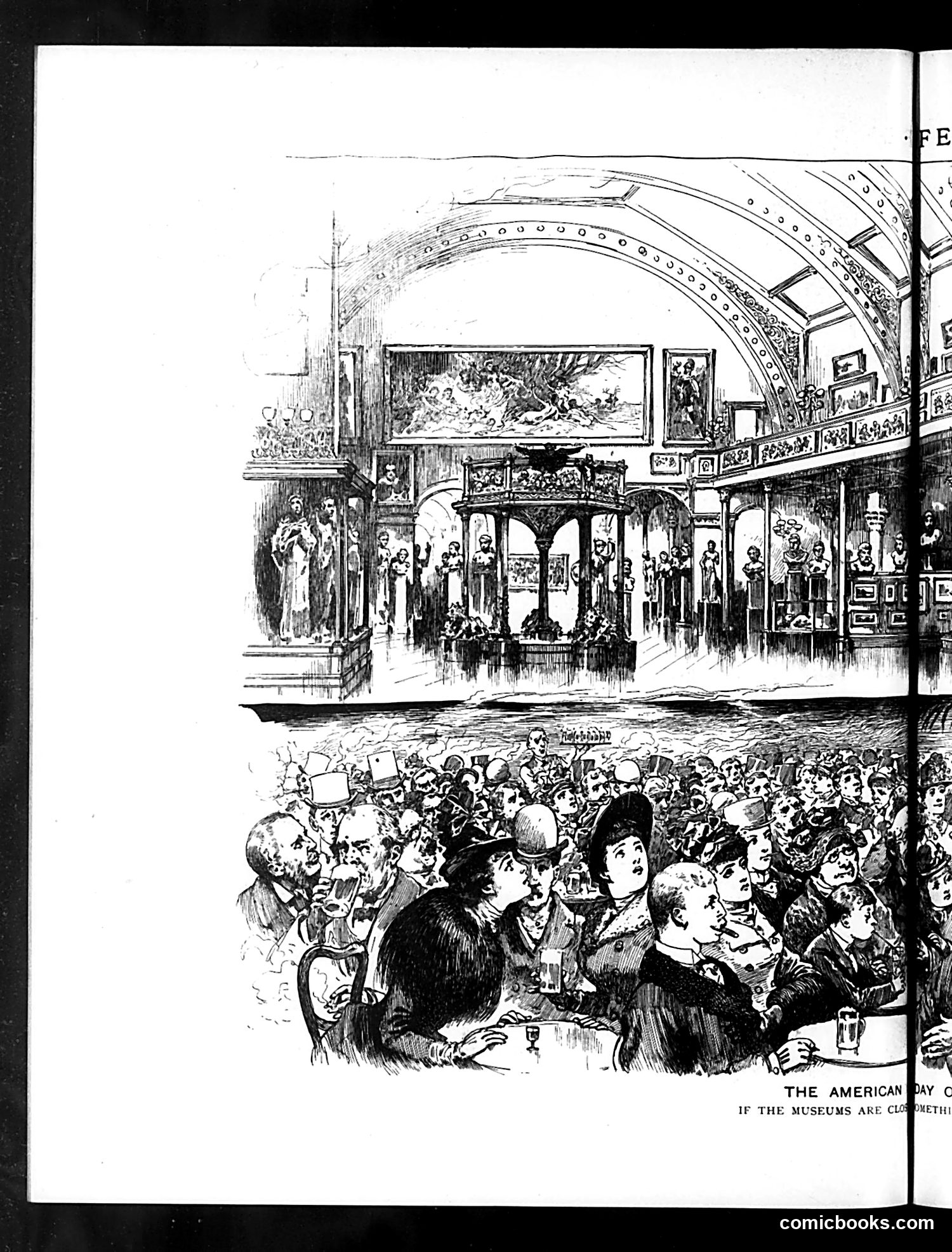
This satirical illustration depicts a crowded theater or concert hall audience looking upward at an ornate, elaborately decorated stage and interior. The caption reads "THE AMERICAN DAY OF REST / IF THE MUSEUMS ARE CLOSED THEN" (text appears cut off). The satire targets American leisure culture and class distinction. While wealthy patrons enjoy refined entertainment in an elegant venue's upper galleries, the lower foreground shows a densely packed crowd of working-class people—many wearing hats and appearing cramped—apparently experiencing the same event differently. The joke appears to satirize how American "days of rest" and cultural institutions create stark divisions: elite access versus crowded, uncomfortable mass experience. The illustration critiques both consumerism and the inequality inherent in how cultural venues served different social classes.
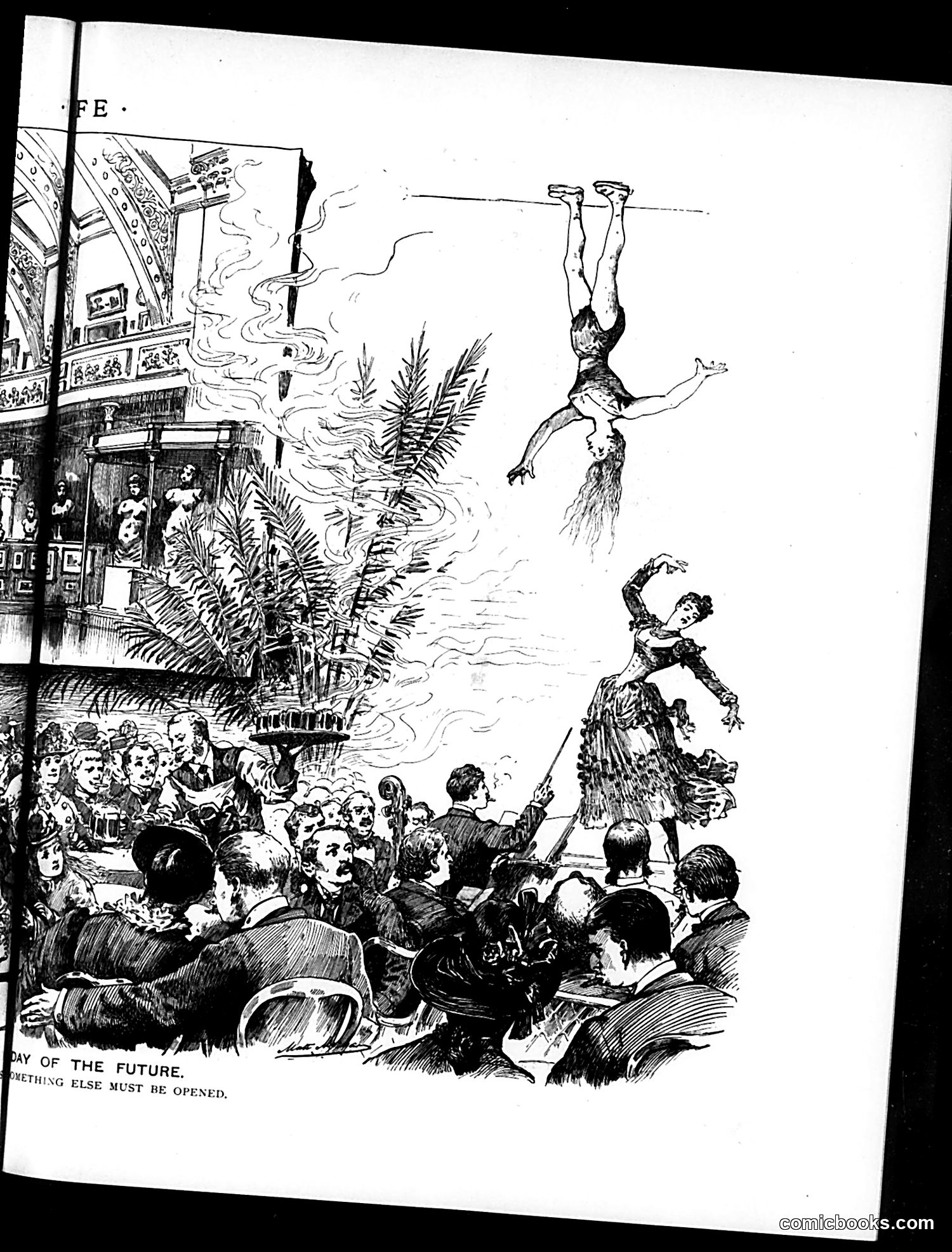
This satirical illustration depicts a crowd gathered before an ornate Asian-inspired structure, watching acrobatic performers suspended above them. The caption reads "DAY OF THE FUTURE. EVERYTHING ELSE MUST BE OPENED." The cartoon appears to critique late 19th-century Western fascination with Asian culture and "exotic" spectacles. The elaborate building and contorted performers suggest popular entertainment venues of the era that featured Asian dancers and acrobats. The caption's reference to "opening" likely alludes to Western imperial efforts to "open" Asian markets and cultures to Western commerce and influence—a contentious policy during this period. The crowd's rapt attention satirizes both the public's hunger for sensational entertainment and Western attitudes toward Asia as something to be consumed and displayed for amusement.
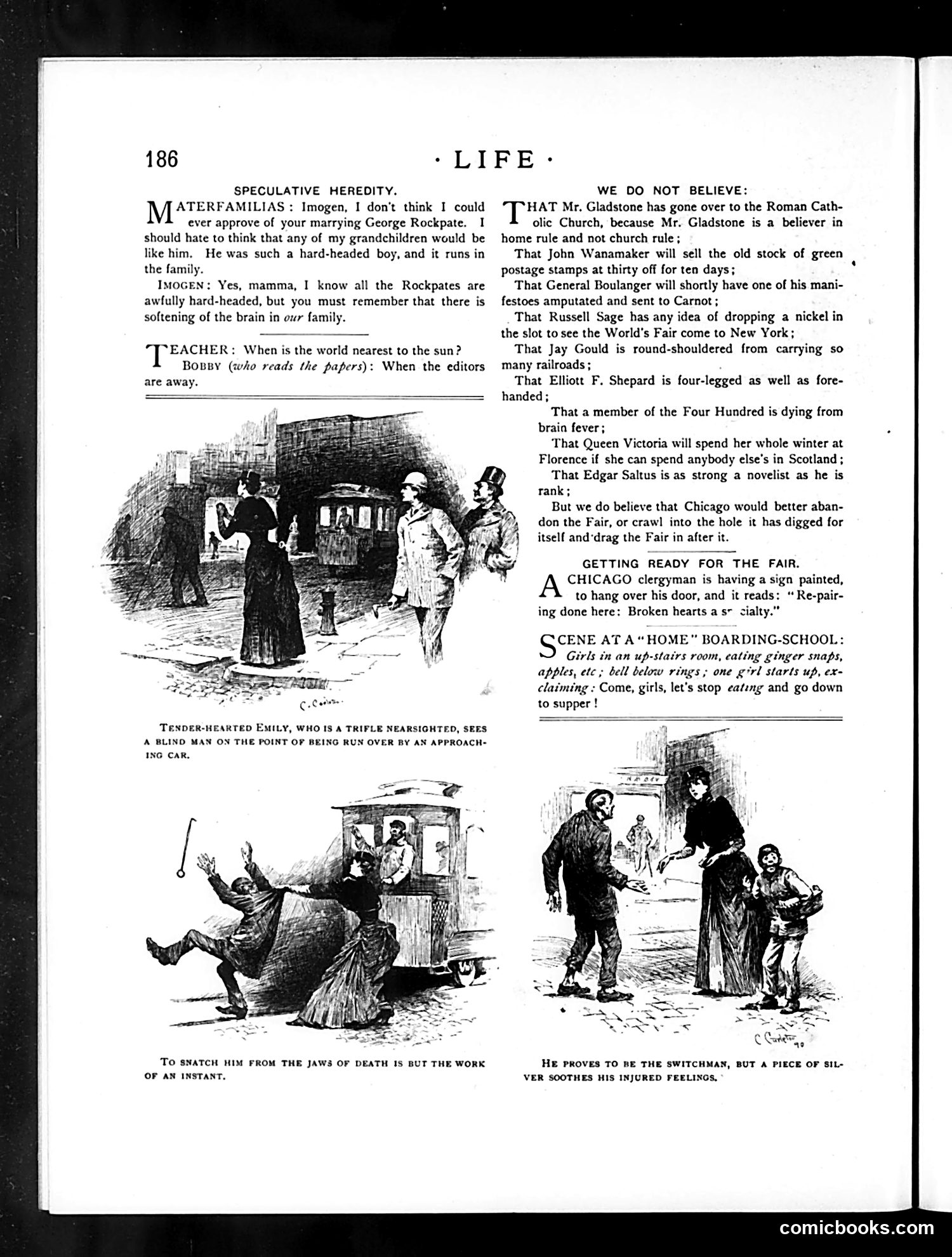
This page contains multiple short satirical pieces targeting late-19th-century figures and social attitudes: **"Speculative Heredity"** mocks class anxieties about inherited traits through a mother opposing her daughter's engagement to George Rockpate, fearing his "hard-headedness" will pass to grandchildren—only to have the daughter counter that her own family has "softening of the brain," suggesting hereditary concerns were absurd. **"Teacher" joke** satirizes newspaper editors' influence, implying the world is "nearest the sun" (most enlightened) when editors are absent. **"We Do Not Believe"** ridicules prominent figures like Gladstone, financier Russell Sage, and Jay Gould through exaggerated claims about their character flaws and hypocrisy. **"Getting Ready for the Fair"** references Chicago's World's Fair preparation, with a clergyman's pun on "repair" suggesting spiritual healing. The illustrations accompany light social humor about a nearsighted girl rescuing a blind man from traffic, and boarding school girls interrupted during snacking. The tone is genteel satire typical of Life's early period.
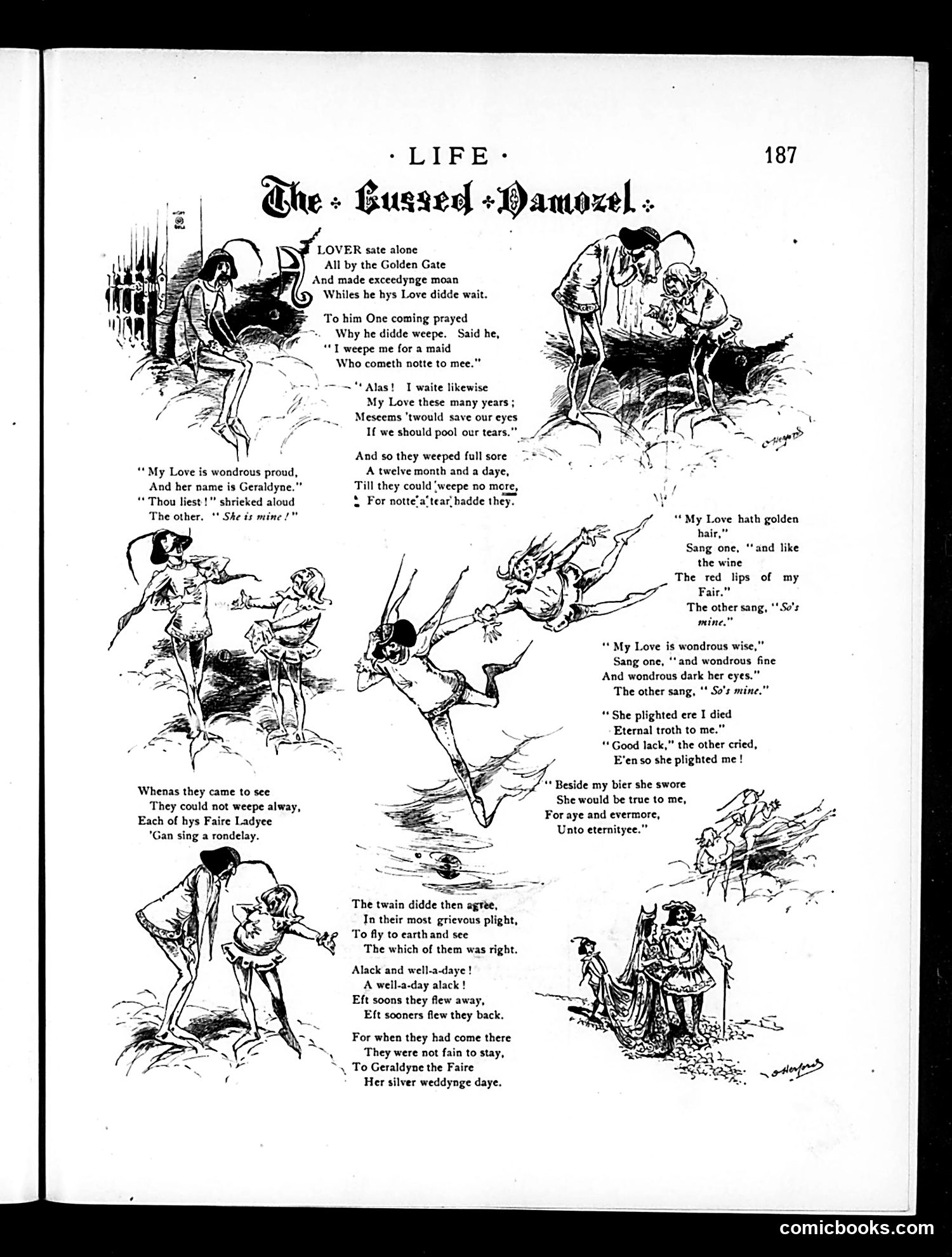
This illustrated poem mocks Victorian romantic idealism through mock-medieval language. Two male lovers meet at heaven's gate, each mourning an idealized beloved named Geraldyne who promised eternal faithfulness. They bond over shared heartbreak, describing their loves in flowery, identical terms—golden hair, red lips, wisdom, dark eyes—suggesting these women are interchangeable fantasy constructs rather than real individuals. The punchline: when the two men descend to earth to verify which lover was truly faithful, they discover **both lovers are the same woman**—and she's actually getting married to someone else. The satire suggests that romantic lovers project such unrealistic ideals onto their beloveds that they miss reality entirely. The elaborate, archaic language underscores the pretentiousness of such sentimental devotion.
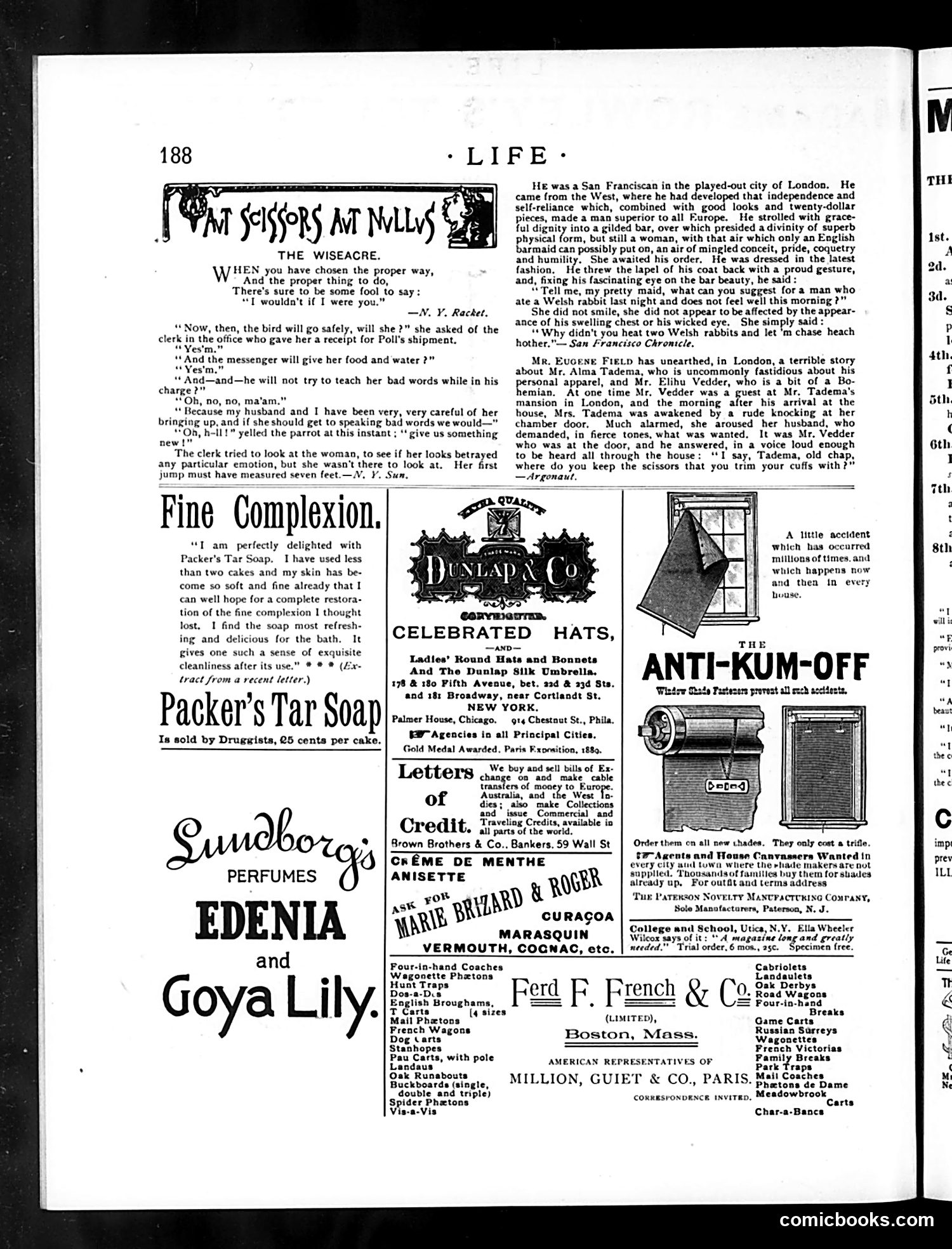
This page is primarily **advertisements and short humor pieces**, not a political cartoon. The main content includes: **"The Wiseacre"** - A short satirical story mocking an arrogant San Franciscan tourist in London who tries to impress an English barmaid with his wealth and confidence, only to be deflated by her practical, witty response about Welsh rabbits (a cheese dish). **"Fine Complexion"** - A testimonial ad for Packer's Tar Soap, a popular 19th-century beauty product. **Two anecdotes** about art world figures (Alma Tadema and Elihu Vedder), depicting obsessive fastidiousness as humorous character flaws. The satire targets American swagger abroad and pretension generally. The page is typical of *Life* magazine's mix of light humor, gossip, and advertising from this era. There are no identifiable political references—just gentle mockery of social types and consumer testimonials.
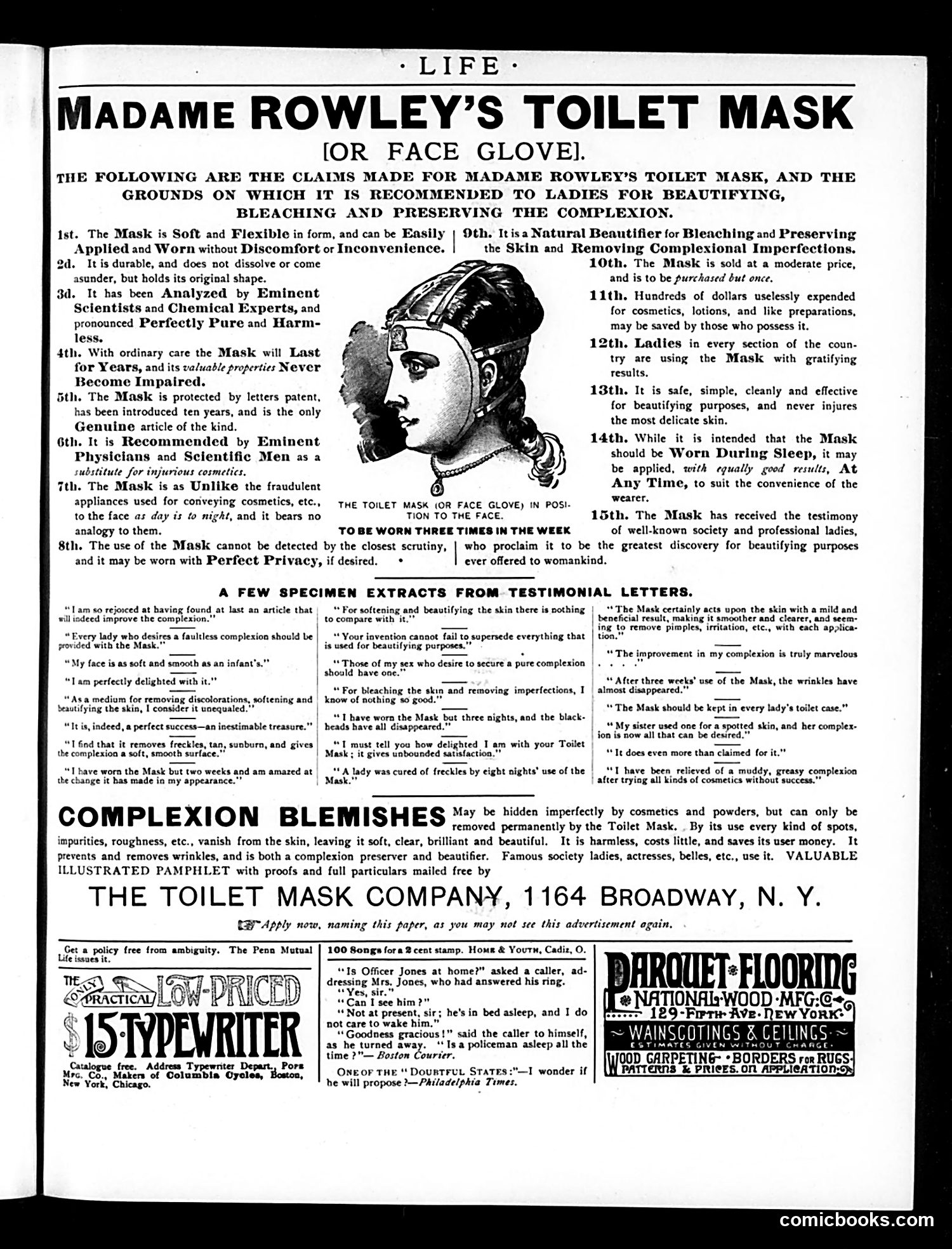
This page is primarily a product advertisement for a face mask/glove device marketed to women for skin beautification. The "mask" appears to be a tight-fitting facial covering worn during sleep to supposedly bleach, soften, and preserve complexion. The satire lies in Life magazine's presentation: the extravagant claims (15 numbered benefits), the mock-scientific endorsements ("Eminent Physicians"), and the gushing testimonial letters all parody the era's dubious beauty product marketing. The illustration shows a woman wearing the device, looking somewhat absurd. This reflects late 19th/early 20th-century skepticism toward unproven cosmetic remedies aggressively marketed to women's vanity and insecurities about appearance. Life's satirical tone suggests these products were common, largely ineffective, and the promotional language deliberately inflated—a consumer critique wrapped in humorous presentation.
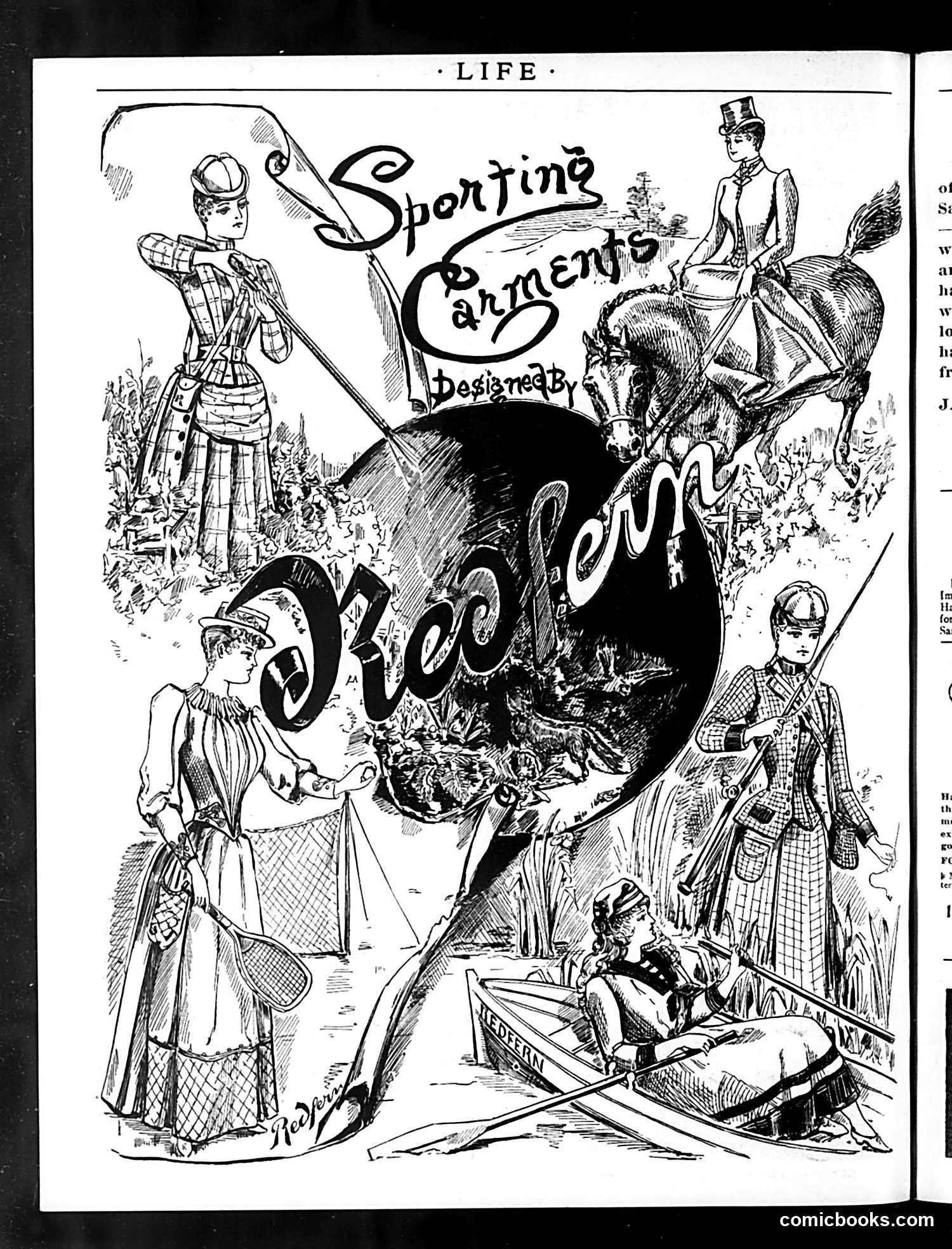
This is an advertisement or feature for sporting wear, illustrated by someone named Reen. The central image shows a large peacock or similar bird wearing fashionable clothing, surrounded by five women in various sporting outfits from what appears to be the late 19th or early 20th century. The women display different athletic pursuits: tennis, horseback riding, and fishing are suggested by their poses and equipment. The satire appears to target the tension between Victorian femininity and women's growing participation in sports—the elegantly dressed figures are styled fashionably despite engaging in active pursuits. The proud peacock at the center may suggest vanity or peacockery in sporting fashion design itself, though the exact satirical point remains somewhat unclear without additional context.
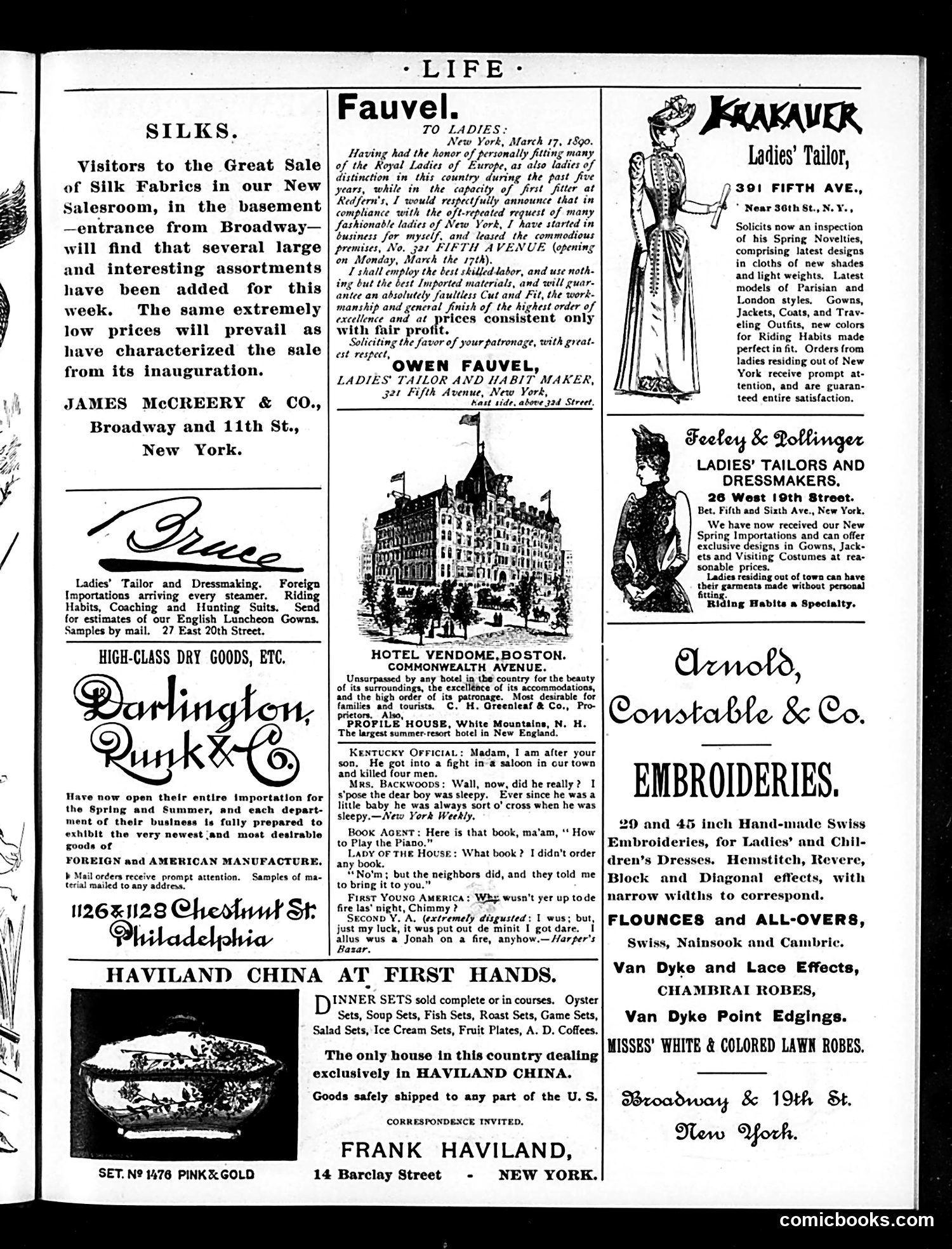
This is primarily an **advertising page** with embedded brief comedic anecdotes rather than political cartoons. The page showcases high-end New York businesses: silk merchants, tailors, hotels, and china dealers. The humor appears in three short **dialect jokes**: 1. A Kentucky official reports a man killed four people; the mother assumes her son was merely sleepy (playing on rural stereotypes). 2. A book agent delivers an unsolicited piano instruction manual the neighbors ordered delivered to annoy the recipient. 3. A young boy complains he always arrives too late to fires because he's habitually unlucky. These jokes rely on **period stereotypes**: rural/backwoods ignorance, practical pranks among neighbors, and children's mischief. The humor is gentle social observation rather than sharp satire. The page primarily targets wealthy New York ladies interested in fashionable clothing and home goods, using these jokes as filler content between advertisements for luxury imports and custom tailoring services.
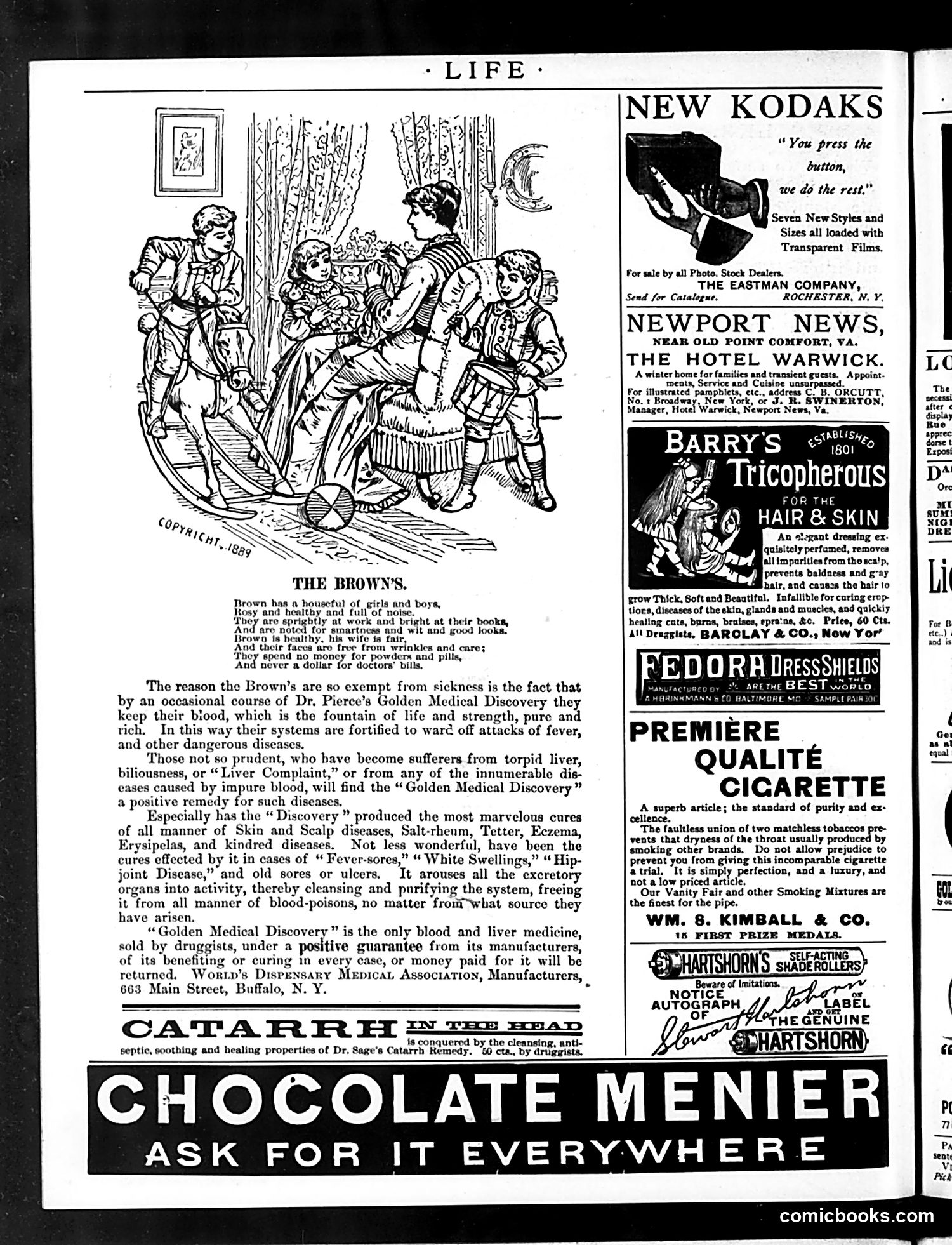
This page is primarily **advertising**, not political satire. The central illustrated feature depicts a wholesome Victorian family ("The Browns") and serves as an extended advertisement for **Dr. Pierce's Golden Medical Discovery**, a patent medicine marketed as a blood purifier. The cartoon shows healthy, rosy-cheeked children and parents, captioned to explain they remain disease-free because they periodically use this tonic to keep their blood "pure and rich." The text then pivots to persuade skeptical readers by listing ailments the "Discovery" allegedly cures—liver disease, eczema, ulcers, and various skin conditions. **The satire is gentle**: the idealized family contrasts implicitly with sickly non-users. The ad promises that proper blood maintenance prevents doctor visits and medical bills—a selling point for cost-conscious families. The page also contains other period advertisements (Kodak cameras, hotels, hair tonics, cigarettes) typical of *Life* magazine's commercial content circa the 1890s.
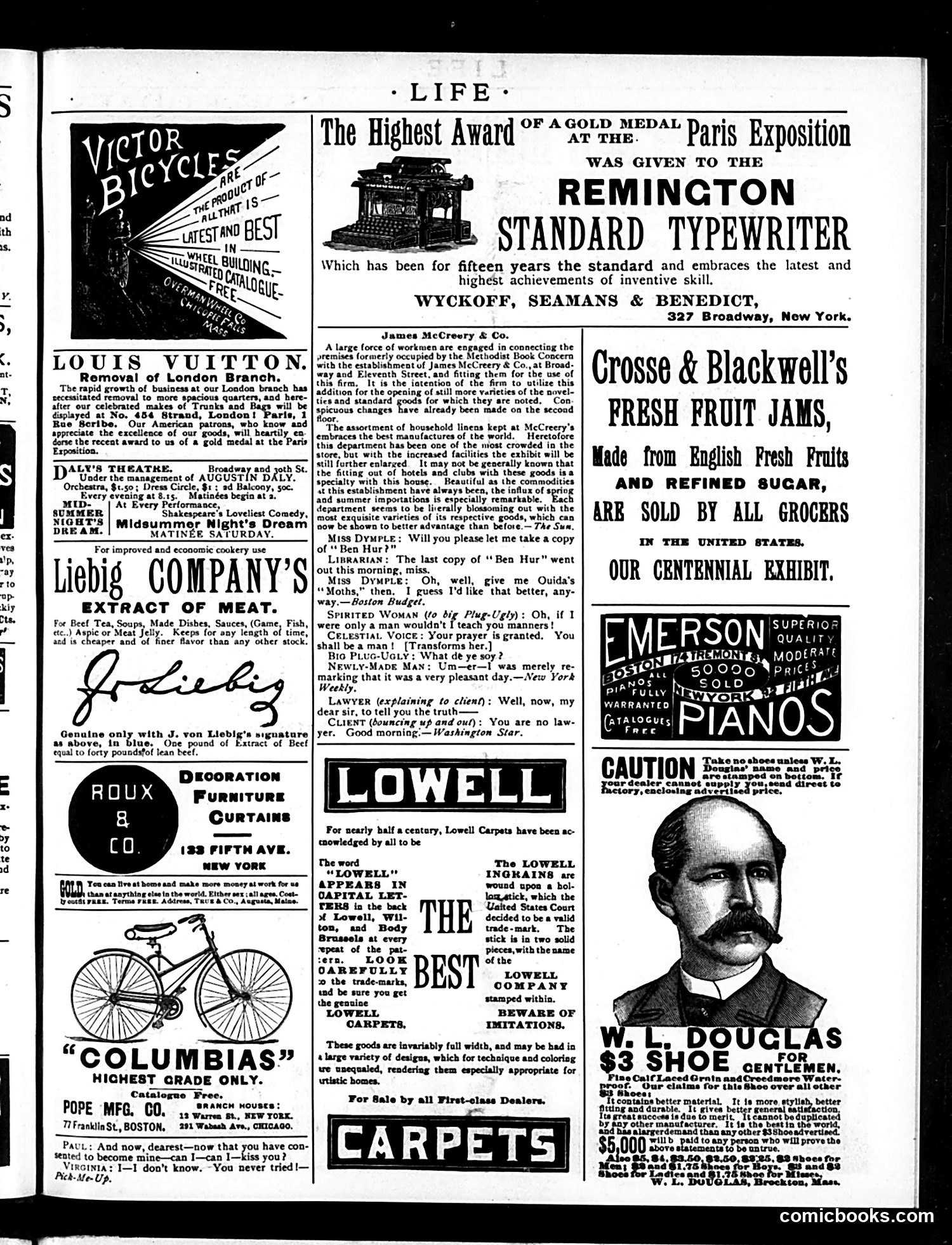
This page is primarily **advertising**, typical of Life's satirical magazine format from the late 19th/early 20th century. The advertisements showcase consumer products and services of the era. The notable content includes: - **Remington Standard Typewriter**: Prominently advertised as winning a gold medal at the Paris Exposition, emphasizing technological advancement and American industrial achievement. - **Comic dialogues** scattered among ads (the "Miss Dimple" and "Spirited Woman" exchanges): Brief humorous vignettes poking fun at social conventions—a woman wishing she were a man to teach manners, a newly-transformed man abandoning rudeness for politeness. - **Lowell Carpets warning**: A cautionary note about counterfeit products, reflecting consumer concerns about trademark protection and imitation goods in an era of rapid industrialization. The page reflects Gilded Age consumer culture, technological pride, and emerging concerns about product authenticity and commercialism. The humor is gentle, focusing on social manners and gender roles rather than sharp political satire.
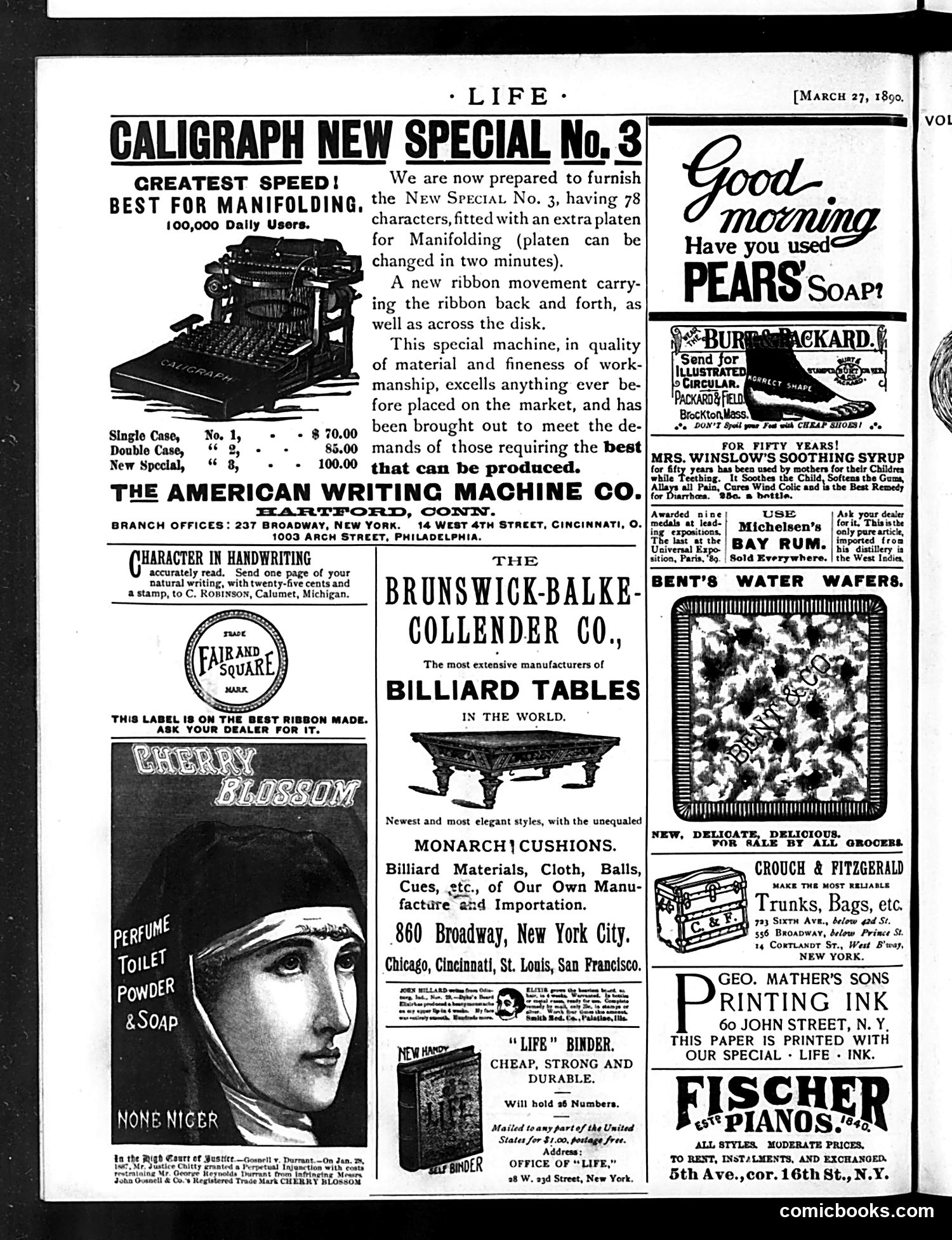
This is primarily an **advertising page** from Life magazine's early period, not a satirical cartoon page. The advertisements showcase late-19th-century consumer products and services typical of the era. **Key content includes:** - **Caligraph typewriter** ad (top): Promotes a new "manifolding" model for business use, reflecting the rapid office mechanization of the 1890s - **Character handwriting analysis service**: Offers personality readings based on penmanship—a pseudo-scientific practice popular in the period - **Cherry Blossom perfume** (left): Features a woman's face; the fine-print legal note references a trademark dispute, suggesting competitive markets for branded goods - **Brunswick-Balke-Collender billiard tables**: High-end leisure furniture for the wealthy - **Various consumer goods**: Remedies (Mrs. Winslow's Soothing Syrup), food (Bent's Water Wafers), and printing supplies The page reflects **Gilded Age consumer culture**—typewriters, patent medicines, leisure goods—aimed at middle and upper-class readers. No political satire appears here.