
Life, 1890-03-27 · page 4 of 20
Life — March 27, 1890 — page 4: what you’re looking at
What you’re looking at
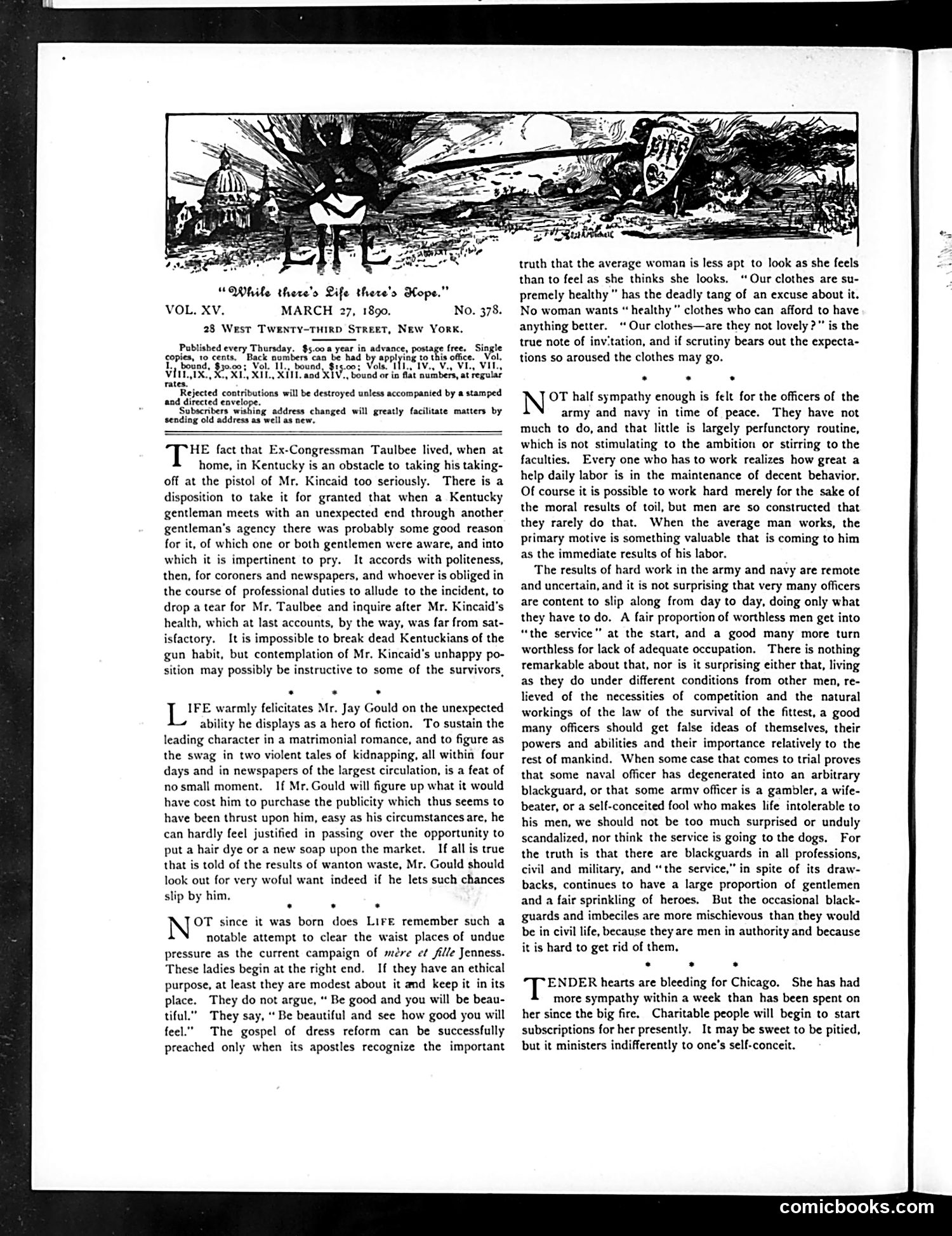
The masthead illustration depicts a chaotic scene with a large figure dominating a landscape, seemingly representing "Life" itself personified. The crude, expressionistic style is typical of Life's satirical approach. The page's main content consists of editorial commentary rather than comic strips. Articles discuss: - **Ex-Congressman Taubee's shooting incident** involving Mr. Kincaid in Kentucky—a violent confrontation between gentlemen that Life uses to critique the dueling/shooting culture among politicians - **Dress reform debates** criticizing both overly restrictive women's fashion and reform advocates' moral preaching - **Army/Navy officer conduct**, questioning whether officers deserve sympathy for perceived hardships or moral failings The satire targets hypocrisy in American politics, fashion moralism, and military culture. Specific figures are referenced but lack sufficient context to identify precisely from the text alone.
📄 Transcribed text from this page (OCR, searchable)
Machine-transcribed from the original scan — historical spelling and the odd misread are preserved.
pat my " “While there's Life there's Hope.” VOL, XV. MARCH 27, 1890. No. 378. 28 West TWENTY-THIRD STREET, New York, Published every Thursday. $5.00 year in advance, bene frees Single goples, to cents, Back pumbers can ee had by applying to this of } $2.0: Val. Il. bound, $15.00; Vals vil. vied aa XOX, ound or in Mat nucabers, at egula? rates. Rejected contributions will be destroyed unless accompanied by a stamped and directed envelope. Subscribers wishing address changed will greatly facilitate matters by sending old address as well as new. XIE, XT aod XS HE fact that Ex-Congressman Taulbee lived, when at home, in Kentucky is an obstacle to taking his taking- off at the pistol of Mr. Kincaid too seriously. There is a disposition to take it for granted that when a Kentucky gentleman meets with an unexpected end through another gentleman's agency there was probably some good reason for it, of which one or both gentlemen were aware, and into which it is impertinent to pry. It accords with politeness, then, for coroners and newspapers, and whoever is obliged in the course of professional duties to allude to the incident, to drop a tear for Mr. Taulbee and inquire after Mr. Kincaid's health, which at last accounts, by the way, was far from sat- isfactory. It is impossible to break dead Kentuckians of the gun habit, but contemplation of Mr. Kincaid's unhappy po- sition may possibly be instructive to some of the survivors, IFE warmly felicitates Mr. Jay Gould on the unexpected ability he displays as a hero of fiction. To sustain the leading character in a matrimonial romance, and to figure as the swag in two violent tales of kidnapping, all within four days and in newspapers of the largest circulation, is a feat of no small moment. If Mr. Gould will figure up what it would have cost him to purchase the publicity which thus seems to have been thrust upon him, easy as his circumstances are, he can hardly feel justified in passing over the opportunity to put a hair dye or a new soap upon the market. If all is true that is told of the results of wanton waste, Mr. Gould should look out for very woful want indeed if he lets such chances slip by him. . . . OT since it was born does LiFe remember such a notable attempt to clear the waist places of undue pressure as the current campaign of mére et fille Jenness. These ladies begin at the right end. If they have an ethical purpose, at least they are modest about it and keep it in its place. They do not argue, “ Be good and you will be beau- tiful.” They say, ‘Be beautiful and see how good you will feel." The gospel of dress reform can be successfully preached only when its apostles recognize the important truth that the average woman is less apt to look as she feels than to feel as she thinks she looks. ‘Our clothes are su- premely healthy " has the deadly tang of an excuse about it. No woman wants “healthy” clothes who can afford to have anything better. “ Our clothes—are they not lovely?" is the true note of inv:tation, and if scrutiny bears out the expecta- tions so aroused the clothes may go. OT half sympathy enough is felt for the officers of the army and navy in time of peace. They have not much to do, and that little is largely perfunctory routine, which is not stimulating to the ambition or stirring to the faculties. Every one who has to work realizes how great a help daily labor is in the maintenance of decent behavior. Of course it is possible to work hard merely for the sake of the moral results of toil, but men are so constructed that they rarely do that. When the average man works, the primary motive is something valuable that is coming to him as the immediate results of his labor. The results of hard work in the army and navy are remote and uncertain, and it is not surprising that very many officers are content to slip along from day to day, doing only what they have to do. A fair proportion of worthless men get into “the service” at the start, and a good many more turn worthless for lack of adequate occupation. There is nothing remarkable about that, nor is it surprising either that, living as they do under different conditions from other men, re- lieved of the necessities of competition and the natural workings of the law of the survival of the fittest, a good many officers should get false ideas of themselves, their powers and abilities and their importance relatively to the rest of mankind. When some case that comes to trial proves that some naval officer has degenerated into an arbitrary blackguard, or that some army officer is a gambler, a wife- beater, or a self-conceited fool who makes life intolerable to his men, we should not be too much surprised or unduly scandalized, nor think the service is going to the dogs. For the truth is that there are blackguards in all professions, civil and military, and “the service,” in spite of its draw- backs, continues to have a large proportion of gentlemen and a fair sprinkling of heroes. But the occasional black- guards and imbeciles are more mischievous than they would be in civil life, because they are men in authority and because it is hard to get rid of them. . . . “TENDER hearts are bleeding for Chicago. She has had more sympathy within a week than has been spent on her since the big fire. Charitable people will begin to start subscriptions for her presently. It may be sweet to be pitied, but it ministers indifferently to one’s self-conceit. comicbooks.com