
Life, 1890-03-27 · page 6 of 20
Life — March 27, 1890 — page 6: what you’re looking at
What you’re looking at
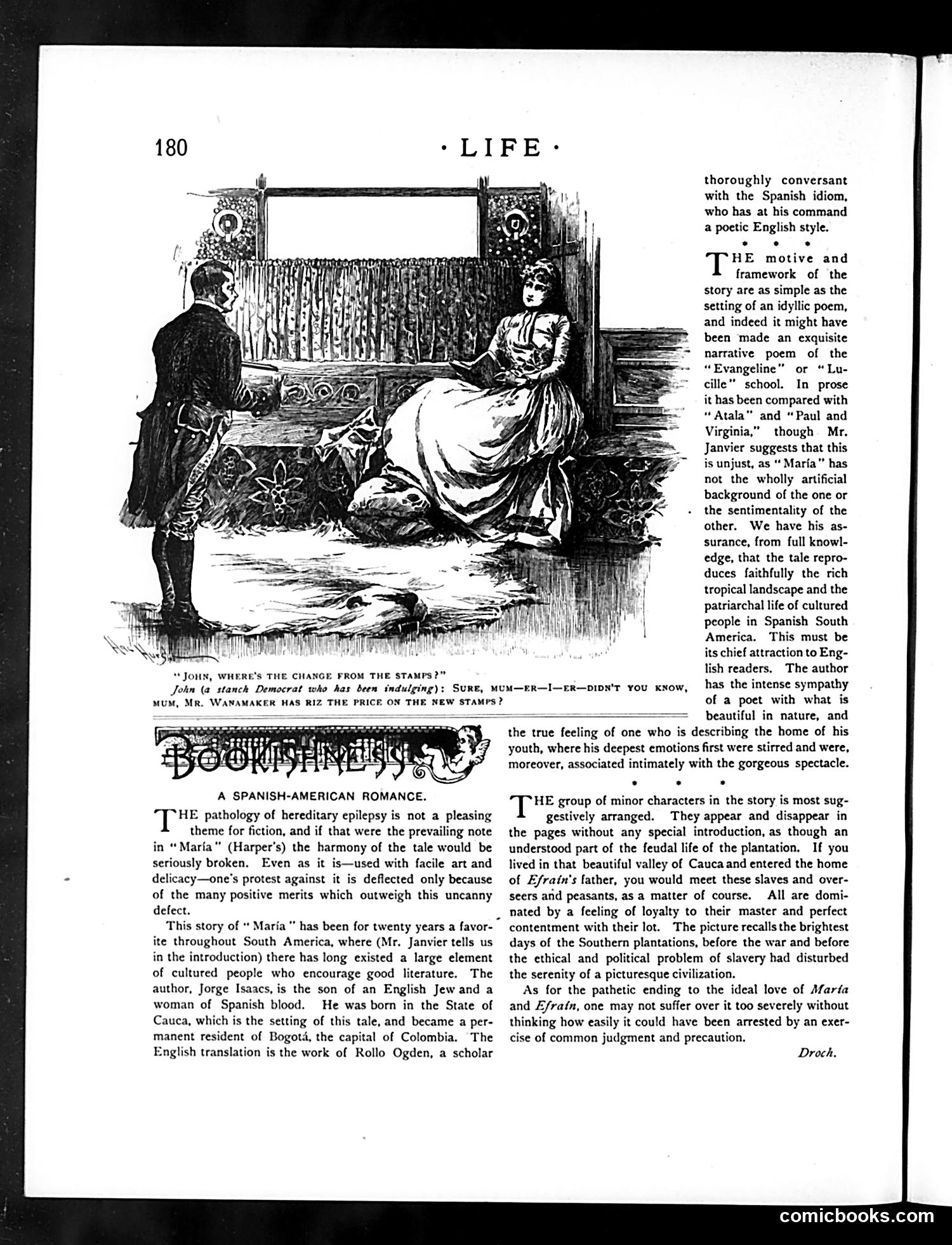
The main illustration depicts a domestic scene with a man and woman in an interior setting, accompanying a book review of "Maria: A Spanish-American Romance" by Jorge Isaacs, translated by Rollo Ogden. The caption below the illustration contains a joke: "John, where's the change from the stamps?" with a response about stamps and their price, suggesting domestic humor about household finances and a character named "M. Wammacker" who apparently controls stamp pricing. The text discusses the novel's literary merits, its tropical South American setting, and themes of plantation life. The page is primarily a literary review rather than political satire, examining how the book depicts Spanish colonial culture and its portrayal of slavery's ethical implications.
📄 Transcribed text from this page (OCR, searchable)
Machine-transcribed from the original scan — historical spelling and the odd misread are preserved.
“JOMUN, WHERE'S THE CHANGE FROM THE STAMPS?” John (a stanch Democrat who has been indulging): SURE, MUM—ER—I—ER—DIDN'T YOU KxOW, muM, MR. WANAMAKER HAS RIZ THE PRICE ON THE NEW STAMPS? thoroughly conversant with the Spanish idiom, who has at his command a poetic English style. * ee 6 HE motive and framework of the story are as simple as the setting of an idyllic poem, and indeed it might have been made an exquisite narrative poem of the “Evangeline” or “ Lu- cille” school. In prose it has been compared with “Atala” and “Paul and Virginia,” though Mr. Janvier suggests that this is unjust, as “* Marfa” has not the wholly artificial background of the one or the sentimentality of the other. We have his as- surance, from full knowl- edge, that the tale repro- duces faithfully the rich tropical landscape and the patriarchal life of cultured people in Spanish South America. This must be its chief attraction to Eng- lish readers. The author has the intense sympathy of a poet with what is A SPANISH-AMERICAN ROMANCE. E pathology of hereditary epilepsy is not a pleasing theme for fiction, and if that were the prevailing note T in “ Maria" (Harper's) the harmony of the tale would be seriously broken. Even as it is—used with facile art and delicacy—one’s protest against it is deflected only because of the many positive merits which outweigh this uncanny defect. This story of “ Maria” has been for twenty years a favor-~ ite throughout South America, where (Mr. Janvier tells us in the introduction) there has long existed a large element of cultured people who encourage good literature. The author, Jorge Isaacs, is the son of an English Jew and a woman of Spanish blood. He was born in the State of Cauca, which is the setting of this tale, and became a per- manent resident of Bogota, the capital of Colombia. The English translation is the work of Rollo Ogden, a scholar beautiful in nature, and the true feeling of one who is describing the home of his youth, where his deepest emotions first were stirred and were, moreover, associated intimately with the gorgeous spectacle. . T™ group of minor characters in the story is most sug- gestively arranged. They appear and disappear in the pages without any special introduction, as though an understood part of the feudal life of the plantation. If you lived in that beautiful valley of Cauca and entered the home of Efratn's father, you would meet these slaves and over- seers and peasants, as a matter of course. All are domi- nated by a feeling of loyalty to their master and perfect contentment with their lot. The picture recalls the brightest days of the Southern plantations, before the war and before the ethical and political problem of slavery had disturbed the serenity of a picturesque civilization. As for the pathetic ending to the ideal love of Marfa and Efrain, one may not suffer over it too severely without thinking how easily it could have been arrested by an exer- cise of common judgment and precaution. Droch. comicbooks.com