
A complete issue · 18 pages · 1890
Life — February 27, 1890
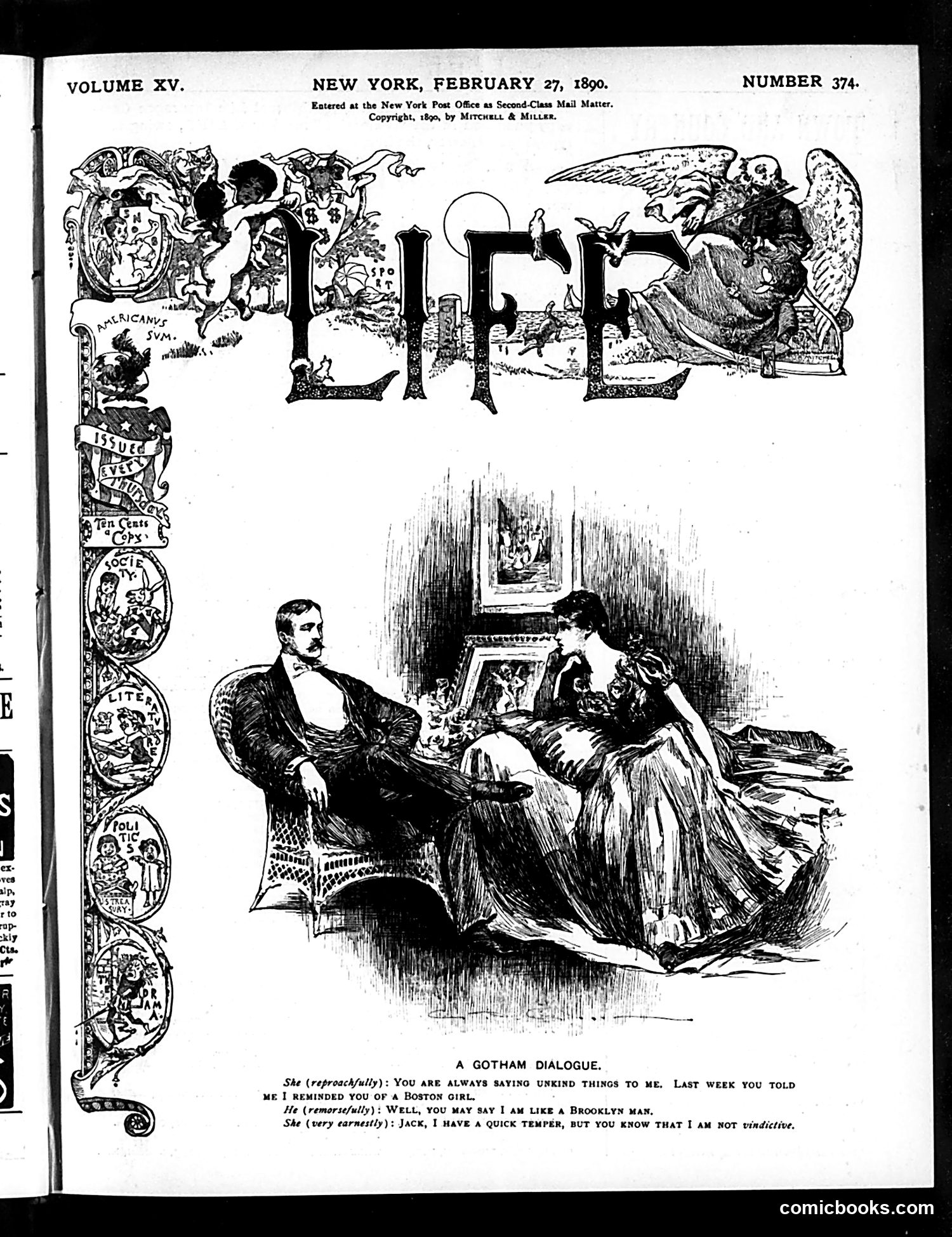
This satirical sketch depicts a domestic conversation between a couple in what appears to be a wealthy New York ("Gotham") home. The dialogue mocks gender relations and regional stereotypes of the era. The man defends himself against his wife's complaints about his behavior by claiming he's "like a Brooklyn man"—suggesting Brooklyn men were perceived as boorish or difficult partners. The woman responds that while she has a "quick temper," she's "not vindictive," implying her husband's behavior provokes her irritation. The ornate decorative border and intimate domestic setting suggest this targets upper-class New York society. The humor relies on stereotypes about Brooklyn as a less refined borough, contrasting with Manhattan's pretensions—a common satirical device in Gilded Age publications.
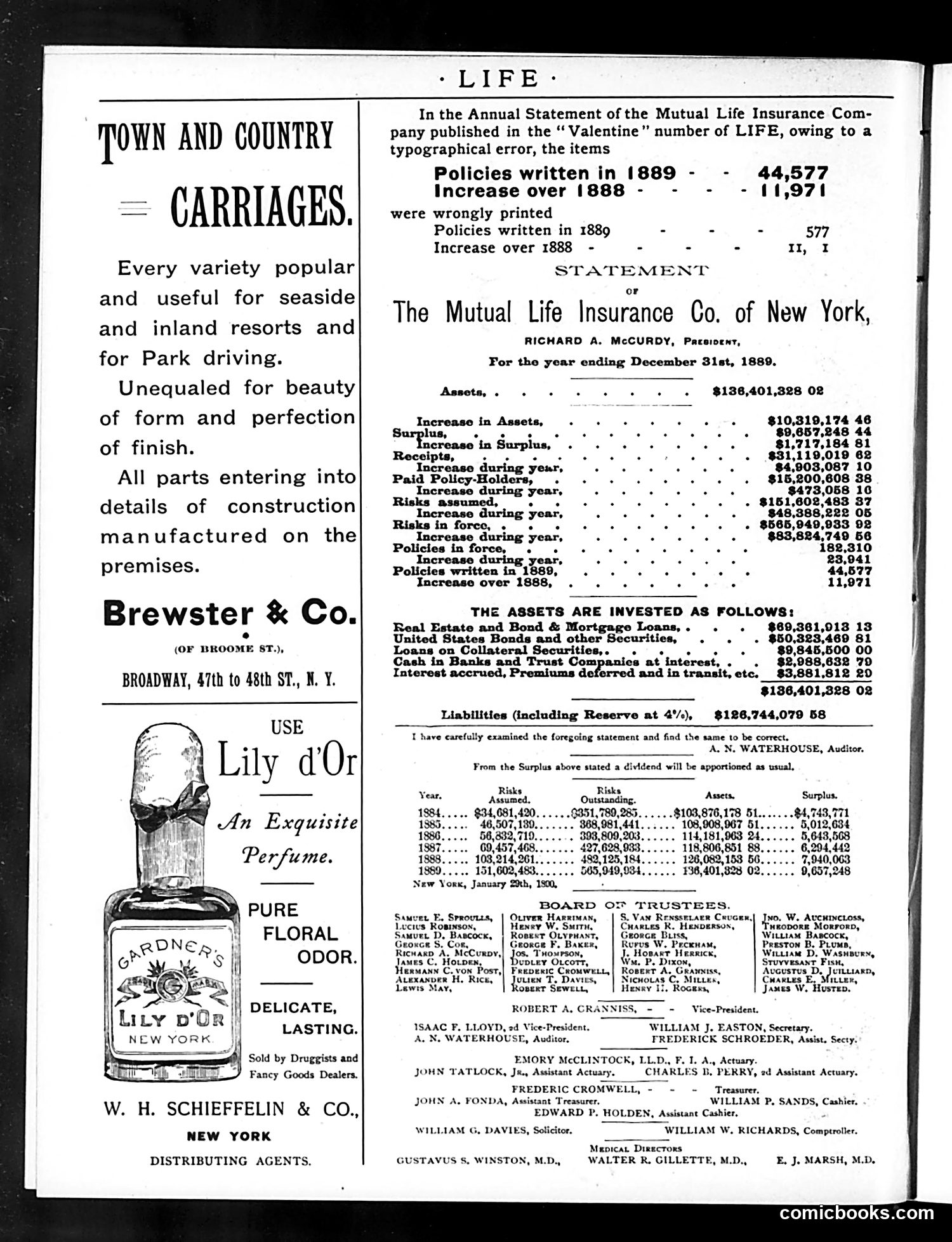
This page is **primarily advertising and financial statements**, not satirical content. The left side features advertisements for: - **Brewster & Co.** (carriages for "seaside and inland resorts") - **Lily d'Or perfume** by W.H. Schieffelin & Co. The right side contains a financial statement from **The Mutual Life Insurance Co. of New York** for the year ending December 31, 1889, listing assets, liabilities, and board of trustees. There is **no political cartoon or satirical content** visible on this page. It represents typical late-19th-century *Life* magazine advertising mixed with corporate financial disclosures, reflecting the publication's reliance on paid advertisements alongside editorial content.
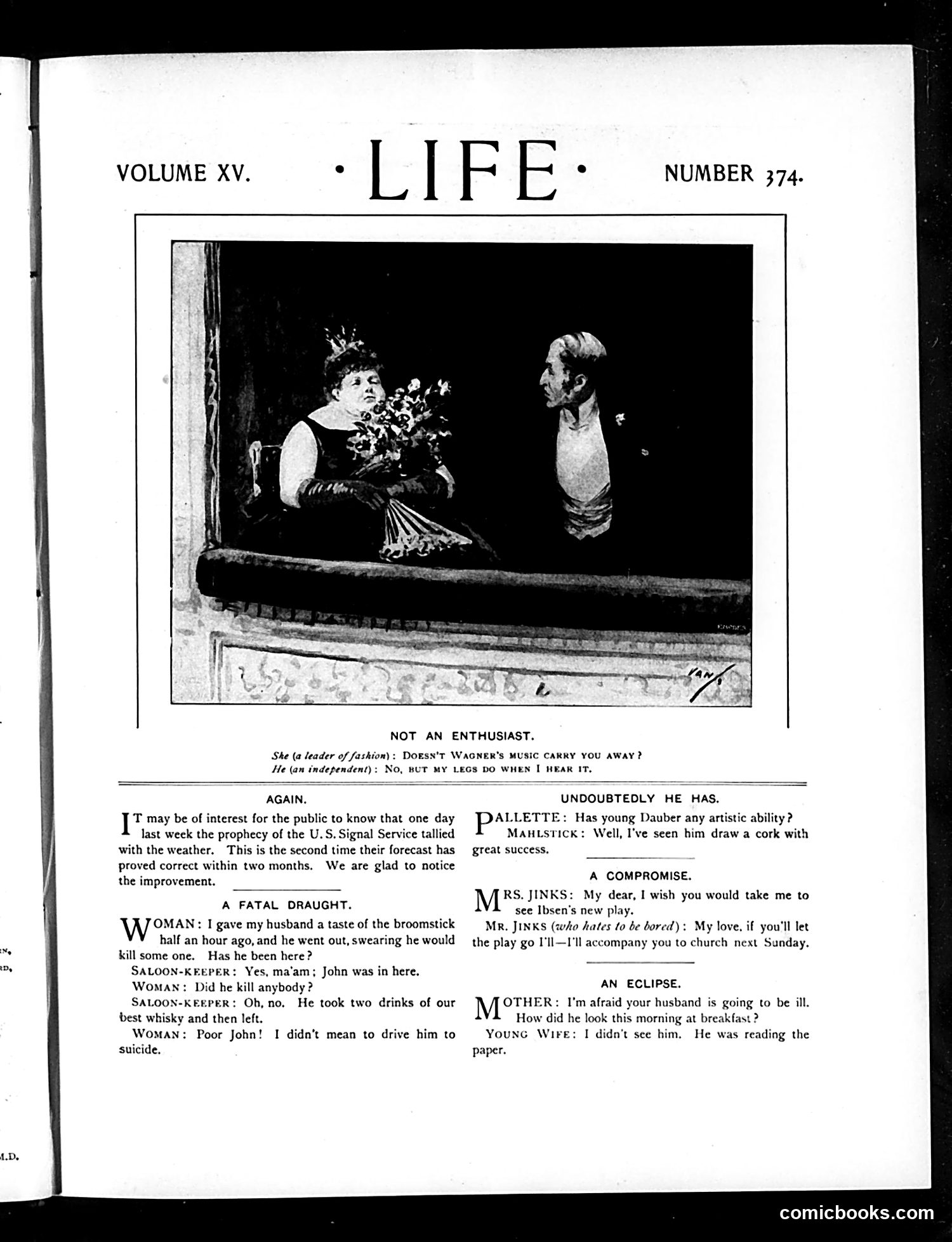
This cartoon satirizes a woman's lack of interest in Wagner's classical music. The caption shows her telling a man (presumably her husband) that Wagner's compositions don't move her emotionally—her legs don't respond even when she hears it. The humor relies on early 20th-century cultural assumptions: Wagner was considered high art requiring emotional sophistication, so a woman's indifference to it was comedic. The cartoon mocks both the pretentiousness around classical music appreciation and suggests women's supposed shallowness. The page's humorous vignettes below ("A Fatal Draught," "A Compromise," "An Eclipse") follow similar domestic comedy patterns typical of Life magazine's satirical approach to marriage and gender relations of the era.
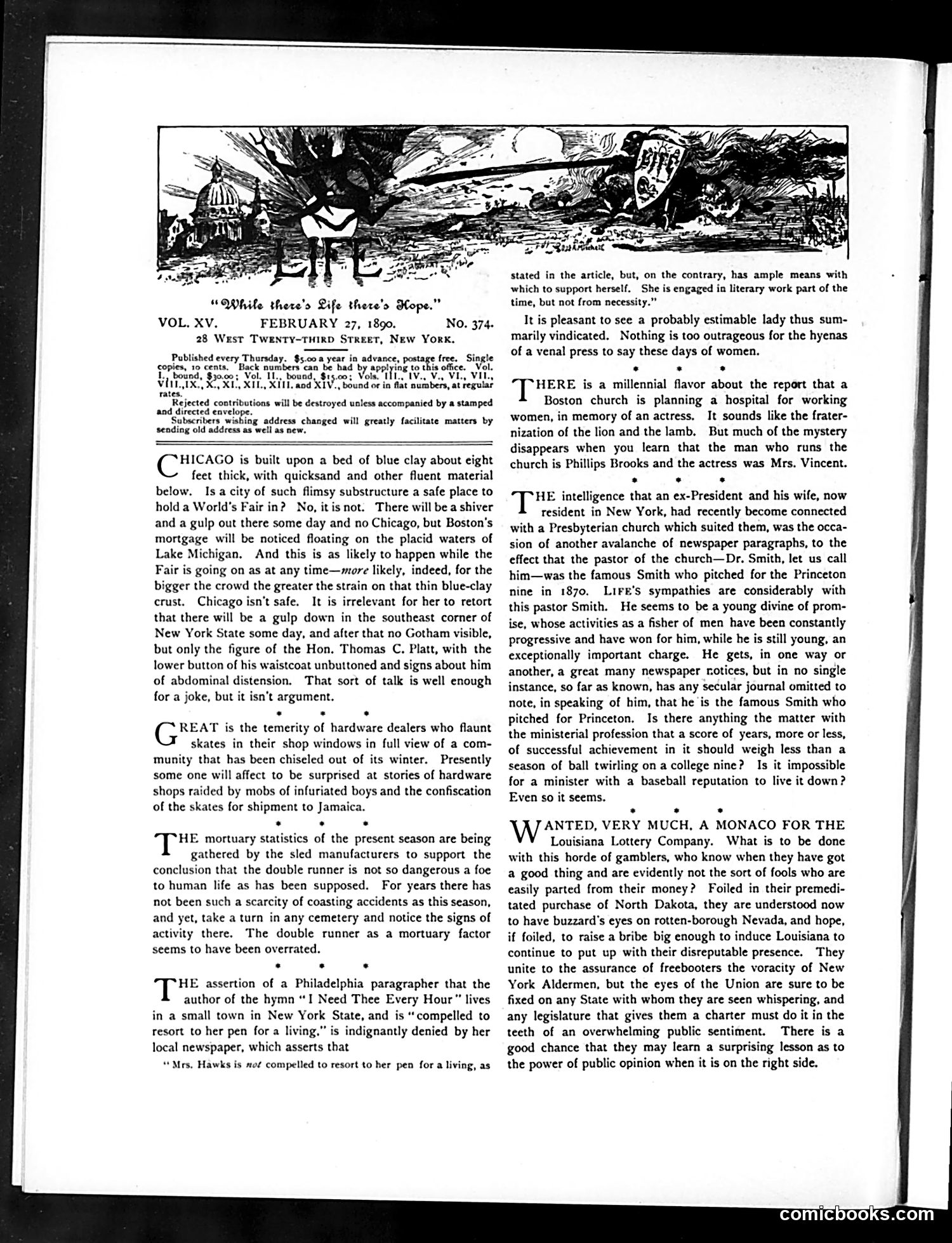
The page is primarily **text-based editorial commentary** rather than political cartoons. The masthead illustration shows a somewhat abstract or symbolic figure, but lacks clear satirical intent. The content addresses several contemporary issues: 1. **Chicago's World's Fair** - discusses construction vulnerabilities and crowd safety 2. **Hardware dealer fraud** - mocking stores selling skates to boys who then use them for petty theft 3. **Mortuary statistics** - debating whether double-runners (sleds) cause more deaths than claimed 4. **Mrs. Hawks controversy** - defending a female author's literary work against accusations she needed writing income 5. **Louisiana Lottery** - criticizing gamblers and praising anti-gambling sentiment The satire employs **ironic commentary** on contemporary social problems rather than visual caricature. The tone is moralistic, typical of 1890s American satirical journalism.
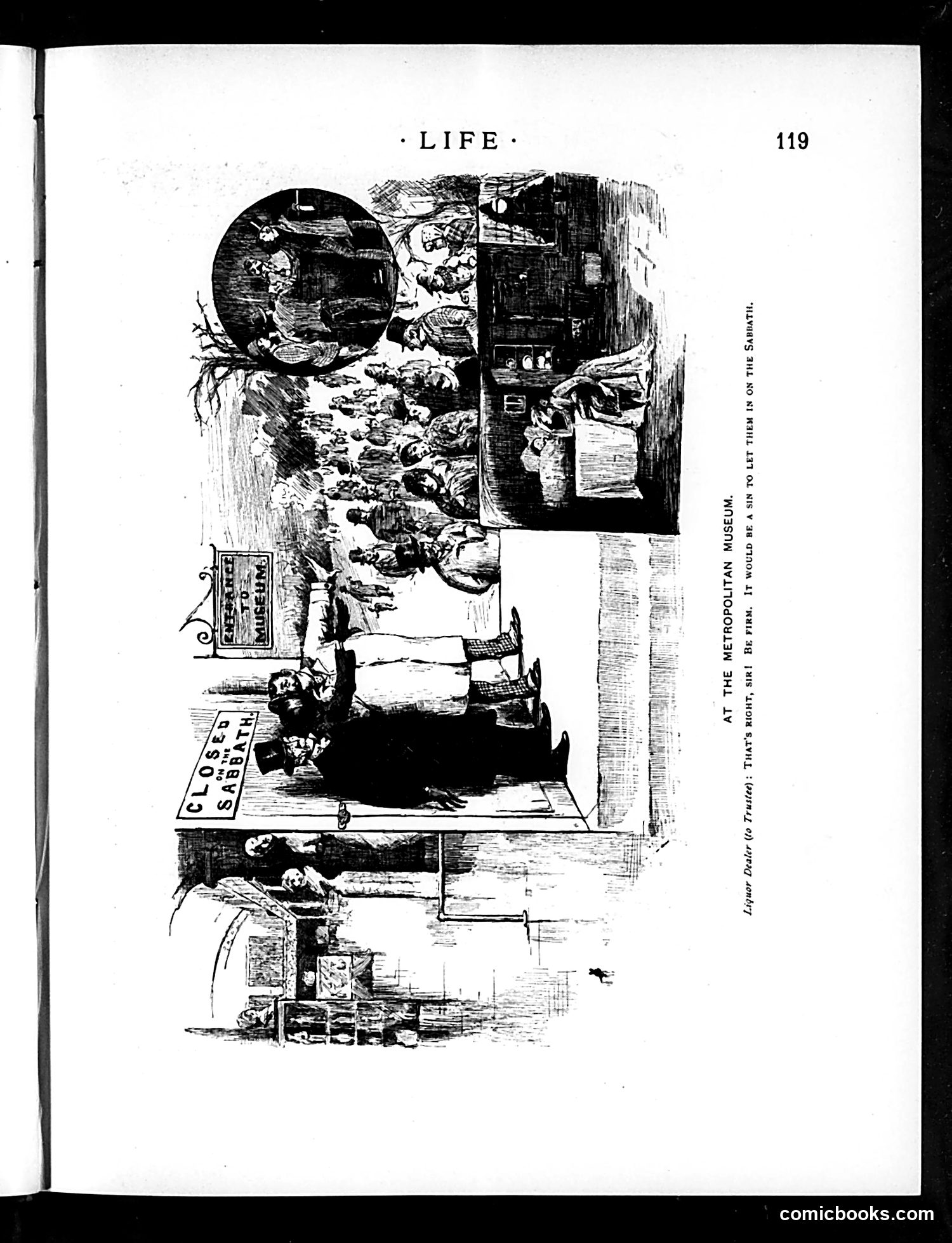
This page from Life magazine shows a satirical illustration titled "Egypt Dined at Tycoon 'Tycoon,' and Be Tried to Let Them off the Starlight" (caption text is partially unclear in OCR). The cartoon depicts a scene at the Metropolitan Museum, showing what appears to be an elaborate Egyptian-themed dinner or social event. The illustration is oriented sideways on the page and features multiple figures in formal dress, elaborate furnishings, and Egyptian decorative elements and artifacts. The satire likely mocks wealthy Manhattan socialites hosting lavish, themed entertainment events—possibly ridiculing their pretentious affectation of cultural sophistication or the conspicuous consumption of the wealthy during this period. Without clearer caption text, the specific people or event being satirized cannot be definitively identified, though it clearly targets high-society New York social practices.
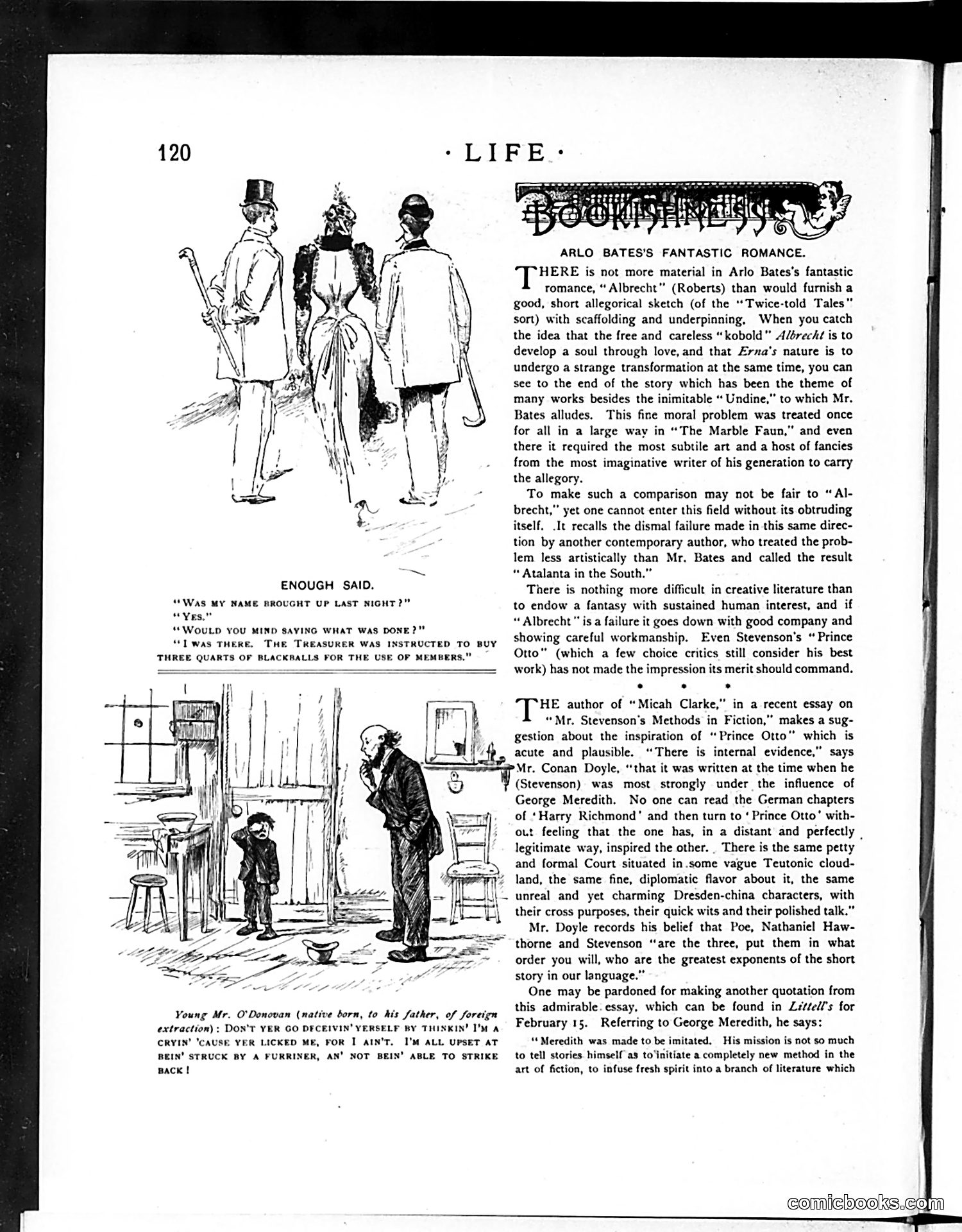
This page discusses Arlo Bates's romantic novel "Albrecht" (Roberts), comparing it to other allegorical works like "Undine" and "The Marble Faun." The text critiques fantasy literature's difficulty in sustaining human interest while maintaining allegorical meaning. The upper cartoon depicts three men in conversation, with dialogue about someone's name being "broadcast" and instructions to buy marbles "for the use of members"—likely satirizing some social or political custom, though the specific reference is unclear. The lower illustration shows a domestic scene with a tall man and boy, captioned "Young Mr. O'Donovan," with dialogue about deception and being "struck by a furnisher." The exact satirical target remains unclear from the image alone, but appears to mock social pretension or dishonest dealings.
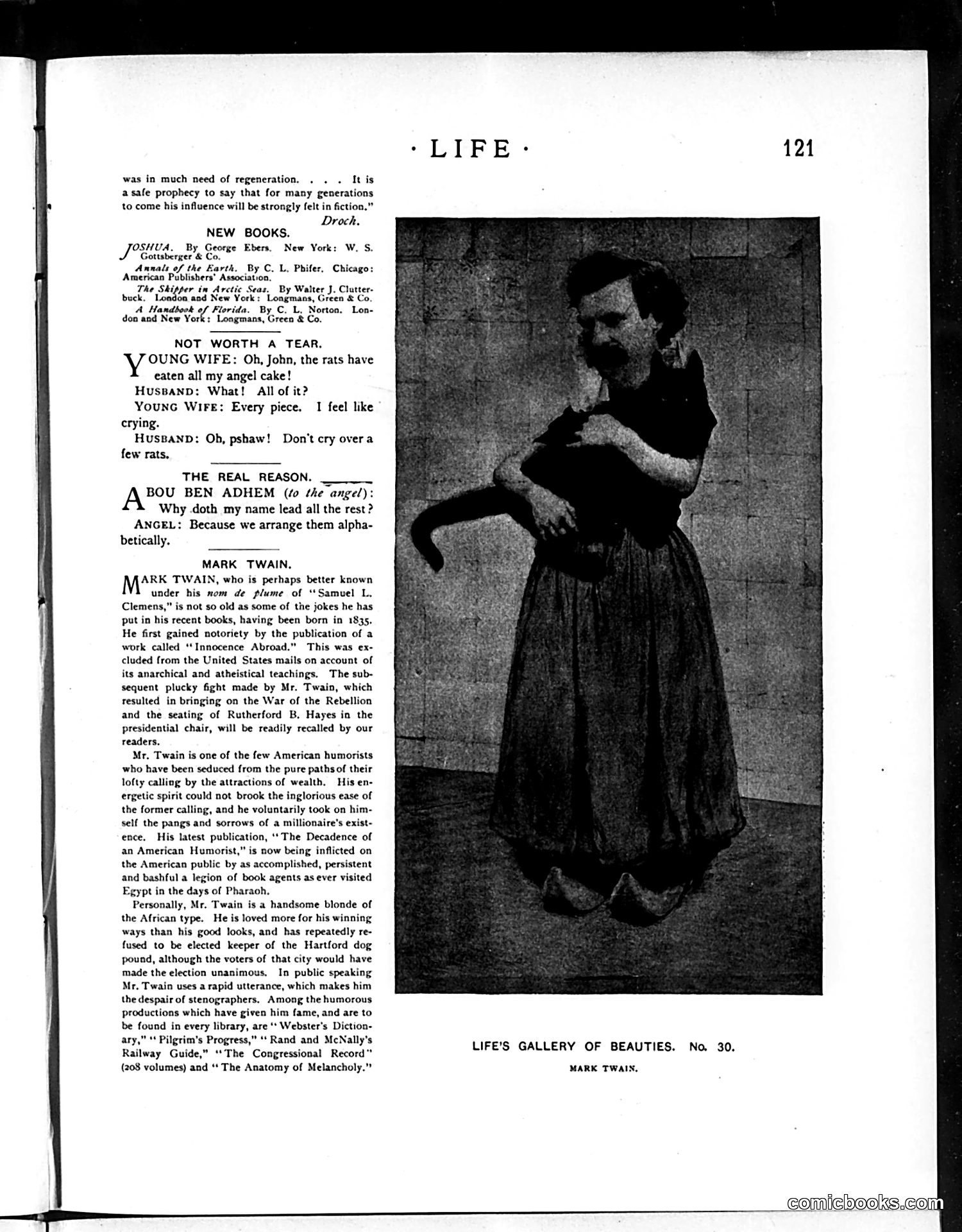
This page contains three humor items and a portrait section. "Not Worth a Tear" and "The Real Reason" are brief joke exchanges about domestic life—a wife upset about rats eating her cake, and a character named Abou Ben Adhem questioning alphabetical name ordering. These appear to be standard domestic humor, not political satire. The main content is an extensive article about **Mark Twain**, praising him as an American humorist who, despite his good looks, is valued more for his "winning ways" than appearance. The article mentions his notoriety from "Innocence Abroad" and references his role in satirizing American imperialism and wealth. The accompanying photograph is captioned "Life's Gallery of Beauties, No. 30: Mark Twain," presenting him as a cultural figure worthy of the magazine's attention.
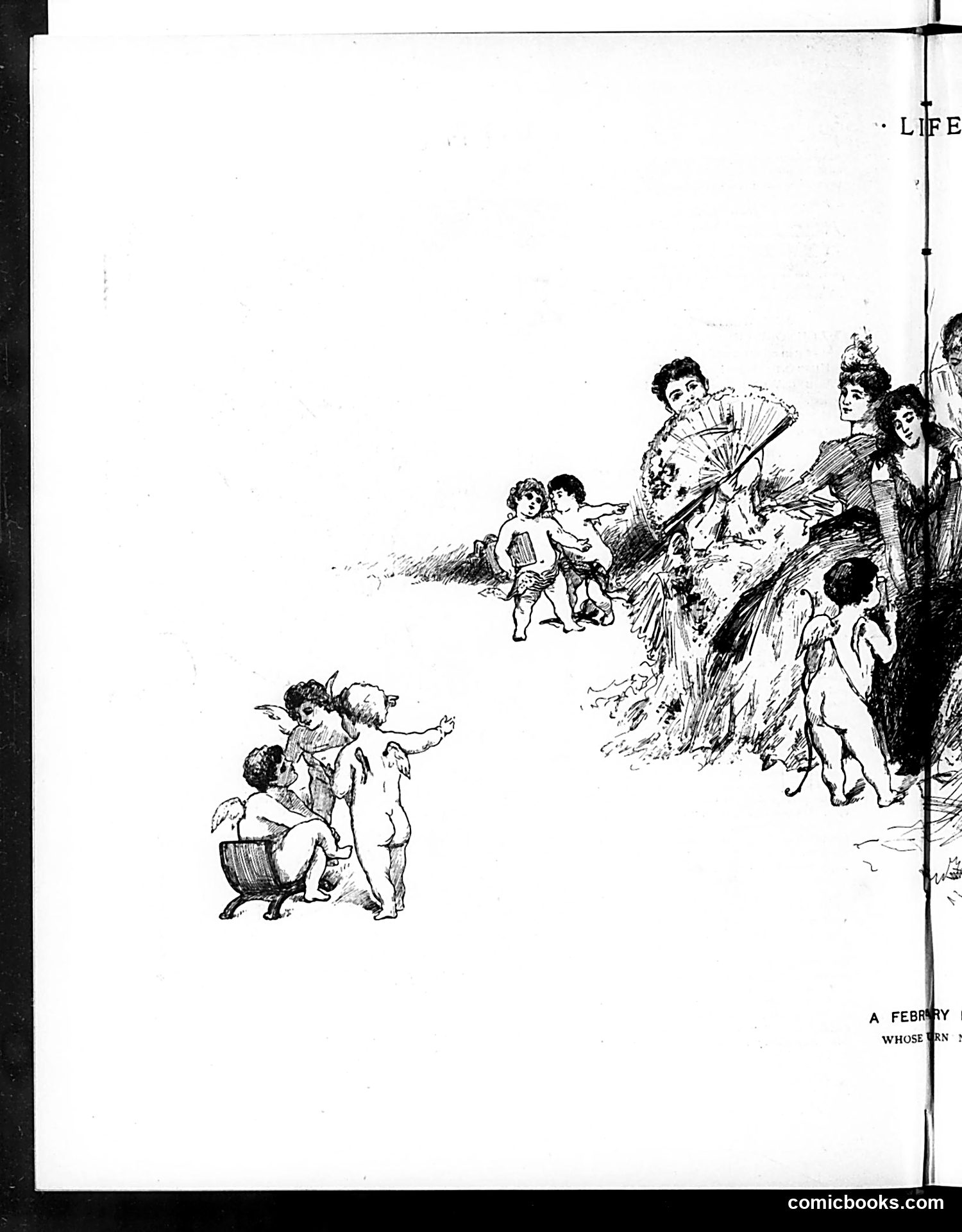
This page from *Life* magazine features an illustration contrasting two scenes of cherubs or cupids. On the left, a smaller group of winged children appear playful and unrefined. On the right, a larger group interacts with elegantly dressed women holding fans, suggesting a more sophisticated or romanticized scenario. The partial text at bottom reads "A FEBRARY [sic]" and "WHOSE PAN [?]," though it's cut off and unclear. The satire likely comments on **idealized versus realistic depictions of romance or courtship** — contrasting crude, childish desire (left) with the refined, theatrical performance of romance among the upper classes (right). The cherubs may represent cupid/love in both "natural" and "civilized" forms, mocking either romantic pretension or the gap between romantic fantasy and reality.
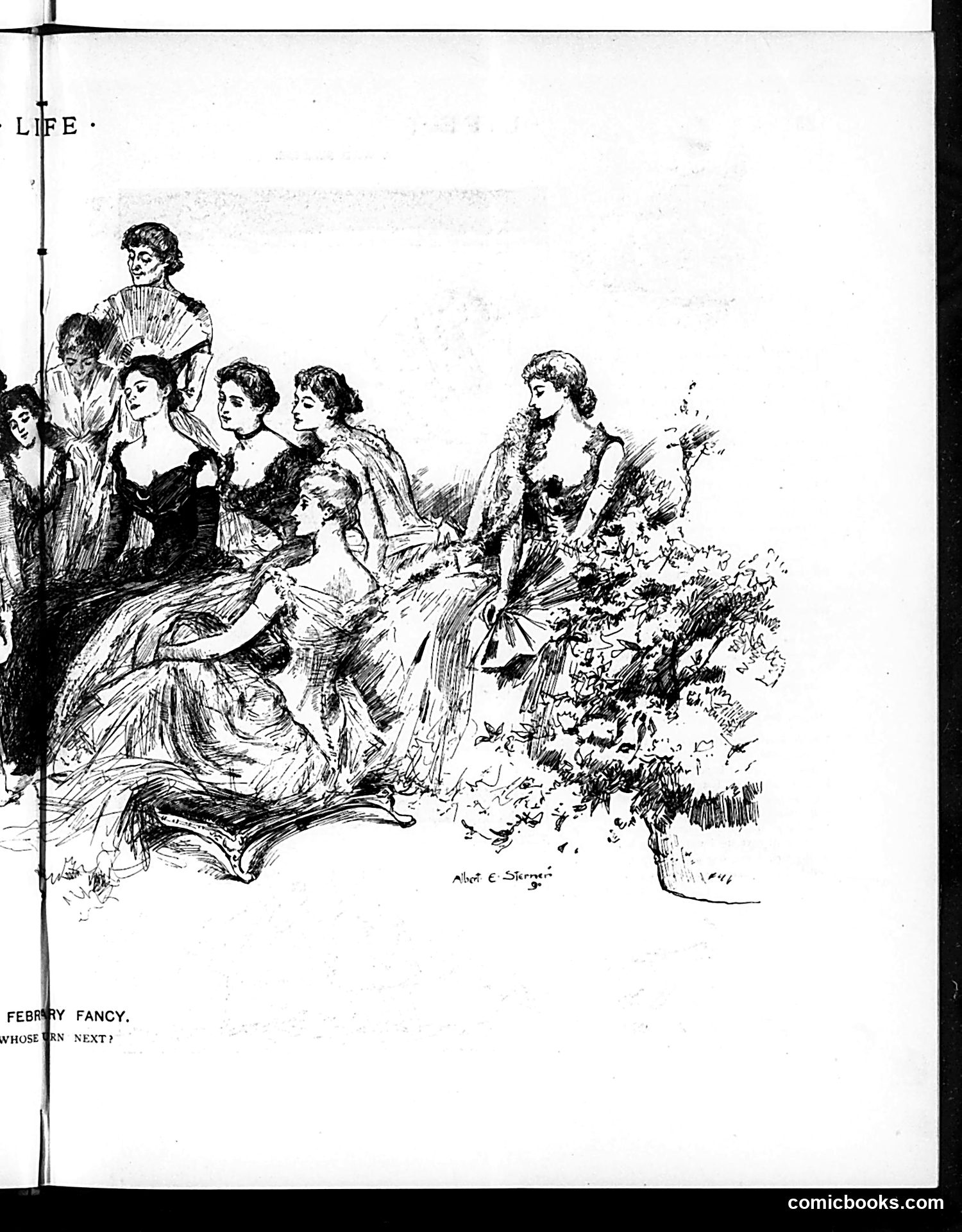
This is a sketch titled "FEBRARY FANCY. WHOSE VAN NEXT?" (likely "February Fancy" with "Whose Van Next?" - a play on words about social competition). The cartoon depicts a group of fashionably dressed women in an elegant interior setting, gathered around flowers. The composition suggests a social scene, possibly a tea party or salon gathering among upper-class women. The caption "Whose Van Next?" appears to reference social rivalry or competition—likely a satirical comment on the competitive nature of women's social gatherings and status-seeking behavior within high society. The artist (signed "Alef C. Sterner") is mocking the elaborate social posturing and competitive display of wealth or taste among affluent women. The overall tone is gently satirical rather than sharp political commentary.
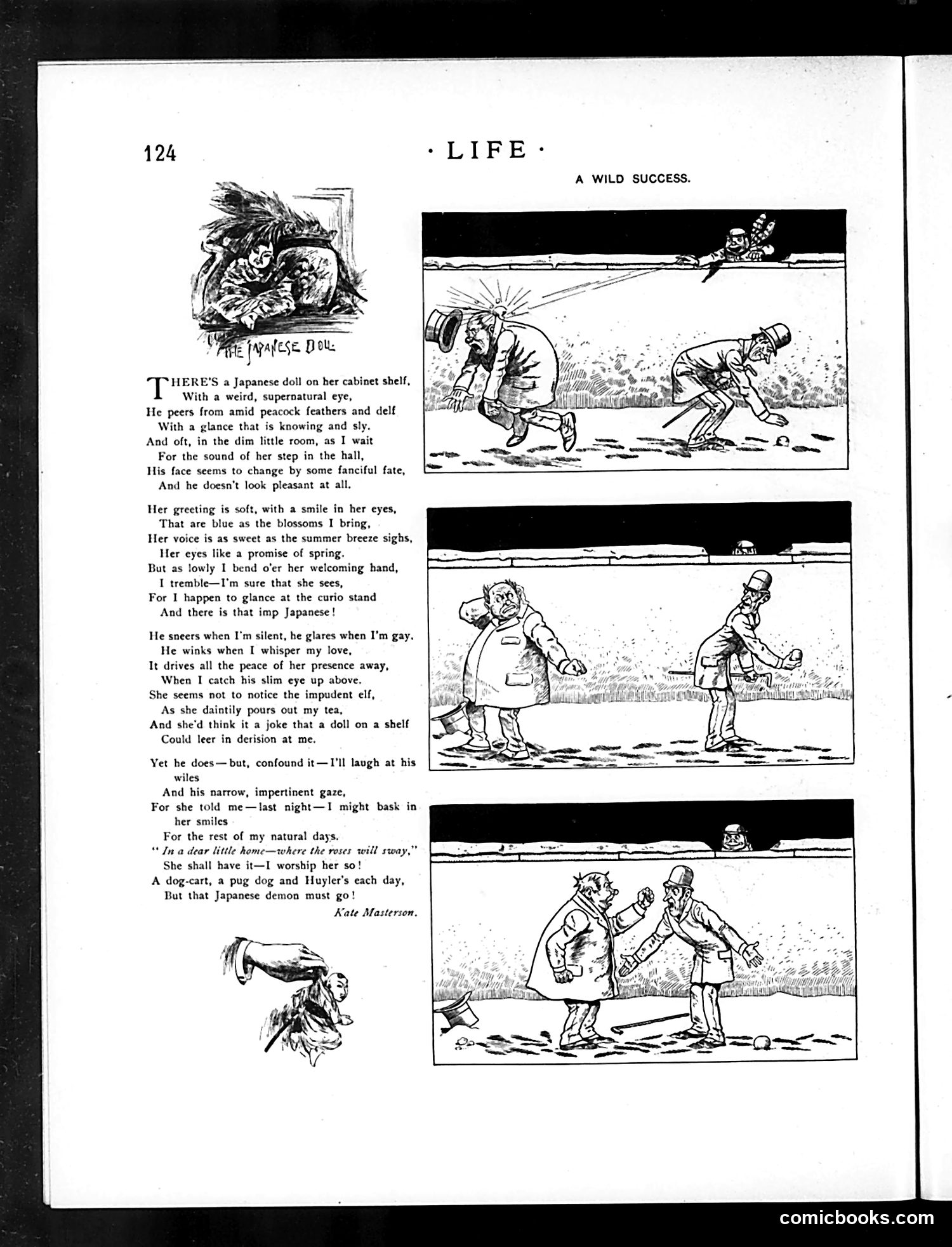
This page combines a poem "The Japanese Doll" by Kate Masterson with a four-panel comic strip depicting what appears to be a baseball game. The comic shows two teams competing, with players in period dress (early 20th century) engaged in baseball action—batting, pitching, and fielding. The poem describes a Japanese doll with supernatural qualities that unsettles the narrator, suggesting unease about Japanese culture or influence. The comic's title "A Wild Success" appears ironic, showing chaotic, poorly-executed baseball play rather than actual success. Together, these likely reflect early 20th-century American attitudes toward Japan—a mixture of fascination and anxiety about Japanese presence or influence during a period of increasing U.S.-Japan tension.
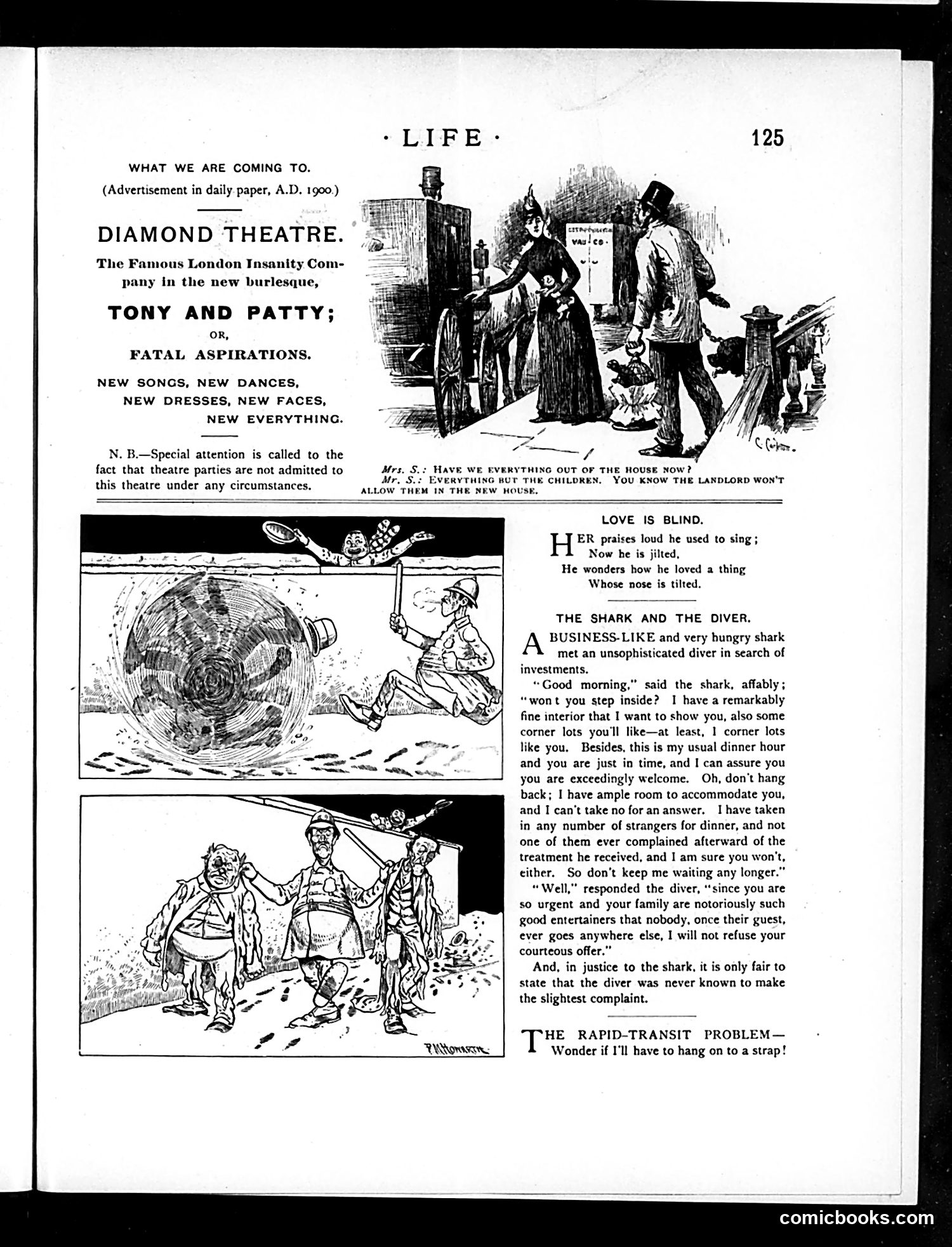
This page contains theatrical advertising and satirical humor typical of turn-of-the-century Life magazine. **Top section:** An advertisement for the Diamond Theatre's burlesque production "Tony and Patty; or, Fatal Aspirations," emphasizing novelty entertainment with "new songs, new dances, new dresses, new faces." **Middle cartoon ("The Shark and the Diver"):** A shark uses aggressive sales tactics to entice an unsophisticated diver into viewing his "interior," promising corner lots and hospitality. The satire mocks predatory business practices and real estate schemes common in 1900. **Bottom cartoon ("The Rapid-Transit Problem"):** References contemporary urban transit challenges, likely New York City's developing subway system. The page overall satirizes contemporary consumer culture, entertainment excess, and emerging urban problems of the period.
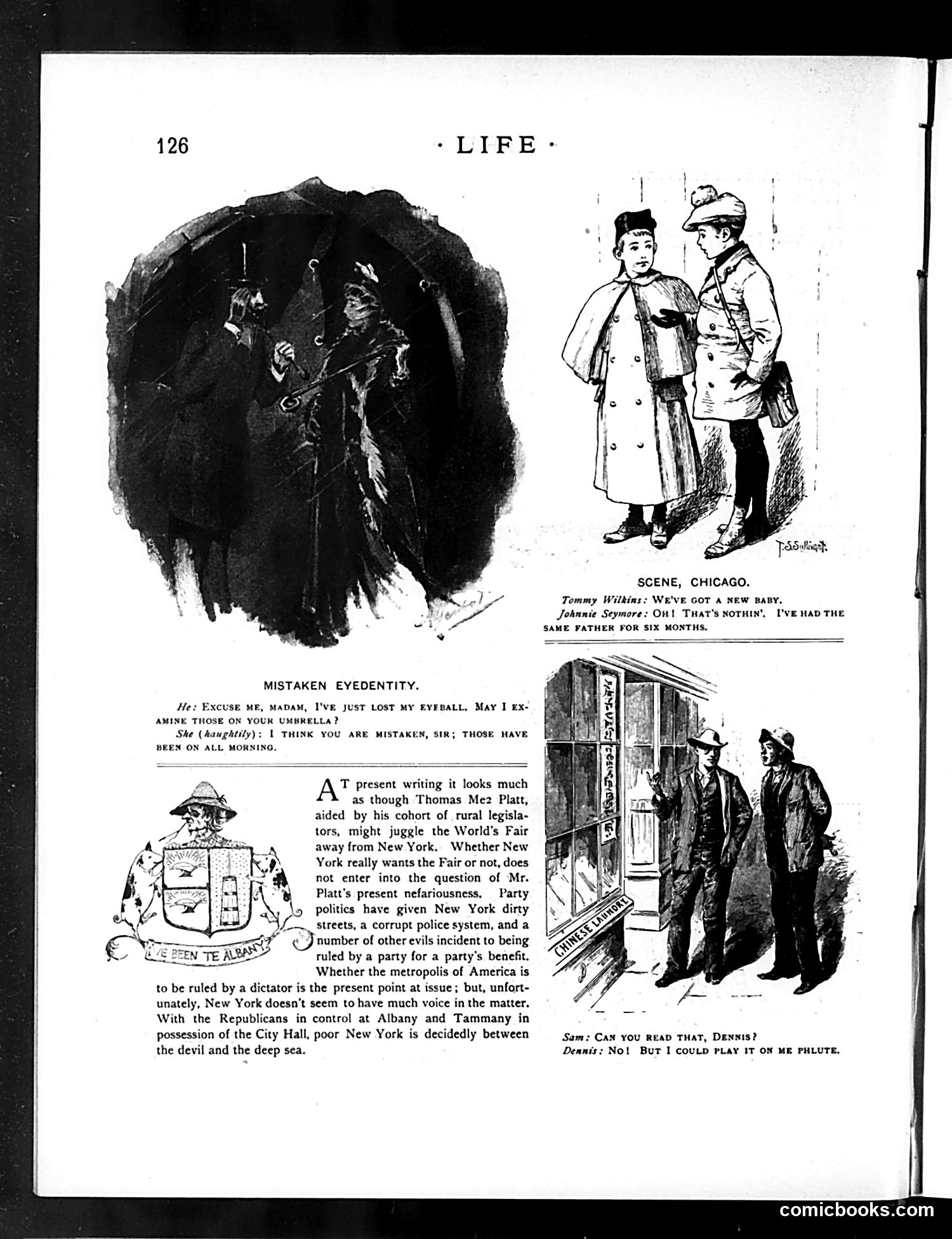
This page contains three separate satirical pieces: **"Mistaken Eyeidentity"** is a visual pun: a man asks to examine a woman's umbrella, claiming he lost his eyeball. Her sharp reply—those eyes have been there "all morning"—implies they're decorative umbrella ornaments, not actual eyes, creating absurdist humor. **The Chicago dialogue** jokes about infidelity: one boy brags about a new baby while another boasts his father has been the same for six months, suggesting the latter's mother has a long-term affair. **The main political article** criticizes Thomas C. Platt (a New York Republican politician) for allegedly manipulating the World's Fair location away from New York for partisan gain. The text condemns New York's governance, caught between Republican control in Albany and Tammany Hall (Democratic machine) controlling City Hall—leaving ordinary New Yorkers powerless, "between the devil and the deep sea." The final panel appears unrelated wordplay about reading and playing music.
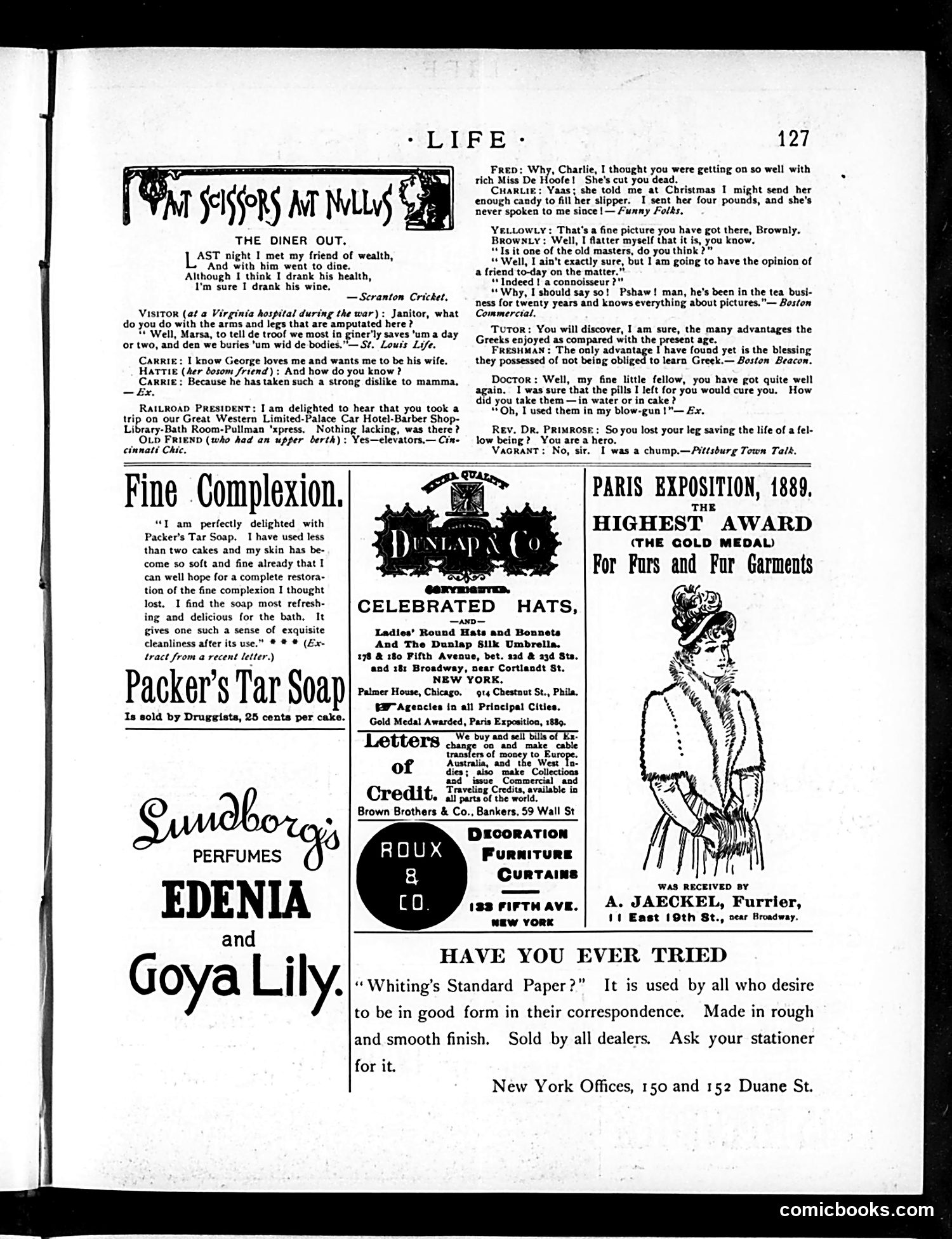
This page from *Life* magazine contains humorous short anecdotes and advertisements typical of late 19th-century American humor. The jokes rely on wordplay and social observation rather than identifying specific political figures. The cartoons/jokes include: a wealthy man's friend getting drunk on his wine; a Civil War hospital worker's matter-of-fact description of amputated limbs; a man rejected by a rich woman after sending her excessive candy; and a railroad company's luxury train lacking elevators. A freshman prefers not learning Greek; a doctor discovers his patient used pills as blowgun ammunition; and a man modestly denies being a hero, calling himself "a chump" instead. These reflect period concerns: wealth disparities, class consciousness, medical practice, and transportation innovation. The humor is genteel and observational—typical of *Life*'s satirical approach to everyday American life and social pretension, without targeting specific politicians or events.
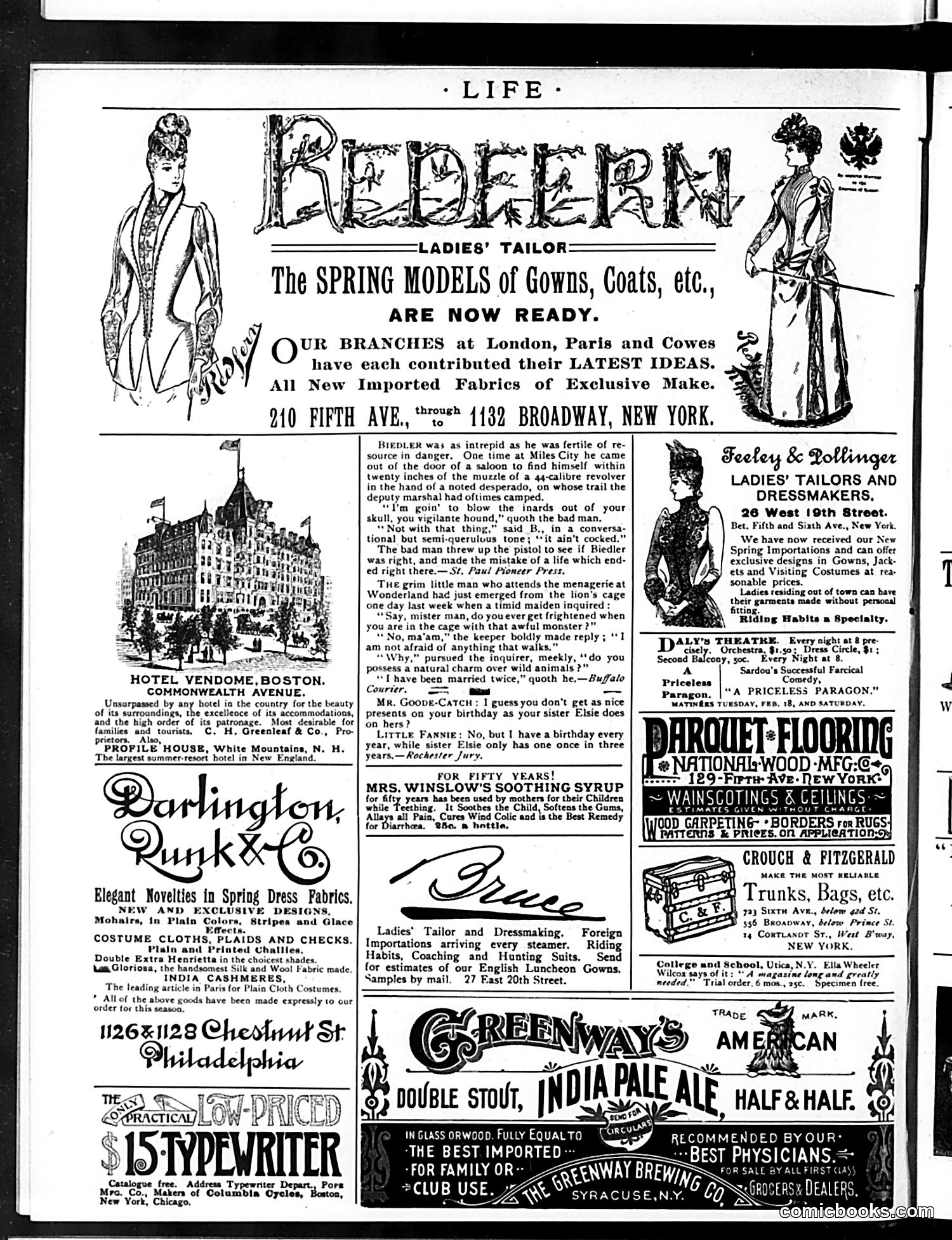
This is primarily an **advertising page** with no political cartoons or satirical content. The page features fashion and commercial advertisements typical of early 1900s American magazines. The small narrative snippets scattered among ads (about a gunslinger named Biedler, a zookeeper, and children's birthdays) are humorous **filler anecdotes**—brief jokes unrelated to any political satire. They're pure entertainment, not commentary. The advertisements themselves reflect the era's priorities: ladies' tailoring services emphasizing imported fabrics from London and Paris, luxury hotels, typewriters, and patent medicines like Mrs. Winslow's Soothing Syrup (a real product once widely marketed, though we'd now recognize it as potentially harmful). **For modern readers:** This page shows how turn-of-the-century magazines monetized content through ads while filling remaining space with light humor rather than substantive commentary.
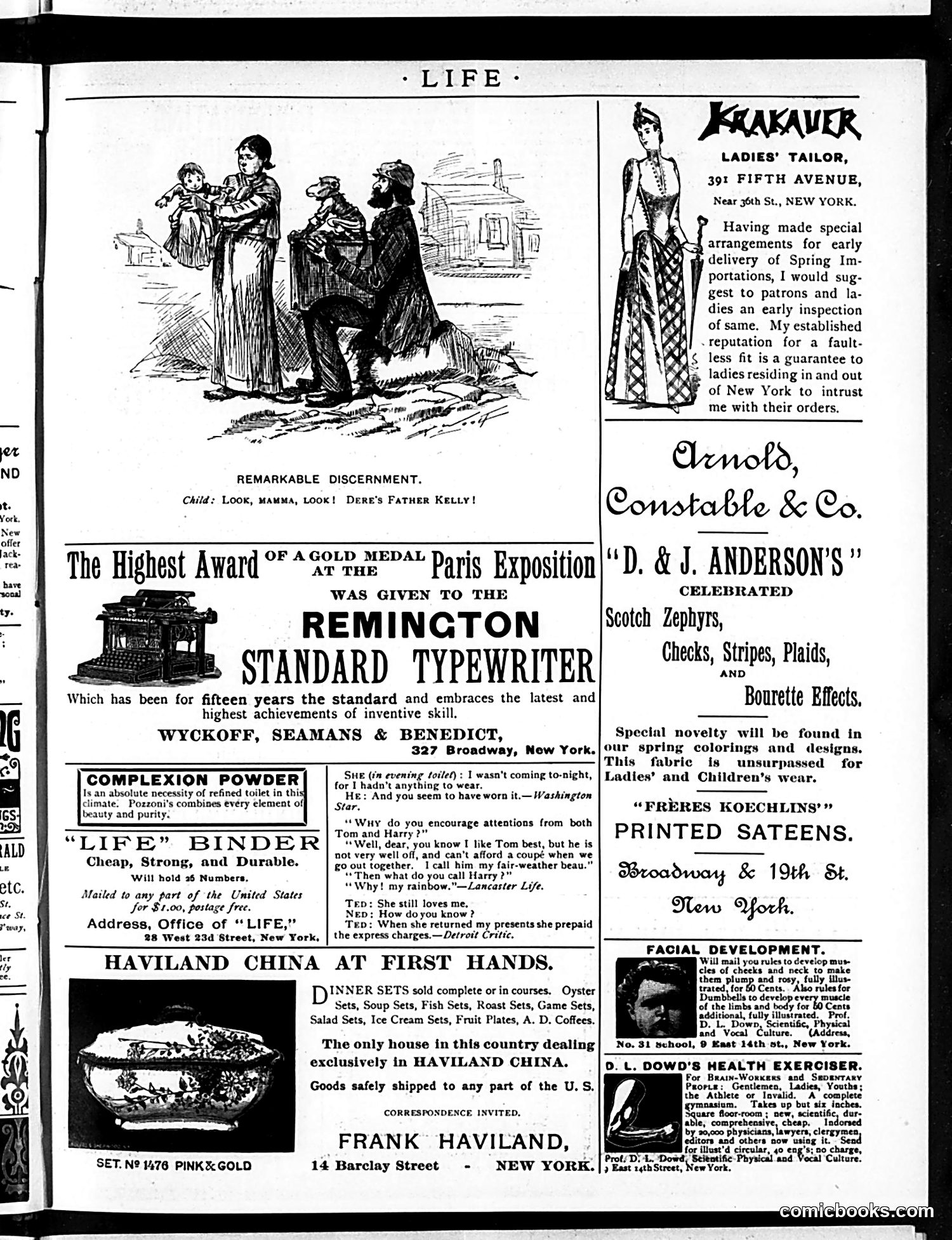
The single cartoon on this page depicts a social comedy about mistaken identity. A child points excitedly at a man in the street, telling his mother "Look, Mamma, look! There's Father Kelly!" The mother and another woman regard the man with amusement—the joke being the child's confusion or the man's resemblance to a priest. The title "Remarkable Discernment" suggests irony: either the child has remarkably poor judgment (confusing an ordinary man for a priest) or the man bears such a striking accidental resemblance to Father Kelly that even a child notices it. This is gentle, domestic humor typical of Life magazine's satirical content—poking fun at everyday social situations and human perception rather than political targets. The rest of the page comprises advertisements for typewriters, china, tailoring, and beauty products typical of late 19th-century American periodicals.
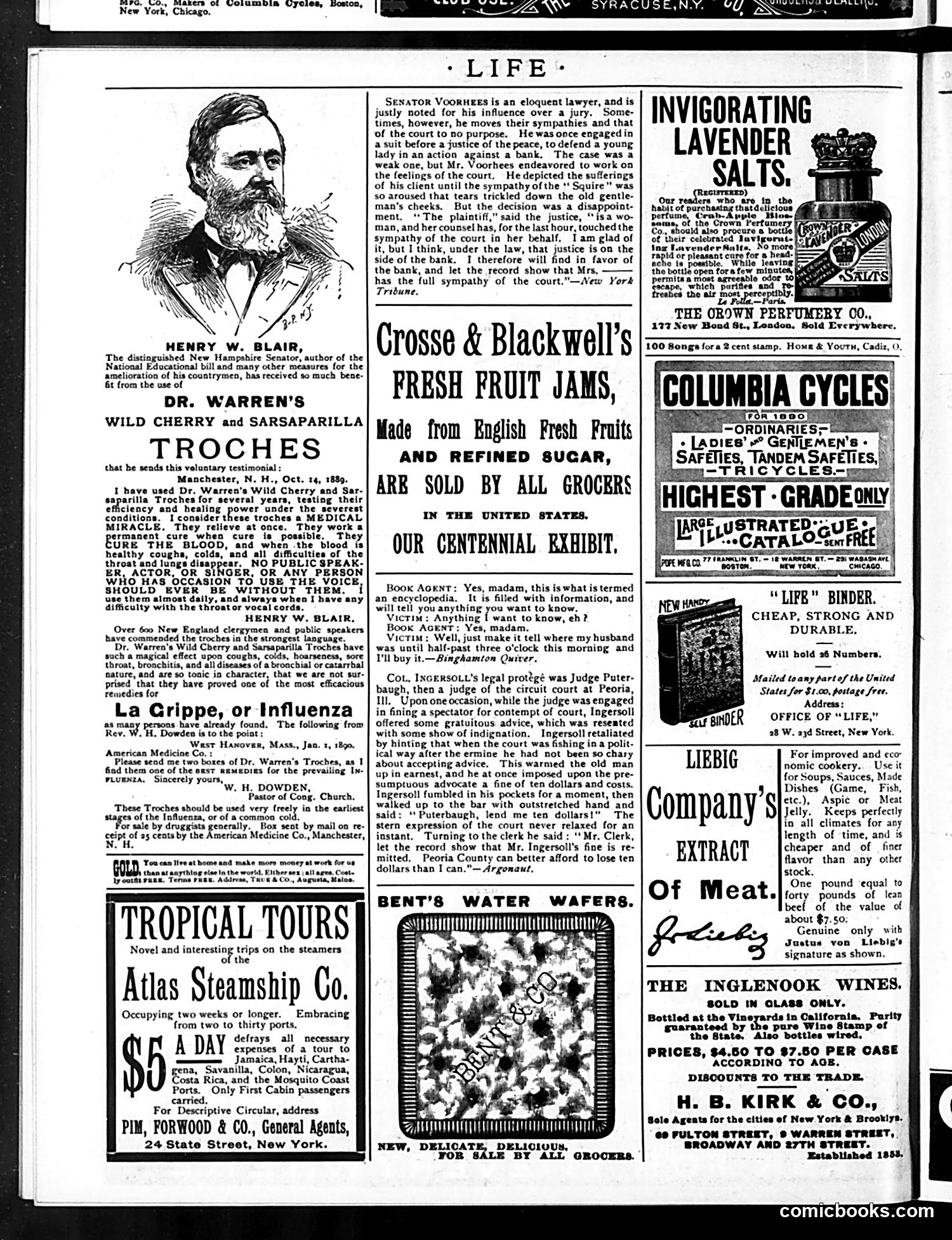
This page is primarily **advertising and editorial content**, not political satire. The main article features Senator Daniel W. Voorhees of Indiana, a noted orator. The anecdote illustrates a legal irony: Voorhees emotionally moved a justice of the peace to tears defending a young woman against a bank, yet lost the case anyway. The justice admitted the law favored the bank despite his sympathy—a commentary on law's sometimes harsh indifference to emotion or fairness. The page otherwise contains testimonial advertisements (Dr. Warren's medicinal troches endorsed by Senator Henry W. Blair and clergy), travel promotions (Atlas Steamship tropical tours), and product ads (jams, cycles, perfume, wine, meat extract). These represent typical late-19th-century magazine content mixing editorial content with commercial endorsements, often blurring distinctions between journalism and advertising.
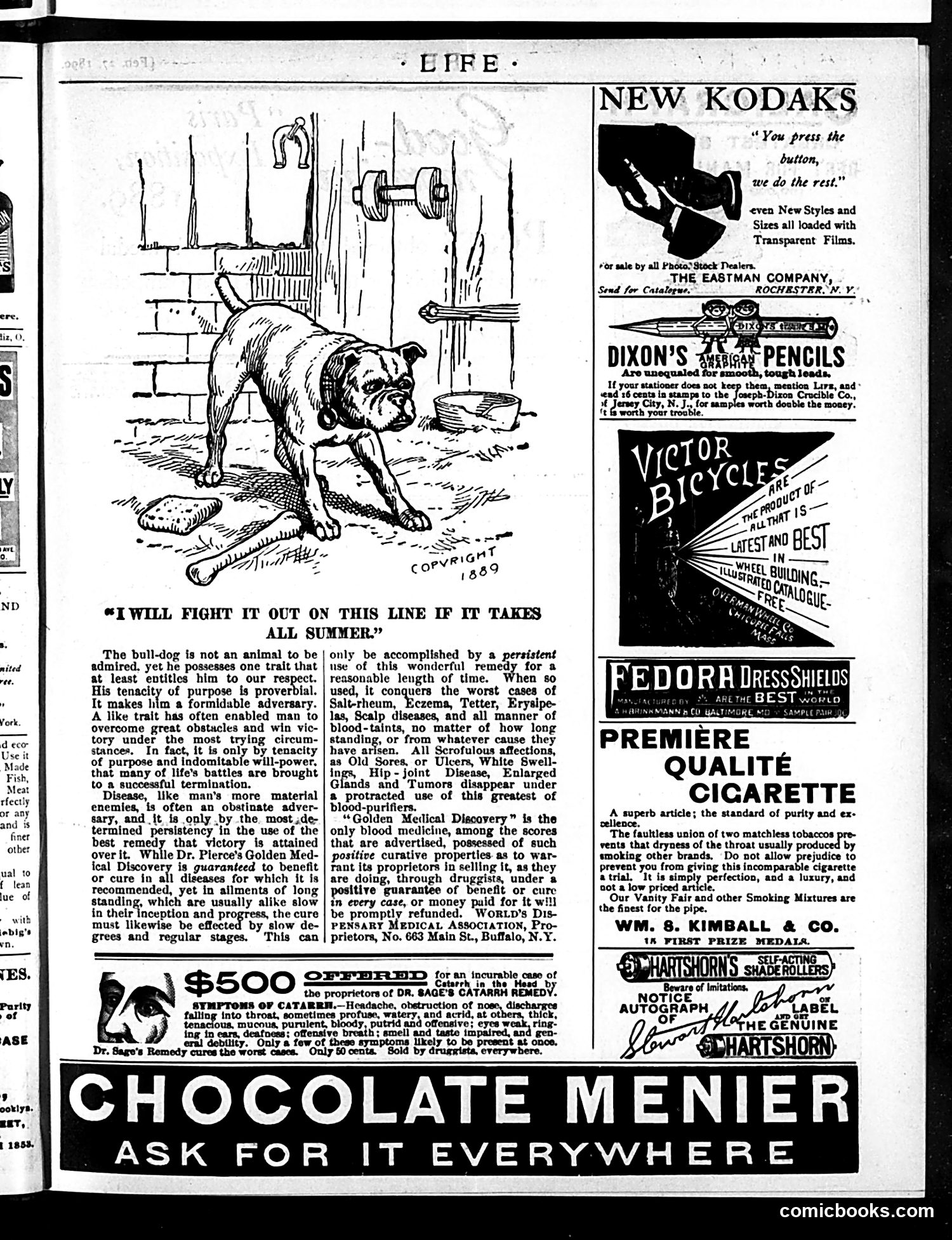
The main cartoon shows a bull-dog with the caption "I WILL FIGHT IT OUT ON THIS LINE IF IT TAKES ALL SUMMER." This quote appears to reference General Ulysses S. Grant's famous statement during the American Civil War, known for his relentless determination in battle. The satire equates the bull-dog's stubborn tenacity with human perseverance. The accompanying text uses this analogy to promote Dr. Pierce's Golden Medical Discovery—arguing that defeating disease, like winning a war, requires persistent determination and the "right remedy." The joke is the comparison: just as Grant fought without surrender, patients must persistently use this patent medicine to overcome chronic ailments like eczema, rheumatism, and blood diseases. The page is primarily **advertisements** for patent medicines, cameras (Kodak), pencils, bicycles, and cigarettes—typical of late 19th/early 20th-century *Life* magazine. The satire exploits American admiration for Grant's wartime resolve to sell dubious medical treatments.
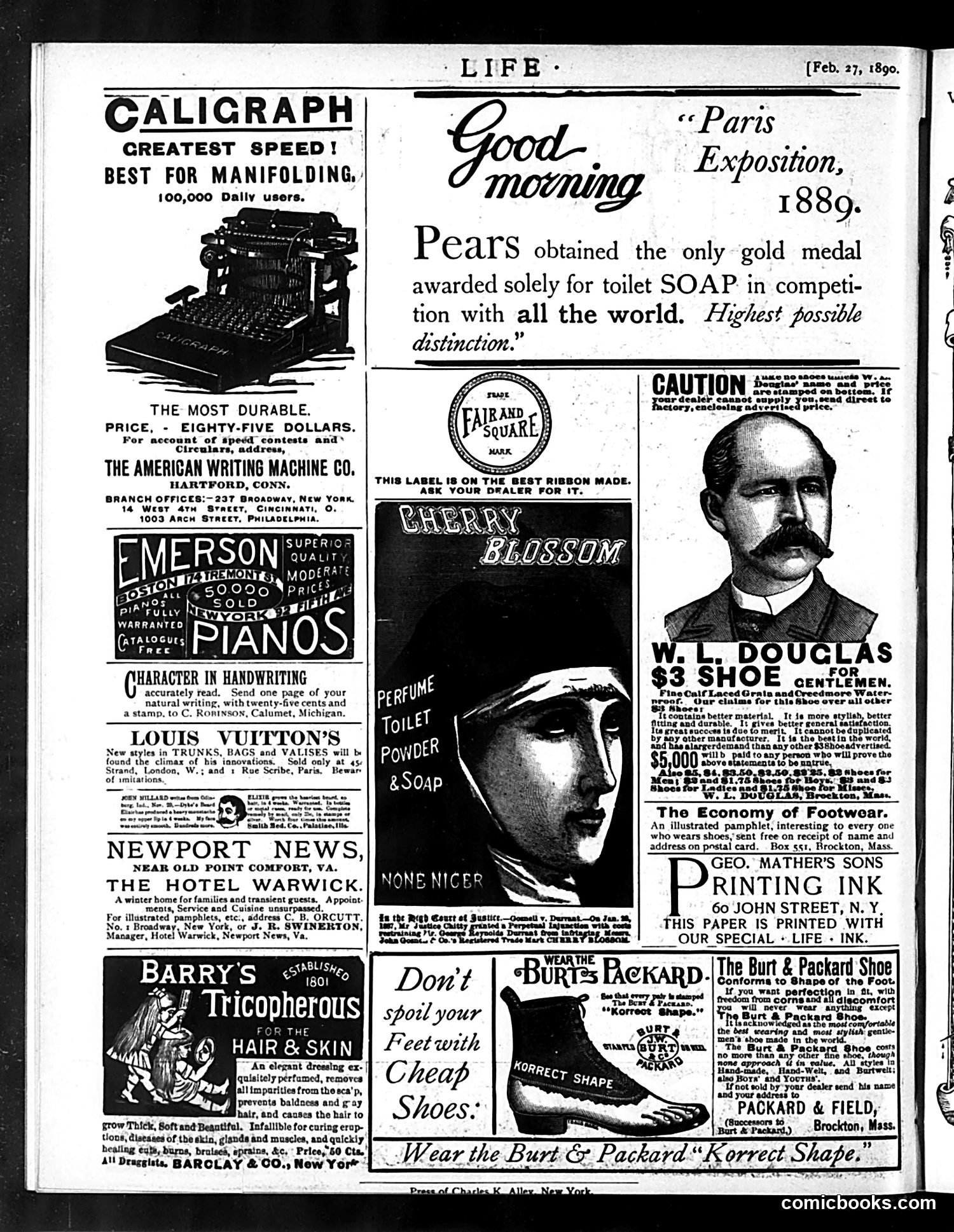
This is primarily a **advertisements page** from Life magazine (Feb. 27, 1890), not a political cartoon. The page contains commercial ads for typewriters, pianos, toiletries, shoes, hotels, and printing ink—typical of late 19th-century magazines. The only notable visual content beyond text consists of **portrait photographs** used to endorse products: a mustachioed man advertising W.L. Douglas shoes, and facial studies promoting perfume and soap. These appear to be standard advertising practices of the era. The **substantive content** is the Pears soap advertisement claiming a gold medal from the 1889 Paris Exposition—a legitimate claim used to establish product superiority through international recognition. The shoe advertisements emphasize durability and affordability, common selling points for working-class goods. No satire, political commentary, or caricature is evident on this page. It represents straightforward commercial promotion typical of 1890s American magazines, where advertising subsidized publication costs.