
Life, 1890-02-27 · page 6 of 18
Life — February 27, 1890 — page 6: what you’re looking at
What you’re looking at
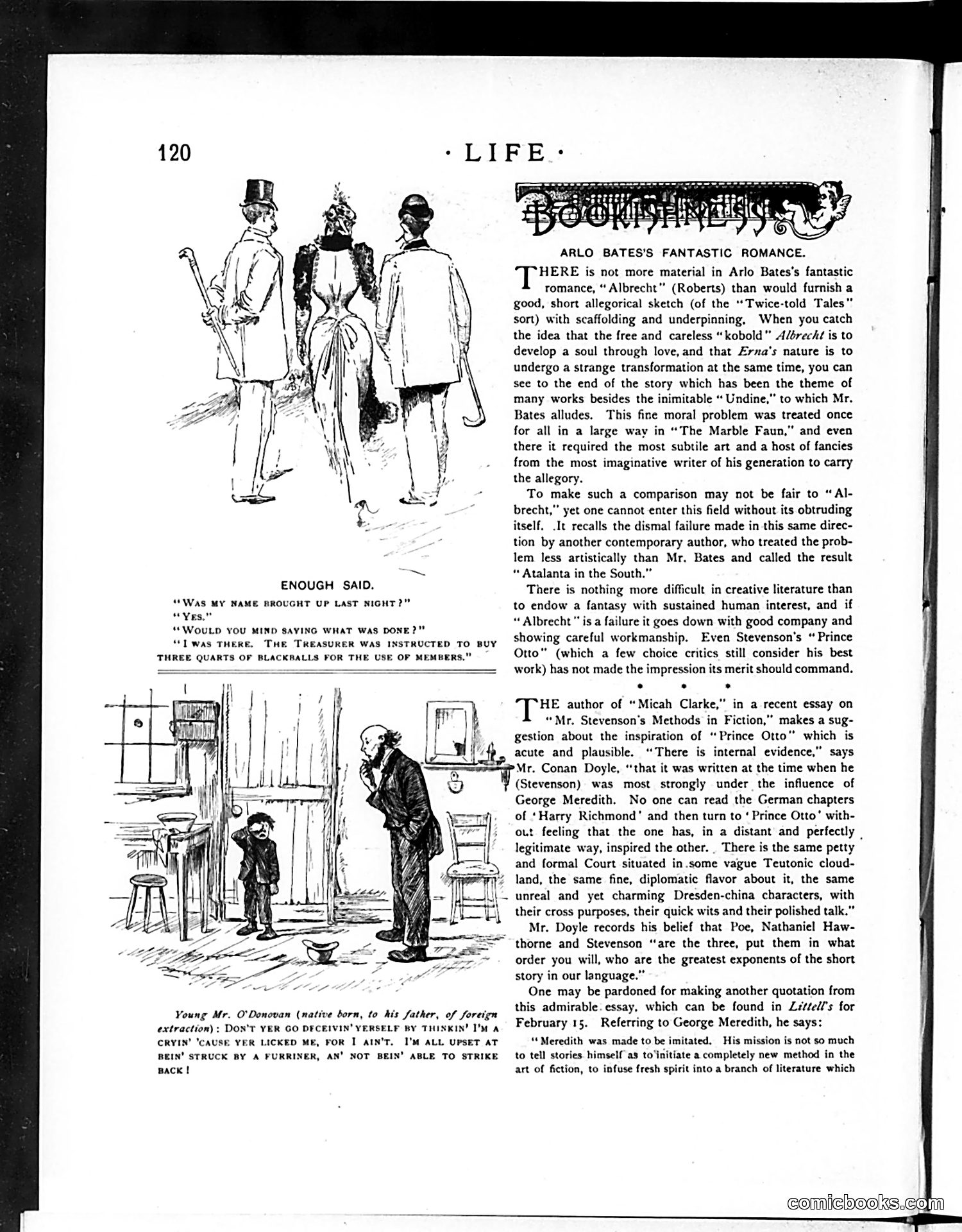
This page discusses Arlo Bates's romantic novel "Albrecht" (Roberts), comparing it to other allegorical works like "Undine" and "The Marble Faun." The text critiques fantasy literature's difficulty in sustaining human interest while maintaining allegorical meaning. The upper cartoon depicts three men in conversation, with dialogue about someone's name being "broadcast" and instructions to buy marbles "for the use of members"—likely satirizing some social or political custom, though the specific reference is unclear. The lower illustration shows a domestic scene with a tall man and boy, captioned "Young Mr. O'Donovan," with dialogue about deception and being "struck by a furnisher." The exact satirical target remains unclear from the image alone, but appears to mock social pretension or dishonest dealings.
📄 Transcribed text from this page (OCR, searchable)
Machine-transcribed from the original scan — historical spelling and the odd misread are preserved.
SS. Va ENOUGH SAID. “*WAS MY NAME BROUGHT UP LAST NIGHT?" “Yas.” “WOULD YOU MIND SAYING WHAT WAS DONE?" “Twas THERE, THE TREASURER WAS INSTRUCTED TO BUY THREE QUARTS OF BLACKRALLS FOR THE USE OF MEMBERS.” eo 3k8n} . TELA RUSCH 6\ ARLO BATES'’S FANTASTIC ROMANCE, HERE is not more material in Arlo Bates’s fantastic romance, “Albrecht” (Roberts) than would furnish a good, short allegorical sketch (of the Twice-told Tales” sort) with scaffolding and underpinning, When you catch the idea that the free and careless “kobold" Albrecht is to develop a soul through love, and that £rxa's nature is to undergo a strange transformation at the same time, you can see to the end of the story which has been the theme of many works besides the inimitable “ Undine,” to which Mr. Bates alludes. This fine moral problem was treated once for all in a large way in “The Marble Faun,” and even there it required the most subtile art and a host of fancies from the most imaginative writer of his generation to carry the allegory. To make such a comparison may not be fair to “Al- brecht,” yet one cannot enter this field without its obtruding itself. It recalls the dismal failure made in this same direc- tion by another contemporary author, who treated the prob- lem less artistically than Mr. Bates and called the result “ Atalanta in the South.” There is nothing more difficult in creative literature than to endow a fantasy with sustained human interest, and if “Albrecht " is a failure it goes down with good company and showing careful workmanship. Even Stevenson's “ Prince Otto” (which a few choice critics still consider his best work) has not made the impression its merit should command, . . . HE author of “Micah Clarke,” in a recent essay on “Mr. Stevenson's Methods in Fiction,” makes a sug- gestion about the inspiration of “Prince Otto” which is acute and plausible. “There is internal evidence,” says Mr. Conan Doyle, “that it was written at the time when he (Stevenson) was most strongly under the influence of George Meredith. No one can read the German chapters of ‘Harry Richmond’ and then turn to ‘ Prince Otto’ with- out feeling that the one has, in a distant and perfectly _ legitimate way, inspired the other. There is the same petty and formal Court situated in.some vague Teutonic cloud- ryZ land, the same fine, diplomatic flavor about it, the same Young Mr. O'Donovan (native born, to his father, of foreign extraction): DON'T YER GO DECEIVIN' YERSELF BY THINKIN? I'M A CRYIN’ ‘CAUSE YER LICKED ME, FOR I AIN'T. I'M ALL UPSET AT BEIN’ STRUCK BY A FURRINER, AN’ NOT BEIN’ ABLE TO STRIKE Back! unreal and yet charming Dresden-china characters, with their cross purposes, their quick wits and their polished talk.” Mr. Doyle records his belief that Poe, Nathaniel Haw- ~~ thorne and Stevenson “are the three, put them in what order you will, who are the greatest exponents of the short story in our language.” One may be pardoned for making another quotation from this admirable. essay, which can be found in Li¢tell’s for February 15. Referring to George Meredith, he says: “*Meredith was made to be imitated. His mission is not so much to tell stories himself as to'initiate a completely new method in the art of fiction, to infuse fresh spirit into a branch of literature which