
Life, 1890-02-27 · page 4 of 18
Life — February 27, 1890 — page 4: what you’re looking at
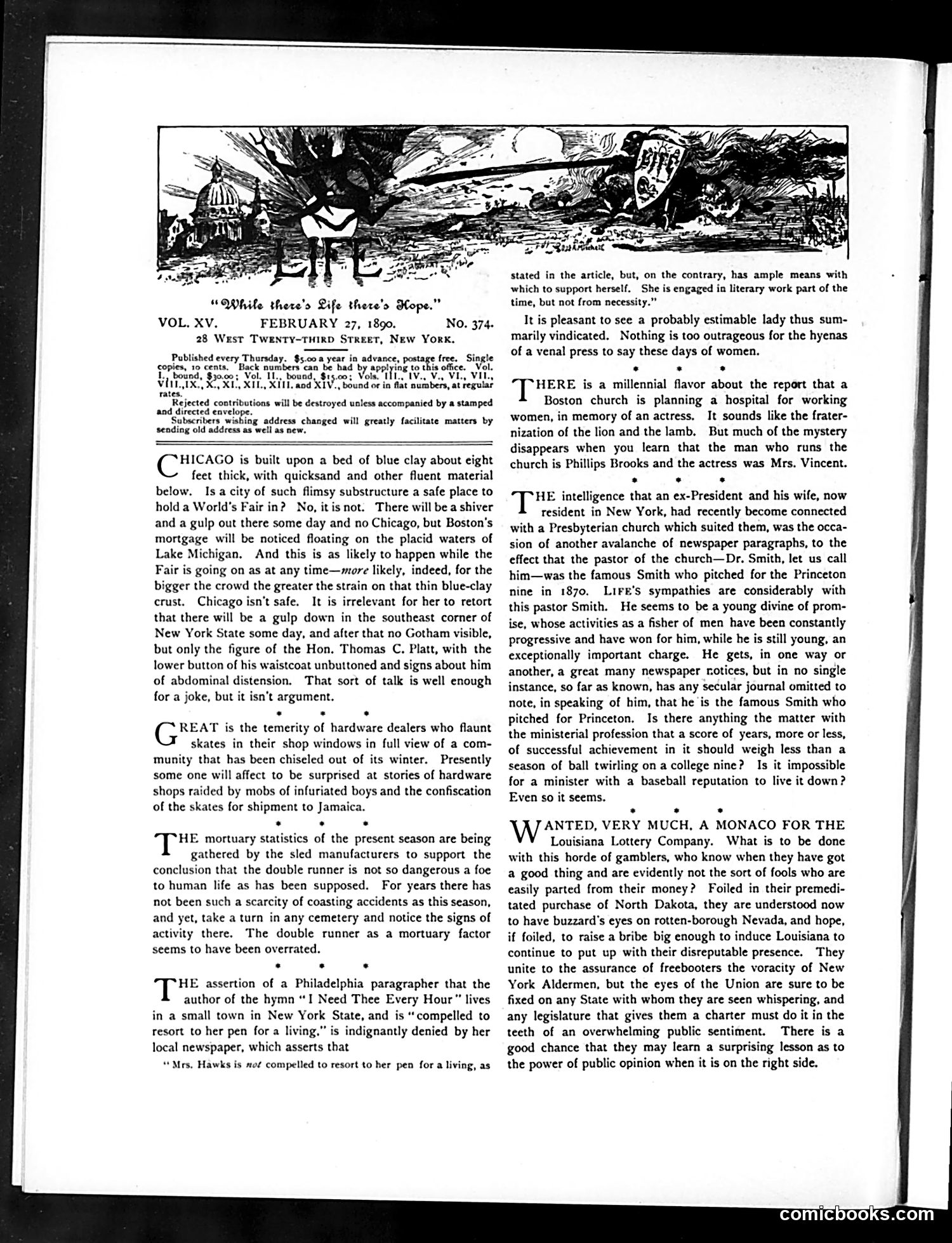
What you’re looking at
The page is primarily **text-based editorial commentary** rather than political cartoons. The masthead illustration shows a somewhat abstract or symbolic figure, but lacks clear satirical intent. The content addresses several contemporary issues: 1. **Chicago's World's Fair** - discusses construction vulnerabilities and crowd safety 2. **Hardware dealer fraud** - mocking stores selling skates to boys who then use them for petty theft 3. **Mortuary statistics** - debating whether double-runners (sleds) cause more deaths than claimed 4. **Mrs. Hawks controversy** - defending a female author's literary work against accusations she needed writing income 5. **Louisiana Lottery** - criticizing gamblers and praising anti-gambling sentiment The satire employs **ironic commentary** on contemporary social problems rather than visual caricature. The tone is moralistic, typical of 1890s American satirical journalism.
📄 Transcribed text from this page (OCR, searchable)
Machine-transcribed from the original scan — historical spelling and the odd misread are preserved.
“While there's Life there's Hope.” VOL, XV. FEBRUARY 27, 1890. No. 374. 28 West Twenty-THIRD Street, New Yorx, Published every Thursday. $5.00. year in advance, postage free. Single ‘i Back numbers can be had by applying to this office. Vol. 1. bound, $30.00; Vol. Il,. bound, $ts.co; Vola Mle lV., Vic Ving Vile, VUIL,IX,, X., XL, XIL, XT, aod XIV., bound of in flat numbers, at regular rates, Rejected contributions will be destroyed unless accompanied by a stamped and directed envelope. Subscribers wishing address changed will greatly facilitate matters by sending old address as well as new, HICAGO is built upon a bed of blue clay about eight feet thick, with quicksand and other fluent material below. Isa city of such flimsy substructure a safe place to hold a World’s Fair in? No, itis not. There will be a shiver and a gulp out there some day and no Chicago, but Boston's mortgage will be noticed floating on the placid waters of Lake Michigan. And this is as likely to happen while the Fair is going on as at any time—more likely, indeed, for the bigger the crowd the greater the strain on that thin blue-clay crust. Chicago isn’t safe. It is irrelevant for her to retort that there will be a gulp down in the southeast corner of New York State some day, and after that no Gotham visible, but only the figure of the Hon. Thomas C, Platt, with the lower button of his waistcoat unbuttoned and signs about him of abdominal distension. That sort of talk is well enough for a joke, but it isn’t argument. . . . REAT is the temerity of hardware dealers who flaunt skates in their shop windows in full view of a com- munity that has been chiseled out of its winter. Presently some one will affect to be surprised at stories of hardware shops raided by mobs of infuriated boys and the confiscation of the skates for shipment to Jamaica. . . . HE mortuary statistics of the present season are being gathered by the sled manufacturers to support the conclusion that the double runner is not so dangerous a foe to human life as has been supposed. For years there has not been such a scarcity of coasting accidents as this season, and yet, take a turn in any cemetery and notice the signs of activity there. The double runner as a mortuary factor seems to have been overrated. . . . HE assertion of a Philadelphia paragrapher that the author of the hymn “I Need Thee Every Hour” lives in a small town in New York State, and is “compelled to resort to her pen fora living,” is indignantly denied by her local newspaper, which asserts that “Mrs. Hawks is of compelled to resort to her pen fora living, as stated in the article, but, on the contrary, has ample means with which to support herself. She is engaged in literary work part of the time, but not from necessity.” It is pleasant to see a probably estimable lady thus sum- marily vindicated. Nothing is too outrageous for the hyenas of a venal press to say these days of women. . . * HERE is a millennial flavor about the report that a Boston church is planning a hospital for working women, in memory of an actress. It sounds like the frater- nization of the lion and the lamb. But much of the mystery disappears when you learn that the man who runs the church is Phillips Brooks and the actress was Mrs. Vincent. . . . HE intelligence that an ex-President and his wife, now resident in New York, had recently become connected with a Presbyterian church which suited them, was the occa- sion of another avalanche of newspaper paragraphs, to the effect that the pastor of the church—Dr. Smith, let us call him—was the famous Smith who pitched for the Princeton nine in 1870, LiFe’s sympathies are considerably with this pastor Smith. He seems to be a young divine of prom- ise, whose activities as a fisher of men have been constantly progressive and have won for him, while he is still young, an exceptionally important charge. He gets, in one way or another, a great many newspaper notices, but in no single instance, so far as known, has any secular journal omitted to note, in speaking of him, that he is the famous Smith who pitched for Princeton. Is there anything the matter with the ministerial profession that a score of years, more or less, of successful achievement in it should weigh less than a season of ball twirling on a college nine? Is it impossible for a minister with a baseball reputation to live it down? Even so it seems. . . . ANTED, VERY MUCH, A MONACO FOR THE Louisiana Lottery Company. What is to be done with this horde of gamblers, who know when they have got a good thing and are evidently not the sort of fools who are easily parted from their money? Foiled in their premedi- tated purchase of North Dakota, they are understood now to have buzzard’s eyes on rotten-borough Nevada, and hope, if foiled, to raise a bribe big enough to induce Louisiana to continue to put up with their disreputable presence. They unite to the assurance of freebooters the voracity of New York Aldermen, but the eyes of the Union are sure to be fixed on any State with whom they are seen whispering, and any legislature that gives them a charter must do it in the teeth of an overwhelming public sentiment. There is a good chance that they may learn a surprising lesson as to the power of public opinion when it is on the right side.