
A complete issue · 18 pages · 1890
Life — February 13, 1890
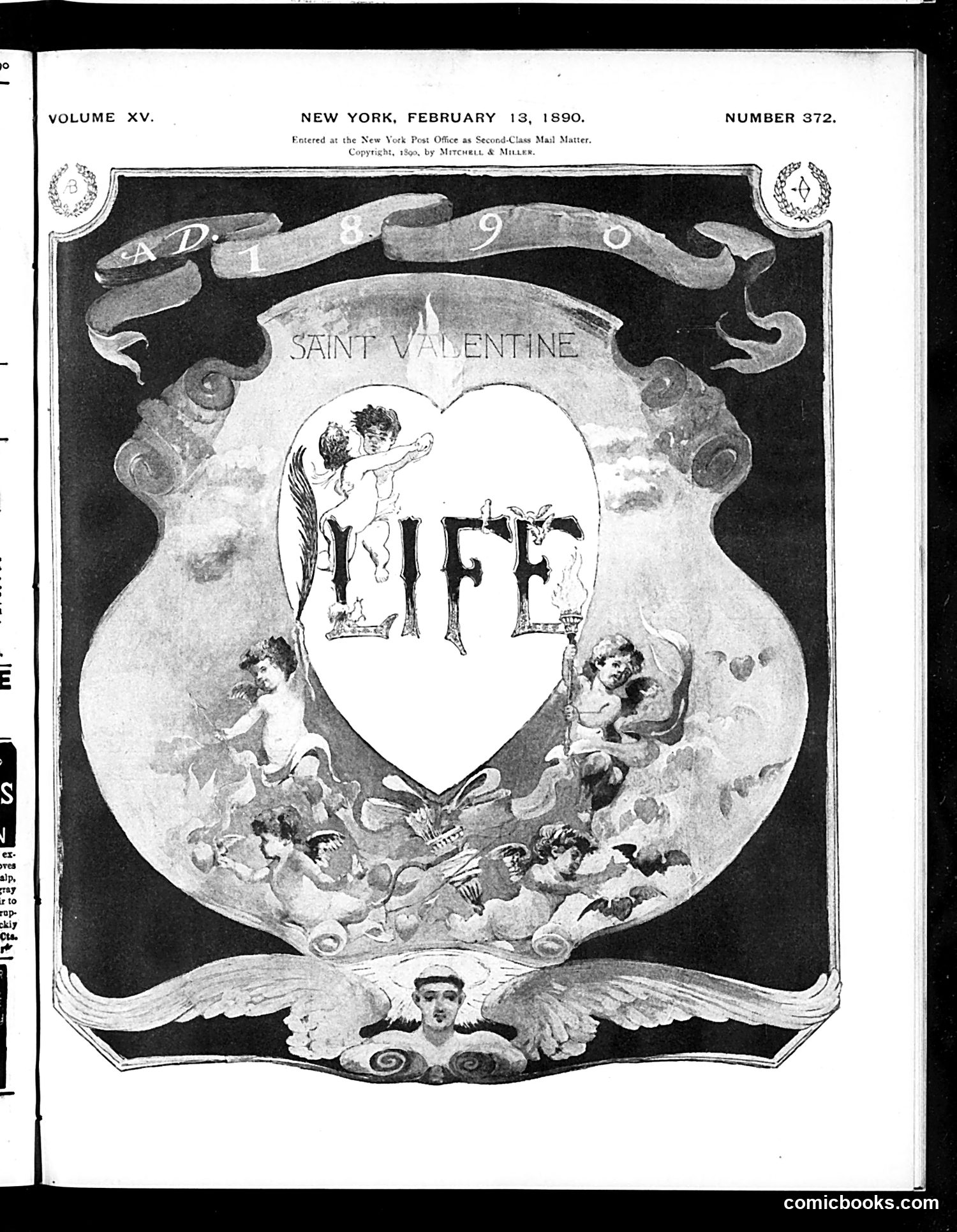
This is a Valentine's Day-themed cover for *Life* magazine. The central image shows a large heart containing the word "LIFE" surrounded by cherubs (cupids) in a decorative, classical style. The composition is ornate and romantic, featuring multiple cherub figures arranged around the heart—some at the top, sides, and bottom of the frame. The banner at top reads "SAINT VALENTINE," establishing the holiday context. The design is purely decorative rather than satirical, celebrating romantic love and Valentine's Day traditions. This appears to be a festive special issue rather than a political cartoon—typical of the period's magazine cover art using classical allegorical imagery (cupids, hearts, scrollwork) to market the holiday edition to readers.
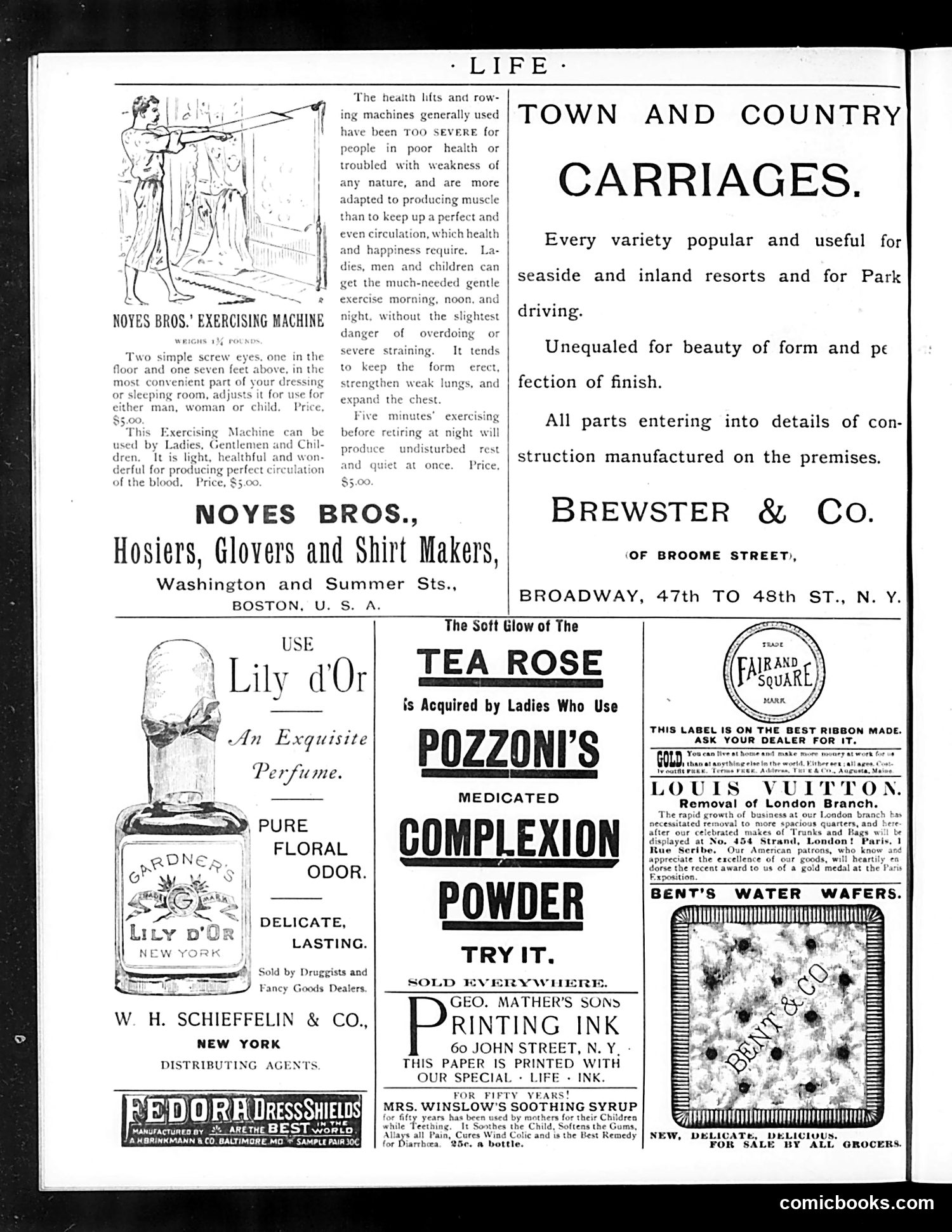
This page is **primarily advertising with minimal editorial content**. The single cartoon shows a man using Noyes Bros.' Exercising Machine—a Victorian-era fitness device with pulleys and weights. The accompanying text describes it as safe for "ladies, gentlemen and children," emphasizing gentle exercise for weak constitutions and poor health. The humor is mild and situational rather than satirical: the cartoon simply illustrates the machine's use. The appeal to health-conscious readers reflects genuine late-19th/early-20th-century anxieties about physical fitness and weakness, particularly among sedentary urban populations. The remaining page consists entirely of period product advertisements (perfume, carriages, complexion powder, printing ink, wafers), typical of *Life* magazine's revenue model. No political satire is present.
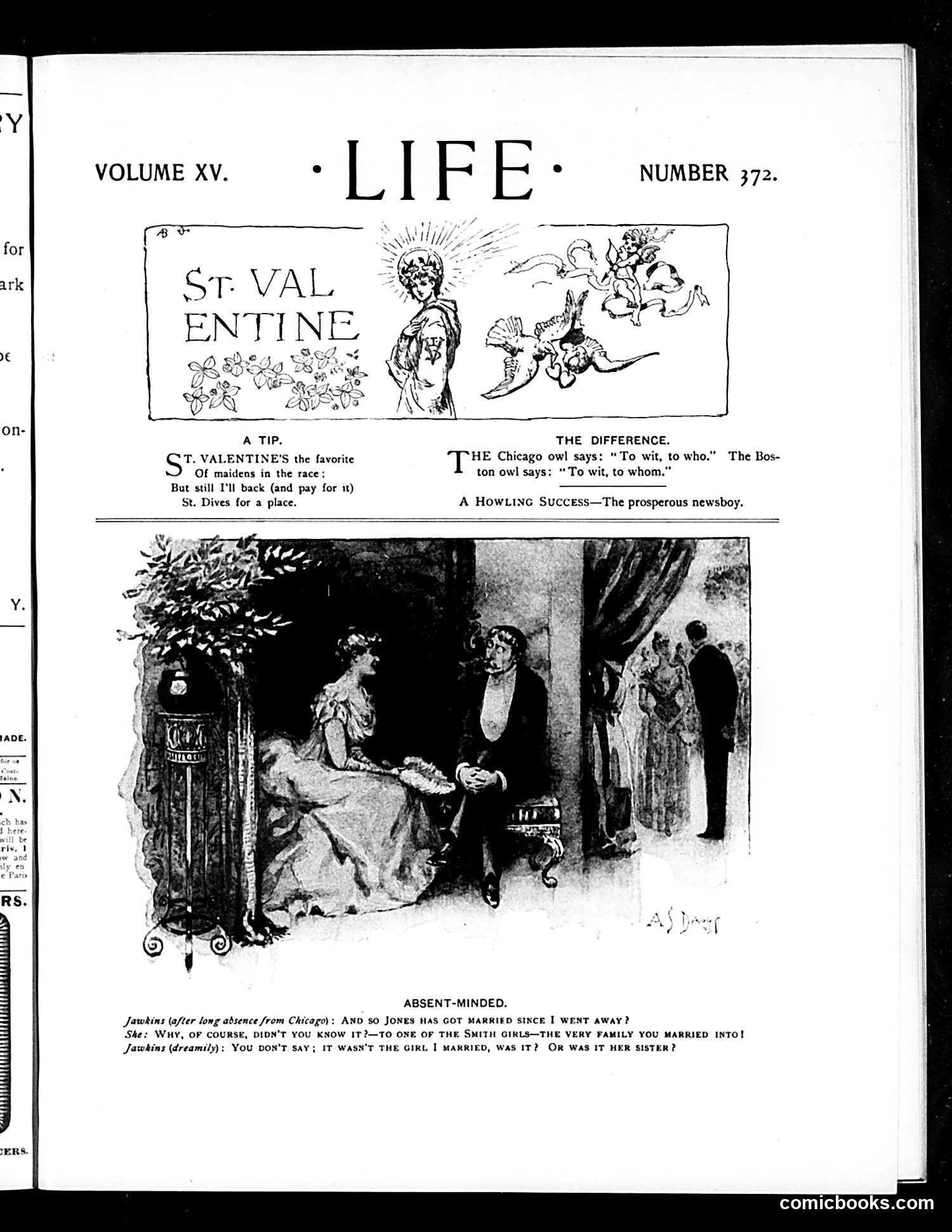
This page contains three separate humorous pieces: 1. **"St. Valentine"** (header illustration): A decorative Valentine's Day themed drawing. 2. **"A Tip" and "The Difference"**: Two brief jokes contrasting horse-racing terminology and owl homophones (wit/to whom vs. wit/to who). 3. **"Absent-Minded"** (main cartoon): Depicts a man (Janckins) returning home after a long absence from Chicago, confusing which family member he married. His wife explains he married "one of the Smith girls"—not her sister. The satire mocks absentmindedness and suggests marrying members of the same family are interchangeable. The cartoon reflects early 20th-century upper-class domestic humor focused on forgetfulness and social embarrassment rather than political commentary.
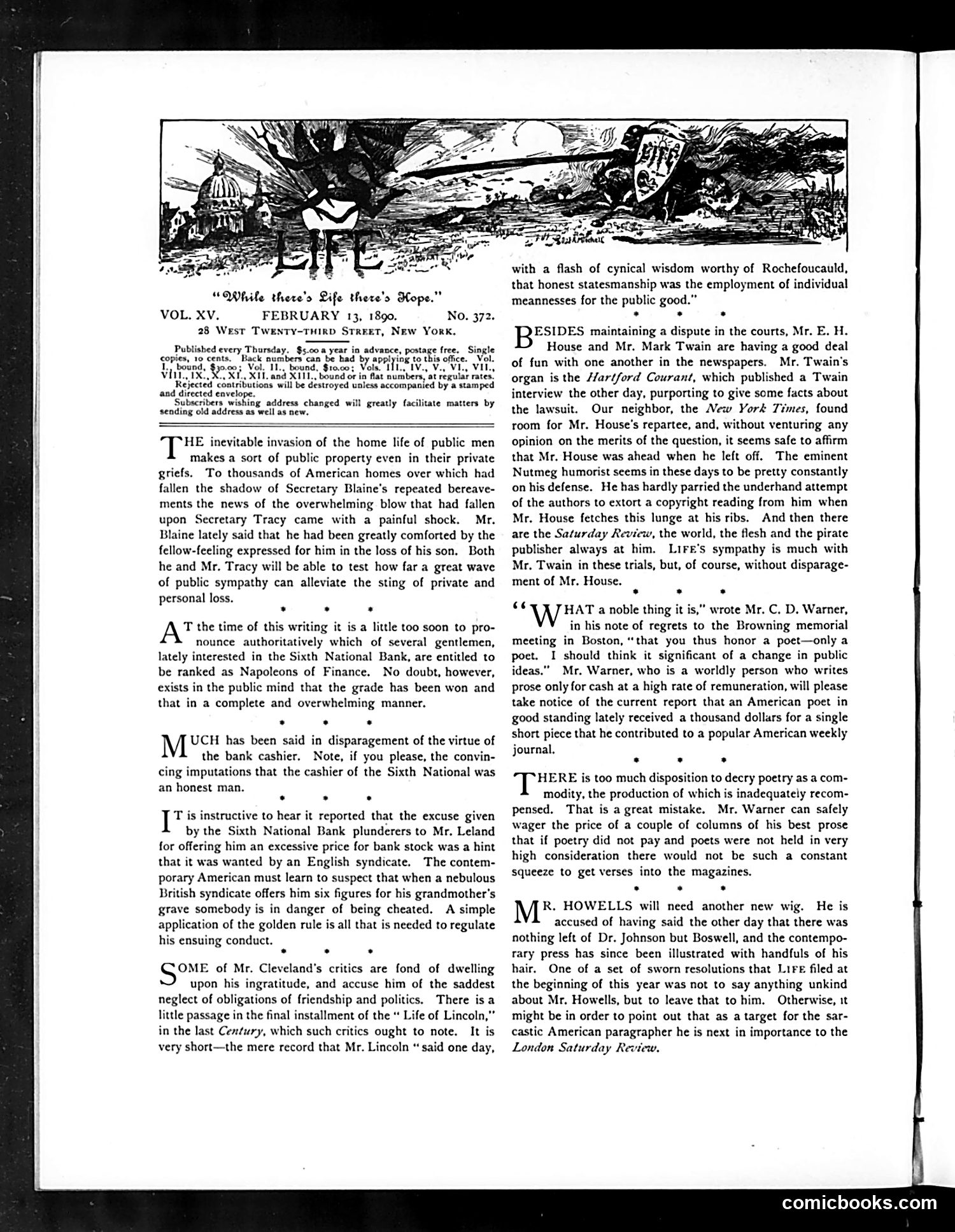
The cartoon at the top, titled "While there's a Wife there's Hope," depicts a domestic scene with allegorical figures. The imagery appears to show Secretary of the Treasury (referenced in the text) amid broader commentary on public and private life. The article discusses how public figures' private lives become public property, specifically addressing Secretary Tracy's recent bereavement. The text notes the "inevitable invasion of the home life of public men," suggesting contemporary concern about media intrusion into politicians' personal affairs. The piece also covers disputes between Mark Twain and E.H. House over copyright and literary matters, and critiques the low payment poets receive from American magazines—suggesting these were pressing cultural issues in 1890.
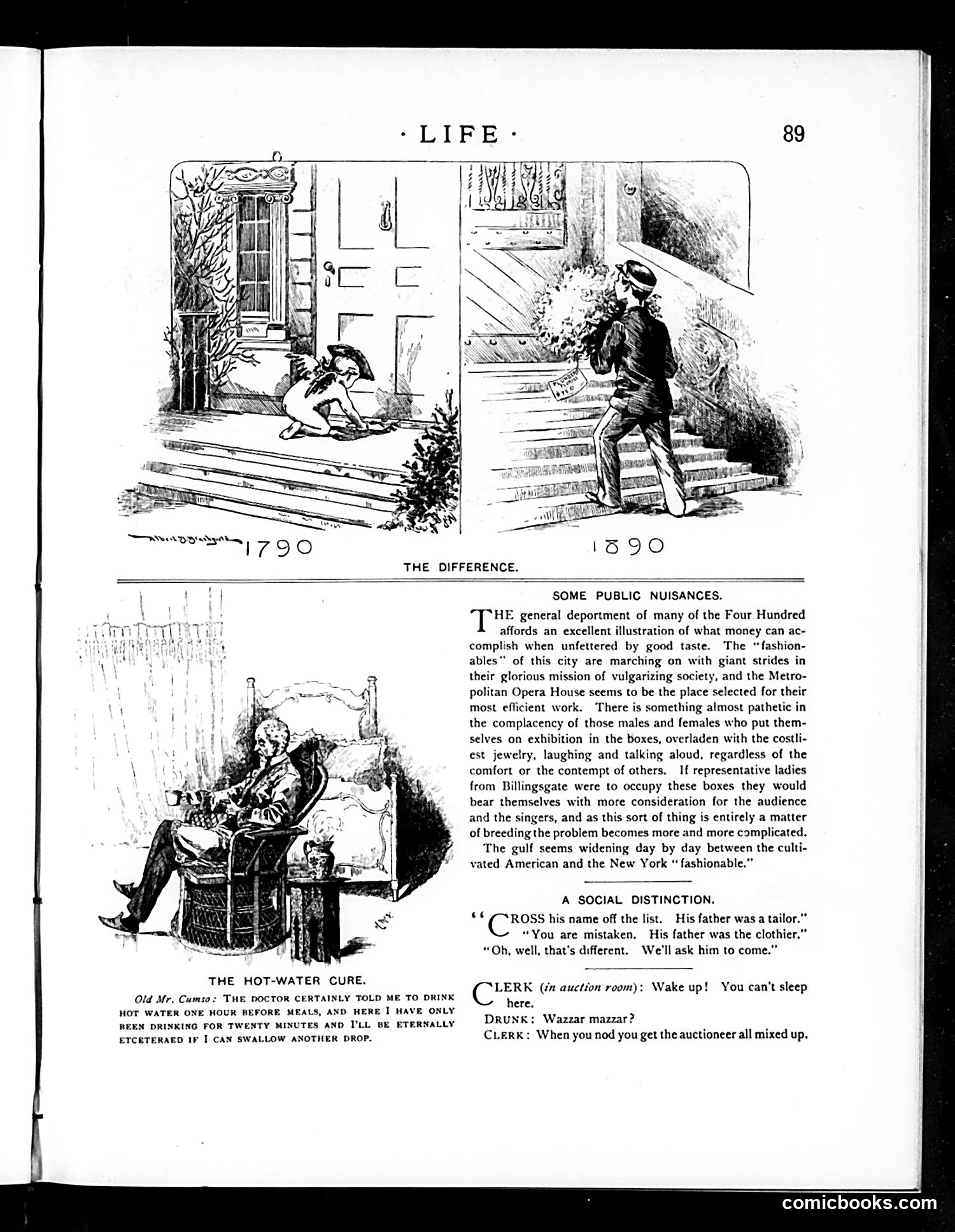
**"The Difference" (1790 vs. 1890):** This comparative cartoon shows a century of social change. The 1790 image depicts a child playing outside a modest home. The 1890 image shows a well-dressed man (likely representing the same social position, now prosperous) on what appears to be an elegant street. The satire suggests that American society has grown wealthier and more refined over the century. **"Some Public Nuisances":** This section criticizes fashionable society women who monopolize opera boxes, disrupting performances through loud conversation and jewelry display rather than appreciating the art. **"The Hot-Water Cure":** A comic sketch mocking medical fads—specifically a doctor's recommendation to drink hot water before meals for health, which the patient has taken to absurd extremes. The page illustrates fin-de-siècle American social criticism through humor.
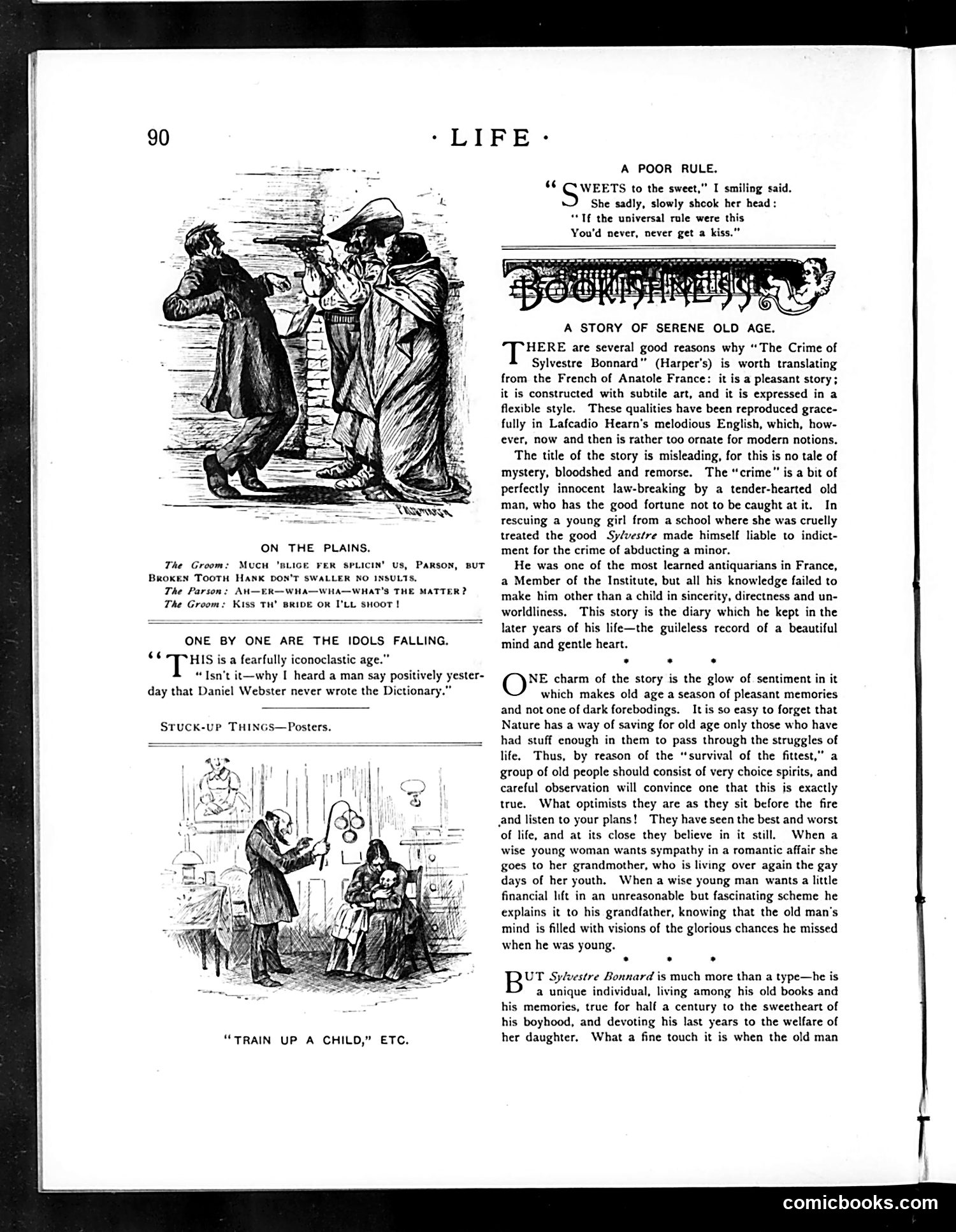
This page from *Life* magazine contains three distinct sections: 1. **"On the Plains"** (top left): A sketch showing two men in conversation. The caption references "blige per splicin'" and mentions shooting, suggesting this is a humorous dialogue about nautical or frontier mishaps. 2. **"One by One Are the Idols Falling"** (middle): A brief satirical quote mocking the phrase "iconoclastic age," commenting on the erosion of established authorities or figures—a common *Life* theme critiquing social change. 3. **"Stuck-up Things"** (bottom left): An illustration depicting what appears to be social pretension, likely satirizing affected behavior among certain classes. 4. **"Bookshelf"** (right): A substantial book review of "The Crime of Sylvestre Bonnard," praising its sentimental exploration of old age and memory. The page blends satirical humor with literary critique, typical of *Life*'s mixed-content format.
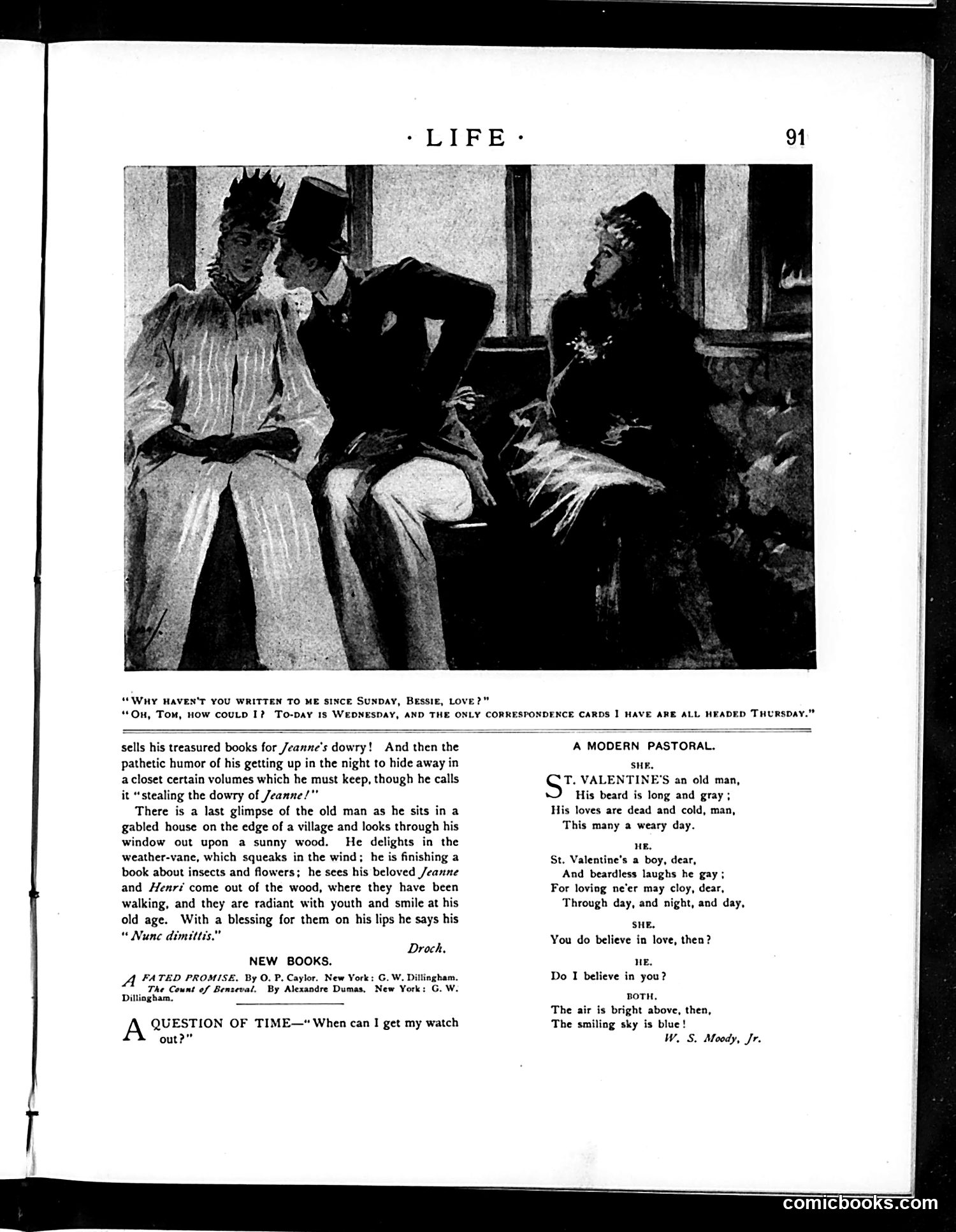
This page contains a theatrical scene photograph at top, showing three figures in period costume engaged in conversation. The caption's dialogue references correspondence cards and a Wednesday deadline, suggesting a comedic domestic situation. Below is a "New Books" section advertising "A Gilded Promise" and "The Count of Breval" by Alexander Dumas, followed by a brief humorous item titled "A Question of Time" about getting a watch repaired. The main literary content is "A Modern Pastoral," a poem by W.S. Moody Jr., presenting a dialogue between "She" and "He" about love and belief, with romantic imagery ("the air is bright above, then, / The smiling sky is blue!"). The page appears primarily focused on literary and theatrical content rather than political satire, typical of Life magazine's mixed entertainment approach during this era.
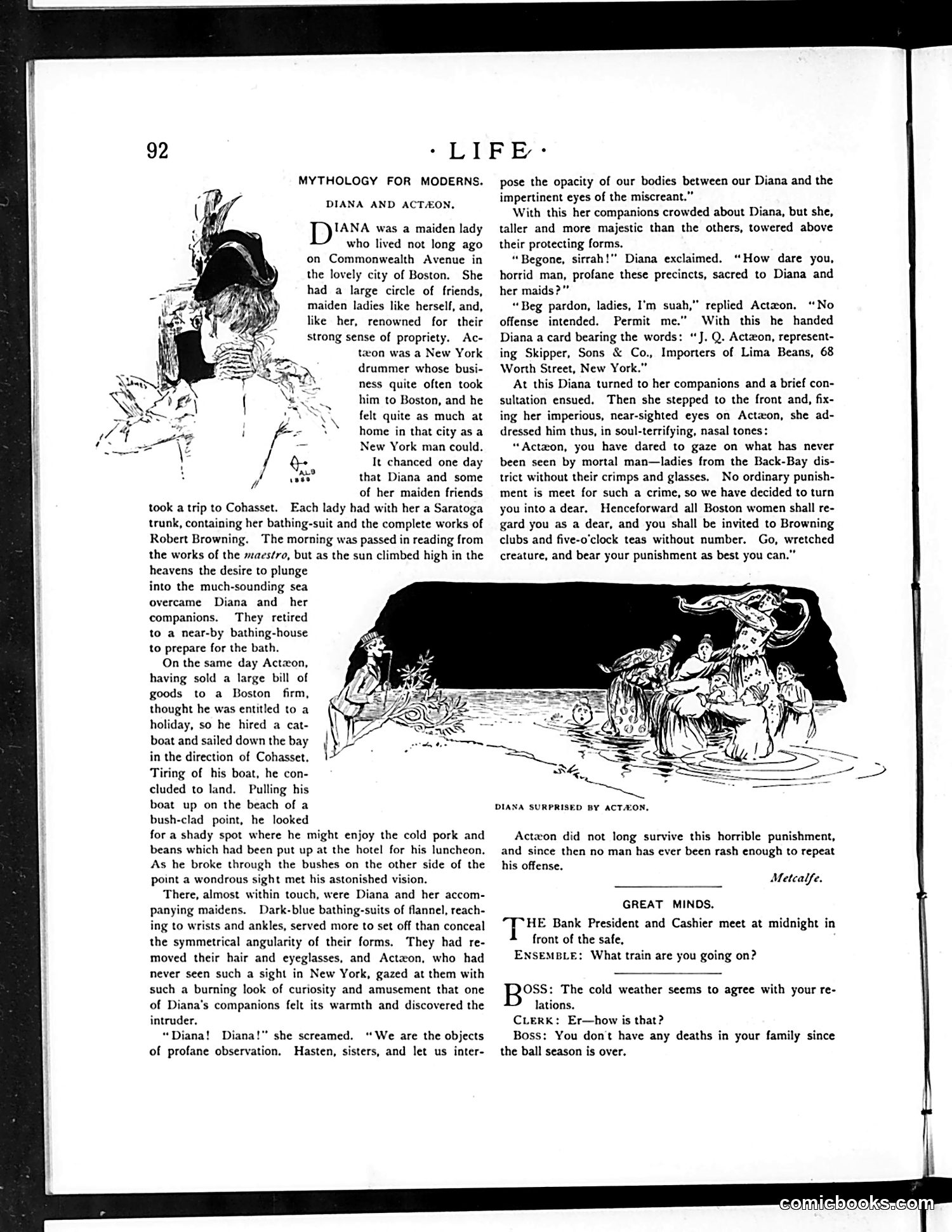
This page presents a satirical retelling of the classical myth of Diana and Actaeon. In the original myth, the huntress goddess Diana punishes a man who glimpses her bathing by transforming him into a deer. The satire updates this to a Boston social scenario: Diana is a wealthy lady on Commonwealth Avenue; Actaeon is a New York drummer (traveling salesman) who encounters her and her fashionable companions at Cohasset beach. When he gazes at them in their bathing attire, Diana publicly shames and threatens him with social exclusion—the modern equivalent of mythological punishment. The joke targets both the pretentiousness of Boston's social elite and the transgressive gaze of the outsider male, using classical mythology to mock contemporary class anxieties.
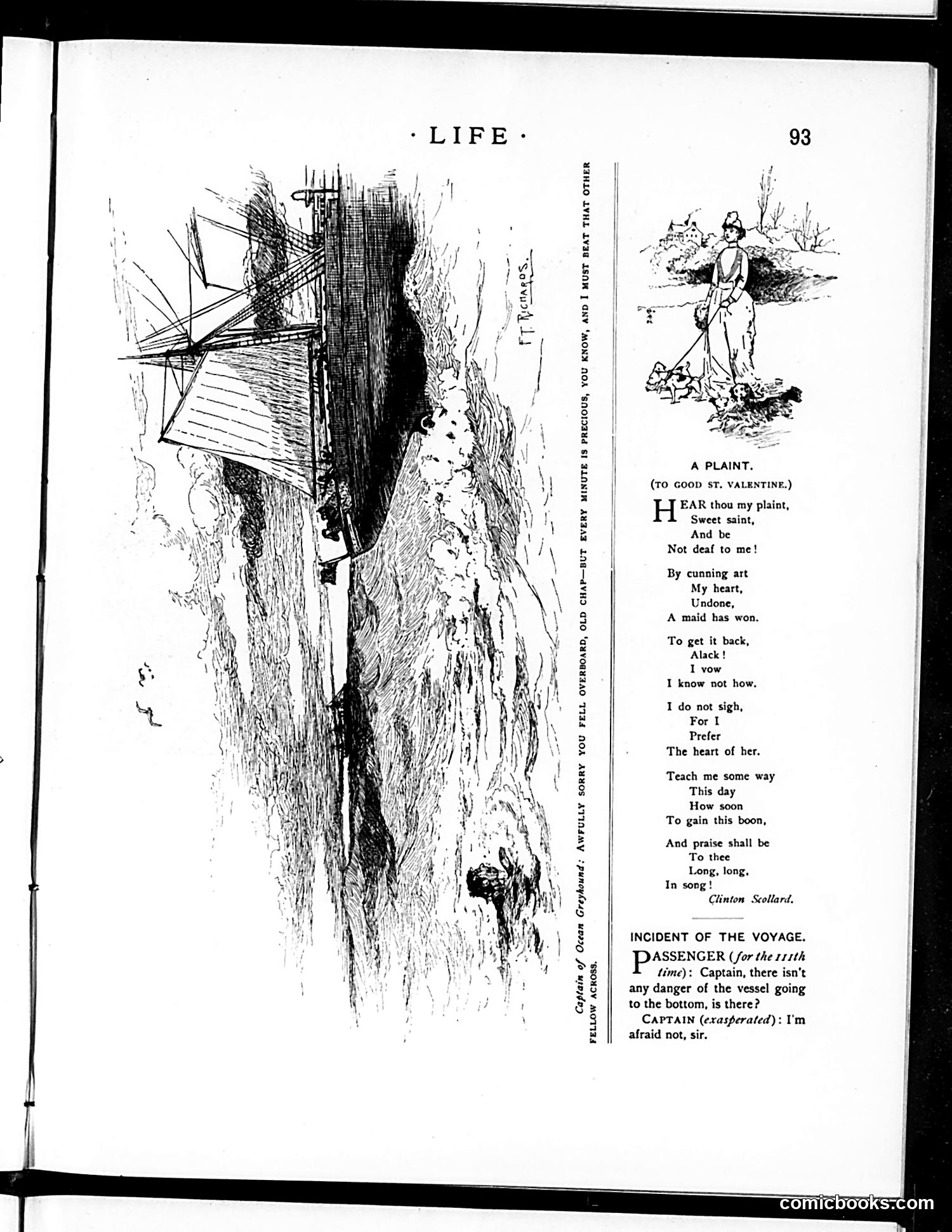
The page contains two distinct pieces: **Left side:** A sketch of a sailing ship in distress, tilted at a dramatic angle in rough seas—illustrating a maritime disaster scenario. **Right side:** A poem titled "A Plaint (To Good St. Valentine)" accompanied by an illustration of a man in period dress with hunting dogs, addressing a plant. The poem expresses romantic frustration—the speaker's heart has been "won" by a maid through cunning, and he requests St. Valentine's assistance in winning her affection. Below is a brief comedic dialogue titled "Incident of the Voyage" where a nervous passenger asks the captain if the ship will sink, and the exasperated captain reassures him. The satire appears to mock both romantic desperation (the poem) and travel anxieties (the dialogue), typical Victorian-era humor targets.
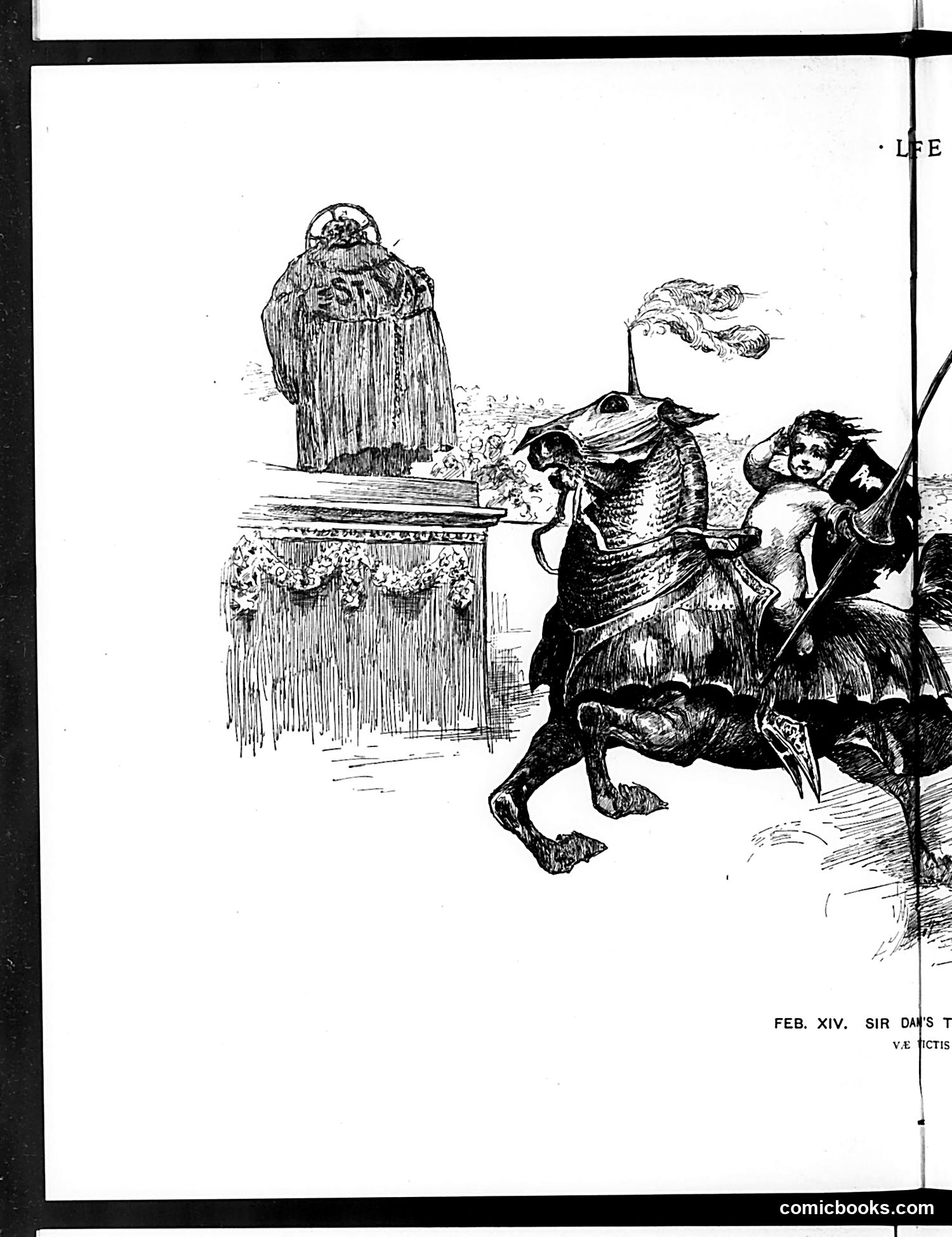
This is a satirical illustration from *Life* magazine labeled "FEB. XIV. SIR DAM'S T[...]" (Valentine's Day reference, text cut off). The cartoon depicts a camel bearing riders approaching a robed figure standing on an ornate pedestal. The figure appears to be a statue or idol being presented with offerings. The satire likely comments on **colonial or imperial attitudes toward non-Western cultures**—specifically, the romanticized or condescending depiction of Eastern/Middle Eastern peoples and their religious or cultural practices. The "Sir Dam" reference (possibly a play on words) combined with the camel, robes, and idol worship suggests mockery of either: - European fascination with "exotic" Orient - Colonial power dynamics and cultural exploitation - Religious stereotyping The Valentine's Day date suggests ironic contrast between Western sentimentality and Orientalist fantasy. Without clearer text, the precise political target remains unclear.
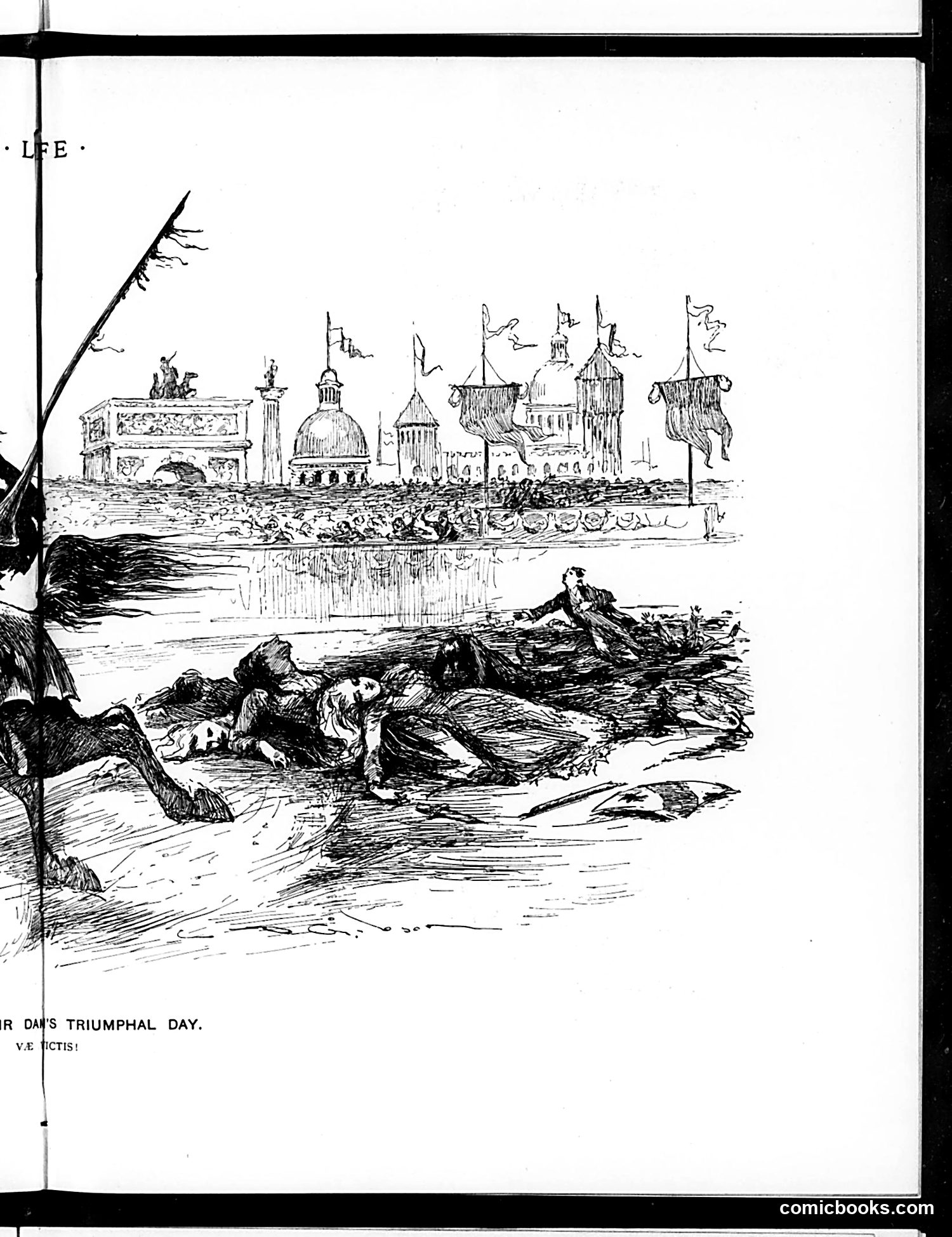
This is a dark satirical illustration titled "IR DAI'S TRIUMPHAL DAY" with a subtitle reading "V.E VICTIS" (Latin: "woe to the vanquished"). The image depicts a stark contrast: an elaborate, ornate cityscape with domes, towers, and flags across a river, while the foreground shows dead and dying bodies strewn on a beach or shore. The composition sardonically juxtaposes imperial grandeur with human carnage. The Latin phrase "V.E Victis" suggests this critiques a military victory or conquest achieved through massive loss of life. The "triumphal day" becomes grimly ironic—the victory procession in the distant city is built literally upon corpses. Without clearer identification of "IR DAI" or specific context, the exact historical reference remains unclear, though the style and sensibility suggest early 20th-century anti-war sentiment, likely depicting the human cost of imperial ambitions.
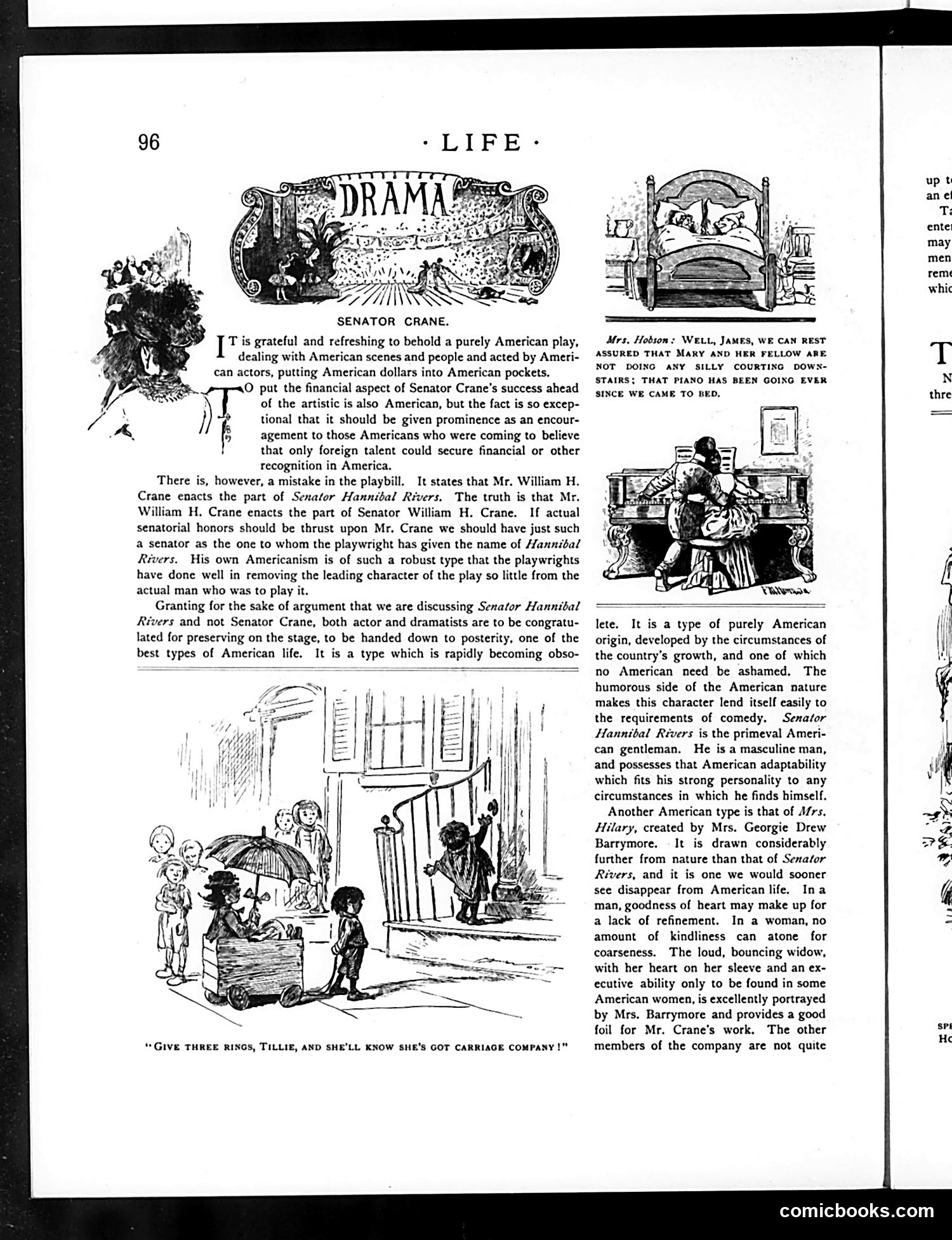
This page reviews a play starring actor **William H. Crane**, who portrays a character named Senator Hannibal Rivers. Life's critic makes a clever point: Crane is essentially playing himself—the character is so authentically based on Crane's own robust American personality that there's little distinction between actor and role. The review celebrates the play as genuinely American entertainment, featuring American actors, scenes, and money staying in American pockets. This was notable because foreign talent then dominated American stages. The critic praises Senator Hannibal Rivers as representing an idealized, "primeval American gentleman"—a disappearing type embodying American adaptability and masculinity. However, he criticizes Mrs. Hilary (played by Georgie Drew Barrymore) as a loud, coarse American widow stereotype, arguing that such rudeness in women cannot be redeemed by kindness, as it might be in men. The sidebar cartoon about "carriage company" is a separate domestic joke about courtship propriety.
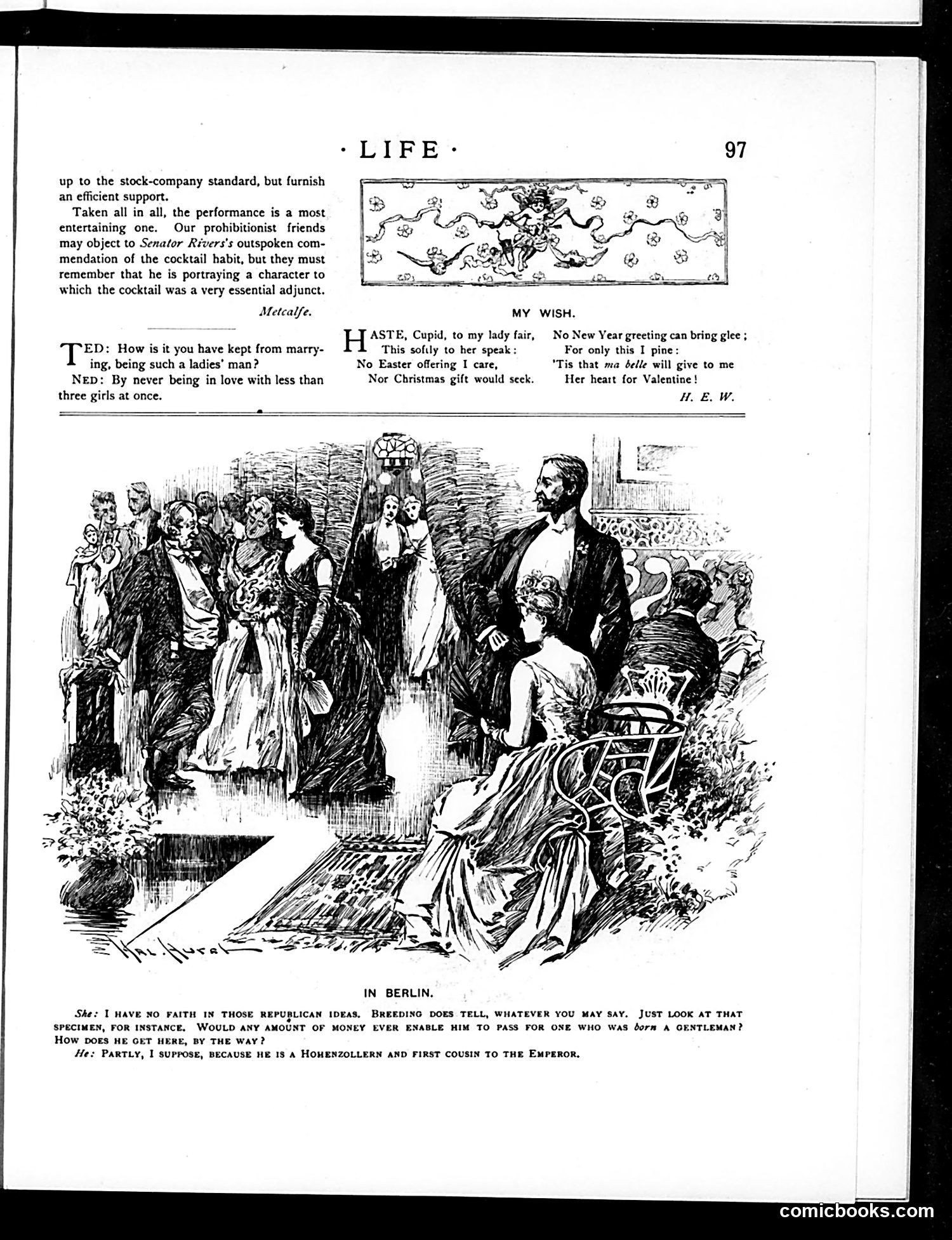
This page contains three distinct pieces satirizing social attitudes of the era. The main cartoon, "In Berlin," mocks aristocratic snobbery and hypocrisy. A woman dismisses republican ideals, insisting breeding determines worth—then reveals the poorly-dressed man she's criticizing is actually a *Hohenzollern*, a member of the German royal family and cousin to the Kaiser. The satire's point: aristocrats claim superiority based on inherent breeding, yet a genuine aristocrat can appear common. This likely critiques pre-WWI German class pretensions and the hollowness of nobility's claims to natural superiority. The other items are lighter: a dialogue joke about romantic commitment, a sentimental poem about Valentine's Day, and a theater review praising Senator Rivers's portrayal of a cocktail-drinking character—with a jab at prohibitionists who object to such depictions. The overall effect positions satire against rigid class systems and moral absolutism.
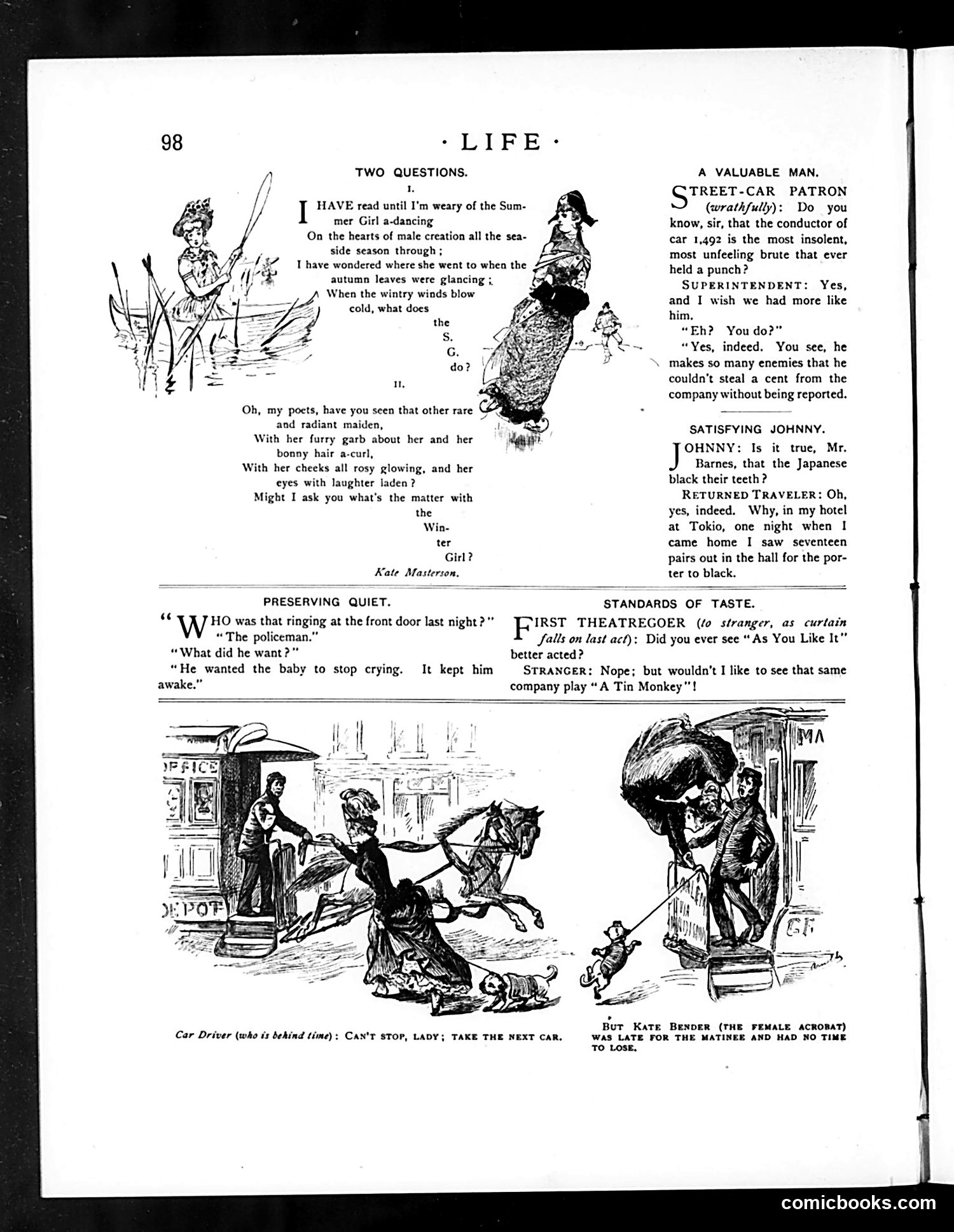
This page collects several short jokes and comic sketches typical of *Life* magazine's humor format: **"Two Questions"** is a poem asking what happened to the "Summer Girl" and "Winter Girl"—likely satirizing the period's obsession with romanticizing seasonal social types. **"A Valuable Man"** jokes that a rude streetcar conductor is valuable *because* his many enemies will report him if he steals, making him honest by virtue of being disliked. **"Satisfying Johnny"** is a children's joke with a returned traveler's tall tale about Japanese teeth-blackening customs (a real historical practice). **"Preserving Quiet"** humorously suggests a crying baby disturbed the neighborhood enough to warrant police intervention. **"Standards of Taste"** mocks theater audiences, implying the same actors performing a children's play ("A Tin Monkey") would be preferable to Shakespeare. The illustrated cartoons depict everyday urban scenes—a rushed carriage driver and an acrobat missing her show—with gentle social commentary on modern life's minor frustrations.
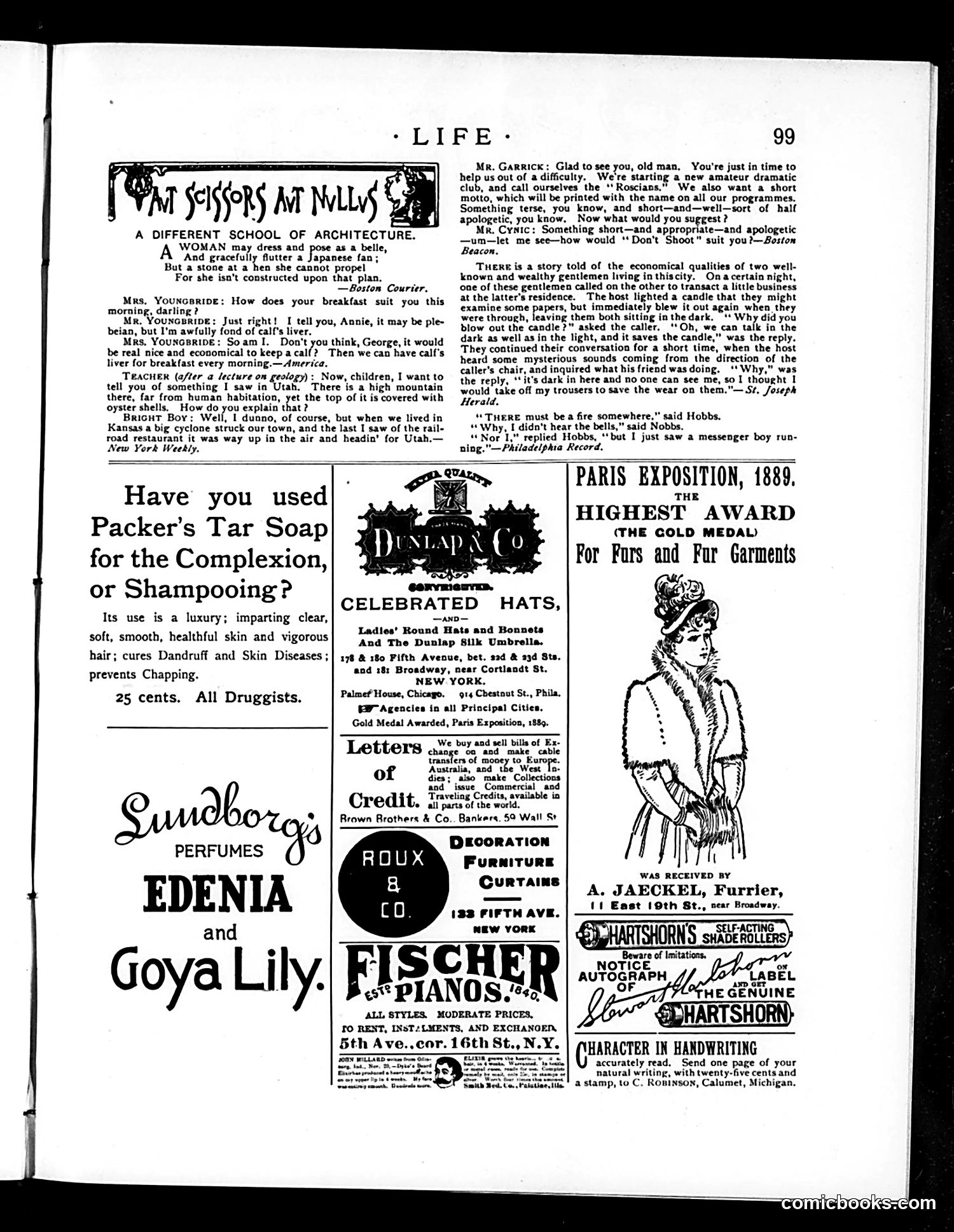
This page contains **primarily advertisements** with several brief humorous anecdotes scattered throughout, typical of Life's satirical magazine format. The text includes four short jokes: 1. **Architecture/Gender**: A Boston Courier quip mocking women's physical capabilities—reflecting period attitudes about female weakness. 2. **Domestic Economy**: A couple considering keeping a calf for breakfast—gentle domestic humor. 3. **Geology Lesson**: A bright boy explains oyster shells atop a Utah mountain by referencing a Kansas cyclone carrying a railroad restaurant—absurdist humor about natural phenomena. 4. **Two Wealthy Men**: A story satirizing miserliness, where one gentleman blows out a candle to save it, then undresses in the dark (implying theft prevention)—social commentary on the wealthy's penny-pinching. 5. **Fire/Messenger Boy**: A brief pun about hearing a fire through a running messenger boy rather than bells. The advertisements showcase period products (tar soap, hats, pianos, perfumes) and services common to 1880s-90s America. No significant political figures are caricatured; the humor is observational and domestic.
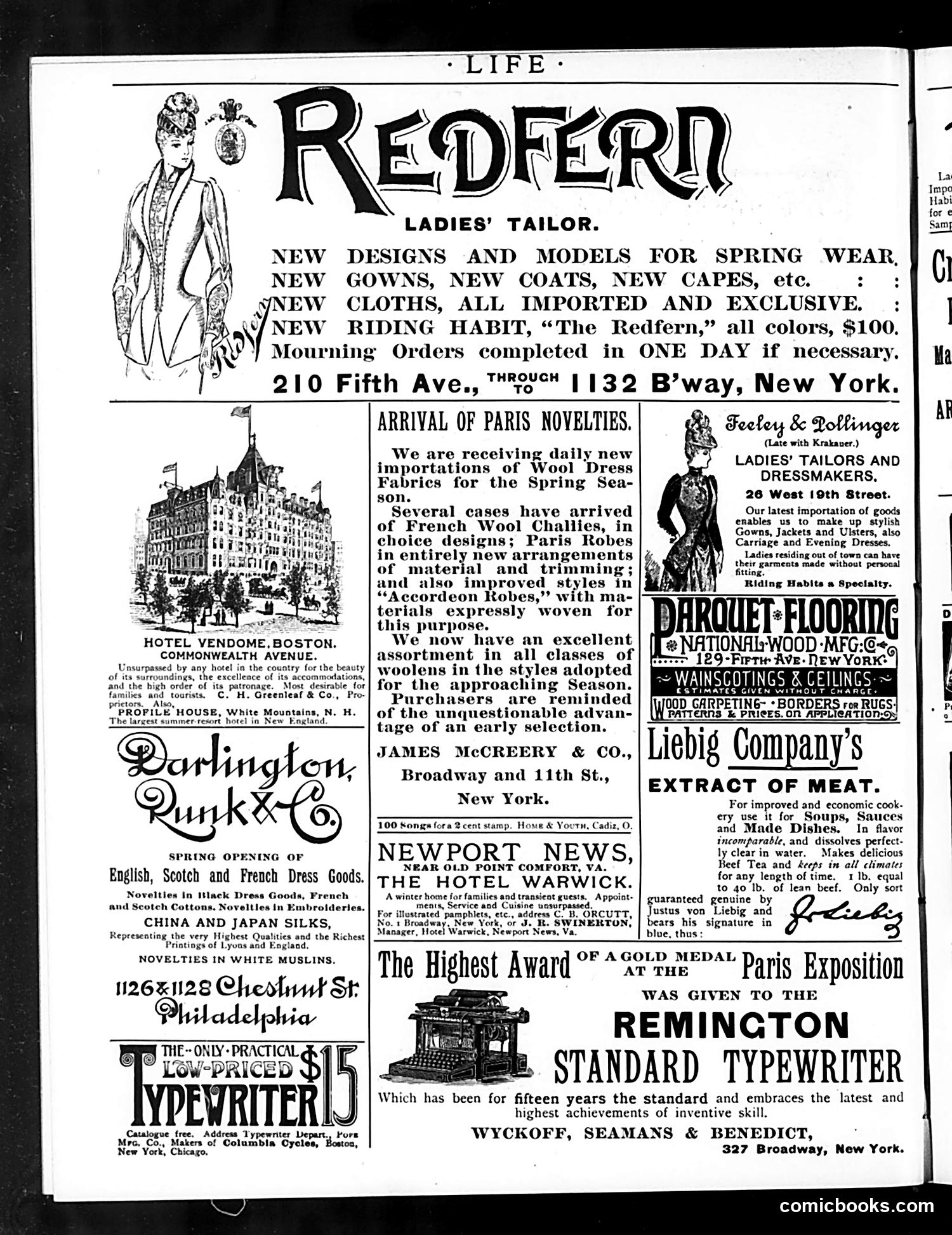
This is primarily an **advertising page** with no political cartoons or satirical content. The page showcases late 19th-century consumer goods and services aimed at affluent readers. The advertisements reflect the era's class structure and gender norms: women's fashion dominates (tailoring services, dress fabrics, riding habits), alongside luxury hotels catering to wealthy travelers. The Remington typewriter ad—promoting "the standard" for fifteen years—suggests emerging office technology. Liebig Company's meat extract advertisement represents popular commercial products of the period, marketed as economical and scientifically superior. The layout itself is notable: dense, competing advertisements with varied typefaces and modest illustrations. The "Redfern" riding habit at $100 signals extreme expense for the era, indicating this magazine served the wealthy elite. No satire or political messaging is evident—this is straightforward commercial promotion typical of Life magazine's advertising sections.
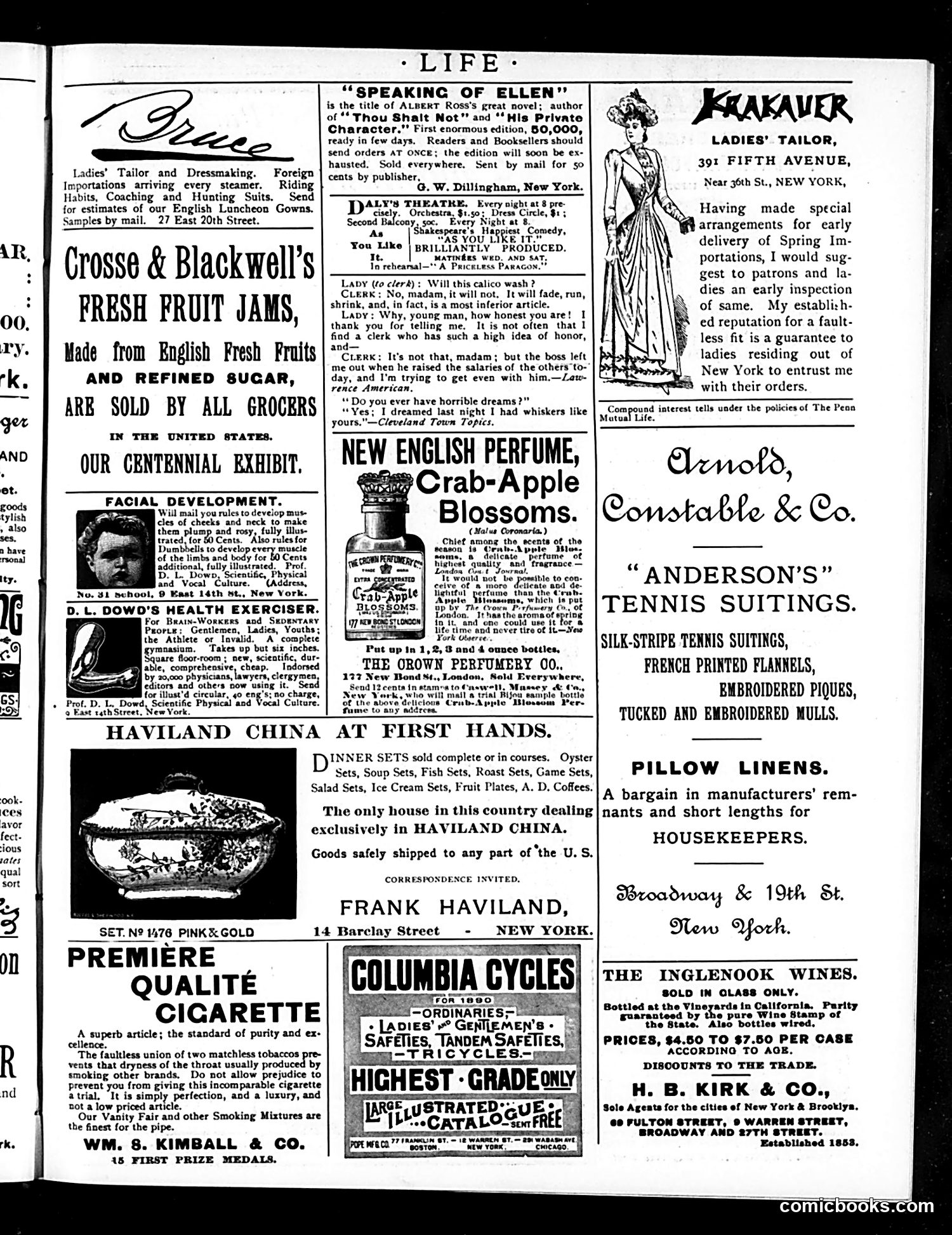
This is primarily an **advertising page** from *Life* magazine, circa late 1880s-1890s (based on "Centennial Exhibit" reference and aesthetic). The only substantive editorial content is a brief **humor column** featuring two short jokes: 1. **"Speaking of Ellen"** – promotes Albert Ross's novel 2. **Clerk honesty joke** – A customer asks if calico will wash. The clerk honestly warns it's inferior quality. When complimented for his integrity, he admits he's actually sabotaging the sale because his boss denied him a raise. The satire targets dishonest retail practices and employee resentment. 3. **Dreams joke** – A one-liner about nightmares involving whiskers (unclear reference, possibly dated social humor). The remainder consists of period advertisements for ladies' tailoring, jams, facial development exercises, perfume, china, bicycles, cigars, wines, and tennis clothing—typical of *Life*'s commercial revenue model. No political satire is present on this particular page.
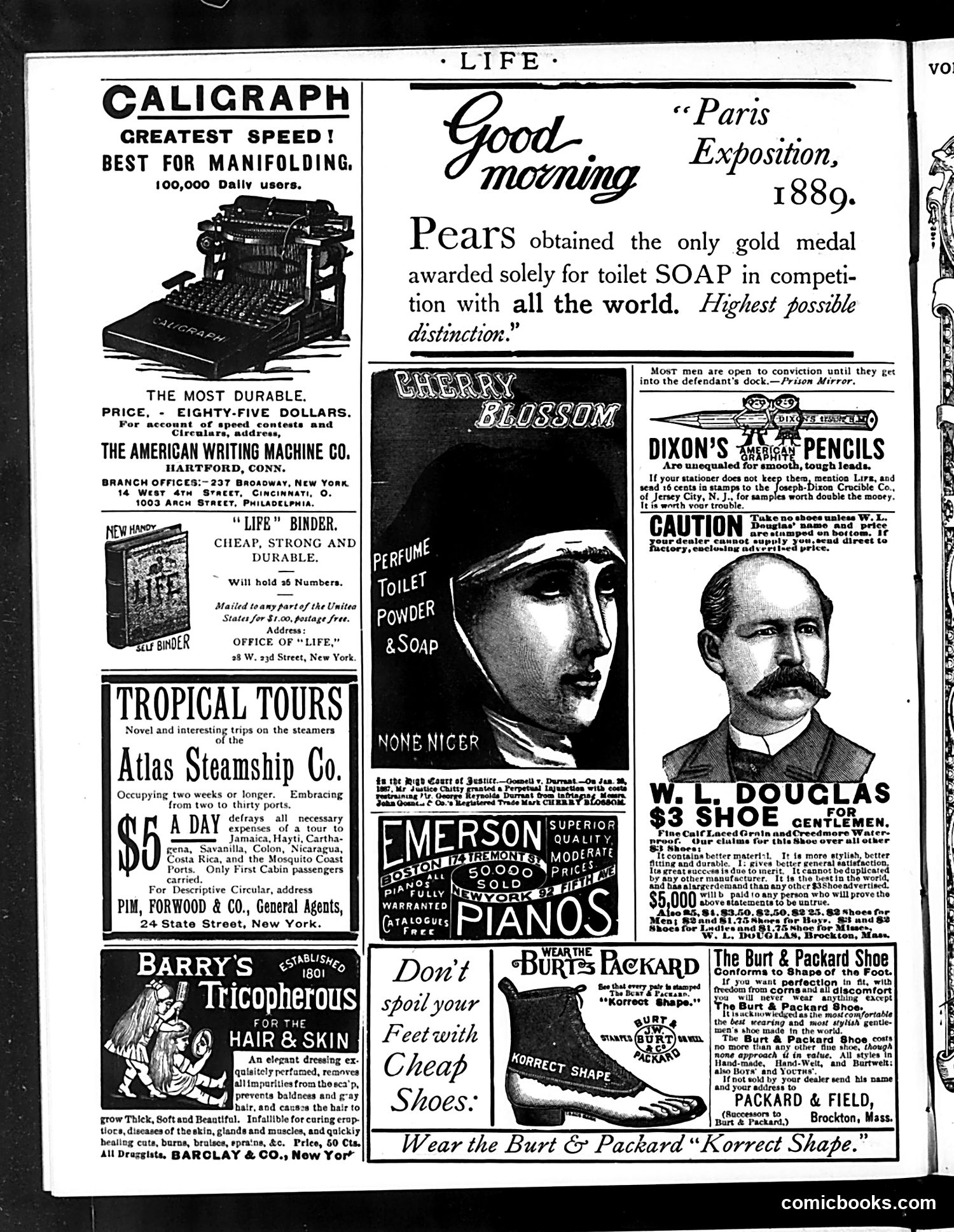
This page is primarily **advertisements**, not editorial content or satire. It showcases various consumer products marketed to late 19th-century Americans: **Notable ads include:** - **Caligraph typewriter** ($85)—promoting speed for business use - **Pears Soap**—prominently featuring a Paris Exposition 1889 gold medal claim for toilet soap - **W.L. Douglas Shoe** ($3)—a gentlemen's shoe emphasizing value and durability - **Burt & Packard Shoe**—competing premium footwear claiming anatomical correctness - **Barry's Tricopherous**—hair and skin treatment - **Dixon's Pencils**, **Emerson Pianos**, and **Atlas Steamship Tours** The page reflects the **commercial culture of the 1890s**, where Life magazine's advertising supported its operation. The repeated shoe advertisements reveal keen market competition. The "highest possible distinction" Pears claimed demonstrates how brands leveraged international expositions for credibility—a major marketing strategy of the era. There is **no identifiable political cartoon or satire** on this page.