
Life, 1890-02-13 · page 6 of 18
Life — February 13, 1890 — page 6: what you’re looking at
What you’re looking at
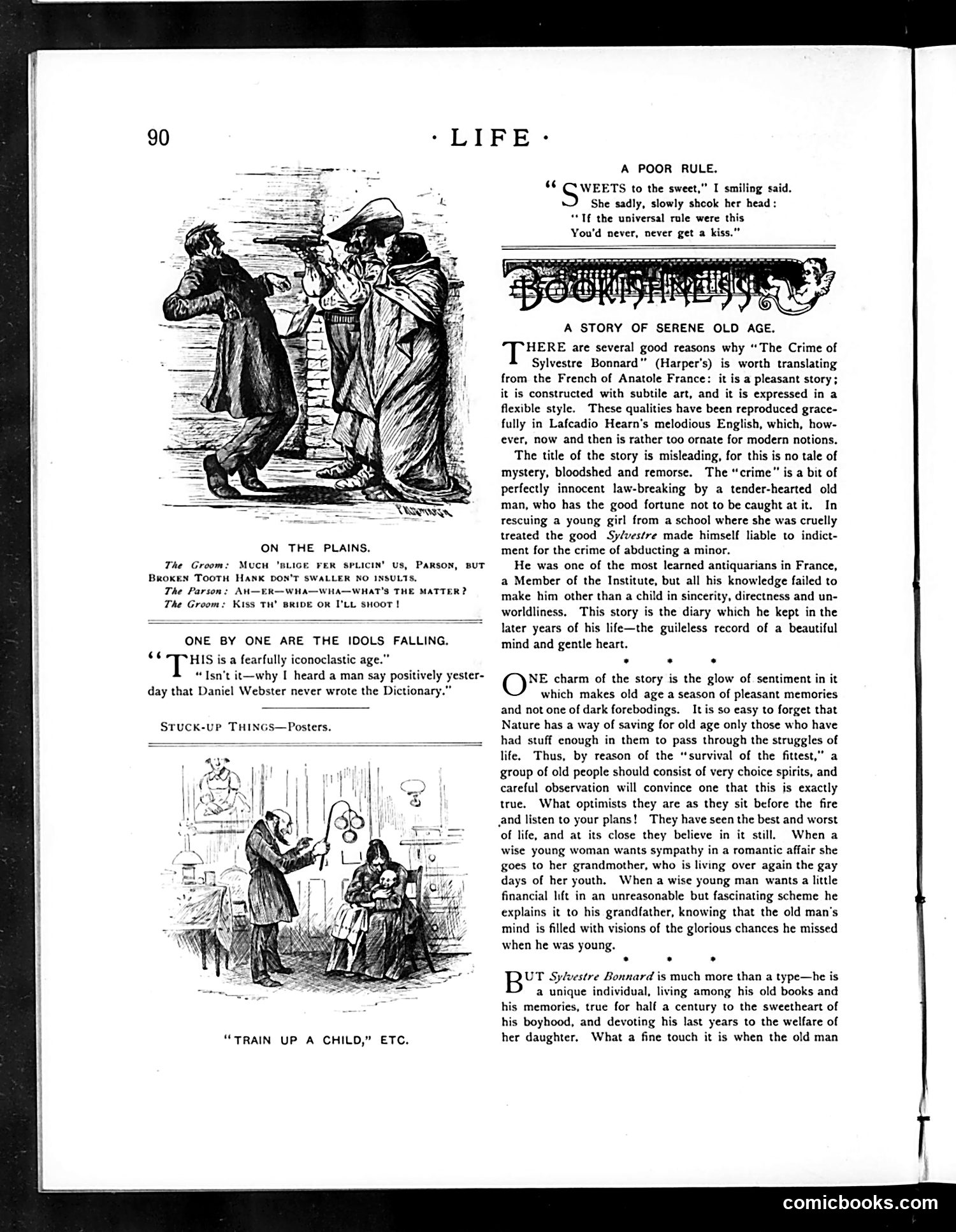
This page from *Life* magazine contains three distinct sections: 1. **"On the Plains"** (top left): A sketch showing two men in conversation. The caption references "blige per splicin'" and mentions shooting, suggesting this is a humorous dialogue about nautical or frontier mishaps. 2. **"One by One Are the Idols Falling"** (middle): A brief satirical quote mocking the phrase "iconoclastic age," commenting on the erosion of established authorities or figures—a common *Life* theme critiquing social change. 3. **"Stuck-up Things"** (bottom left): An illustration depicting what appears to be social pretension, likely satirizing affected behavior among certain classes. 4. **"Bookshelf"** (right): A substantial book review of "The Crime of Sylvestre Bonnard," praising its sentimental exploration of old age and memory. The page blends satirical humor with literary critique, typical of *Life*'s mixed-content format.
📄 Transcribed text from this page (OCR, searchable)
Machine-transcribed from the original scan — historical spelling and the odd misread are preserved.
- LIFE: ON THE PLAINS. The Groom: MUCH ‘BLIGE FER SPLICIN' US, PARSON, BUT Broken TooTH HANK DON'T SWALLER NO INSULTS, The Parson: AM—ER—WHA—WHA—WHAT'S THE MATTER? The Groom: Kiss TH’ BRIDE OR I'LL snooT! ONE BY ONE ARE THE IDOLS FALLING. as THs is a fearfully iconoclastic age.” “Isn't it—why I heard a man say positively yester- day that Daniel Webster never wrote the Dictionary.” STUCK-UP THINGS—Posters, “TRAIN UP A CHILD,” ETC. A POOR RULE. $6 GWEETS to the sweet,” I smiling said. She sadly, slowly shcok her head : “Tf the universal rule were this You'd never, never get a kiss.” A STORY OF SERENE OLD AGE. “THERE are several good reasons why “The Crime of Sylvestre Bonnard” (Harper's) is worth translating from the French of Anatole France: it is a pleasant story; it is constructed with subtile art, and it is expressed in a flexible style. These qualities have been reproduced grace- fully in Lafcadio Hearn's melodious English, which, how- ever, now and then is rather too ornate for modern notions. The title of the story is misleading, for this is no tale of mystery, bloodshed and remorse. The “crime” is a bit of perfectly innocent law-breaking by a tender-hearted old man, who has the good fortune not to be caught at it. In rescuing a young girl from a school where she was cruelly treated the good Sylvestre made himself liable to indict- ment for the crime of abducting a minor. He was one of the most learned antiquarians in France, a Member of the Institute, but all his knowledge failed to make him other than a child in sincerity, directness and un- worldliness. This story is the diary which he kept in the later years of his life—the guileless record of a beautiful mind and gentle heart. . . . NE charm of the story is the glow of sentiment in it which makes old age a season of pleasant memories and not one of dark forebodings. It is so easy to forget that Nature has a way of saving for old age only those who have had stuff enough in them to pass through the struggles of life. Thus, by reason of the “survival of the fittest,” a group of old people should consist of very choice spirits, and careful observation will convince one that this is exactly true. What optimists they are as they sit before the fire and listen to your plans! They have seen the best and worst of life, and at its close they believe in it still. When a wise young woman wants sympathy in a romantic affair she goes to her grandmother, who is living over again the gay days of her youth. When a wise young man wants a little financial lift in an unreasonable but fascinating scheme he explains it to his grandfather, knowing that the old man’s mind is filled with visions of the glorious chances he missed when he was young. . . . UT Sylvestre Bonnard is much more than a type—he is a unique individual, living among his old books and his memories, true for half a century to the sweetheart of his boyhood, and devoting his last years to the welfare of her daughter, What a fine touch it is when the old man comicbooks.com