
A complete issue · 18 pages · 1890
Life — February 6, 1890
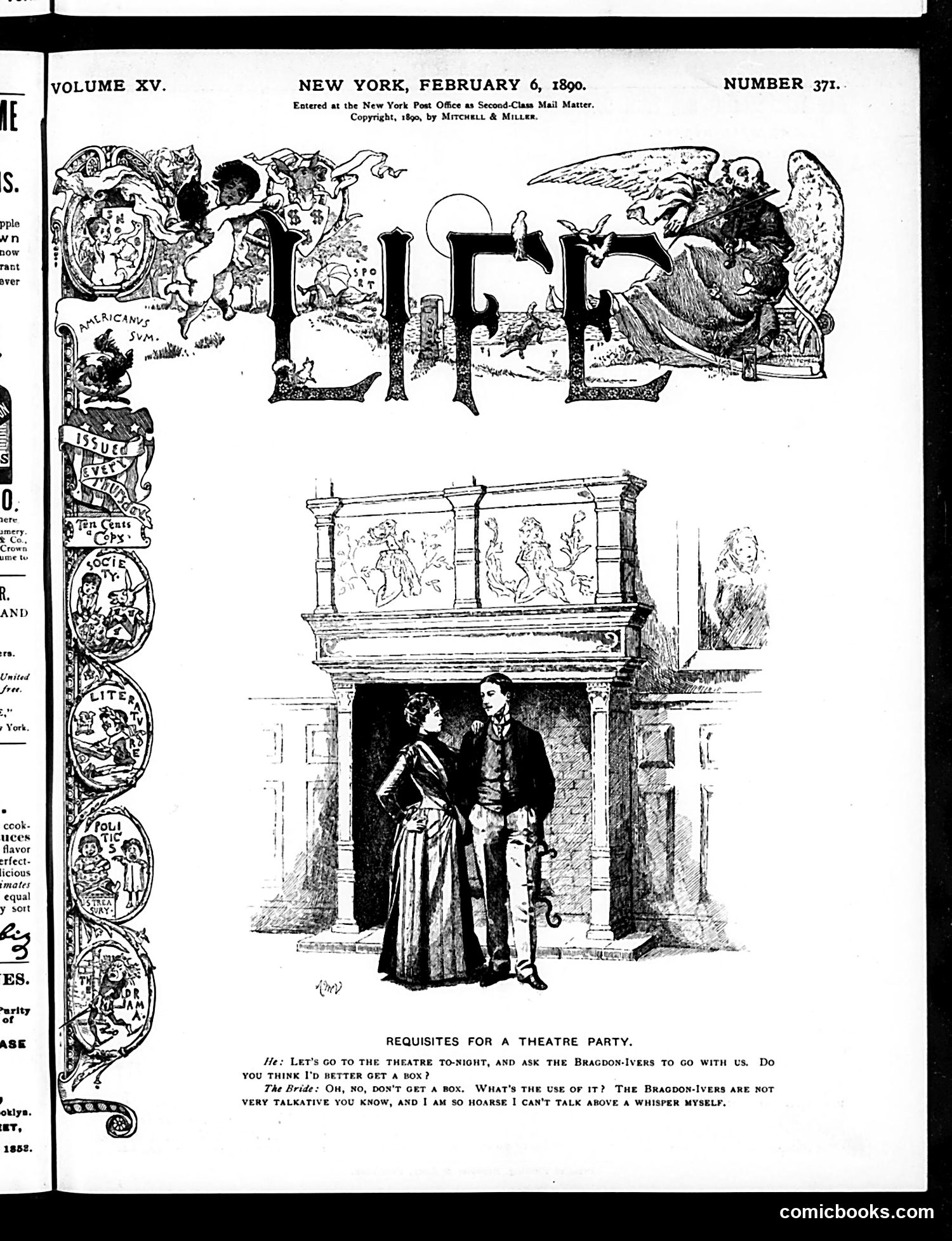
This page features a satirical cartoon titled "REQUISITES FOR A THEATRE PARTY." The illustration shows a well-dressed couple at a grand entrance, with the woman expressing frustration about attending the theater. The dialogue reveals the joke: she wants to invite the "Bradgon-Ivers" to a show, but her companion protests they're "not very talkative." Her response—that she finds them "not very talkative" an advantage because "I am so hoarse I can't talk above a whisper myself"—satirizes social pretense and the empty chatter typical of high-society theater outings in 1890s New York. The ornate border and elaborate title treatment typical of *Life* magazine's design frame this commentary on upper-class manners and the theater as a social performance venue, where being seen matters more than genuine conversation.
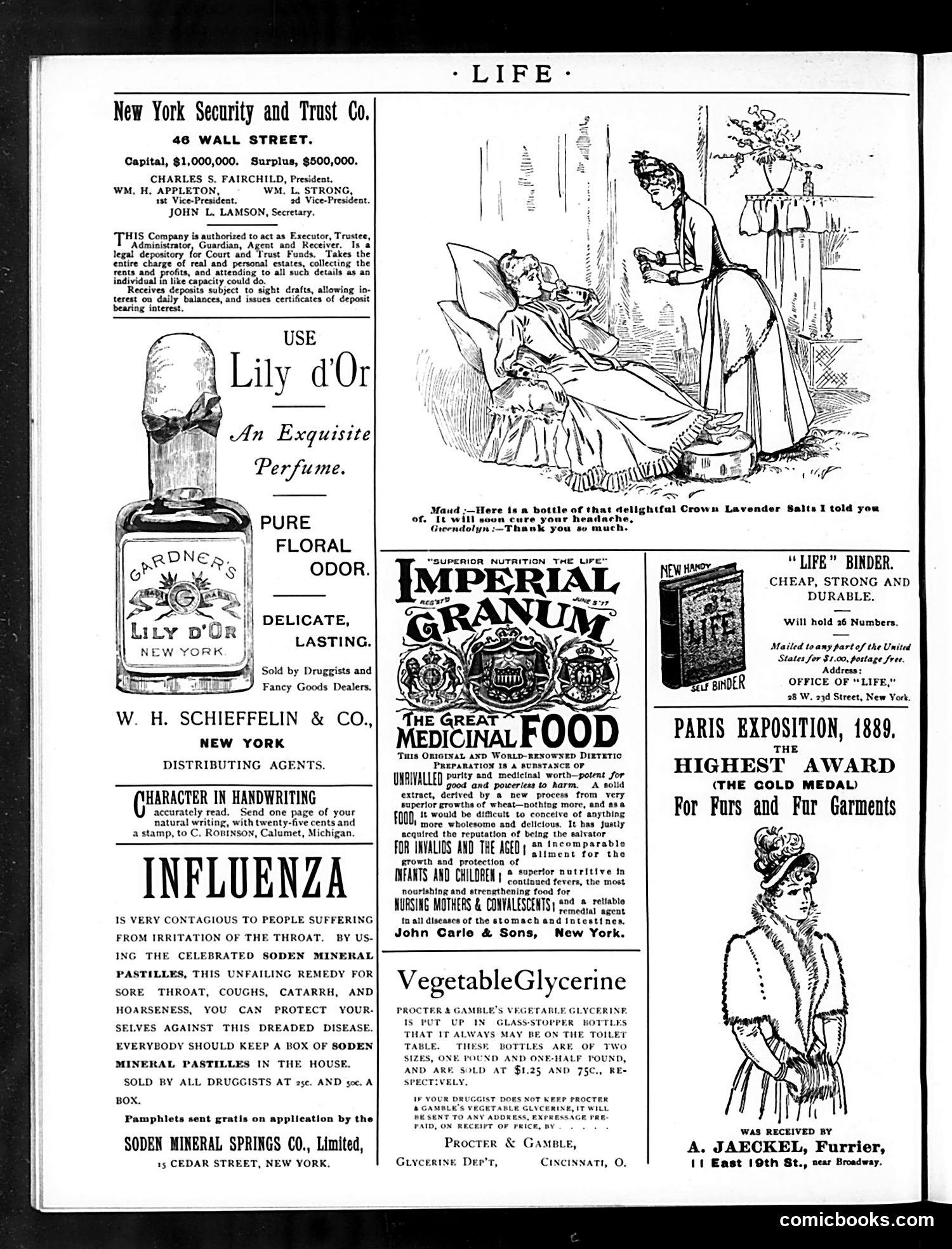
This page is primarily **advertising**, not satirical content. It features multiple commercial advertisements typical of late 19th-century magazines: - **Lily d'Or perfume** (Gardner's brand, New York) - **Imperia Granum** medicinal food for invalids and children - **Soden Mineral Pastilles** for influenza and sore throat - **Vegetable Glycerine** (Procter & Gamble) - **Life Binder** for magazine storage - **A. Jaeckel, Furrier** advertisement The single illustration shows a Victorian woman reclining on a bed while another woman tends to her, likely depicting illness or recovery—presumably to market the medicinal products advertised. The New York Security and Trust Company advertisement appears at top left. This represents typical magazine monetization of the era rather than political satire.
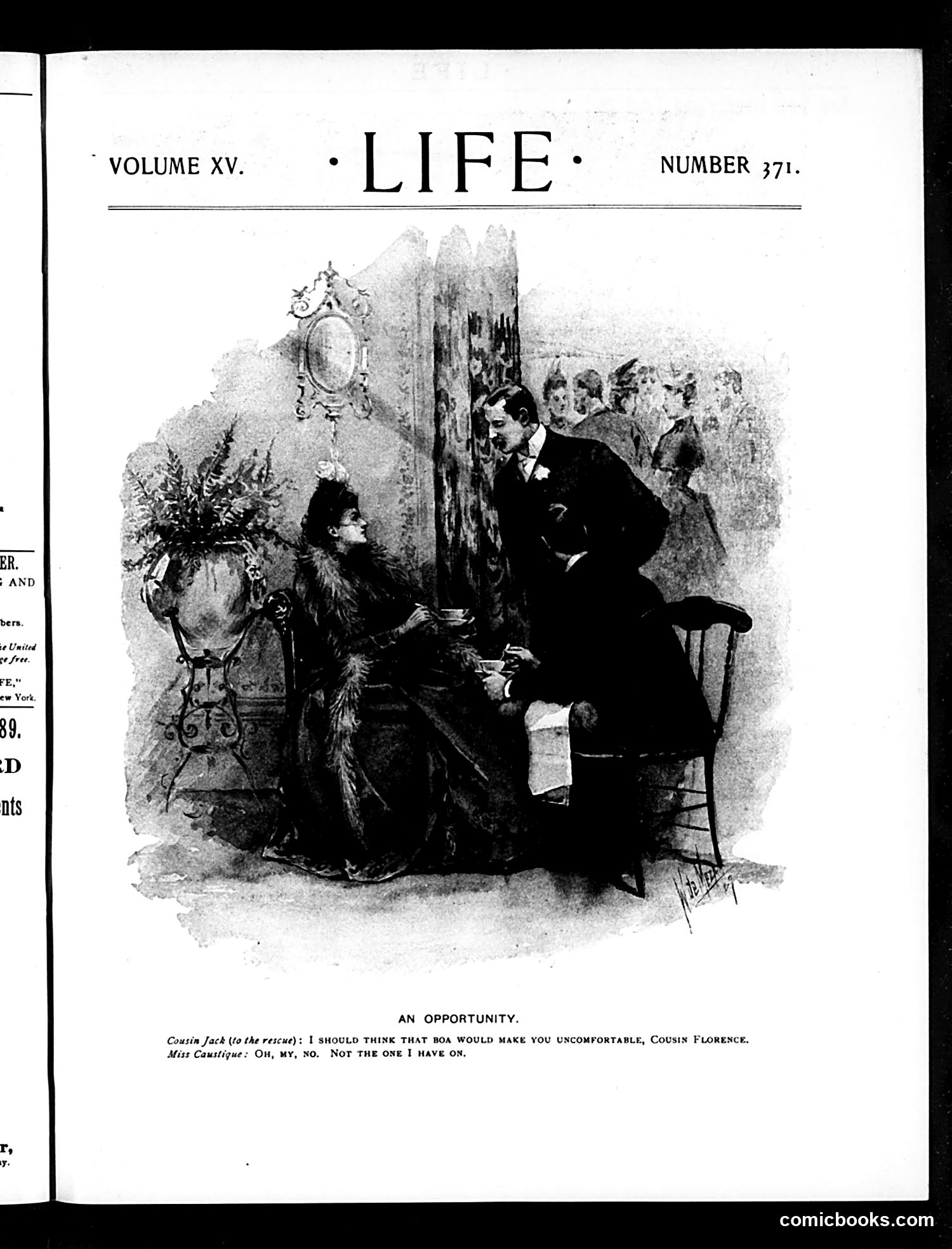
This cartoon depicts a social comedy about class and propriety in Victorian/Edwardian society. A well-dressed gentleman (Cousin Jack) sits beside an elegantly dressed woman (Miss Cassilique, identified as a widow in mourning attire with feathers). In the background, fashionable guests attend what appears to be a social gathering. The humor lies in Cousin Jack's self-interested proposal: he suggests Miss Cassilique's boa constrictor would make her "uncomfortable," offering to take it off her hands—revealing his true motive is acquiring the expensive garment himself rather than genuine concern for her comfort. The satire targets masculine greed disguised as gallantry, and the superficiality of upper-class social interactions where material acquisition masks as courtesy.
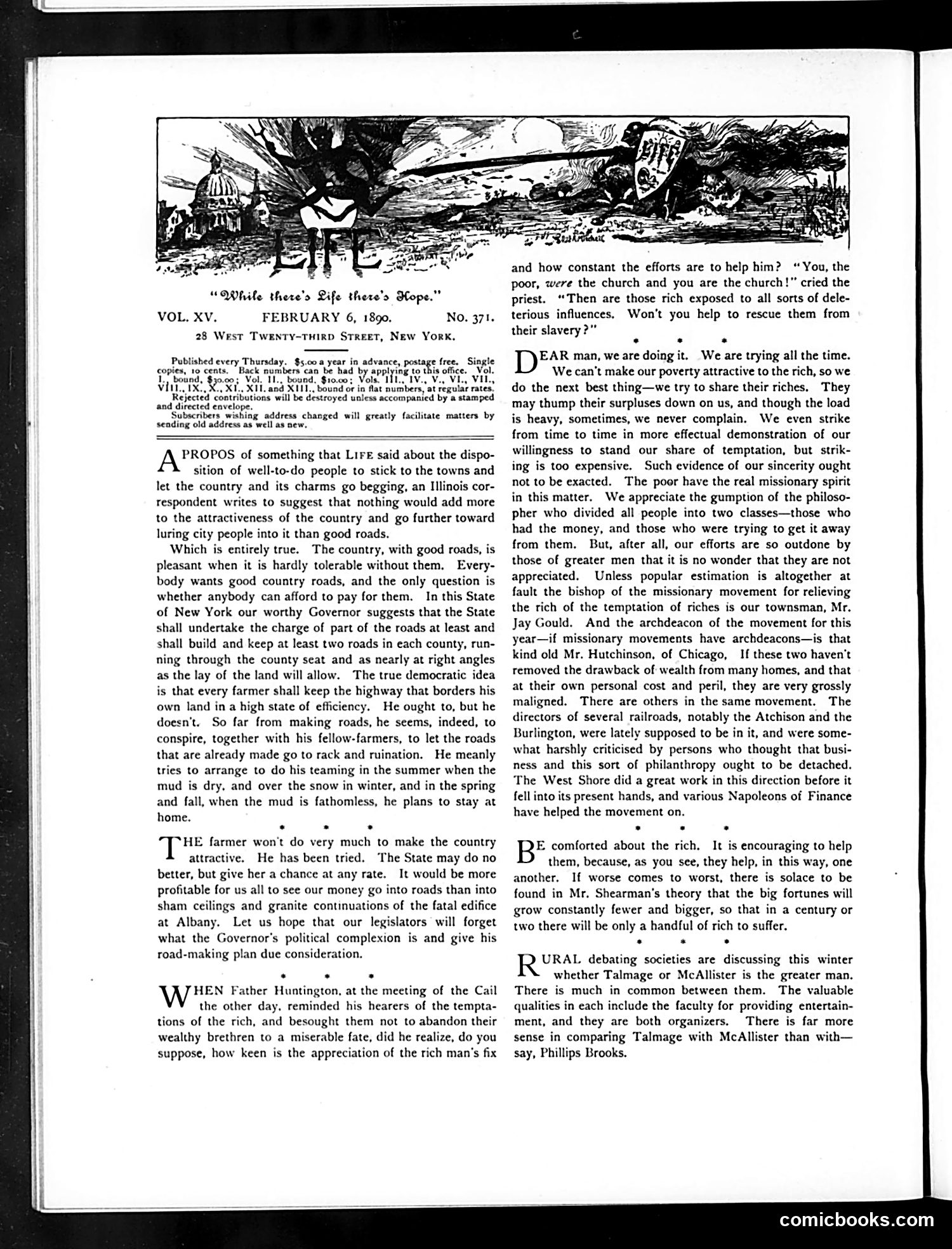
The header cartoon depicts a chaotic scene with "Life" written on a flag, appearing to show urban decay or social turmoil—though specific figures are unclear from the image quality. The editorial discusses poverty relief and missionary work. It criticizes wealthy benefactors for receiving excessive praise while poor people do the actual charitable labor. The text references Father Huntington's plea to the rich to help the poor, and mentions Mr. Jay Gould and an "archdeacon" (likely Edward King or similar church figure) involved in a missionary movement to address urban poverty. The piece satirizes how society disproportionately credits wealthy donors rather than those doing ground-level charitable work, while questioning whether the rich truly understand or appreciate the poor's genuine missionary spirit and sacrifice.
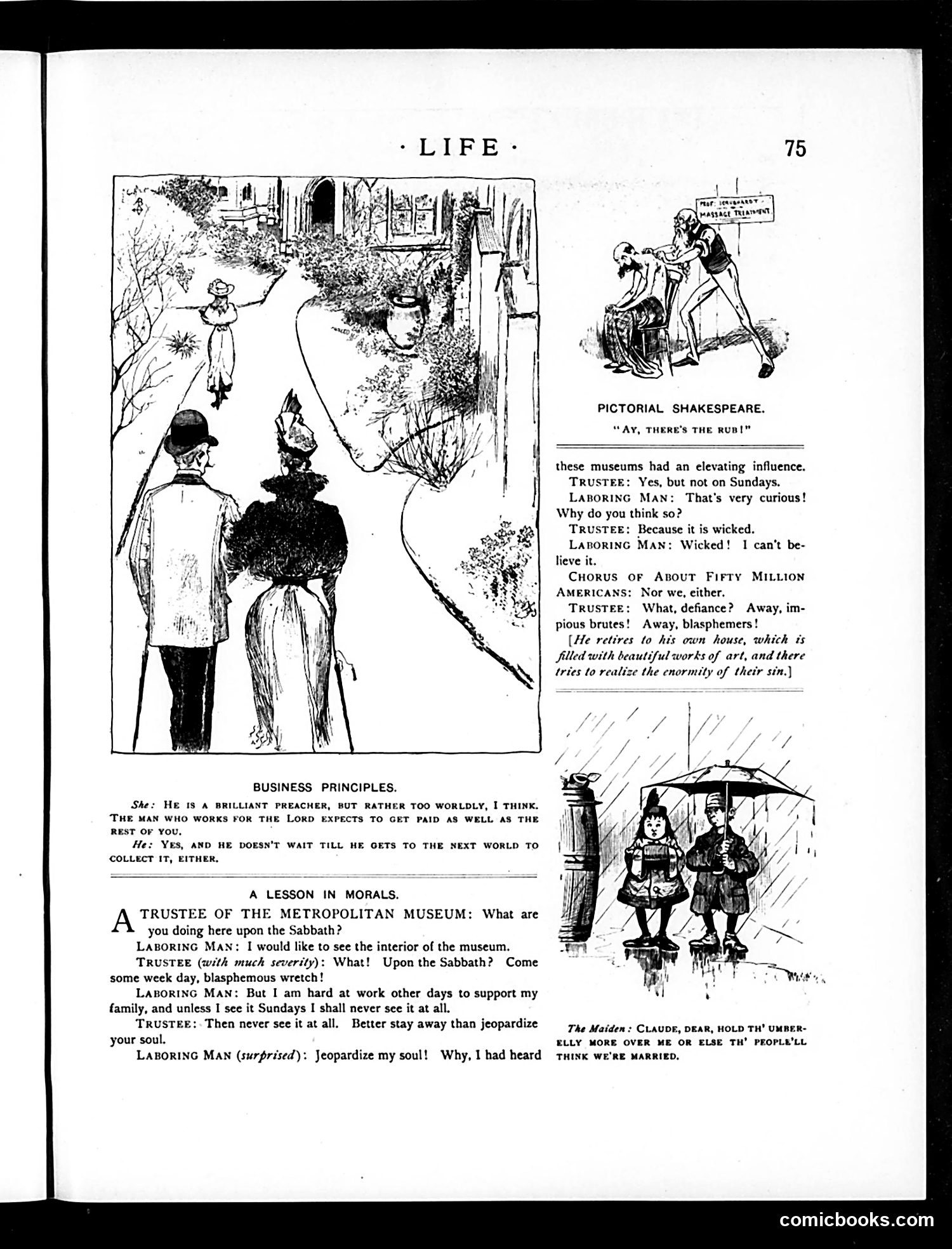
This page contains three satirical sketches critiquing early 20th-century attitudes toward work, religion, and culture. **"Business Principles"** mocks a preacher and working man debating whether laborers deserve payment in the afterlife, satirizing religious hypocrisy about earthly compensation. **"A Lesson in Morals"** depicts a "Trustee of the Metropolitan Museum" confronting a laboring man visiting on Sunday, insisting he shouldn't see art on the Sabbath. The satire attacks upper-class gatekeeping—denying working people access to cultural institutions while claiming moral authority. The trustee's hypocrisy is the joke: he polices the poor man's behavior while profiting from the museum himself. **"Pictorial Shakespeare"** and the rain scene appear lighter in tone, likely offering humorous visual commentary on contemporary life. The page targets class privilege and religious sanctimoniousness.
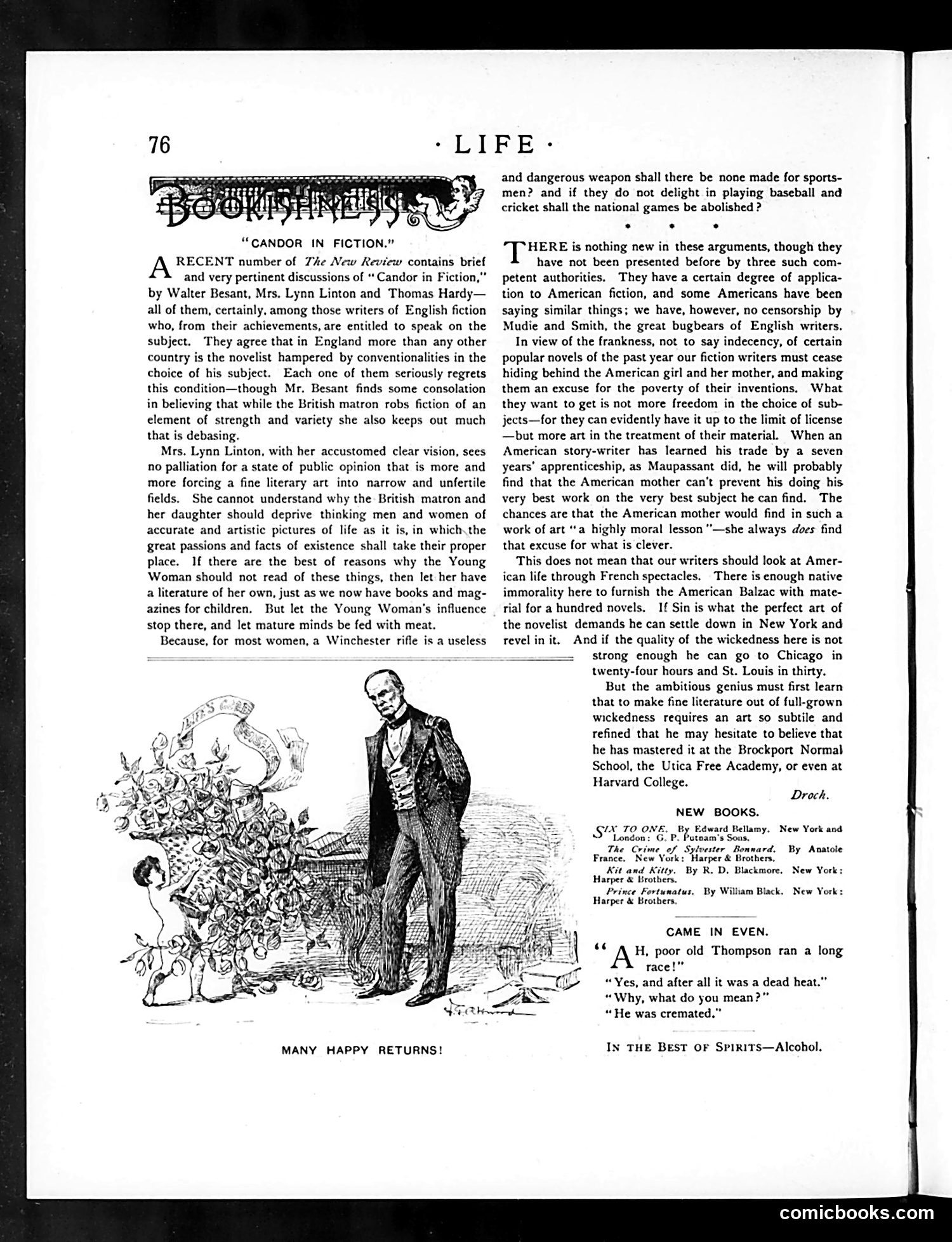
The main cartoon titled "MANY HAPPY RETURNS!" depicts a well-dressed gentleman standing beside an elaborate, grotesque figure emerging from what appears to be a cornucopia or vessel. The imagery suggests a satirical commentary on something returning or being reborn—likely referencing a political figure or social phenomenon the artist wished to ridicule through exaggeration. The page's text discusses "Candor in Fiction," critiquing American and British novelists' treatment of subjects like morality and propriety. The broader context addresses debates about literary freedom versus censorship. Without clearer identification of the specific figure in the cartoon, I cannot definitively state whom it mocks. However, the grotesque character suggests the artist viewed something's "return" as undesirable or absurd.
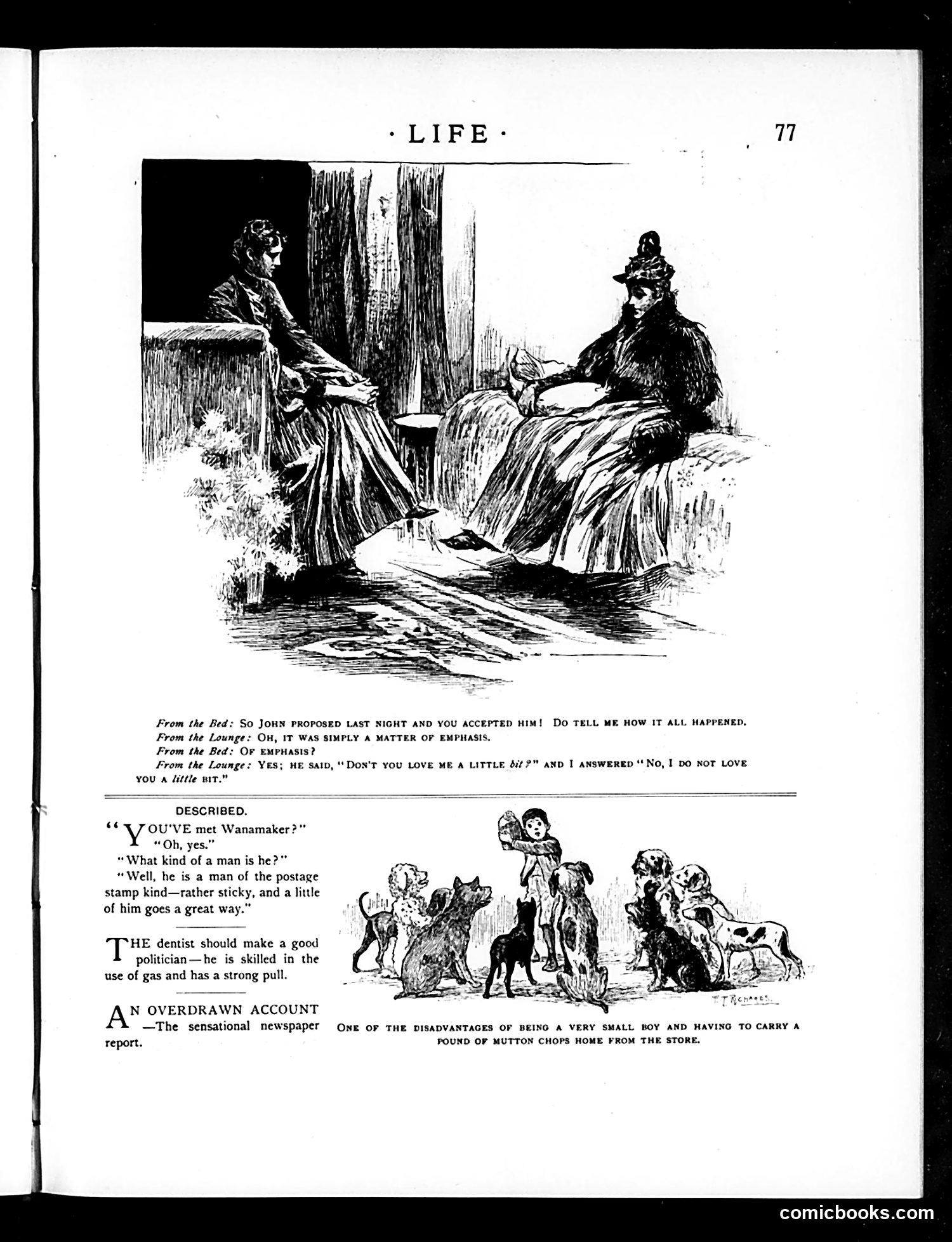
The page contains two distinct humor pieces: **Upper Section:** A sketch showing two women in Victorian dress discussing a marriage proposal. The dialogue satirizes romantic conventions—one woman reports that a suitor named John proposed with "emphasis," and when she declined his advances ("Do not you love me a little bit?"), he accepted her rejection matter-of-factly. The humor lies in the anticlimactic, unemotional response to what should be a dramatic romantic moment. **Lower Section:** Three brief humorous notes about social types: a "Wanamaker" (wealthy person), a dentist as potential politician, and a joke about small boys struggling to carry mutton chops home from the store. These are generic social observations rather than political satire, typical of Life's general-interest humor. The page demonstrates Life's focus on middle-class social comedy and domestic situations rather than specific political events.
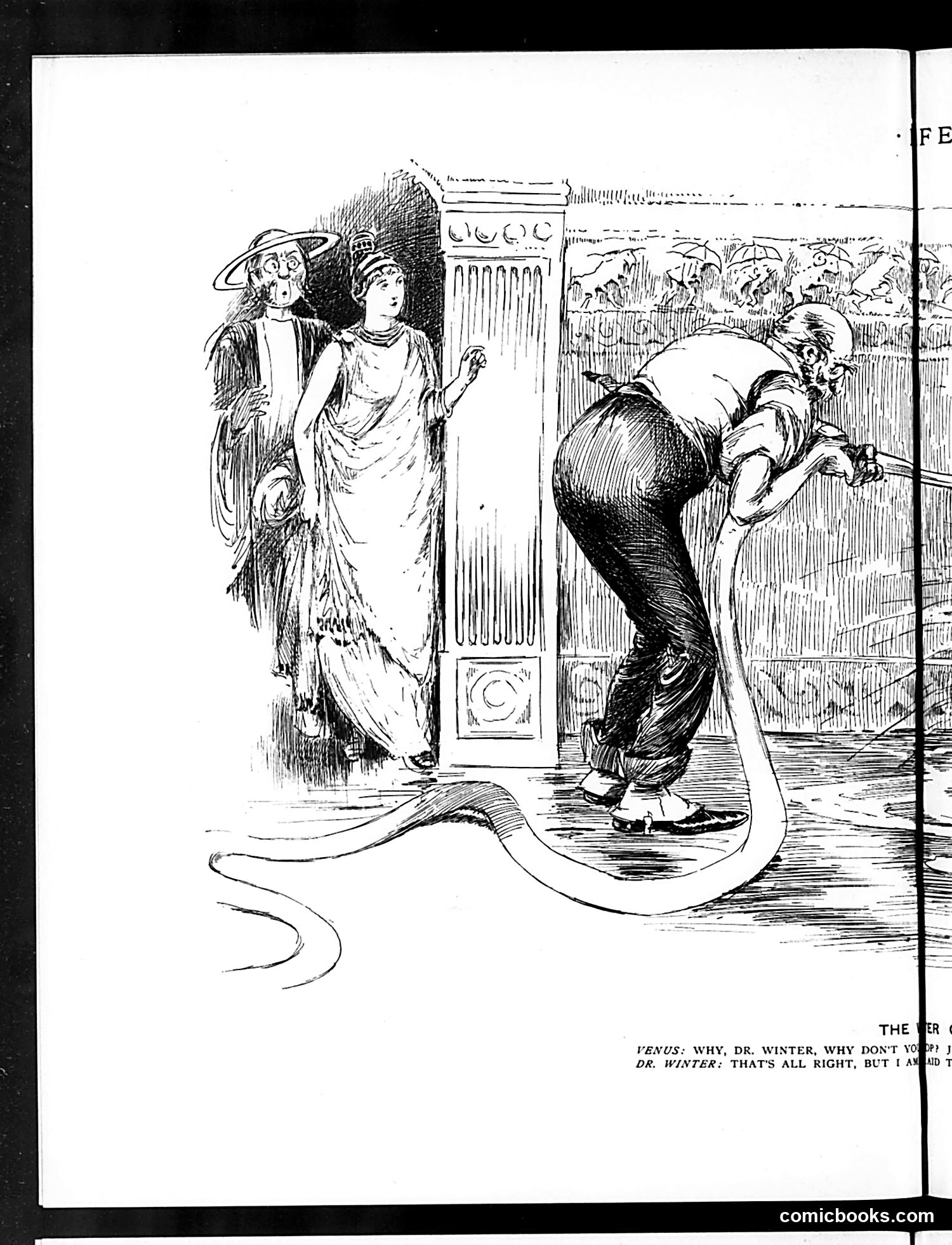
This appears to be a classical-mythology-themed cartoon from Life magazine. The image shows two figures on the left (appearing to represent Venus and another character) observing a man using a garden hose on the right. The partially visible dialogue reads: "VENUS: WHY, DR. WINTER, WHY DON'T YOU...?" and "DR. WINTER: THAT'S ALL RIGHT, BUT I AM'D T..." The satire likely plays on the contrast between classical ideals of beauty and romance (represented by Venus, the Roman goddess of love) and modern domestic practicality (the garden hose). The "Dr. Winter" character appears to prioritize functional utility over romantic sensibility—suggesting a humorous commentary on how modern life and technology have displaced traditional notions of courtship or beauty. The full dialogue would clarify the specific joke, but the visual contrast carries the satirical point.
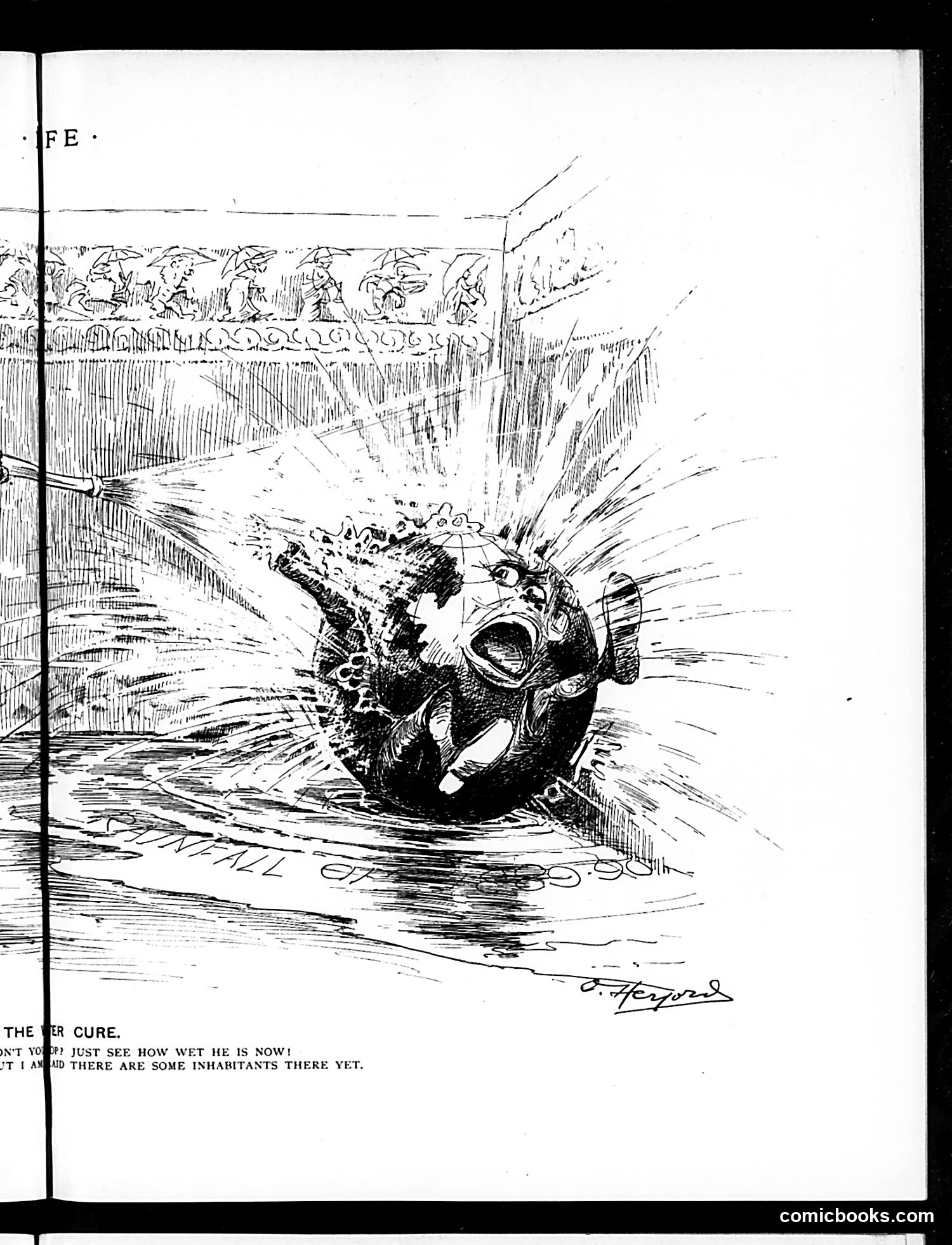
This political cartoon depicts a large spherical object (appears to be a globe or bomb) submerged in water, with radiating lines suggesting an explosion or violent reaction. The caption reads: "Don't you just see how wet he is now! But I am told there are some inhabitants there yet." The cartoon likely satirizes the "water cure" — a controversial interrogation technique used by U.S. forces during the Philippine-American War (early 1900s). The joke appears darkly ironic: someone is commenting on how thoroughly "wet" a victim is after this brutal torture method, while noting inhabitants remain alive in the Philippines despite American military campaigns. The artist's signature appears to be present at bottom right.
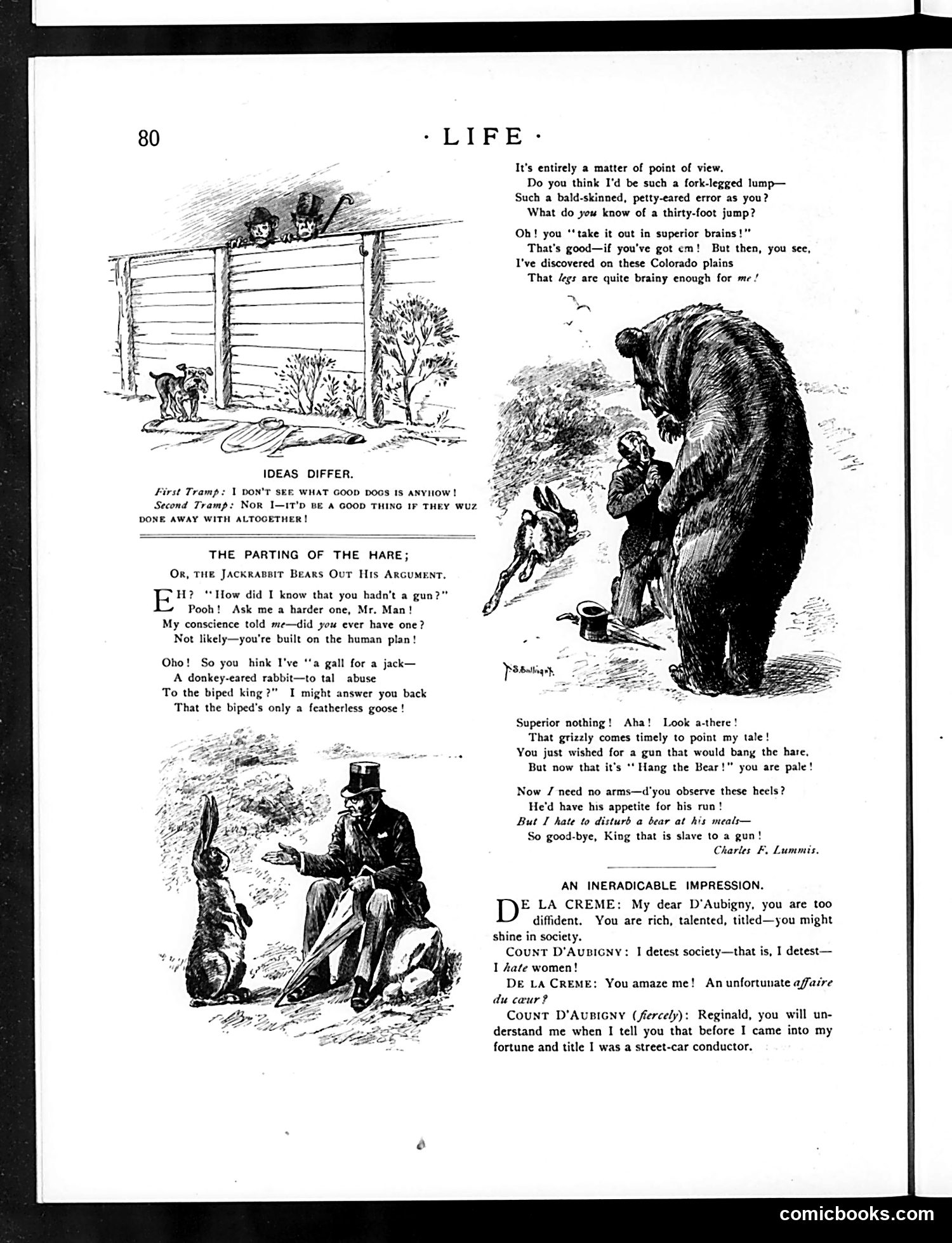
This page contains three satirical pieces from *Life* magazine: 1. **"Ideas Differ"** - A cartoon mocking dogs' limited intelligence, contrasting human superiority with animal foolishness. 2. **"The Parting of the Hare; Or, the Jackrabbit Bears Out His Argument"** - A dialogue between a hare and a jackrabbit debating intelligence. A gentleman figure observes their argument about whether a rabbit is "a gall" (insult). The satire targets pretentious human debate by showing animals outmaneuvering a well-dressed man through wit. 3. **"An Ineradicable Impression"** - A dialogue between French aristocrats (De la Crème and Count D'Aubigny). The joke reveals that despite D'Aubigny's current wealth and social status, he was formerly a street-car conductor—suggesting nouveau-riche embarrassment and social mobility's comic contradictions in early 20th-century America.
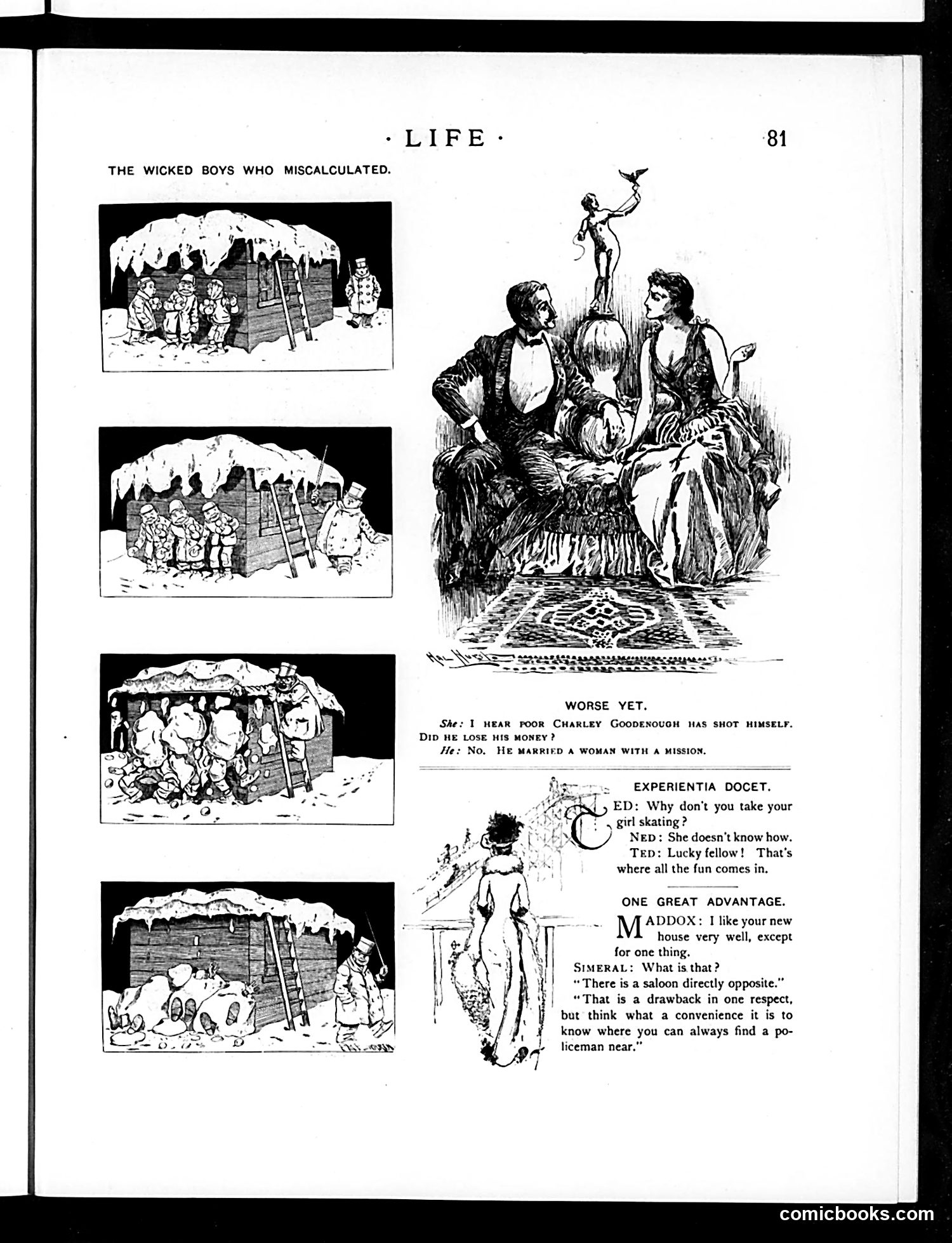
This page contains three separate humorous pieces: 1. **"The Wicked Boys Who Miscalculated"** (left): A four-panel comic strip showing children building what appears to be an igloo or snow fort that progressively collapses inward, trapping them inside. The joke is about poor planning and structural miscalculation leading to comic disaster. 2. **"Worse Yet"** (top right): A joke about a man named Charley Goodenough who shot himself, with the punchline that he married a woman "with a mission"—suggesting his suicide was preferable to his marriage. 3. **"Experientia Docet"** and **"One Great Advantage"** (bottom right): Two brief dialogue jokes about ice-skating and living near a saloon, playing on social expectations about recreation and convenience. These are light satirical pieces typical of Life magazine's humor style.
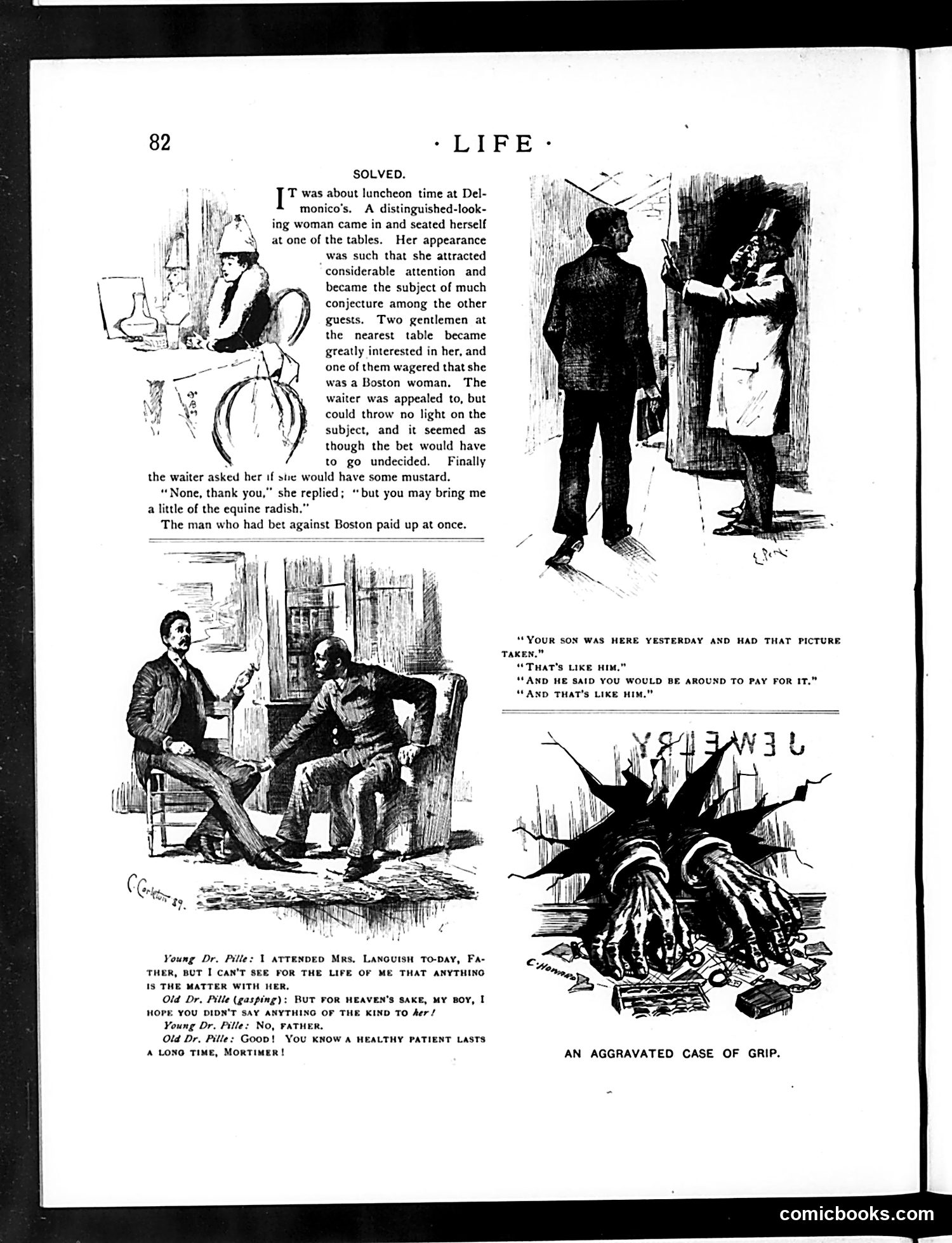
This page contains three satirical pieces from Life magazine's humor section: **"Solved"** (top): A joke about Boston social pretension. A distinguished woman at Delmonico's (an elite NYC restaurant) orders "equine radish" (horseradish) instead of simply asking for horseradish—her affected, pompous language confirms she's a Boston woman, settling a bet among diners. The satire mocks Boston intellectuals' perceived snobbishness and overwrought speech. **Middle cartoon**: A photographer's assistant pressures a father to pay for his son's portrait, sardonically playing on paternal obligation and filial irresponsibility. **"Old Dr. Pille" dialogue**: A cynical exchange between father and son doctors. The elder warns the younger never to tell a patient they're healthy—healthy patients don't return for repeat visits. The satire targets medical practitioners' financial self-interest over patient welfare. **"An Aggravated Case of Grip"** (bottom illustration): Likely depicts influenza or a similar illness; context suggests it complements the doctor joke. All pieces employ dark humor about social pretense, financial exploitation, and professional dishonesty.
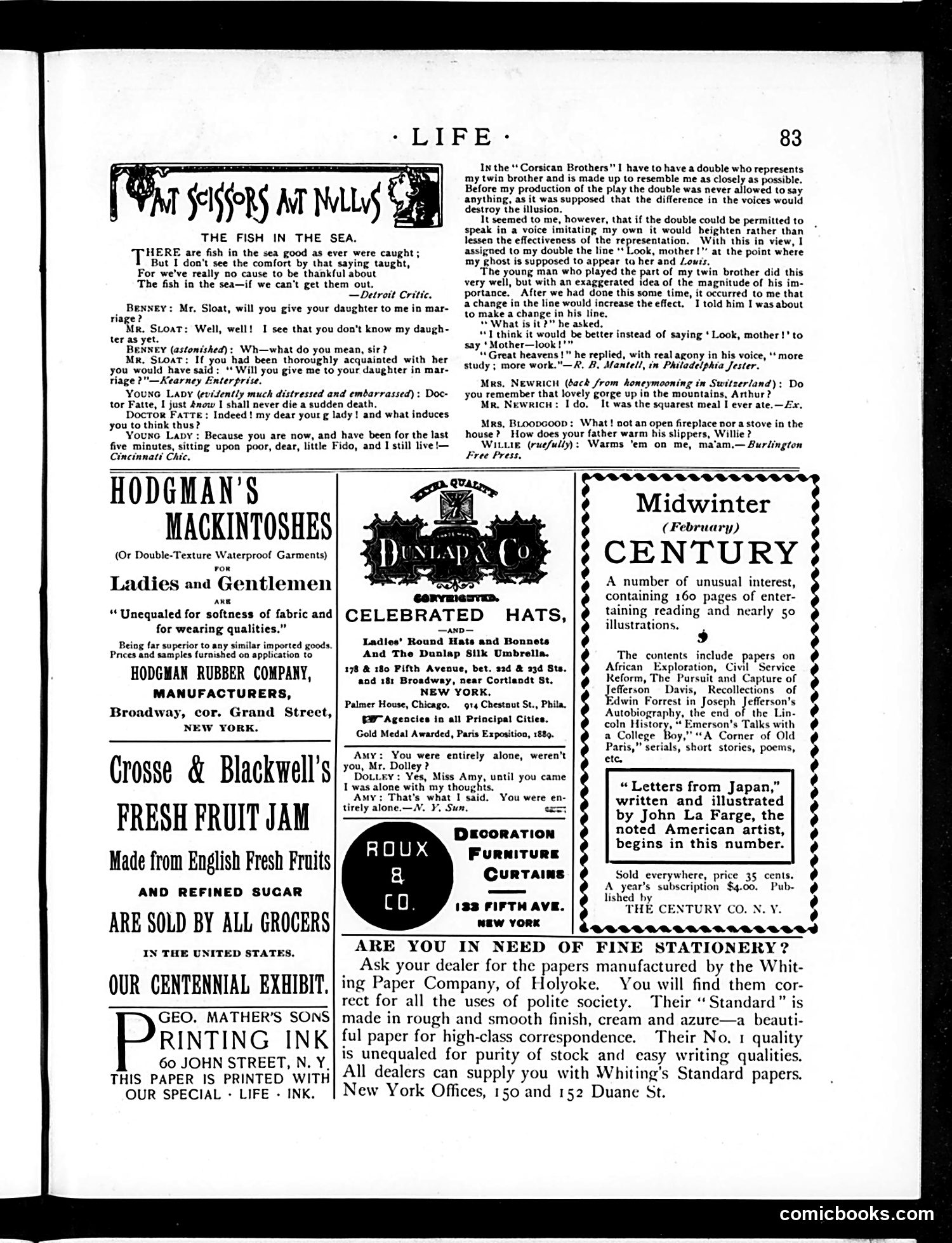
This page from *Life* magazine contains several brief humorous anecdotes typical of late-19th-century American satire: **The opening poem** ("The Fish in the Sea") jokes that fish in the sea are useless if we can't catch them—a commentary on impractical idealism. **Three short jokes** follow: one mocking a suitor's presumption about marrying into a family, another playing on a doctor's weight sitting on a small dog (suggesting the doctor is obese), and a third about a father warming slippers on his son's body due to poor heating. **An actor's anecdote** discusses staging "The Corsican Brothers" and debates whether a double should speak the line "Look, mother!" or "Mother—look!"—satirizing theatrical pretension and the actor's overblown self-importance. **The advertisements** promote period products: waterproof mackintosh coats, fruit jam, printing ink, and the forthcoming February issue of *Century* magazine. The humor relies on class observation, physical comedy, and theatrical mockery characteristic of 1880s-90s American magazines.
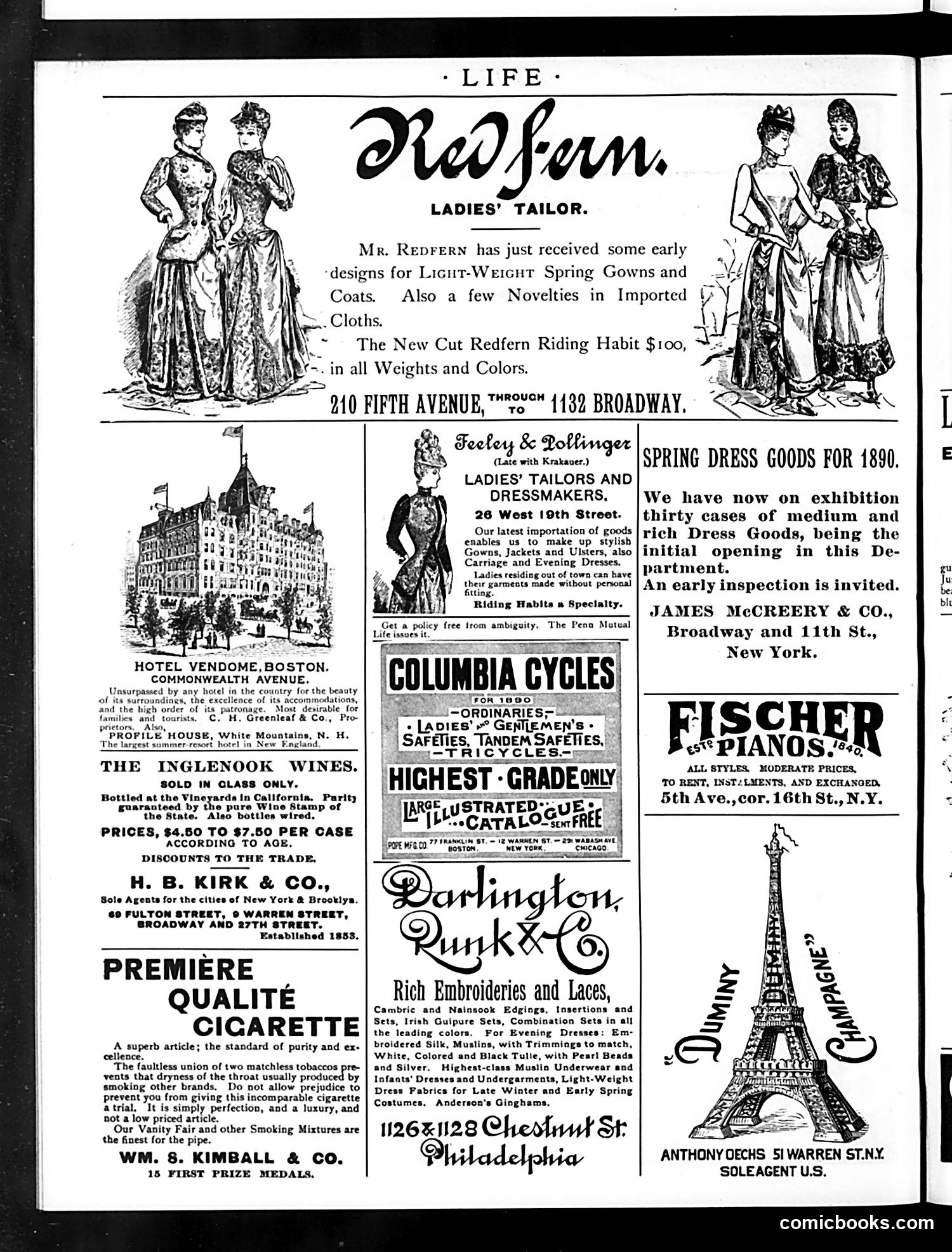
This is primarily an **advertising page** rather than satirical content. It showcases luxury goods and services targeting wealthy, fashionable Americans in the 1890s. Key advertisements include: - **Redfern**: A prestigious ladies' tailor offering spring gowns and riding habits ($100—expensive for the era) - **Hotel Vendome** (Boston) and **Profile House** (White Mountains): High-end resort hotels - **Inglenook Wines**: California wines sold through New York agents - **Fashion/textiles**: Multiple tailors, dressmakers, and fabric importers offering imported goods - **Luxury items**: Pianos, cigarettes ("Première Qualité"), embroideries, and laces The page reflects **Gilded Age consumer culture**—emphasizing imported European fashions, refined leisure travel, and conspicuous consumption. The repeated mention of "imported" goods and high prices signals these are aspirational purchases for the upper-middle and wealthy classes. This represents Life's advertising base: businesses targeting affluent readers.
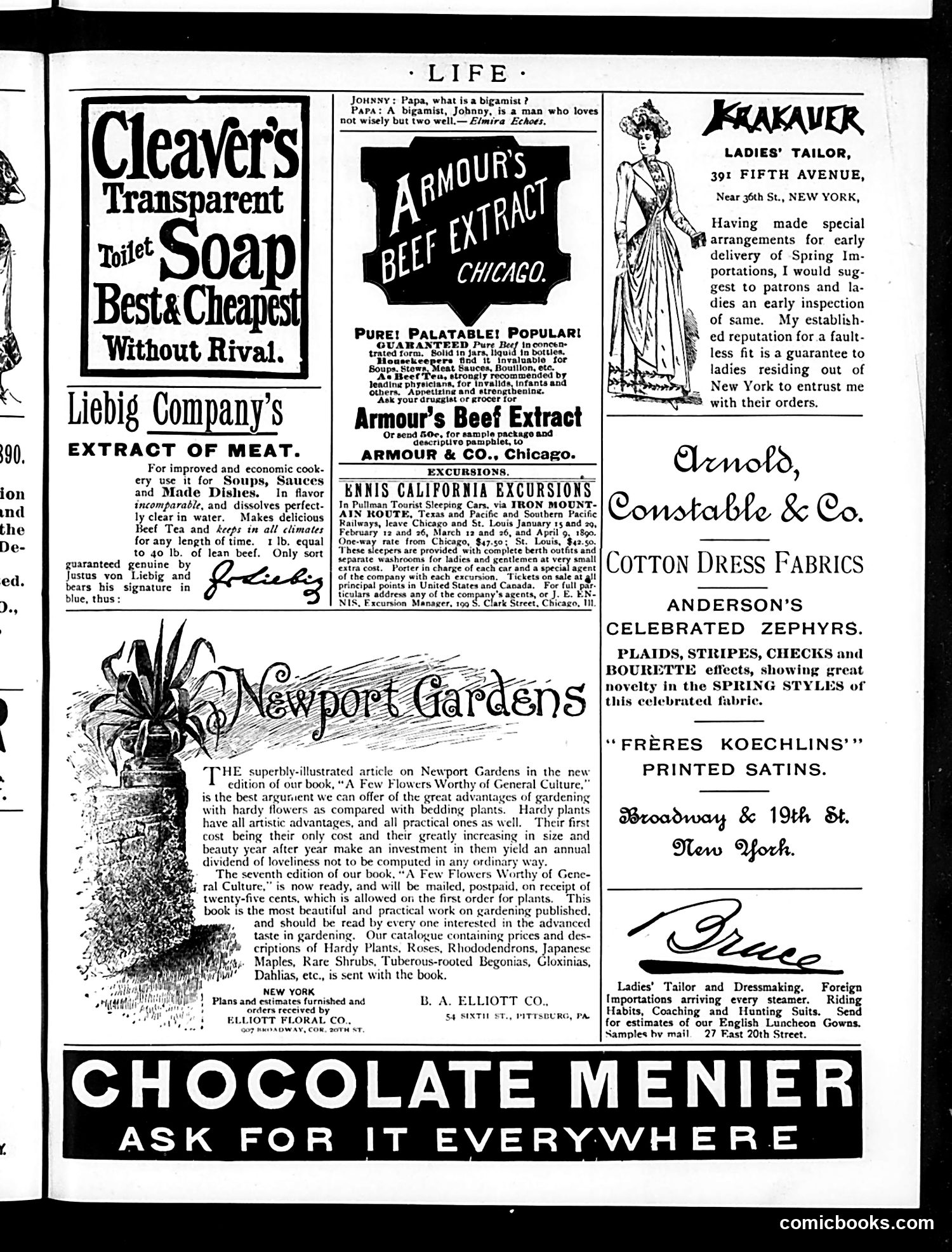
This page is primarily **advertisements and product endorsements** typical of late 19th/early 20th-century Life magazine, with minimal satirical content. The one notable joke appears at the top: a father defines "bigamist" as "a man who loves not wisely but two well"—a pun playing on Shakespeare's *Othello* ("loved not wisely but too well") to make a double-entendre about bigamy and excessive romantic devotion. The rest of the page consists of period advertisements: Cleaver's soap, Liebig's meat extract, Armour's beef extract, a ladies' tailor (Krakauer), cotton dress fabrics, a floral/gardening company (B.A. Elliott Co.), and Chocolate Menier candy. These ads reflect contemporary consumer products and services—beef extracts were popular cooking staples, and mail-order dress fabrics served women unable to access New York shops directly. The Newport Gardens illustration advertises gardening books and plants. This is **not satire but commercial content**, representative of Life's business model: satirical writing mixed with paying advertisements to subsidize publication.
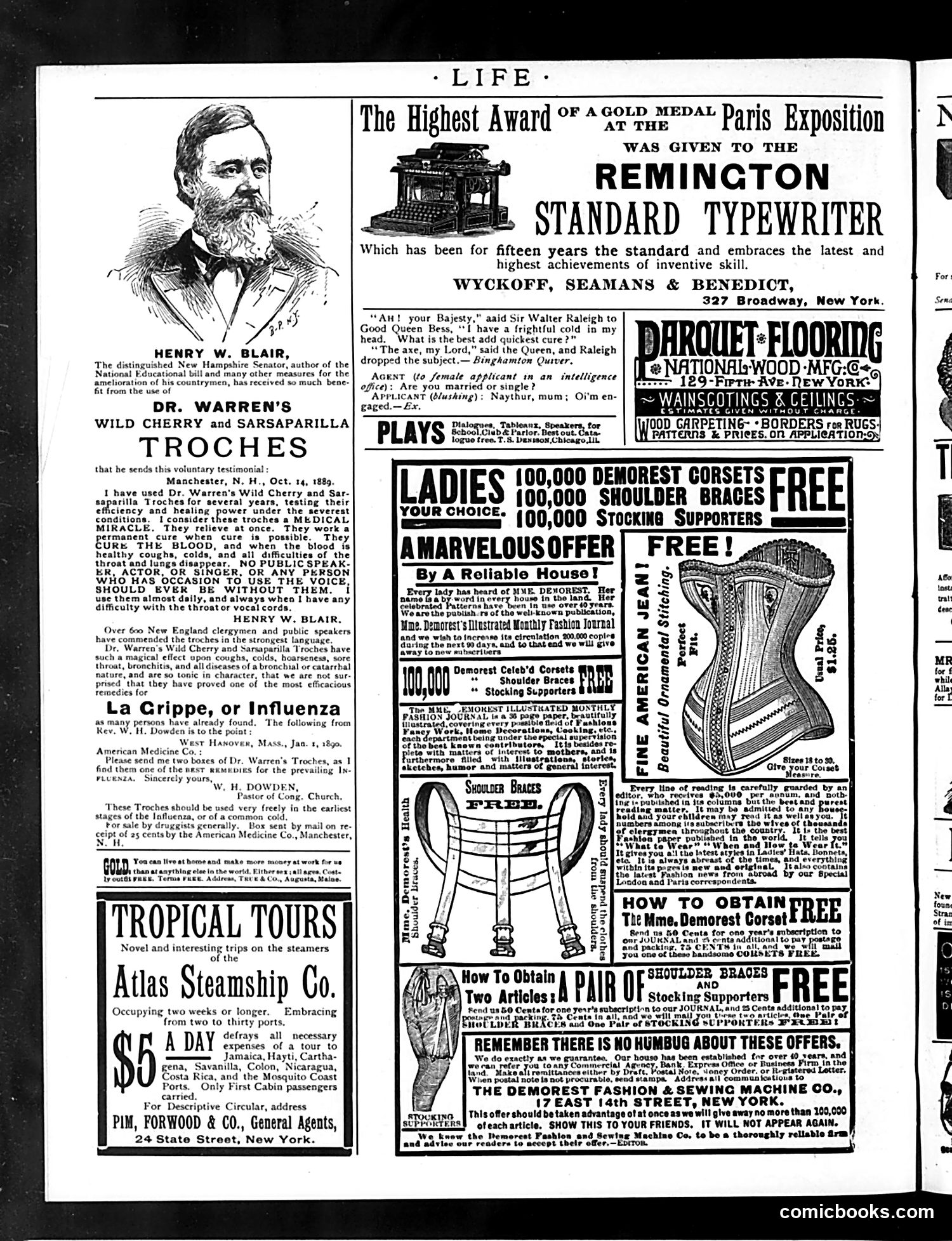
This is primarily an **advertising page** from Life magazine (circa 1889), not a political cartoon. The page contains testimonial ads and commercial promotions typical of the era. **Key content:** - **Henry W. Blair testimonial** (left): A real U.S. Senator endorses Dr. Warren's medicinal troches (lozenges) for throat/cough relief, claiming they cured his "La Grippe" (influenza). This was common practice—politicians freely lent their names to patent medicines without modern FDA regulations. - **Two brief jokes** featuring wordplay: Sir Walter Raleigh's exchange with Queen Elizabeth I, and a maid claiming to be "engaged" rather than married. - **Heavy advertising**: Remington typewriters (emphasizing 15-year dominance), corsets, shoulder braces, steamship tours, and Mme. Demorest's fashion magazine offering free corsets as subscription incentive. **The satire, if any, is light**—poking fun at courtship and the absurdity of patent medicine claims. The page reflects 1880s consumer culture and the era's unregulated medical advertising.
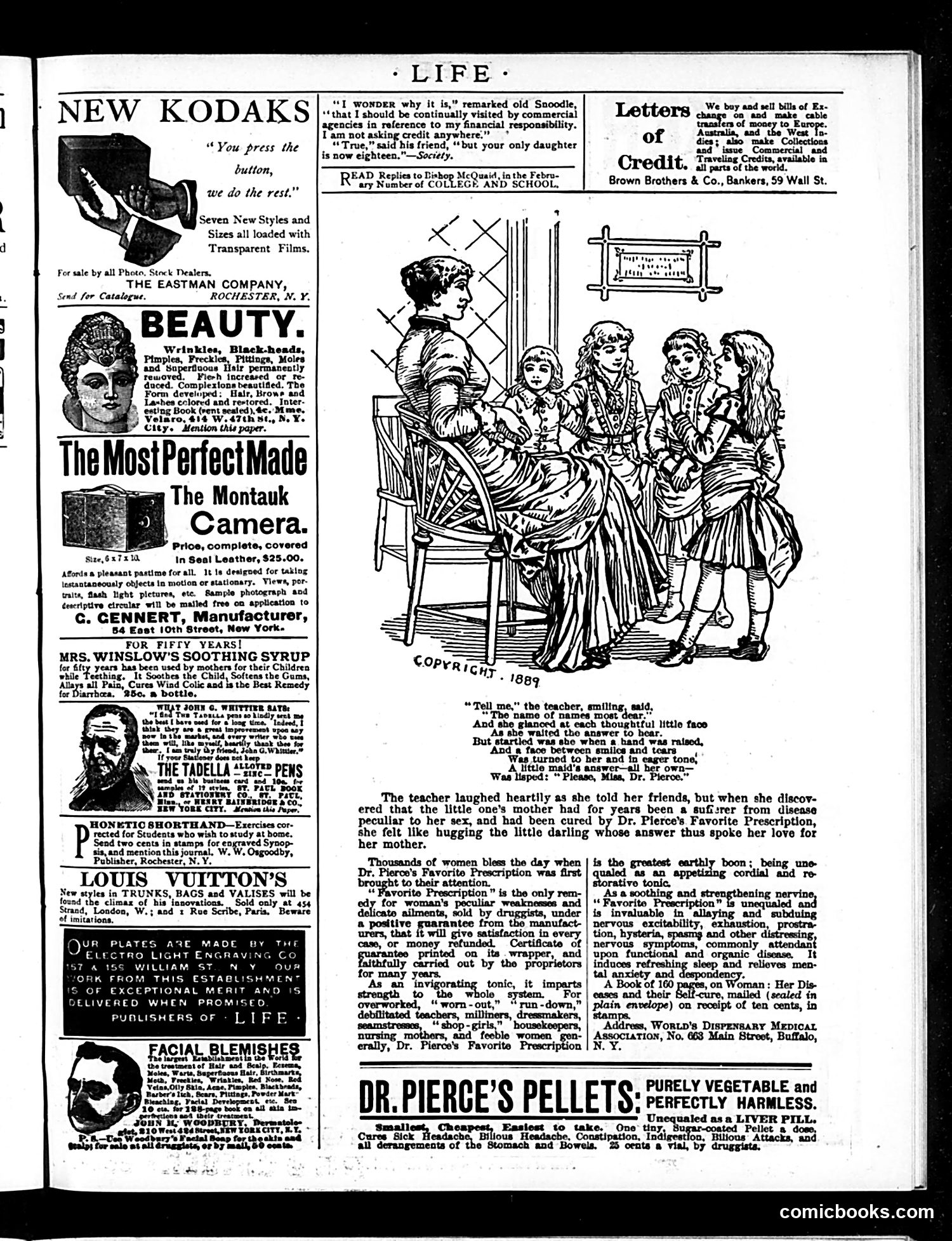
This page is primarily **advertising**, with one small humorous anecdote embedded among the ads. The main cartoon/joke appears in the center: a teacher asks a young girl to name "the names most dear." The child answers "Please, Miss, Dr. Pierce's Favorite Prescription"—because her mother was cured by it. The joke relies on the absurdity of a child naming a patent medicine as her greatest treasure, but it serves as a vehicle to advertise Dr. Pierce's Favorite Prescription, a heavily-marketed patent remedy claiming to cure women's ailments. The page also includes a brief anecdote about "old Snoodle," puzzled why credit agencies contact him—until his friend notes his daughter has turned eighteen, implying young women were credit risks or financial burdens. The surrounding ads promote Kodak cameras, beauty treatments, sewing machines, trunks, and shorthand courses—typical of late-19th-century Life magazine, which mixed satirical commentary with lucrative advertising.
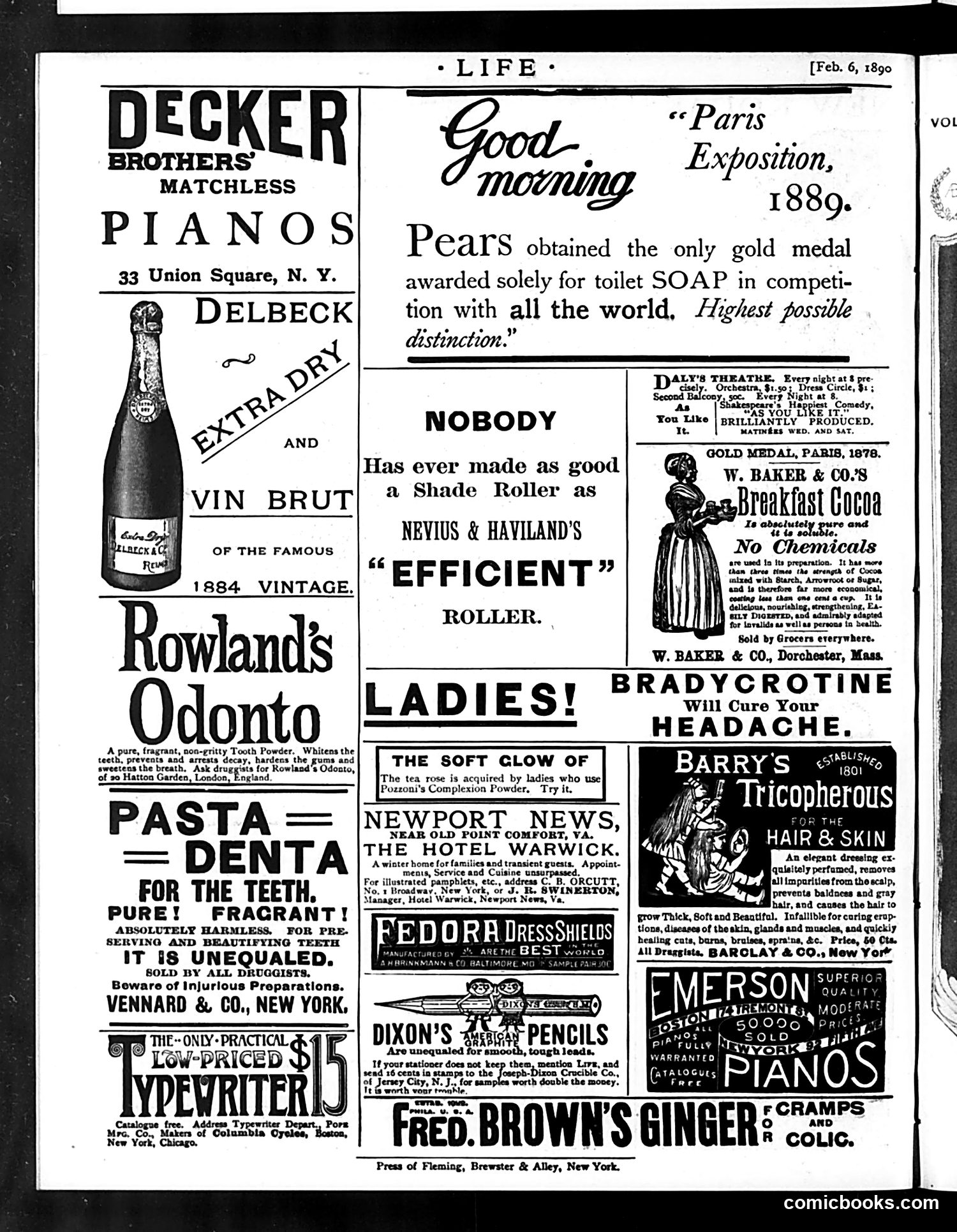
This is primarily an **advertising page** from Life magazine's early period, not a satirical cartoon. The page displays numerous commercial advertisements typical of the 1890s, including: **Notable products advertised:** - Decker Brothers pianos and Delbreck champagne - Rowland's Odonto toothpowder - Pasta Denta tooth cleaner - A $15 typewriter (the "Low-Priced Typewriter") - Dixon's pencils - Various patent medicines: Bradycrotine (headache cure), Barry's Tricopherous (hair/skin treatment), Fred. Brown's Ginger for cramps and colic **Key observation:** The top features Pears soap promoting its 1889 Paris Exposition gold medal for toilet soap—a genuine achievement used in advertising. The page reflects late Victorian commercial culture: medical products made unverified health claims (common before FDA regulation), and advertisements emphasize luxury goods alongside dubious remedies, all presented without the skepticism modern readers expect.