
Life, 1890-02-06 · page 4 of 18
Life — February 6, 1890 — page 4: what you’re looking at
What you’re looking at
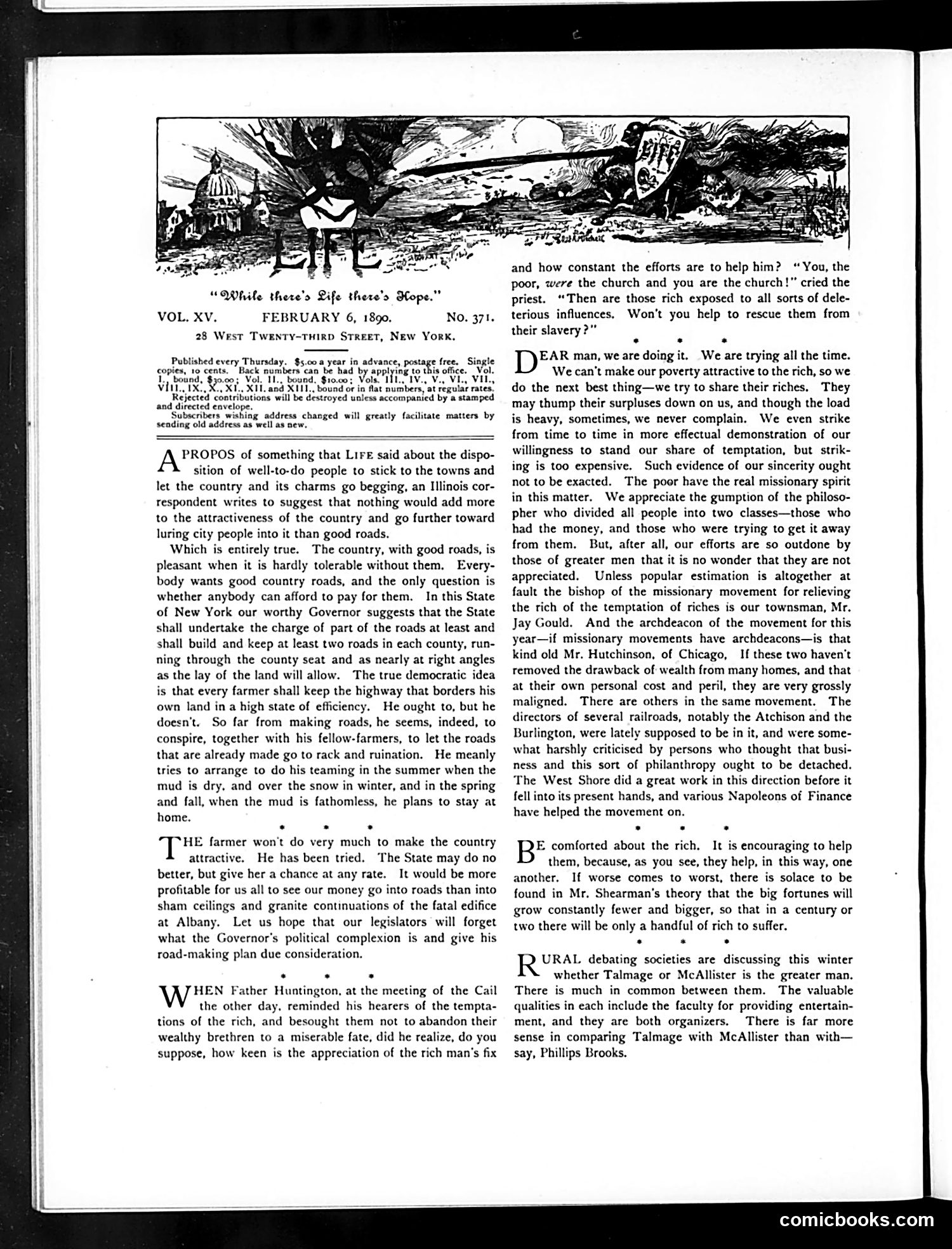
The header cartoon depicts a chaotic scene with "Life" written on a flag, appearing to show urban decay or social turmoil—though specific figures are unclear from the image quality. The editorial discusses poverty relief and missionary work. It criticizes wealthy benefactors for receiving excessive praise while poor people do the actual charitable labor. The text references Father Huntington's plea to the rich to help the poor, and mentions Mr. Jay Gould and an "archdeacon" (likely Edward King or similar church figure) involved in a missionary movement to address urban poverty. The piece satirizes how society disproportionately credits wealthy donors rather than those doing ground-level charitable work, while questioning whether the rich truly understand or appreciate the poor's genuine missionary spirit and sacrifice.
📄 Transcribed text from this page (OCR, searchable)
Machine-transcribed from the original scan — historical spelling and the odd misread are preserved.
“While there's Life there's Hope.” VOL. XV. FEBRUARY 6, 1890, No. 371. 28 West TwEenty-THIRD STREET, New York. Published every Thursday. $5.coa year in advance, postage free. Single copies, 10 cents. “Back numbers can be had by applying to this office. bound, $70.90; Vol, Il-, bound. Sioco; Vole IIs1V., Ve. Vie VIE TR! 82 8F Si. and Nite ounce inne mursbers at regula rates Rejected contributions will be destroyed unless accompanied by a stamped and directed envelope. Subscribers wishing address changed will greatly facilitate matters by sending old address as well as new, fPeotes of something that Lire said about the dispo- sition of well-to-do people to stick to the towns and let the country and its charms go begging, an Illinois cor- respondent writes to suggest that nothing would add more to the attractiveness of the country and go further toward luring city people into it than good roads. Which is entirely true. The country, with good roads, is pleasant when it is hardly tolerable without them. Every- body wants good country roads, and the only question is whether anybody can afford to pay for them. In this State of New York our worthy Governor suggests that the State shall undertake the charge of part of the roads at least and shall build and keep at least two roads in each county, run- ning through the county seat and as nearly at right angles as the lay of the land will allow. The true democratic idea is that every farmer shall keep the highway that borders his own land in a high state of efficiency. He ought to, but he doesn't. So far from making roads, he seems, indeed, to conspire, together with his fellow-farmers, to let the roads that are already made go to rack and ruination. He meanly tries to arrange to do his teaming in the summer when the mud is dry, and over the snow in winter, and in the spring and fall, when the mud is fathomless, he plans to stay at home. . - . HE farmer won't do very much to make the country attractive. He has been tried. The State may do no better, but give her a chance at any rate. It would be more profitable for us all to see our money go into roads than into sham ceilings and granite continuations of the fatal edifice at Albany. Let us hope that our legislators will forget what the Governor's political complexion is and give his road-making plan due consideration. . . . HEN Father Huntington, at the meeting of the Cail the other day, reminded his hearers of the tempta- tions of the rich, and besought them not to abandon their wealthy brethren to a miserable fate, did he realize, do you suppose, how keen is the appreciation of the rich man’s fix and how constant the efforts are to help him? “ You, the poor, were the church and you are the church!” cried the priest. “Then are those rich exposed to all sorts of dele- terious influences. Won't you help to rescue them from their slavery?” . . . EAR man, we are doing it. We are trying all the time. We can’t make our poverty attractive to the rich, so we do the next best thing—we try to share their riches. They may thump their surpluses down on us, and though the load is heavy, sometimes, we never complain. We even strike from time to time in more effectual demonstration of our willingness to stand our share of temptation, but. strik- ing is too expensive. Such evidence of our sincerity ought not to be exacted. The poor have the real missionary spirit in this matter. We appreciate the gumption of the philoso- pher who divided all people into two classes—those who had the money, and those who were trying to get it away from them. But, after all, our efforts are so outdone by those of greater men that it is no wonder that they are not appreciated. Unless popular estimation is altogether at fault the bishop of the missionary movement for relieving the rich of the temptation of riches is our townsman, Mr. Jay Gould. And the archdeacon of the movement for this year—if missionary movements have archdeacons—is that kind old Mr. Hutchinson, of Chicago, If these two haven't removed the drawback of wealth from many homes, and that at their own personal cost and peril, they are very grossly maligned. There are others in the same movement. The directors of several railroads, notably the Atchison and the Burlington, were lately supposed to be in it, and were some- what harshly criticised by persons who thought that busi- ness and this sort of philanthropy ought to be detached. The West Shore did a great work in this direction before it fell into its present hands, and various Napoleons of Finance have helped the movement on. . . . E comforted about the rich, It is encouraging to help them, because, as you see, they help, in this way, one another. If worse comes to worst, there is solace to be found in Mr. Shearman’s theory that the big fortunes will grow constantly fewer and bigger, so that in a century or two there will be only a handful of rich to suffer. . . . URAL debating societies are discussing this winter whether Talmage or McAllister is the greater man. There is much in common between them. The valuable qualities in each include the faculty for providing entertain- ment, and they are both organizers. There is far more sense in comparing Talmage with McAllister than with— say, Phillips Brooks. comicbooks.com