
Life, 1890-02-06 · page 6 of 18
Life — February 6, 1890 — page 6: what you’re looking at
What you’re looking at
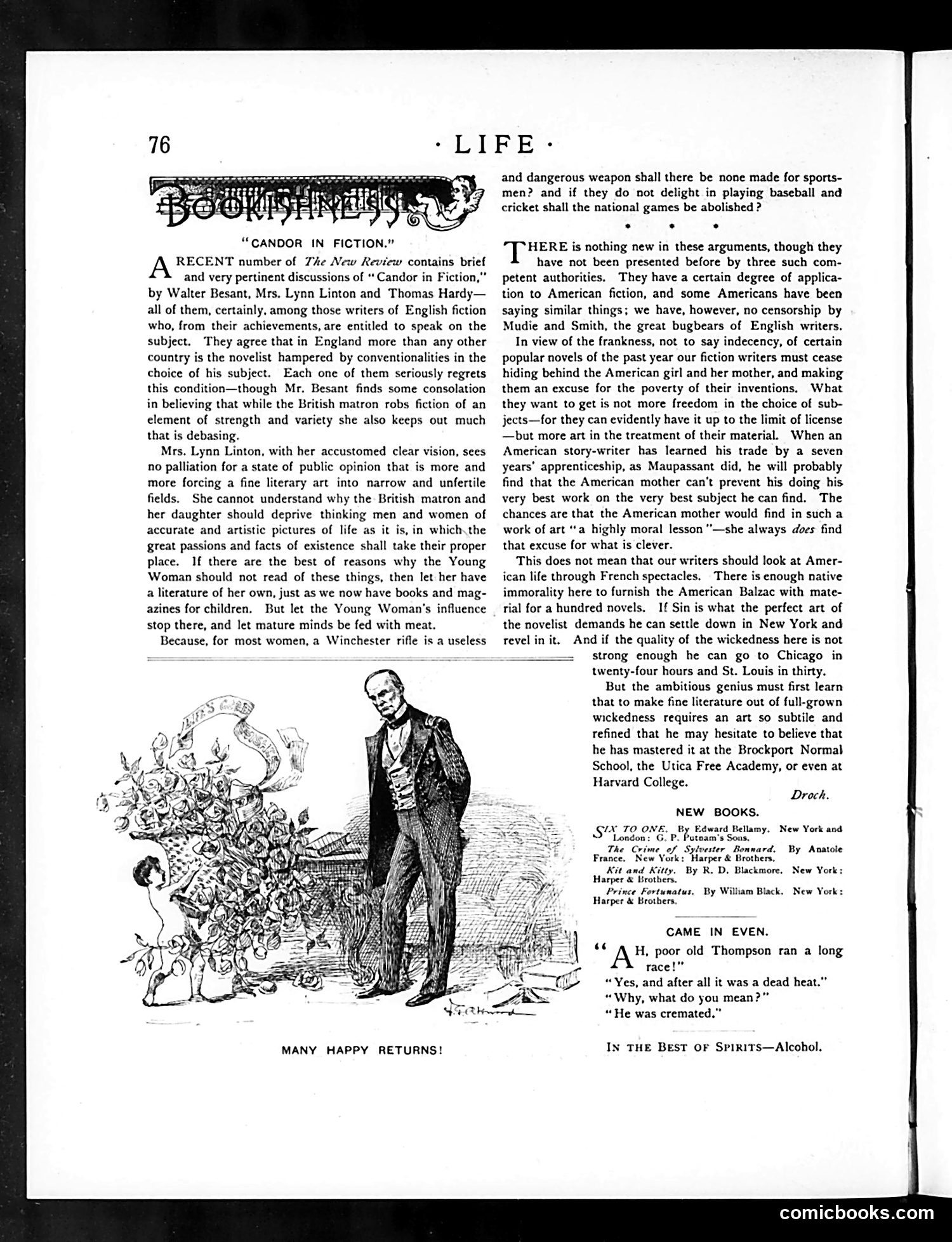
The main cartoon titled "MANY HAPPY RETURNS!" depicts a well-dressed gentleman standing beside an elaborate, grotesque figure emerging from what appears to be a cornucopia or vessel. The imagery suggests a satirical commentary on something returning or being reborn—likely referencing a political figure or social phenomenon the artist wished to ridicule through exaggeration. The page's text discusses "Candor in Fiction," critiquing American and British novelists' treatment of subjects like morality and propriety. The broader context addresses debates about literary freedom versus censorship. Without clearer identification of the specific figure in the cartoon, I cannot definitively state whom it mocks. However, the grotesque character suggests the artist viewed something's "return" as undesirable or absurd.
📄 Transcribed text from this page (OCR, searchable)
Machine-transcribed from the original scan — historical spelling and the odd misread are preserved.
-LIFE- “CANDOR IN FICTION.” RECENT number of The New Review contains brief and very pertinent discussions of “Candor in Fiction,” by Walter Besant, Mrs. Lynn Linton and Thomas Hardy— all of them, certainly, among those writers of English fiction who, from their achievements, are entitled to speak on the subject. They agree that in England more than any other country is the novelist hampered by conventionalities in the choice of his subject. Each one of them seriously regrets this condition—though Mr. Besant finds some consolation in believing that while the British matron robs fiction of an element of strength and variety she also keeps out much that is debasing. Mrs. Lynn Linton, with her accustomed clear vision, sees no palliation for a state of public opinion that is more and more forcing a fine literary art into narrow and unfertile fields. She cannot understand why the British matron and her daughter should deprive thinking men and women of accurate and artistic pictures of life as it is, in which.the great passions and facts of existence shall take their proper place. If there are the best of reasons why the Young ‘Woman should not read of these things, then let her have a literature of her own, just as we now have books and mag- azines for children. But let the Young Woman's influence stop there, and let mature minds be fed with meat. Because, for most women, a Winchester rifle is a useless MANY HAPPY RETURNS! and dangerous weapon shall there be none made for sports- men? and if they do not delight in playing baseball and cricket shall the national games be abolished ? 5) Pee is nothing new in these arguments, though they have not been presented before by three such com- petent authorities. They have a certain degree of applica- tion to American fiction, and some Americans have been saying similar things; we have, however, no censorship by Mudie and Smith, the great bugbears of English writers. In view of the frankness, not to say indecency, of certain popular novels of the past year our fiction writers must cease hiding behind the American girl and her mother, and making them an excuse for the poverty of their inventions, What they want to get is not more freedom in the choice of sub- jects—for they can evidently have it up to the limit of license —but more art in the treatment of their material. When an American story-writer has learned his trade by a seven years’ apprenticeship, as Maupassant did, he will probably find that the American mother can’t prevent his doing his very best work on the very best subject he can find. The chances are that the American mother would find in such a work of art ‘‘a highly moral lesson "—she always does find that excuse for what is clever. This does not mean that our writers should look at Amer- ican life through French spectacles. There is enough native immorality here to furnish the American Balzac with mate- rial for a hundred novels. If Sin is what the perfect art of the novelist demands he can settle down in New York and revel in it. And if the quality of the wickedness here is not strong enough he can go to Chicago in twenty-four hours and St. Louis in thirty. But the ambitious genius must first learn that to make fine literature out of full-grown wickedness requires an art so subtile and refined that he may hesitate to believe that he has mastered it at the Brockport Normal School, the Utica Free Academy, or even at Harvard College. Droch. NEW BOOKS. Six TO ONE. By Edward Bellamy. New York and "London: G. P. Puteam’s Sous. The Crime of Sylvester Bonnard. France. New Vork: Harper & Brothers. Kit and Kitty. By R. D. Blackmore. Harper & Brothers. Prince Fortunatus. Harper & Brothers. By Anatole New York: By William Black, New York: CAME IN EVEN. gs A® poor old Thompson ran a long race!" “Yes, and after all it was a dead heat.” “Why, what do you mean?” “He was cremated.” IN THE Best OF SpIRITS—Alcohol. comicbooks.com