
A complete issue · 18 pages · 1889
Life — December 19, 1889
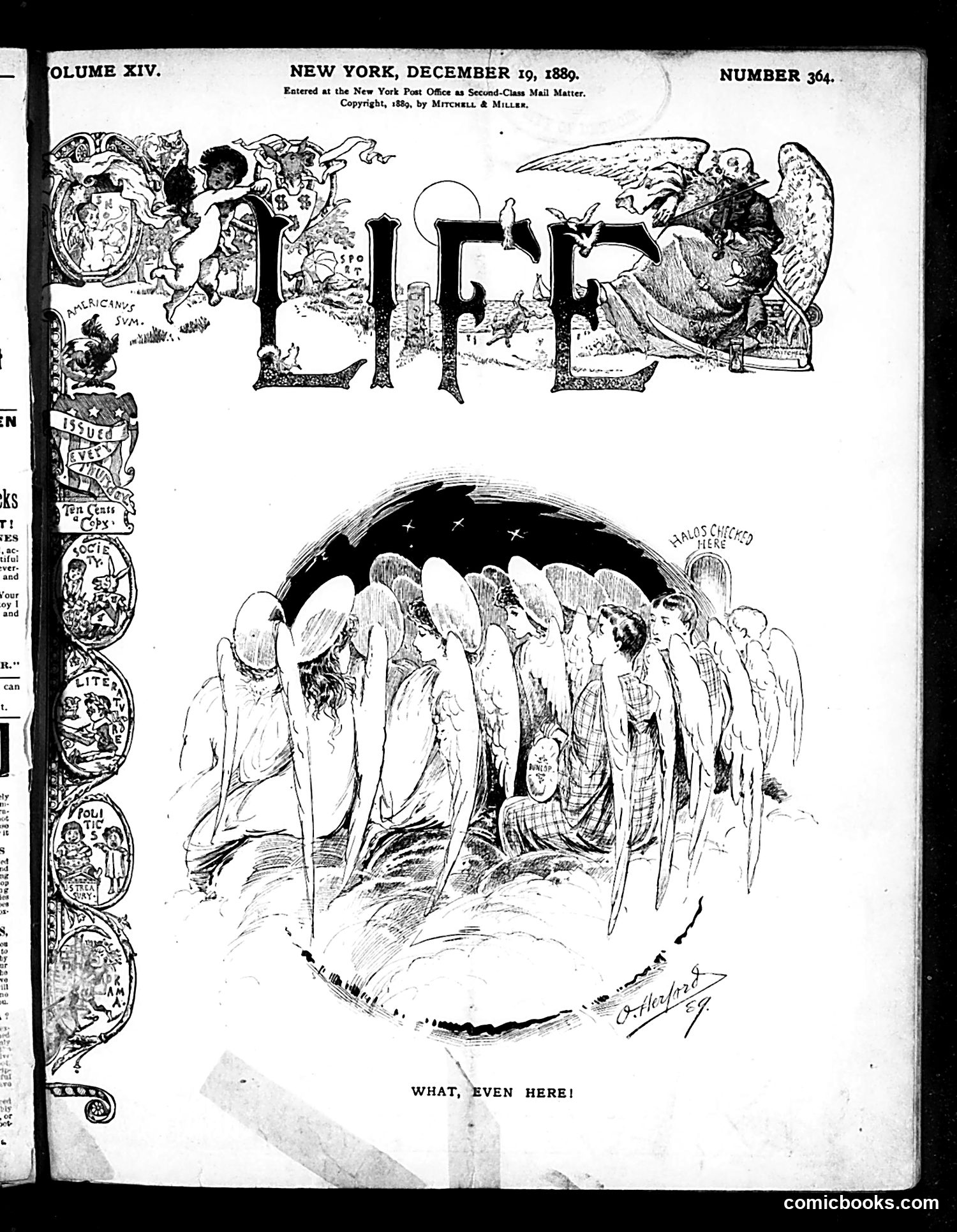
This page from Life magazine contains two distinct cartoons. The top uses decorative letters spelling "LIFE" as part of an ornate header design. The main cartoon below, captioned "WHAT, EVEN HERE!" depicts a group of angels gathered beneath a dark cloud labeled "HALOS CHECKED HERE." The satire suggests that even heaven's sanctity is being invaded or corrupted by something worldly—the checked halos imply that even angels must temporarily surrender their moral purity. Without additional context, the specific target of this satire is unclear. It likely comments on a particular social scandal or hypocrisy prominent in 1890 America where corruption or vice was unexpectedly discovered in seemingly pure or sacred spaces, though the exact reference requires historical documentation.
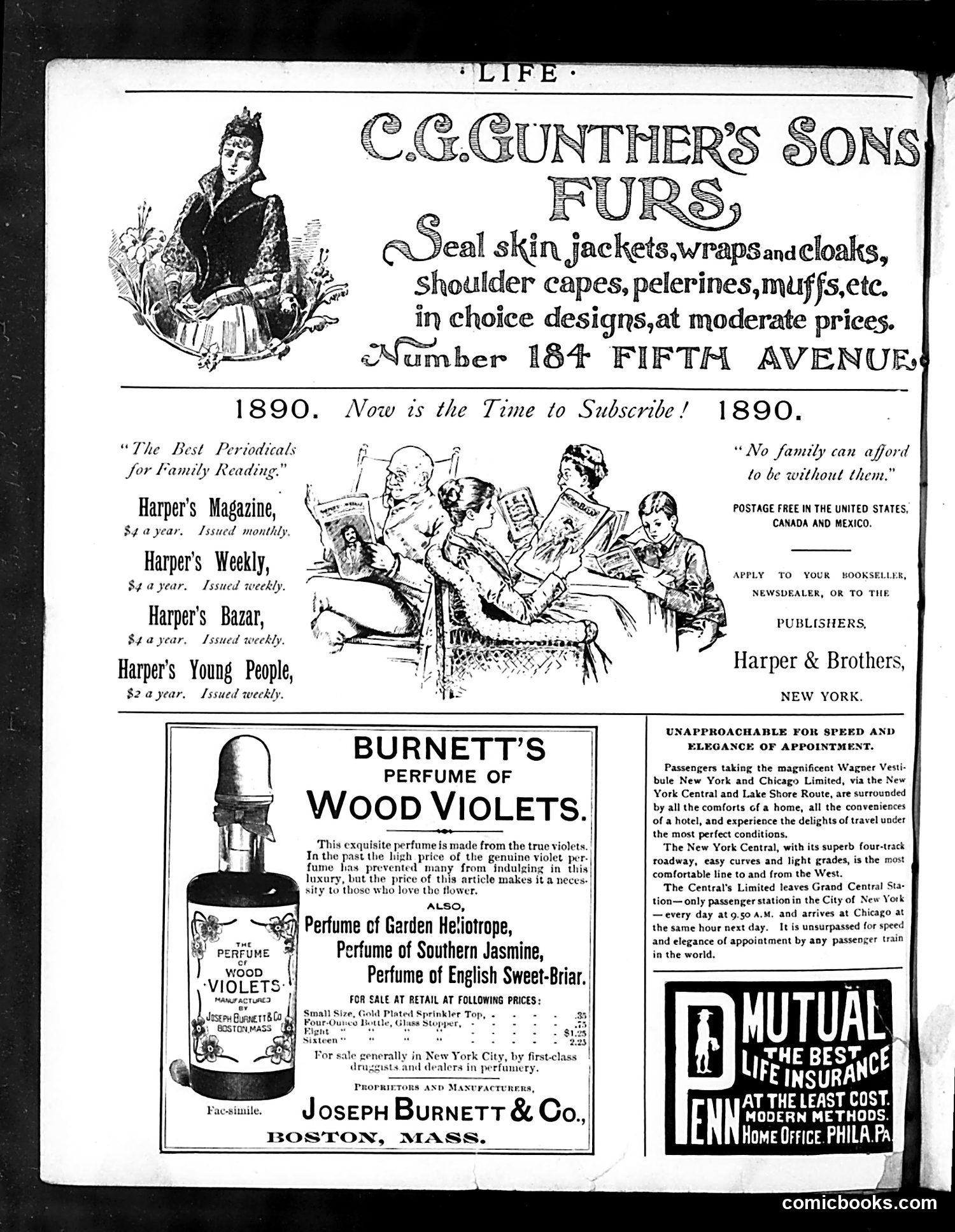
This page is primarily **advertising**, not satire or political commentary. It contains three distinct ads: 1. **C.G. Gunthers Sons Furs** (top): Promotes seal skin jackets and cloaks at "Number 184 Fifth Avenue"—a luxury fur retailer catering to wealthy women. 2. **Burnett's Perfume of Wood Violets** (center-left): Advertises perfume products made from genuine violets, marketed as an affordable luxury. 3. **Mutual Life Insurance** (bottom-right): A life insurance company advertisement. The page also includes subscription promotions for Harper's publications (Magazine, Weekly, Bazar, Young People), described as "The Best Periodicals for Family Reading." There is **no political cartoon or social satire** present—this is a straightforward 1890 magazine advertisement page aimed at middle and upper-class readers.
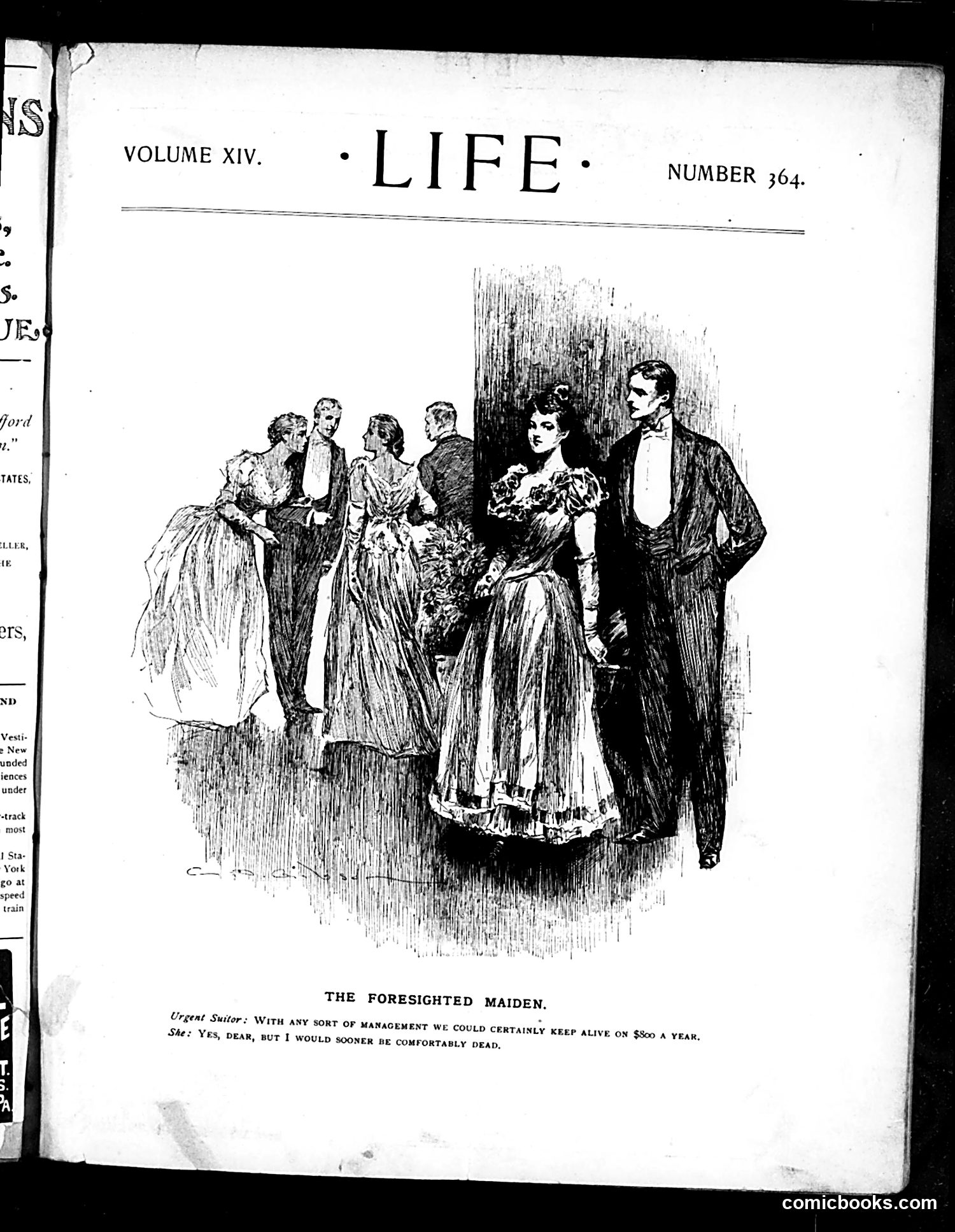
This cartoon satirizes a young woman's pragmatic—if darkly humorous—approach to marriage and finances. The woman, depicted as the central figure in formal evening dress, is surrounded by suitors in tuxedos at what appears to be a social gathering. The caption reveals her calculation: a suitor urgently proposes managing her finances on $300 annually, but she responds that she'd "sooner be comfortably dead"—implying the sum is inadequate for her desired lifestyle. The satire targets both the woman's materialism and the era's economic realities: the cartoon mocks her mercenary marriage prospects while also suggesting that $300 yearly was genuinely insufficient for comfortable living, particularly for a woman dependent on a husband's income.
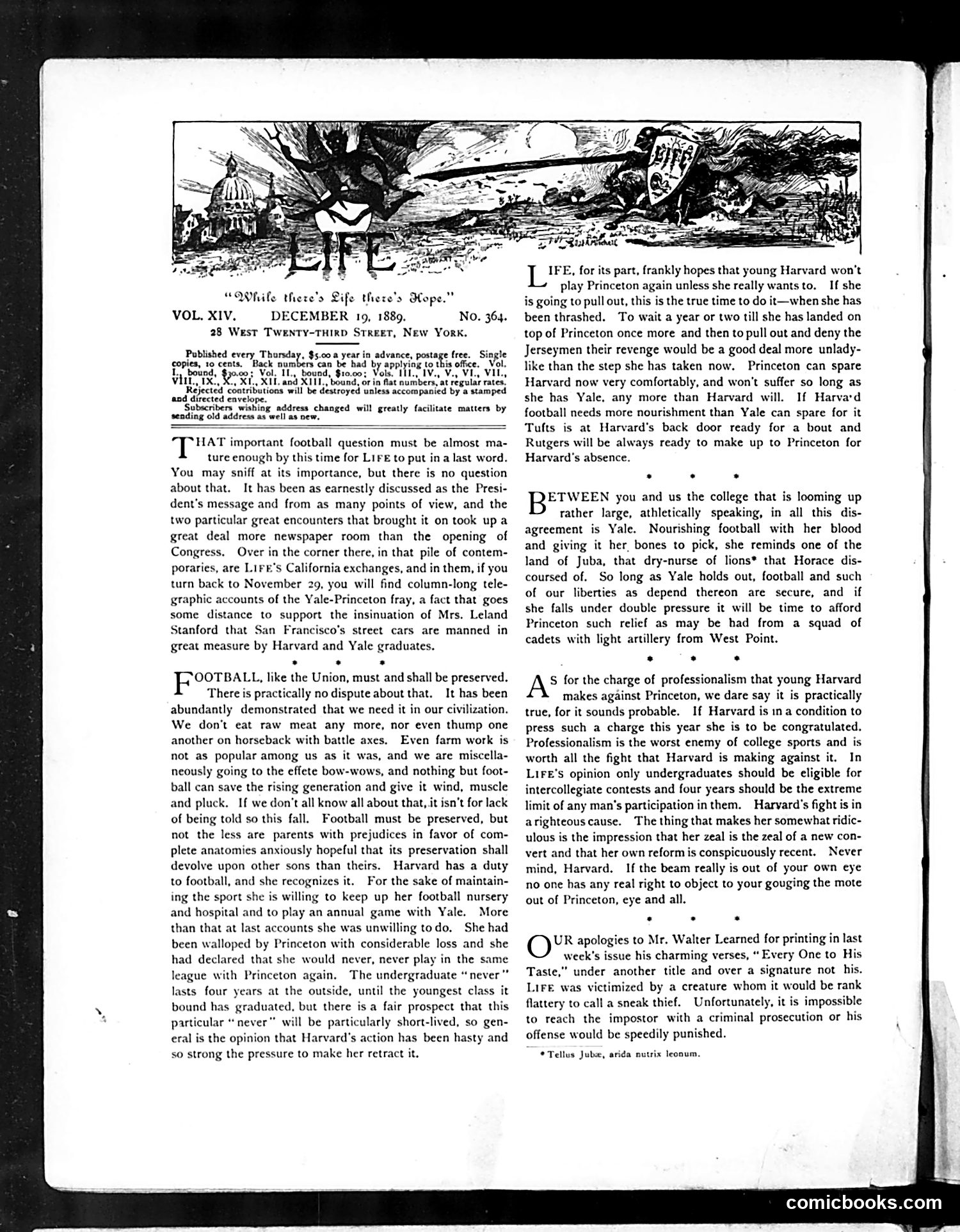
The masthead cartoon depicts a tree with a noose, referencing capital punishment. The motto "While there's Life there's Hope" suggests ironic commentary on mortality or justice. The article's main focus concerns a Harvard-Princeton football dispute. Harvard had withdrawn from playing Princeton, prompting Life to editorialize on the controversy. The text suggests Harvard accused Princeton of professionalism (paying players), which violated amateur sporting ideals of the era. Life defends Harvard's decision while arguing football itself should be preserved as valuable for civilization and character-building. The magazine urges Harvard to reconsider future matches but supports her principled stance against what they frame as Princeton's corruption of amateur athletics. This reflects late-19th-century anxieties about commercializing collegiate sports.
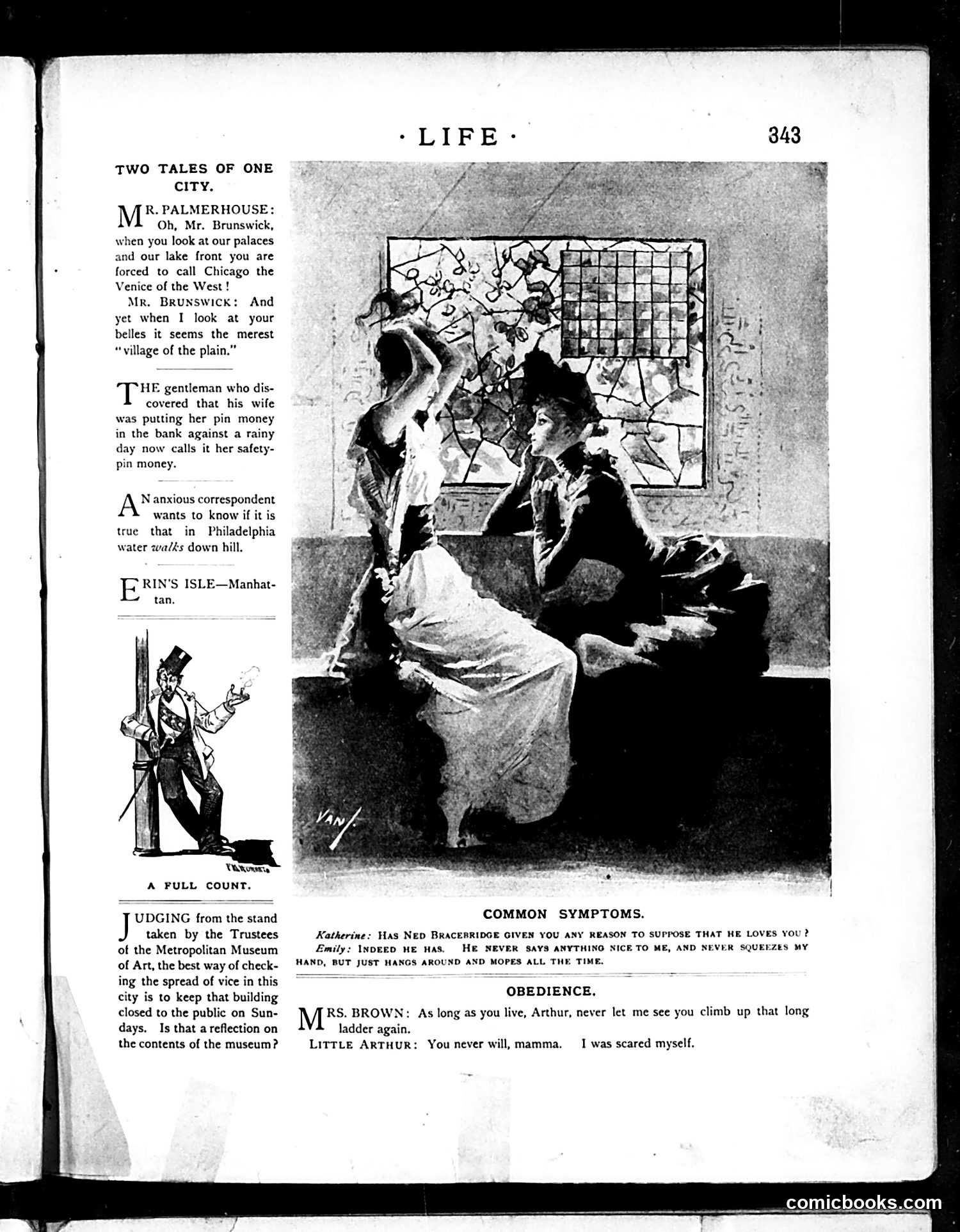
This page from Life magazine contains social commentary and advice columns rather than political cartoons. The main content includes: **"Two Tales of One City"**: A dialogue between Mr. Palmerhouse and Mr. Brunswick debating Chicago's character—whether it's a grand metropolis or merely a "village of the plain." **The illustration** shows two people examining a map of Manhattan, apparently discussing urban geography or development. **"Common Symptoms" and "Obedience"** sections offer satirical relationship advice. The humor appears to target romantic dynamics: suspicious behavior ("mopes all the time") and controlling partners. Little Arthur's reassurance to his mother about not climbing a ladder represents domestic obedience themes. The page reflects early 20th-century Life magazine's focus on urban commentary, romantic satire, and family social dynamics rather than direct political critique.
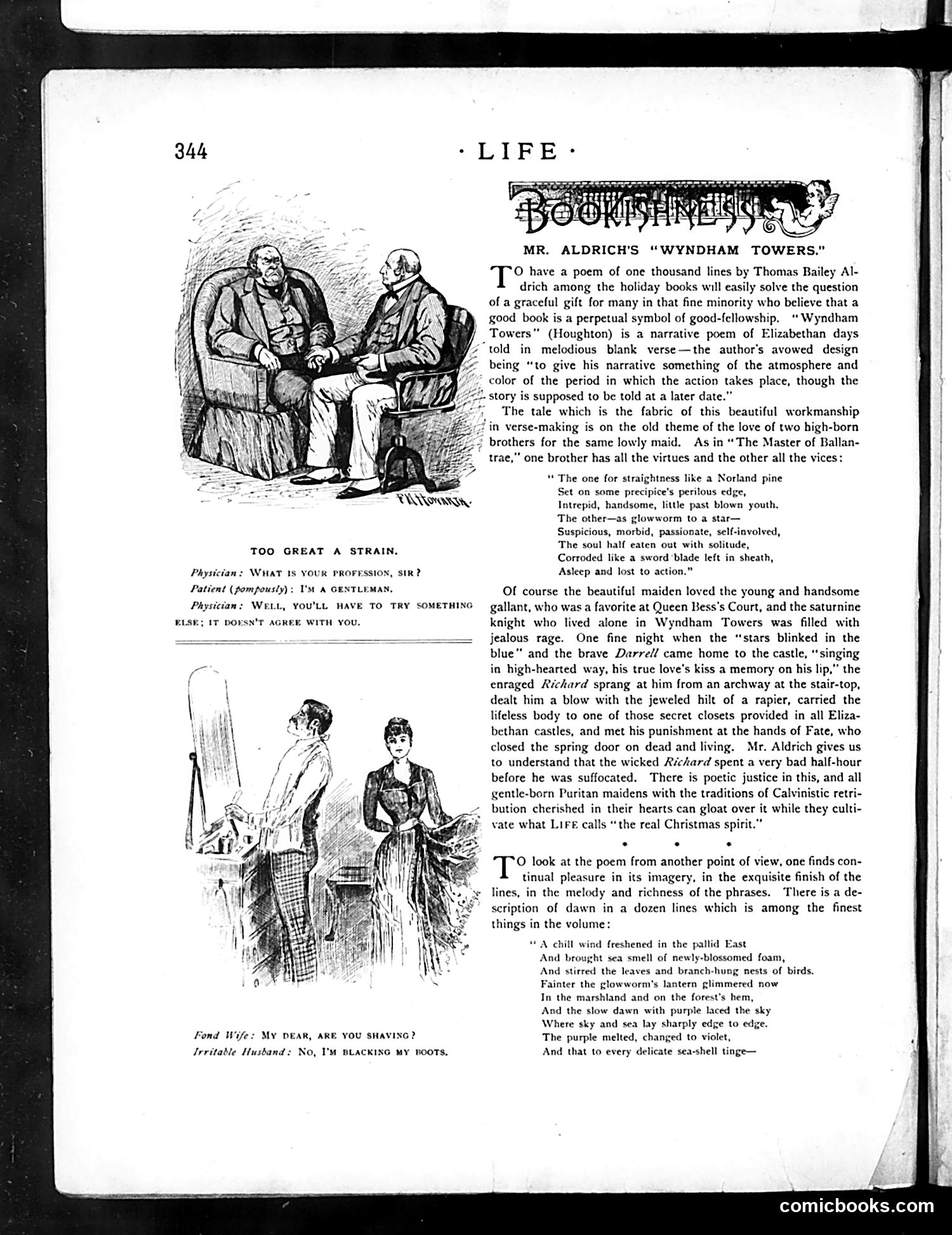
This page contains a **book review** of Thomas Bailey Aldrich's "Wyndham Towers," a narrative poem set in Elizabethan England. The review praises the work's atmospheric verse and describes its plot: two contrasting brothers, one virtuous and one dissolute, compete for a maiden's affection at Queen Elizabeth's court. The **two satirical cartoons** are unrelated to the book review: 1. **Top cartoon**: A physician and patient discussing profession—the patient claims to be a "gentleman," which the physician dismisses as disagreement with his "profession." 2. **Bottom cartoon**: Titled "Fond Wife" and "Irritable Husband," depicting domestic humor about the husband blacking his boots. These are generic Victorian-era domestic comedy sketches with no specific political commentary.
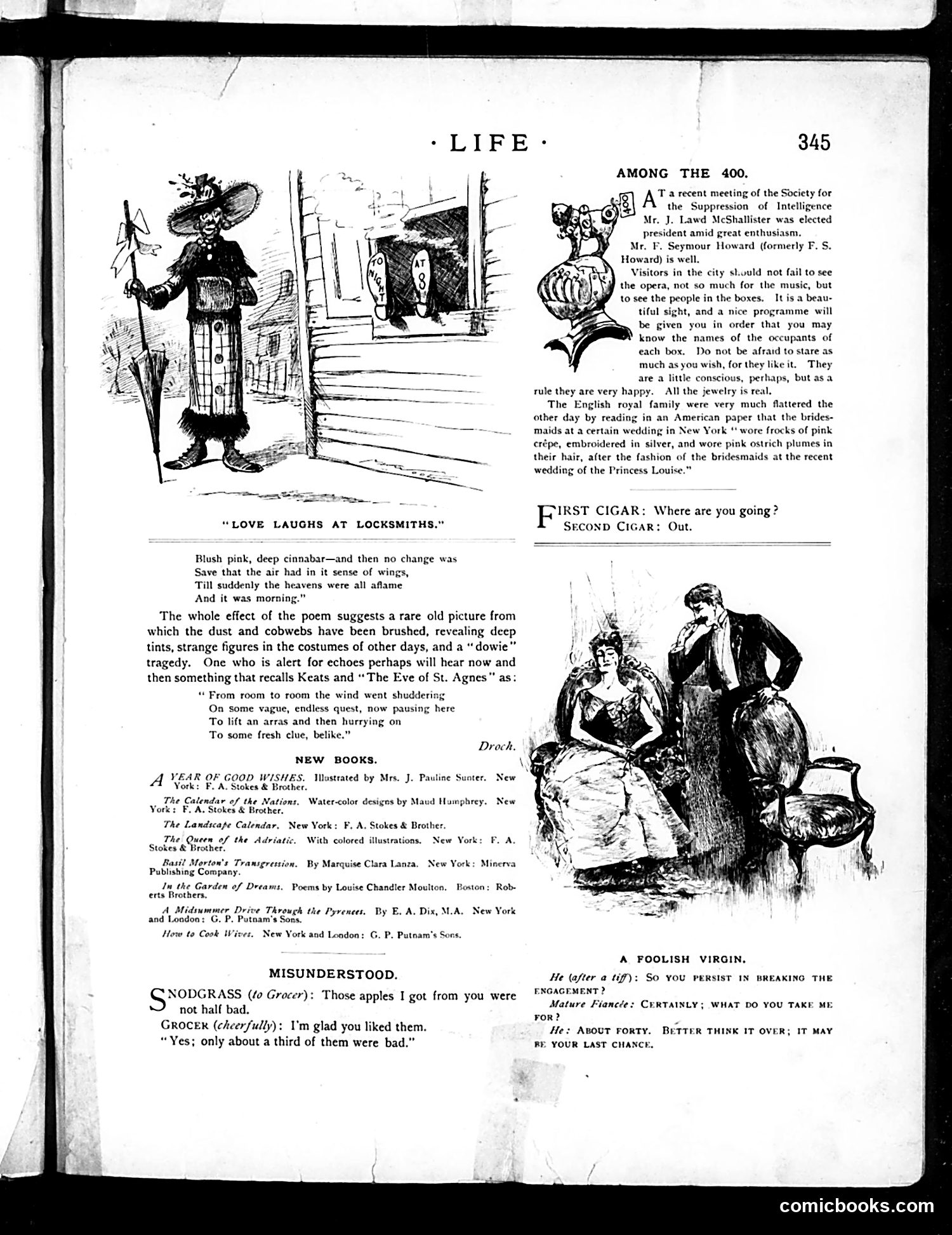
**"Love Laughs at Locksmiths"** (top cartoon): A woman in elaborate Edwardian dress stands at a doorway, suggesting a romantic or illicit rendezvous. The title plays on the common phrase, satirizing the idea that love (or infidelity) cannot be prevented by physical locks or barriers—a commentary on social hypocrisy regarding courtship and discretion among the wealthy. **"Among the 400"** describes high society at the opera, mocking the pretensions of New York's elite ("the 400" refers to the city's most prominent families). The text satirizes their materialism and fashion-obsession, particularly regarding jewelry and mimicking royal fashions. The remaining sections include brief comic dialogues ("First Cigar," "A Foolish Virgin," "Misunderstood") and book advertisements—typical Life magazine filler content.
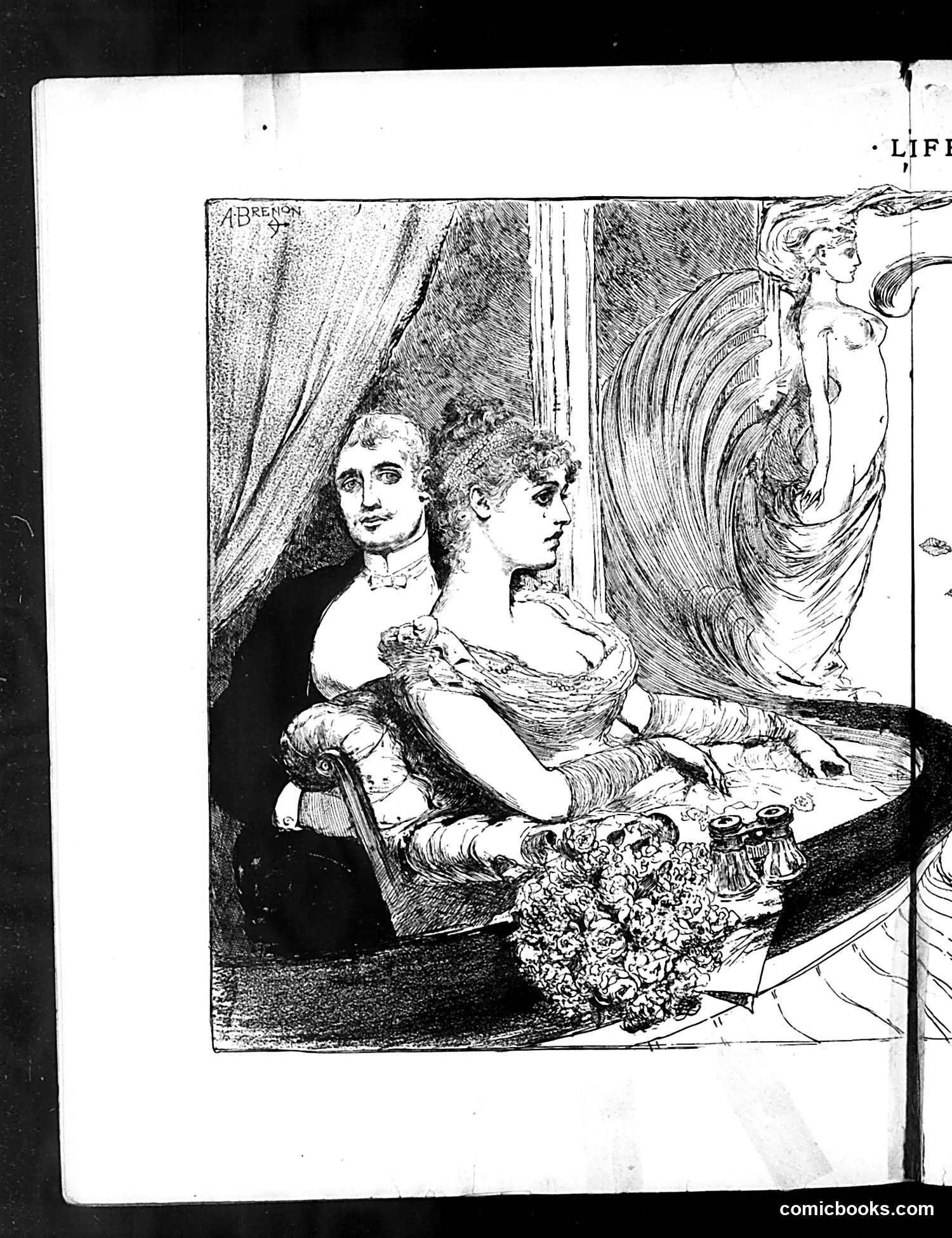
This appears to be a satirical illustration signed "D. Brenon" from *Life* magazine. The cartoon depicts an interior scene with elegantly dressed figures in what seems to be a theatrical or domestic setting. A well-dressed man in formal attire stands behind a woman in an off-shoulder gown seated at a table with flowers and decorative items. Classical female figures appear in the background, suggesting artistic or mythological references. The satire likely comments on vanity, seduction, or social pretense among the wealthy or theatrical classes—common *Life* magazine targets. The classical allusions and luxurious setting contrast with potential human folly or hypocrisy. However, without additional caption text visible, the specific satirical point remains unclear.
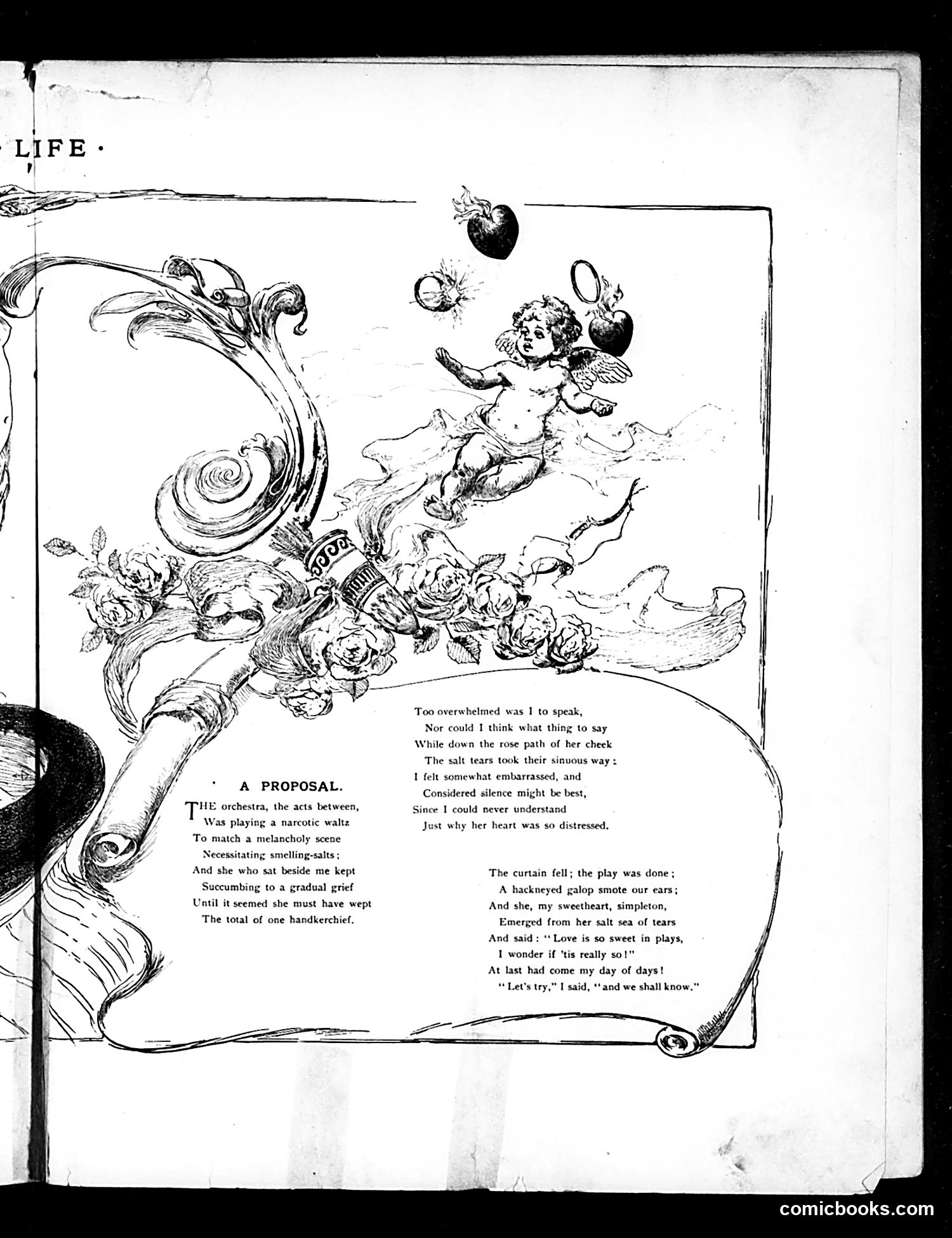
This page features a romantic poem titled "A Proposal" accompanied by decorative art nouveau styling. The illustration depicts a cherub or cupid figure juggling hearts while floating above ornamental scrollwork and roses, establishing a romantic theme. The poem narrates a theatrical proposal scene: the narrator and his companion attended a play with melancholic music that moved her to tears. Afterward, he proposed marriage, asking "Let's try," to which she agreed. The text emphasizes emotional vulnerability—her tears, his embarrassment, and their tentative commitment ("I wonder if 'tis really so!"). This represents typical Life magazine content: sentimental, comedic romantic literature paired with whimsical illustration, appealing to early 20th-century audiences' taste for both sentiment and gentle mockery of courtship rituals.
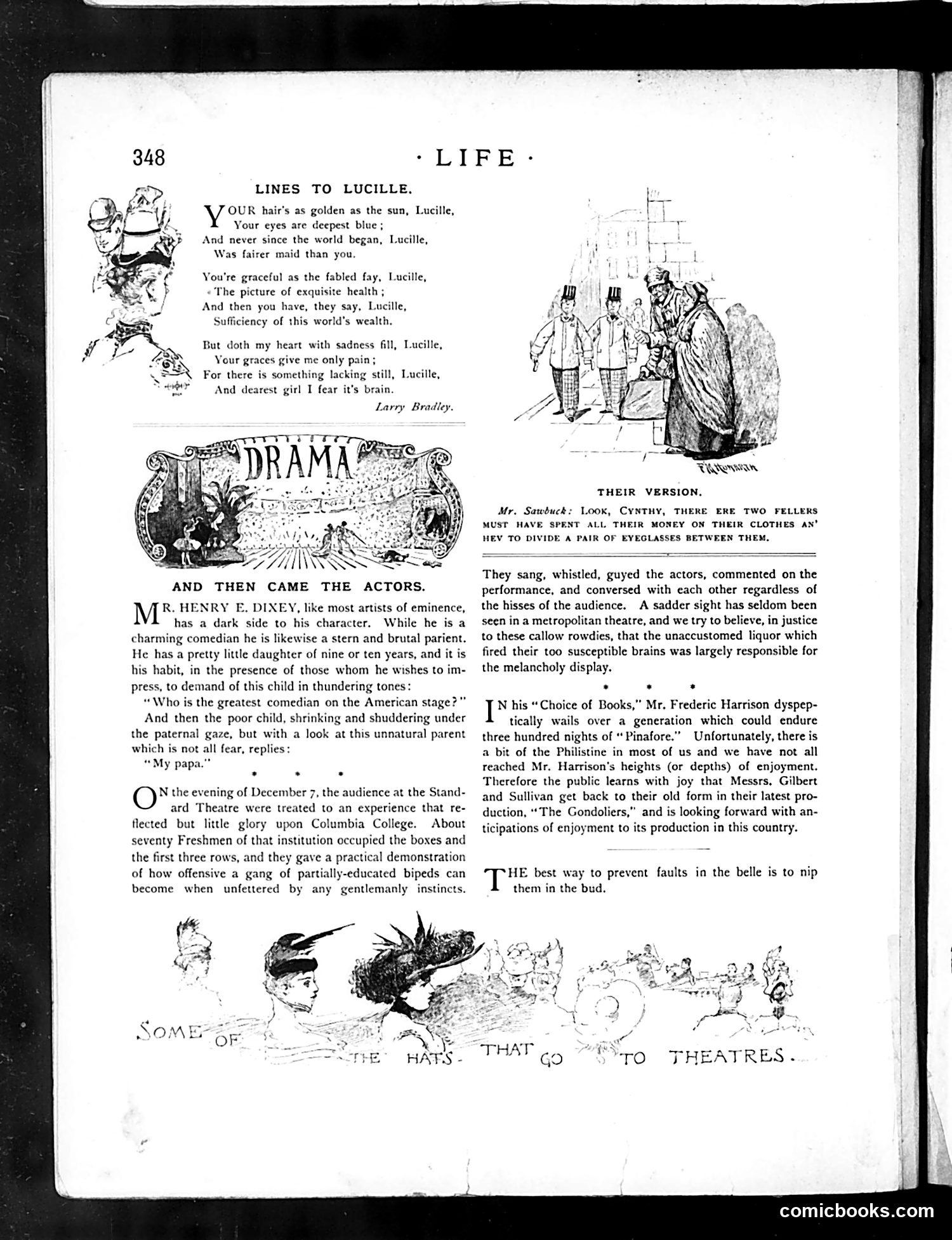
This page satirizes theatrical culture and audience behavior circa early 1900s. The main article "AND THEN CAME THE ACTORS" critiques Mr. Henry E. Dixey as a charming but dark-charactered performer who intimidates his child with thundering tones. The satire mocks both actors' pretensions and audience disruption: Columbia College freshmen at a December 7th performance engaged in crude behavior, demonstrating how "partially-educated bipeds" behave without "gentlemanly instincts." The bottom illustration lampooning elaborate theatrical hats satirizes women's fashion excess—a recurring Life theme. The piece argues such ostentatious headwear interferes with theater-going, captioned "SOME OF THE HATS THAT GO TO THEATRES," suggesting women's vanity disrupts public venues.
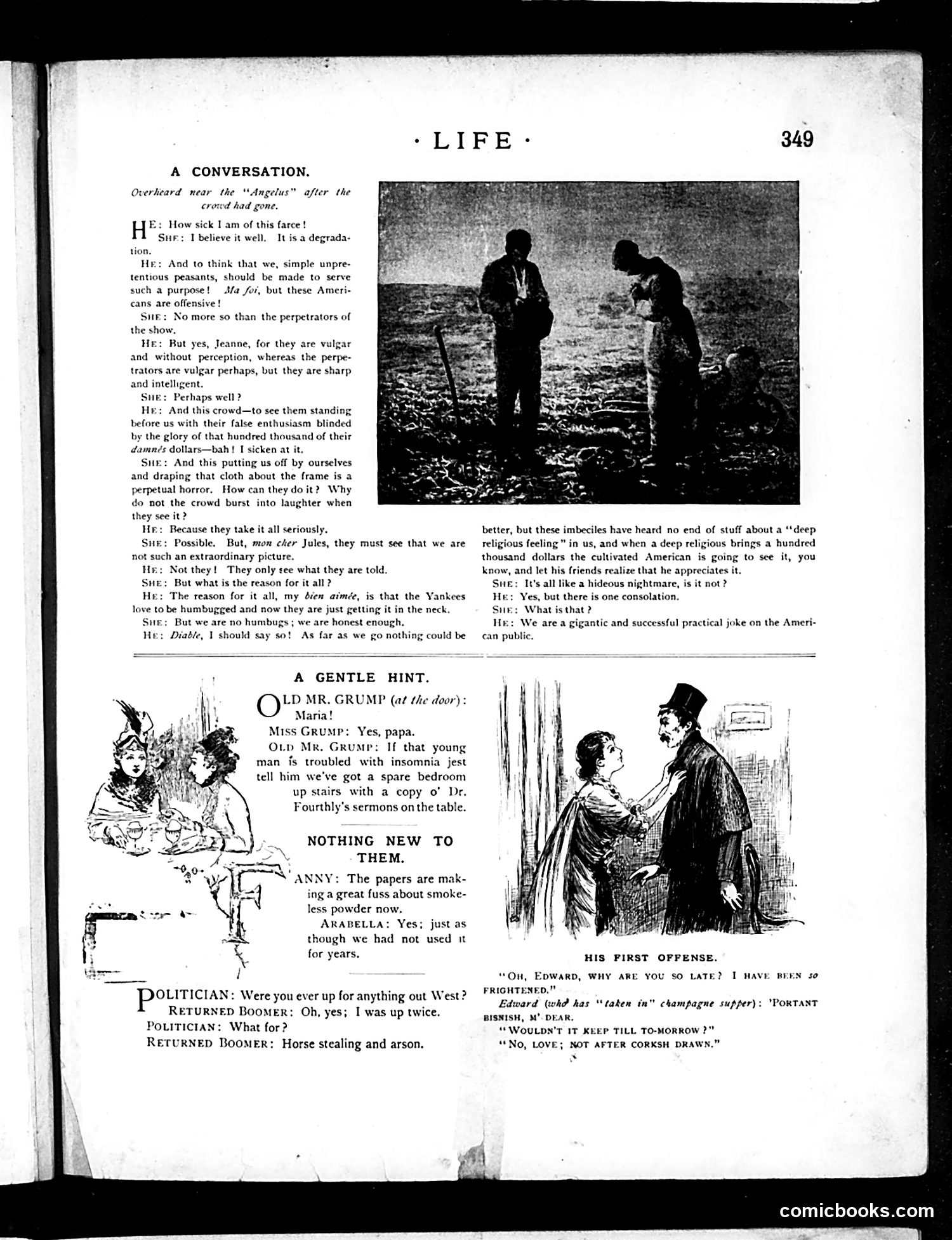
This page contains three satirical pieces: 1. **"A Conversation"** (top): A dialogue mocking American showmanship and theatrical fraud. Two figures debate whether circus perpetrators are "vulgar" or "sharp and intelligent," ultimately concluding Americans view the entire enterprise as "a gigantic and successful practical joke." 2. **"A Gentle Hint"** (middle-left): Mr. and Miss Grump discuss insomnia remedies—Dr. Fourfthly's sermons are humorously suggested as a cure for sleeplessness. 3. **"Nothing New to Them"** and related pieces (lower section): Brief quips about smokeless powder and a politician's crimes (horse stealing, arson). "His First Offense" depicts a domestic scene involving infidelity and reconciliation. The overall tone satirizes American entertainment culture, politics, and social hypocrisy typical of *Life* magazine's satirical approach.
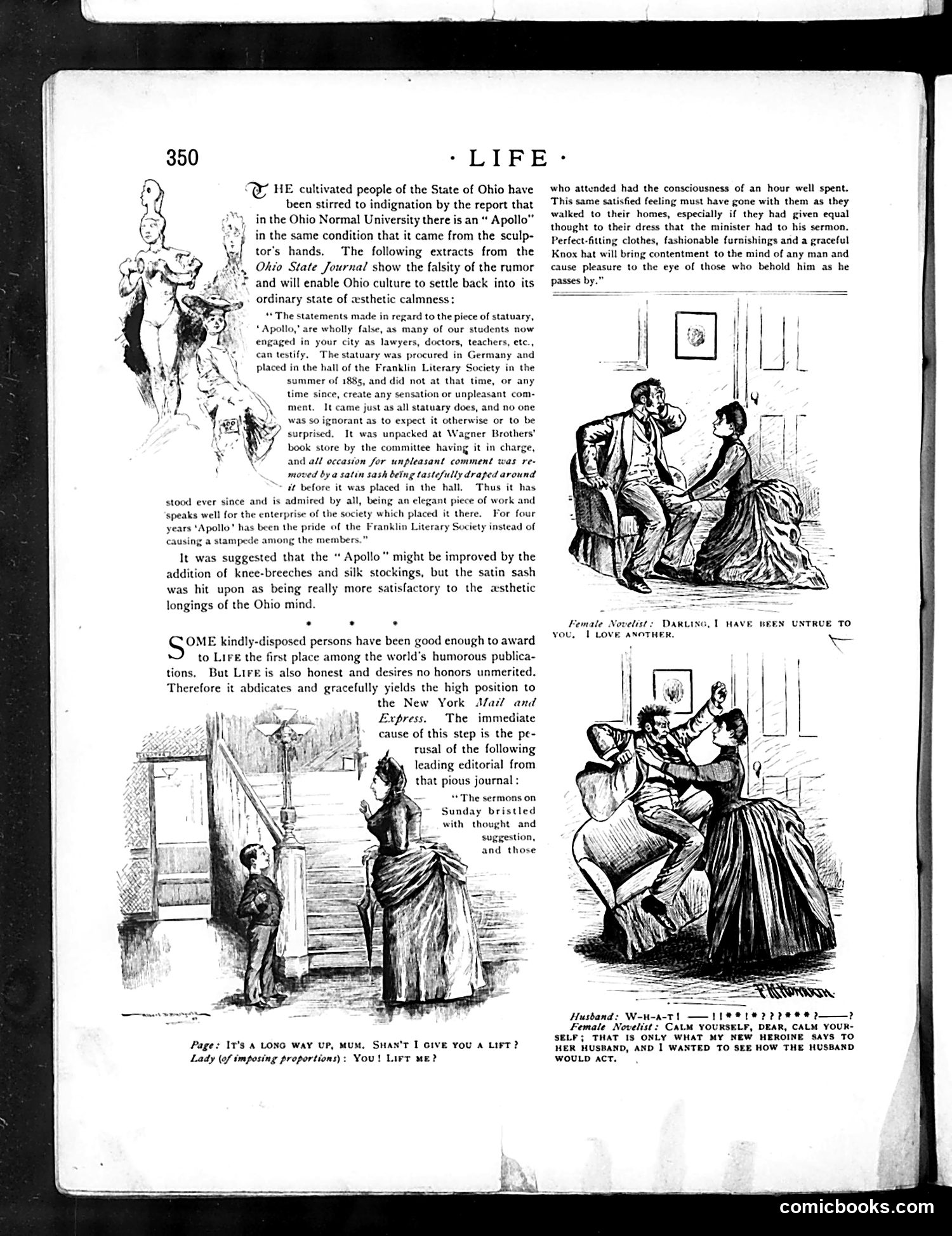
This page contains three satirical pieces from *Life* magazine: **1. The "Apollo" Controversy (top):** Ohio Normal University faced public outrage over an nude classical statue. The university's defensive response claims the statue arrived in 1885 and was immediately covered with a "satin sash"—a detail Life ridicules as absurdly prudish. The satire mocks Ohio's alleged cultural anxiety about classical art and the notion that draping fabric somehow resolves moral objections to nudity. **2. "Life vs. Mail and Express" (middle):** Life sarcastically "yields" its claim as the funniest publication to the *New York Mail and Express*, mocking that newspaper's overwrought sermon editorial that connects proper dress and consumer goods (Knox hats) to spiritual contentment—mixing religion with commercialism. **3. Two domestic cartoons (bottom):** Brief comedic sketches about working-class life: a large woman refusing help from a small man, and a wife testing her husband's reaction to her new novel's dialogue about marital discord. The page satirizes Victorian prudishness, commercial hypocrisy, and social pretension.
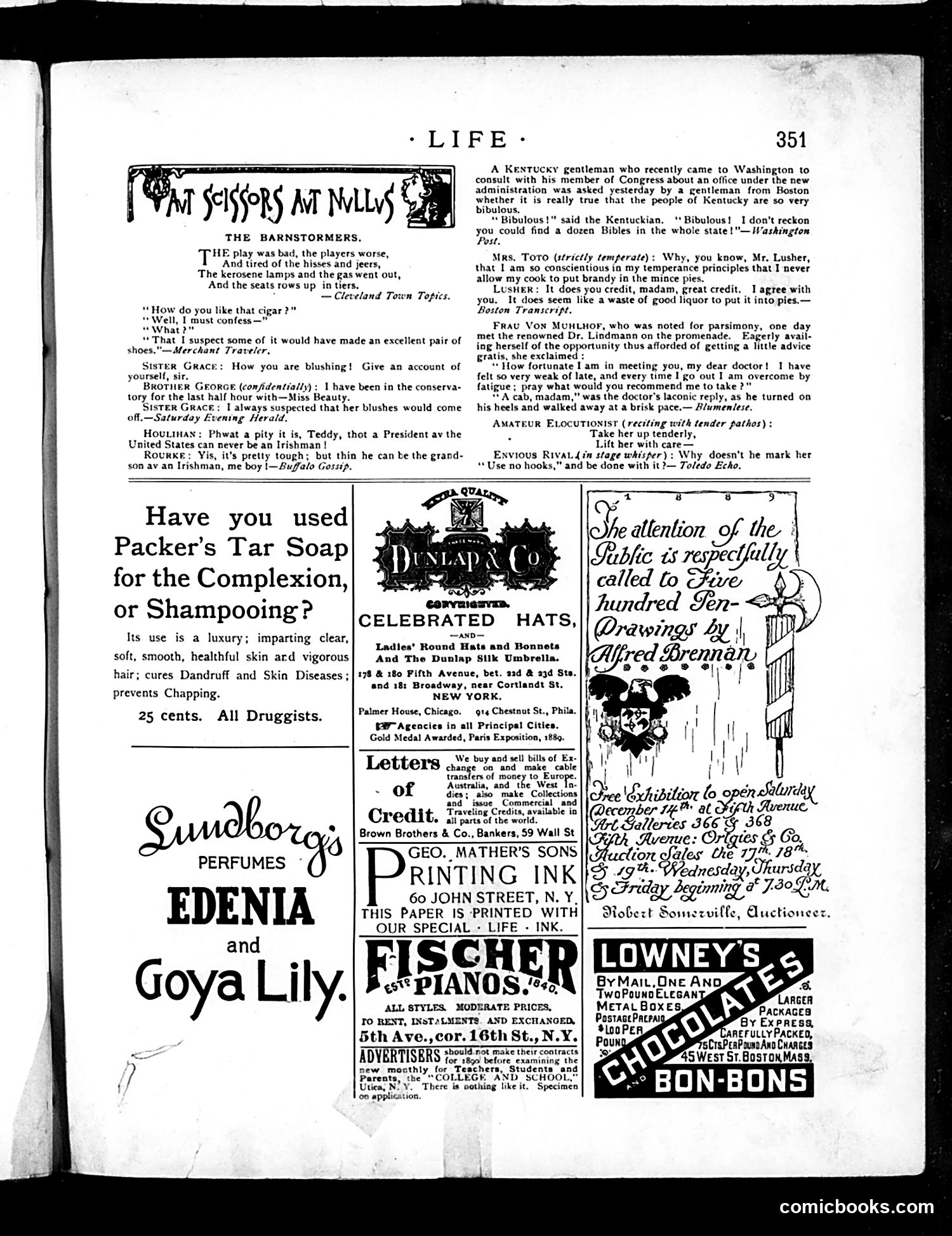
This page from *Life* magazine contains primarily **humor pieces and advertisements** rather than political cartoons. The main satirical content is a series of brief jokes typical of the era: 1. **Kentucky/Bibulous joke**: A Kentucky man, asked if his state's people drink excessively, responds that he couldn't find a dozen *Bibles* in Kentucky—a pun playing on "bibulous" (drinking heavily) versus "Bibles" (religious texts). The joke mocks rural Kentucky as both irreligious and alcohol-loving. 2. **Theater/Cigar/Irish jokes**: Various short gags about bad theater, poor cigars, and ethnic humor about Irish immigrants' aspirations to political status. 3. **Female temperance joke**: A woman boasts of never allowing brandy in mince pies, only to be told this wastes good liquor—mocking teetotaling hypocrisy. The rest comprises period advertisements for soap, perfumes, hats, pianos, and financial services—typical of contemporary magazine advertising. No major political figures or events are referenced.
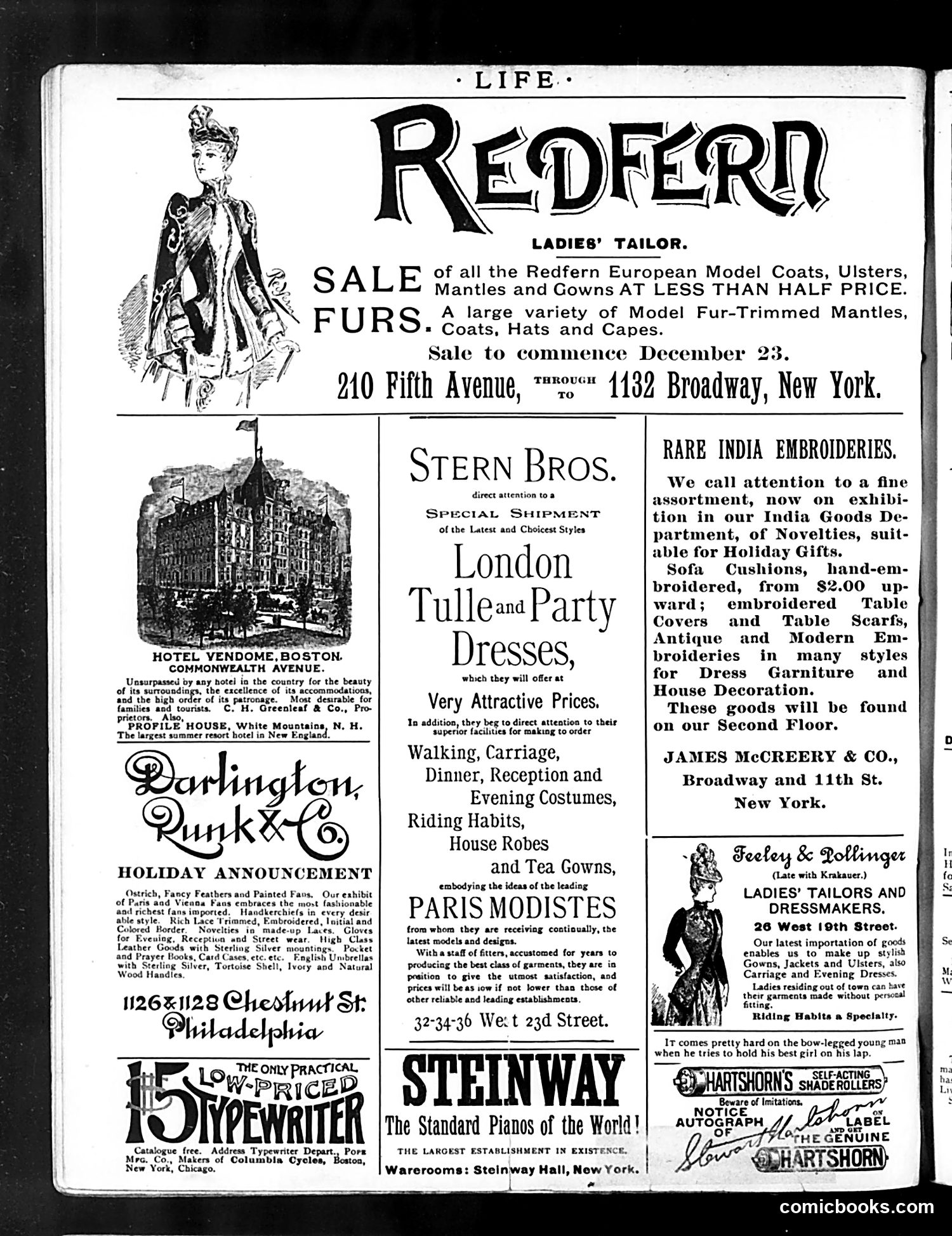
This is a Life magazine page dominated entirely by commercial advertisements—no political cartoons or satirical content. The only humor appears at the bottom: a brief joke about a "bow-legged young man" struggling to hold his girlfriend on his lap, which is a mild physical comedy gag typical of early 1900s magazines. The rest consists of holiday shopping ads (December 23 sale date visible) for luxury goods: Redfern ladies' clothing, Stern Bros. Paris dresses, Steinway pianos, James McCreery's India embroideries, and various tailors and hotels. These ads reflect the era's wealthy readership and their consumption patterns—fancy furs, Paris fashions, imported goods. The Hotel Vendome and similar establishments advertised suggest this was aimed at upper-class audiences.
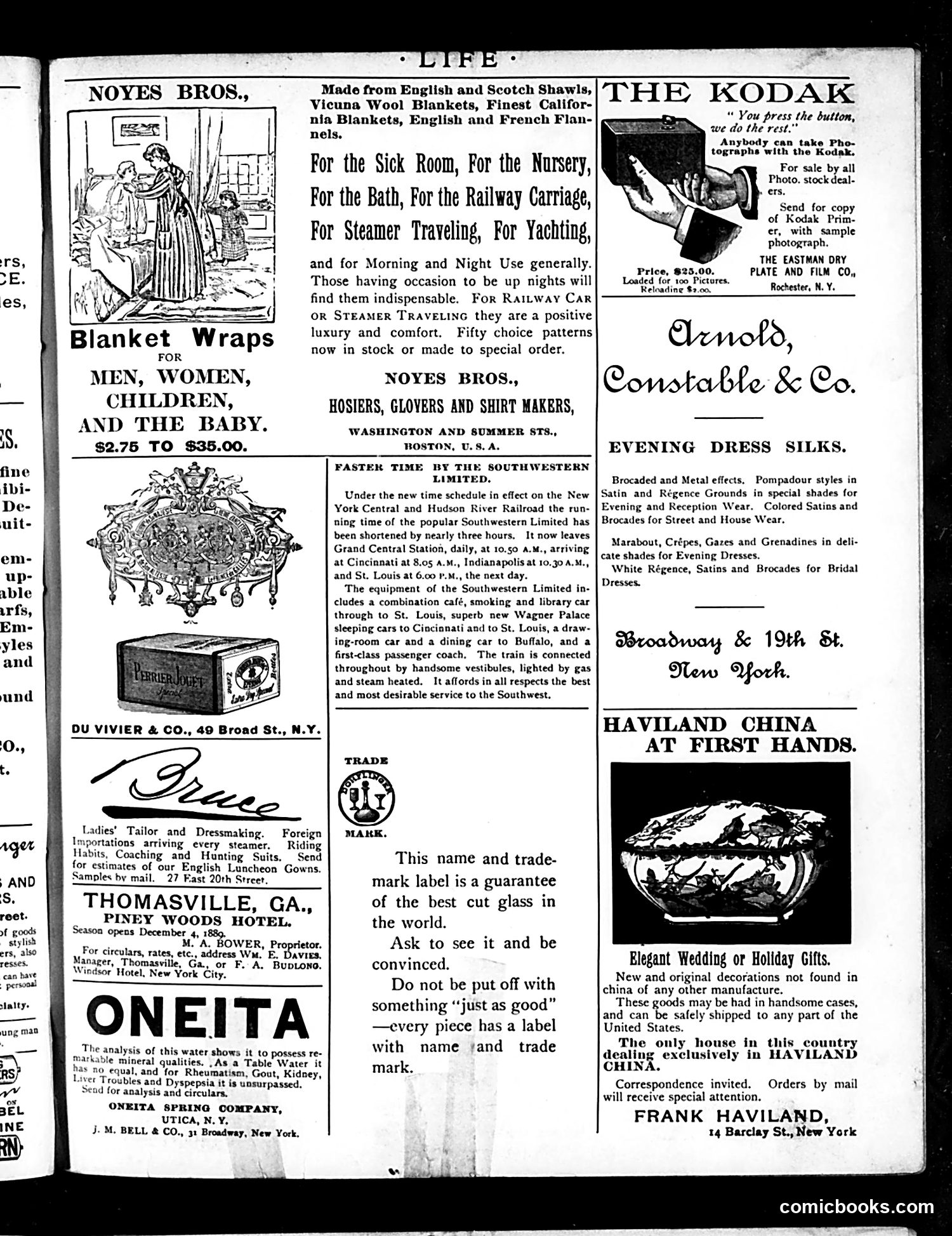
This page is primarily **advertising**, not political satire. It contains commercial notices for late-19th-century luxury goods and services: blanket wraps by Noyes Bros., the Kodak camera (with its famous "You press the button, we do the rest" slogan), evening dress silks, cut glass, railroad service on the Southwestern Limited, and Haviland china. The only illustration with potential satirical content is a small sketch of a cherub or cupid figure associated with one of the blanket wrap advertisements—a common decorative trope of the era, not a political cartoon. There are no identifiable caricatures or political references visible. The page reflects the consumer culture and technological innovations (photography, rail travel) of the Gilded Age.
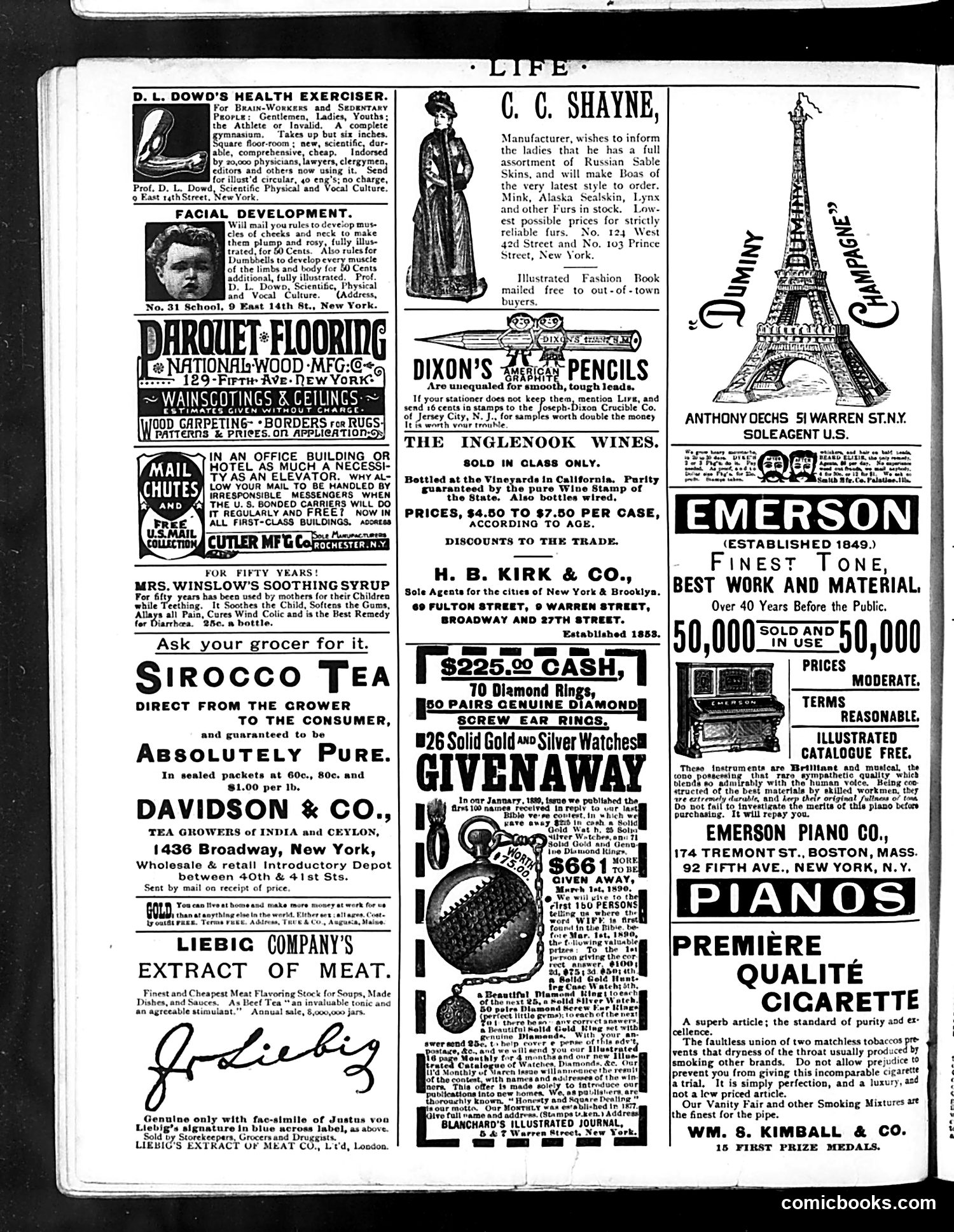
This is primarily an **advertising page** with no political cartoons or satirical content. It consists entirely of commercial advertisements typical of late-19th-century American magazines. Notable ads include: health devices (facial exercises, dumbbells), home furnishings, office services, patent medicines (Mrs. Winslow's Soothing Syrup for teething), food products (tea, meat extract), furs and fashion, writing instruments, wine, and jewelry giveaways. The ads reflect period concerns—manual facial development for the sedentary, elevator mail services as modern conveniences, and dubious health remedies marketed without FDA regulation. The giveaway contest promising "$225 in cash" and "Solid Gold" watches exemplifies the promotional tactics common in era magazines used to build circulation. No satire or political commentary is present on this page.
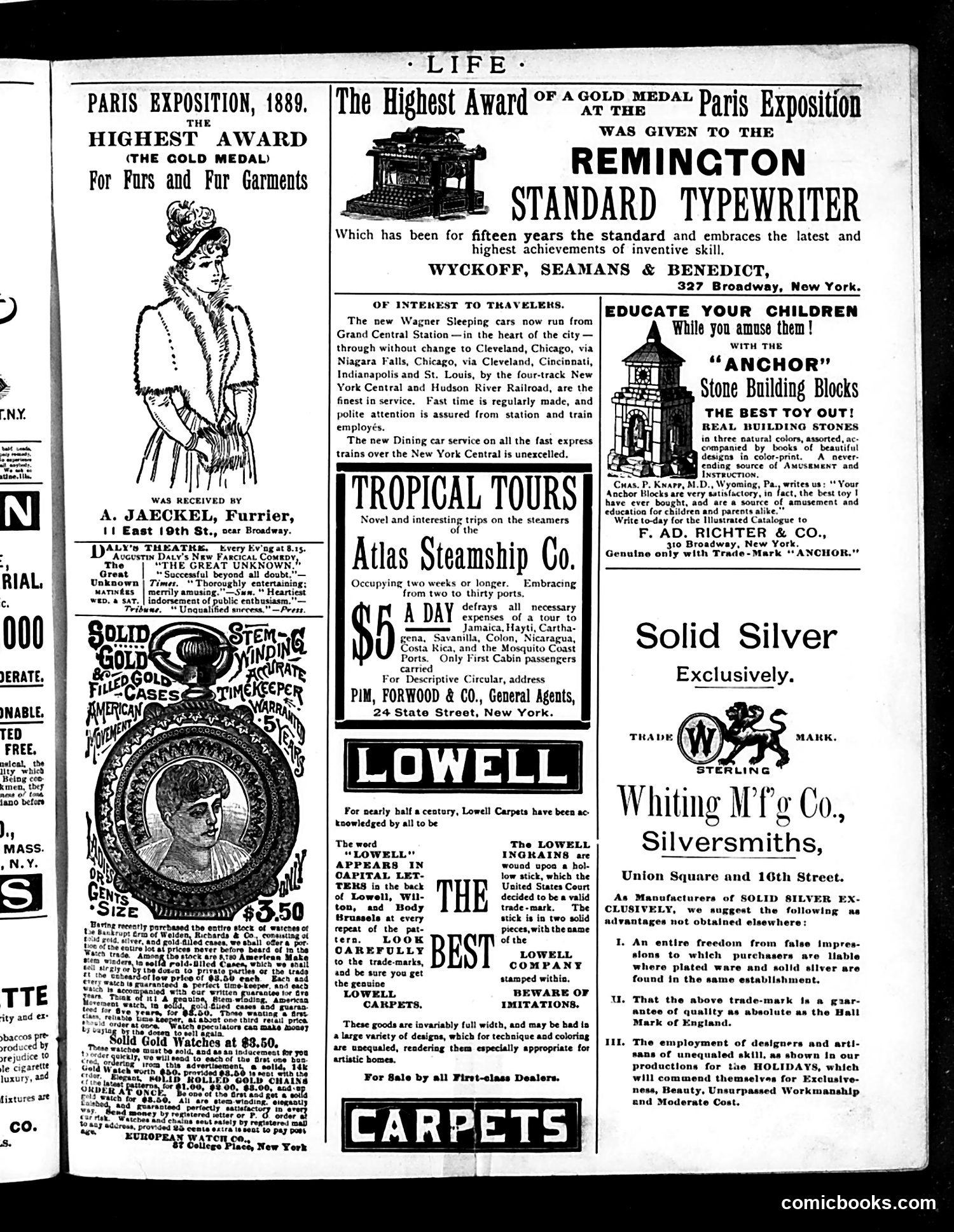
This is primarily an **advertising page** from Life magazine, circa 1889, featuring commercial endorsements rather than political satire or editorial cartoons. The page showcases advertisements for luxury goods and services positioned as award-winners or quality products: - **Remington Typewriter** claims highest honors from the Paris Exposition - **A. Jaeckel Furrier** advertises Paris Exposition gold medals for furs - **Anchor Stone Building Blocks** promote educational toys - **Lowell Carpets** emphasize their established reputation and trademark - **Whiting Manufacturing Co.** advertises sterling silver goods - **Atlas Steamship Co.** offers tropical tours The imagery includes period fashion illustrations and product engravings. The repeated emphasis on "awards," "trade-marks," and "quality guarantees" reflects late-19th-century consumer culture's concern with authenticity and prestige branding. These advertisements target affluent readers seeking validated luxury purchases—typical of Life's audience during this era.
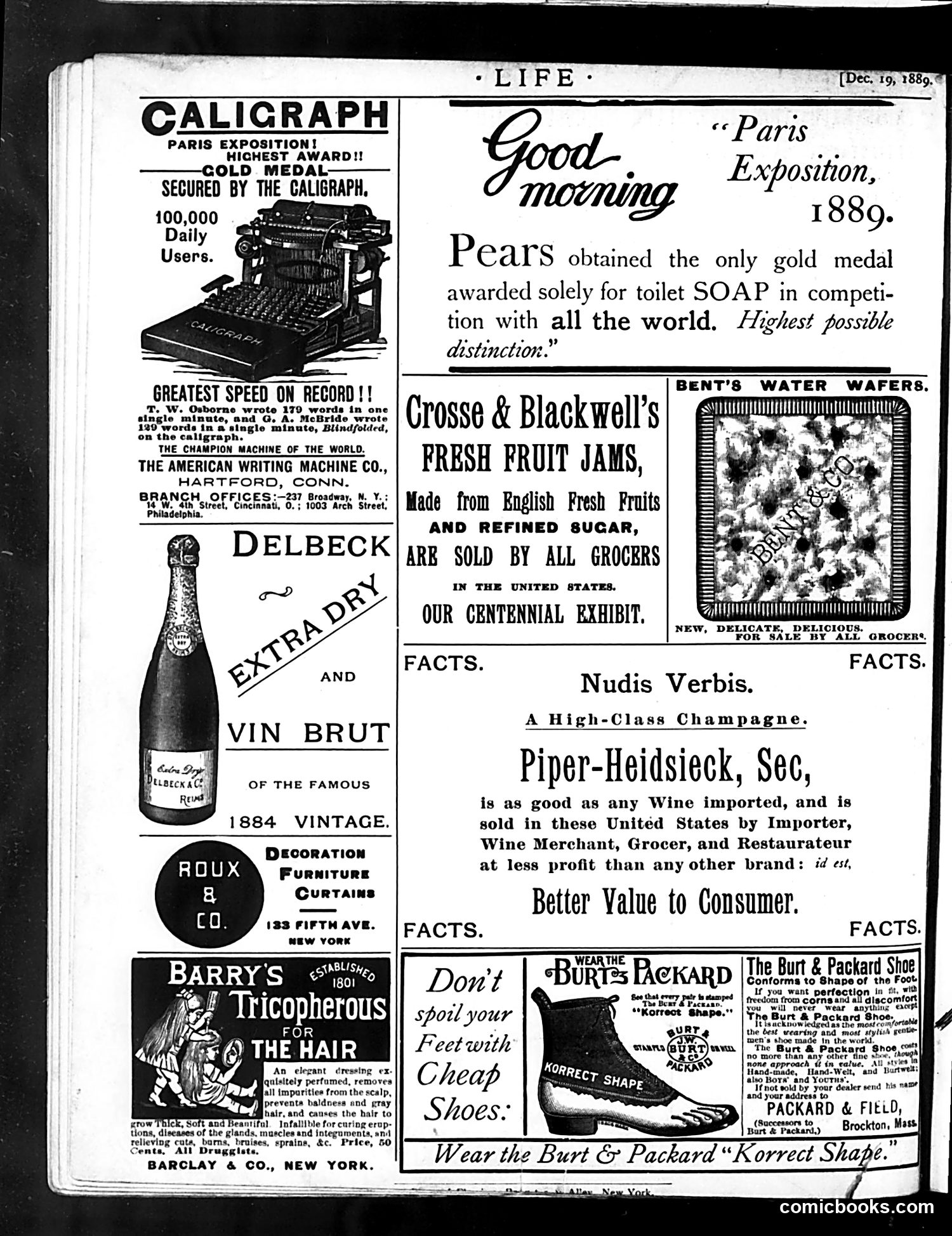
This is primarily an **advertising page** from *Life* magazine (December 19, 1889), not a political cartoon. It consists entirely of commercial advertisements for products and services. The ads promote: - **Caligraph typewriters** (claiming 100,000 daily users and speed records) - **Pears soap** (boasting a Paris Exposition gold medal) - **Crosse & Blackwell's jams** (English products sold in the U.S.) - **Piper-Heidsieck champagne** (claiming good value) - **Barry's hair tonic** (for hair growth and health) - **Bent's water wafers** (crackers) - **Burt & Packard shoes** (marketed as properly shaped footwear) - **Roux Decoration Furniture** The page reflects late-19th-century consumer culture, with manufacturers competing to establish product credibility through international awards, scientific claims, and appeals to economy. There is no satire or political commentary—this is straightforward commercial promotion typical of *Life*'s revenue model during this period.