
Life, 1889-12-19 · page 10 of 18
Life — December 19, 1889 — page 10: what you’re looking at
What you’re looking at
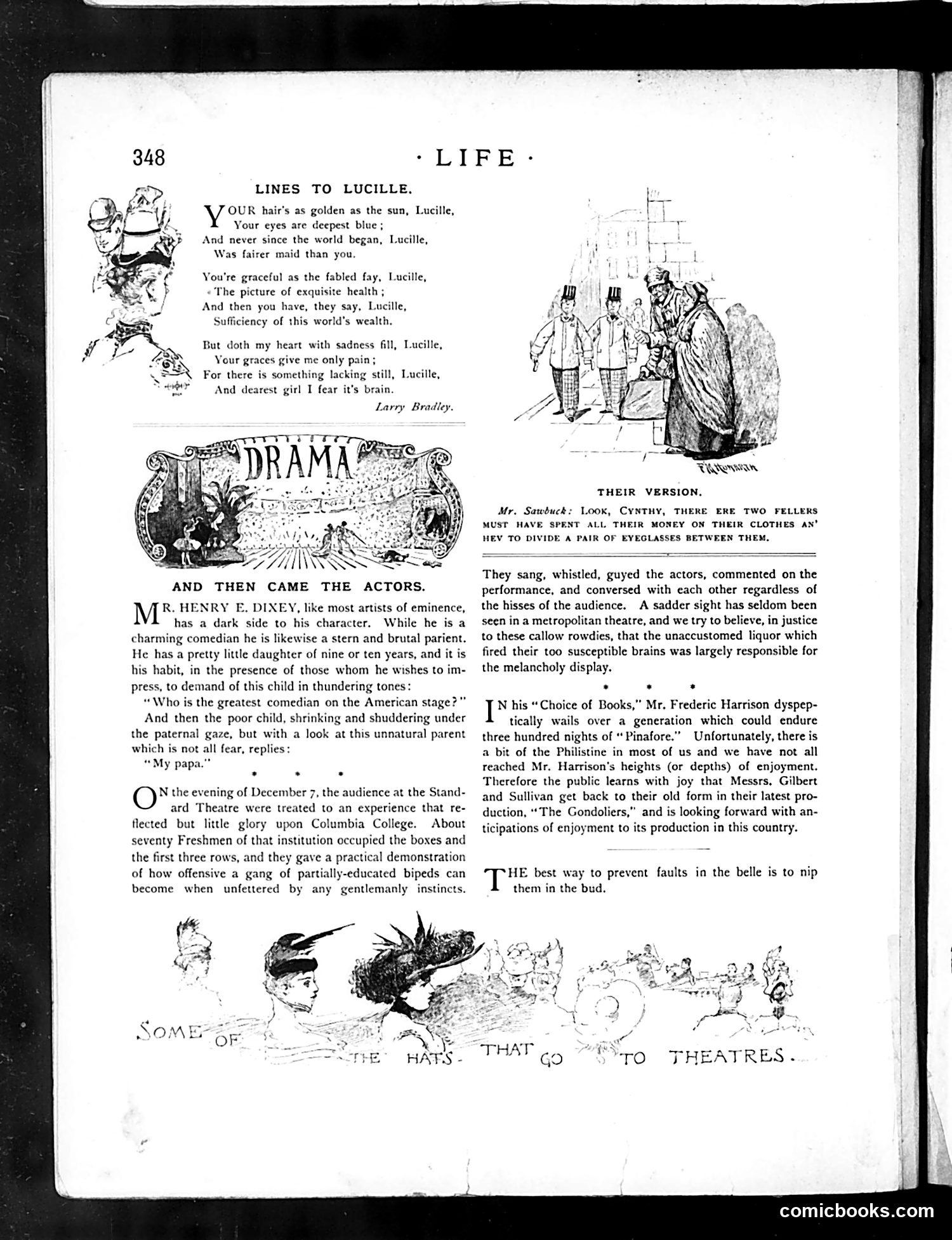
This page satirizes theatrical culture and audience behavior circa early 1900s. The main article "AND THEN CAME THE ACTORS" critiques Mr. Henry E. Dixey as a charming but dark-charactered performer who intimidates his child with thundering tones. The satire mocks both actors' pretensions and audience disruption: Columbia College freshmen at a December 7th performance engaged in crude behavior, demonstrating how "partially-educated bipeds" behave without "gentlemanly instincts." The bottom illustration lampooning elaborate theatrical hats satirizes women's fashion excess—a recurring Life theme. The piece argues such ostentatious headwear interferes with theater-going, captioned "SOME OF THE HATS THAT GO TO THEATRES," suggesting women's vanity disrupts public venues.
📄 Transcribed text from this page (OCR, searchable)
Machine-transcribed from the original scan — historical spelling and the odd misread are preserved.
*LIFE- LINES TO LUCILLE. OUR hair's as golden as the sun, Lucille, Your eyes are deepest blue ; And never since the world began, Lucille, Was fairer maid than you. You're graceful as the fabled fay, Lucille, The picture of exquisite health ; And then you have, they say, Lucille, Sufficiency of this world’s wealth, But doth my heart with sadness fill, Lucille, . aN Your graces give me only pain; / For there is something lacking still, Lucille, “et And dearest girl I fear it’s brain. Larry Bradley. Z FTN V1 | AW Sees ae AND THEN CAME THE ACTORS. R. HENRY E, DIX like most artists of eminence, has a dark side to his character, While he is a charming comedian he is likewise a stern and brutal parient. He has a pretty little daughter of nine or ten years, and it is his habit, in the presence of those whom he wishes to im- press, to demand of this child in thundering tone: “Who is the greatest comedian on the American stage?" And then the poor child, shrinking and shuddering under the paternal gaze, but with a look at this unnatural parent which is not all fear, replies: “My papa.” . . . N the evening of December 7, the audience at the Stand- ard Theatre were treated to an experience that re- flected but little glory upon Columbia College. About seventy Freshmen of that institution occupied the boxes and the first three rows, and they gave a practical demonstration of how offensive a gang of partially-educated bipeds can become when unfettered by any gentlemanly instincts. OF Wewsany THEIR VERSION, Mr. Sawbuck: Look, CYNTHY, THERE ERE TWO FELLERS MUST HAVE SPENT ALL THEIR MONEY ON THEIR CLOTHES AN’ HEV TO DIVIDE A PAIR OF EYEGLASSES BETWEEN THEM. They sang, whistled, guyed the actors, commented on the performance, and conversed with each other regardless of the hisses of the audience. A sadder sight has seldom been seen in a metropolitan theatre, and we try to believe, in justice to these callow rowdies, that the unaccustomed liquor which fired their too susceptible brains was largely responsible for the melancholy display. . . * N his “Choice of Books,” Mr. Frederic Harrison dyspep- tically wails over a generation which could endure three hundred nights of “Pinafore.” Unfortunately, there is a bit of the Philistine in most of us and we have not all reached Mr. Harrison's heights (or depths) of enjoyment. Therefore the public learns with joy that Messrs, Gilbert and Sullivan get back to their old form in their latest pro- duction, “The Gondoliers,” and is looking forward with an- ticipations of enjoyment to its production in this country. HE best way to prevent faults in the belle is to nip them in the bud. comicbooks.com