
Life, 1889-12-19 · page 4 of 18
Life — December 19, 1889 — page 4: what you’re looking at
What you’re looking at
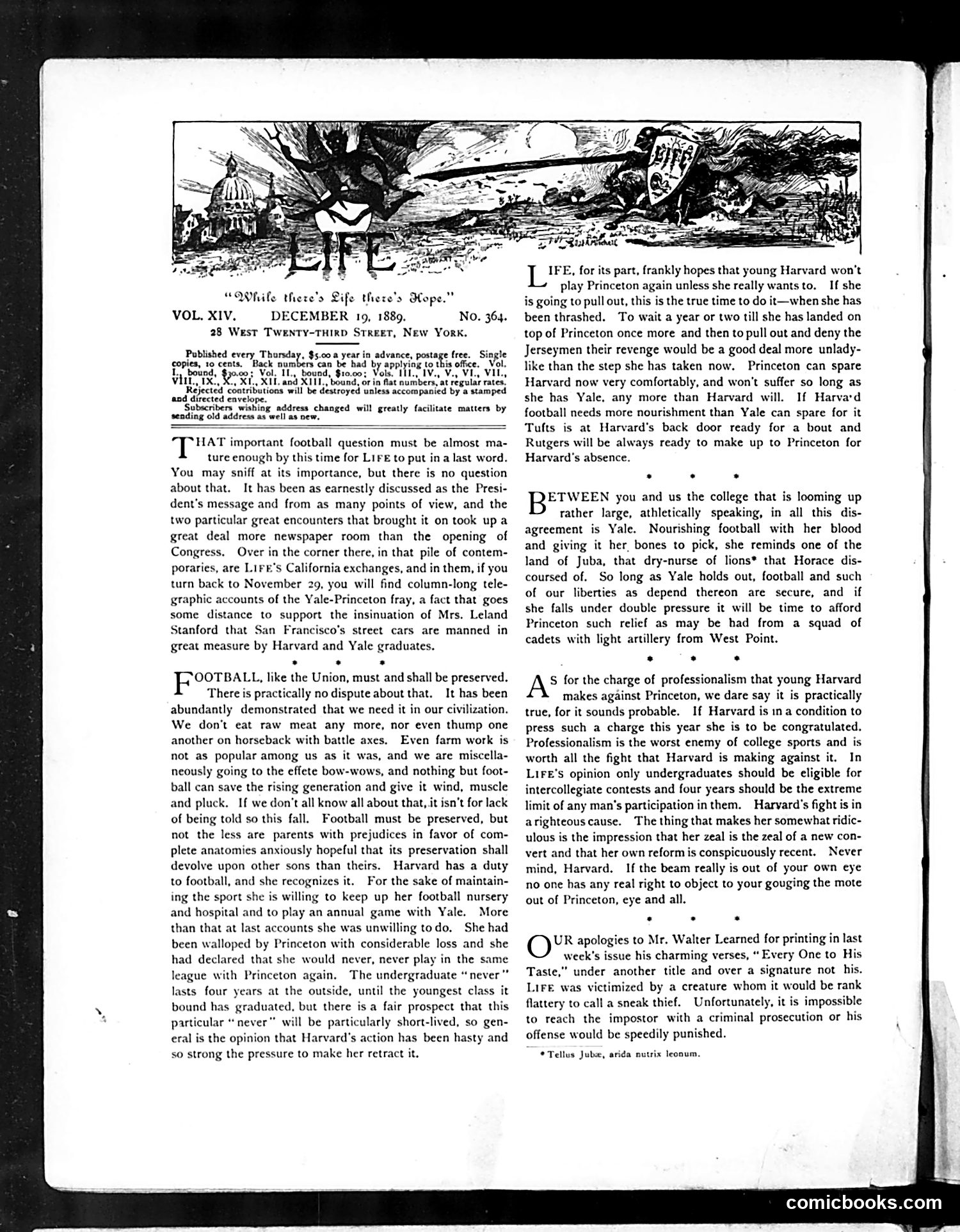
The masthead cartoon depicts a tree with a noose, referencing capital punishment. The motto "While there's Life there's Hope" suggests ironic commentary on mortality or justice. The article's main focus concerns a Harvard-Princeton football dispute. Harvard had withdrawn from playing Princeton, prompting Life to editorialize on the controversy. The text suggests Harvard accused Princeton of professionalism (paying players), which violated amateur sporting ideals of the era. Life defends Harvard's decision while arguing football itself should be preserved as valuable for civilization and character-building. The magazine urges Harvard to reconsider future matches but supports her principled stance against what they frame as Princeton's corruption of amateur athletics. This reflects late-19th-century anxieties about commercializing collegiate sports.
📄 Transcribed text from this page (OCR, searchable)
Machine-transcribed from the original scan — historical spelling and the odd misread are preserved.
“Qhife there's Life there's Hope.” VOL. XIV. DECEMBER 19, 1889. No. 364. 28 West TwenTy-THIRD STREET, New York. Published every, Tharsday, $5.00. year in, advance, postage free. Single copies, 10 cents. Back numbers can be had by applying to this office, Vol. L, bound, co; Vol. If., bound, $10.00; Vols. itis IV., V.. Vi, VIL, vir, 1x. XL, XL and XIIL., bound, or in fiat numbers, at regular rates. Rejected contributions will be destroyed unless accompanied by a stamped and directed envelope. jubscribers wishing address changed will greatly facilitate matters by sending old address as well as new. HAT important football question must be almost ma- ture enough by this time for LiFe to put ina last word. You may sniff at its importance, but there is no question about that. It has been as earnestly discussed as the Presi- dent's message and from as many points of view, and the two particular great encounters that brought it on took up a great deal more newspaper room than the opening of Congress. Over in the corner there, in that pile of contem- poraries, are Lire’s California exchanges, and in them, if you turn back to November 29, you will find column-long tele- graphic accounts of the Yale-Princeton fray, a fact that goes some distance to support the insinuation of Mrs. Leland Stanford that San Francisco's street cars are manned in great measure by Harvard and Yale graduates. . . . OOTBALL, like the Union, must and shall be preserved. There is practically no dispute about that. It has been abundantly demonstrated that we need it in our civilization. We don’t eat raw meat any more, nor even thump one another on horseback with battle axes. Even farm work is not as popular among us as it was, and we are miscella- neously going to the effete bow-wows, and nothing but foot- ball can save the rising generation and give it wind, muscle and pluck. If we don’t all know all about that, it isn’t for lack of being told so this fall. Football must be preserved, but not the less are parents with prejudices in favor of com- plete anatomies anxiously hopeful that its preservation shall devolve upon other sons than theirs. Harvard has a duty to football, and she recognizes it. For the sake of maintain- ing the sport she is willing to keep up her football nursery and hospital and to play an annual game with Yale. More than that at last accounts she was unwilling todo. She had been walloped by Princeton with considerable loss and she had declared that she would never, never play in the same league with Princeton again. The undergraduate “never” lasts four years at the outside, until the youngest class it bound has graduated, but there is a fair prospect that this particular “ never" will be particularly short-lived, so gen- eral is the opinion that Harvard's action has been hasty and so strong the pressure to make her retract it, eal H 0 Pata IFE, for its part, frankly hopes that young Harvard won't play Princeton again unless she really wants to. If she is going to pull out, this is the true time to do it—when she has been thrashed. To wait a year or two till she has landed on top of Princeton once more and then to pull out and deny the Jerseymen their revenge would be a good deal more unlady- like than the step she has taken now. Princeton can spare Harvard now very comfortably, and won't suffer so long as she has Yale, any more than Harvard will. If Harvard football needs more nourishment than Yale can spare for it Tufts is at Harvard's back door ready for a bout and Rutgers will be always ready to make up to Princeton for Harvard's absence. . . . ETWEEN you and us the college that is looming up rather large, athletically speaking, in all this dis- agreement is Yale. Nourishing football with her blood and giving it her, bones to pick, she reminds one of the land of Juba, that dry-nurse of lions* that Horace dis- coursed of. So long as Yale holds out, football and such of our liberties as depend thereon are secure, and if she falls under double pressure it will be time to afford Princeton such relief as may be had from a squad of cadets with light artillery from West Point. . . . AS for the charge of professionalism that young Harvard makes against Princeton, we dare say it is practically true, for it sounds probable. If Harvard is ina condition to press such a charge this year she is to be congratulated. Professionalism is the worst enemy of college sports and is worth all the fight that Harvard is making against it. In LiFe’s opinion only undergraduates should be eligible for intercollegiate contests and four years should be the extreme limit of any man’s participation inthem. Harvard's fight is in arighteouscause. The thing that makes her somewhat ridic- ulous is the impression that her zeal is the zeal of a new con- vert and that her own reform is conspicuously recent. Never mind, Harvard. If the beam really is out of your own eye no one has any real right to object to your gouging the mote out of Princeton, eye and all. UR apologies to Mr. Walter Learned for printing in last week's issue his charming verses, “ Every One to His Taste,” under another title and over a signature not his. Lire was victimized by a creature whom it would be rank flattery to call a sneak thief. Unfortunately, it is impossible to reach the impostor with a criminal prosecution or his offense would be speedily punished. Tellus Jube, arida nutrix leonum. comicbooks.com