
A complete issue · 16 pages · 1889
Life — November 7, 1889
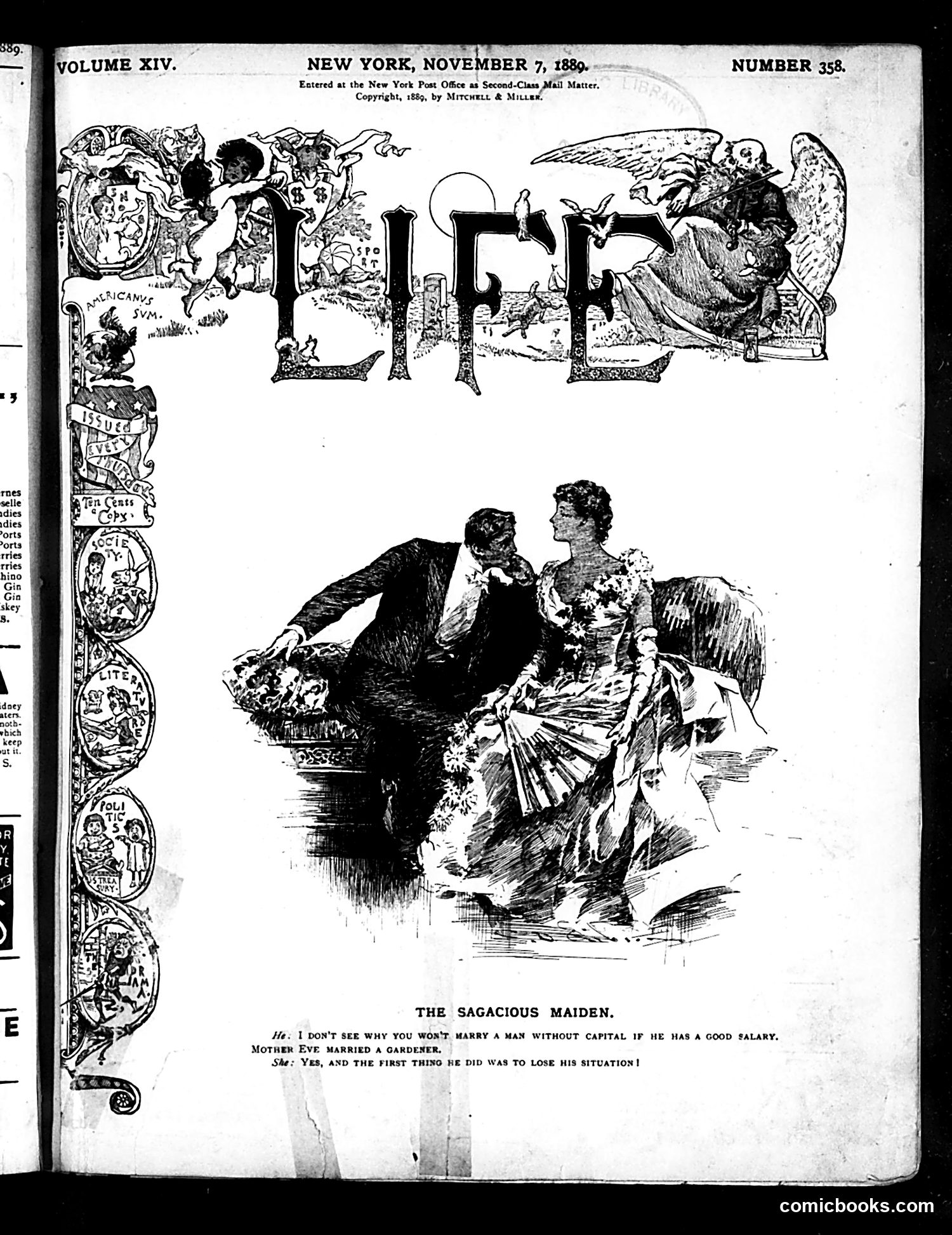
This cartoon satirizes women's financial reasoning in marriage. The dialogue shows a woman (labeled "Mother Eve") defending her choice to marry a gardener despite his lack of capital, arguing he had a "good salary." Her companion points out the flaw in this logic: the gardener's first action was to "lose his situation"—lose his job. The satire mocks the stereotype of women making foolish marital decisions based on insufficient financial consideration. The title "Sagacious Maiden" is ironic, suggesting the woman considers herself wise when she's actually demonstrated poor judgment. The cartoon reflects late 19th-century anxieties about women's economic vulnerability and decision-making capacity regarding marriage.
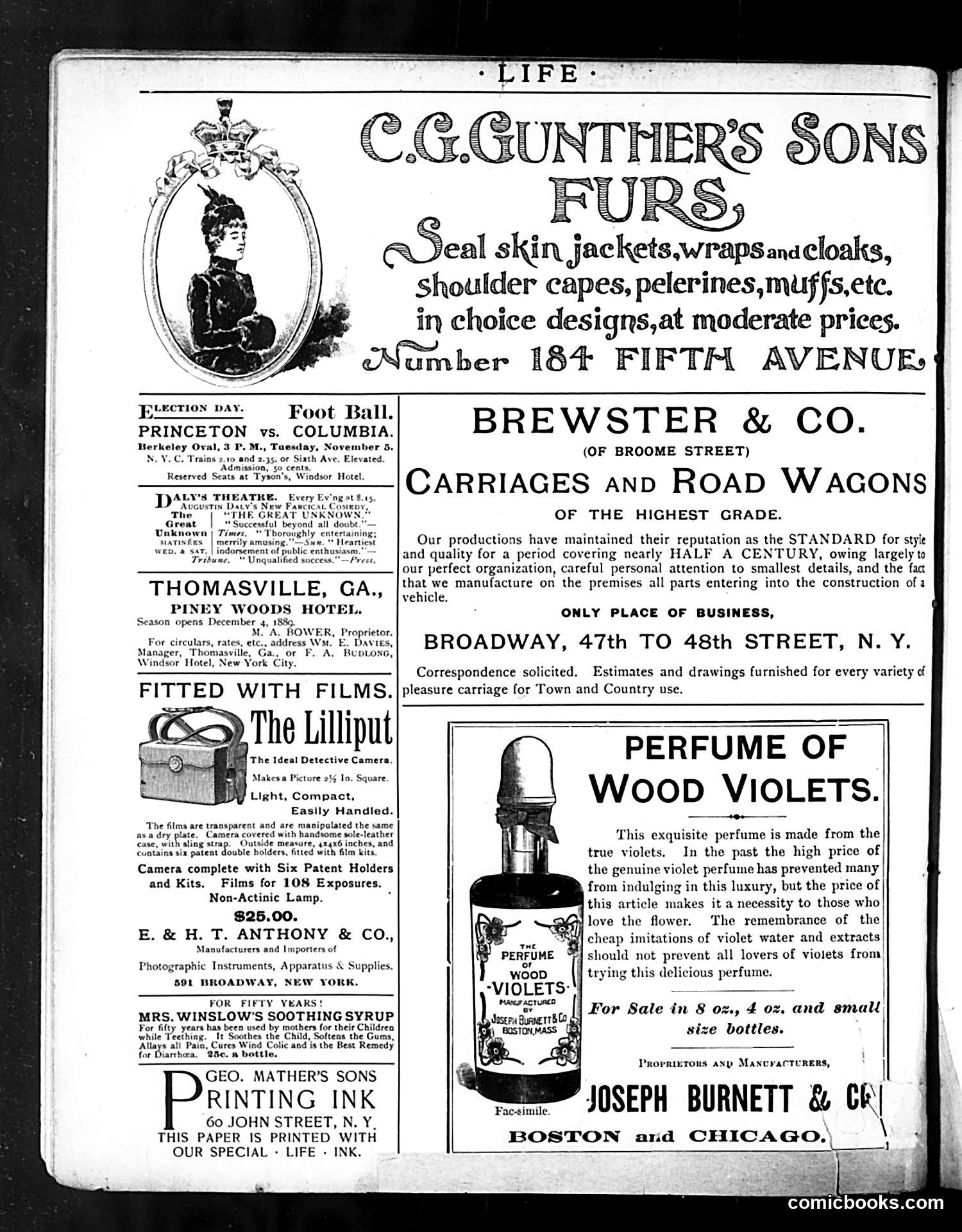
This page is **primarily advertising**, not satire or political commentary. It contains multiple commercial advertisements from the 1880s-90s era: - C.G. Gunther's Sons fur business (seal skin garments) - Brewster & Co. (carriages and road wagons) - The Lilliput detective camera - E. & H.T. Anthony & Co. (photographic supplies) - Mrs. Winslow's Soothing Syrup (a patent medicine for children) - Geo. Mather's Sons printing ink - Joseph Burnett & Co. (Perfume of Wood Violets) The small "Election Day" section mentions a Princeton vs. Columbia football game (November 8). There are **no political cartoons or satirical figures** on this page. It's a standard advertising section from *Life* magazine's commercial content.
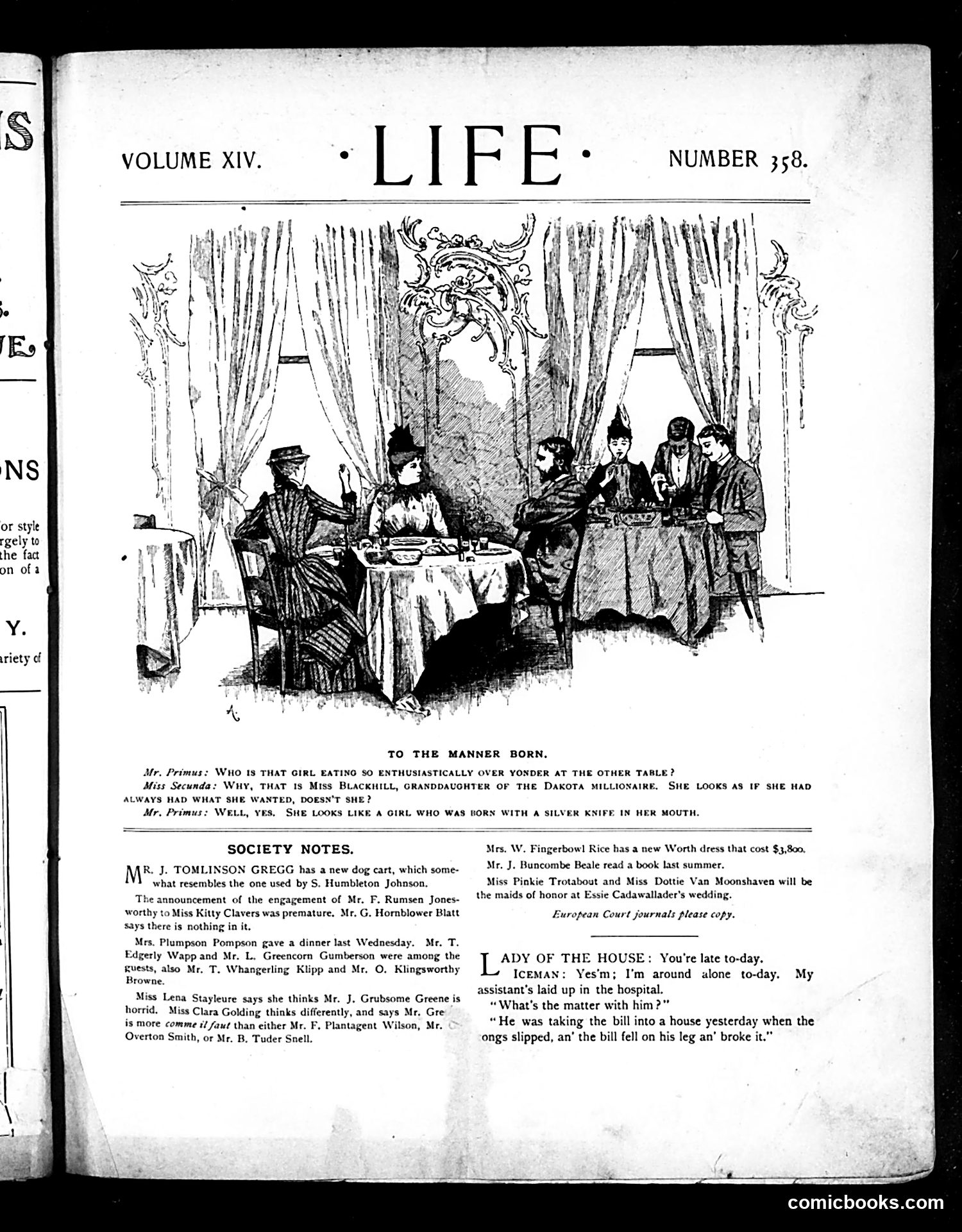
This cartoon satirizes wealthy society's pretensions about inherited status and manners. The caption presents a dialogue where Mr. Primus asks about a girl eating "enthusiastically" at another table, and Miss Secunda identifies her as Miss Blackhill, "granddaughter of the Dakota millionaire." The joke hinges on the ironic contrast: despite her vast wealth, Miss Blackhill apparently lacks refined table manners—she eats with unladylike enthusiasm. Mr. Primus's quip that she "looks like a girl who was born with a silver knife in her mouth" (inverting the phrase "born with a silver spoon") mocks the assumption that money automatically confers gentility and proper deportment. The satire targets Gilded Age nouveaux riches who possessed fortunes but lacked inherited social refinement.
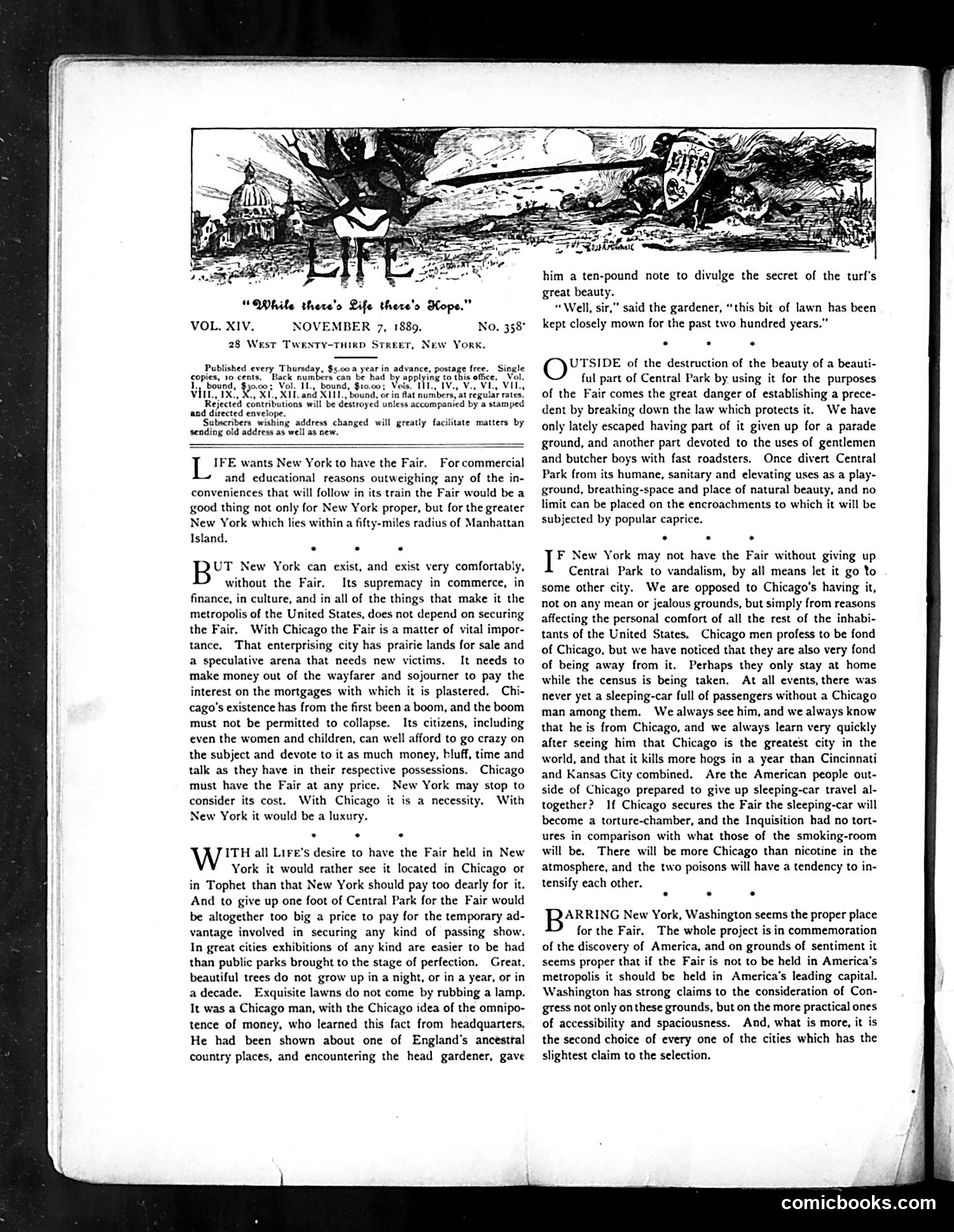
The page contains editorial opinion rather than satirical cartoons. The small illustration at top left appears to show a figure with a large head—possibly caricaturing a wealthy or pompous individual—though the specific identity is unclear from the image alone. The text debates whether New York City should host the 1889 World's Fair. The editor argues New York could host it comfortably without Central Park, implying Chicago's claim is weaker. There's clear rivalry between the cities over hosting rights. The piece also includes pointed commentary about Chicago's character, suggesting New Yorkers view Chicagoans as crude or unsophisticated—typical late-19th-century metropolitan snobbery. The rhetoric reflects genuine competition between emerging American cities for prestige and economic benefit.
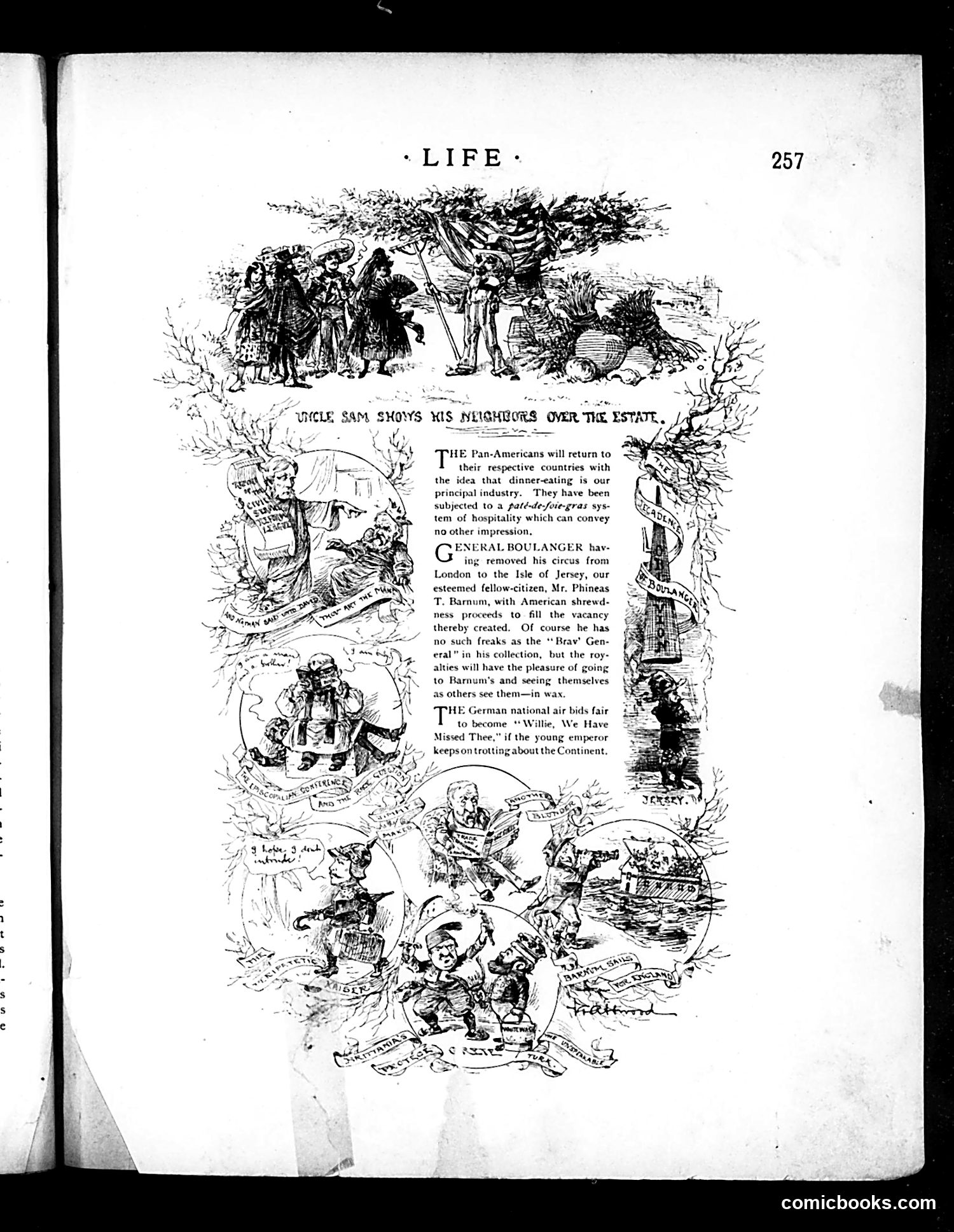
This page satirizes early 20th-century American tourist culture and international relations. The main illustration shows "Uncle Sam Shows His Neighbors Over the Estate," depicting Sam as a host displaying American prosperity to foreign visitors. The text references Pan-American visitors impressed by American "dinneracting" (dining/hospitality) as the nation's principal industry. It mentions General Boulanger removing his circus from London to Jersey, and P.T. Barnum filling a vacancy with "American shrewdness." A secondary joke concerns German national air bids and a young emperor "keeping about the Continent," likely referencing early aviation developments and European imperial politics. The satirical point: America showcases material abundance to international guests while relying on entertainment/spectacle—positioning the nation as both wealthy host and showman.
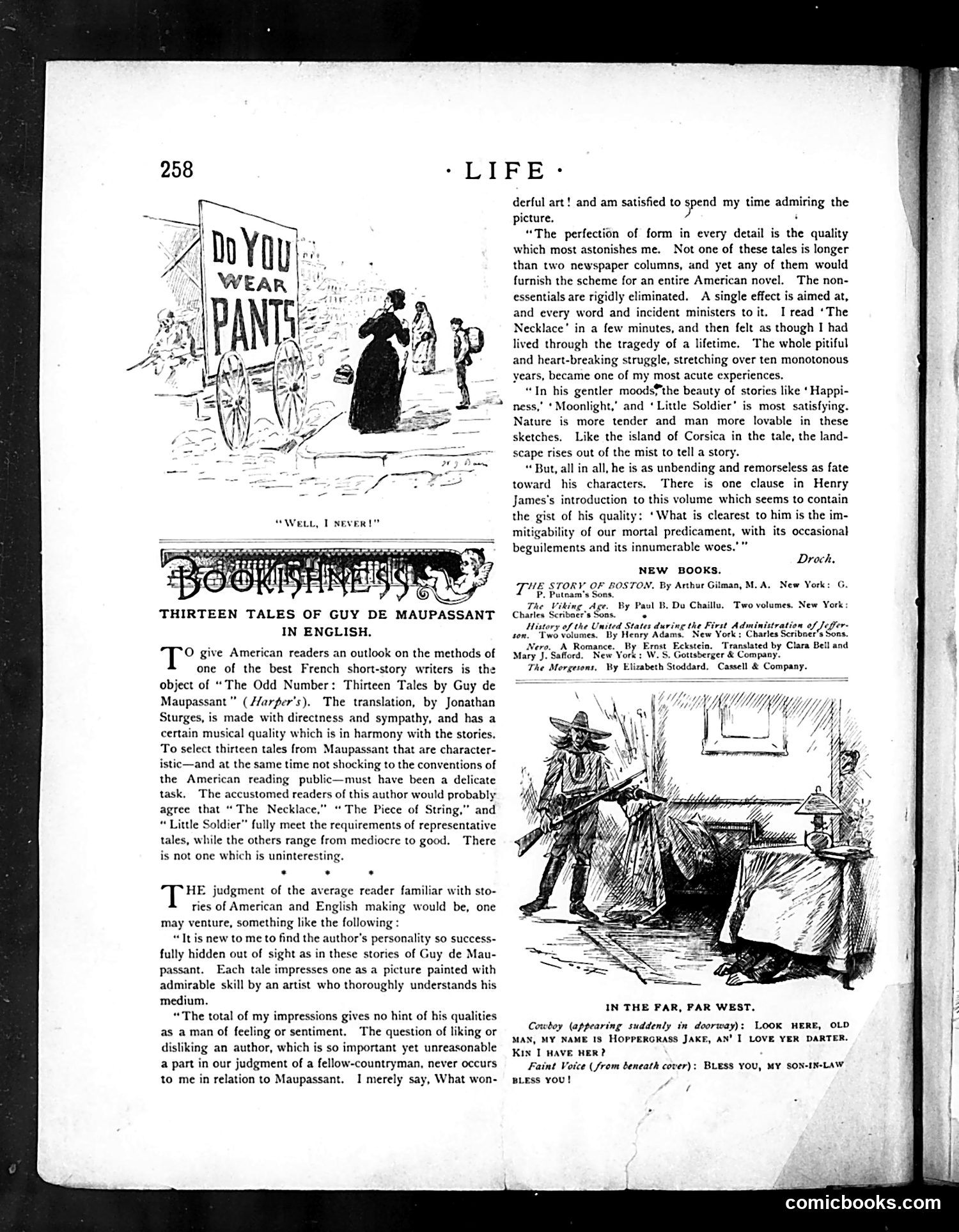
The top cartoon depicts a woman in Victorian dress standing before a large billboard reading "DO YOU WEAR PANTS?" with the caption "WELL, I NEVER!" This satirizes the late 19th-century "rational dress" movement, which advocated women wearing pants or bloomers instead of restrictive skirts. The woman's shocked response ("Well, I never!") reflects contemporary moral outrage at this idea—considered scandalous and unfeminine by conservative society. The cartoon mocks both the radical proposal and the prudish reaction to it. The lower portion reviews "Thirteen Tales of Guy de Maupassant," praising the French writer's skill at character portrayal and storytelling economy. An accompanying illustration shows a scene "In the Bar, Far West," depicting a saloon encounter.
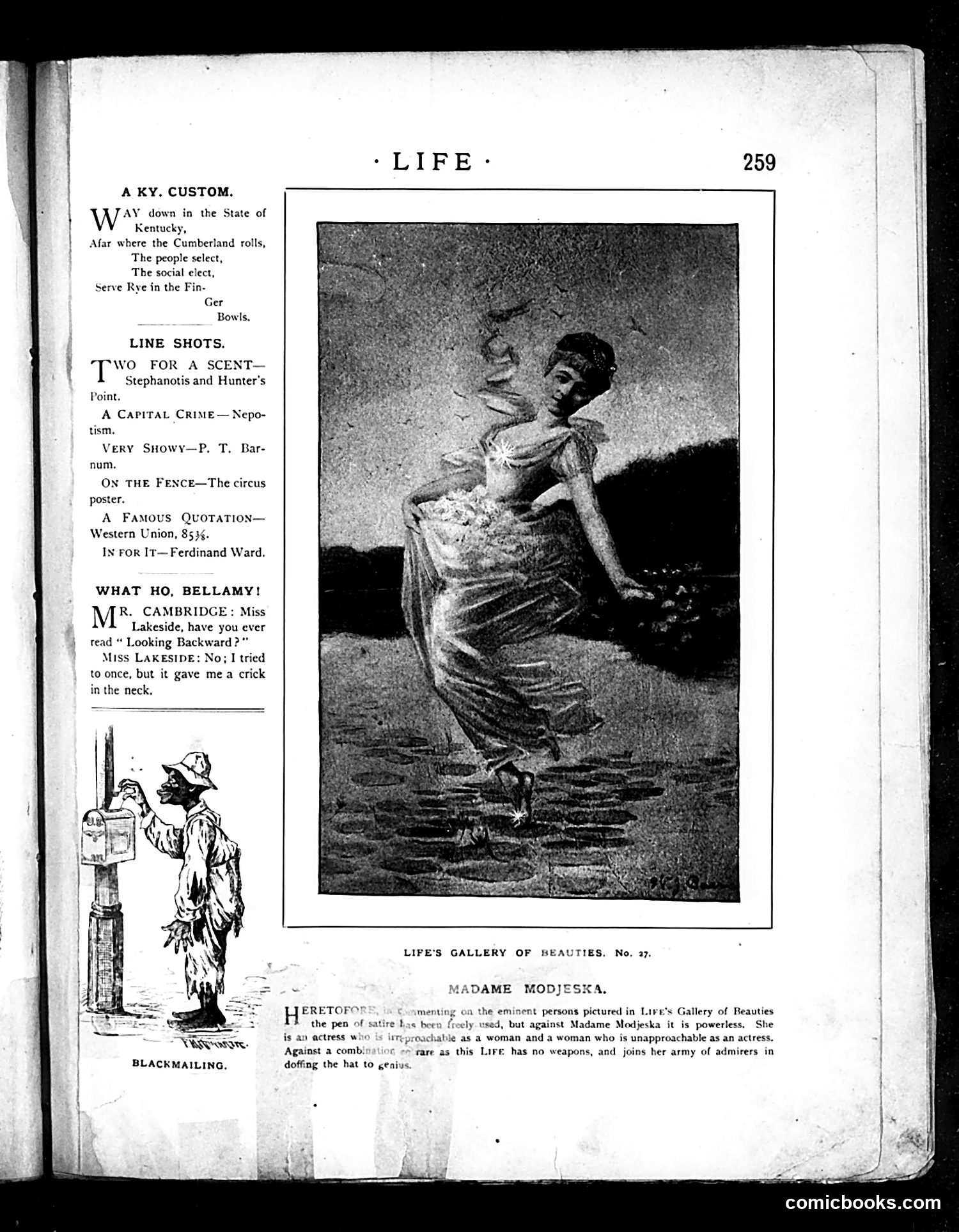
This page contains two distinct sections: **"Blackmailing" cartoon** (lower left): A simple satirical sketch showing one figure apparently coercing another at what appears to be a mailbox. The caption "Blackmailing" suggests commentary on extortion or threats, though the specific target is unclear without additional context. **"Madame Modjeska" feature** (right): A photograph and biographical note about the actress Madame Modjeska, described as "irreplaceable as a woman and a woman who is unapproachable as an actress." The text praises her talents and notes she "joins her army of admirers in doffing the hat to gratis"—suggesting she performs charitable work. The remaining left-column items are brief satirical "line shots" (short jokes) on various topics. The overall page mixes theatrical promotion with light social satire typical of Life magazine's format.
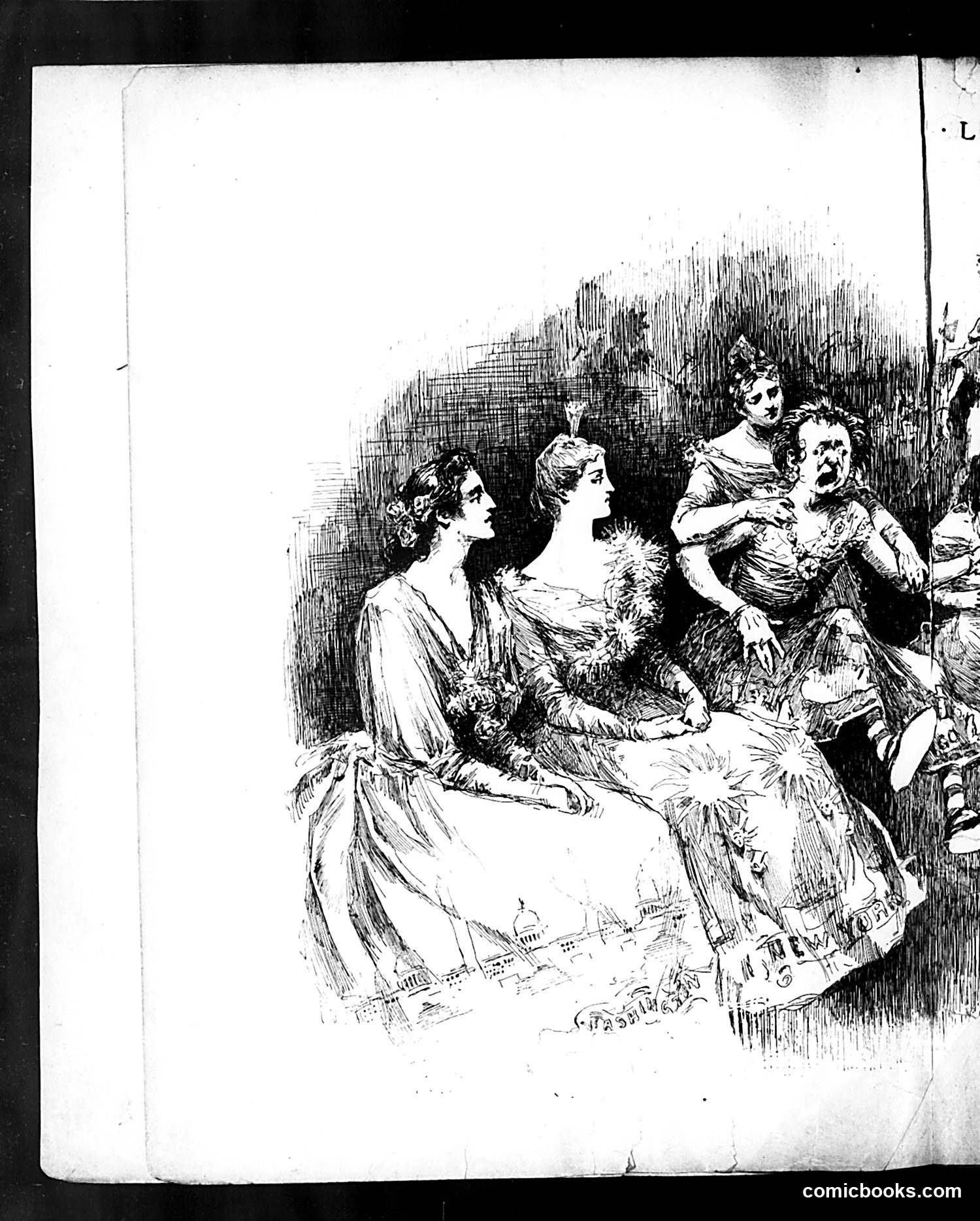
This appears to be a satirical sketch from Life magazine depicting a social scene with elegantly dressed women and men in what looks like a Victorian or Edwardian-era interior. The drawing style and clothing suggest late 19th or early 20th century. The sketch seems to mock high society or aristocratic social gatherings, though without clearer OCR text or visible captions, the specific satirical point remains unclear. The composition shows figures in fashionable dress arranged in a crowded, somewhat theatrical manner typical of Life's social commentary illustrations. The artist's signature appears at the bottom, but is not clearly legible in this image. Without additional context or readable captions, I cannot definitively identify which specific social trend, political figure, or event this cartoon satirizes.
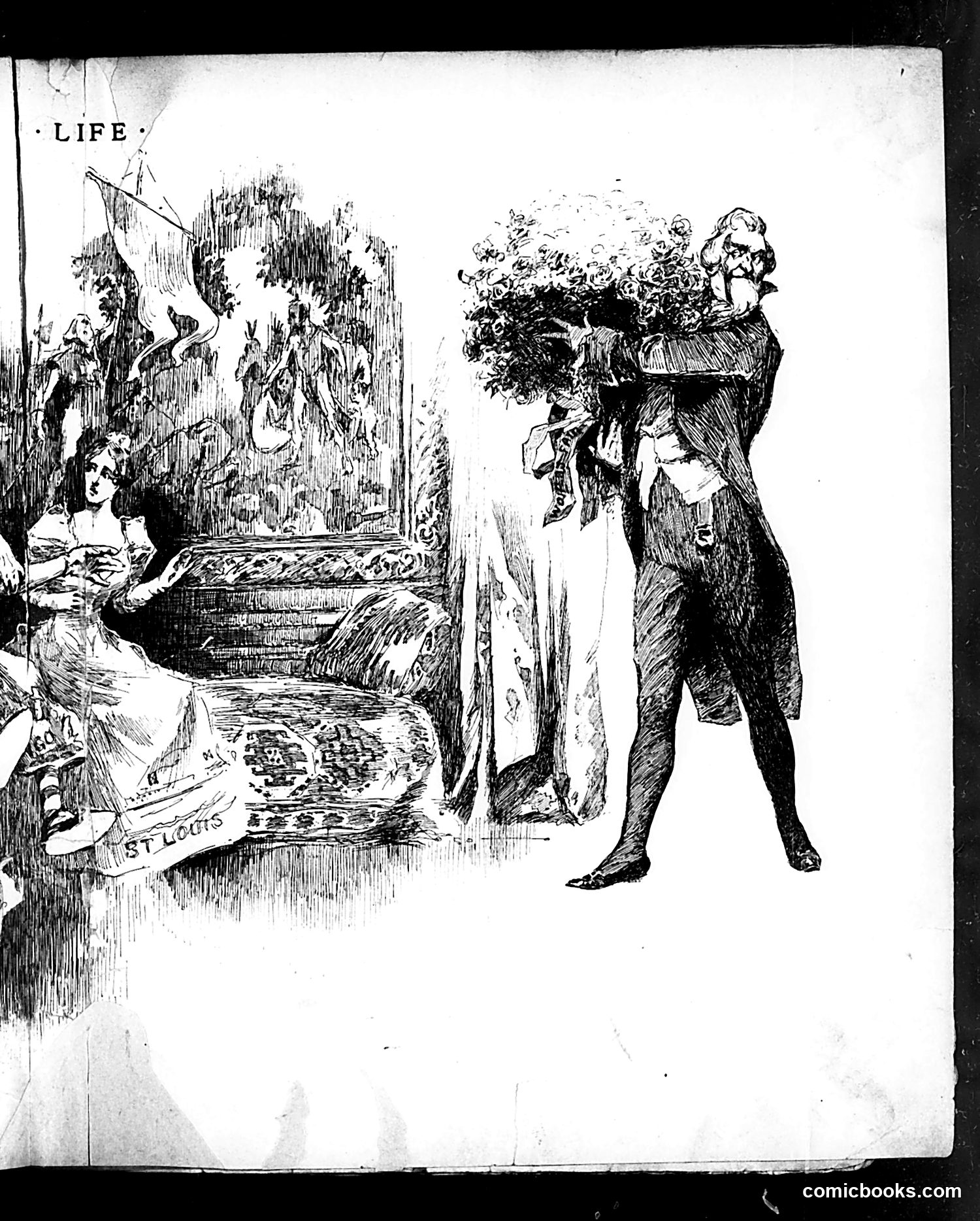
This appears to be a satirical illustration from Life magazine showing a domestic scene. On the left, a woman sits reading what appears to be a map or document labeled "St Louis." On the right, a man in formal attire holds a large bouquet of flowers, seemingly presenting them with theatrical gestures. The satire likely critiques courtship or romantic performance—possibly mocking elaborate or insincere romantic gestures. The woman's absorbed attention to the map (suggesting travel or relocation plans) contrasts with the man's showy flower presentation, suggesting either miscommunication between partners or commentary on superficial romantic displays missing the point of actual connection. Without additional context about the specific issue date, the precise meaning remains somewhat unclear.
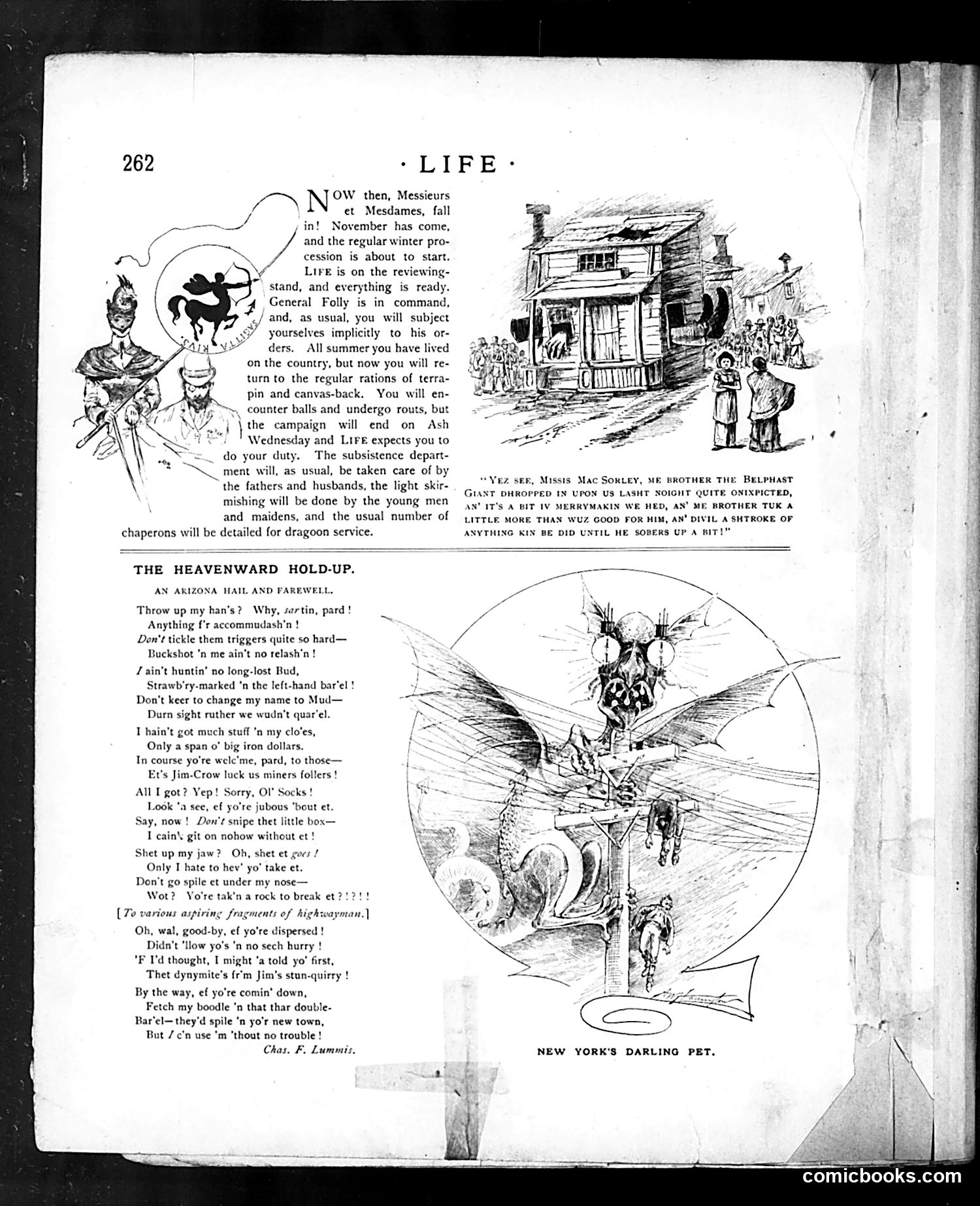
This page contains two distinct pieces: **Top section:** A prose passage addresses "Messieurs et Mesdames" about November's arrival and military preparations. It discusses General Foley commanding operations, with soldiers returning to "regular means of terra-pin and canvas-back" (likely referring to transport methods). The text references campaign logistics and assignments for dragoon service. **"The Heavenward Hold-Up":** A dialectal poem in Western vernacular, credited to Chas. F. Lummis. It appears to be a farewell or departure scene, with colloquial speech patterns suggesting a cowboy or frontier character saying goodbye—possibly humorous or poignant farewell dialogue. **"New York's Darling Pet":** An illustration showing what appears to be a flying creature or vehicle in a circular frame. The page's exact historical context and satirical targets remain unclear without additional dating information.
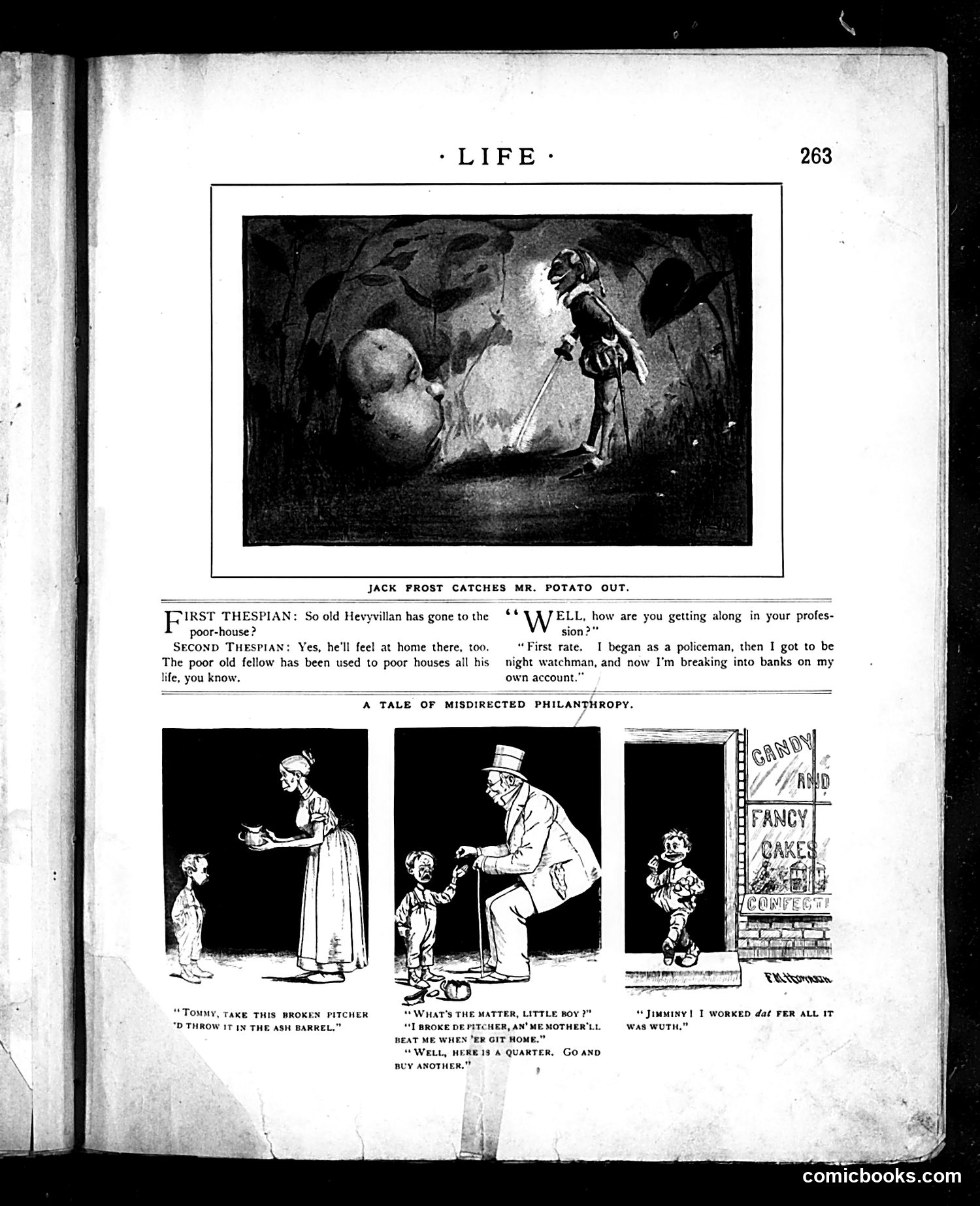
This page contains two satirical pieces: **Top image**: "Jack Frost Catches Mr. Potato Out" depicts a small figure confronting a large potato character, illustrating the phrase "getting along in your profession" through a dialogue where someone boasts of progressing from policeman to night watchman to bank robber. **Bottom section**: "A Tale of Misdirected Philanthropy" uses three sequential cartoon panels to satirize well-intentioned but misguided charity. A woman gives a broken pitcher to a poor boy to "throw in the ash barrel"; a man gives a quarter to buy another pitcher, which the boy's mother will beat him with upon his return home. The final panel shows the boy at a bakery, suggesting the charity had unintended consequences. The satire critiques charity that doesn't address actual needs.
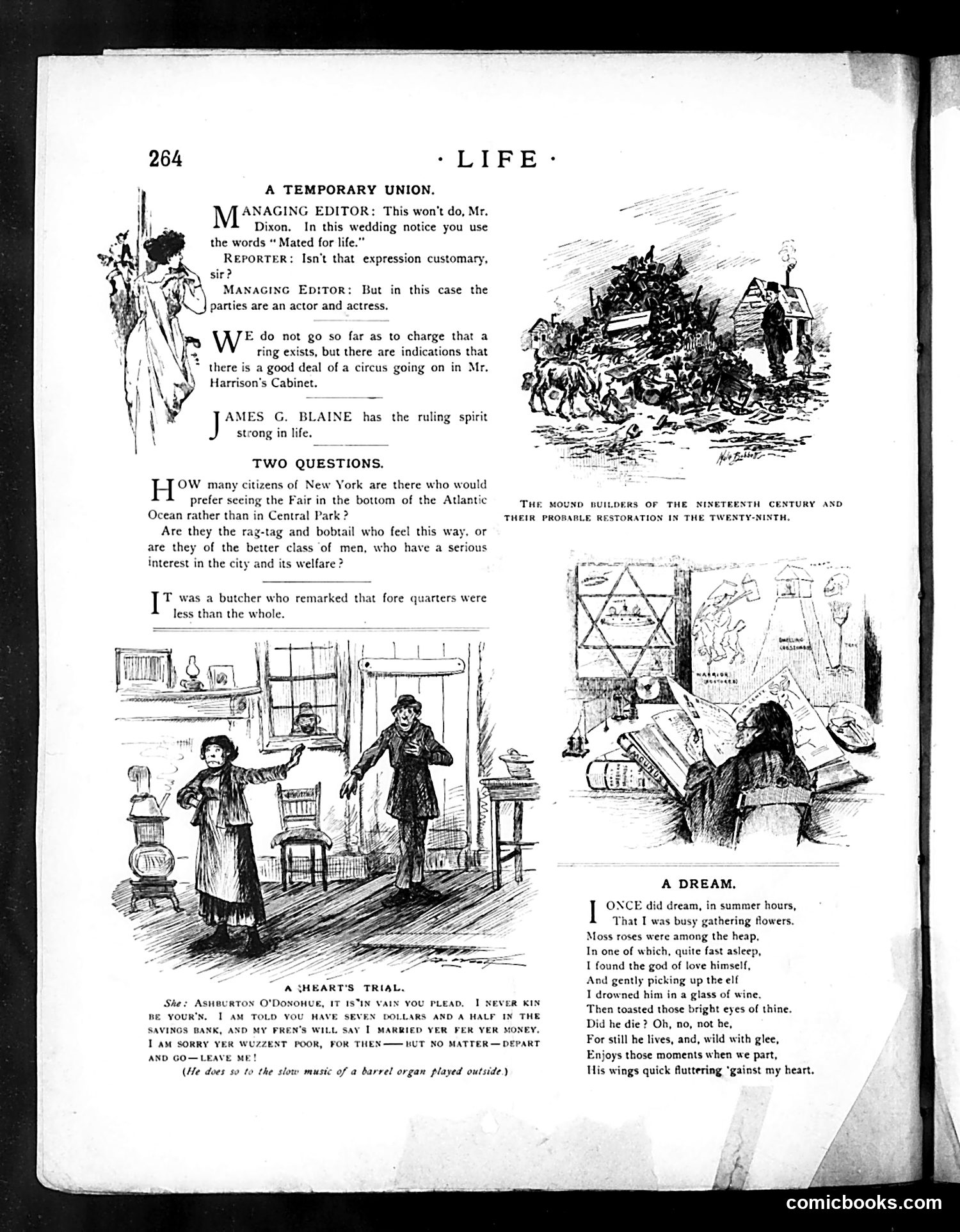
This page contains satirical commentary on contemporary issues around 1880s-90s America. **"A Temporary Union"** mocks actor-actress marriages as inherently unstable. The managing editor jokes that "mated for life" is inappropriate language for performers, implying their unions are circus acts rather than genuine commitments—a jab at theatrical culture and marital frivolity among entertainers. **"Two Questions"** criticizes New York elites' opposition to a fair (likely the World's Fair) in Central Park, suggesting only the "rag-tag and bobtail" would object—sarcastic reversal implying the wealthy actually oppose it for snobbish reasons. **"A Heart's Trial"** depicts a working-class domestic drama where a desperate man abandons his wife and savings, illustrated with period-typical melodrama. The page also includes a romantic poem "A Dream" about cupid and love, contrasting with the satirical domestic content above. Overall, the page targets theatrical pretension, class hypocrisy, and domestic hardship through sharp wit and illustration.
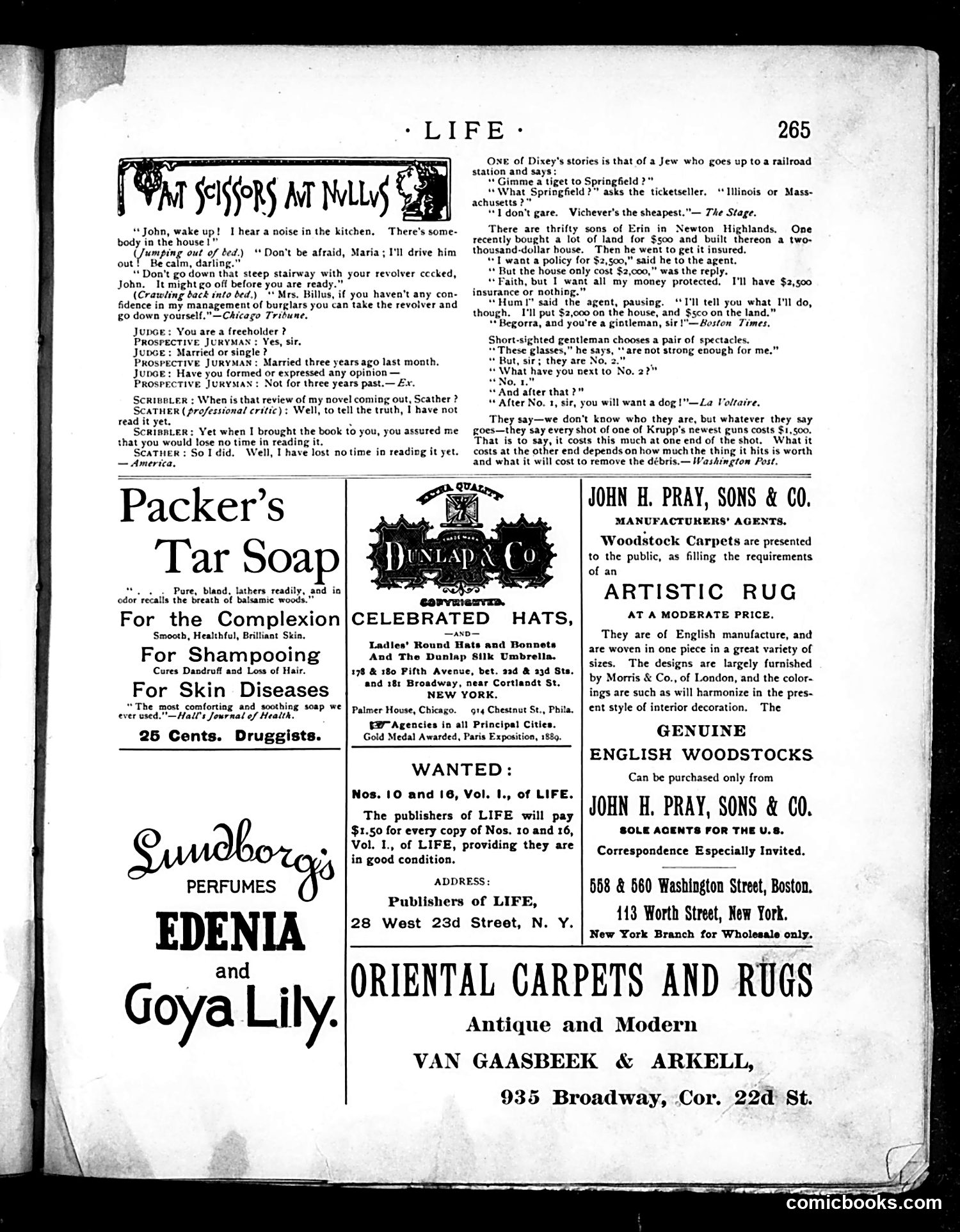
This page presents several short humorous anecdotes typical of *Life* magazine's satirical content. The main cartoon strip "Igors at Nullus" depicts domestic comedy: a husband awakened by noise confidently announces he'll handle an intruder, but his wife expresses such doubt in his competence that he offers to surrender his revolver and let *her* confront the burglar instead. The joke satirizes marital dynamics and male bravado deflated by spousal skepticism. Below appear three separate jokes: one about a jury member who claims no opinions in three years of marriage (mocking domestic submission); one about a dilatory book critic; and one about Irish-American thrift (a stereotype common to period humor). The remaining content is advertisements for period products—soaps, hats, carpets—typical of magazine filler. The page reflects *Life*'s focus on genteel domestic and social satire rather than political commentary.
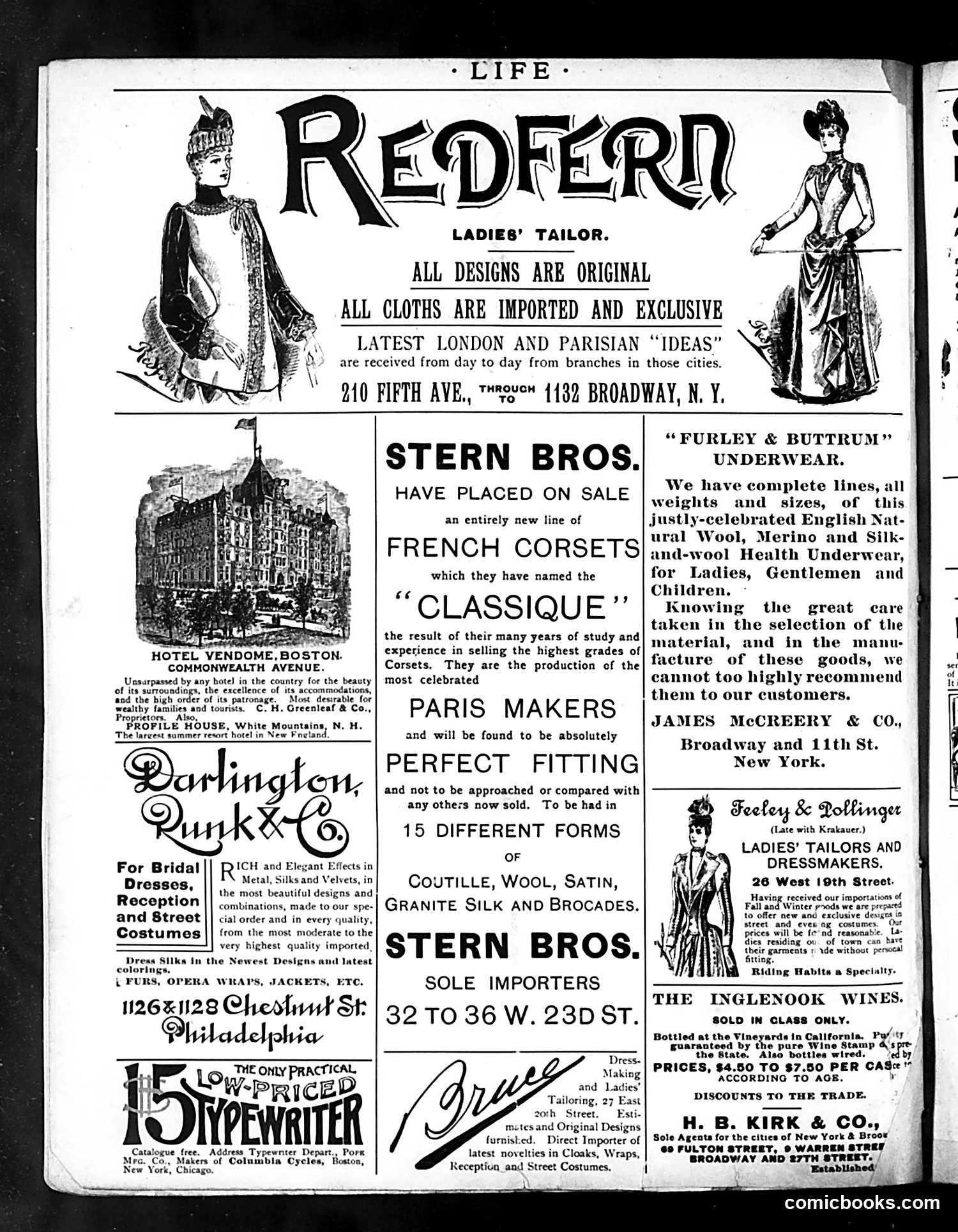
This is **not a cartoon or satirical content page**—it's primarily a **fashion and luxury goods advertisement section** from Life magazine, typical of the late 19th/early 20th century. The page showcases high-end American and imported merchandise targeting wealthy urban consumers: ladies' tailoring (Redfern), French corsets (Stern Bros.), bridal wear (Darlington, Quik & Co.), hotel accommodations, and luxury goods like wine and typewriters. The **social context** reflects Gilded Age consumer culture: advertisements emphasize exclusivity ("imported and exclusive"), Paris and London fashions, and patronage by "wealthy families." The repeated invocation of European sources signals that American wealth aspired to Old World sophistication. There is **no political satire or caricature** visible. The decorative illustrations are simply fashion plates showing women's clothing styles of the era, not satirical commentary. This represents Life's commercial function as a society publication catering to affluent readers.
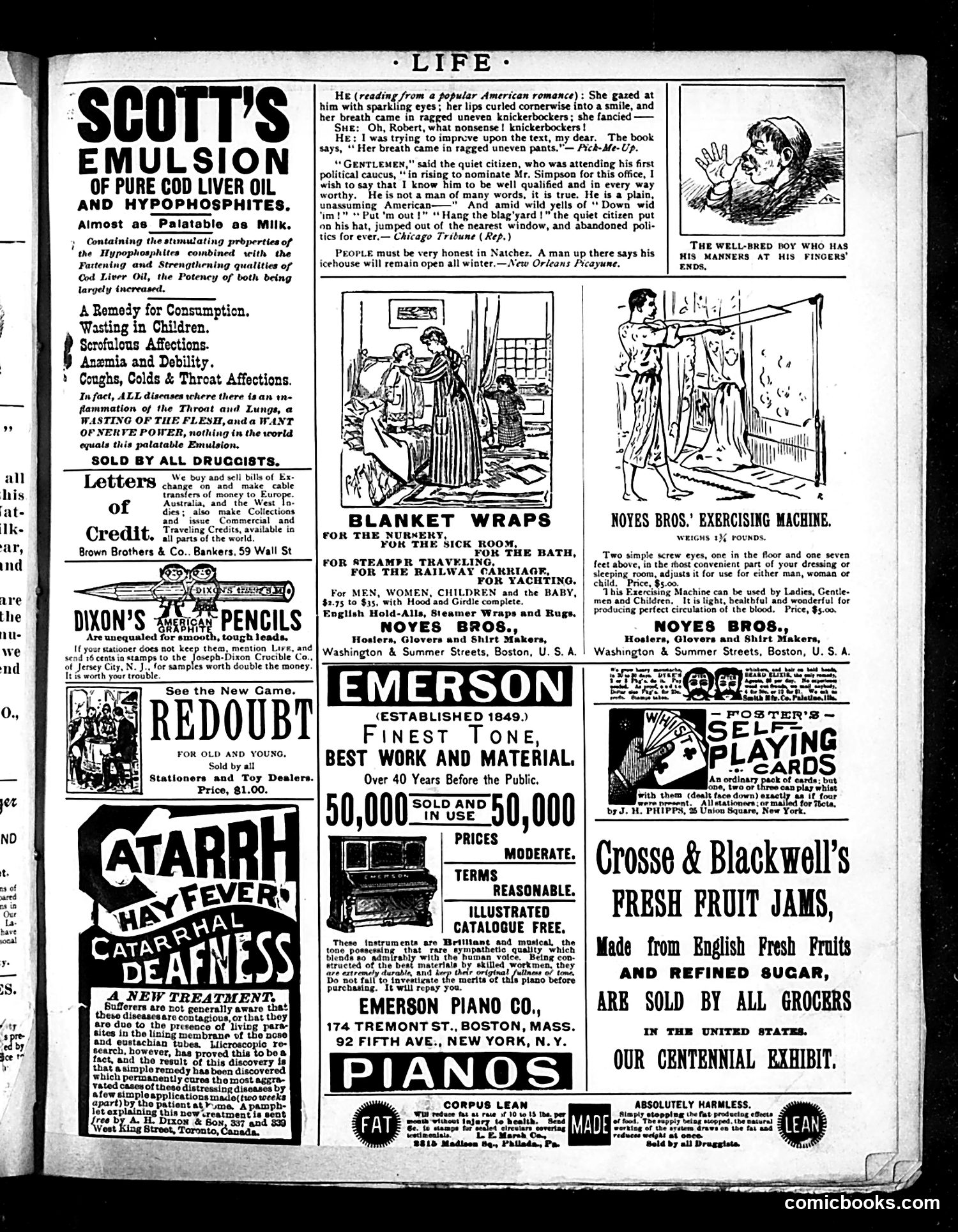
This page is primarily **advertising** with two brief satirical vignettes embedded. **The two cartoons:** 1. **"She gazed at him..."** - A husband reading aloud from a romance novel attempts to "improve" the text by changing "her breath came in ragged uneven pants" to "ragged uneven knickerbockers." His wife objects to the nonsensical revision. The joke mocks both pretentious literary editing and absurd male attempts at sophistication. 2. **The political meeting** - A citizen at a political caucus nominates a candidate as "unassuming American," but rowdy attendees drown him out with "Down wid 'im!" and "Hang the blag'yard!" The nominee jumps out a window. This satirizes chaotic, violent American political rallies of the era—suggesting political discourse devolved into mob behavior rather than reasoned debate. **The rest** is period advertising for remedies (Scott's Emulsion for consumption), writing implements, pianos, jams, and clothing—typical of late 19th-century Life magazine content.
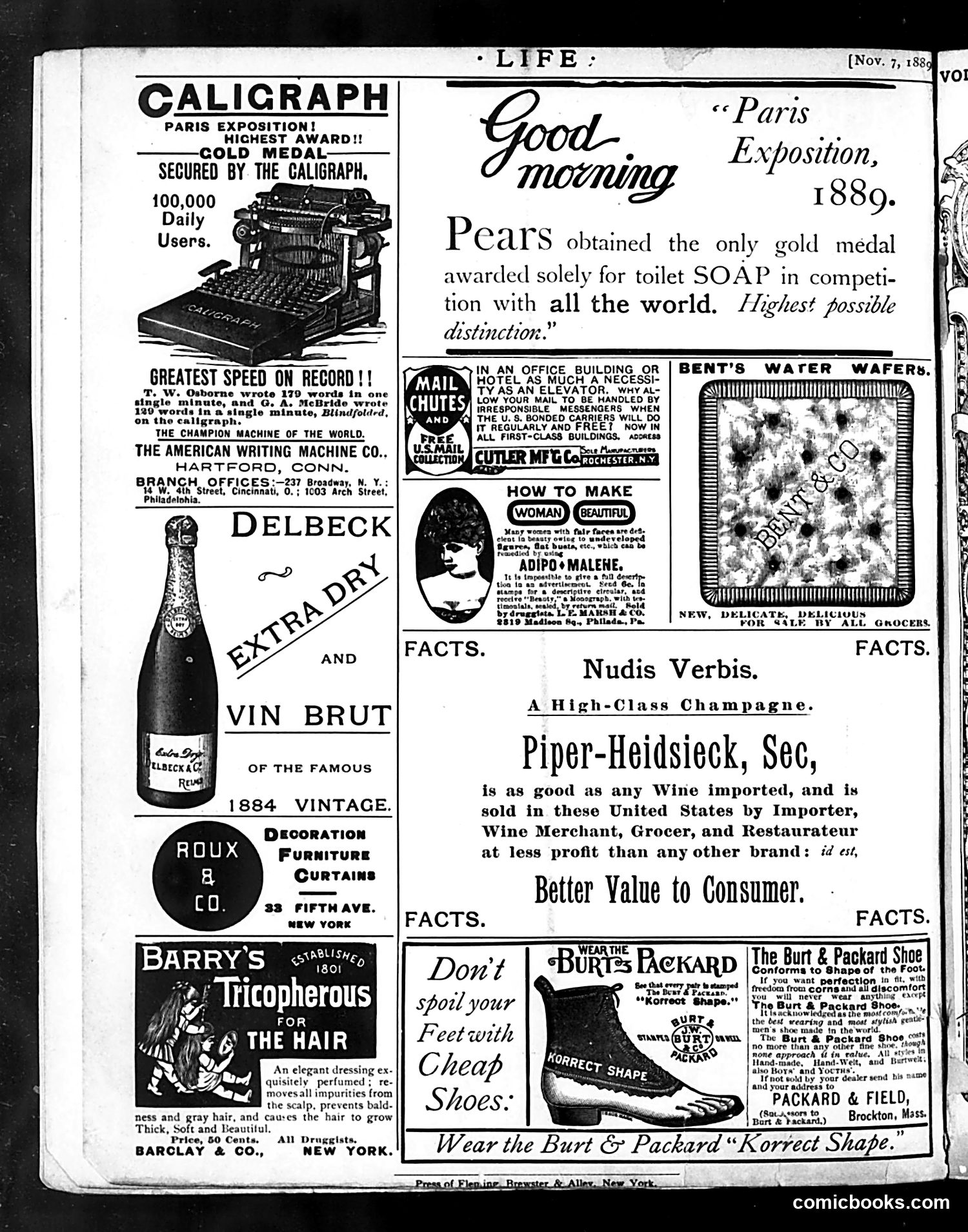
This is primarily a **advertising page**, not a satirical cartoon. It showcases commercial products of the 1880s with competitive claims typical of the era. Key advertisements include: - **Caligraph typewriter**: Claims fastest typing speed and a Paris Exposition gold medal - **Pears soap**: Boasts the only gold medal awarded "solely for toilet soap" at the 1889 Paris Exposition - **Delbeck champagne** (1884 vintage) - **Barry's Tricopherous hair tonic**: Promises to prevent baldness and gray hair - **Burt & Packard shoes**: Marketed as superior to cheap alternatives, conforming to foot shape - **Piper-Heidsieck champagne**: Positioned as equal to imports but cheaper The recurring phrase "**FACTS**" appears as a humorous editorial aside, likely satirizing exaggerated advertising claims by calling dubious assertions "facts." This suggests *Life* magazine's editorial voice was subtly mocking the often-hyperbolic product endorsements of the period.