
Life, 1889-11-07 · page 6 of 16
Life — November 7, 1889 — page 6: what you’re looking at
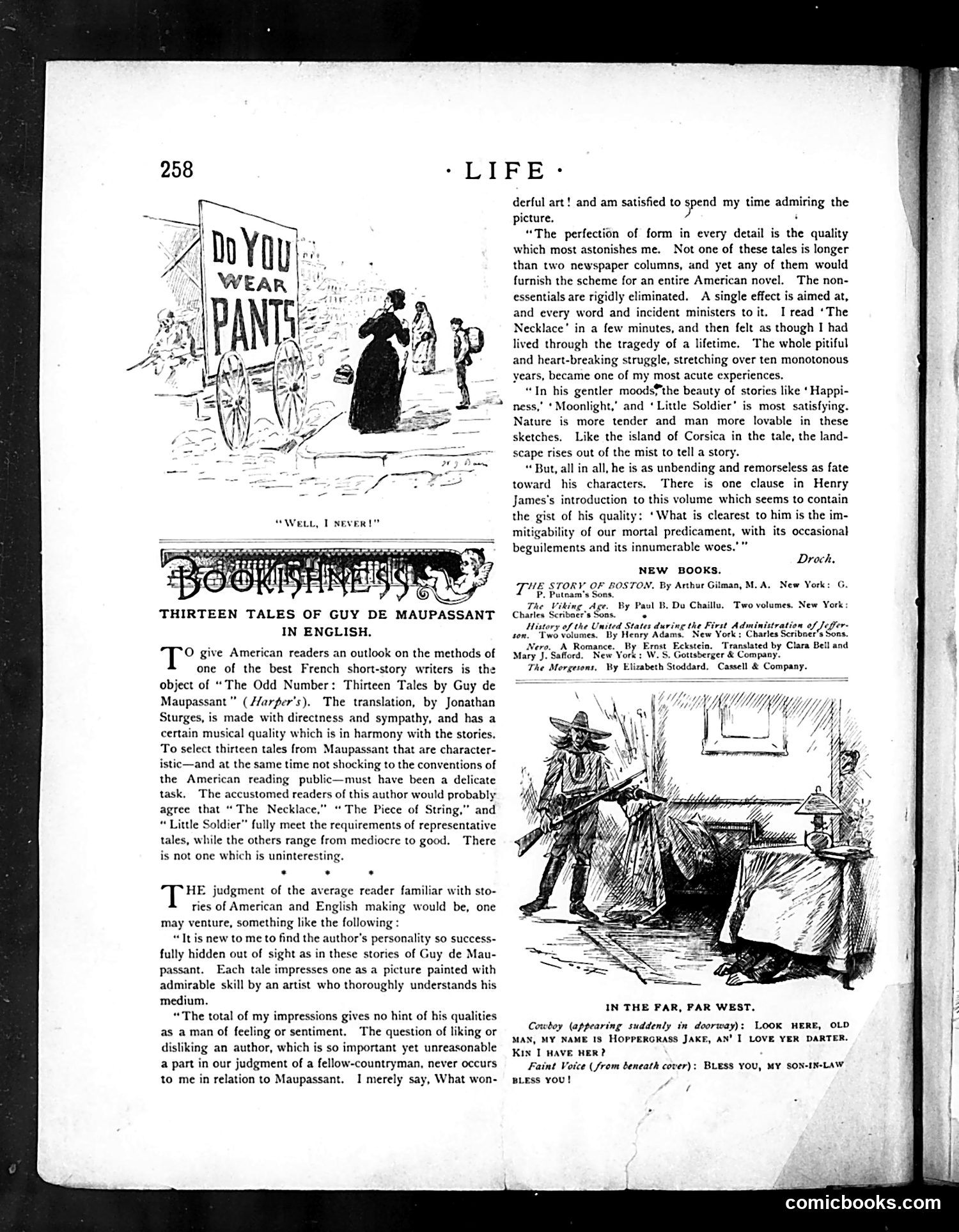
What you’re looking at
The top cartoon depicts a woman in Victorian dress standing before a large billboard reading "DO YOU WEAR PANTS?" with the caption "WELL, I NEVER!" This satirizes the late 19th-century "rational dress" movement, which advocated women wearing pants or bloomers instead of restrictive skirts. The woman's shocked response ("Well, I never!") reflects contemporary moral outrage at this idea—considered scandalous and unfeminine by conservative society. The cartoon mocks both the radical proposal and the prudish reaction to it. The lower portion reviews "Thirteen Tales of Guy de Maupassant," praising the French writer's skill at character portrayal and storytelling economy. An accompanying illustration shows a scene "In the Bar, Far West," depicting a saloon encounter.
📄 Transcribed text from this page (OCR, searchable)
Machine-transcribed from the original scan — historical spelling and the odd misread are preserved.
-LIFE: derful art! and am satisfied to spend my time admiring the picture. ‘ “The perfection of form in every detail is the quality which most astonishes me. Not one of these tales is longer than two newspaper columns, and yet any of them would furnish the scheme for an entire American novel. The non- essentials are rigidly eliminated. A single effect is aimed at, and every word and incident ministers to it. I read ‘The Necklace’ in a few minutes, and then felt as though I had lived through the tragedy of a lifetime. The whole pitiful and heart-breaking struggle, stretching over ten monotonous years, became one of my most acute experiences. “In his gentler moods? the beauty of stories like ‘Happi- ness,’ ‘Moonlight,’ and ‘Little Soldier’ is most satisfying. Nature is more tender and man more lovable in these sketches. Like the island of Corsica in the tale, the land- scape rises out of the mist to tell a story. “ But, all in all, he is as unbending and remorseless as fate toward his characters. There is one clause in Henry James's introduction to this volume which seems to contain the gist of his quality: ‘What is clearest to him is the im- mitigability of our mortal predicament, with its occasional beguilements and its innumerable woes.’” Droch. NEW BOOKS. TUE STORY, OF BOSTON. By Arthur Gilman, M.A. New York: G. P, Putnam's Sons. The Viking Age. By Paul B. Du Chaillu, Two volumes, New York: Charles Scribaer's Sons. History of the United States during the First Administration of Jeffer- IN ENGLISH. 10 ee eee Kanak ‘Meme Works Charles Coe * cf Nero. A Romance. By Ernst Eckstein. Translated by Clara Bell and O give American readers an outlook on the methods of — Mary JSafford. "New York : W. S. Gotisberger & Company, one of the best French short-story writers is the The Morgesons, By Elizabeth Stoddard. Cassell & Company. object of “The Odd Number: Thirteen Tales by Guy de - Maupassant" (Harper's). The translation, by Jonathan Sturges, is made with directness and sympathy, and has a certain musical quality which is in harmony with the stories. To select thirteen tales from Maupassant that are character- istic—and at the same time not shocking to the conventions of the American reading public—must have been a delicate task, The accustomed readers of this author would probably agree that The Necklace,” “ The Piece of String,” and “ Little Soldier” fully meet the requirements of representative tales, while the others range from mediocre to good. There is not one which is uninteresting. . . . HE judgment of the average reader familiar with sto- ries of American and English making would be, one may venture, something like the following : “It is new to me to find the author's personality so success- fully hidden out of sight as in these stories of Guy de Mau- passant. Each tale impresses one as a picture painted with admirable skill by an artist who thoroughly understands his medium. “The total of my impressions gives no hint of his qualities as a man of feeling or sentiment, ‘The question of liking or 45. \ny wane 18 HOPPEKOMASS JAKE, aN" I LOVE YER DARTER. disliking an author, which is so important yet unreasonable 441 wave HER? a part in our judgment of a fellow-countryman, never occurs Faint Voice (from beneath cover); BLESS YOU, MY SON-IN-LAW to me in relation to Maupassant, I merely say, What won- Less you! y, IN THE FAR, FAR WEST. Cowboy (appearing suddenly in doorway): LOOK MERE, OLD t comicbooks.com