
Life, 1889-11-07 · page 4 of 16
Life — November 7, 1889 — page 4: what you’re looking at
What you’re looking at
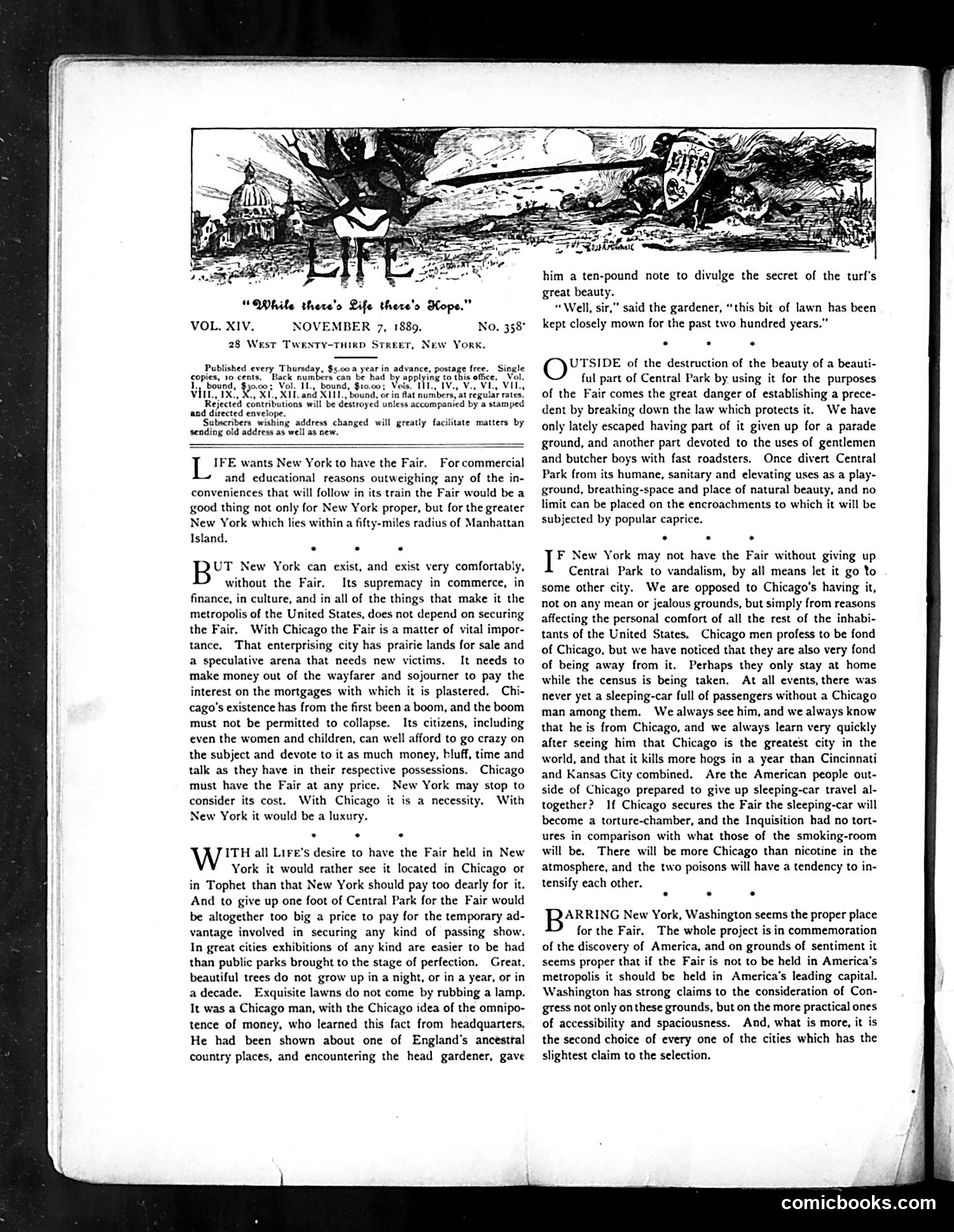
The page contains editorial opinion rather than satirical cartoons. The small illustration at top left appears to show a figure with a large head—possibly caricaturing a wealthy or pompous individual—though the specific identity is unclear from the image alone. The text debates whether New York City should host the 1889 World's Fair. The editor argues New York could host it comfortably without Central Park, implying Chicago's claim is weaker. There's clear rivalry between the cities over hosting rights. The piece also includes pointed commentary about Chicago's character, suggesting New Yorkers view Chicagoans as crude or unsophisticated—typical late-19th-century metropolitan snobbery. The rhetoric reflects genuine competition between emerging American cities for prestige and economic benefit.
📄 Transcribed text from this page (OCR, searchable)
Machine-transcribed from the original scan — historical spelling and the odd misread are preserved.
“While there's Life there's Hope.” VOL. XIV. NOVEMBER 7, 1889. 28 West TWENTY-THIRD STREET, New York, Published every Thursday, $5.00 a year in advance, posta copies, 10 cents, Back Members can be bad by applying to 1, bound, ee; Vol. I1., bound, $10.00; Vols. ite Iv., VitL., 1X), X., X1., X11. and X11, bound, or in flat numbers, at re Rejected contributions will be destroyed unless accompanied by a stamped and directed envelope. Subscribers wishing address changed will greatly facilitate matters by sending old address as well as new. . Single fice. Vol, IFE wants New York to have the Fair. For commercial and educational reasons outweighing any of the in- conveniences that will follow in its train the Fair would be a good thing not only for New York proper, but for the greater New York which lies within a fifty-miles radius of Manhattan Island. . . . UT New York can exist, and exist very comfortably, without the Fair, Its supremacy in commerce, in finance, in culture, and in all of the things that make it the metropolis of the United States, does not depend on securing the Fair. With Chicago the Fair is a matter of vital impor- tance, That enterprising city has prairie lands for sale and a speculative arena that needs new victims. It needs to make money out of the wayfarer and sojourner to pay the interest on the mortgages with which it is plastered. Chi- cago’s existence has from the first been a boom, and the boom must not be permitted to collapse. Its citizens, including even the women and children, can well afford to go crazy on the subject and devote to it as much money, bluff, time and talk as they have in their respective possessions. Chicago must have the Fair at any price. New York may stop to consider its cost. With Chicago it is a necessity. With New York it would be a luxury. ITH all Lire’s desire to have the Fair held in New York it would rather see it located in Chicago or in Tophet than that New York should pay too dearly for it. And to give up one foot of Central Park for the Fair would be altogether too big a price to pay for the temporary ad- vantage involved in securing any kind of passing show. In great cities exhibitions of any kind are easier to be had than public parks brought to the stage of perfection. Great, beautiful trees do not grow up in a night, or in a year, or in a decade. Exquisite lawns do not come by rubbing a lamp. It was a Chicago man, with the Chicago idea of the omnipo- tence of money, who learned this fact from headquarters, He had been shown about one of England's ancesttal country places, and encountering the head gardener, gave him a ten-pound note to divulge the secret of the turf's great beauty. “Well, sir,” said the gardener, “this bit of lawn has been kept closely mown for the past two hundred years.” QO UtsiPe of the destruction of the beauty of a beauti- ful part of Central Park by using it for the purposes of the Fair comes the great danger of establishing a prece- dent by breaking down the law which protects it. We have only lately escaped having part of it given up for a parade ground, and another part devoted to the uses of gentlemen and butcher boys with fast roadsters. Once divert Central Park from its humane, sanitary and elevating uses as a play- ground, breathing-space and place of natural beauty, and no limit can be placed on the encroachments to which it will be subjected by popular caprice. F New York may not have the Fair without giving up Central Park to vandalism, by all means let it go to some other city. We are opposed to Chicago's having it, not on any mean or jealous grounds, but simply from reasons affecting the personal comfort of all the rest of the inhabi- tants of the United States. Chicago men profess to be fond of Chicago, but we have noticed that they are also very fond of being away from it. Perhaps they only stay at home while the census is being taken. At all events, there was never yet a sleeping-car full of passengers without a Chicago man among them. We always see him, and we always know that he is from Chicago, and we always learn very quickly after seeing him that Chicago is the greatest city in the world, and that it kills more hogs in a year than Cincinnati and Kansas City combined. Are the American people out- side of Chicago prepared to give up sleeping-car travel al- together? If Chicago secures the Fair the sleeping-car will become a torture-chamber, and the Inquisition had no tort- ures in comparison with what those of the smoking-room will be. There will be more Chicago than nicotine in the atmosphere, and the two poisons will have a tendency to in- tensify each other. . . . ARRING New York, Washington seems the proper place for the Fair. The whole project is in commemoration of the discovery of America, and on grounds of sentiment it seems proper that if the Fair is not to be held in America’s metropolis it should be held in America’s leading capital. Washington has strong claims to the consideration of Con- gress not only on these grounds, but on the more practical ones of accessibility and spaciousness. And, what is more, it is the second choice of every one of the cities which has the slightest claim to the selection. comicbooks.com