
A complete issue · 18 pages · 1889
Life — September 19, 1889
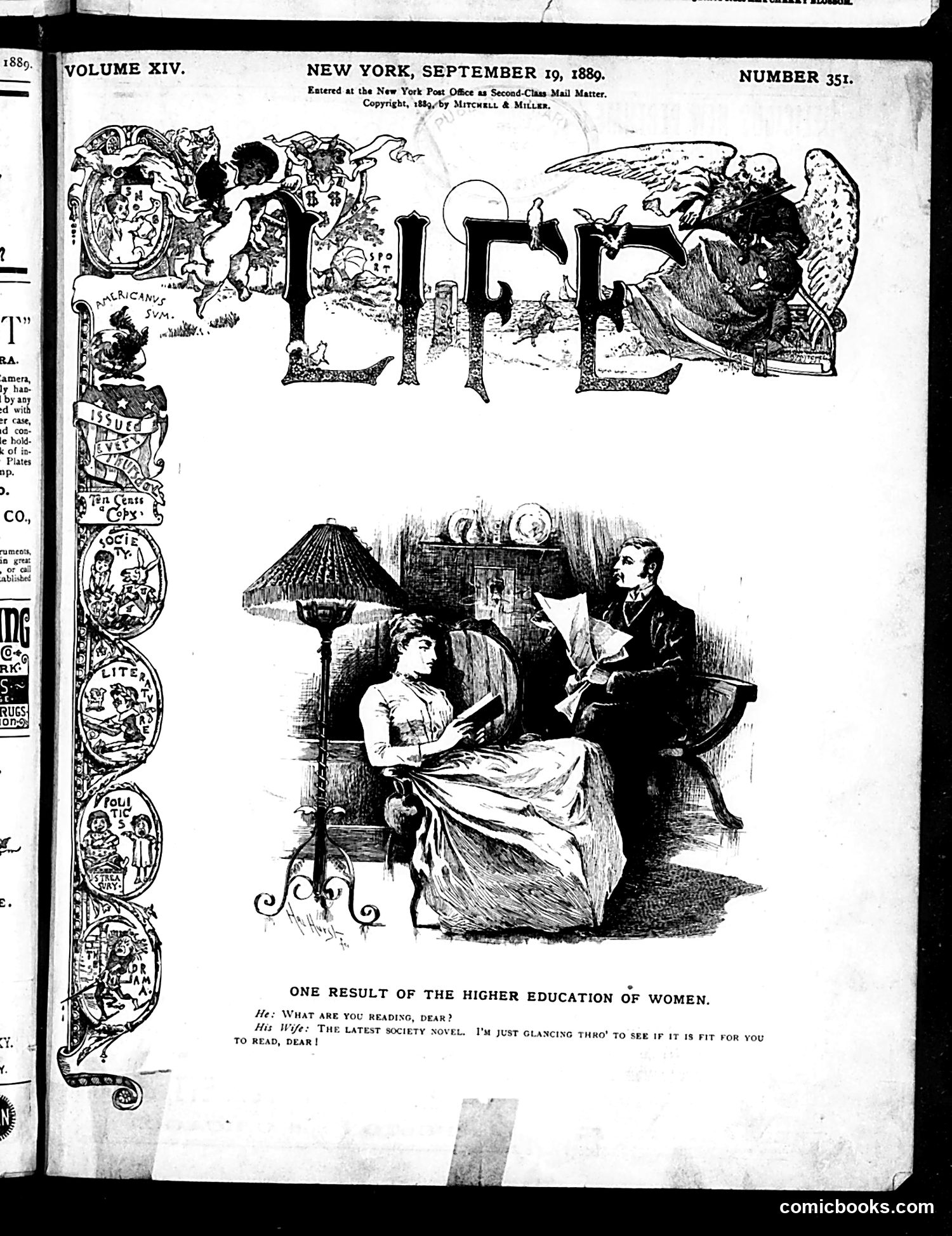
This 1890 *Life* magazine cartoon satirizes women's education through domestic role-reversal. The illustration shows a woman reading a "society novel" while her husband stands nearby holding papers, apparently managing household matters. The caption presents their dialogue: he asks what she's reading; she dismissively replies she's "just glancing thro'" a novel to check if it's suitable for him. The satire mocks anxieties about educated women—suggesting that women's higher education made them neglect traditional domestic duties, instead becoming absorbed in literary pursuits while husbands handled household responsibilities. This inverts Victorian gender expectations, using humor to critique both women's education and changing social roles during this period of women's expanding access to universities.
This page is **primarily advertising**, not satirical content. It contains commercial advertisements for luxury goods and services typical of early 20th-century Life magazine, including: - Perfumes (Crab Apple Blossoms, Wood Violets, Lavender Salts) - A typewriter ($15, marketed as "practical" and low-priced) - Silk umbrellas - Wine and spirits distributors - Carpets and furniture - Mineral water The only substantive editorial content is a header for "John Osborn, Son & Co." at page top, identifying them as agents for Piper-Heidsieck champagne and various wines/spirits. There are **no political cartoons or satirical commentary** visible on this page. It represents Life's revenue model: mixing advertisements with editorial content.
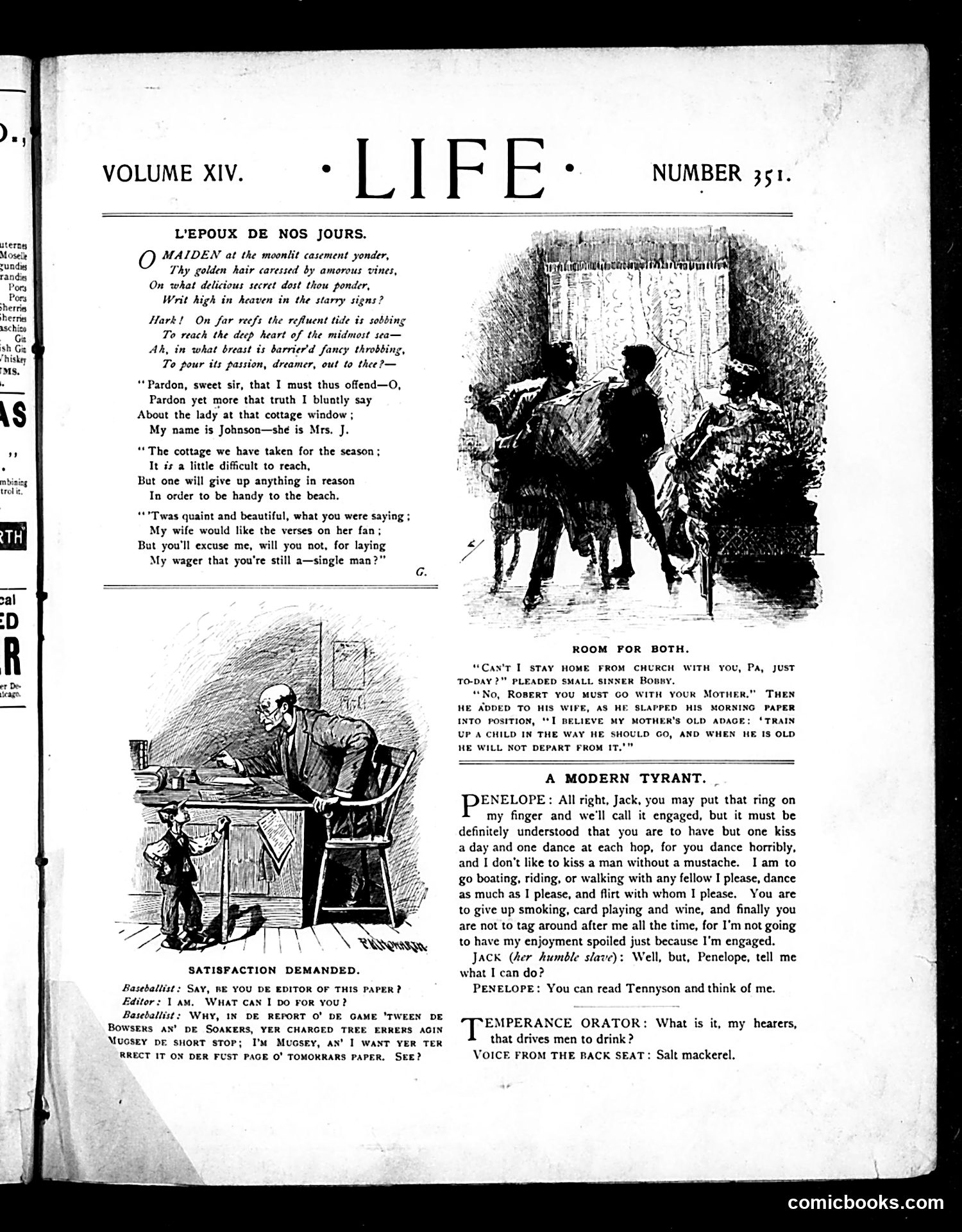
This page contains three satirical pieces: 1. **"L'Epoux de Nos Jours"** (The Husband of Our Days): A poem mocking modern husbands, illustrated with a scene of people outside a cottage. The satire targets men's indifference to their wives' romantic interests. 2. **"Satisfaction Demanded"**: A baseball-themed dialogue where an editor is confronted about coverage of a game between "Bowsers" and "Soakers," with demands for correction. This appears to be sports section humor. 3. **"A Modern Tyrant"**: A dialogue between "Penelope" and "Jack" satirizing controlling fiancés. Jack demands his future wife abandon smoking, cards, dancing, boating, and socializing—essentially all independence. The satire mocks tyrannical male attitudes toward women in courtship. 4. **"Room for Both"**: Brief text about parental authority over children. These pieces collectively satirize gender relations and male dominance in early 20th-century society.
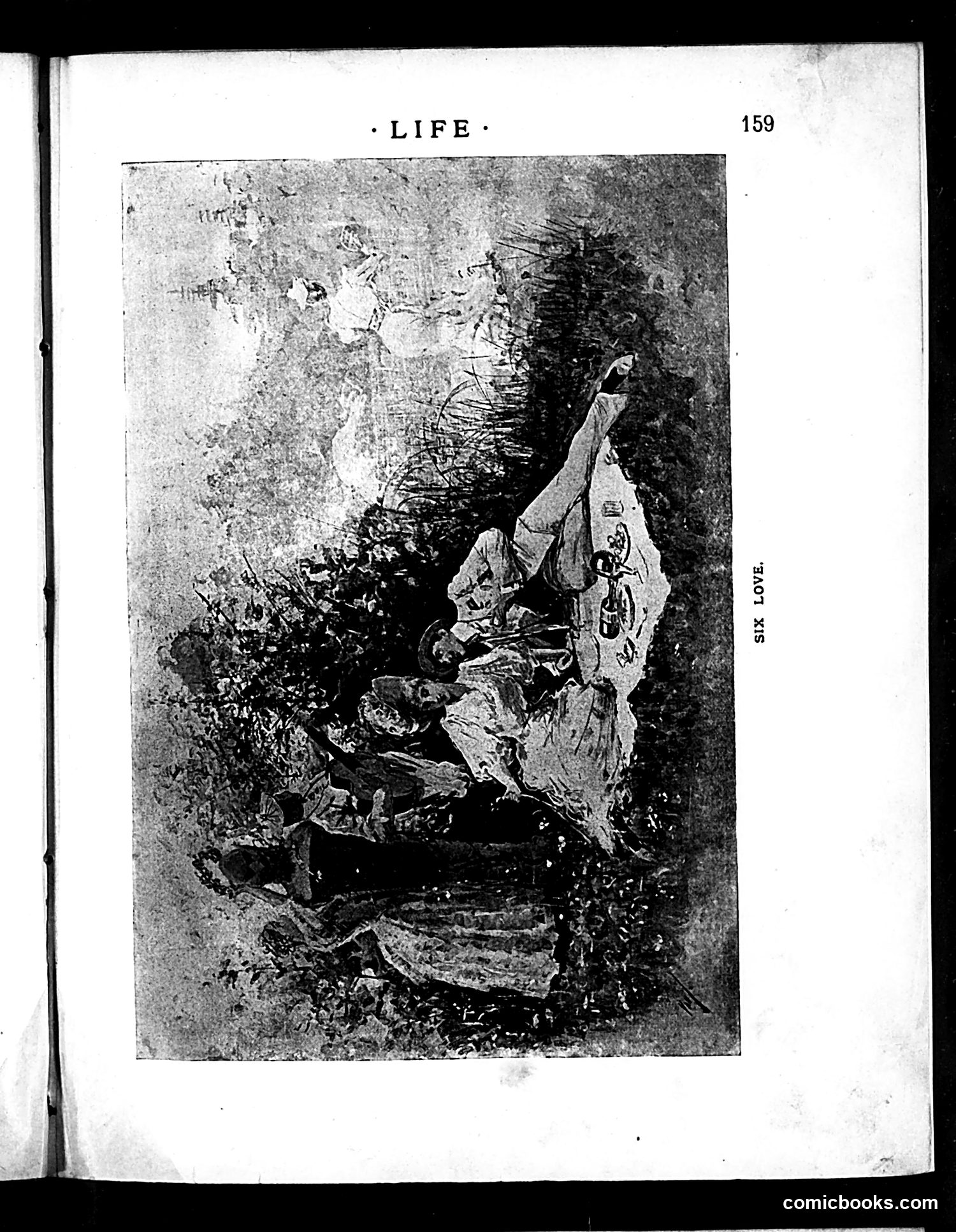
I can see this is page 159 of Life magazine, titled "SIX LOVE" (visible on the right margin). However, the image quality is quite poor—heavily degraded and appearing inverted or overexposed in places—which makes it difficult to discern clear details about the cartoon or illustration. The image appears to show figures in what might be a romantic or domestic scene, but I cannot reliably identify specific individuals, read any captions clearly, or determine the political or social satire being referenced. Without legible text or clearer imagery, I cannot accurately explain the cartoon's meaning to a modern reader as requested. To properly analyze this page, a higher-quality scan would be necessary.
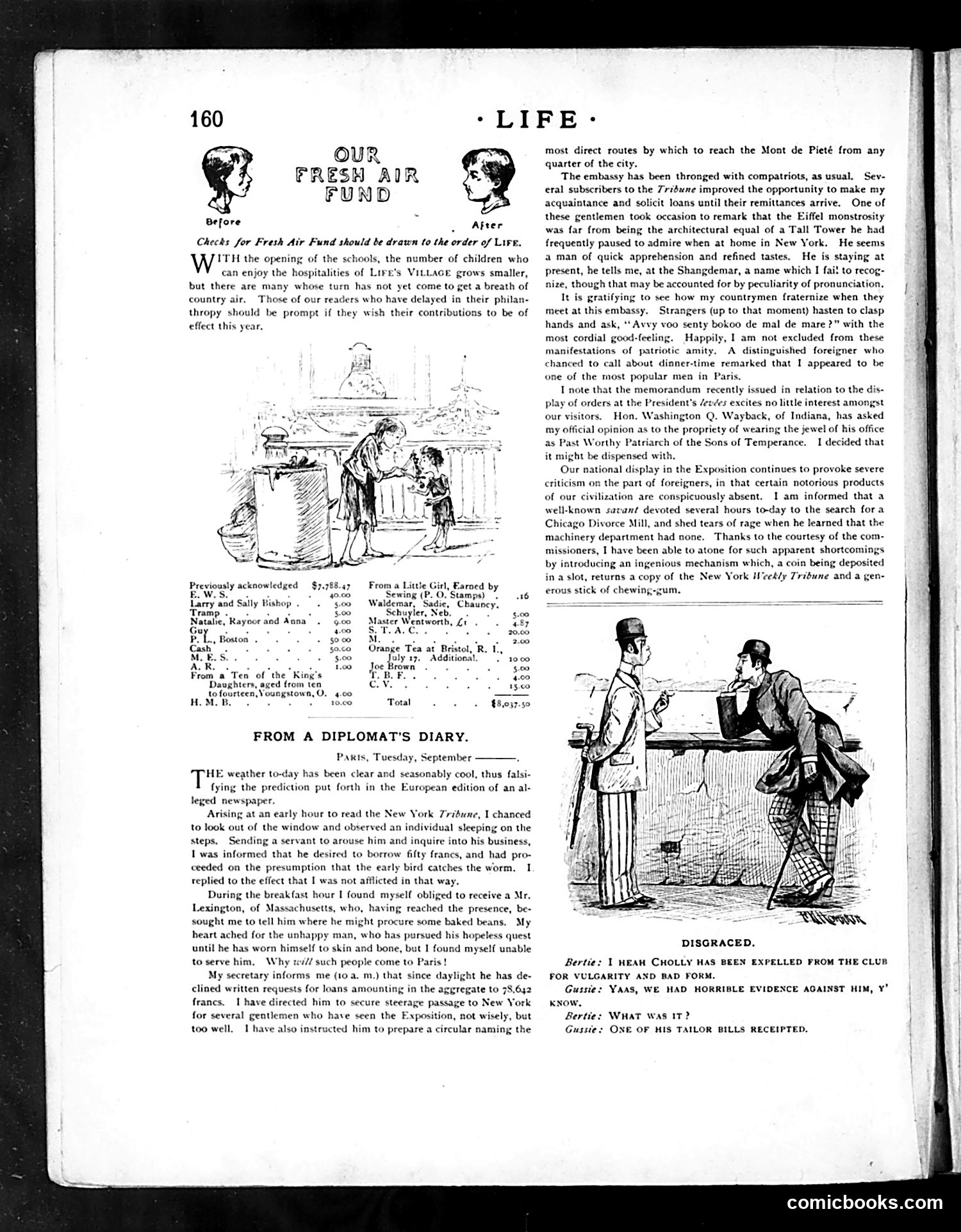
The page contains two distinct sections: **"Our Fresh Air Fund"** (top left): A fundraising appeal with a before/after illustration showing children benefiting from fresh air access. A donation list follows. **"From a Diplomat's Diary"** (main article): A satirical account set in Paris describing diplomatic life. The author humorously recounts receiving a visitor seeking loans, observing the Exposition's shortcomings, and managing various social obligations. **"Disgraced"** (bottom right): A cartoon dialogue between two gentlemen. One reports that "Cholly" was expelled from a club for "vulgarity and bad form." The other responds that his tailor submitted a bill—implying the expulsion resulted from unpaid debts rather than moral failing. This satirizes wealthy men prioritizing appearances while avoiding financial responsibility. The humor targets pretension and hypocrisy among the upper classes.
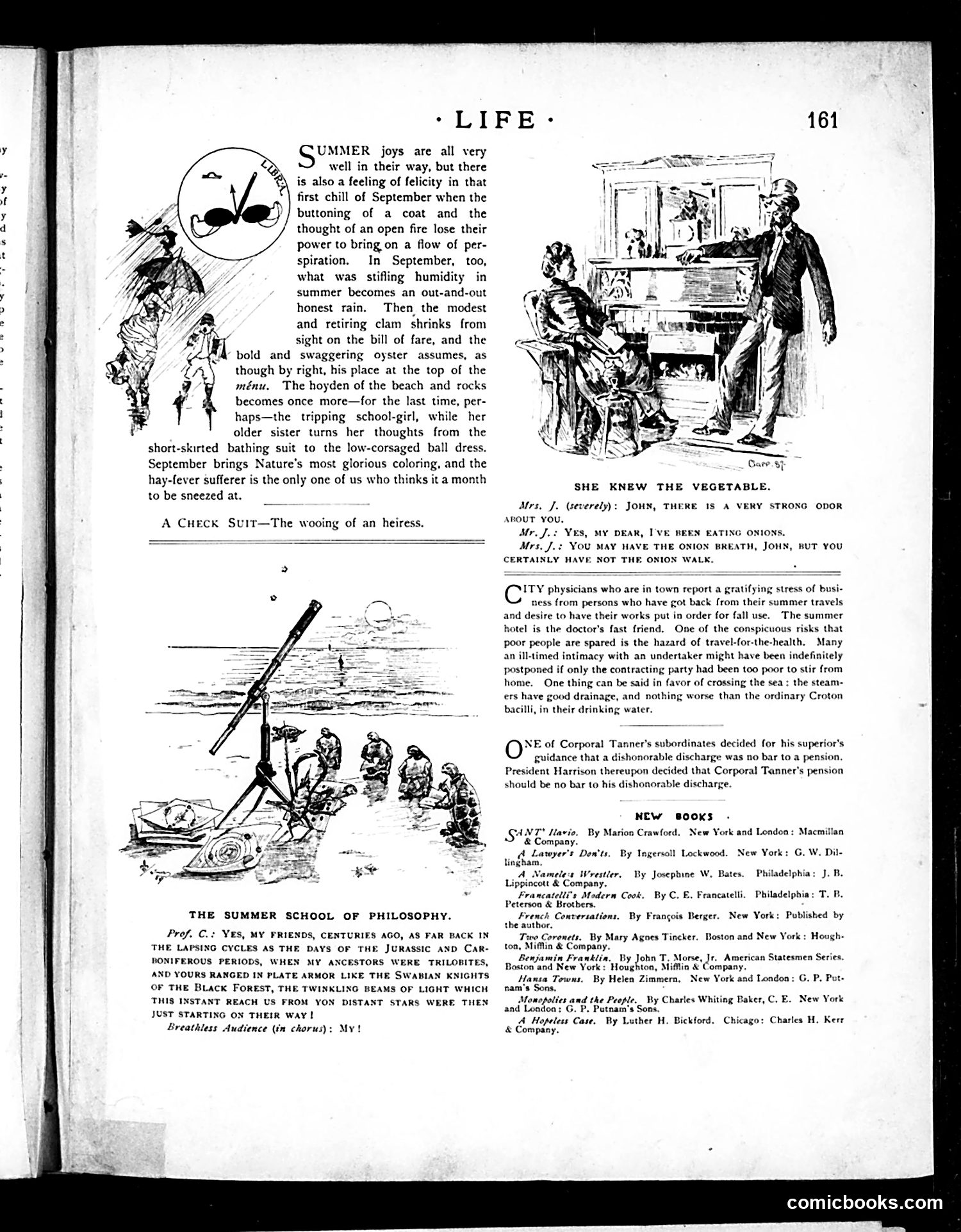
This page contains three distinct pieces of satire: 1. **"A Check Suit"** (top left): A brief joke about an heiress's romantic pursuits, illustrated with a couple in period dress. 2. **"She Knew the Vegetable"** (top right): A domestic humor cartoon where a wife complains to her husband "John" about his onion breath after eating onions, playing on the common social embarrassment of onion odor. 3. **"The Summer School of Philosophy"** (bottom): A beach scene where a professor lectures about ancient history and distant stars to an audience of beachgoers. The satire mocks pretentious intellectual pursuits interrupting leisure—suggesting the absurdity of philosophical lectures at the seaside. The page also includes a "New Books" section listing contemporary publications.
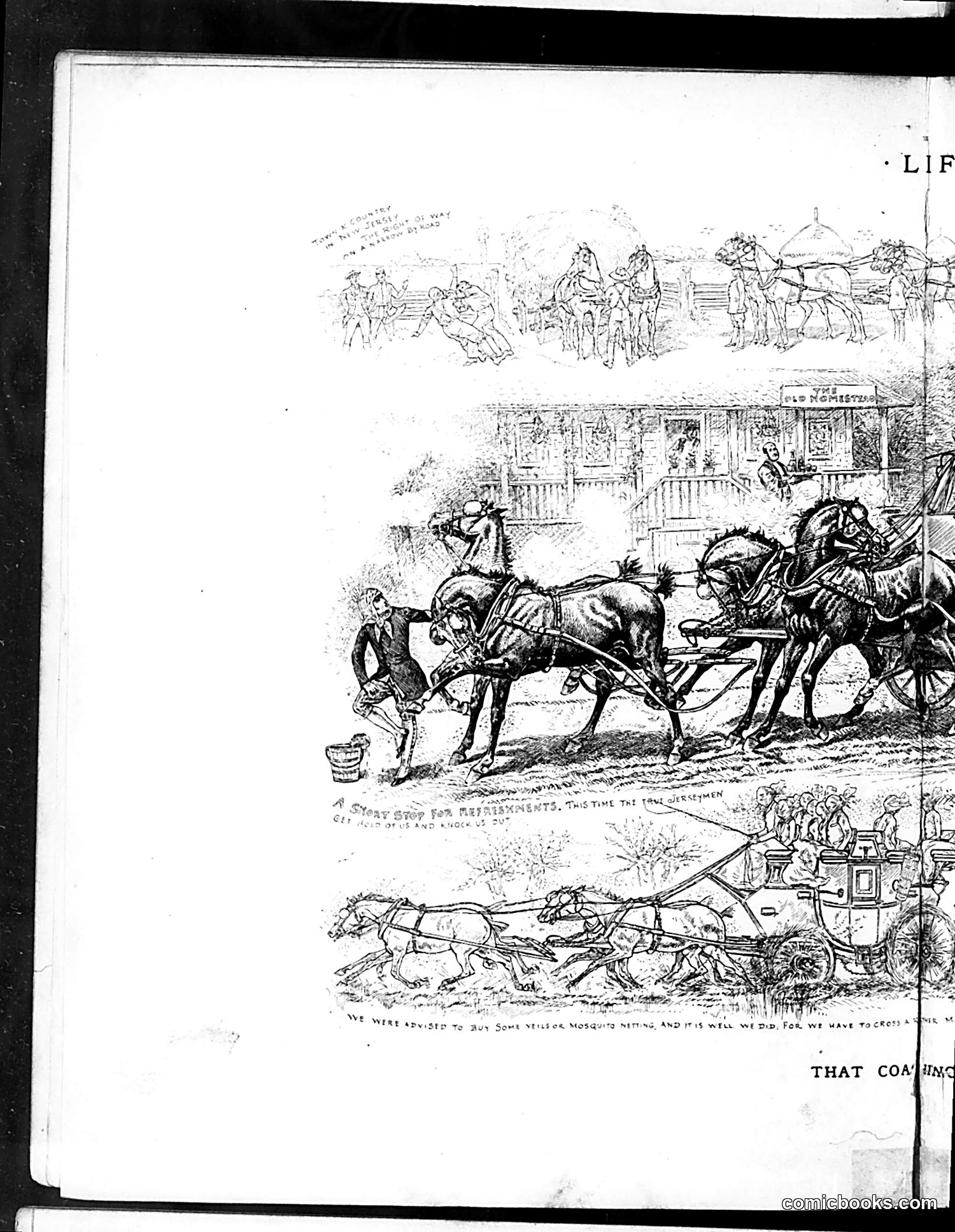
This page contains multiple satirical cartoon scenes depicting rural or frontier life with horses, carriages, and period buildings. The sketches appear to illustrate humorous situations involving transportation and social interactions. The readable text references "a most dreadful row" and mentions "mosquito netting," suggesting the humor involves complaints about insects and domestic discomfort—common satirical targets in American magazines of this era. The bottom panel shows an elaborate horse-drawn carriage with multiple passengers, captioned with text about "coaching" (likely referring to carriage travel). Without clearer text or identified political figures in the illustrations, I cannot confidently identify specific historical references or individuals being caricatured. The satire appears directed at rural inconveniences and social situations rather than specific political targets.
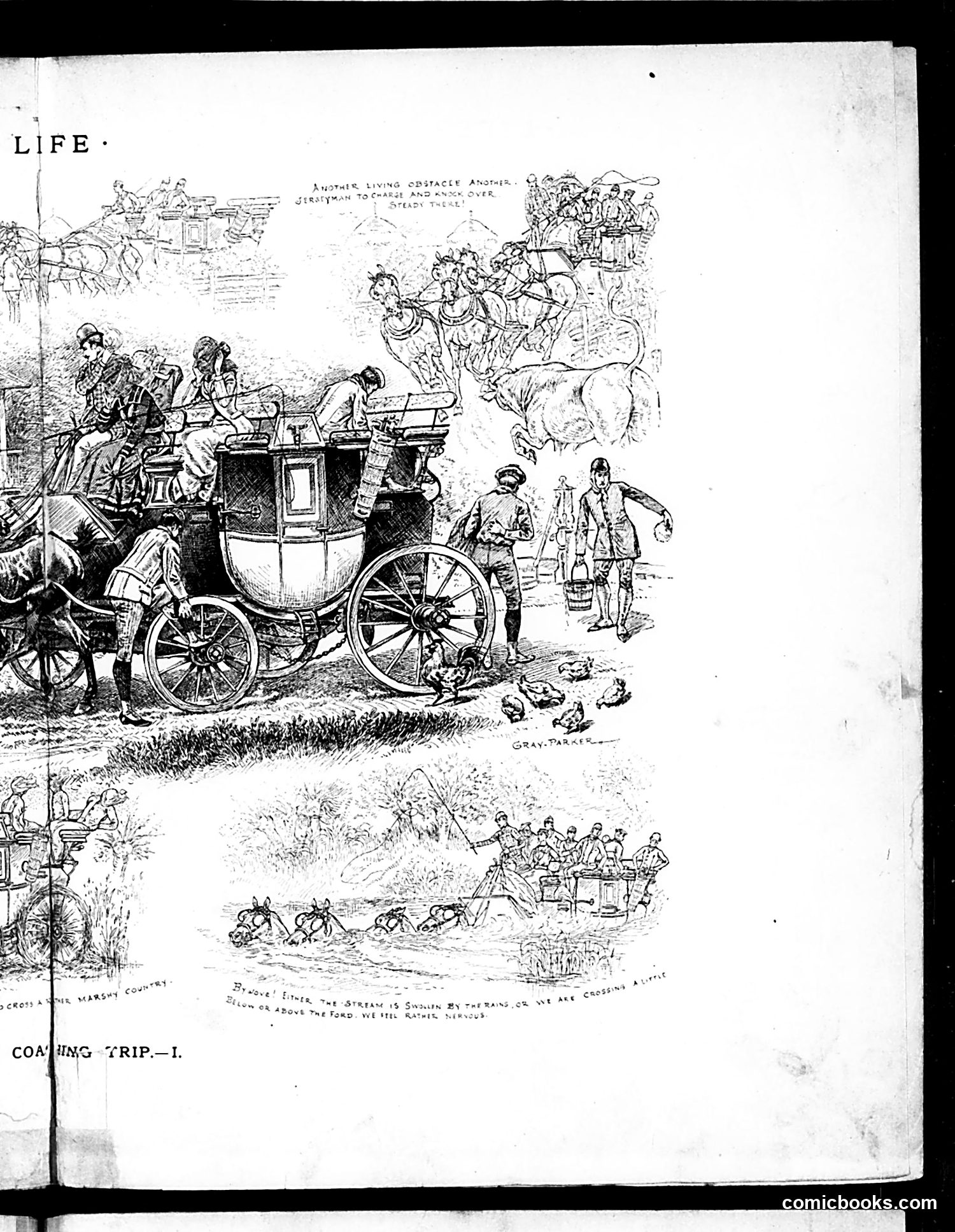
This page satirizes Victorian-era coaching excursions, a popular leisure activity. The top illustration shows an ornate horse-drawn carriage packed with fashionably dressed passengers, contrasted with the elaborate "living obstacle" annotation—suggesting the trip involved navigating around pedestrians and animals. The lower scene depicts the same coach attempting to cross a ford or river, with passengers appearing distressed as the carriage struggles through water. The caption references crossing "above the ford" with "all the baggage safe," implying comic mishaps during the journey. The satire mocks the pretensions and impracticality of these elaborate social outings—fashionable people attempting ambitious travel that inevitably encounters muddy, uncomfortable reality. The artist is Gray Parker, as signed.
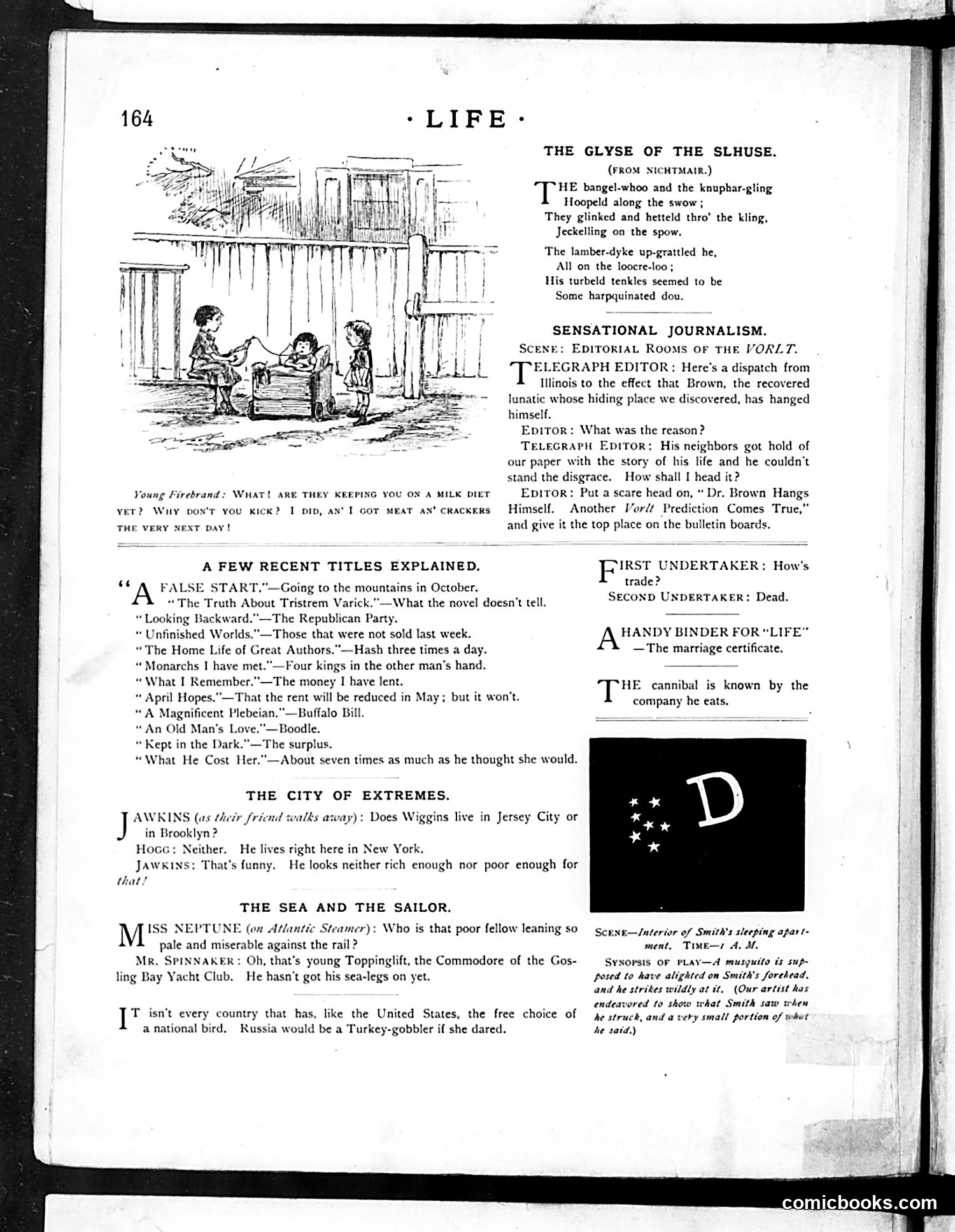
This page contains several humorous short sketches typical of Life's satirical format: **"The Glyse of the Sluse"** is a mock-poetic piece about animals in winter conditions, appearing to parody overwrought nature writing. **"Sensational Journalism"** mocks newspaper sensationalism through a dialogue between editors discussing a lunatic's suicide and how to exploit it for circulation—satirizing yellow journalism's callous disregard for human tragedy in pursuit of sales. **"A Few Recent Titles Explained"** offers sardonic one-liners debunking book titles—satirizing literary pretension and publishing trends. **"The City of Extremes,"** "The Sea and the Sailor"** are brief comedic vignettes poking fun at geographical contradictions and social pretension. The small cartoon illustration shows children in poverty, accompanying social satire about class and hardship.
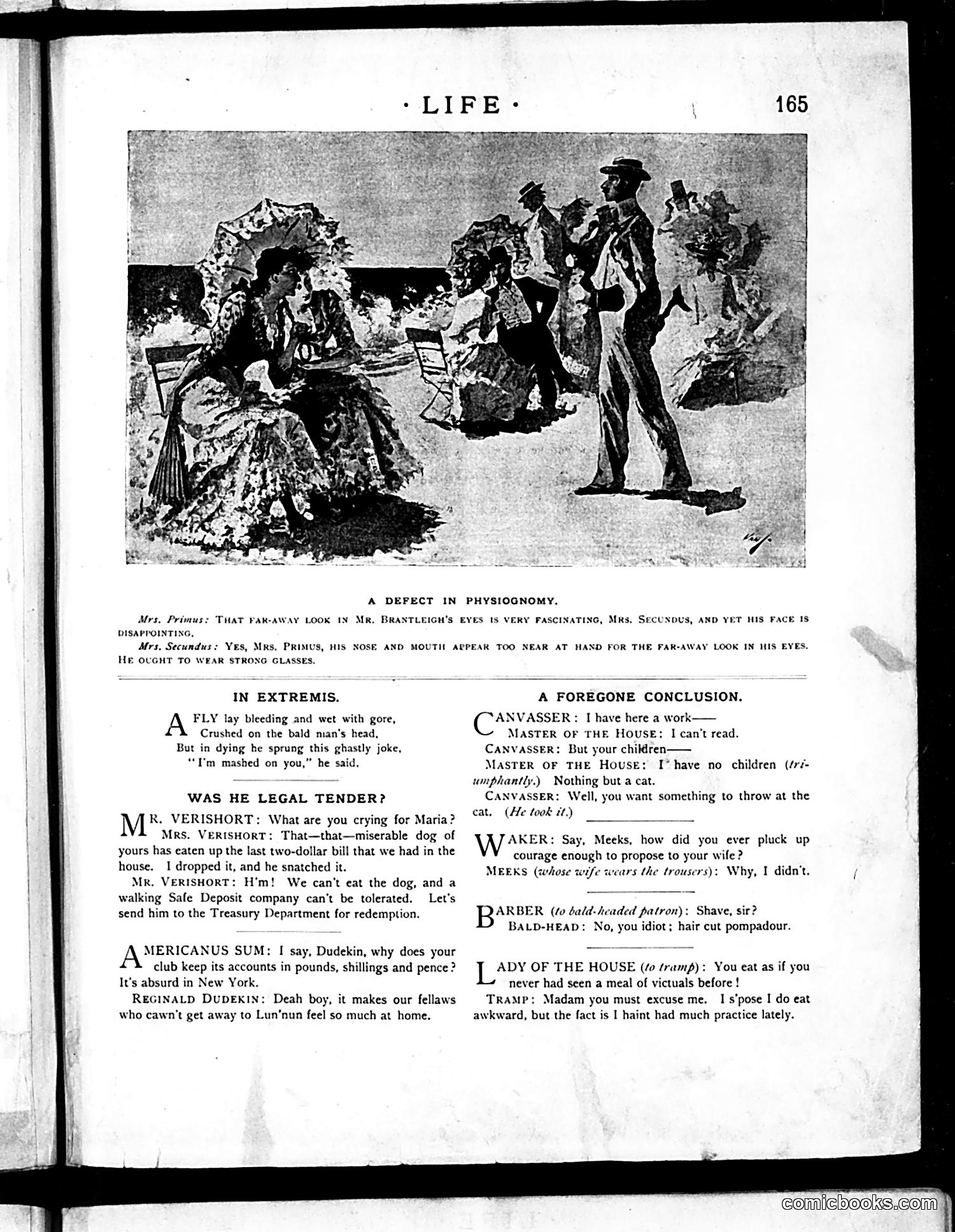
The top illustration, "A Defect in Physiognomy," mocks the pseudoscience of reading character from facial features. It shows a society gathering where Mrs. Primus finds Mr. Brastleigh's "far-away look" fascinating despite his unflattering appearance, while Mrs. Secundus notes his nose and mouth seem "too near at hand"—a joke about physiognomy's supposed ability to judge character by facial proportions. Below are four brief comedic dialogues satirizing everyday life: a man's dog eats money; a club keeps accounts in pounds/shillings (mocking British monetary systems); a domestic dispute over a eaten bill; and awkward dinner etiquette with a tramp. These represent typical Life magazine humor—sharp observations of social absurdities and class conflicts in early 20th-century America.
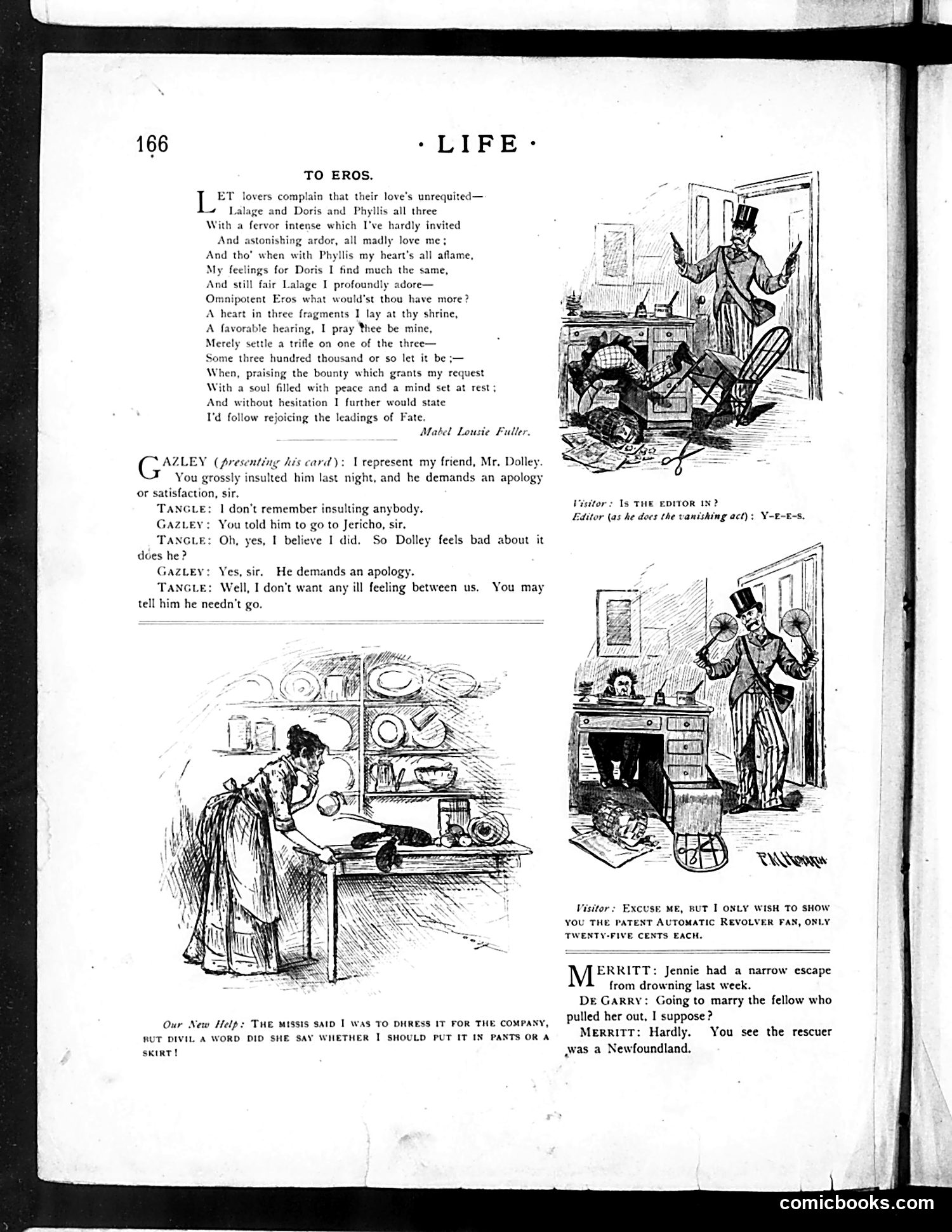
This page from *Life* magazine contains several short satirical pieces and accompanying illustrations: **"To Eros"** is a humorous poem about a man juggling three romantic interests (Lalage, Doris, and Phyllis) while simultaneously pursuing wealth—he asks the god of love to settle "three hundred thousand" on one of them, revealing his mercenary motives. **The "Gazley/Tangle" dialogue** satirizes honor culture: a man demands an apology for being told to "go to Jericho" (a dismissive biblical phrase). Tangle's casual resolution mocks the absurdity of such disputes. **"Our New Help"** jokes about a domestic servant's confusion over whether new clothing should be pants or a skirt—likely poking fun at either immigration confusion or gender ambiguity. **The "Automatic Revolver Fan"** gag shows a salesman pitching an invention to the editor, who literally flees—satirizing both intrusive salesmen and editors avoiding unwanted visitors. **The final joke** about Jennie's rescue plays on expectations: readers expect her to marry the rescuer, but he's a Newfoundland dog, subverting sentimental romance tropes.
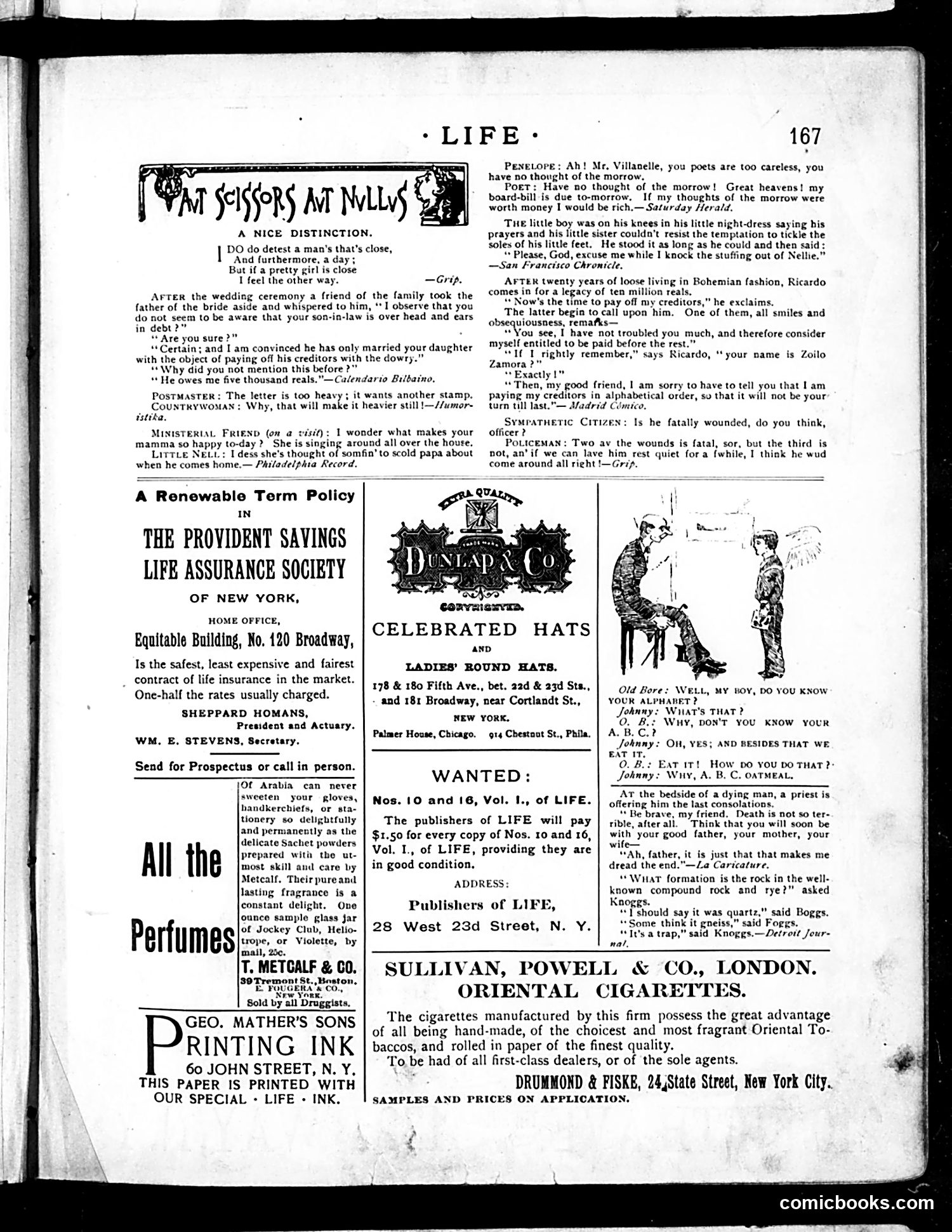
This page is primarily **satirical short humor pieces** rather than political cartoons. The jokes mock universal human folly: **Key humorous scenarios:** - A man marries solely to pay off debts using his bride's dowry - A poet obsesses over creditors while claiming he never thinks of tomorrow - A child interrupts prayer to fight his sister - A creditor tries flattery to be paid first, but Ricardo pays debts alphabetically—a joke about rational bureaucracy defeating emotional manipulation - An Irish policeman suggests letting a fatally wounded man rest so a non-fatal wound might heal **The satire targets:** debt and financial irresponsibility, pretentious poets, domestic annoyance, and absurd logic. These are timeless comedy subjects requiring no historical context. The remainder is **advertising**: insurance, perfume, hats, printing ink, and cigarettes—typical late 19th/early 20th-century magazine filler. The "WANTED" section seeks missing back issues of *Life* magazine itself.
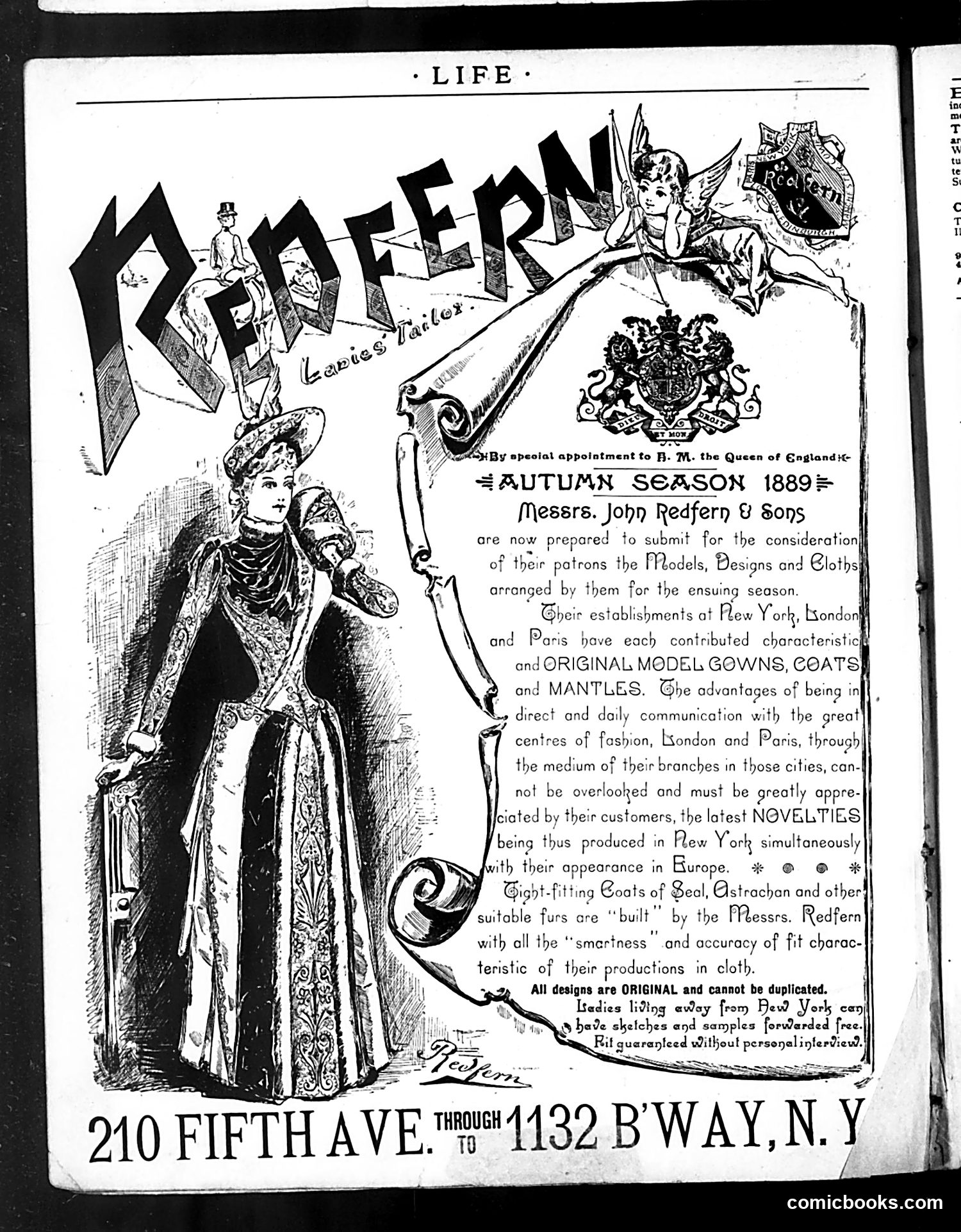
This is primarily a **fashion advertisement**, not a political cartoon. It showcases John Redfern & Sons, a high-end dressmaker with royal appointment to Queen Victoria, advertising their autumn 1889 collection. The decorative header features allegorical figures (winged cherubs, a crowned royal crest) emphasizing luxury and prestige. The large illustration depicts an elaborately dressed woman in a fashionable coat with ornate fur trim—the type of garment Redfern specializes in. The text emphasizes exclusivity: designs are "original and cannot be duplicated," and the firm maintains branches in New York, London, and Paris to offer the latest European fashions simultaneously. This appeals to wealthy American clients wanting to match European sophistication. The advertisement targets affluent women, offering mail-order samples for those traveling away from New York—reflecting both the transportation and communication advances of the 1880s and the concentration of fashion authority in European capitals.
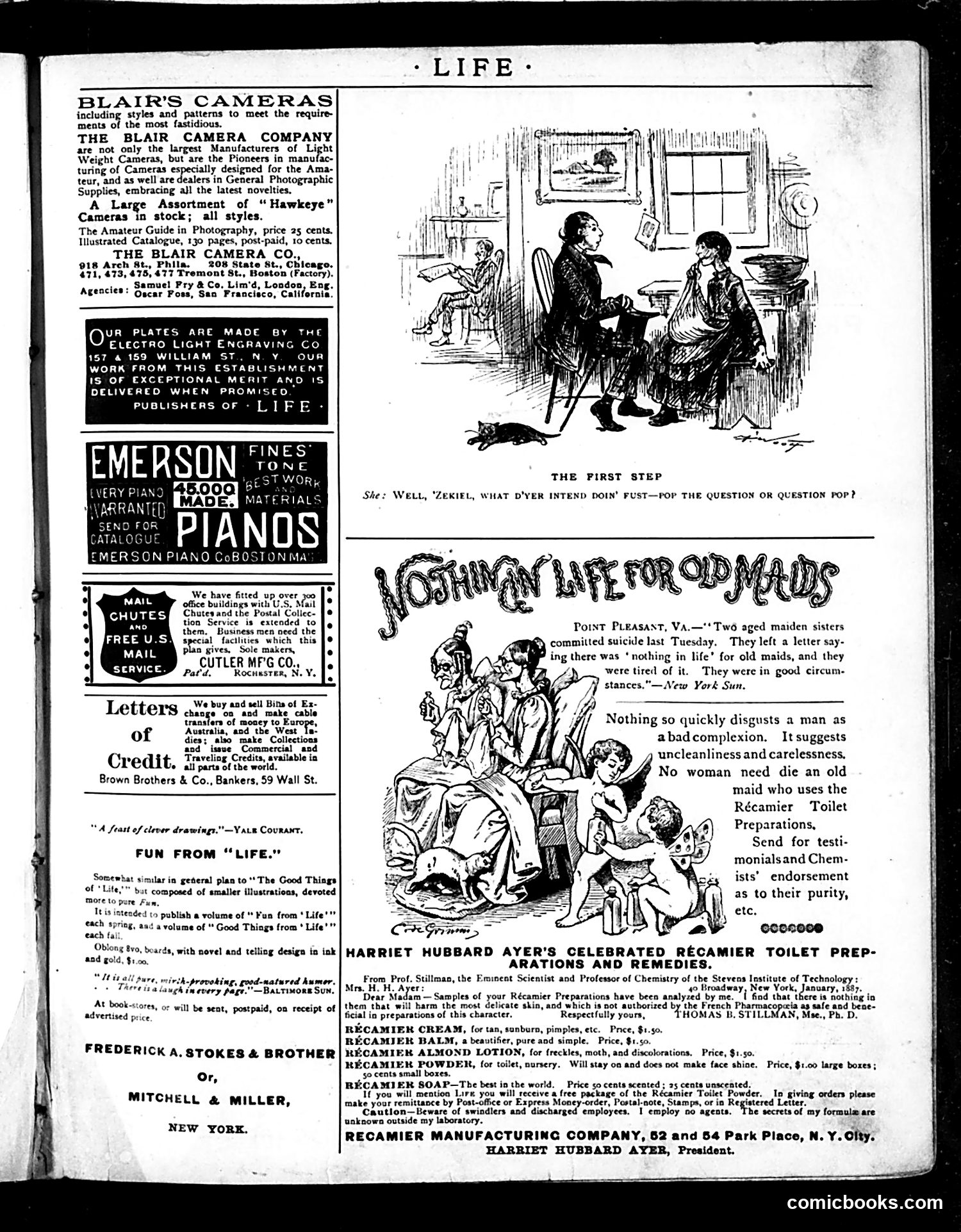
The cartoon depicts a rural couple courting, with the caption featuring dialect ("d'ver intend doin' fust") that appears to mock rural/country speech patterns. The man asks the woman whether they should "pop the question" (propose marriage) first or ask her father's permission ("question pop") beforehand. The satire works on two levels: it pokes fun at rustic courtship customs and their formal priorities, while the pairing with the adjacent news snippet about elderly unmarried women committing suicide darkly suggests the grim stakes of failing to marry. The cartoon trivializes this tragic context through crude humor about provincial customs. This reflects Life magazine's general position as a publication aimed at educated, urban readers who found rural American life and speech patterns a source of comedy.
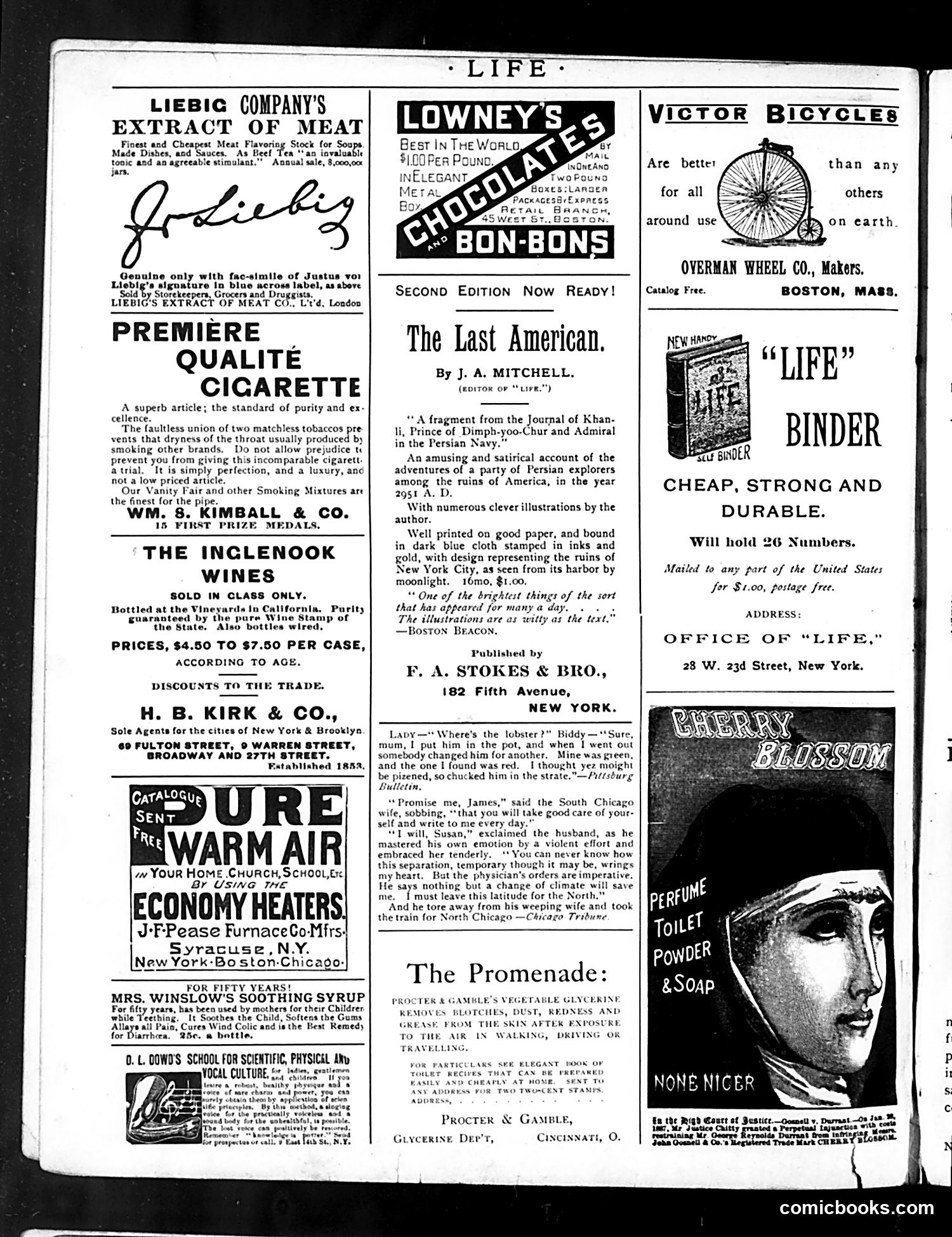
This page is primarily **advertisements and book promotion**, not political cartoons. The main content is: **"The Last American"** by J.A. Mitchell (Life's editor): A satirical science-fiction novel imagining Persian explorers visiting the ruins of America in 2951 A.D. The satire works by *reversing perspective*—instead of Western explorers studying "exotic" civilizations, future Persians study our collapsed society. This mocks contemporary American confidence and imperialism by suggesting our civilization, too, will eventually crumble into archaeological ruins. The page also contains brief **humorous anecdotes** (an Irish maid confusing lobsters; a husband leaving his wife for "health reasons"). These are mild domestic comedy, not political satire. The remaining content is **period product advertising**: meat extract, cigarettes, wines, heating systems, and beauty products—typical of late-19th-century magazines.
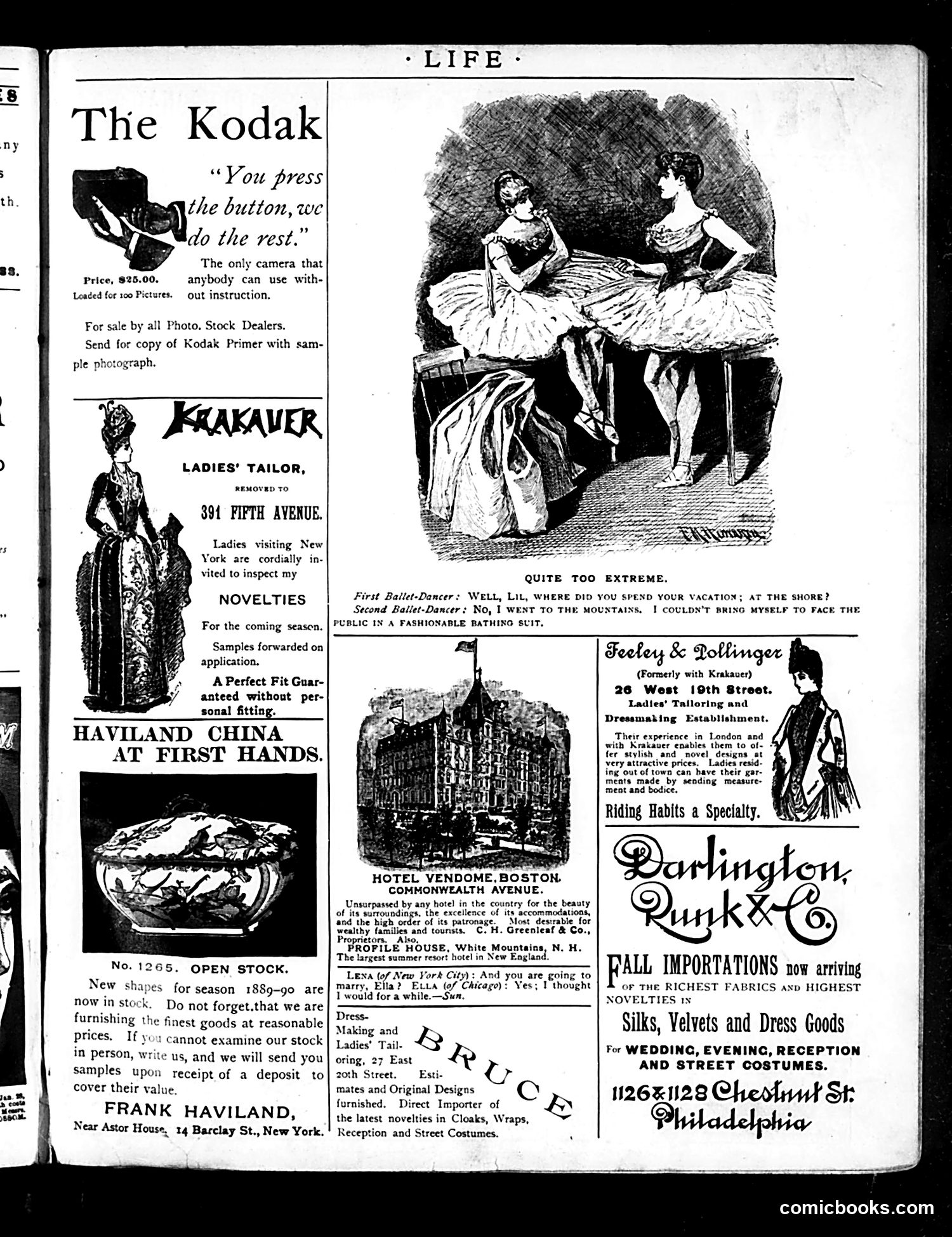
The main cartoon satirizes Victorian-era body modesty anxieties. Two ballet dancers discuss summer vacations: one went to the shore but won't admit it publicly, claiming she "couldn't bring herself to face the public in a fashionable bathing suit." The joke hinges on the contradiction: ballet dancers perform near-naked on stage nightly, yet feel embarrassed wearing the modest (by modern standards) bathing costumes of the 1880s-90s. The humor mocks how absurdly restrictive social conventions were—a performer comfortable in theatrical attire finds beach wear scandalous. This reflects the Victorian obsession with propriety and the paradox of acceptable versus unacceptable female exposure depending on context. The page is otherwise filled with period advertisements for tailoring, china, photography, and hotels.
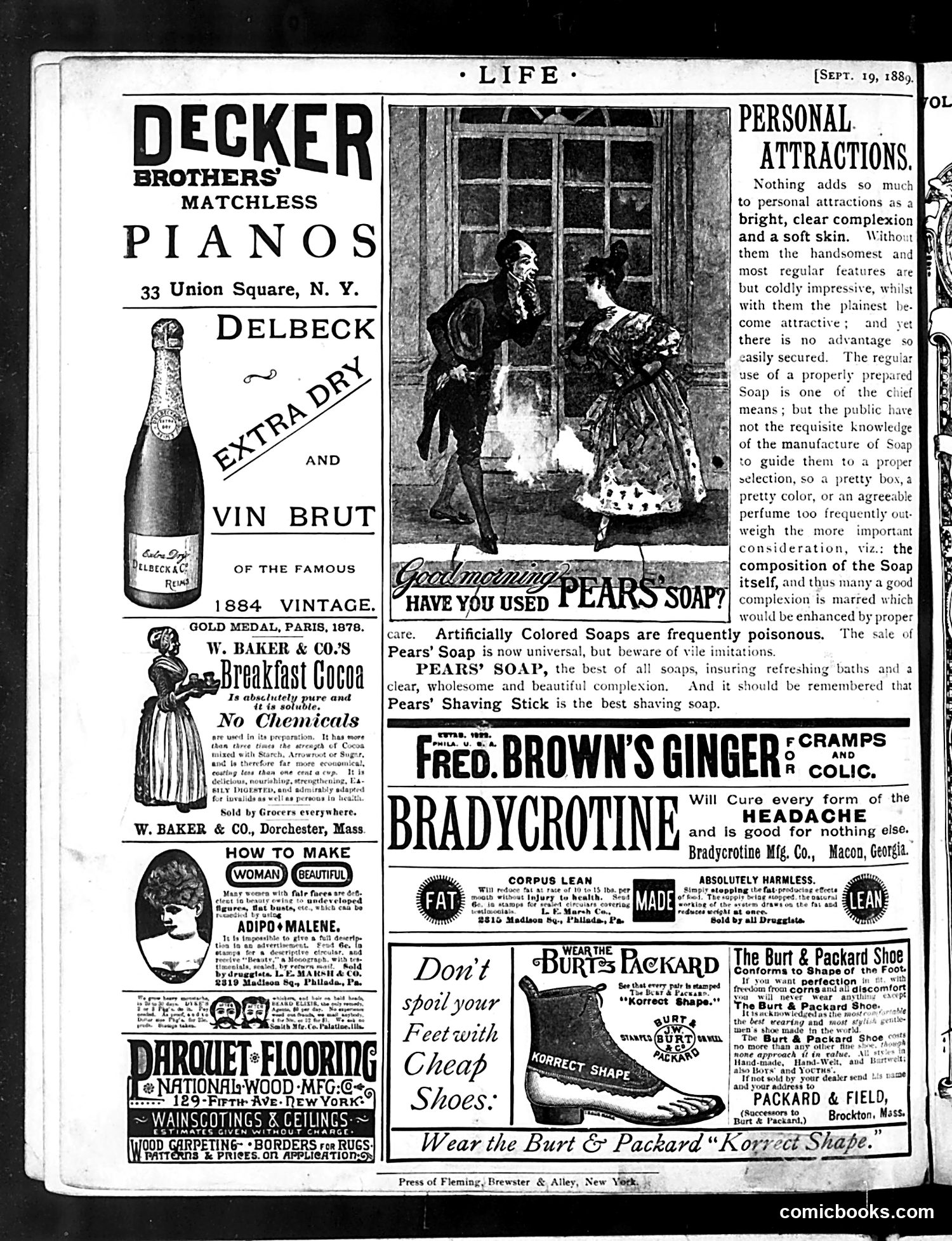
This is **primarily a commercial advertising page**, not a satirical cartoon. The page is dominated by period product advertisements for luxury and health goods typical of the late 1880s. **Key advertisements include:** - **Decker Brothers Pianos** and **Delbbeck champagne** (1884 vintage)—luxury consumer goods for the wealthy - **Pears' Soap**—with a moralizing message about feminine beauty and "personal attractions," warning that artificially colored soaps are "frequently poisonous" - **Patent medicines**: Fred Brown's Ginger (for cramps/colic), Bradycrotine (headache remedy, "absolutely harmless") - **Burt & Packard shoes**—positioned as superior to "cheap" alternatives, emphasizing proper foot support **Social context**: These ads reflect Gilded Age consumer culture and widespread faith in patent medicines and branded products. The heavy emphasis on feminine beauty, soap composition, and health tonics shows Victorian anxieties about appearance, purity, and wellness. There is **no political satire evident**—this appears to be Life functioning as a conventional magazine rather than as social commentary.