
Life, 1889-09-19 · page 4 of 18
Life — September 19, 1889 — page 4: what you’re looking at
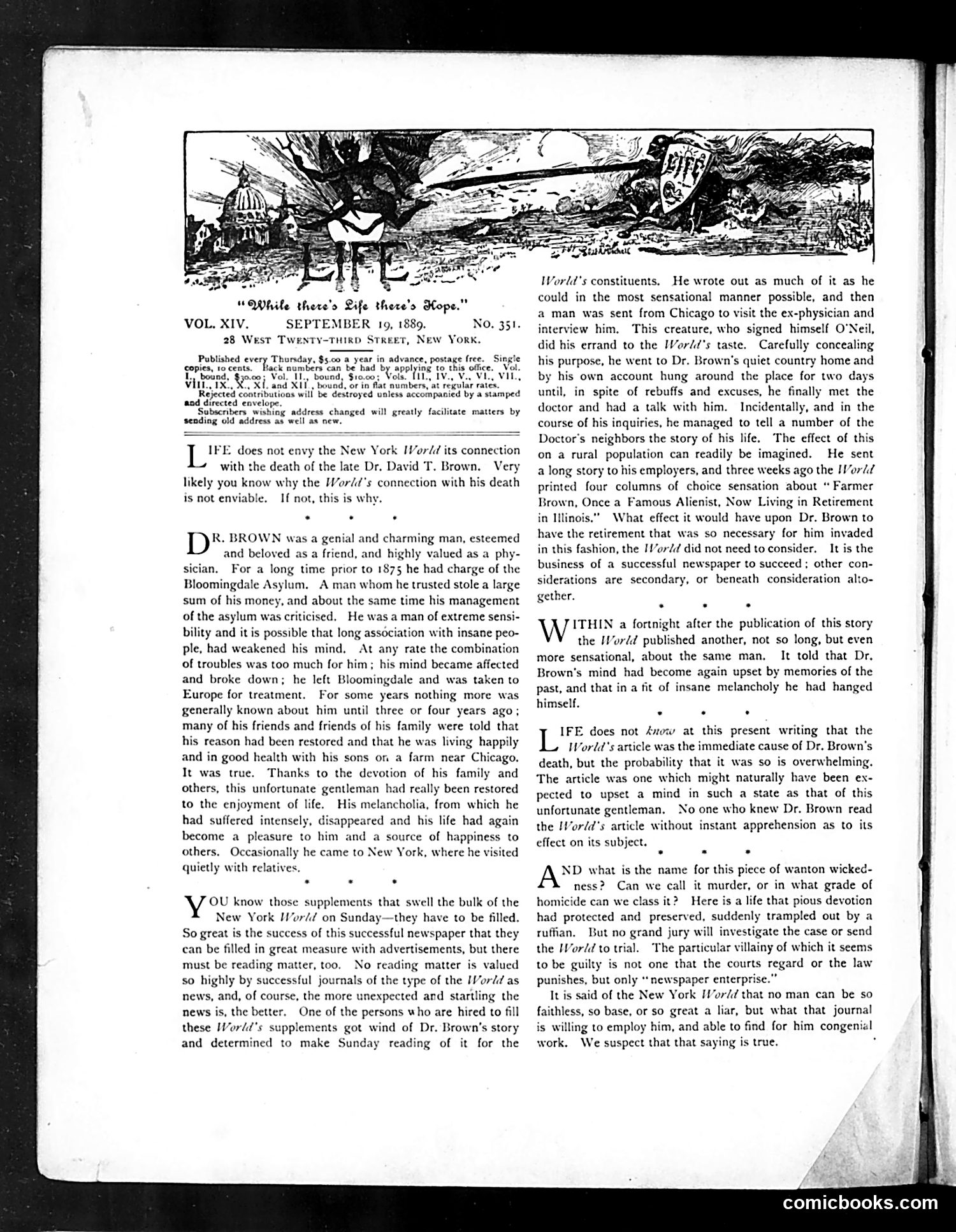
A restored page from Life, 1889-09-19. Page through the whole issue in the reader above.
📄 Transcribed text from this page (OCR, searchable)
Machine-transcribed from the original scan — historical spelling and the odd misread are preserved.
“OPhile there's fife there's Hope.” VOL. XIV. SEPTEMBER 19, 1889. No. 351. 28 West Twenty-tTHirp Street, New York. Published every Thursday, $5.00 a year in advance, postage free. Single he copies, ro cents, Hack numbers can be had by an applying to this office, See Vol. I1., bound, $10.00; fie Vv. VL, Vil. WTS, BOR, sod Nv Nivea, Seon tac oumbern at rekalar rates Rejected contributions will be destroyed unless accompanied by a stamped and directed envelope. Subscribers wishing address changed will greatly facilitate matters by sending old address as well as new. IFE does not envy the New York IVordd its connection —~ with the death of the late Dr. David T. Brown. Very likely you know why the Wor/d's connection with his death is not enviable. If not, this is why. R. BROWN was a genial and charming man, esteemed and beloved as a friend, and highly valued as a phy- For a long time prior to 1875 he had charge of the Bloomingdale Asylum. A man whom he trusted stole a large sum of his money, and about the same time his management of the asylum was criticised. He was a man of extreme sensi- bility and it is possible that long association with insane peo- ple, had weakened his mind, At any rate the combination of troubles was too much for him; his mind became affected and broke down; he left Bloomingdale and was taken to Europe for treatment. For some years nothing more was generally known about him until three or four years ago; many of his friends and friends of his family were told that his reason had been restored and that he was living happily and in good health with his sons on a farm near Chicago. It was true. Thanks to the devotion of his family and others, this unfortunate gentleman had really been restored to the enjoyment of life. His melancholia, from which he had suffered intensely, disappeared and his life had again become a pleasure to him and a source of happiness to others, Occasionally he came to New York, where he visited quietly with relatives. OU know those supplements that swell the bulk of the New York Hor/id on Sunday—they have to be filled. So great is the success of this successful newspaper that they can be filled in great measure with advertisements, but there must be reading matter, too, No reading matter is valued so highly by successful journals of the type of the [orld as news, and, of course, the more unexpected and startling the news is, the better, One of the persons who are hired to fill these Horid's supplements got wind of Dr, Brown's story and determined to make Sunday reading of it for the World's constituents. He wrote out as much of it as he could in the most sensational manner possible, and then a man was sent from Chicago to visit the ex-physician and interview him, This creature, who signed himself O'Neil, did his errand to the [ordd's taste. Carefully concealing his purpose, he went to Dr. Brown's quiet country home and by his own account hung around the place for two days until, in spite of rebuffs and excuses, he finally met the doctor and had a talk with him. Incidentally, and in the course of his inquiries, he managed to tell a number of the Doctor's neighbors the story of his life. The effect of this on a rural population can readily be imagined. He sent a long story to his employers, and three weeks ago the IVor/d printed four columns of choice sensation about “ Farmer Brown, Once a Famous Alienist, Now Living in Retirement in Illinois.” What effect it would have upon Dr. Brown to have the retirement that was so necessary for him invaded in this fashion, the I’or/d did not need to consider. It is the business of a successful newspaper to succeed ; other con- siderations are secondary, or beneath consideration alto- gether. V ITHIN a fortnight after the publication of this story the Horéd published another, not so long, but even Tt told that Dr. Brown's mind had become again upset by memories of the past, and that in a fit of insane melancholy he had hanged himself. more sensational, about the same man, IFE does not Avow at this present writing that the World's article was the immediate cause of Dr. Brown's death, but the probability that it was so is overwhelming. The article was one which might naturally have been ex- pected to upset a mind in such a state as that of this unfortunate gentleman. No one who knew Dr. Brown read the !orld’s article without instant apprehension as to its effect on its subject. ND what is the name for this piece of wanton wicked- ness? Can we call it murder, or in what grade of homicide can we class it? Here is a life that pious devotion had protected and preserved, suddenly trampled out by a tuffian. But no grand jury will investigate the case or send the World to trial. The particular villainy of which it seems to be guilty is not one that the courts regard or the law punishes, but only “newspaper enterprise.” It is said of the New York Hor/d that no man can be so faithless, so base, or so great a liar, but what that journal is willing to employ him, and able to find for him congenial work. We suspect that that saying is true. s comicbooks.com