
A complete issue · 16 pages · 1889
Life — September 12, 1889
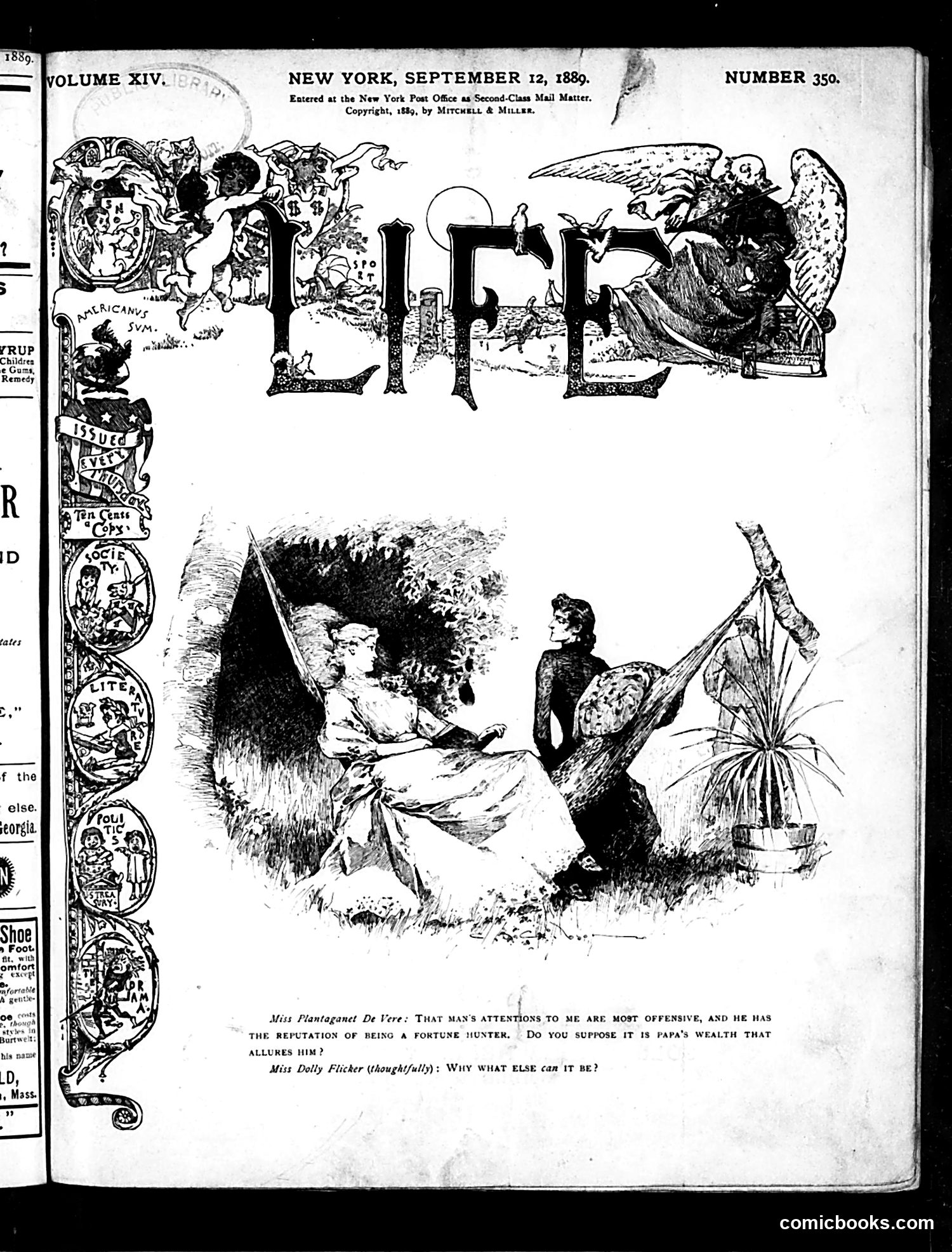
This page features a satirical dialogue between two women discussing a man's behavior. Miss Plantagenet De Vere complains that a man's "attentions to me are most offensive" and questions whether his wealth ("papa's") excuses such conduct. Miss Dolly Flicker responds with apparent sarcasm: "Why what else can it be?" The cartoon illustrates the social commentary: wealthy men of the Gilded Age could apparently behave inappropriately toward women with relative impunity, relying on financial status to offset offensive conduct. The exchange mocks both the man's presumption and society's tolerance of wealthy men's behavior toward women. The satirical point critiques the era's class-based double standard regarding propriety and acceptable social conduct.
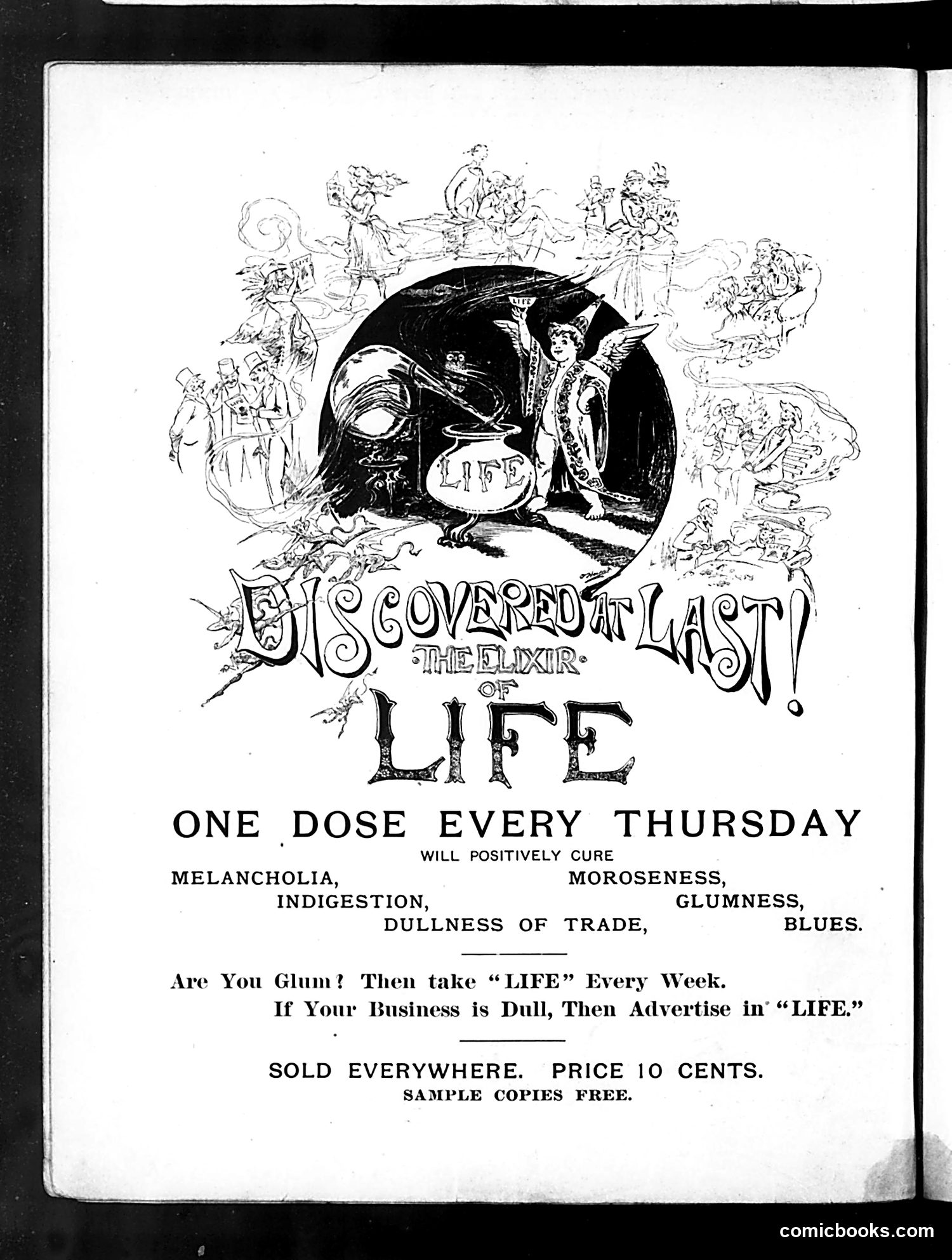
This is primarily a **humorous advertisement** for a magazine called "Life," using satire to market itself. The central image depicts Death (skeleton in black robes holding a scythe) being confronted by an angel holding a bottle labeled "LIFE"—a visual pun playing on the magazine's name. The ad claims that taking "Life" every Thursday cures melancholia, moroseness, indigestion, glumness, dullness of trade, and blues—common afflictions of the era. It's self-promoting satire: the magazine presents itself as an antidote to modern life's disappointments and low spirits. The surrounding sketches show various scenes of daily Victorian life and leisure, reinforcing that the magazine itself is the remedy to life's tedium. The price of 10 cents reflects late 19th-century publication costs.
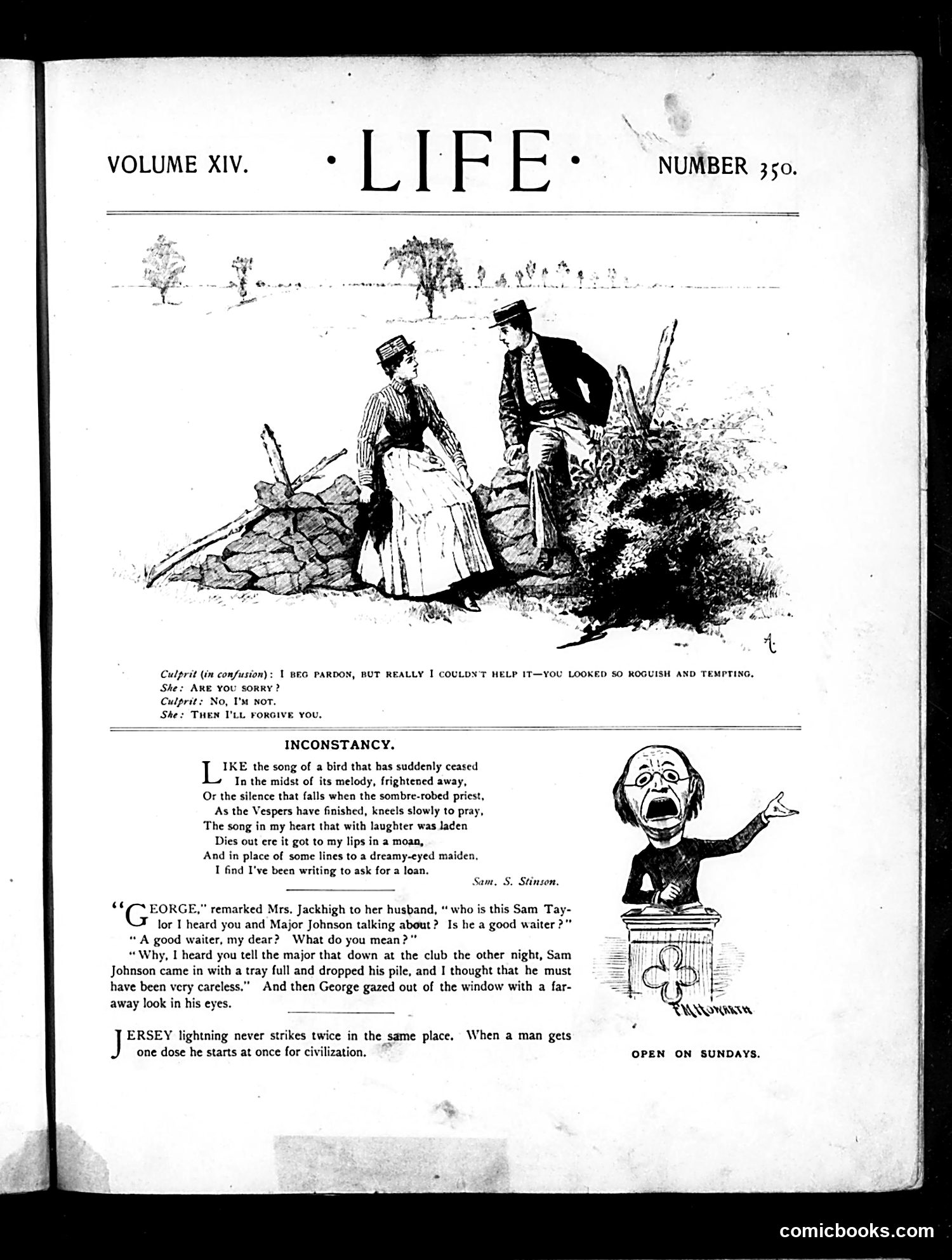
**Top Cartoon:** Shows a couple at a fence. The man apologizes for looking "roguish and tempting," and the woman forgives him. This illustrates the section title "INCONSISTENCY"—depicting the contradictory nature of romantic reconciliation. **"Inconsistency" Poem:** S.S. Stimson's verse contrasts abrupt silence with persistent longing, using metaphors of a bird's song and prayer. It concludes with an ironic punchline about requesting a loan, suggesting romantic setbacks lead to financial desperation. **Anecdote:** Mrs. Jackhigh questions her husband about "Sam Taylor," a supposedly good waiter. The husband reveals Taylor actually lost his job after getting drunk—a commentary on unreliable reputation and social pretense among working-class men. **Final Quip:** A Jersey proverb warns against repeated mistakes, implying once-burned individuals should learn their lesson.
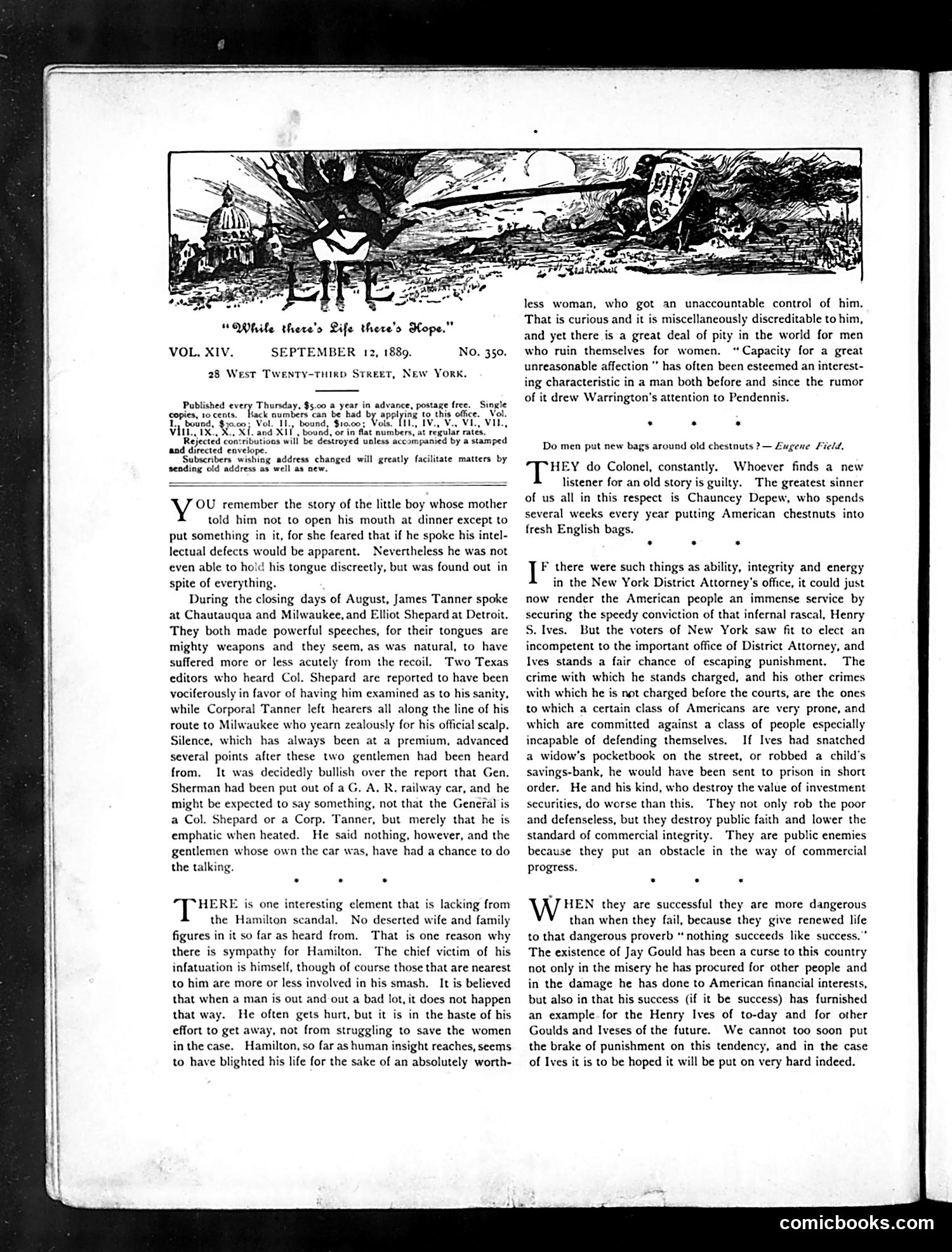
The page contains three editorial pieces criticizing prominent figures of the era. The masthead references "While there's Life there's Hope." **Key figures mentioned:** - **Colonel James Tanner** and **Elliot Shepard** — speakers at recent political events; the text suggests they've been making inflammatory remarks about political rivals - **Henry S. Ives** — a New York District Attorney criticized as incompetent - **Jay Gould** — the railroad magnate attacked for his financial manipulation and harmful influence on American commerce The satire attacks these men as either incompetent public officials or dangerous robber barons whose success corrupts the nation. The editorial particularly condemns Gould's wealth and influence, arguing that his success has damaged American financial integrity. The tone is sharp moral criticism of Gilded Age corruption and political incompetence.
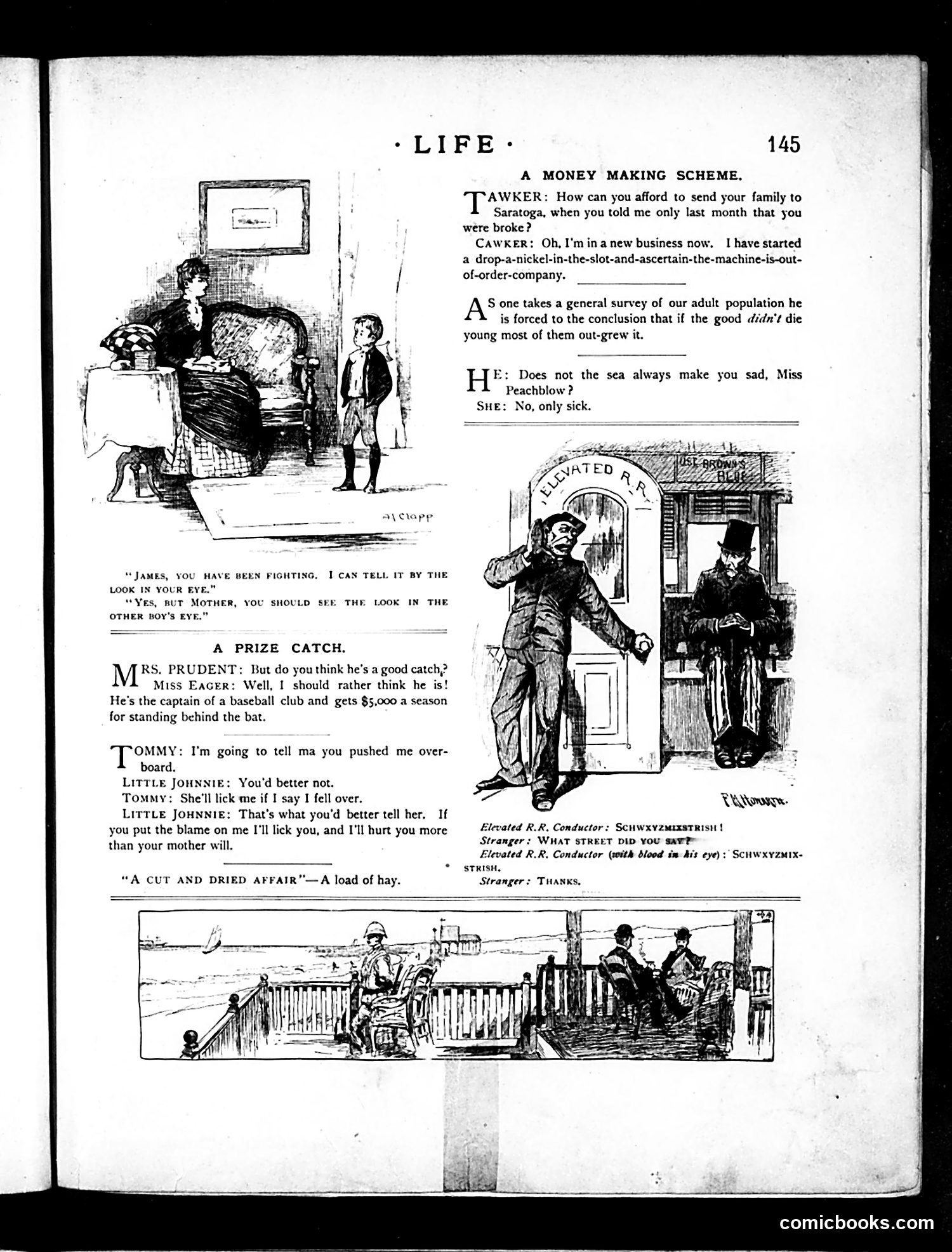
This page contains several short humorous sketches typical of Life's satirical style: **"A Money Making Scheme"** mocks a man (Cawker) who claims to have started a dubious "drop-a-nickel-in-the-slot" machine business, despite being broke. **"A Prize Catch"** jokes about a baseball player earning $5,000 annually—presented as unreasonably high compensation, reflecting early 20th-century attitudes toward sports salaries. **"A Cut and Dried Affair"** (bottom cartoon) depicts hay harvesting, likely satirizing agricultural work or rural life. The page also includes brief comedic exchanges between characters about fighting, sadness, and threats—typical vaudeville-style humor of the era. The cartoons are unsigned except for artist signatures, and target middle-class anxieties about money, social status, and modern commerce.
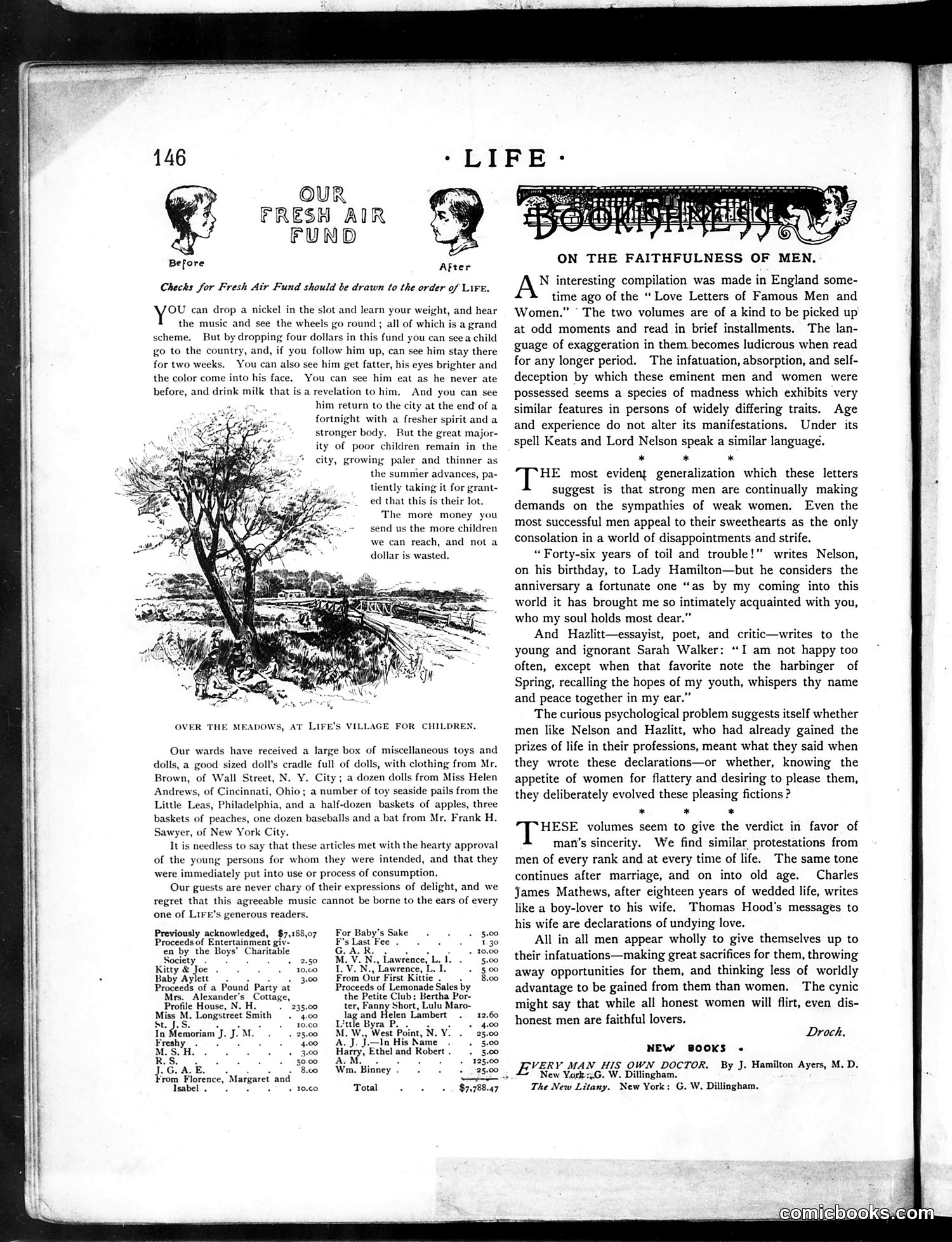
The top of this page features a charitable advertisement for Life's "Fresh Air Fund," which provided poor urban children with countryside experiences. The before/after illustrations show a sickly child transformed by fresh air and country living. The main article, "On the Faithfulness of Men," discusses a compilation of "Love Letters of Famous Men and Women" published in England. It satirizes men's protestations of undying devotion in their letters—examining whether figures like Nelson and Hazlitt genuinely meant their romantic declarations or deliberately crafted pleasing fictions for women. The piece suggests men across all ranks make similar grand promises, which conveniently continue after marriage. The satire questions male sincerity in romantic matters.
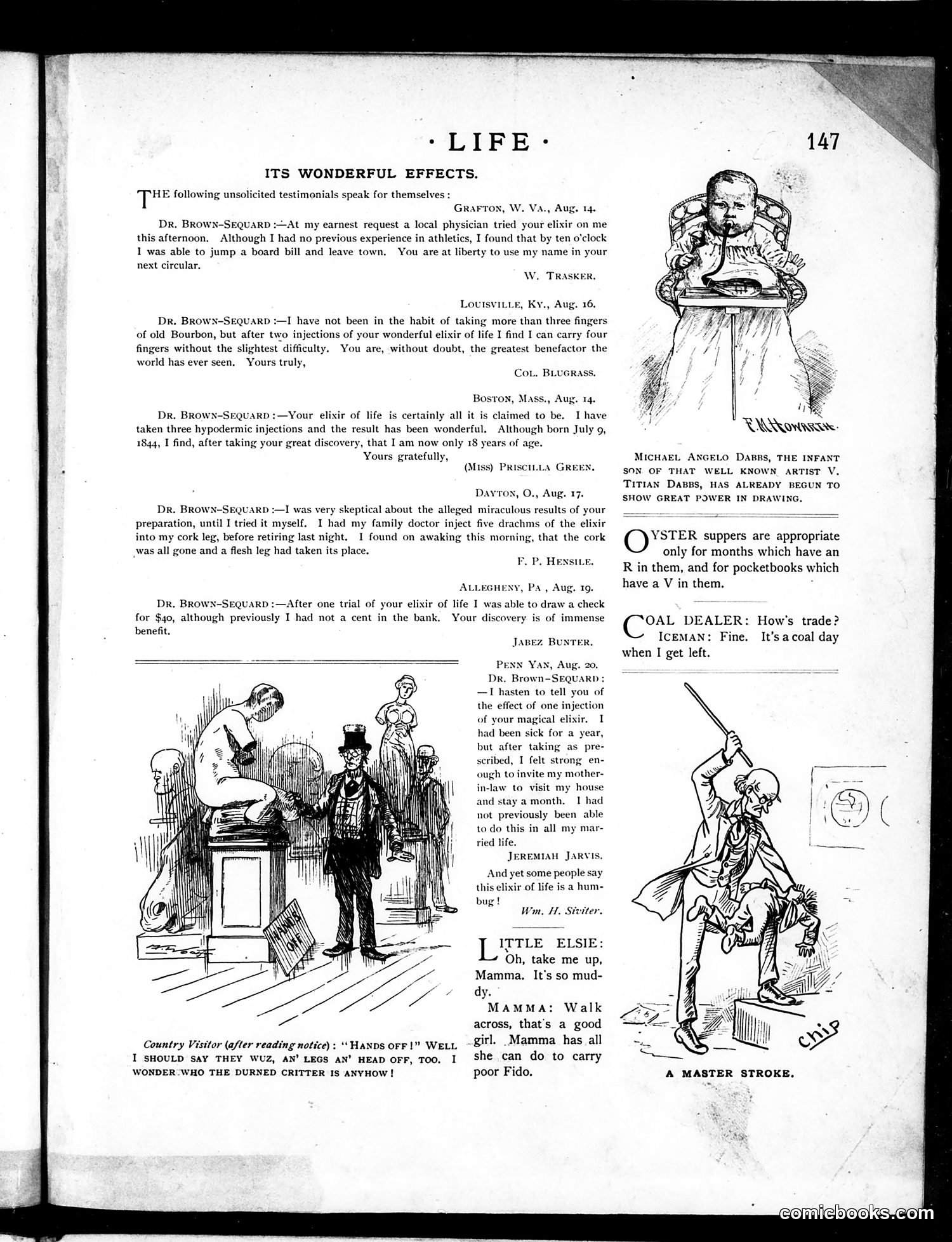
This page satirizes Dr. Brown-Sequard's "elixir of life"—a real late-19th century medical treatment involving animal extract injections that promised miraculous rejuvenation. The testimonials (genuine or mocking) claim benefits ranging from increased strength to financial gain. The cartoons mock both the treatment's absurdity and credulous believers. One sketch shows a sculptor, suggesting the "elixir" supposedly restored his artistic vigor. Another depicts a man striking a dramatic pose labeled "A Master Stroke," likely mocking the exaggerated claims. The humorous sidebar about oysters and a coal-dealer joke provides light relief from the main satire. The page targets medical quackery and the human tendency to believe in miraculous cures—timeless subjects that resonate today.
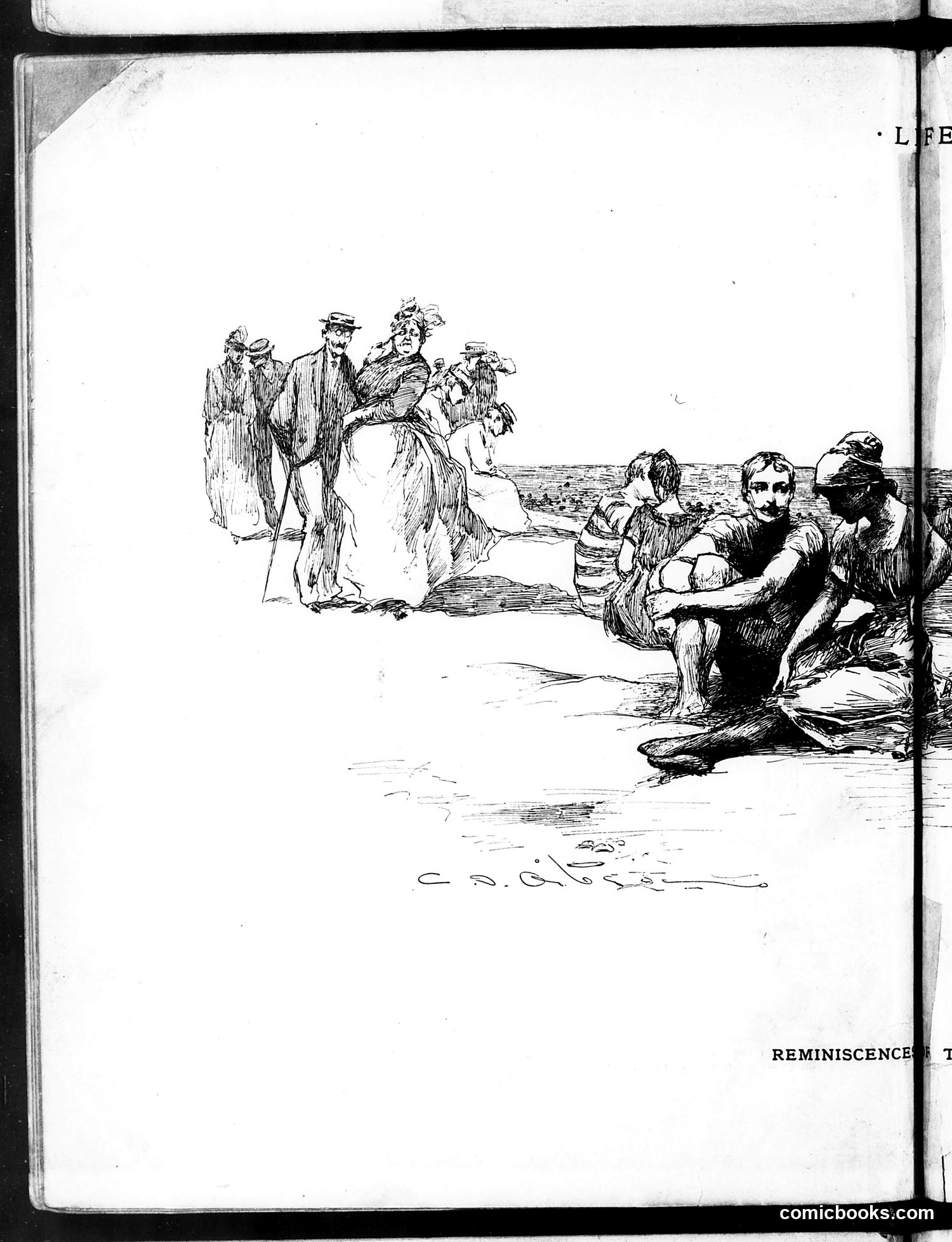
This appears to be an illustration titled "REMINISCENCES" from *Life* magazine, showing a beach or seaside scene. On the left, well-dressed figures in formal attire (including what appears to be a man in a top hat) observe a group of working-class or lower-class individuals on the right who are lounging, bathing, or relaxing informally by the water. The satire likely contrasts social classes at leisure—the formally dressed observers appear removed from or watching the casual recreation of ordinary people. This reflects *Life*'s typical satirical commentary on American social distinctions and class behavior. The "reminiscences" title suggests nostalgia or reflection on social differences during leisure time, a common *Life* theme addressing class divides in Gilded Age America.
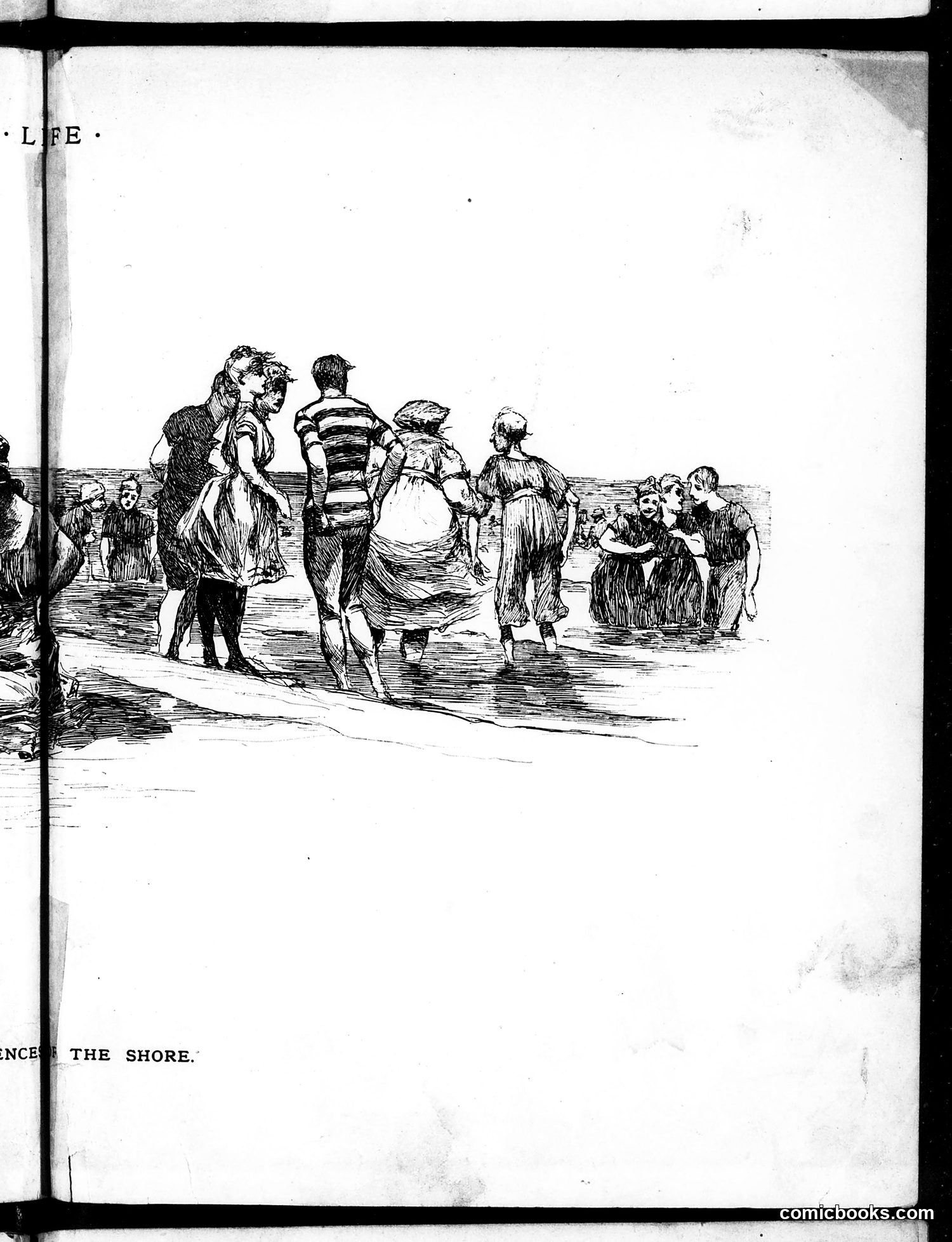
This appears to be a Victorian-era beach scene illustration titled "Life at the Shore." The image depicts a group of people wading and standing in shallow water at a seaside resort, drawn in ink in a style typical of late 19th-century satirical magazines. The figures display period-appropriate swimming and beach attire—long dresses for women, striped bathing suits for men. The composition captures a leisure scene that likely satirizes Victorian beach culture, possibly mocking social conventions, fashion pretensions, or class dynamics among seaside visitors. Without additional OCR text from the page itself, the specific satirical point remains unclear. The cartoon may critique bathing costume absurdities, social interactions at fashionable resorts, or contemporary attitudes toward leisure activities.
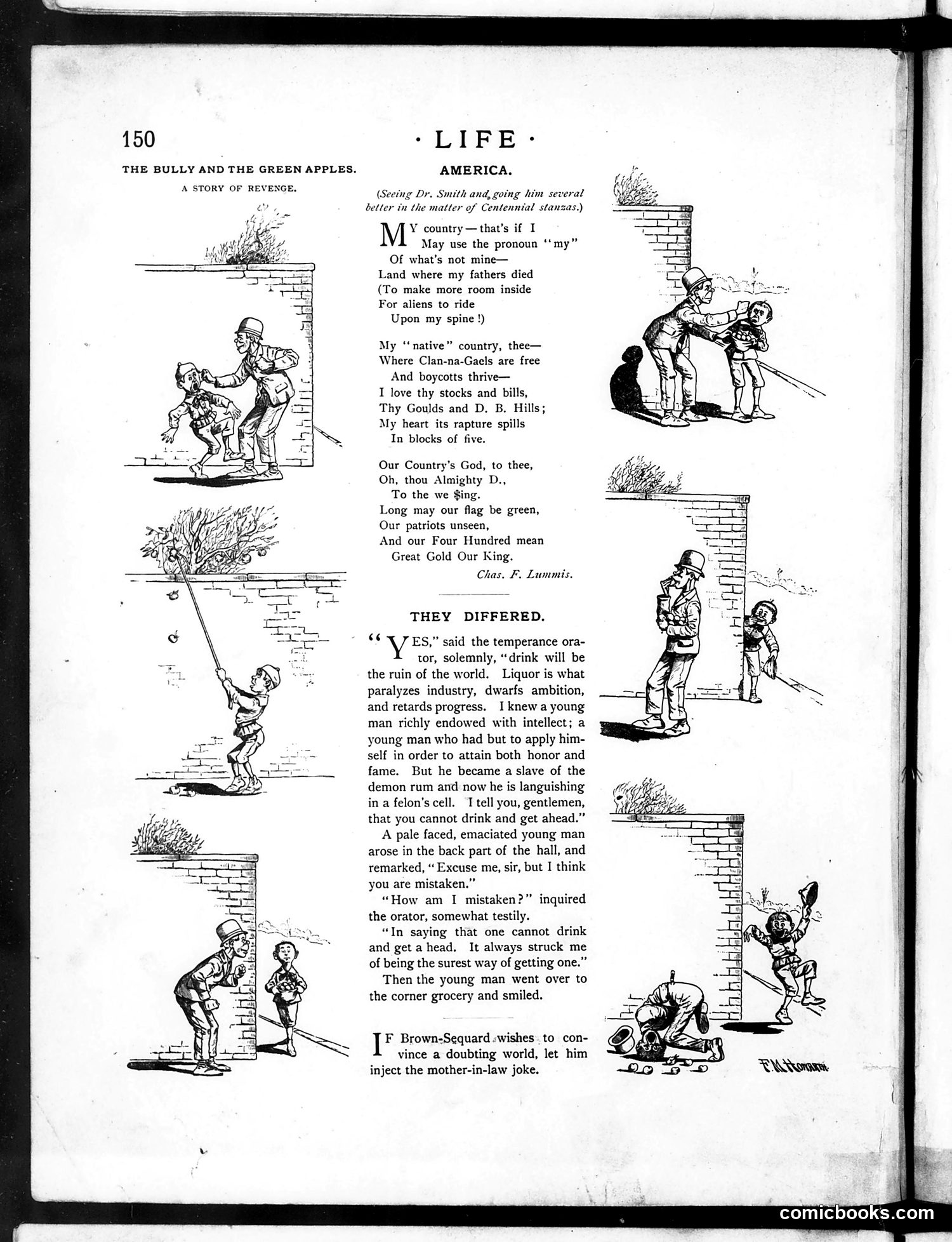
This page contains two distinct pieces: a patriotic poem titled "America" (addressed to Dr. Smith regarding Centennial affairs) celebrating Irish-American identity and "native" Irish values, and a satirical article called "They Differed" about temperance advocacy. The left illustrations depict children climbing a wall in various poses. The right illustrations show similar climbing scenes, apparently demonstrating the consequences of drink versus abstinence—a visual argument for temperance. The main satire: a temperance orator claims drinking ruins the world, but a pale, emaciated young man interrupts, observing that abstinence also fails to guarantee success. He sardonically suggests drinking is "the surest way of getting one," then ironically proves the point by visiting a corner grocery and smiling—implying even sobriety offers little hope. The overall message satirizes absolutist temperance claims through dark humor.
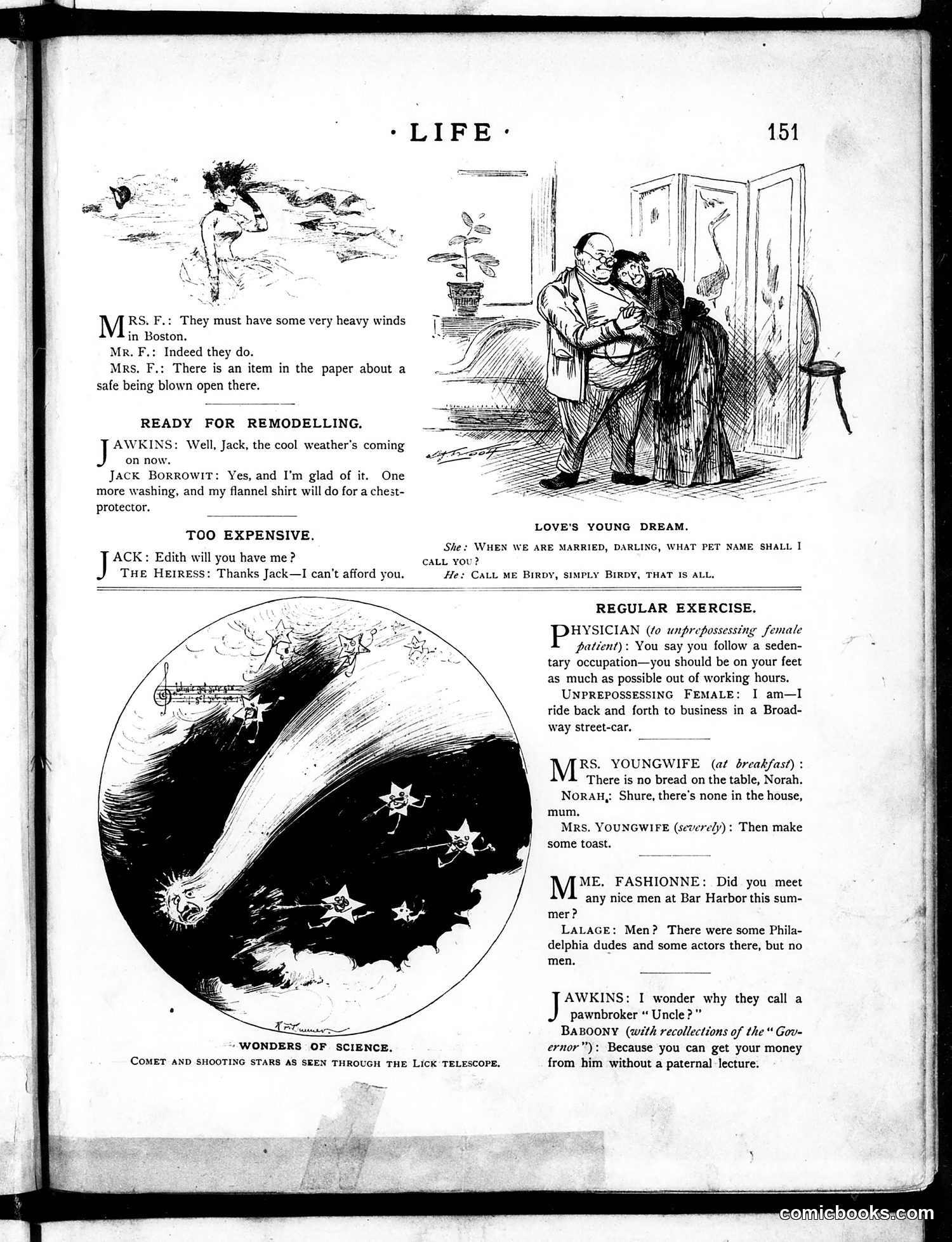
This page contains several brief satirical dialogues and a scientific illustration, typical of Life's humor format. **"Love's Young Dream"** mocks romantic expectations: a couple plans to name their pet "Birdy"—a diminutive, cutesy choice suggesting how marriage infantilizes partners' speech. **"Ready for Remodelling"** jokes about domestic labor: a man anticipates his flannel shirt doing laundry duty, reducing it to a utilitarian object rather than clothing. **"Too Expensive"** presents a gold-digger scenario where a woman rejects a suitor due to financial inadequacy—sharp economic commentary on marriage as transaction. **"Wonders of Science"** depicts a comet and stars through a telescope—an astronomical illustration with no apparent satirical intent. The remaining vignettes mock gender dynamics, domestic incompetence, and social pretension typical of early-20th-century American humor magazines.
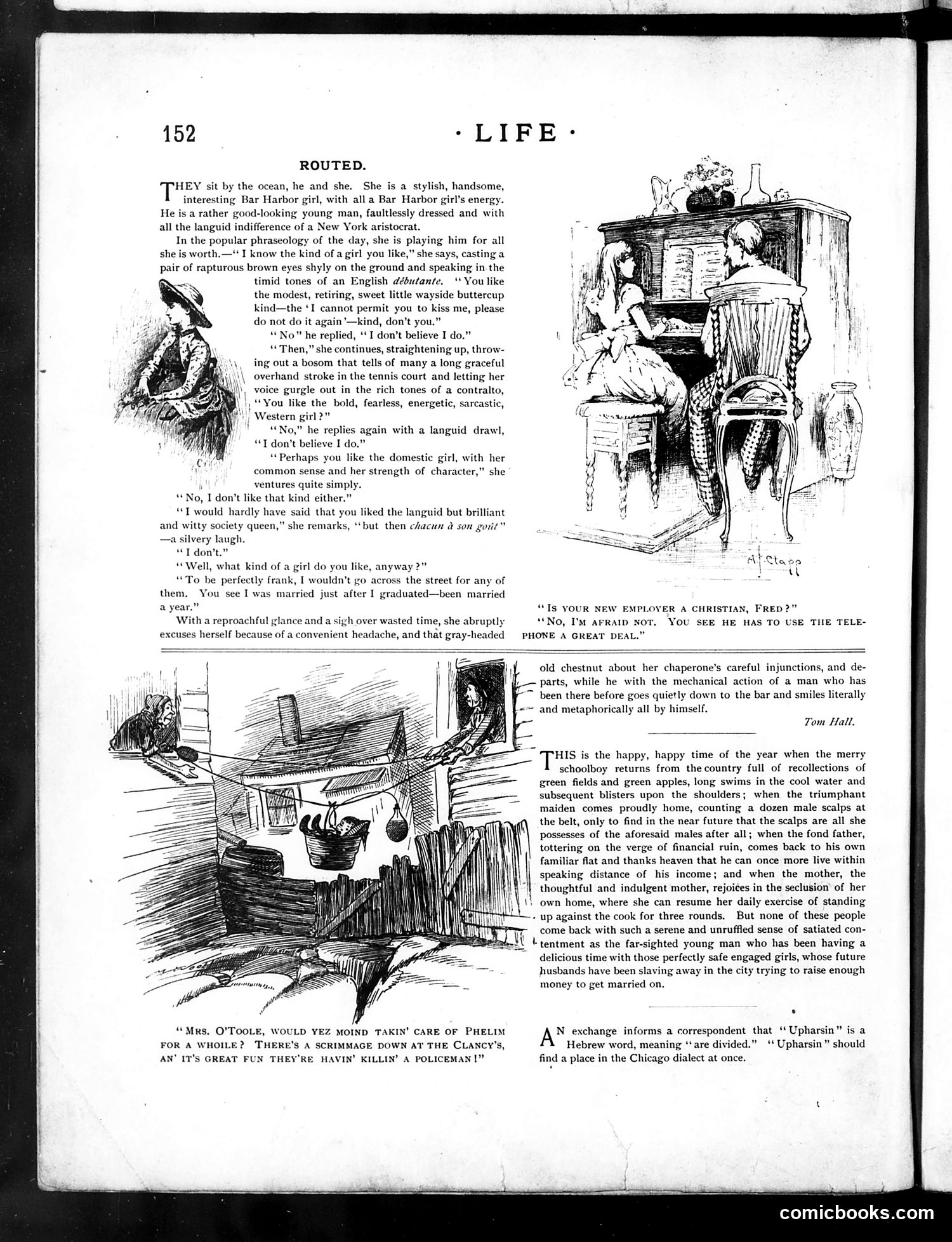
This story-cartoon depicts a flirtation game between a Bar Harbor socialite and a wealthy New York gentleman. The woman employs calculated manipulation, cycling through false personas—the modest "buttercup," the bold Western girl, the domestic type—to determine what the man desires. Each performance is a theatrical performance designed to "play him." The joke: he's immune to all strategies because he's already married. His detachment isn't aristocratic aloofness but marital indifference. The woman's elaborate performance is entirely wasted. The satire targets early-1900s dating culture among the wealthy leisure class, where courtship involved calculated performance and manipulation. The twist exposes how such games collapse when confronted with reality. The phrase "chacun à son goût" (to each his own) underscores the futility of her scheming—no strategy works against a man already committed elsewhere. The supporting jokes mock religious hypocrisy (using telephones as "unchristian") and immigrant caricatures (Irish dialect humor).
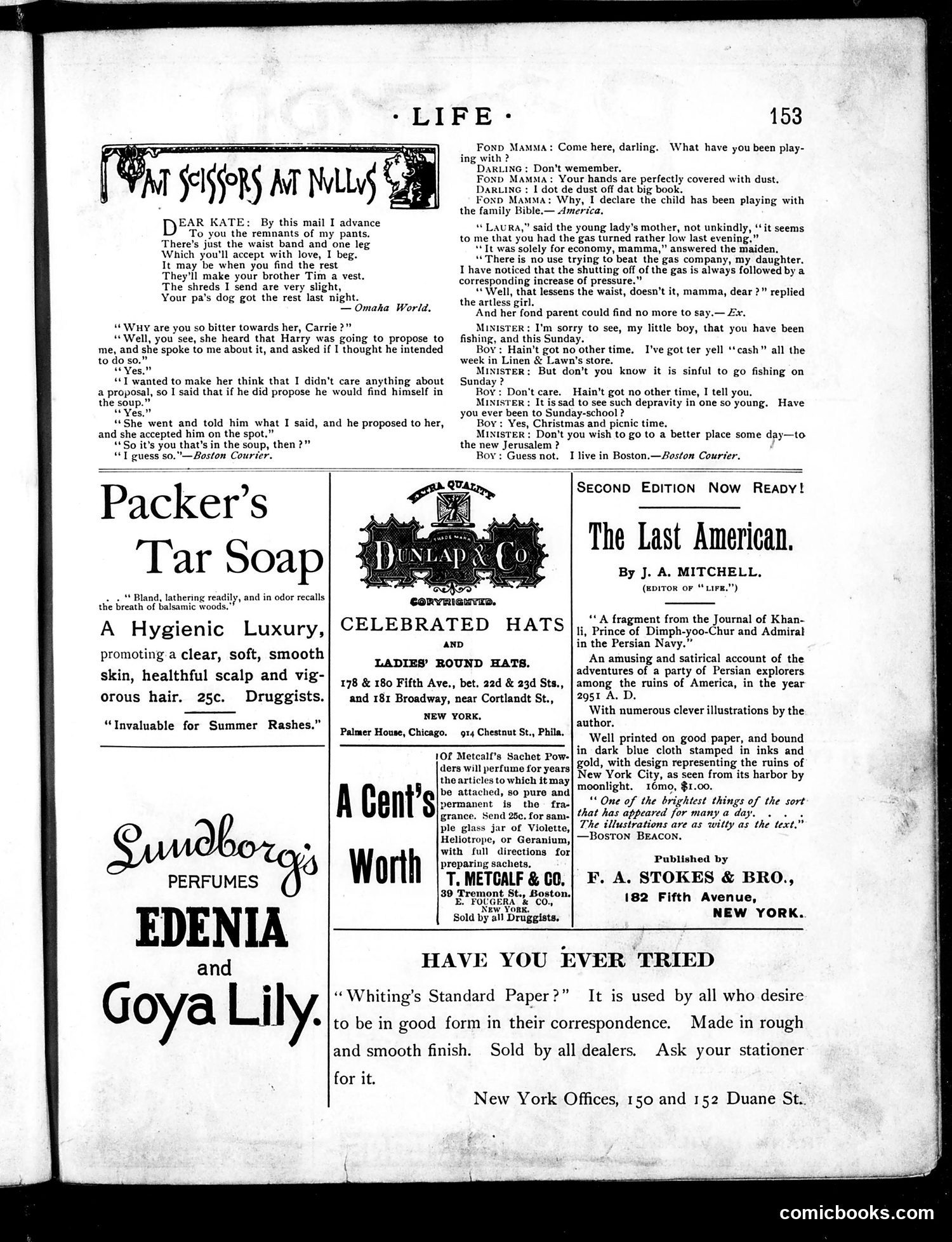
This is primarily a humor/jokes page from *Life* magazine (page 153). The top cartoon, "At Scissors at Mulligan's," appears to be a visual gag about clothing repair, though details are unclear from the OCR. The page consists mainly of brief satirical jokes on contemporary social situations: - A love-triangle joke where a woman's reverse psychology backfires - A child innocently dustying herself with the family Bible (satirizing religious hypocrisy) - A girl dimming gas lamps during courting (a courtship custom), with her mother's witty retort about gas pressure - A working boy unable to attend Sunday school because he must work retail, and his irreverent answers to a minister's questioning The humor targets Victorian social conventions—courtship rituals, religious piety, class economics, and child labor—through gentle irony. The page also advertises period products (Packer's Tar Soap, perfumes, hats) and promotes J.A. Mitchell's satirical book *The Last American*, imagining future Persians exploring America's ruins.
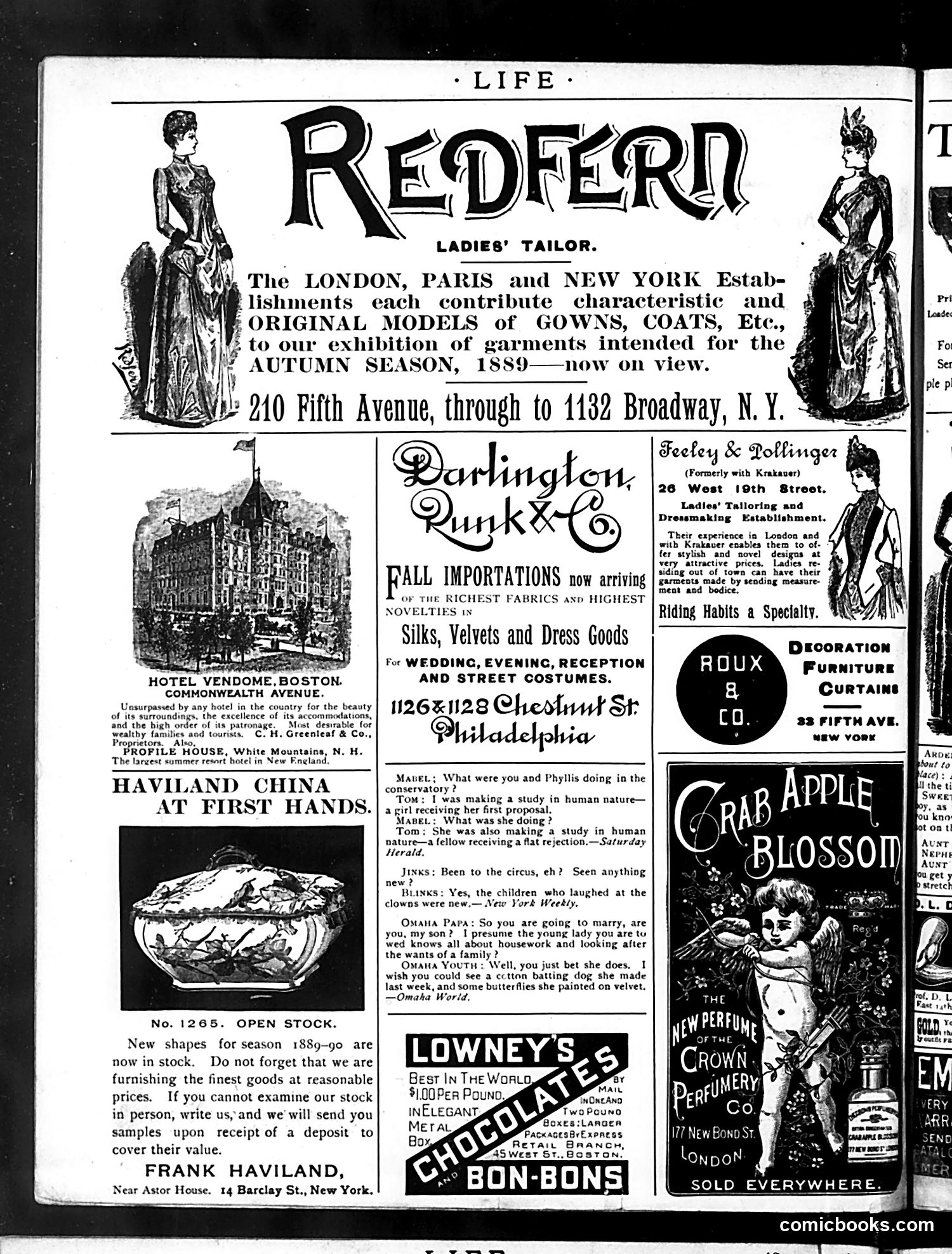
This is primarily an **advertising page** from Life magazine's autumn 1889 issue, not a political cartoon. The page features luxury goods advertisements targeting wealthy consumers: ladies' tailoring (Redfern), fine china (Haviland), imported fabrics (Darlington, Roux & Co.), and perfume (Crab Apple Blossom). The only satirical content consists of three brief **humor jokes** in the center: 1. A man claims to study "human nature" by watching a woman's first marriage proposal—she studies it by rejecting him. 2. A circus joke: the only "new" thing was children laughing at clowns. 3. A domestic humor piece where a young man brags his fiancée can make cotton batting dogs and paint velvet butterflies—implying these domestic crafts are useless skills, not actual housekeeping abilities. These jokes gently mock courtship rituals and the gap between "accomplishments" and practical homemaking. The humor reflects late-Victorian attitudes toward gender and marriage.
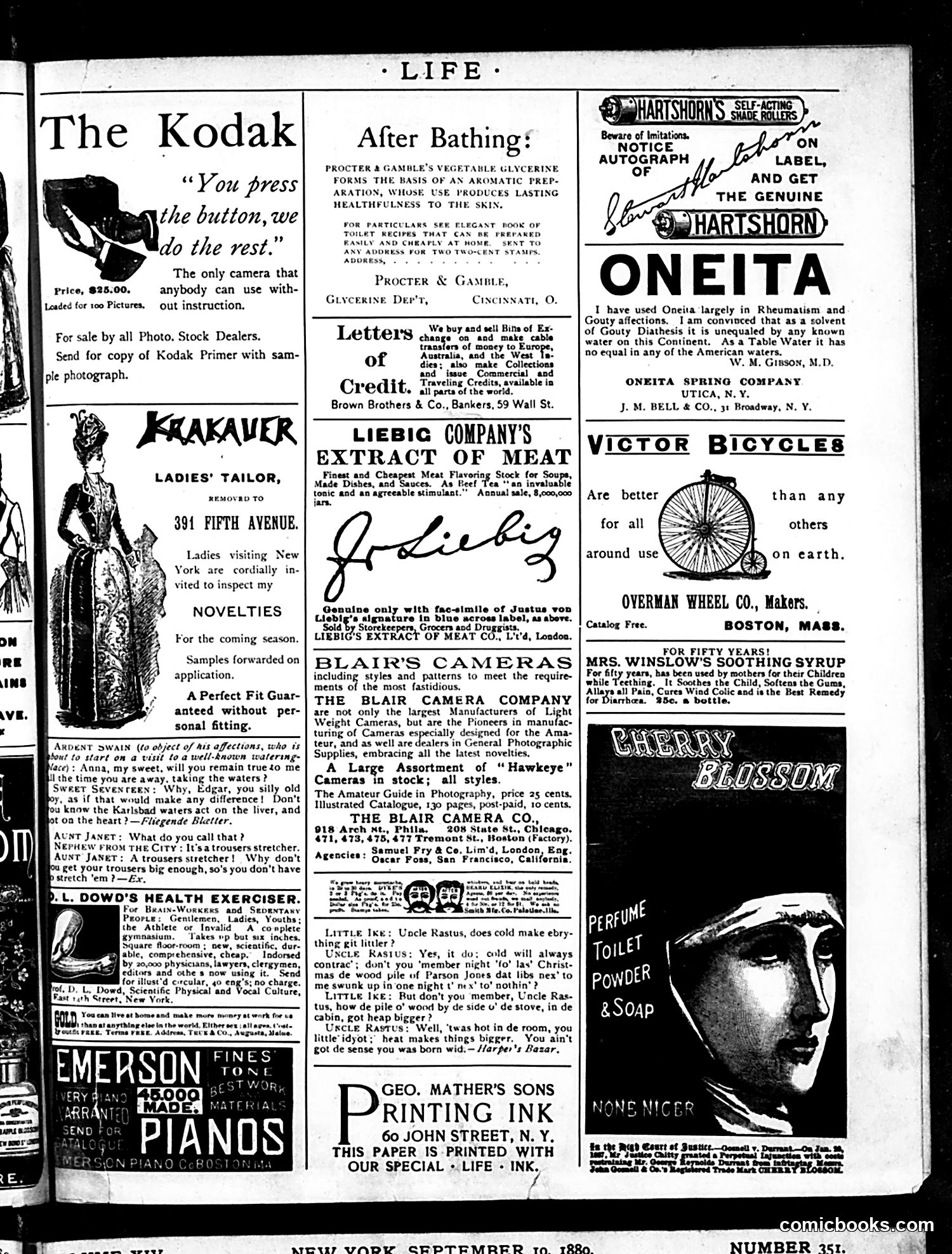
This is primarily an **advertising page** from Life magazine's early period, featuring product promotions rather than political satire or editorial cartoons. The notable content includes: **Kodak Camera Advertisement**: Promotes the revolutionary $25 Kodak camera with the famous slogan "You press the button, we do the rest"—marketing it as requiring no photographic instruction, democratizing photography for ordinary people. **Humor Snippets**: Small comedic dialogues typical of the era, including jokes about: - A young man asking his sweetheart to remain faithful while he takes the waters at a spa - An aunt mocking her nephew's use of a "trousers stretcher" **Advertisements**: Various products (Liebig's Meat Extract, Blair's Cameras, Procter & Gamble Glycerine, Victor Bicycles, Oneita Spring Water) represent late-19th-century consumer goods and the emerging mass-market advertising culture. The page reflects the **consumer-focused society** of 1880s America rather than satirical political commentary. There are no identifiable political figures or substantive satire present.
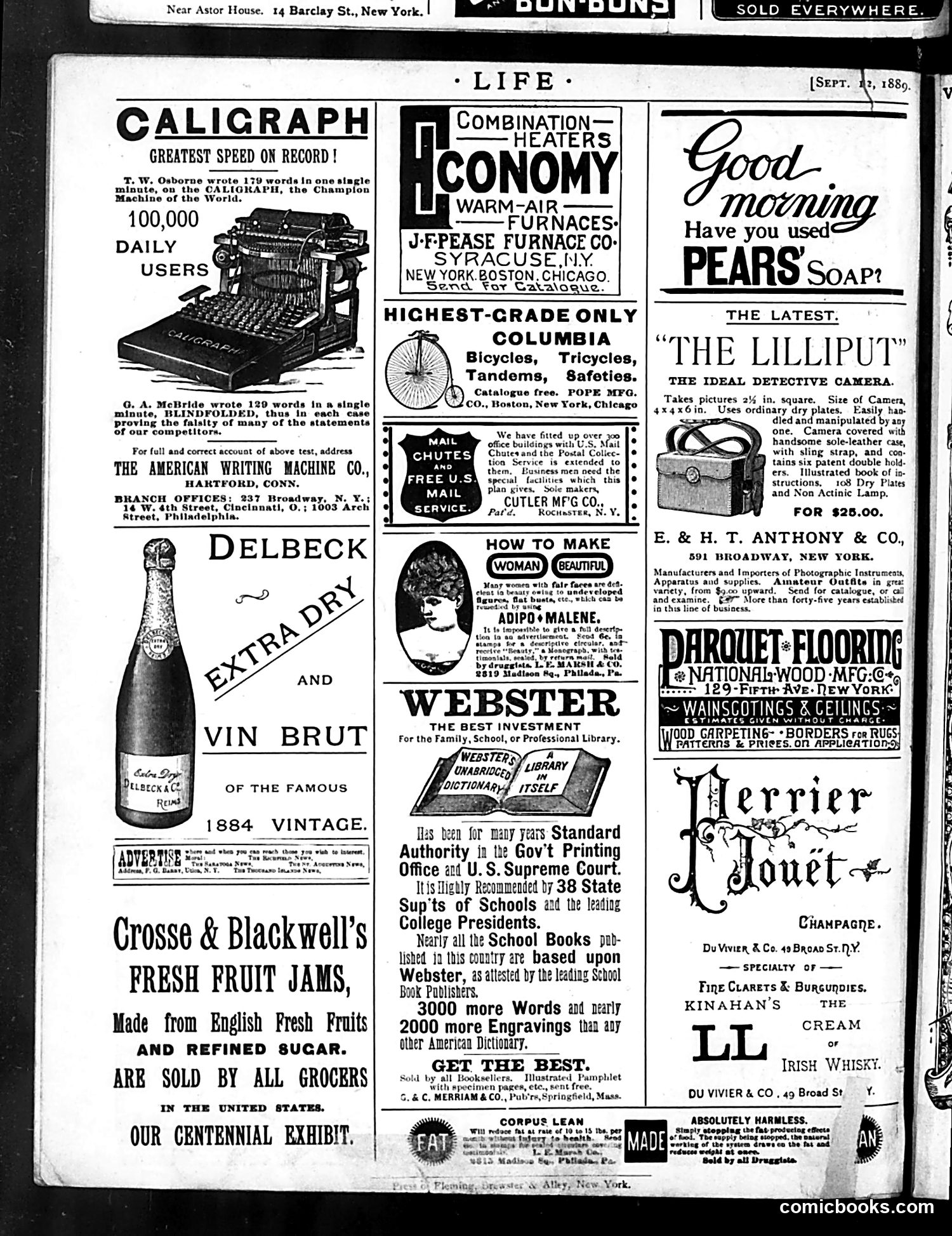
This is primarily an **advertising page** rather than a satirical cartoon page. It showcases late-19th-century consumer products and services typical of Life magazine's commercial content. Notable advertisements include: - **Caligraph typewriter**: Boasts speed records (100,000 daily users), with claims that a blindfolded operator wrote 129 words in one minute—clearly competitive marketing against rival machines. - **Webster's Dictionary**: Positioned as the "standard authority" used by the U.S. government and Supreme Court, emphasizing its 3,000 additional words over competitors. - **Columbia bicycles**: Promotes high-grade cycles and tricycles. - **Pears' Soap**: A simple morning greeting advertisement. - **Delbeck champagne and various luxury goods** (furnaces, jams, cameras, flooring, whisky). The page reflects the **Gilded Age economy**—consumer competition was fierce, and manufacturers made bold, often unverified claims. There is **no satirical content** visible; this is straightforward commercial promotion.