
A complete issue · 16 pages · 1889
Life — September 5, 1889
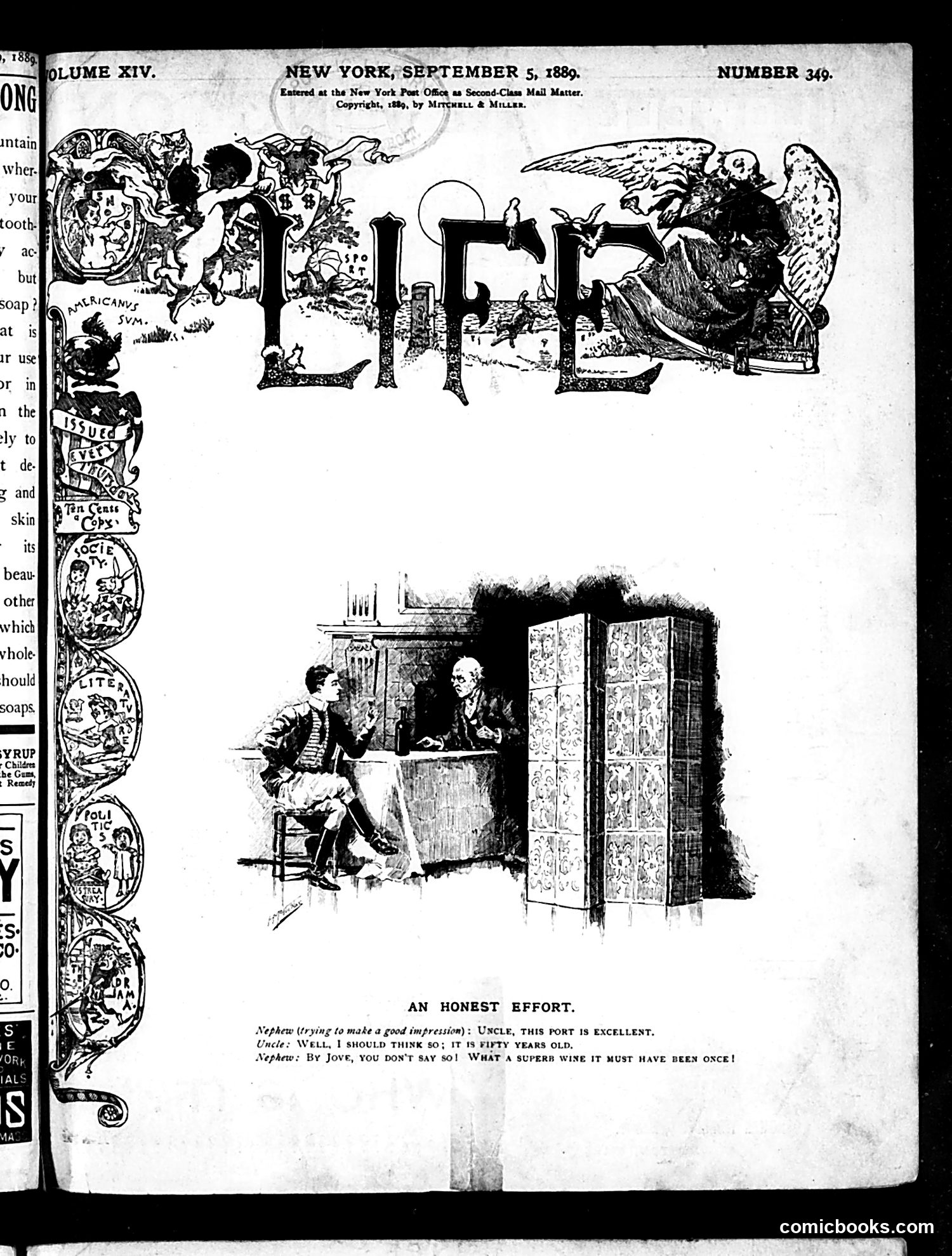
This satirical cartoon depicts a nephew attempting to impress his uncle by serving an old port wine. The uncle, examining the bottle, expresses skepticism about the wine's quality and age, asking how the nephew obtained such a supposedly excellent fifty-year-old vintage. The joke plays on the nephew's dubious claim. The caption's title, "An Honest Effort," suggests the nephew is *trying* to make a good impression through hospitality, but his transparent deception—likely serving inferior wine in an old bottle—undermines his pretense. The humor lies in the gap between the nephew's aspirations to appear sophisticated and the uncle's shrewd recognition of the fraud. This reflects Victorian-era social anxieties about class performance and authenticity.
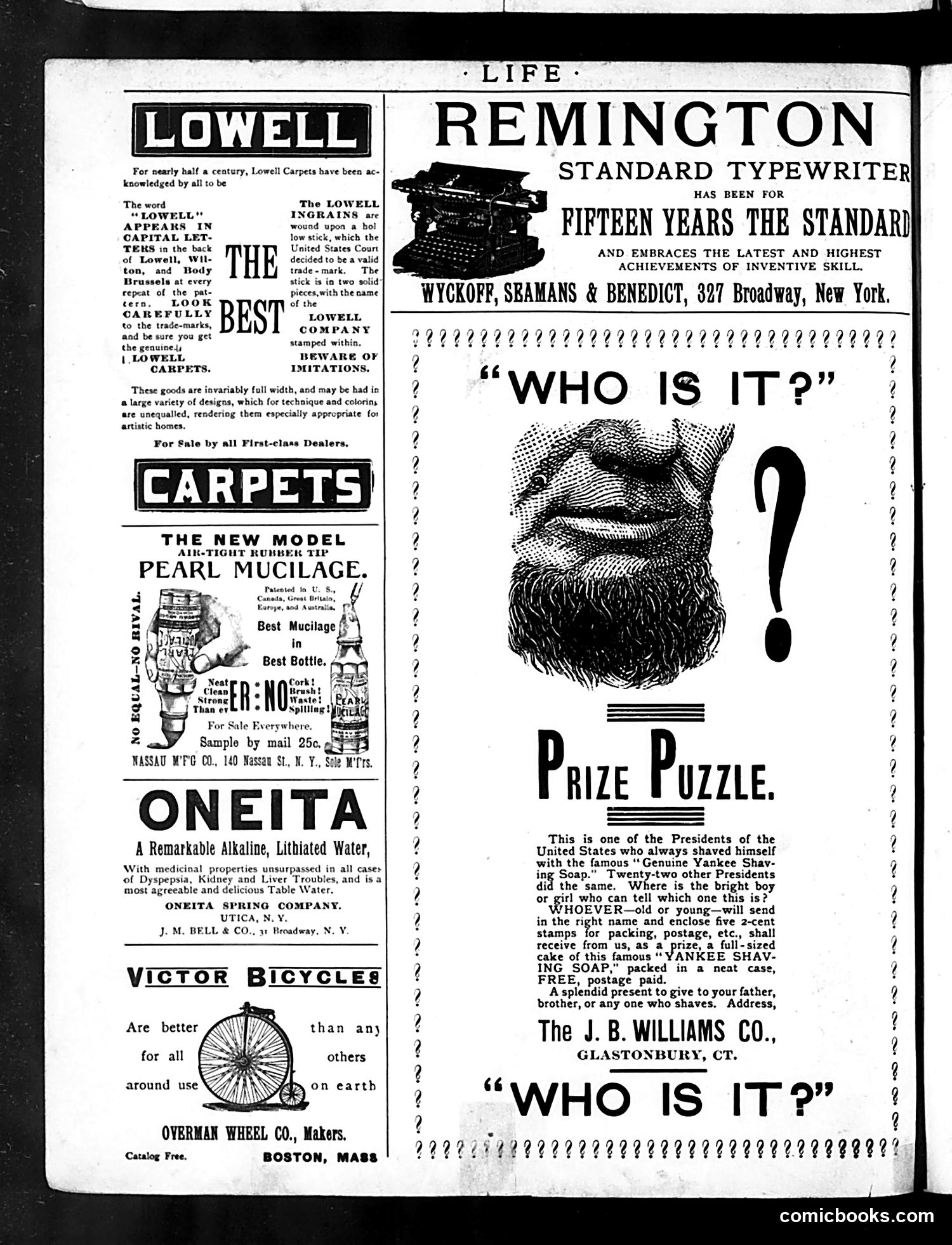
This page features a contest from *Life* magazine where readers attempt to identify a bearded man's face based on his distinctive facial hair alone. The J.B. Williams Co. (a soap manufacturer) sponsored this "Prize Puzzle," offering a full-sized cake of their "Yankee Shaving Soap" as the prize. The contest plays on the era's popular "puzzle" entertainment format—guessing games were common magazine features. The mystery figure appears to be a famous American, likely a president or public figure, given the text's reference to "Presidents" and "Genuine Yankee Shaving Soap" association. However, without additional context or caption, the specific identity remains unclear from the image alone. The puzzle's humor relies on readers recognizing someone from facial hair alone.
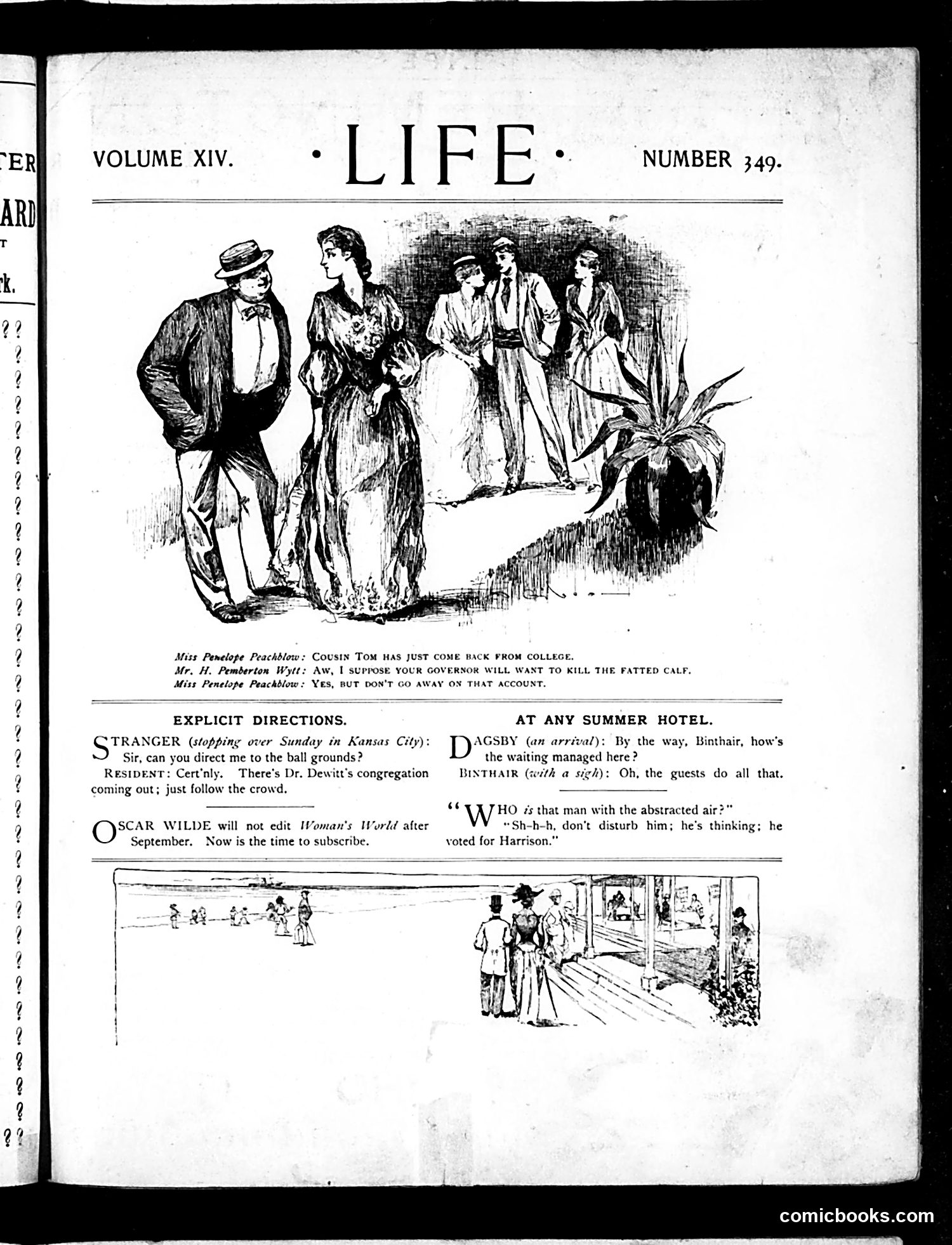
This page contains three separate humor pieces from Life magazine (Volume XIV, Number 349): **Top cartoon**: Shows a social gathering where "Cousin Tom" has returned from college. The joke satirizes parental anxiety—a mother worries the governor will execute a "fatted calf" for the homecoming, while the father dismisses this concern, suggesting parents' exaggerated fears about their children's college experiences. **"Explicit Directions"** and **"At Any Summer Hotel"**: These are brief comedic dialogues. The first involves directions to a baseball game; the second mocks hotel staff incompetence and references someone who "voted for Harrison" (likely William Henry Harrison, suggesting outdated politics or an absent-minded guest). The page demonstrates Life's format: mixing visual and textual humor targeting upper-middle-class social situations and domestic comedy.
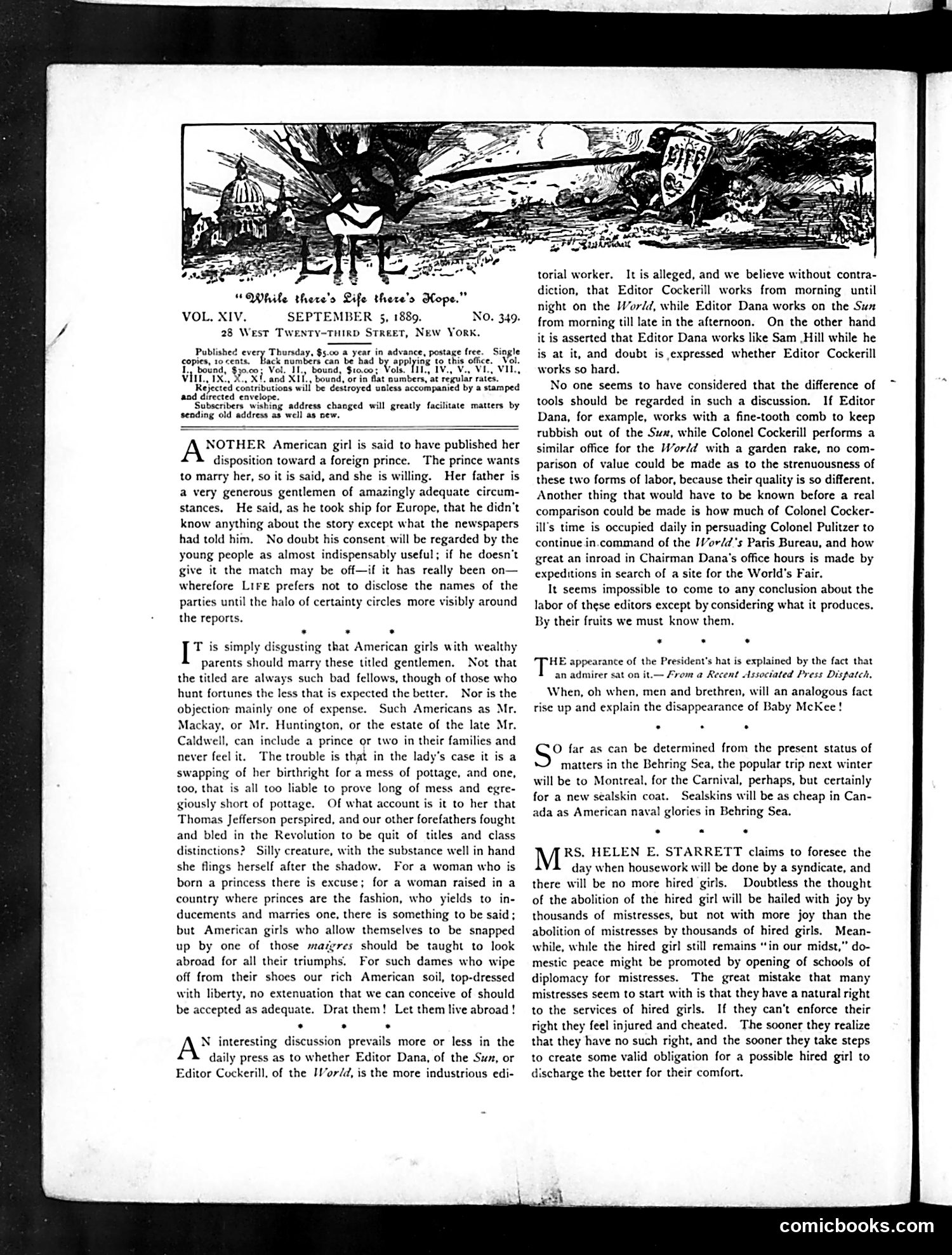
The cartoon at top left, captioned "While there's Life there's Hope," depicts a figure being blown away by wind, likely symbolizing precarious circumstances or uncertainty—a visual pun on the magazine's own name. The page's main text discusses American girls marrying foreign princes, criticizing wealthy American parents who eagerly arrange such marriages for social status. The author mocks this as unpatriotic, contrasting it with Revolutionary ideals about rejecting titles and class distinctions. Additional commentary addresses editorial work practices at rival newspapers (the *World* and *Sun*), and includes brief notes about sealskin coats, the President's hat, and a Mrs. Helen E. Starrett's views on hired domestic help. The tone throughout is satirical social commentary typical of *Life*'s editorial voice.
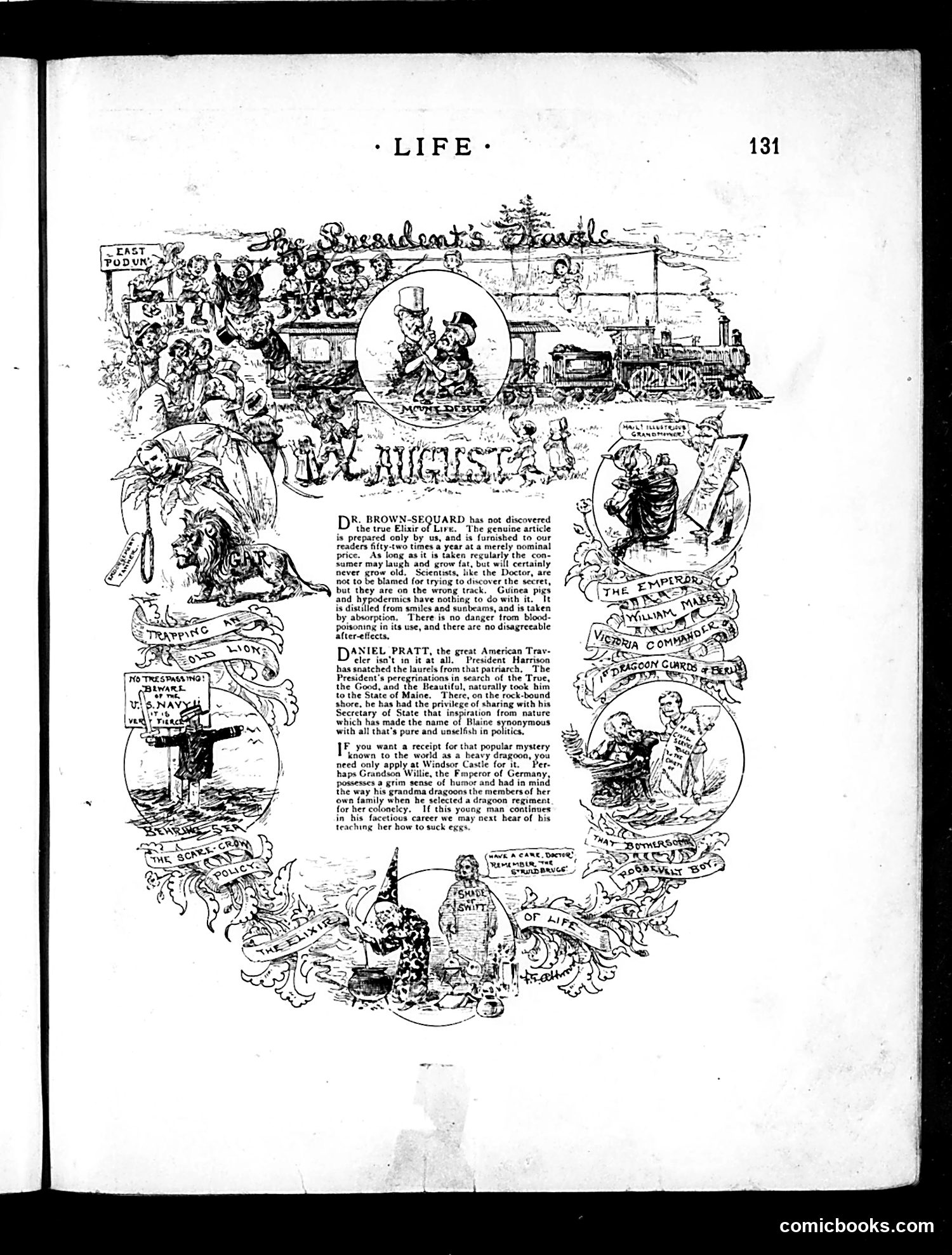
This satirical illustration mocks **President Harrison's** travels and political activities. The central circular vignette shows Harrison in a train, referencing his actual touring. The surrounding ornamental border contains various caricatures and references: - **Dr. Brown-Sequard** (mentioned in text) is ridiculed for claiming to have discovered an "Elixir of Life"—a contemporary pseudoscientific fraud the magazine dismisses - **Daniel Pratt**, described as "the great American Traveler," appears to be contrasted with Harrison - Various satirical vignettes mock political figures and contemporary absurdities - References to "Windsor Castle" and "Percheron Grandpa Willie, the Emperor of Germany" suggest international political commentary The overall theme ridicules Harrison's presidency through the metaphor of constant travel and movement, implying his administration lacks substance—a common critique of his brief, disease-plagued term (1841).
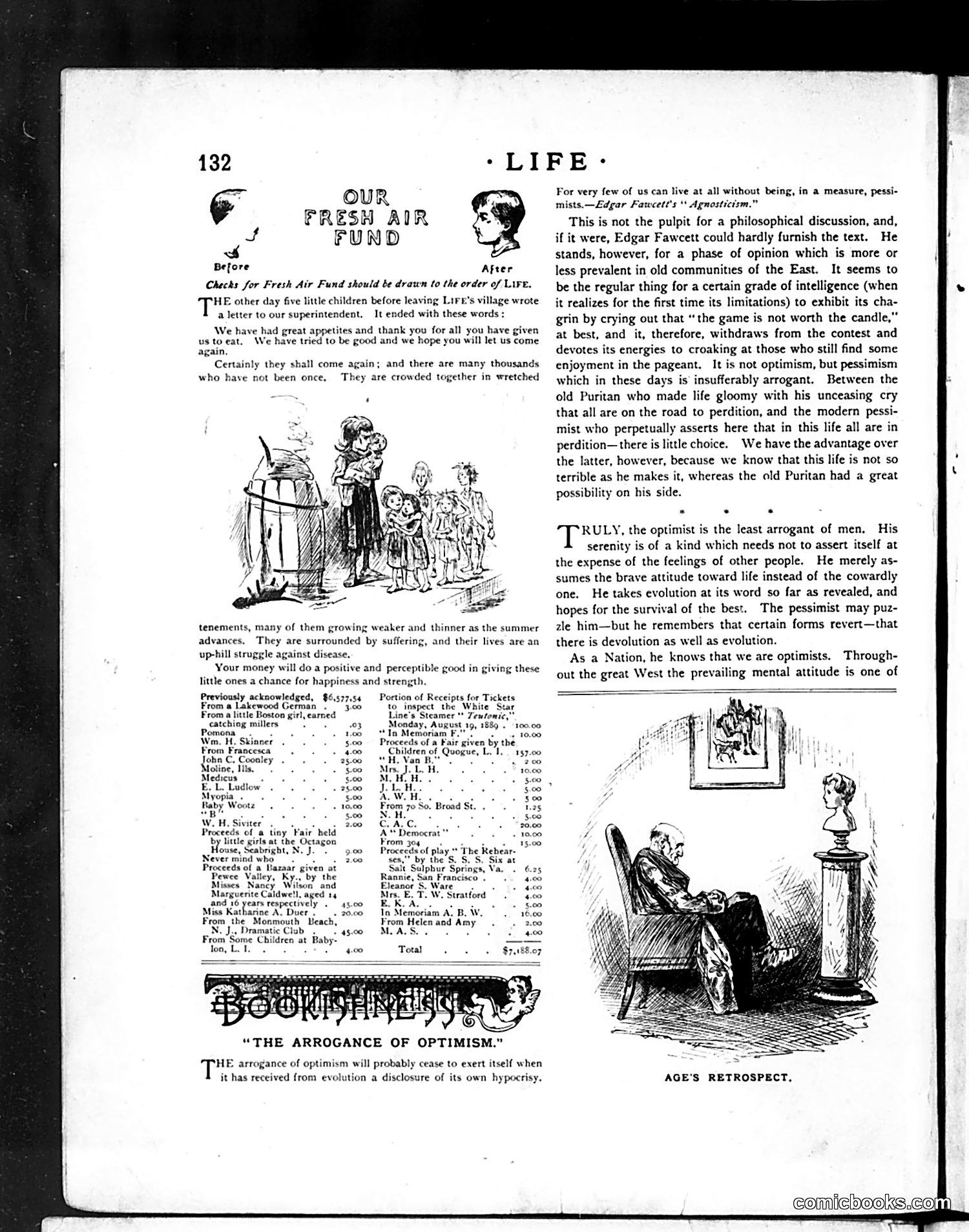
This page satirizes American optimism in the early 20th century. The main article critiques what it calls the "arrogance of optimism"—the tendency of optimists to dismiss legitimate suffering and social problems as unimportant. The left illustration shows impoverished families in crowded conditions, illustrating the real hardships the optimists ignore. The text argues optimists are self-centered, assuming their comfortable worldview applies universally without acknowledging others' genuine struggles. The right illustration, titled "Age's Retrospect," shows an elderly man reflecting—suggesting that time reveals optimism's naiveté. The article contrasts this with older Puritan pessimism, ultimately concluding that unchecked optimism lacks moral awareness of actual human suffering.
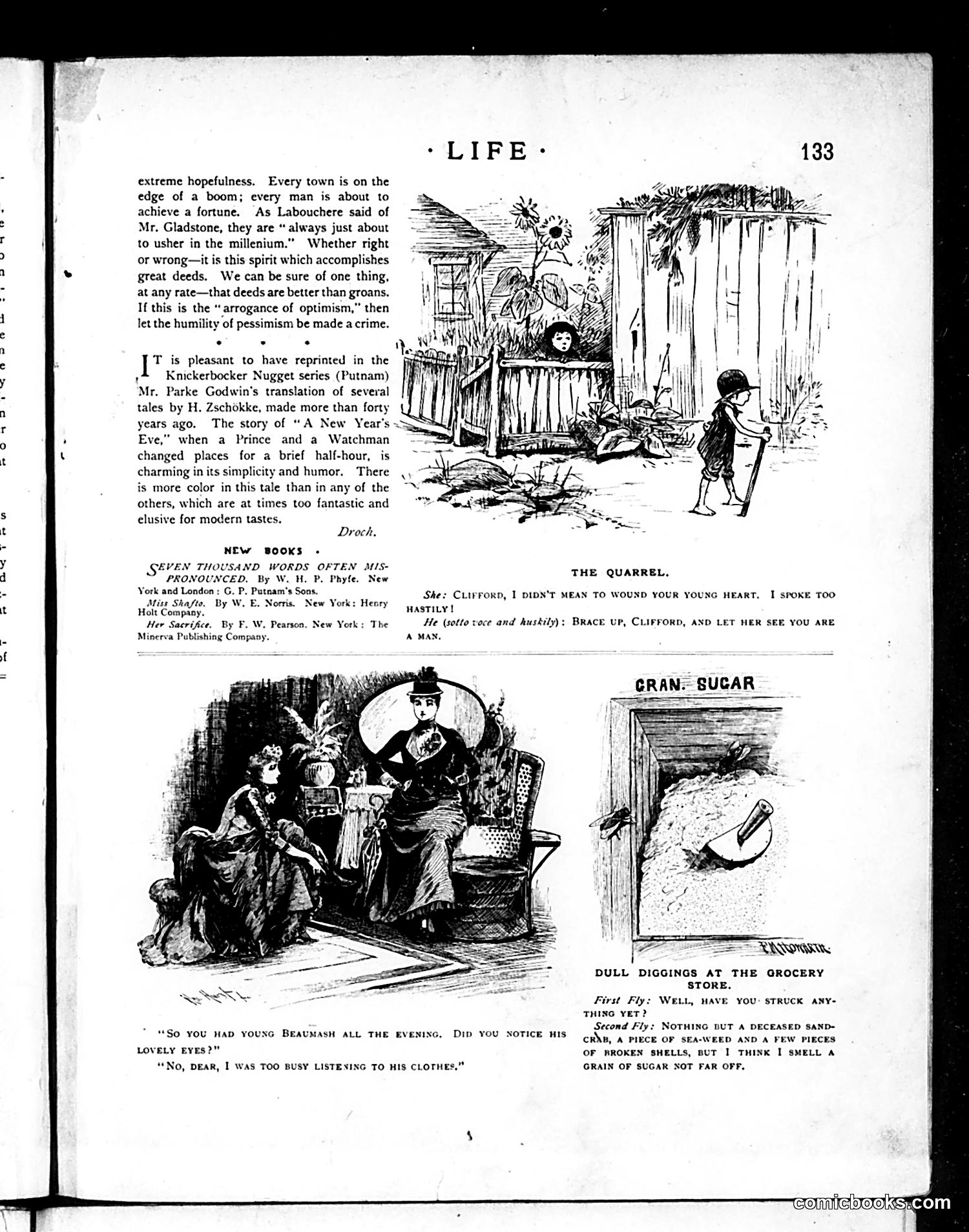
**"The Quarrel"** (top illustration): A domestic scene showing a man and woman in conflict. The dialogue reveals a husband who spoke "too hastily" to his wife's young heart, and she demands he prove his masculinity by "bracing up" and showing he's "a man." This appears to satirize Victorian-era gender dynamics and marital disputes—mocking both the woman's melodramatic response and the man's need to perform masculine authority to resolve conflict. **"Gran: Sugar"** (bottom): Shows grocery store "dull diggings" where customers find only undesirable items—dead seaweed, broken shells, and sand—instead of actual sugar. This satirizes either grocery store quality or wartime/shortage conditions where basic supplies became unavailable or adulterated. The humor lies in the absurd discovery. Both cartoons use domestic and commercial scenarios for social commentary.
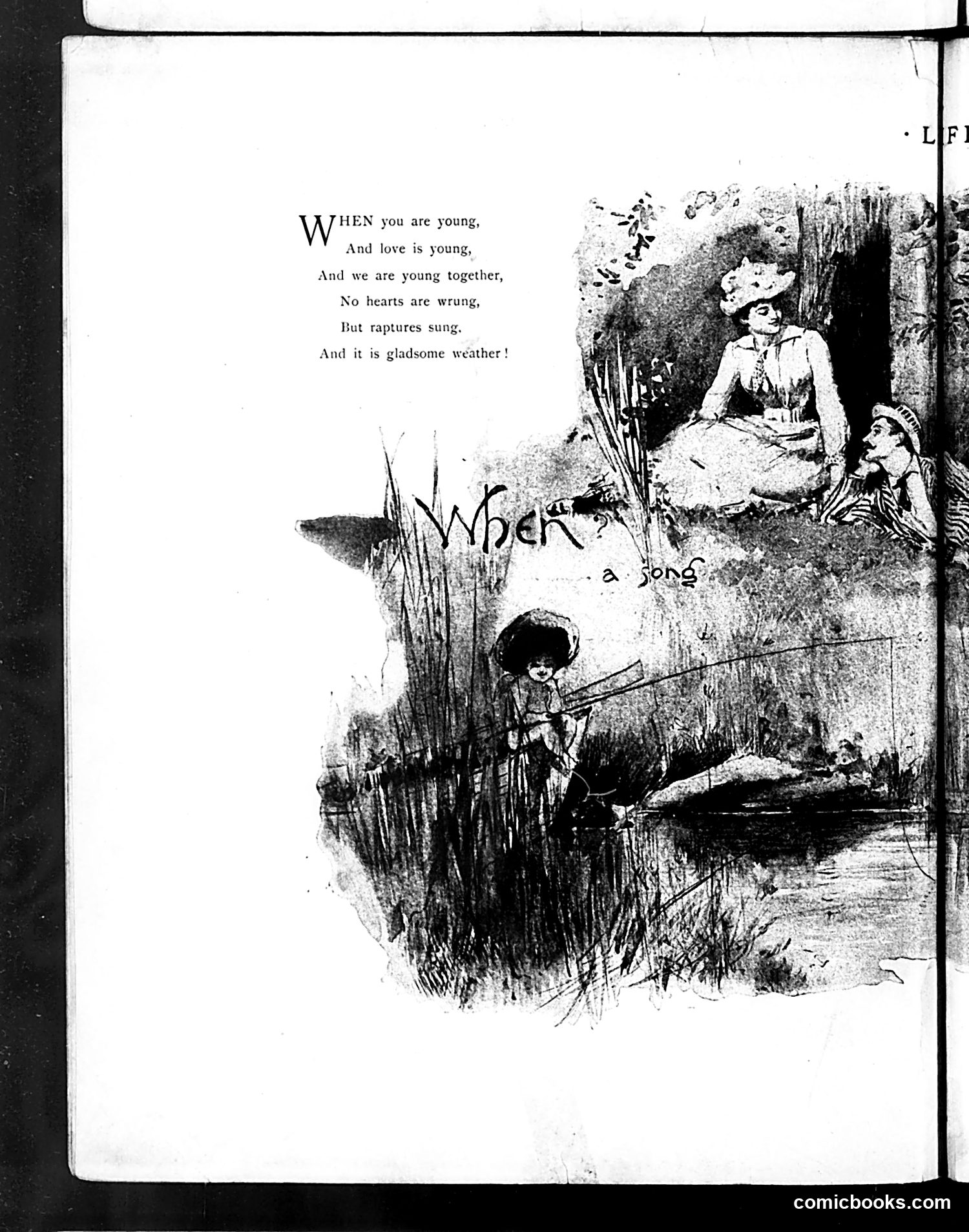
This page presents a romantic poem titled "When you are young" paired with an illustration labeled "When a song." The verse celebrates youthful love—"no hearts are wrung, / But raptures sung"—in what appears to be Edwardian-era language and sensibility. The illustration depicts a pastoral scene with a woman and child by water amid reeds, watching a young man fishing. The image romanticizes leisure and nature as settings for courtship and family life. Rather than satire, this appears to be sentimental, illustrative content typical of early 20th-century *Life* magazine—celebrating idealized romance and domesticity. The "joke" or appeal likely lay in the nostalgic, emotionally earnest treatment of young love rather than any political commentary.
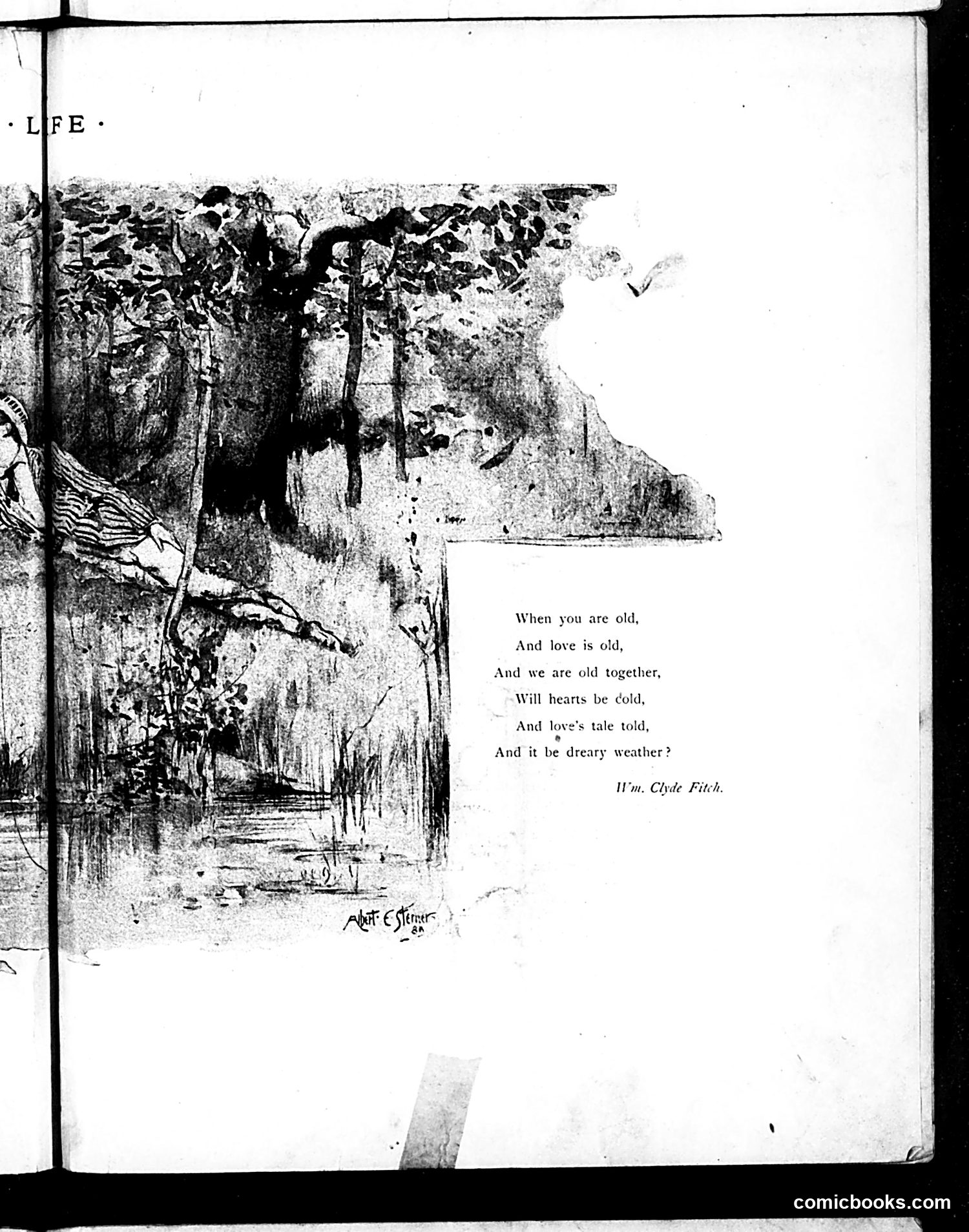
This page from *Life* magazine features a romantic illustration by Albert E. Sterner (signed lower left) depicting a scenic landscape with water and vegetation. The accompanying poem is attributed to William Clyde Fitch, a prominent American playwright of the late 19th/early 20th century. The text is sentimental rather than satirical—it contemplates aging love and shared mortality ("When you are old, / And love is old, / And we are old together, / Will hearts be cold"). This represents *Life*'s lighter content, mixing literary excerpts with artwork. Rather than political commentary, this page demonstrates the magazine's broader editorial scope beyond satire, appealing to readers' romantic and literary sensibilities. The mood is melancholic and introspective rather than humorous.
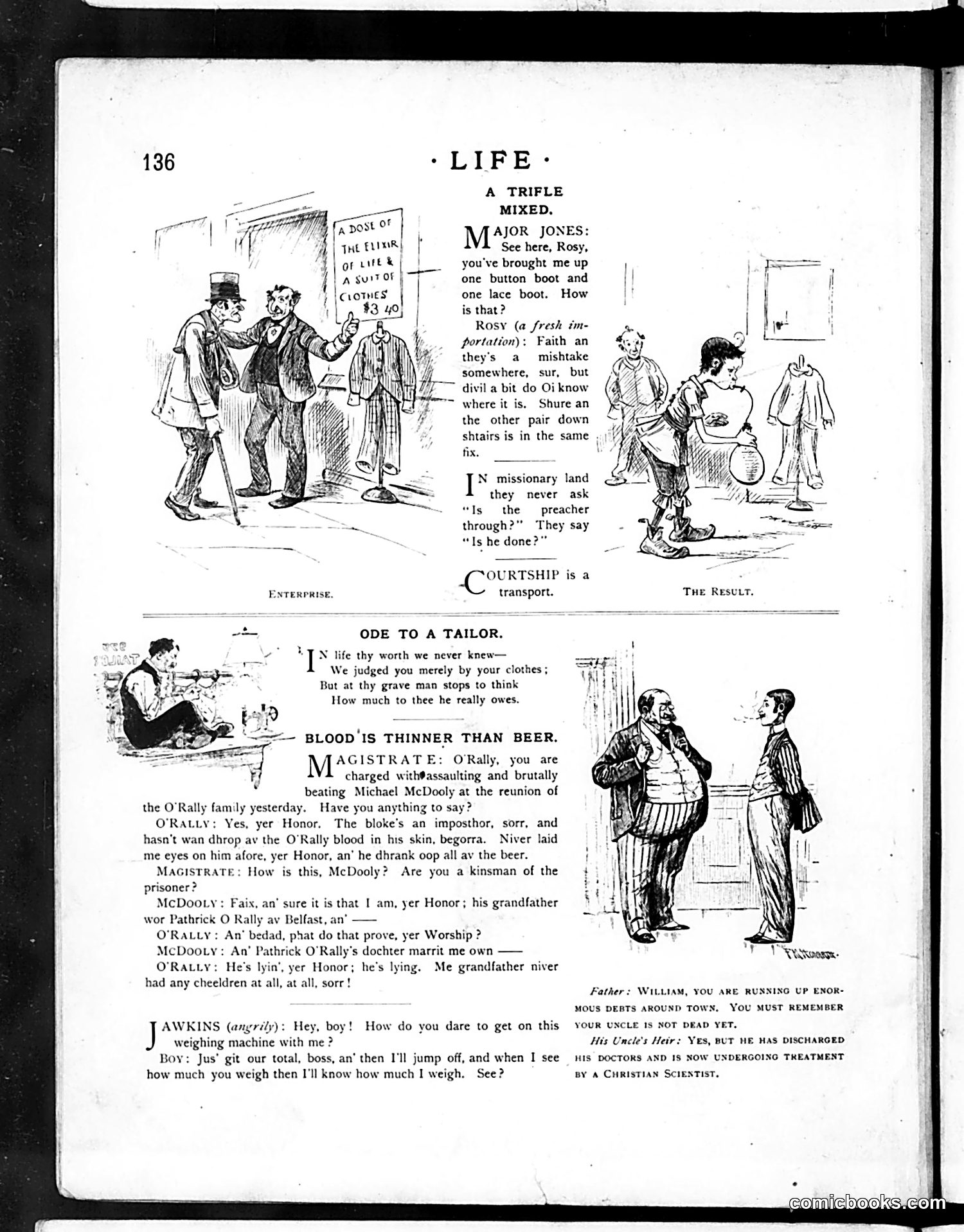
This page contains three satirical pieces: **"A Trifle Mixed"** depicts a tailor's mistake—bringing mismatched boots (one button, one lace) to a customer. The humor lies in the absurd mix-up and the characters' attempts to find the matching pair downstairs. **"Ode to a Tailor"** is a poem mocking tailors' inflated self-importance, suggesting people judge tailors merely by their appearance rather than character. **"Blood's Thinner Than Beer"** features an Irish magistrate interrogating a man named O'Reilly about assaulting Michael McDooly. The satire targets Irish working-class disputes and ethnic stereotypes of the era—depicting lower-class Irish brawling and kinship claims with exaggerated dialect ("begorra," "yer Honor"). All pieces use humor to mock social pretension and class divisions of the period.
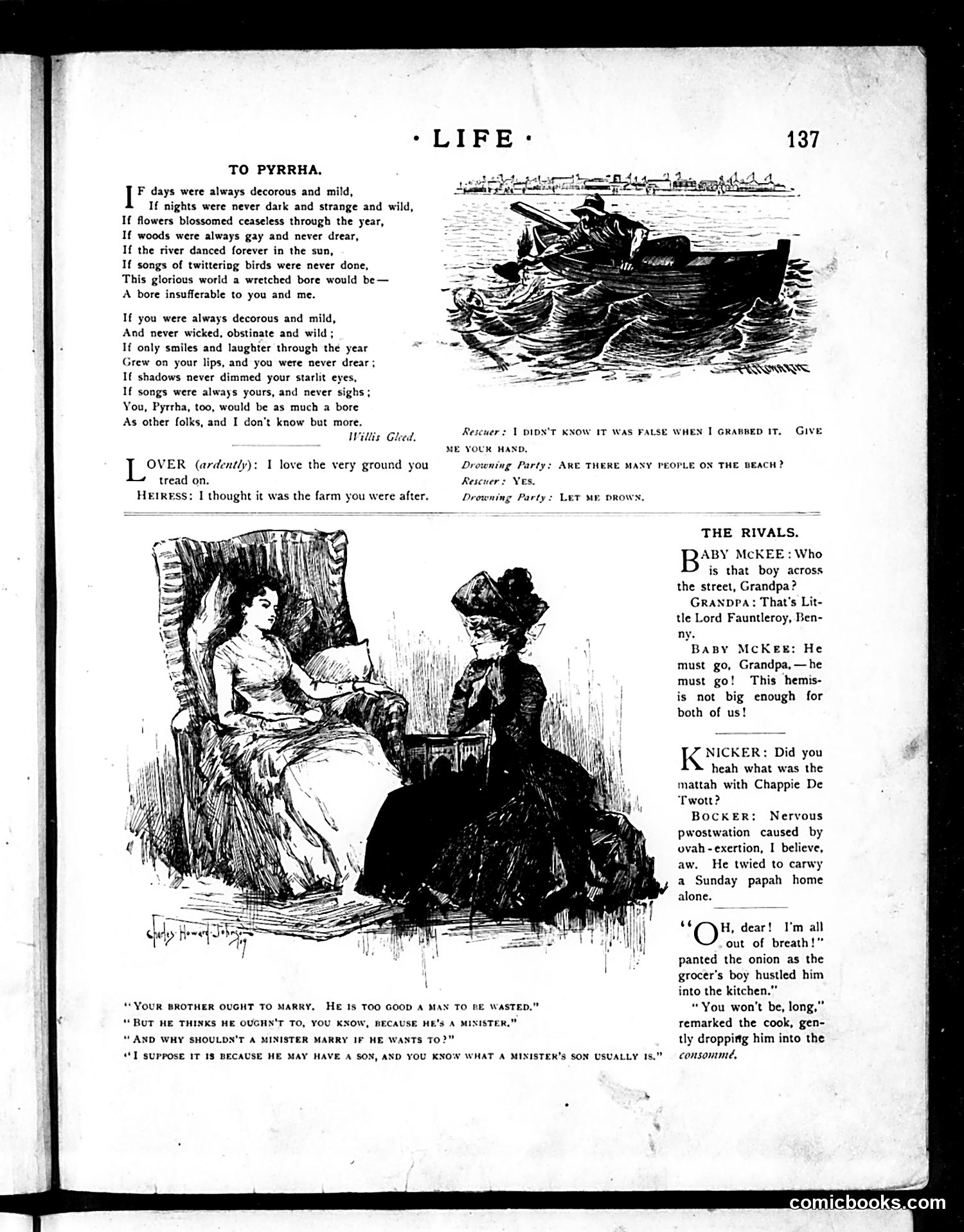
This page contains two distinct sections: **"To Pyrrha"** (top left): A poem celebrating idealized rural life—eternal spring, singing birds, dancing rivers, perpetual smiles. The satire mocks romantic pastoralism by suggesting such monotonous perfection would actually be tedious ("a bore"). **"The Rivals"** (right side): A comedic sketch depicting a conversation between a Grandpa and Baby McKee about "Little Lord Fauntleroy" across the street. The humor revolves around class pretension—the child's ostentatious formal title contrasts with Baby McKee's casual, American informality. Additional gossip about a minister's son's nervous condition adds social commentary on Victorian propriety and reputation management. The illustration shows two women in period dress conversing, likely about local social matters. Both pieces satirize late-19th-century American social conventions and affectations.
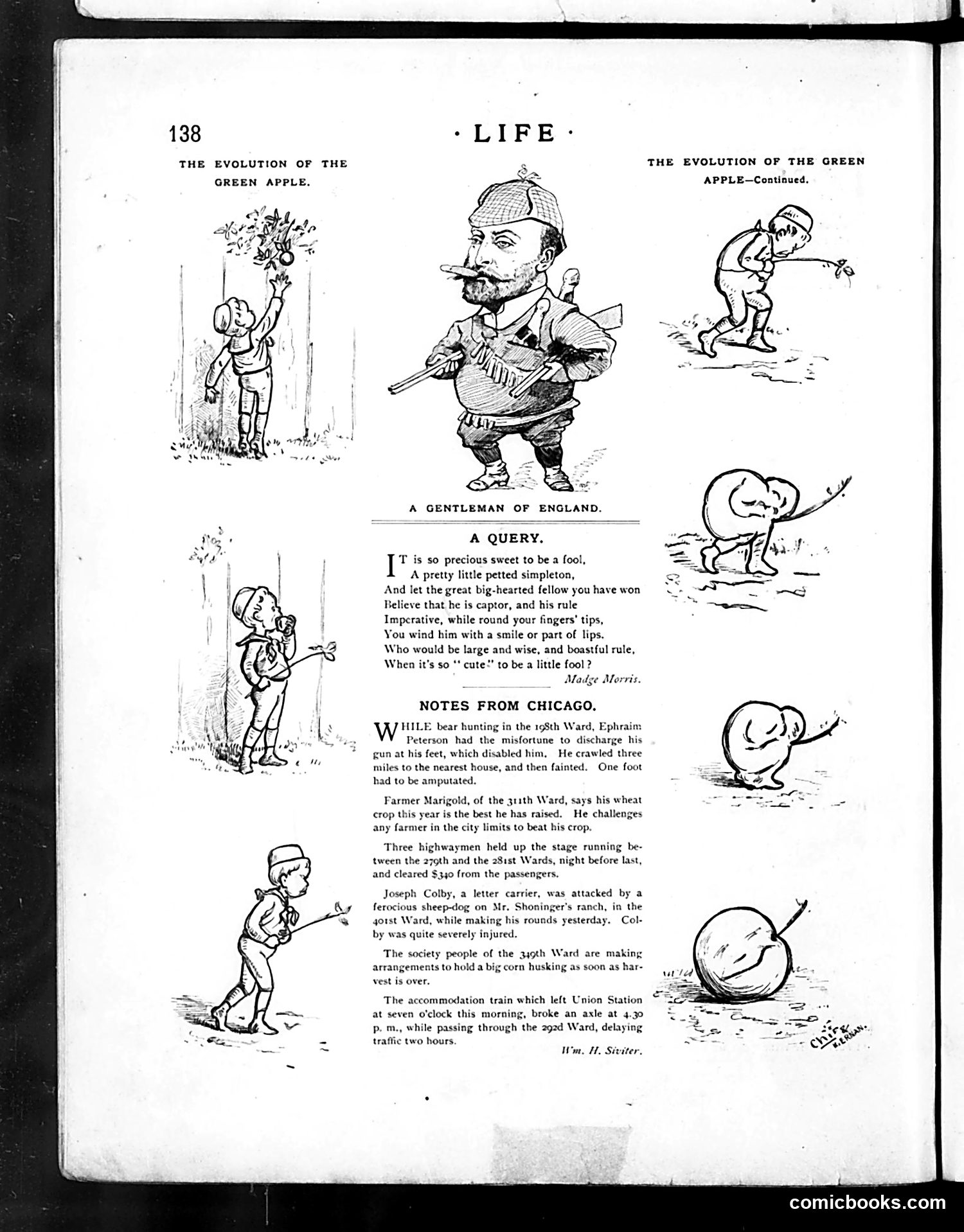
This page satirizes the corrupting effects of unripe ambition and foolishness. The left column shows a visual progression—a small figure reaching for green apples that grow larger—suggesting how initial modest desires escalate into grander, more destructive pursuits. The central caricature labeled "A Gentleman of England" appears to mock British aristocratic pretension, depicted as a bloated, self-important figure. The poem "A Query" by Madge Morris critiques women who feign foolishness to manipulate men into dominance, questioning why anyone would abandon wisdom for cuteness—likely social commentary on gender roles and romantic manipulation of the era. "Notes from Chicago" provides darkly humorous local incidents: hunting accidents, robberies, dog attacks, and train derailments—presenting frontier/rural life as comically chaotic and dangerous, contrasting civilized Eastern pretense with Midwestern rough reality. The right column's evolution drawings show the green apple's physical transformations, completing the satirical visual metaphor about how small follies grow into major consequences.
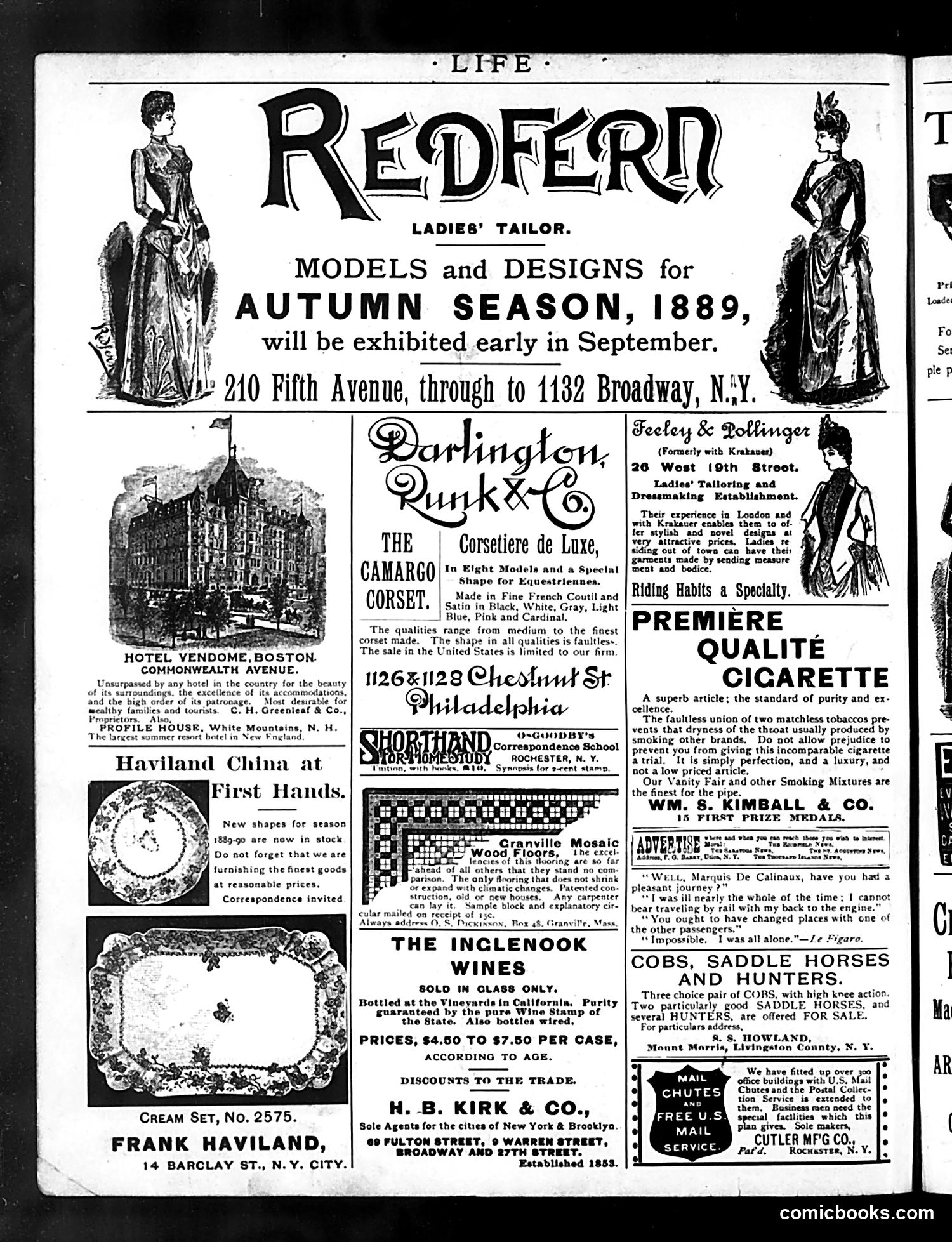
This is primarily an **advertising page**, not a satirical cartoon page. It showcases commercial advertisements typical of late-19th-century American magazines, including: **Fashion & Tailoring**: Redfern (a prestigious ladies' tailor), corsets, and riding habits advertised for the 1889 autumn season. **Household Goods**: Haviland china, wood flooring, and hotel accommodations. **Luxury Items**: Wines, cigarettes (Première Qualité brand), and fine dining. **Services**: Shorthand correspondence schools, mail chute systems, and horse sales. The single **joke/cartoon** is a brief text item from *Le Figaro* about a train passenger complaining of traveling backward, told to switch seats—but unable to because traveling alone. The humor lies in the absurd complaint and impractical solution. The page reflects Gilded Age consumer culture targeting wealthy, fashionable urbanites.
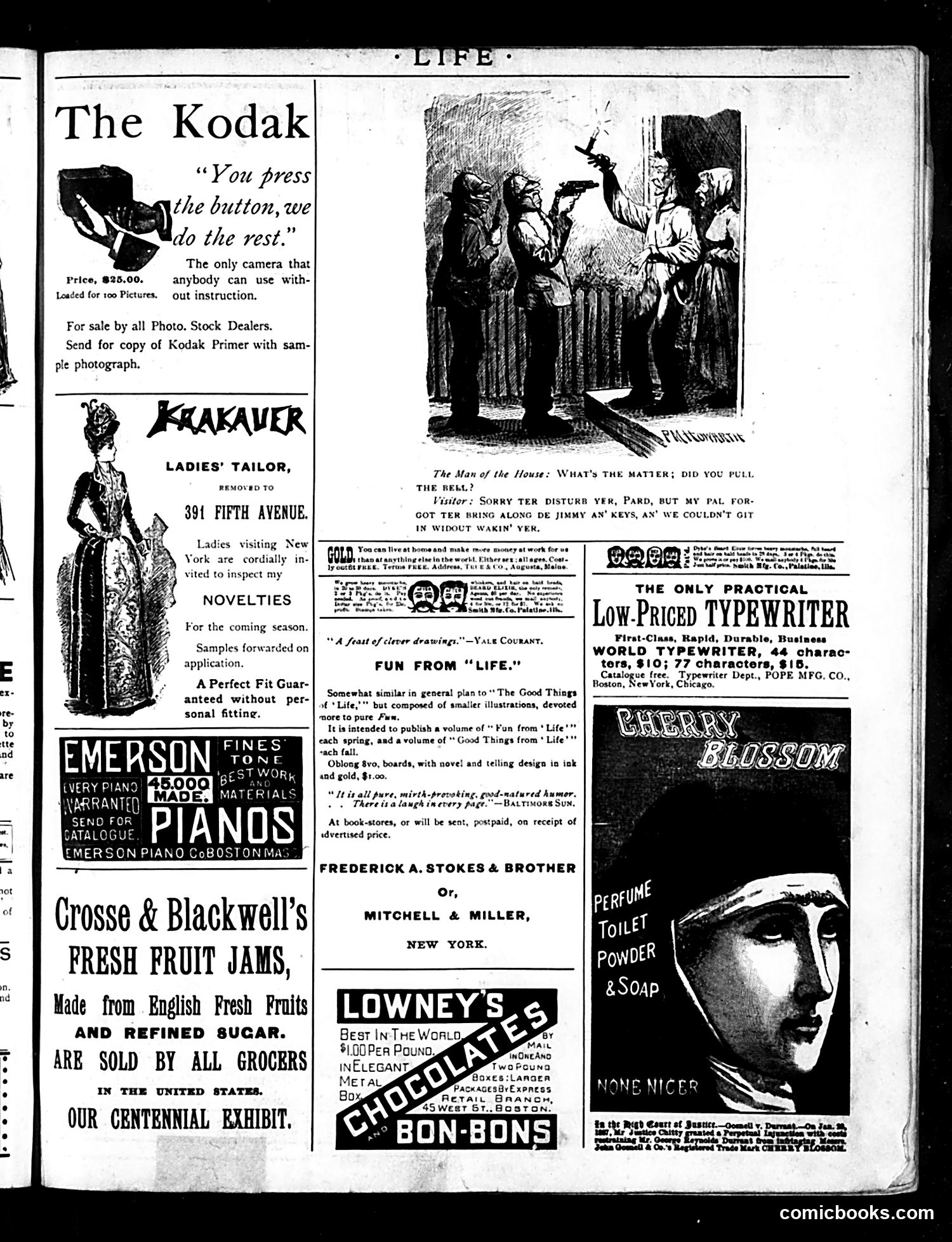
The main cartoon depicts a domestic comedy scene titled "The Man of the House: What's the Matter; Did You Pull the Bell?" A wife asks her husband why he didn't ring for a servant, and he responds that the servant forgot to bring the tools needed to break in—revealing the couple are burglars. The joke satirizes Victorian domestic hierarchies and class pretension. The "man of the house" is portrayed as incompetent and dependent on servants even for criminal enterprise. The cartoon mocks both upper-class reliance on domestic staff and the notion that a husband should be capable and authoritative. The irony lies in depicting burglars behaving like wealthy employers—treating crime as just another household task requiring proper equipment and assistance. The page is primarily advertising (Kodak cameras, pianos, jams, typewriters, perfume), typical of Life's mixed content format. The cartoon represents the satirical humor that distinguished the magazine from purely commercial publications.
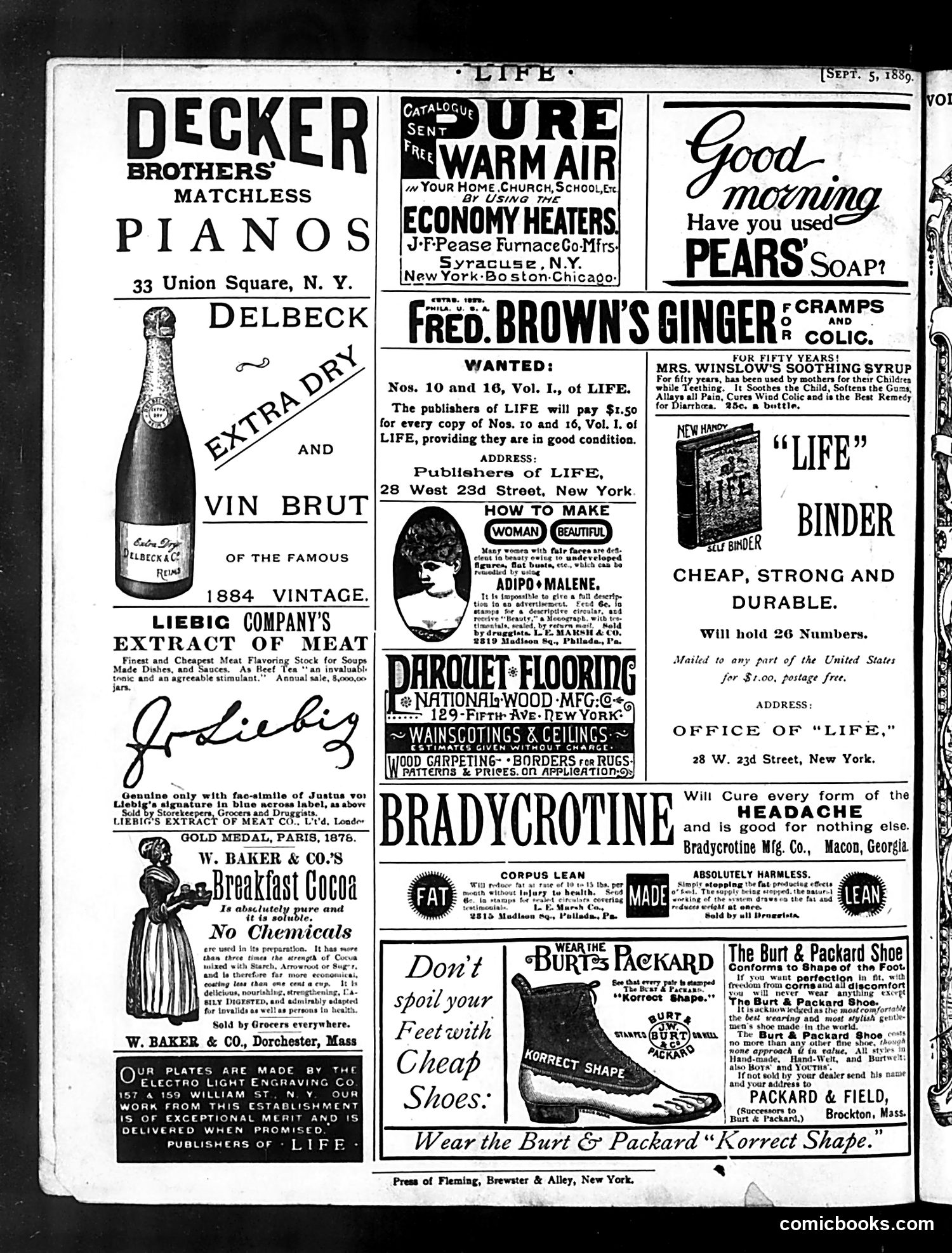
This is primarily a **advertisements page** from Life magazine, not a political cartoon. It showcases consumer products typical of the 1880s-90s era: pianos, champagne, meat extract, cocoa, ginger remedies, flooring, shoes, and patent medicines. Notable for modern readers: the page illustrates period concerns and solutions now considered quaint or problematic. **Mrs. Winslow's Soothing Syrup** and **Bradycrotine** (for headaches) were common patent medicines—many contained opiates or other harmful substances later banned. The emphasis on "economy heaters" and "cheap shoes" reflects working-class concerns about affordability. The shoes advertisement humorously warns against "spoiling your feet with cheap shoes," promoting the Burt & Packard brand as the solution—early advertising using shame to drive sales. The page also includes a **"Wanted" notice** for back issues of Life magazine itself, showing how publications actively collected their own archives.