
A complete issue · 16 pages · 1889
Life — August 1, 1889
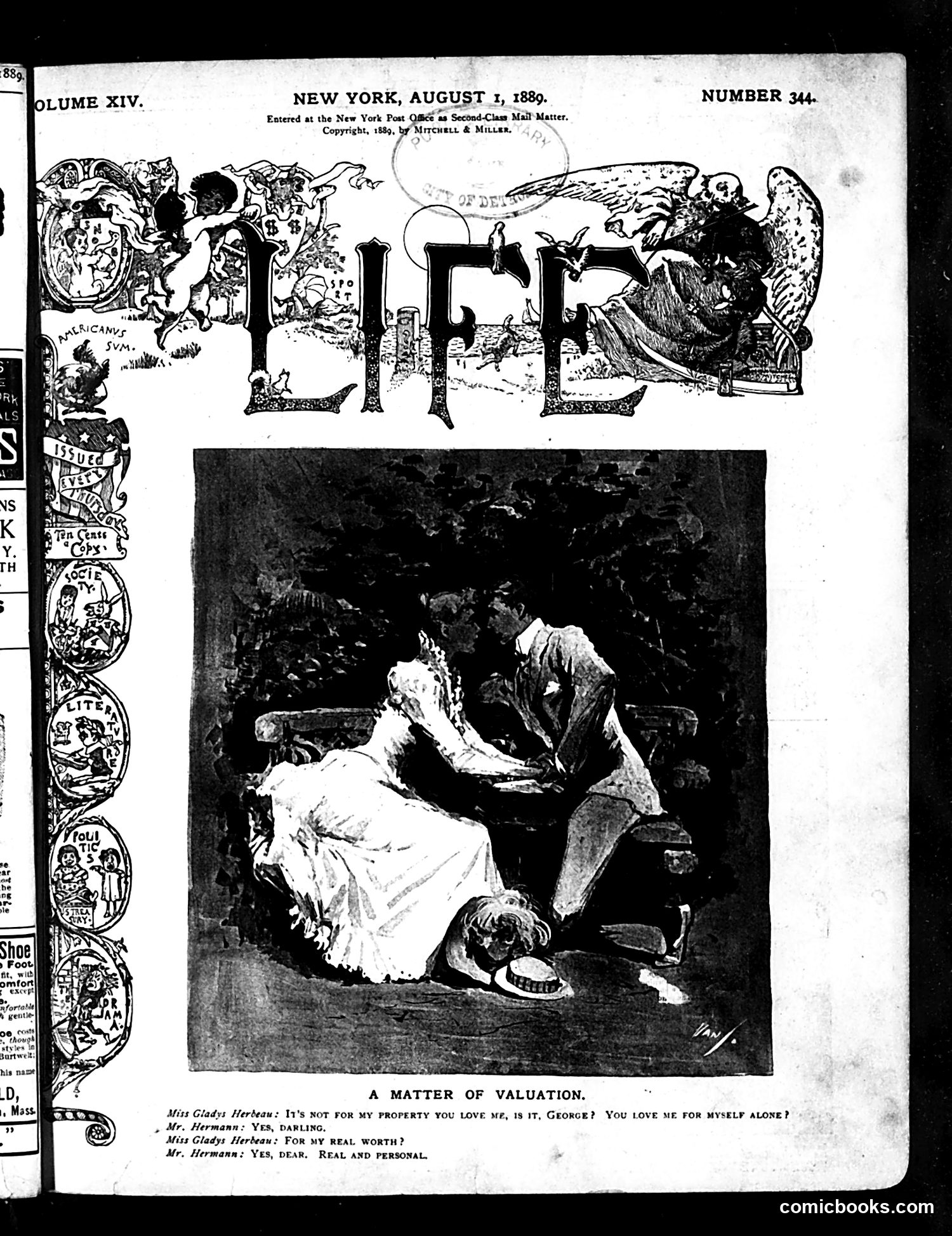
This satirical illustration from Life magazine (August 1, 1889) depicts a domestic scene titled "A Matter of Valuation." The dialogue reveals the cartoon's point: Miss Gladys Herbeau asks if Mr. Herbeau loves her for herself alone, and he responds affirmatively—but then admits he actually values her for her "real and personal" worth, meaning her money or property. The joke targets wealthy marriages of the Gilded Age, satirizing how men married women primarily for financial gain while claiming romantic devotion. The woman's white dress and refined setting suggest upper-class courtship, while the man's mercenary honesty exposes the era's transactional nature of matrimony among the wealthy.
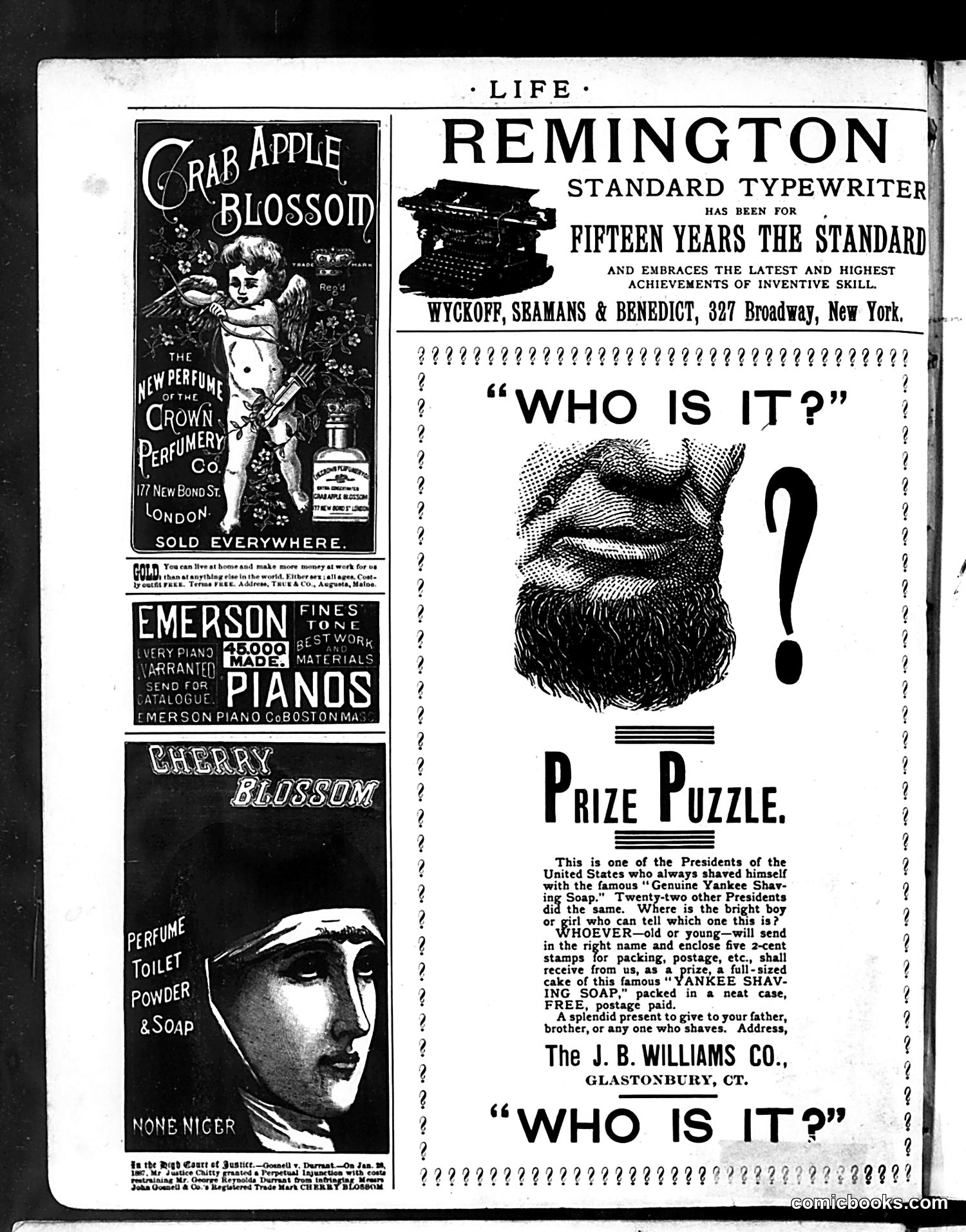
This page is primarily **advertising**, not editorial content. The left side features product ads for perfume (Crab Apple Blossom), pianos (Emerson), and toiletries (Cherry Blossom, None Nicer). The main editorial content is a "Prize Puzzle" by J.B. Williams Company promoting Yankee Shaving Soap. The puzzle shows a bearded face asking "WHO IS IT?" and claims the subject is a U.S. President who used their soap. Readers are invited to guess the identity and submit answers for prizes. This appears to be a **promotional gimmick** rather than satire—using presidential endorsement (implied or actual) to market shaving products. The humor is mild, relying on readers' ability to recognize a president from an artistic sketch.
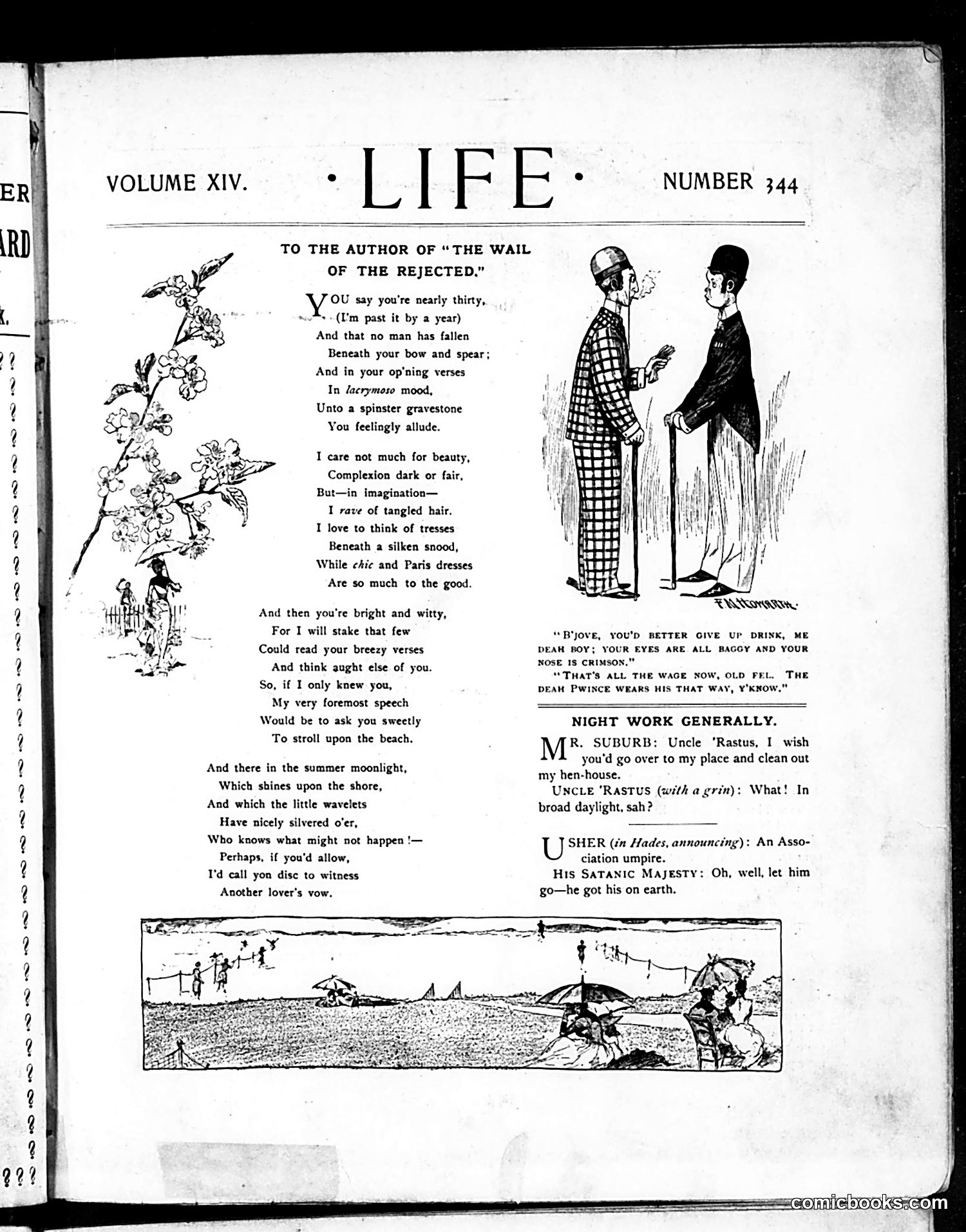
This page contains a poem addressed to "The Author of 'The Wail of the Rejected'"—likely a contemporary literary work—praising the author's wit and romantic sensibility. The poem uses Victorian courtship language ("silken snood," "tangled hair"). The cartoon shows two men in conversation, with one appearing disheveled or working-class (checkered clothing) and the other well-dressed. The caption mocks the first man's drinking problem and general appearance, suggesting a social commentary on class differences or the effects of poverty/vice. The "Night Work Generally" section below appears to be a short comedic dialogue involving characters named Suburb and Rastus (a period name reflecting racial stereotyping), discussing yard maintenance—likely satirizing domestic servant relationships or class dynamics of the era. The bottom illustration depicts beach or seaside leisure activity.
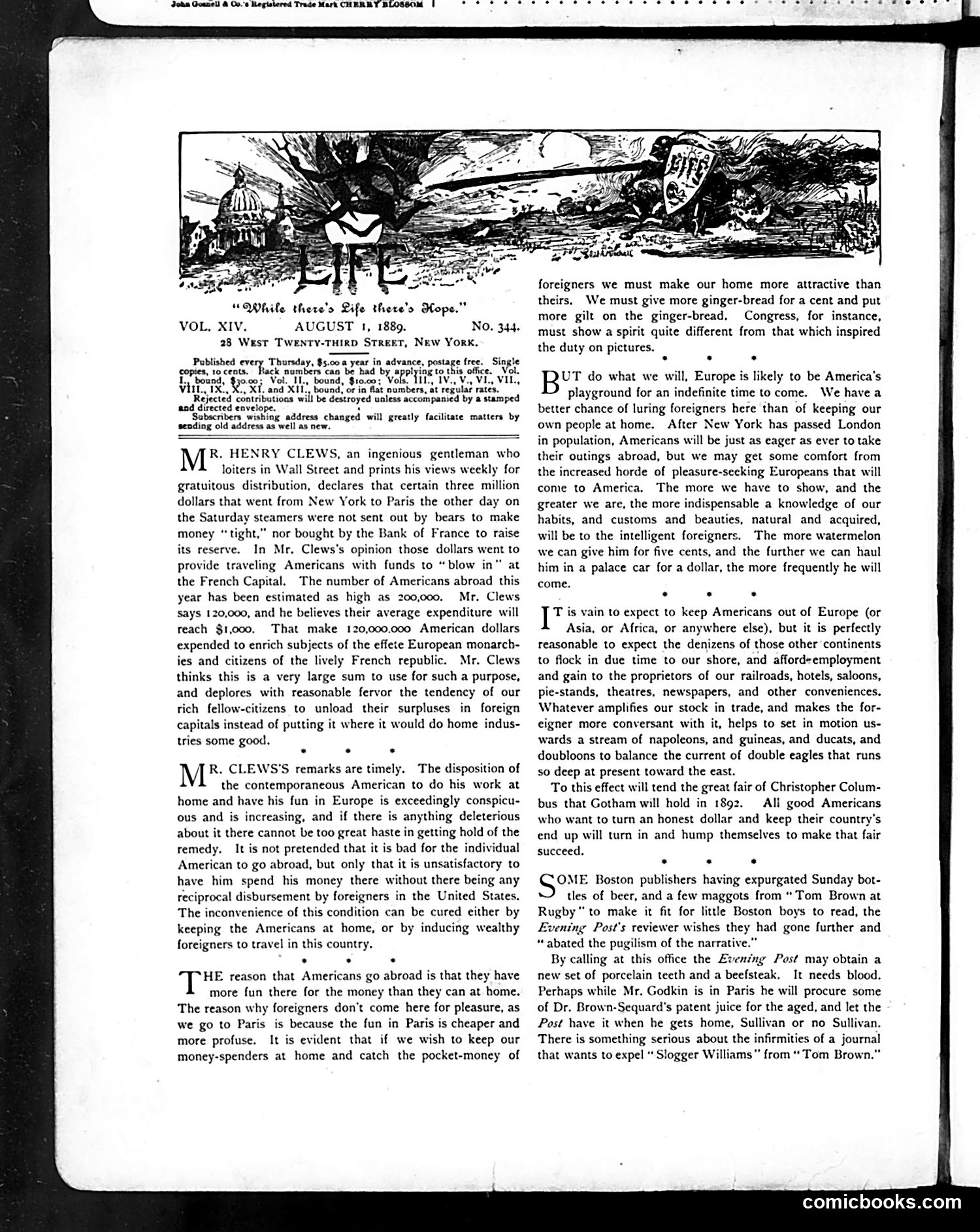
The small header illustration shows a pastoral landscape with the caption "While there's Life there's Hope," typical decorative masthead art. The main text discusses American tourism and spending abroad. It references Henry Clews, a Wall Street financier, who estimated three million dollars left New York weekly for Paris. The author argues Americans should spend money at home instead, to support domestic industries and keep wealth circulating domestically. The satire targets wealthy Americans who find Paris cheaper and more entertaining than home, suggesting this habit drains the nation economically. There's also criticism of Boston publishers and a jab at the *Evening Post* newspaper for sensationalism. No specific political figures are caricatured here; rather, the satire addresses American economic habits and media practices of the era.
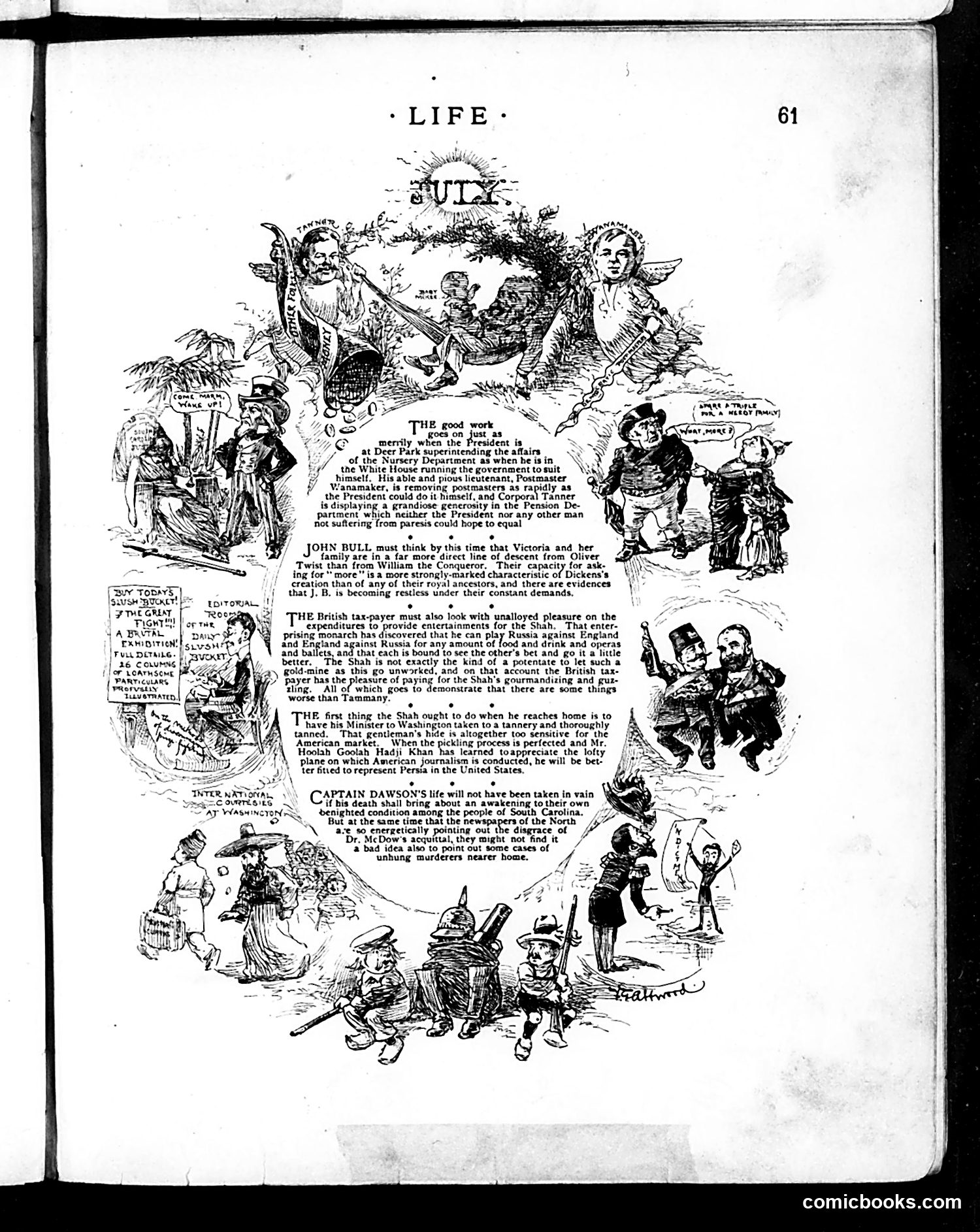
This page contains four satirical editorial pieces critiquing various public figures and policies: 1. **"July"** (top): Angels oversee summer happenings, including commentary on the Deer Park superintendent managing the Nursery Department and Postmaster Gould's railway connections—apparently mocking political patronage and nepotism. 2. **"John Bull"** section: British commentary comparing Victoria's descendants to the Conqueror's line, suggesting they're becoming overwhelmed by constant demands on the monarchy. 3. **"The British Payer"**: Satirizes Britain's financial burden supporting entertainment for the Shah of Persia, with reciprocal obligations that seem disadvantageous. 4. **"Captain Dawson's life"**: References a captain whose life story will awaken Americans to "existing outrages," mentioning North American newspapers criticizing exposed crimes and "unsung murderers nearer home." The overall theme targets institutional corruption, imperial excess, and press-exposed scandals.
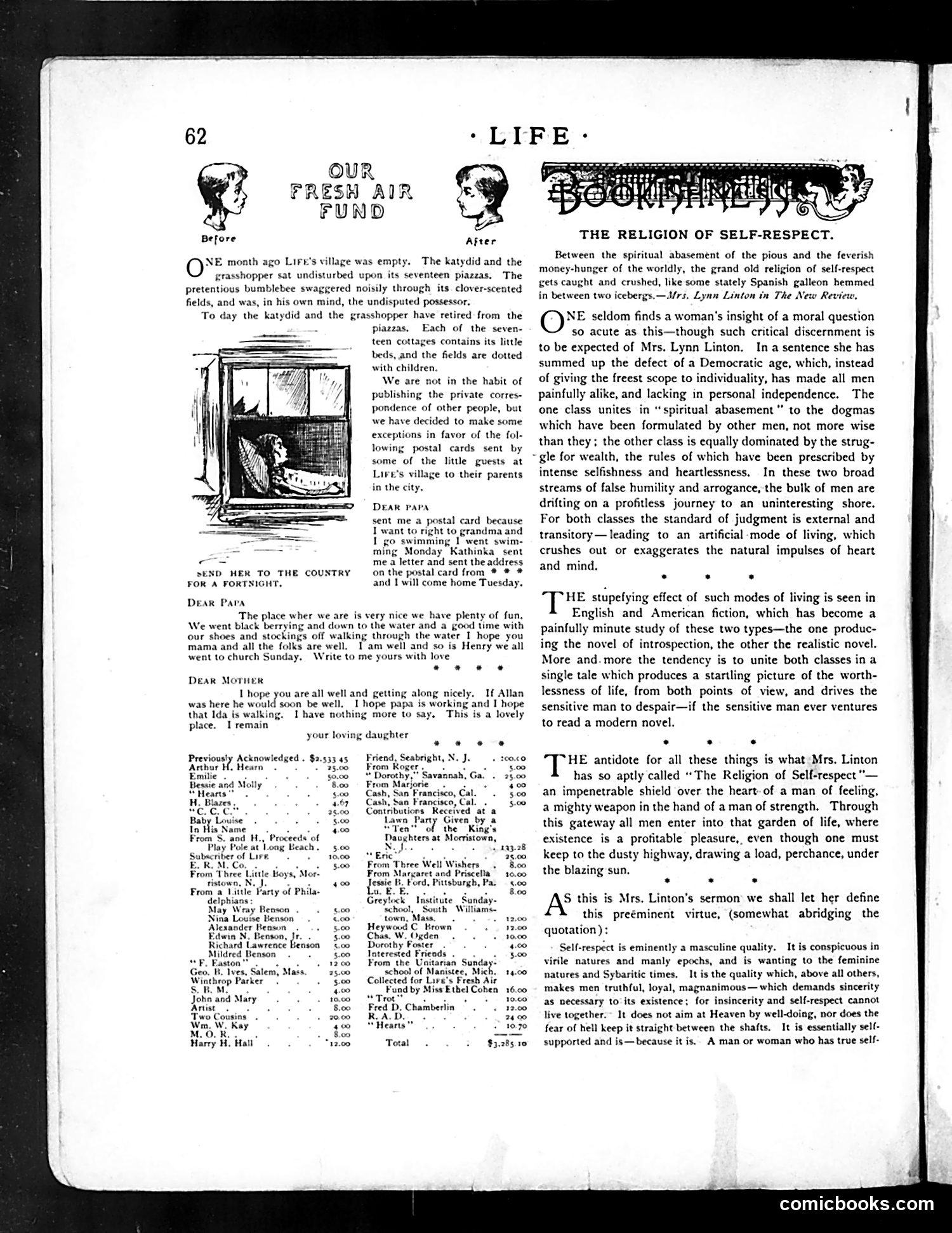
The page contains two distinct sections: **Left side ("Our Fresh Air Fund"):** A charitable appeal featuring before/after illustrations of a child. The "before" shows a sickly urban child; the "after" depicts an improved, healthier version. The accompanying text solicits donations to send poor city children to the countryside for health benefits—a common Progressive Era charitable cause. **Right side ("The Religion of Self-Respect"):** An essay by Mrs. Lynn Linton critiquing modern society's moral failings. She contrasts two classes: the spiritually empty wealthy and struggling workers, arguing both lack genuine self-respect. The piece advocates for personal integrity as life's essential standard. The listings below appear to be acknowledgment of previous contributors to the Fresh Air Fund campaign. This reflects early 20th-century American concerns about urban poverty, charity, and individual morality.
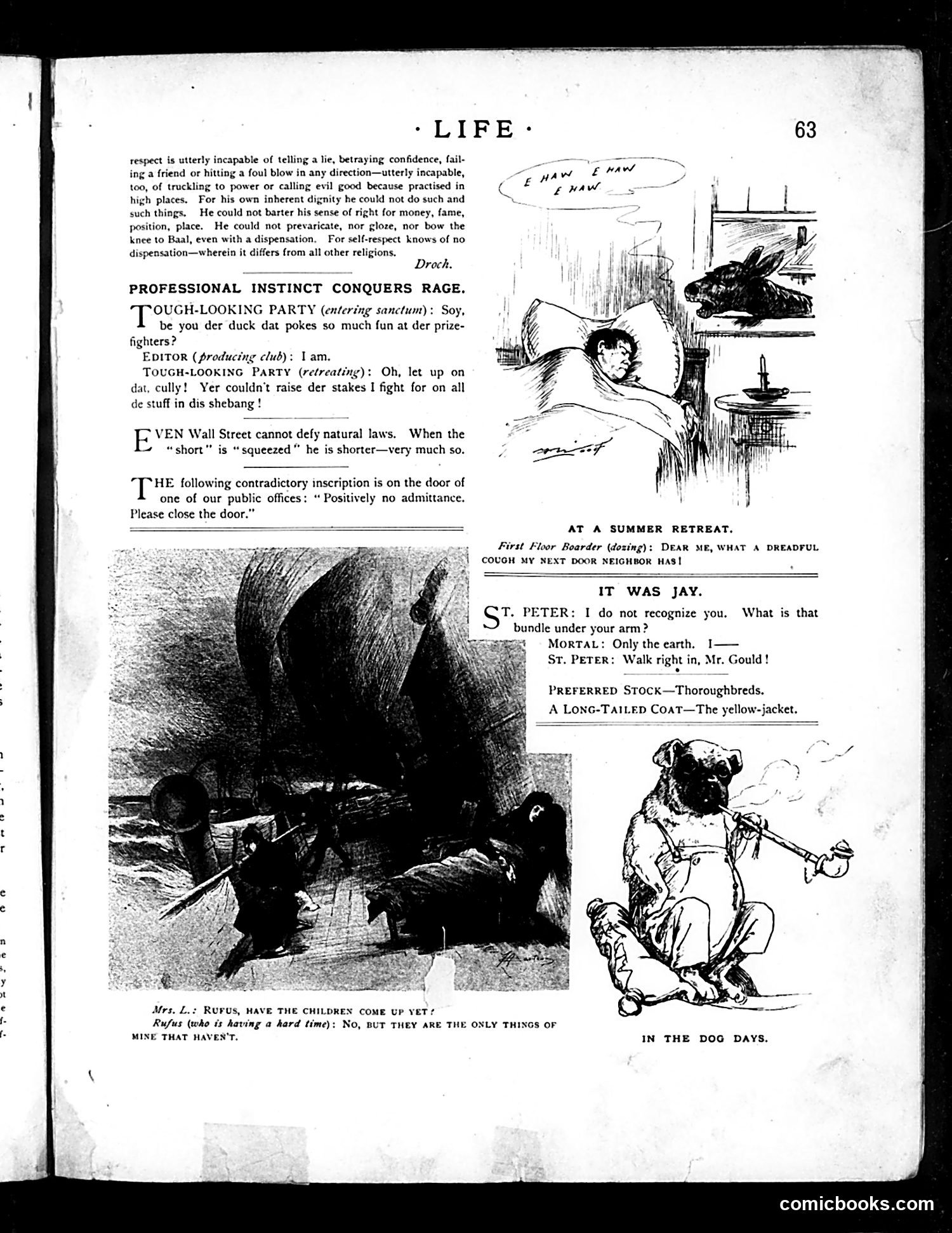
This page contains three separate satirical pieces: 1. **"Professional Instinct Conquers Rage"**: A dialogue between a "tough-looking party" and a "production club" editor, satirizing how professional decorum prevents even angry confrontations from becoming physical—a commentary on workplace civility masking tension. 2. **"Even Wall Street Cannot Defy Natural Laws"**: A brief quip about financial "shorts" being metaphorically "squeezed," playing on stock market terminology with physical humor. 3. **"At a Summer Retreat"**: A dialogue featuring "St. Peter," "Mortal," and "Jay" (a bird), with illustrations of someone sleeping and a dog. The humor involves mistaken identity and the jay's earthy response, suggesting class or spiritual commentary through animal characters. The overall tone is light domestic and social satire typical of early 20th-century Life magazine humor.
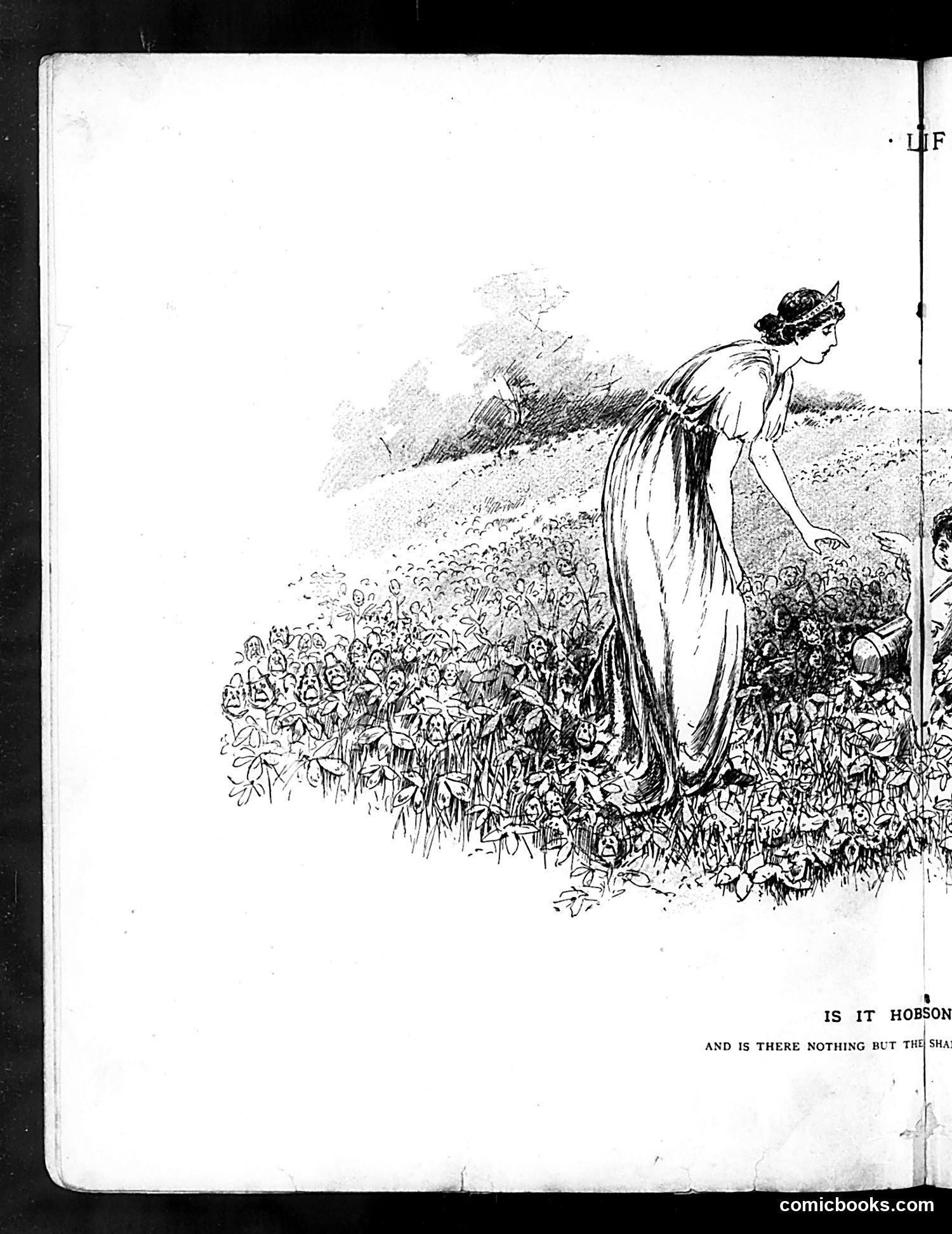
This illustration depicts a classical female figure (appearing to represent Liberty, Justice, or a similar allegorical concept) standing elevated above a large crowd of common people. The figure wears flowing robes and a wreath, gesturing outward in an oratorical pose. The visible text reads "IS IT HOBSON / AND IS THERE NOTHING BUT THE SHA[...]" (text cut off), suggesting this references a political figure or debate, likely involving someone named Hobson. The satire appears to critique either the disconnect between idealistic political rhetoric and common people's experiences, or possibly questions the authenticity of a leader's promises or character. The classical artistic style emphasizes the contrast between lofty ideals and earthly reality.
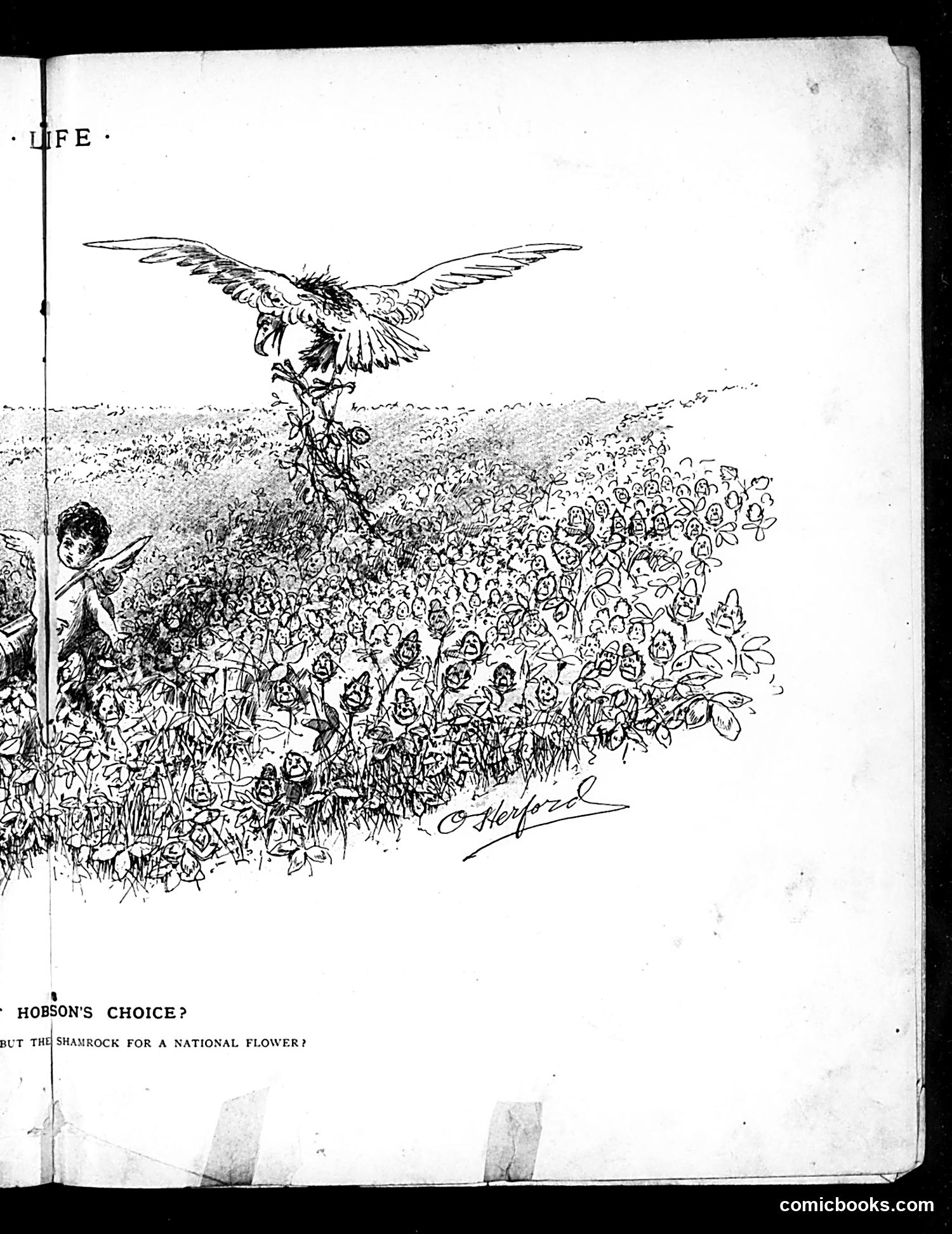
This illustration depicts an eagle descending toward a vast crowd of small figures (suggesting the American public or electorate) in a field of shamrocks. The caption reads "HOBSON'S CHOICE?" followed by "BUT THE SHAMROCK FOR A NATIONAL FLOWER!" The cartoon appears to satirize a debate about selecting a national flower, suggesting it's a false choice or dilemma (referencing "Hobson's choice"—offering only one option while pretending choice exists). The shamrock reference likely alludes to Irish-American political influence or immigration issues of the era. The eagle represents American authority/government, and the dense crowd of faces suggests public sentiment or democratic pressure. The satire implies this flower debate masks or obscures more serious political considerations facing the nation.
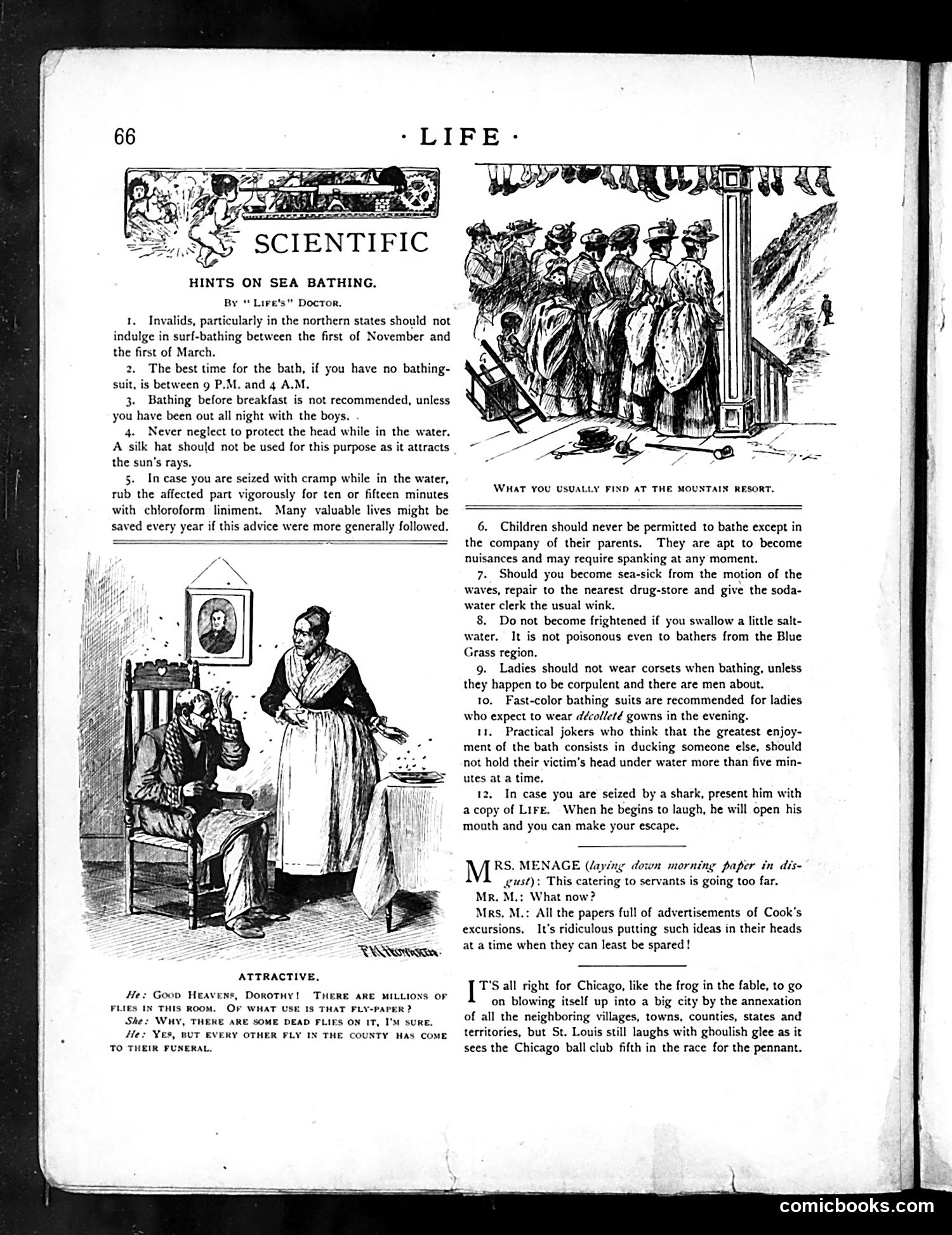
This page combines two unrelated satirical sections: **"Scientific Hints on Sea Bathing"** offers tongue-in-cheek advice, including absurd tips like presenting a copy of *Life* magazine to a shark to make your escape. The humor relies on mock-serious tone applied to ridiculous situations. **"Mrs. Menage" dialogue** shows a domestic scene where a servant reports excessive advertising in newspapers. Mrs. Menage dismisses concerns about poor families affording Cook's excursions, sardonically noting that even Chicago—compared to a bragging frog—pales beside St. Louis's boasting. The satire targets American civic pride and commercial advertising's pervasiveness in 19th-century newspapers. The illustration depicts period-appropriate domestic servants and furnishings.
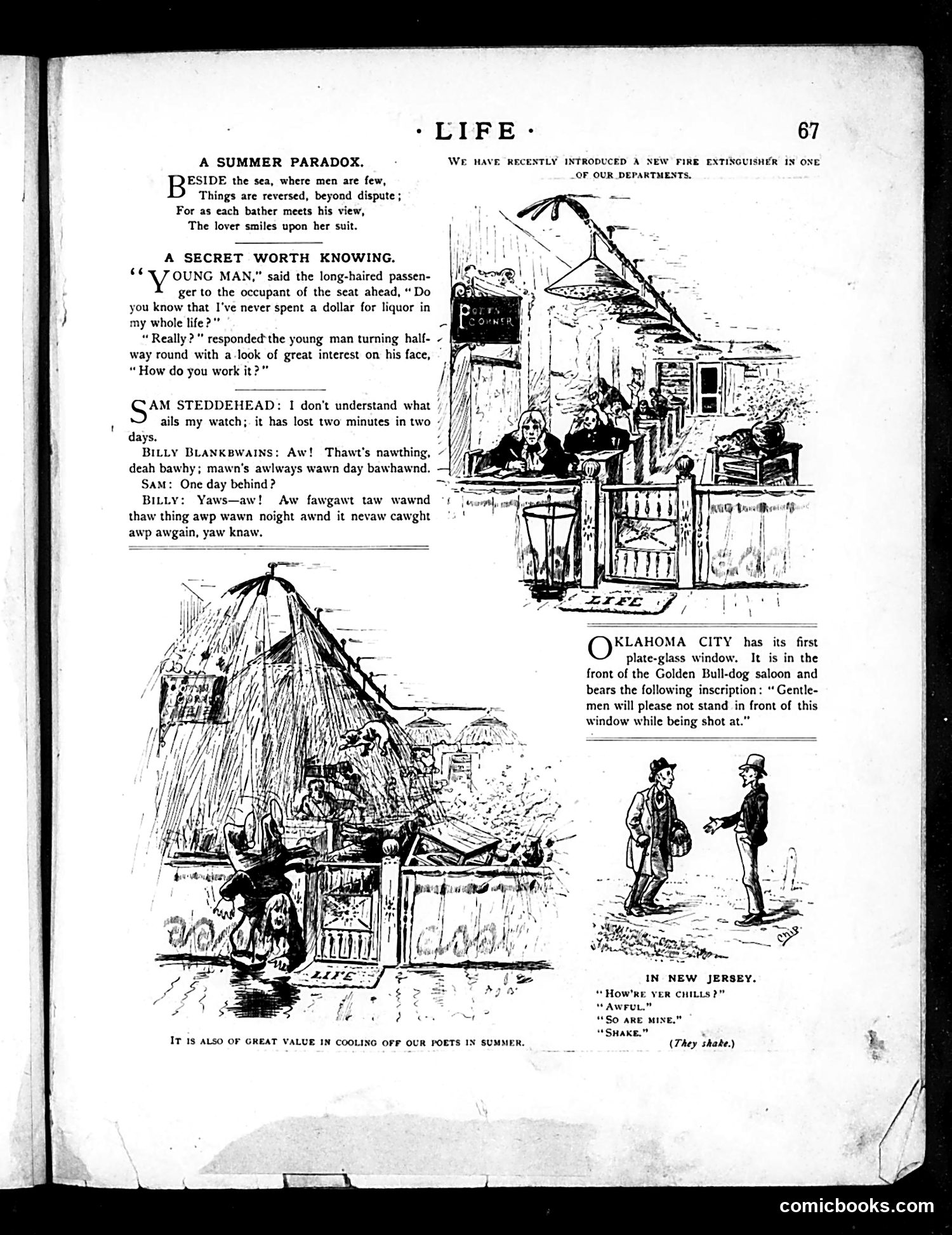
This page contains several humorous vignettes satirizing summer life and American regional peculiarities: **"A Summer Paradox"** jokes about reversed social dynamics at the seaside. **"A Secret Worth Knowing"** depicts a dialogue about a young man's abstinence from alcohol—presented as oddly noteworthy, satirizing either temperance advocates or the rarity of non-drinkers. **"Sam Steddlehead"** and **"Billy Blankwains"** are comic character exchanges using exaggerated dialect (possibly meant to represent regional speech patterns), though the specific references are unclear. The illustrations show seaside and rural scenes typical of 1890s-era American leisure activities. **"Oklahoma City's Plate-Glass Window"** references that town's frontier character, humorously noting a saloon's safety precaution against gunfire. **"In New Jersey"** offers brief coded dialogue ("How's yer chills?" / "Awful") whose specific meaning is unclear today.
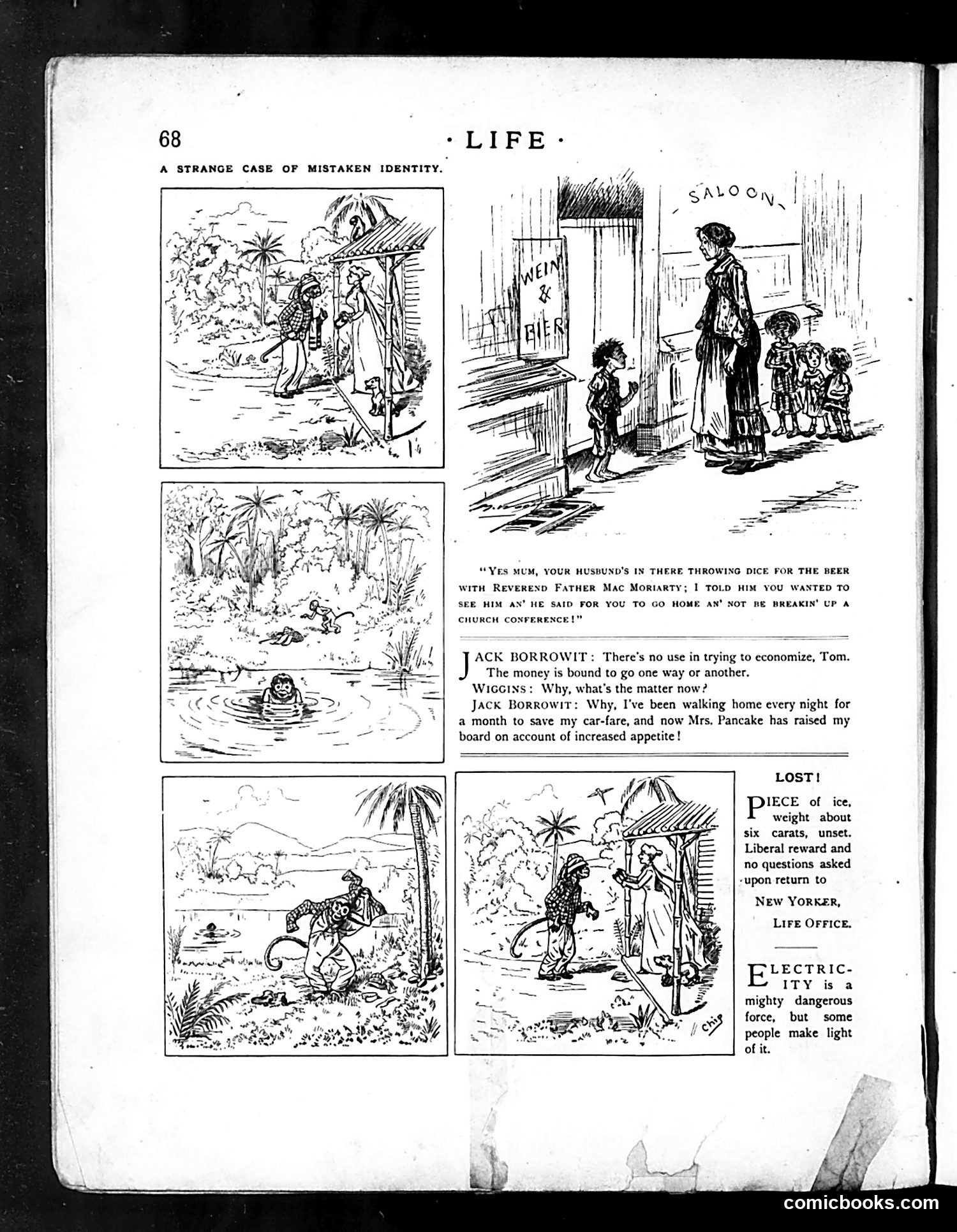
This page contains three separate satirical pieces mocking middle-class hypocrisy and economic folly: **Top cartoon**: A priest uses the excuse of a "church conference" to cover for gambling (throwing dice for beer) in a saloon. The humor lies in the clergy's dubious morality masked by religious pretense. **Middle dialogue**: Two men discuss futile penny-pinching. One walks home nightly to save carfare, only to find his landlady Mrs. Pancake raised his board costs because his increased appetite (from the walks) requires more food. The satire: economic self-sabotage through misguided thrift. **Bottom notices**: Advertisements for a lost diamond and an electrical safety pun ("some people make light of it" regarding electricity dangers). The page satirizes how ordinary people convince themselves their schemes are sensible while achieving opposite results—a common Life magazine theme mocking American materialism and self-deception.
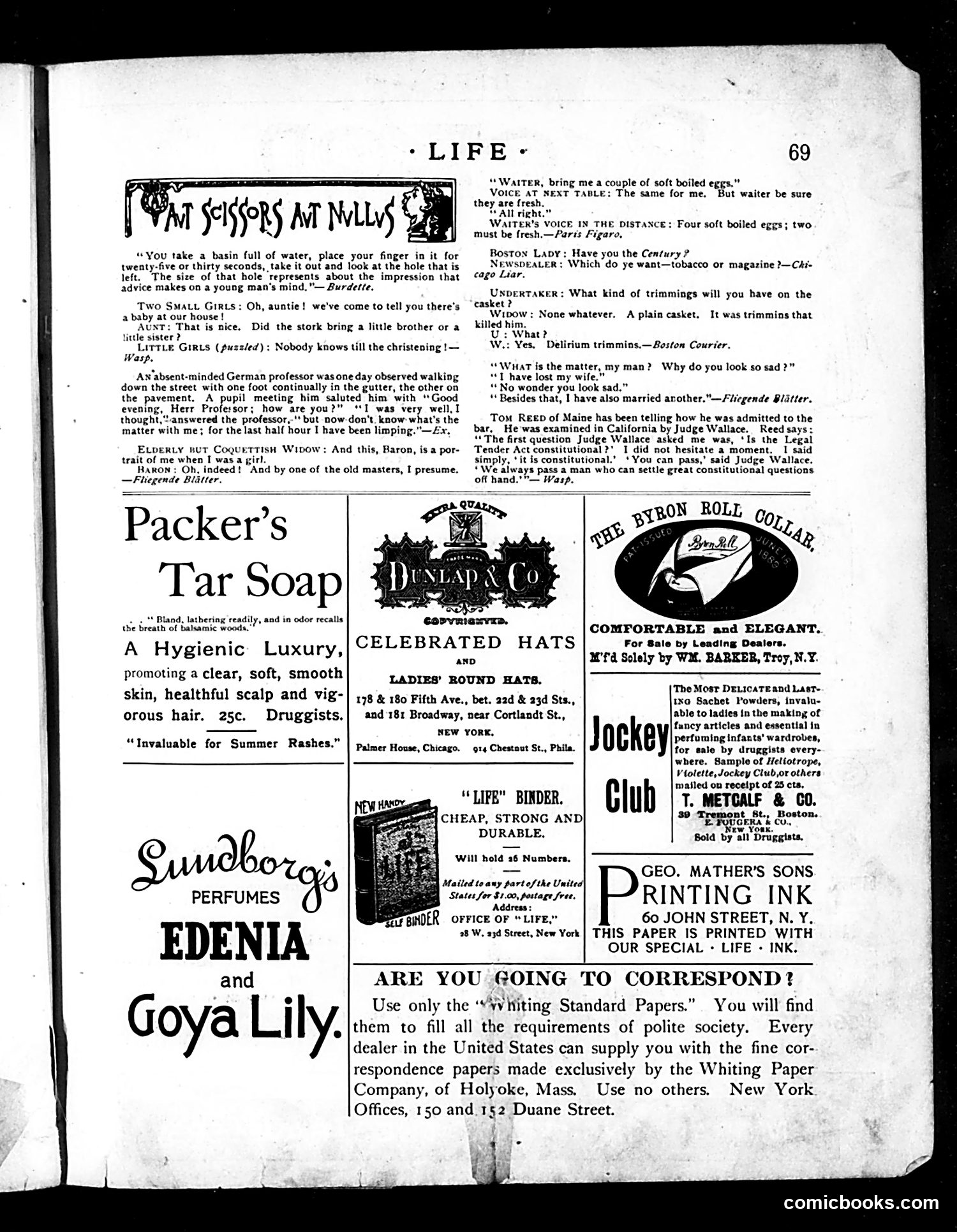
This page from *Life* magazine contains mostly **short humorous anecdotes** rather than visual cartoons. The jokes reflect turn-of-the-century concerns and social observations: - A piece satirizes how easily young men ignore advice - Several jokes play on misunderstandings (a newsdealer confusing "Century" magazine with tobacco; an undertaker mishearing "trimmings") - One anecdote mocks judicial reasoning: a California judge automatically passes a bar applicant who confidently answers a constitutional question, regardless of correctness—suggesting judges care more about confidence than actual legal knowledge - A widow's dark humor about "delirium trimmings" (misheard as decorations) killing her husband **The advertisements** occupy significant space, promoting luxury goods (perfumes, hats, printing ink, soap) to the magazine's middle and upper-class readership. The page is primarily commercial rather than satirical in purpose.
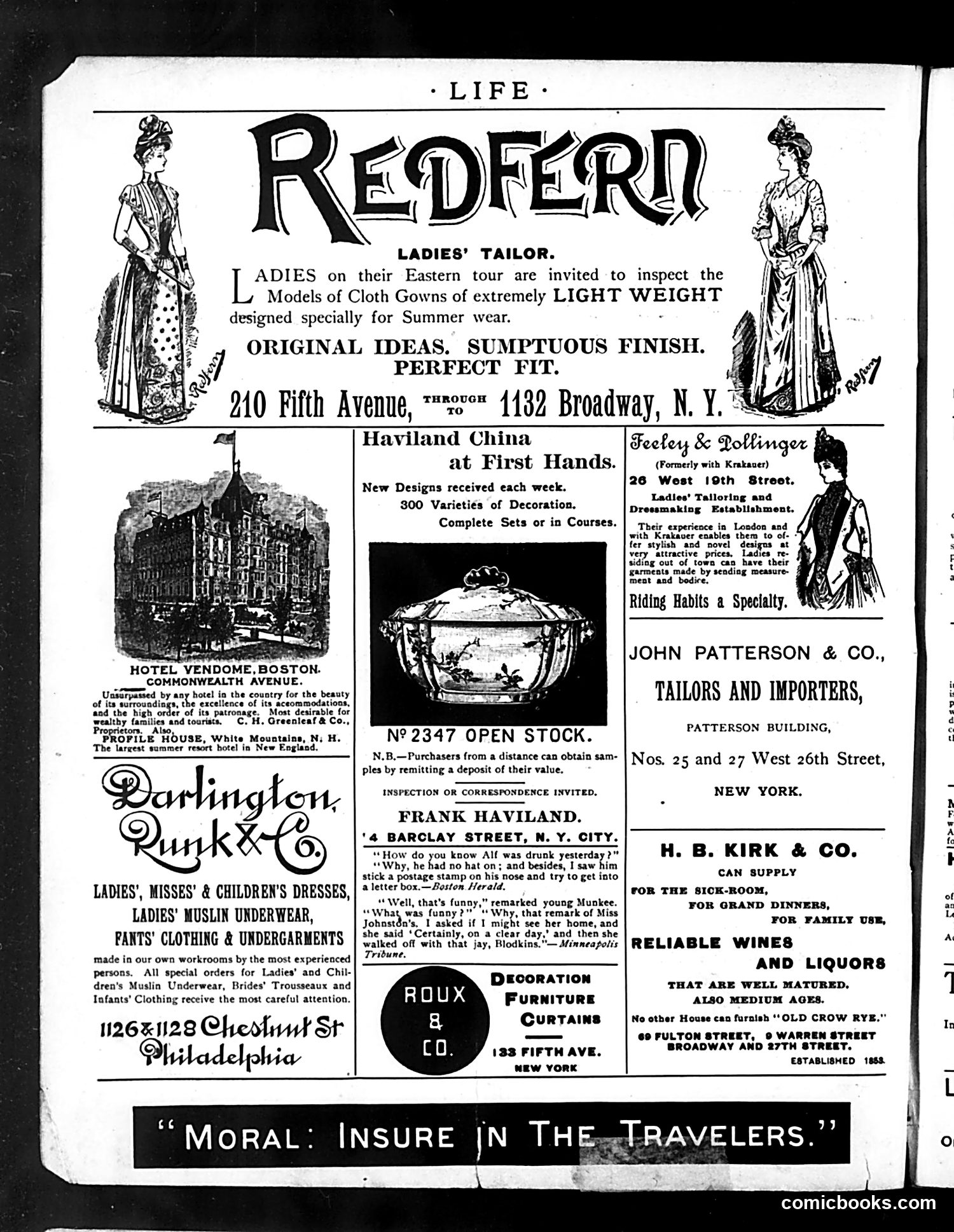
This page from *Life* magazine is primarily **commercial advertising** for late 19th-century New York businesses. The content includes: - **Redfern Ladies' Tailor** (top): promoting lightweight summer gowns for women on Eastern tours - **Darlington, Runk & Co.** (Philadelphia): selling women's dresses and undergarments - **Various NYC merchants**: china, furniture, tailoring, wines, and liquors The only satirical content appears to be two brief **humorous anecdotes** embedded in the advertisements—one about a drunk man mistaking a mailbox for a letter box, another about a mishap at a dance. These are light humor typical of *Life's* style but aren't substantive political or social satire. The page's closing line, "MORAL: INSURE IN THE TRAVELERS," is a tongue-in-cheek advertisement for travel insurance. Overall, this is a standard advertising page with minor comedic flourishes rather than editorial content.
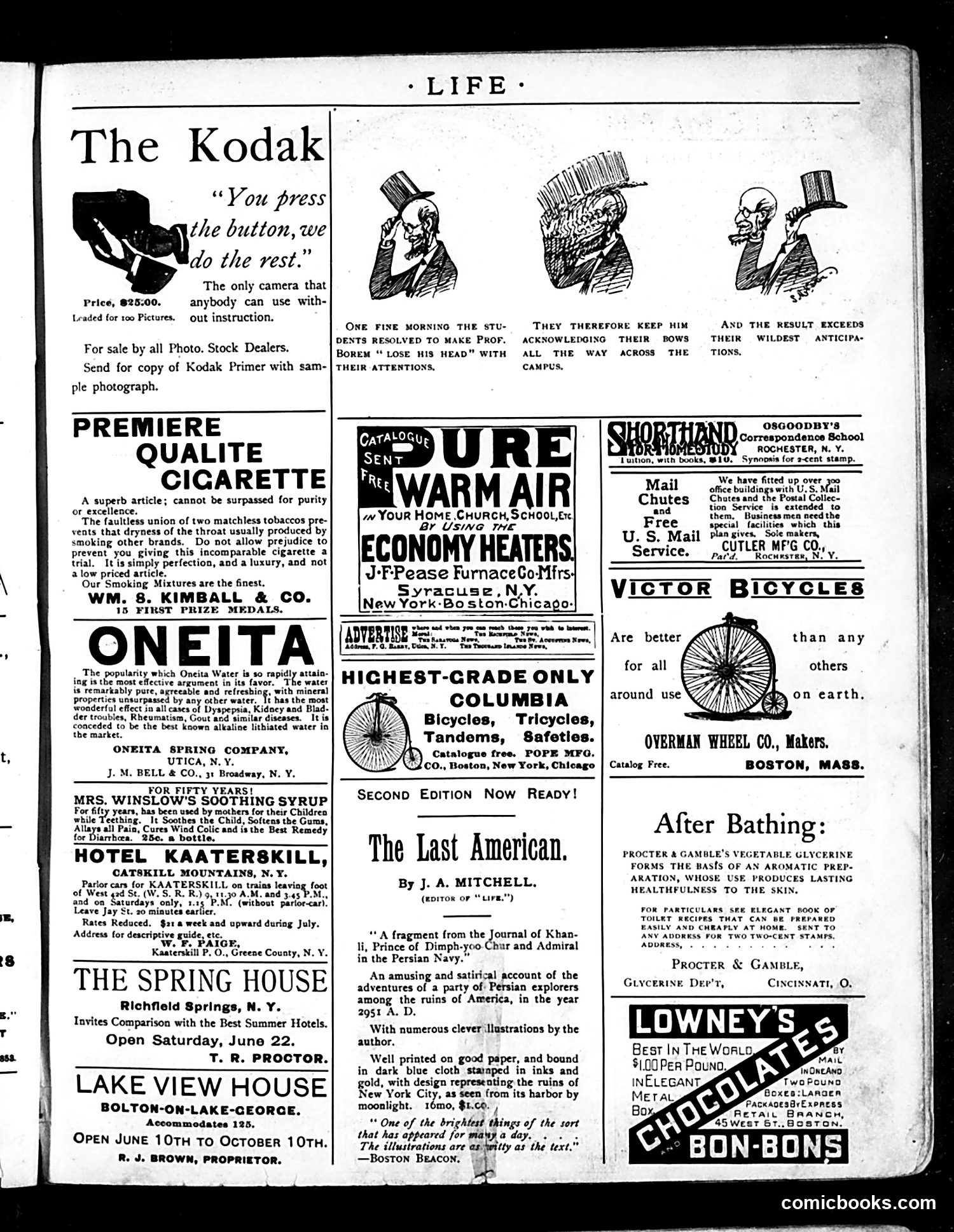
The top of this page features a three-panel cartoon satirizing student pranks at a college campus. The joke depicts students attempting to make their professor "lose his head"—a pun on both embarrassment and literal decapitation via exaggerated caricature. **The gag:** Students greet their professor with such excessive, exaggerated bowing and deference that their persistent flattery backfires. Rather than flustering him, their over-the-top attention causes him to literally lose his composure or dignity, with the final panel showing comically absurd results that "exceed their wildest anticipations." This reflects turn-of-the-century college humor—pranks against authority figures were common fodder for *Life* magazine's satirical content. The caricatured figures (likely drawn to exaggerate Asian features, given the period's crude cartooning conventions) use absurdist humor typical of early 1900s American comedy. The page is primarily advertising; the cartoon occupies minimal space above numerous product promotions (Kodak cameras, cigarettes, mineral water, bicycles).
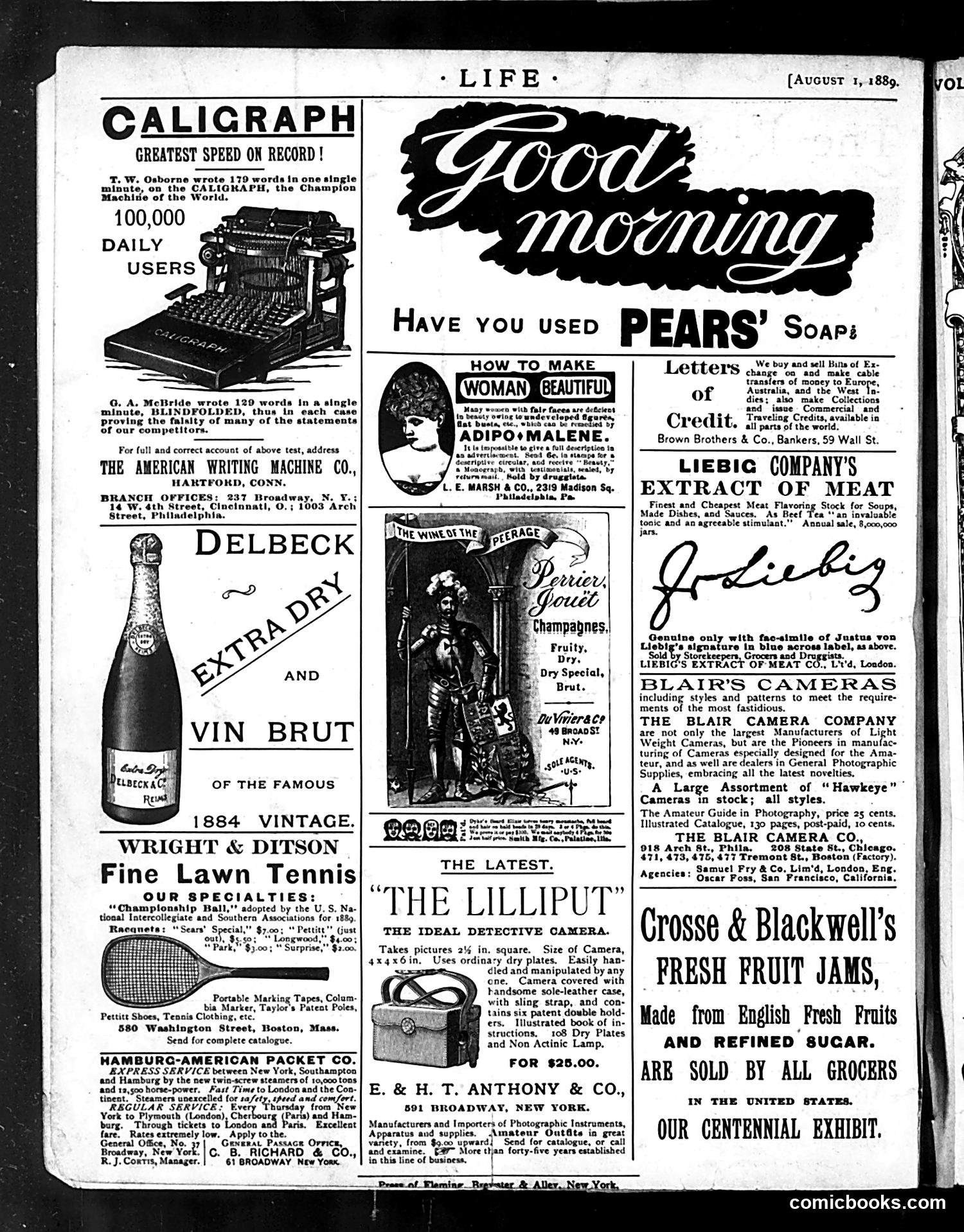
This page is primarily **advertising**, not satire or political commentary. It's a collection of commercial advertisements typical of late-19th-century American magazines. **Notable content includes:** - **Caligraph typewriter**: Boasts speed records (179 words per minute), competing in the emerging typewriter market - **Pears' Soap**: Features a woman's portrait with the tagline "Have you used Pears' Soap?" — representing Victorian-era beauty product marketing - **Liebig Company's Extract of Meat**: Advertises meat extract for cooking and as a health tonic - **Photography equipment**: Multiple ads for cameras ("The Lilliput," Blair Cameras, Anthony & Co.), reflecting the growing amateur photography hobby - **Luxury imports**: Champagne, wine, fine lawn tennis equipment, and ocean liner passage The page reflects 1880s consumer culture: industrial progress (typewriters), Victorian domesticity (soap, food products), leisure activities (tennis, photography), and transatlantic commerce. There is no discernible political cartoon or satirical content—it's a straightforward commercial magazine page.