
Life, 1889-08-01 · page 4 of 16
Life — August 1, 1889 — page 4: what you’re looking at
What you’re looking at
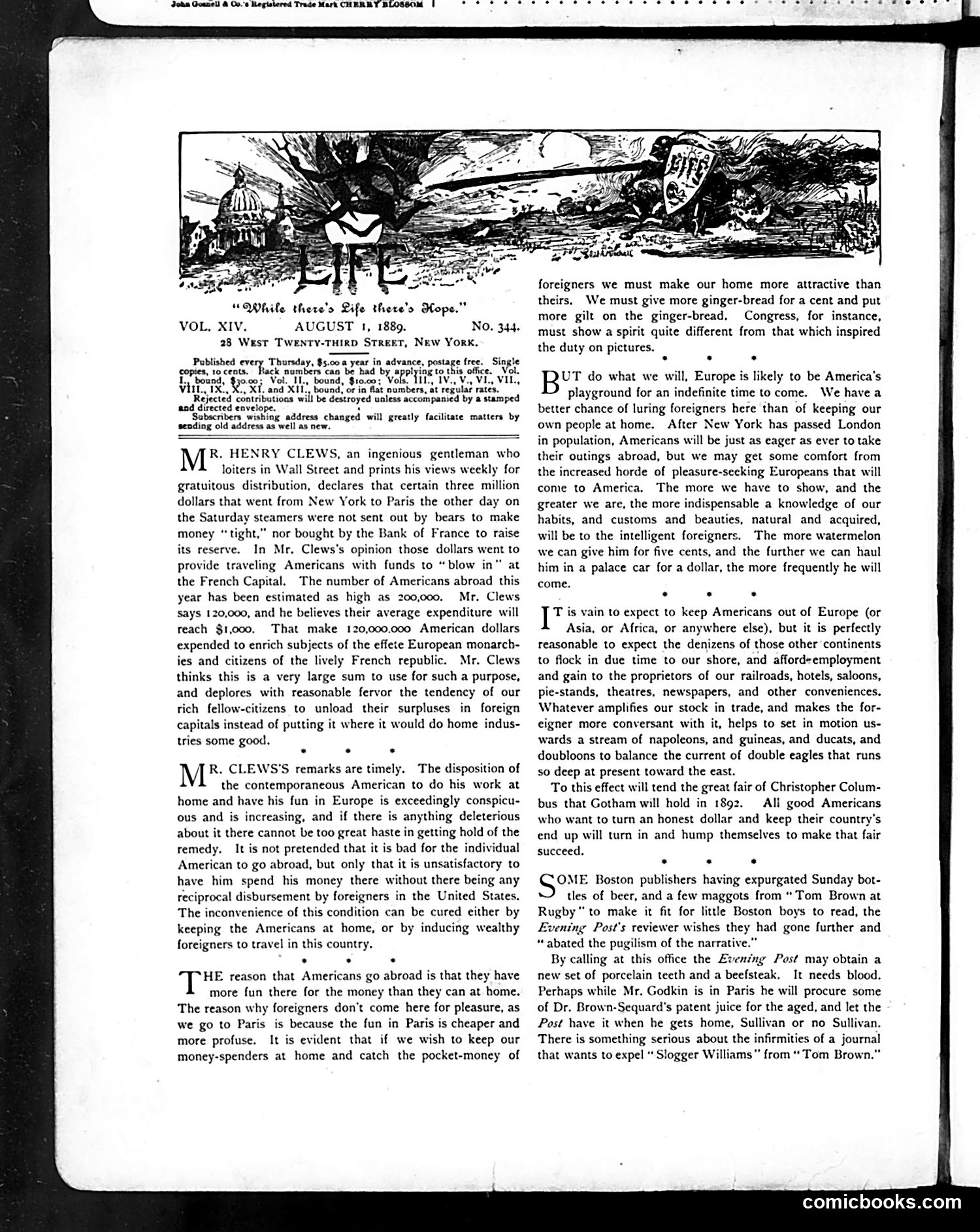
The small header illustration shows a pastoral landscape with the caption "While there's Life there's Hope," typical decorative masthead art. The main text discusses American tourism and spending abroad. It references Henry Clews, a Wall Street financier, who estimated three million dollars left New York weekly for Paris. The author argues Americans should spend money at home instead, to support domestic industries and keep wealth circulating domestically. The satire targets wealthy Americans who find Paris cheaper and more entertaining than home, suggesting this habit drains the nation economically. There's also criticism of Boston publishers and a jab at the *Evening Post* newspaper for sensationalism. No specific political figures are caricatured here; rather, the satire addresses American economic habits and media practices of the era.
📄 Transcribed text from this page (OCR, searchable)
Machine-transcribed from the original scan — historical spelling and the odd misread are preserved.
deka Geanell & Co.'s Registered Trade Mart CHEREY BLOSSOM | va “While there's Life there's Hope.” VOL, XIV. AUGUST 1, 1889. No. 344. 28 West Twenty-THIRD STREET, New York. Published every Thursday, $5.00 a year in advance, postage free. Single cores, 19 cents. hack 5 numbers can be had by applying to this office. Vol. Speen; Volts bound, Stoo: Val IV., V., VI, VIL, vine ax, xt. ae "XI, bound; of in flat numbers, at regular rates. Rejected contributions will be éestroyed unless accompanied by a stamped and directed envelope. Subscribers wishing address changed will greatly facilitate matters by sending old address as well as new. R. HENRY CLEWS, an ingenious gentleman who loiters in Wall Street and prints his views weekly for gratuitous distribution, declares that certain three million dollars that went from New York to Paris the other day on the Saturday steamers were not sent out by bears to make money “tight,” nor bought by the Bank of France to raise its reserve. In Mr. Clews's opinion those dollars went to provide traveling Americans with funds to “blow in” at the French Capital. The number of Americans abroad this year has been estimated as high as 200,000. Mr. Clews Says 120,000, and he believes their average expenditure will reach $1,000, That make 120,000.000 American dollars expended to enrich subjects of the effete European monarch- ies and citizens of the lively French republic. Mr. Clews thinks this is a very large sum to use for such a purpose, and deplores with reasonable fervor the tendency of our rich fellow-citizens to unload their surpluses in foreign capitals instead of putting it where it would do home indus- tries some good. WM R. CLEWS'S remarks are timely. The disposition of the contemporaneous American to do his work at home and have his fun in Europe is exceedingly conspicu- ous and is increasing, and if there is anything deleterious about it there cannot be too great haste in getting hold of the remedy. It is not pretended that it is bad for the individual American to go abroad, but only that it is unsatisfactory to have him spend his money there without there being any reciprocal disbursement by foreigners in the United States. The inconvenience of this condition can be cured either by keeping the Americans at home, or by inducing wealthy foreigners to travel in this country. . . . HE reason that Americans go abroad is that they have more fun there for the money than they can at home. The reason why foreigners don’t come here for pleasure, as we go to Paris is because the fun in Paris is cheaper and more profuse. It is evident that if we wish to keep our money-spenders at home and catch the pocket-money of foreigners we must make our home more attractive than theirs, We must give more ginger-bread for a cent and put more gilt on the ginger-bread. Congress, for instance, must show a spirit quite different from that which inspired the duty on pictures, . . . UT do what we will, Europe is likely to be America’s playground for an indefinite time to come. We have a better chance of luring foreigners here than of keeping our own people at home. After New York has passed London in population, Americans will be just as eager as ever to take their outings abroad, but we may get some comfort from the increased horde of pleasure-secking Europeans that will come to America. The more we have to show, and the greater we are, the more indispensable a knowledge of our habits, and customs and beauties, natural and acquired, will be to the intelligent foreigners. The more watermelon we can give him for five cents, and the further we can haul him in a palace car for a dollar, the more frequently he will come. . . . T is vain to expect to keep Americans out of Europe (or Asia, or Africa, or anywhere else), but it is perfectly reasonable to expect the denizens of those other continents to flock in due time to our shore, and afford-employment and gain to the proprietors of our railroads, hotels, saloons, pie-stands, theatres, newspapers, and other conveniences. Whatever amplifies our stock in trade, and makes the for- eigner more conversant with it, helps to set in motion us- wards a stream of napoleons, and guineas, and ducats, and doubloons to balance the current of double eagles that runs so deep at present toward the east. To this effect will tend the great fair of Christopher Colum- bus that Gotham will hold in 1892. All good Americans who want to turn an honest dollar and keep their country’s end up will turn in and hump themselves to make that fair succeed, . . . OME Boston publishers having expurgated Sunday bot- tles of beer, and a few maggots from “Tom Brown at Rugby" to make it fit for litle Boston boys to read, the Evening Post's reviewer wishes they had gone further and “abated the pugilism of the narrative By calling at this office the Evening Post may obtain a new set of porcelain teeth and a beefsteak. It needs blood. Perhaps while Mr. Godkin is in Paris he will procure some of Dr. Brown-Sequard’s patent juice for the aged, and let the Post have it when he gets home, Sullivan or no Sullivan. There is something serious about the infirmities of a journal that wants to expel “ Slogger Williams" from “Tom Brown.” comicbooks.com