
A complete issue · 16 pages · 1889
Life — July 25, 1889
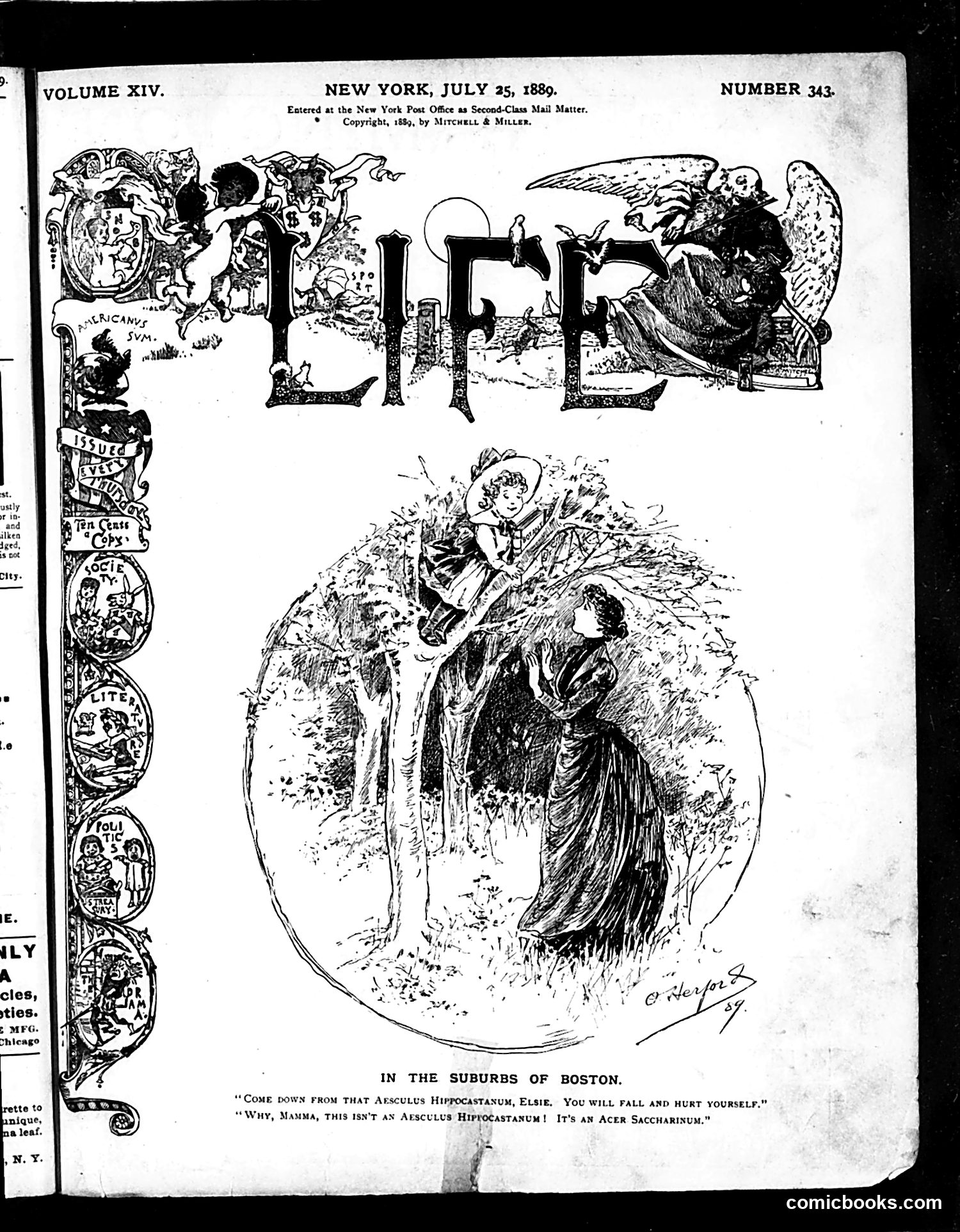
This page features a cartoon titled "In the Suburbs of Boston" showing a woman and child in a tree. The dialogue references "Aesculus Hippocastanum" (horse chestnut) and "Acer Saccharinum" (sugar maple)—scientific plant names. The satire appears to mock overly educated or pretentious Bostonians who use Latin botanical terminology in everyday conversation, even in casual settings like warning a child about tree climbing. The humor relies on the contrast between a simple domestic scene and unnecessarily elaborate scientific language. The ornate decorative border on the left suggests this is from Life's standard satirical format. The cartoonist (signed "Sheridan") targets Boston's reputation for intellectual affectation and learned society culture.
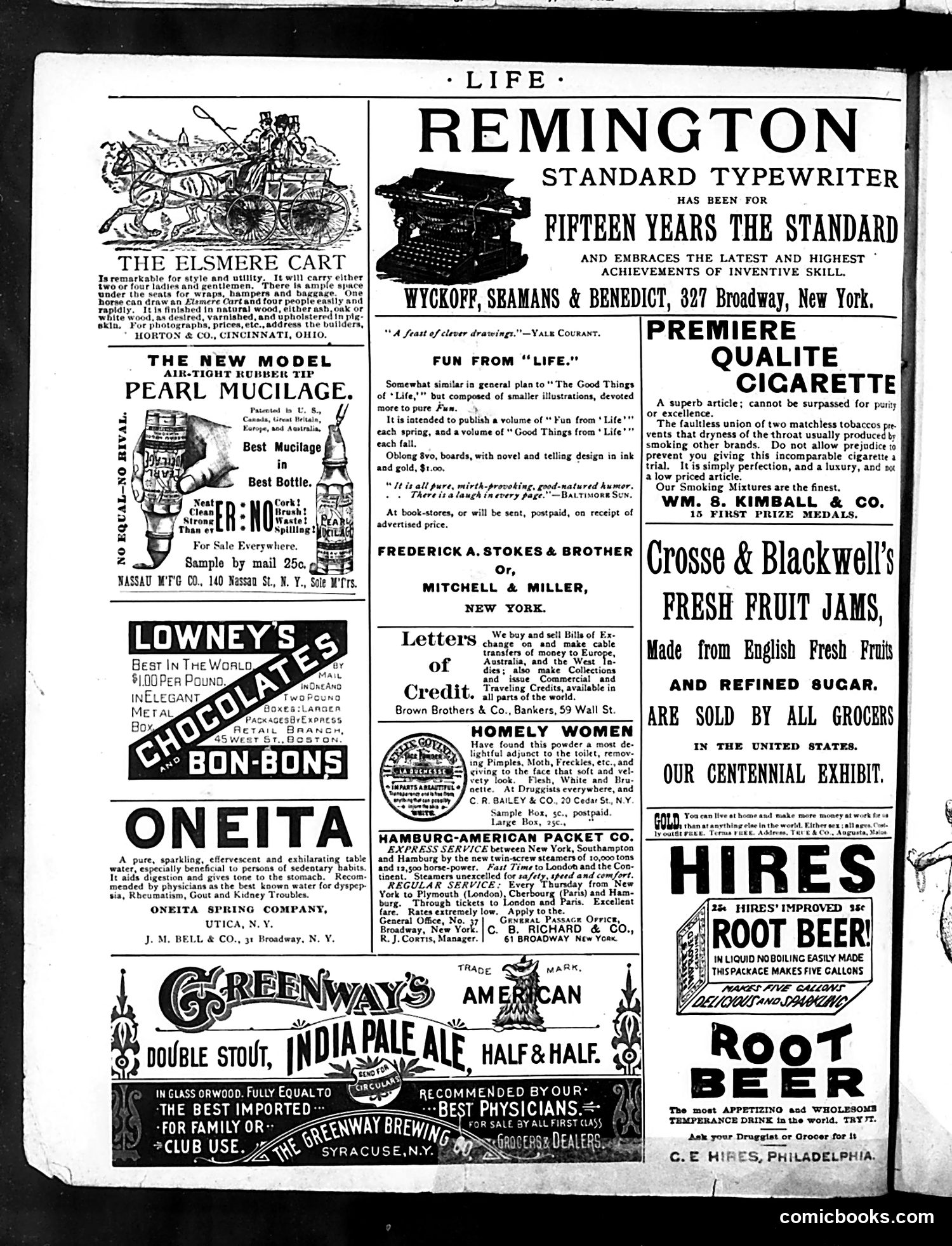
This page is **primarily advertising** with no discernible political cartoon or satirical content visible in the image itself. The page contains vintage advertisements for products including: - Remington Standard Typewriter - Pearl Mucilage (rubber cement) - Lowney's Chocolates - Oneita mineral water - Greenway's beers (Double Stout, India Pale Ale, Half & Half) - Hires Root Beer - Various other consumer goods and services The only non-advertising content appears to be a brief section titled "Fun from 'Life'" mentioning a planned book of humorous illustrations, but no actual cartoon is clearly visible or describable from this reproduction. This represents a typical turn-of-the-century *Life* magazine page mixing editorial mentions with revenue-generating advertisements.
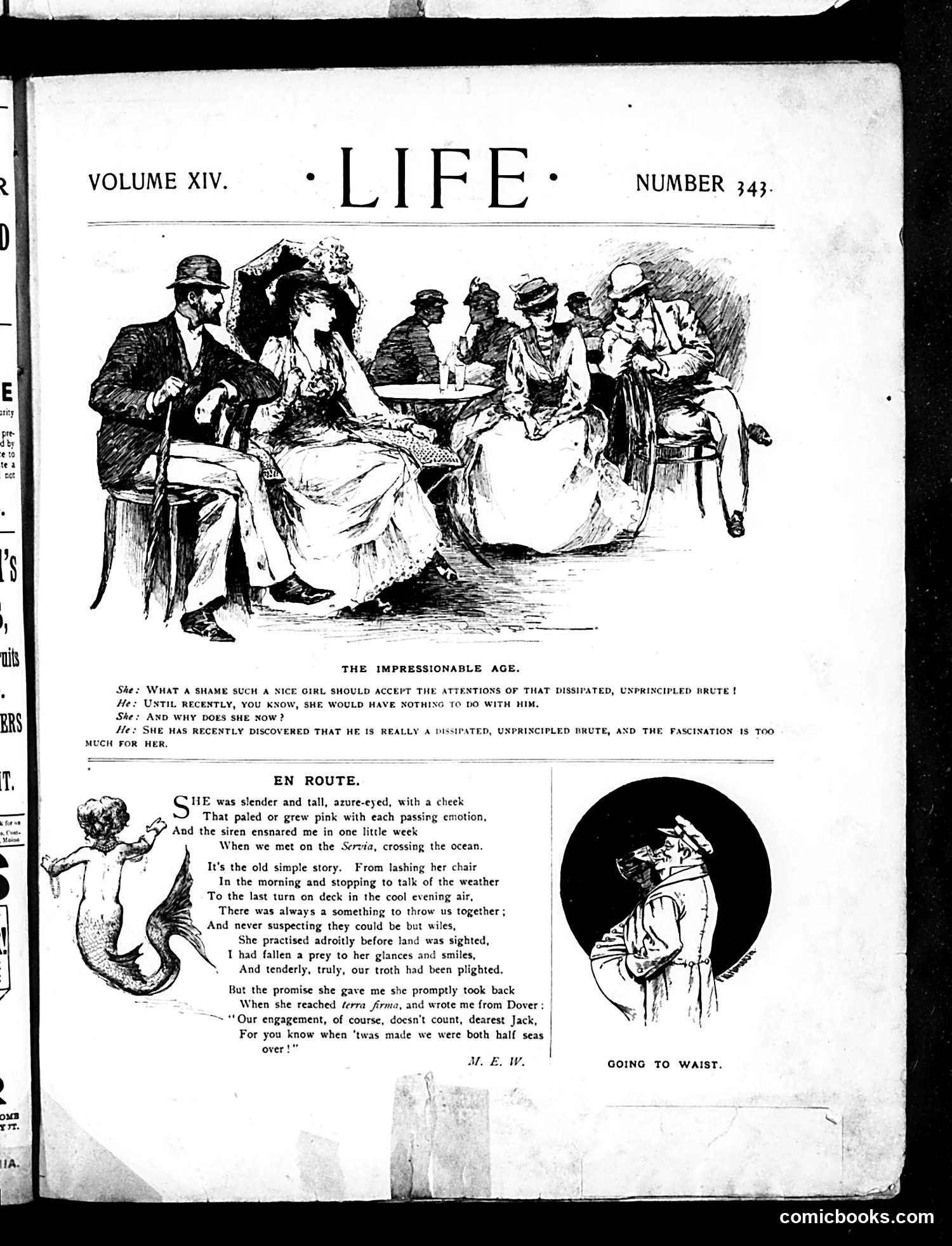
**"The Impressionable Age"** (top cartoon) depicts a social scandal: a young woman is criticized for accepting attention from a "dissipated, unprincipled brute." The joke's irony is that she previously rejected him, but now that she's discovered he's actually a rake, she finds him fascinating—suggesting young women are attracted to dissolute men rather than respectable suitors. **"En Route"** (bottom) is a romantic poem about shipboard romance, describing a brief maritime encounter between the narrator and a woman. The mermaid illustration and "Going to Waist" drawing are decorative elements. The poem's tone is wistful nostalgia for a fleeting romance that couldn't develop into real engagement. Both pieces satirize courtship conventions and female attraction to morally questionable men—typical turn-of-century social commentary.
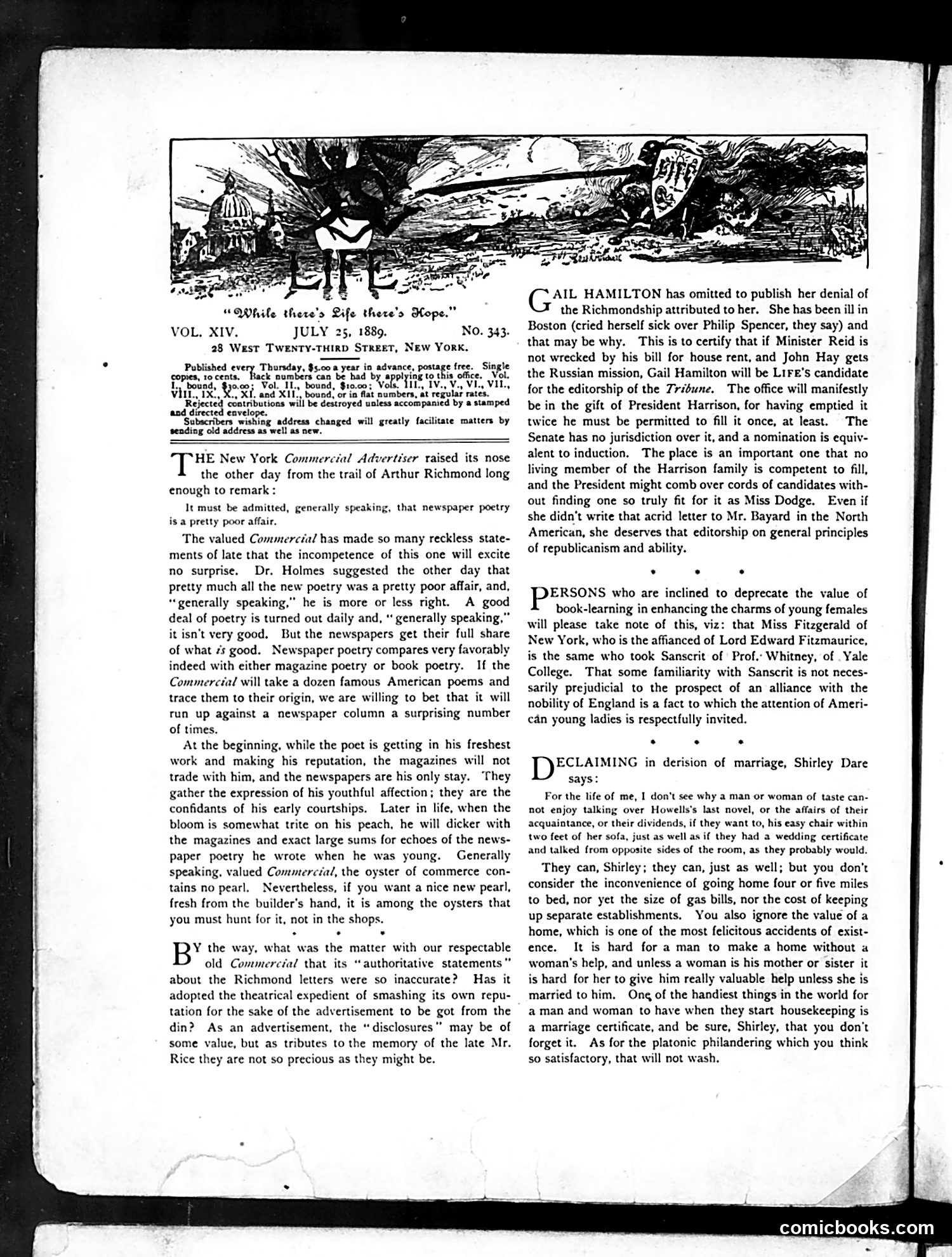
The page contains editorial commentary rather than a political cartoon. The masthead identifies this as Vol. XIV, July 25, 1889, published at 23 West Twenty-third Street, New York. The editors discuss newspaper poetry quality, criticizing the *Commercial Advertiser*'s inconsistent claims about Arthur Richmond's literary merit. They argue newspapers generally publish mediocre verse while magazines preserve better poetry. The right column addresses Gail Hamilton's denial of involvement in the "Richmondship" controversy and discusses her candidacy for editorship of the *Tribune* under President Harrison. A separate item mocks women's book-learning, specifically Miss Fitzgerald's Sanskrit studies at Yale. The final section presents Shirley Dare's commentary on marriage and domestic life. The content is primarily satirical social commentary rather than visual satire.
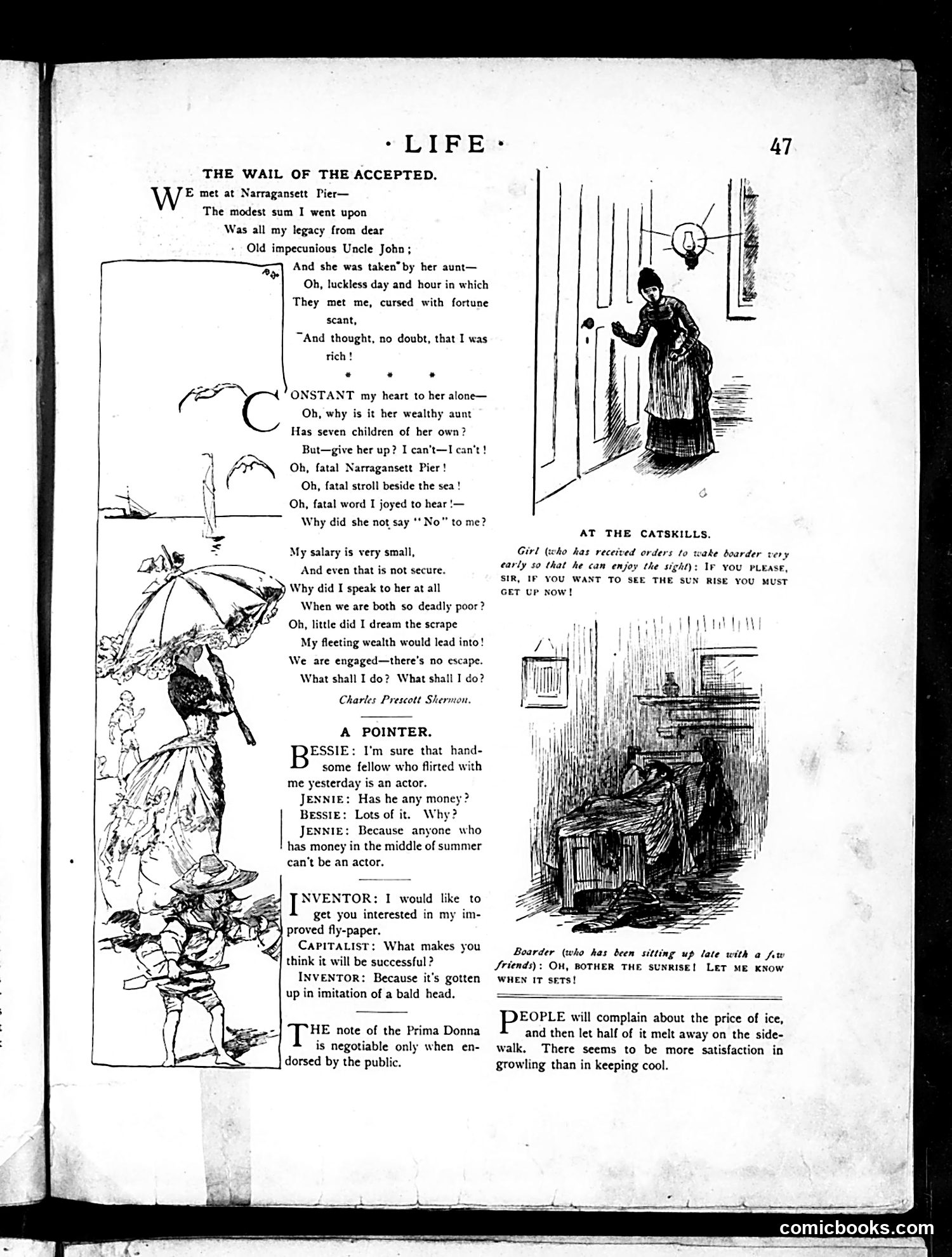
This page contains three distinct humor pieces: **"The Wail of the Accepted"** is a poem about romantic disappointment. A young woman meets a man at Narragansett Pier expecting inheritance from her "Uncle John," but discovers she's poor. She then laments that her wealthy aunt rejected her proposal—apparently the woman proposed to the aunt, seeking security. **"A Pointer"** is a brief comedic dialogue where Bessie explains that only wealthy actors exist in summer, implying poverty and theater don't mix. **"Inventor" section** jokes about a "bald head" fly-paper invention, suggesting satirizing dubious patent claims. The accompanying sketches show period-appropriate domestic scenes. The humor relies on class anxiety and romantic/financial desperation typical of early 20th-century American satire.
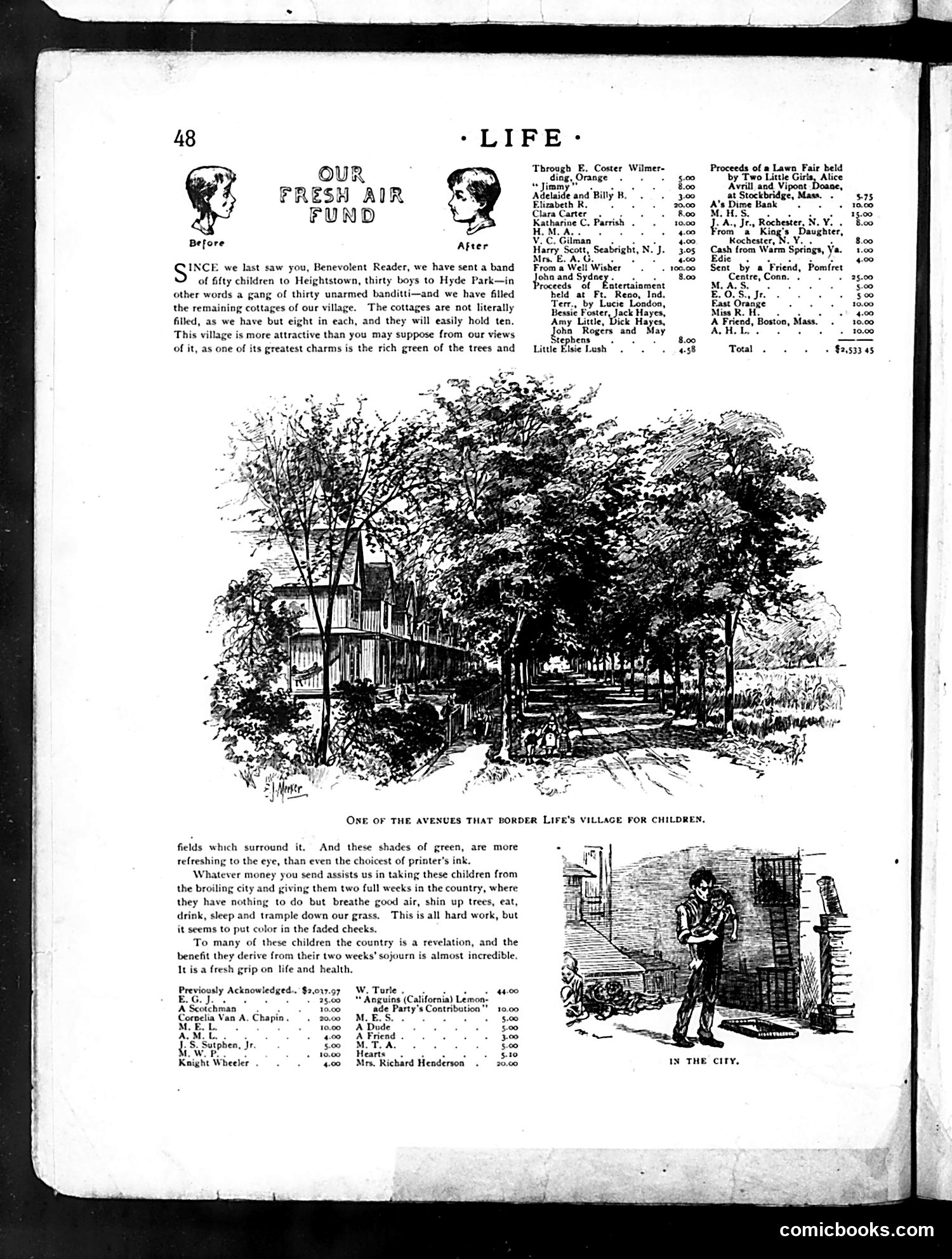
This page describes Life magazine's charitable initiative to send urban children to the countryside. The text explains they've sent fifty children to Heightstown and thirty boys to Hyde Park—"where quiet is a good of thing"—filling "remaining cottages of the village." The illustrated cottage and rural scenes (captioned "One of the avenues that border Life's village for children" and "In the city") present a visual contrast: peaceful trees and pastoral architecture versus urban density. The satire is gentle—the piece praises country air's restorative effects on city children's health ("it seems to put color in the faded cheeks"), while implicitly criticizing industrial urban conditions that make such intervention necessary. The donor list documents contemporary philanthropy rather than political commentary.
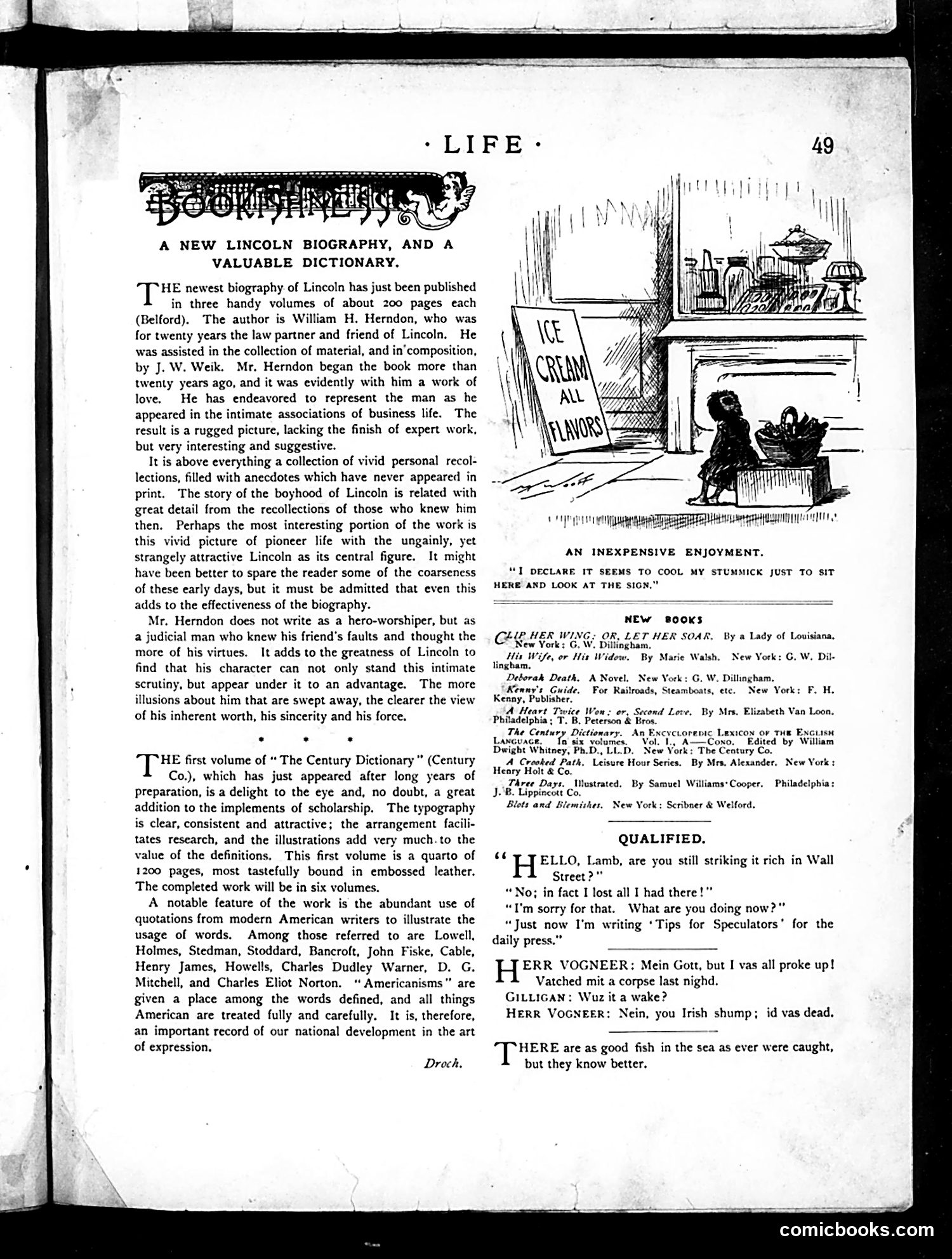
This cartoon depicts a child looking at an ice cream shop window displaying a sign reading "ICE CREAM ALL FLAVORS." The child appears poor or undernourished, gazing longingly at the shop. The caption—"I declare it seems to cool my stumnick just to sit here and look at the sign"—presents dark humor about economic hardship. The joke's bitterness lies in its irony: the child cannot afford ice cream, so merely *looking* at the sign provides imaginary relief from hunger. This reflects early 20th-century American poverty and the desperation of those who could only afford window-shopping rather than actual purchases. The "inexpensive enjoyment" is free—looking—because buying is impossible.
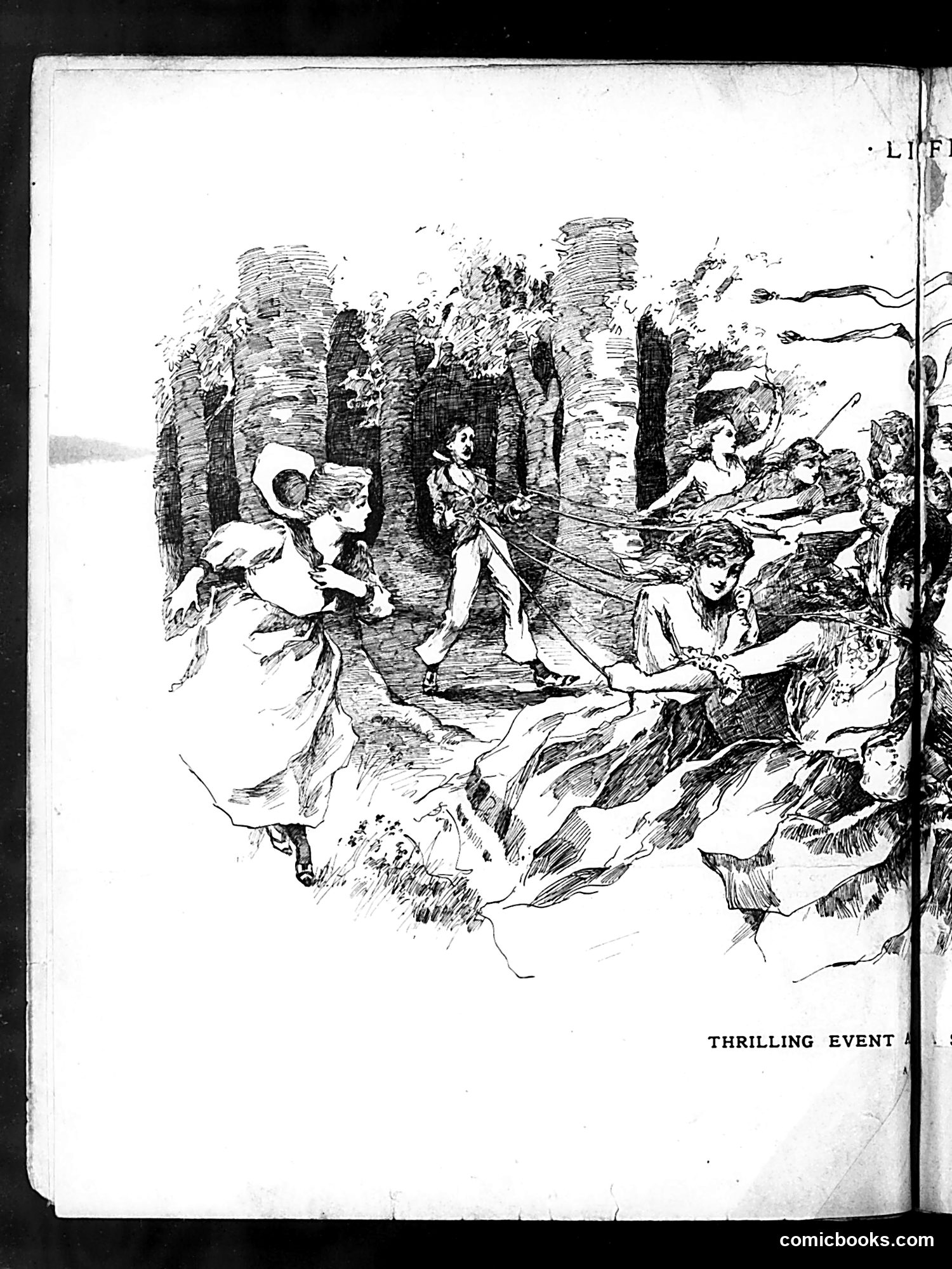
This page presents an illustration titled "THRILLING EVENT" depicting a woodland picnic scene with multiple figures in Victorian-era dress gathered among birch trees. The sketch shows people engaged in recreational activities—some seated, others standing or in motion—suggesting leisure and social gathering. Without additional context from the magazine's accompanying text or caption, the specific satirical point remains unclear. However, given Life magazine's satirical nature, this likely comments on fashionable society's outdoor activities or courtship rituals of the period. The detailed rendering of clothing and poses suggests satire directed at upper-class leisure culture or social pretensions. The image's title implies the scene depicts something considered exciting or noteworthy to contemporary readers, but the precise reference or joke requires the original article text.
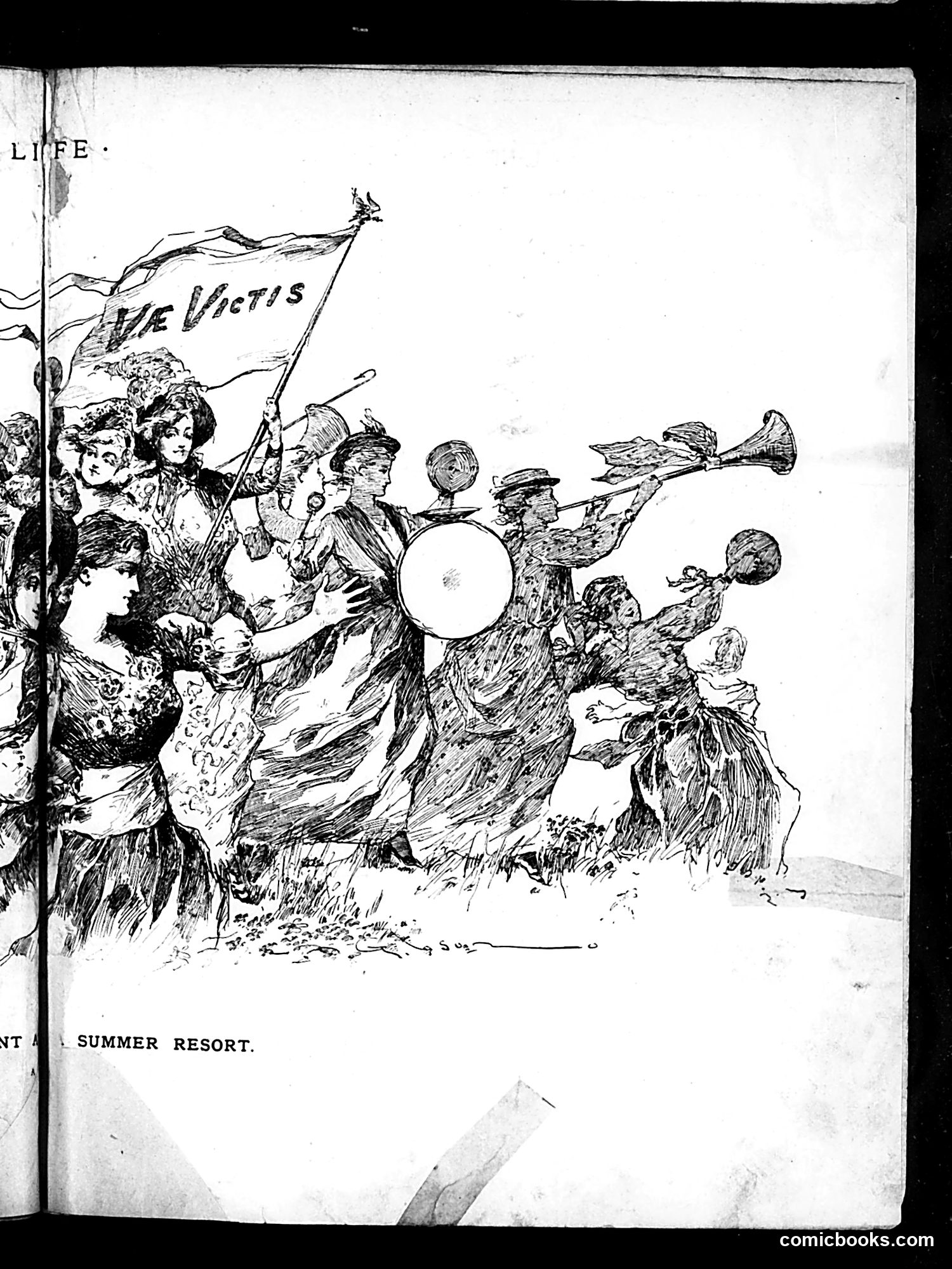
This page shows a satirical illustration titled "A Summer Resort" from *Life* magazine. The cartoon depicts a jubilant crowd of fashionably-dressed women and men celebrating with a flag reading "We Victis" (likely a play on the Latin phrase "Vae Victis"—"woe to the vanquished"). The figures are shown in festive, celebratory poses with trumpets and musical instruments, suggesting a victory celebration. Given the early 20th-century style and the Latin phrase, this appears to satirize women's suffrage advocates celebrating a political victory or milestone. The elaborate dress and exuberant poses mock the participants, reflecting *Life*'s satirical stance on contemporary social movements of the era. The specific victory referenced remains unclear from the visible text alone.
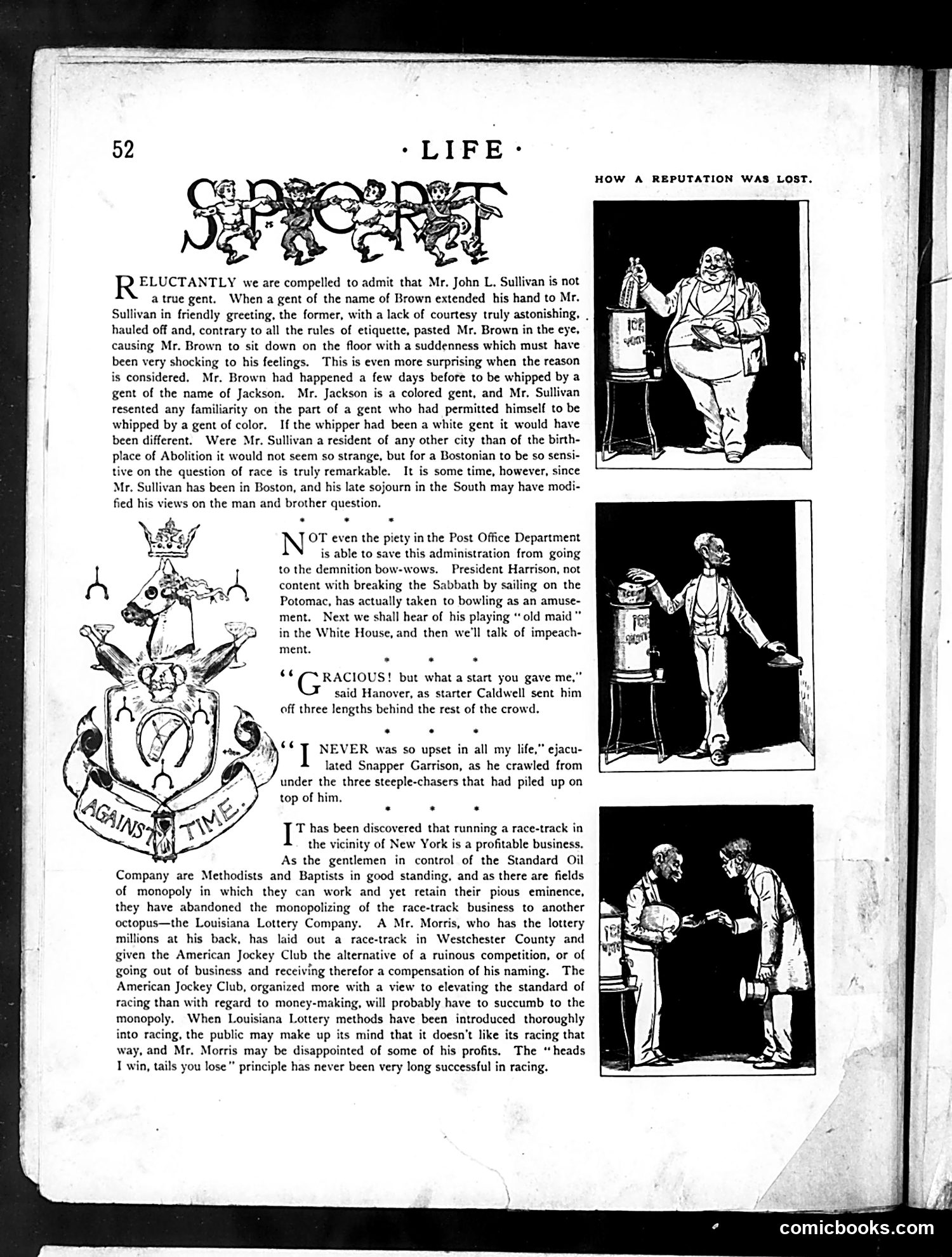
This three-panel cartoon satirizes racial etiquette violations in the late 19th century. The accompanying text describes Mr. John L. Sullivan being embarrassed when he extended his hand in greeting to a Mr. Brown—apparently a Black gentleman—which violated contemporary social conventions. The cartoons mock Sullivan's loss of reputation for this breach. The text references Mr. Jackson, "a colored gent," whom Sullivan had previously allowed to whip him, suggesting Sullivan's inconsistent racial attitudes. The satire targets Northern hypocrisy: Sullivan is a Bostonian (from an abolitionist city) yet enforces strict racial segregation in social interactions. The piece ridicules upper-class pretense and the absurd social rules governing race relations during this era.
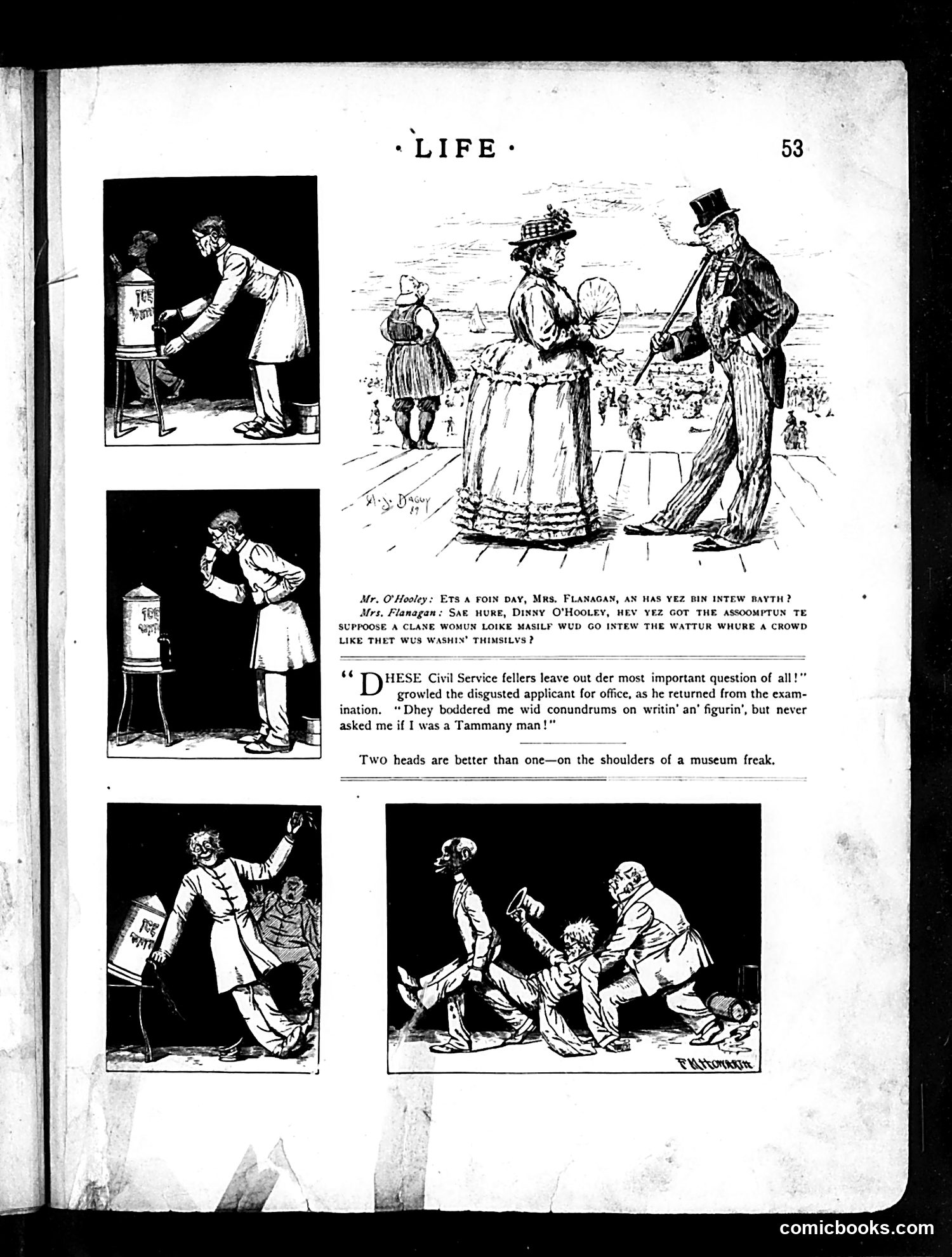
This page satirizes Civil Service examination practices. The main cartoon depicts a job applicant complaining that examiners asked him obscure questions about writing and arithmetic but never asked the crucial question: "if I was a Tammany man!" **The satire targets:** - **Tammany Hall**: New York's Democratic political machine, infamous for patronage and corruption - **Civil Service reform**: The tension between merit-based hiring versus political favoritism The applicant suggests that demonstrating loyalty to Tammany—rather than actual competence—should be the real qualification for government positions. The accompanying humorous sketches show various absurd applicants, reinforcing the joke that political connections mattered more than ability in securing public office. The phrase "Two heads are better than one—on the shoulders of a museum freak" adds additional mockery of bureaucratic incompetence.
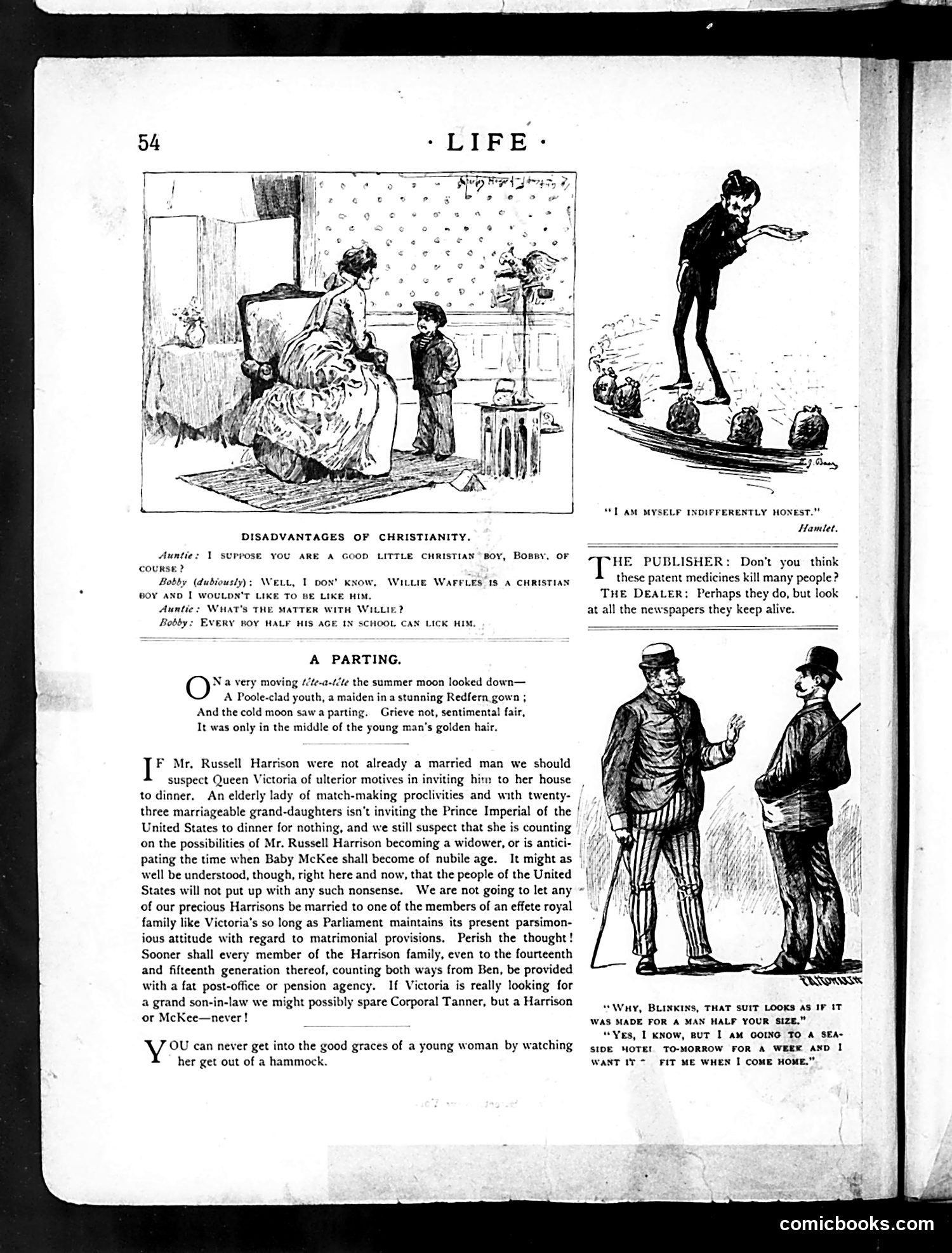
This page contains three satirical pieces typical of 1880s-90s American humor: **"Disadvantages of Christianity"** mocks a boy named Bobby who claims his Christian peer Willie Waffles is weak—every boy half his age can beat him up. The joke: Christianity produces moral virtue but physical weakness, undermining its social value. **"A Parting"** is a romantic poem about a young couple saying goodbye under the moon, with a pun: the separation occurs in "the middle of the young man's golden hair"—suggesting premature baldness rather than heartbreak. **The Russell Harrison section** satirizes potential royal matchmaking between Queen Victoria and President Benjamin Harrison's son. The text expresses American indignation at the prospect of a Harrison marrying into the "effete" British royal family, suggesting even a minor official like Corporal Tanner would be preferable. **Bottom cartoons**: One depicts a publisher and patent medicine dealer cynically discussing how dangerous medicines still profit because newspapers need their advertising revenue. The other shows a man buying an oversized suit to wear on a sea voyage, planning to fit into it upon his return—dark humor about weight loss or mortality.
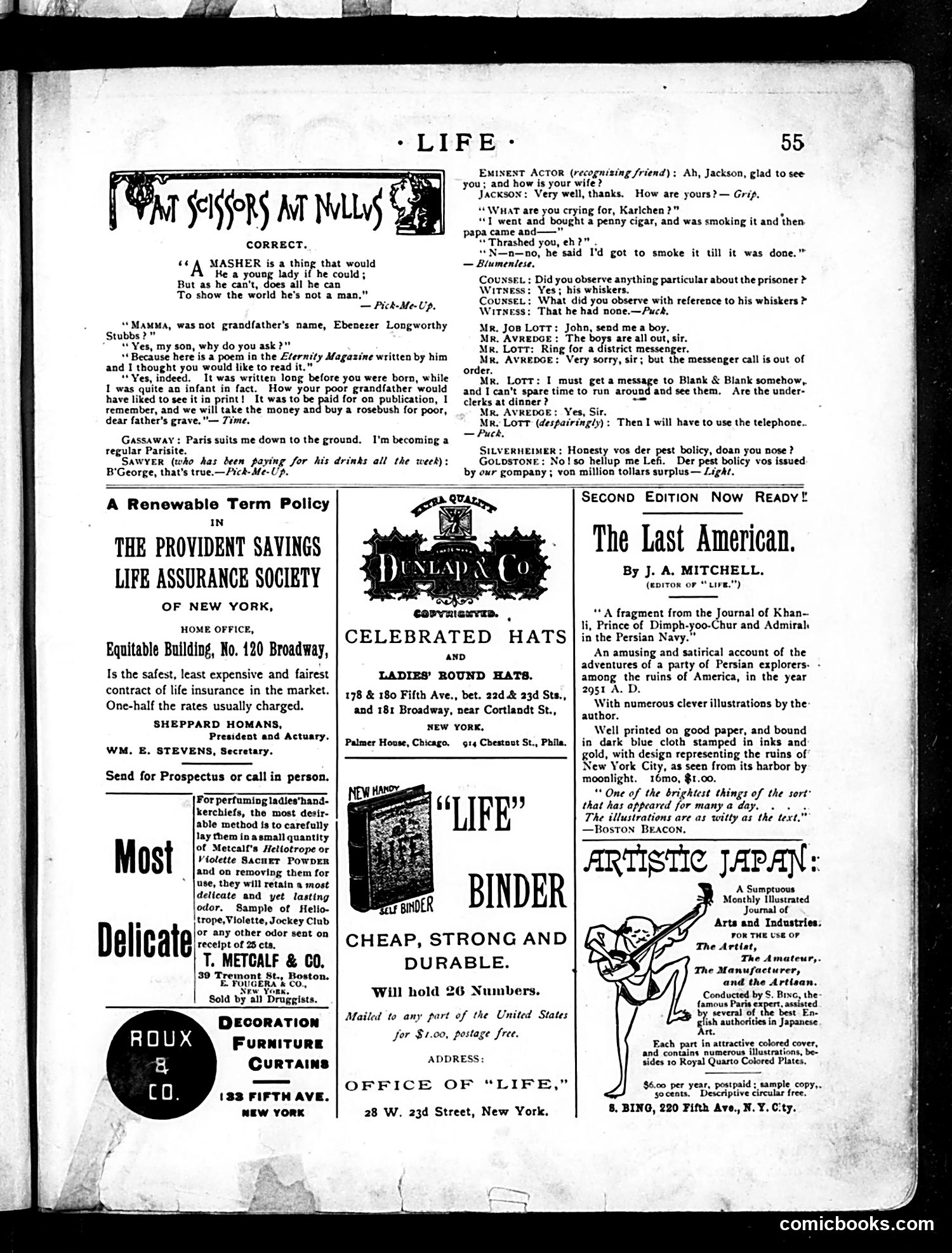
This page is primarily **advertisements and miscellaneous jokes** rather than a coherent political cartoon. The main content consists of brief comedic one-liners from various sources (Puck, Grip, Blumentese, etc.). These include: - A definition of "masher" (a man pretending to be more refined than he is) - Jokes about a boy forced to finish smoking a cheap cigar - A courtroom exchange where a witness describes a prisoner's notable feature as his *lack* of whiskers - Workplace humor about messengers and telephones being unavailable The **satire is gentle social commentary**: poking fun at pretentious men, parental discipline, legal absurdities, and the limitations of Victorian-era office communication systems. The page also advertises insurance, perfumed powders, furniture, hat shops, and notably "The Last American"—a speculative fiction book imagining Persian explorers visiting ruined America in 2951 A.D., suggesting satirical commentary on American civilization itself. No specific political figures or major events are referenced.
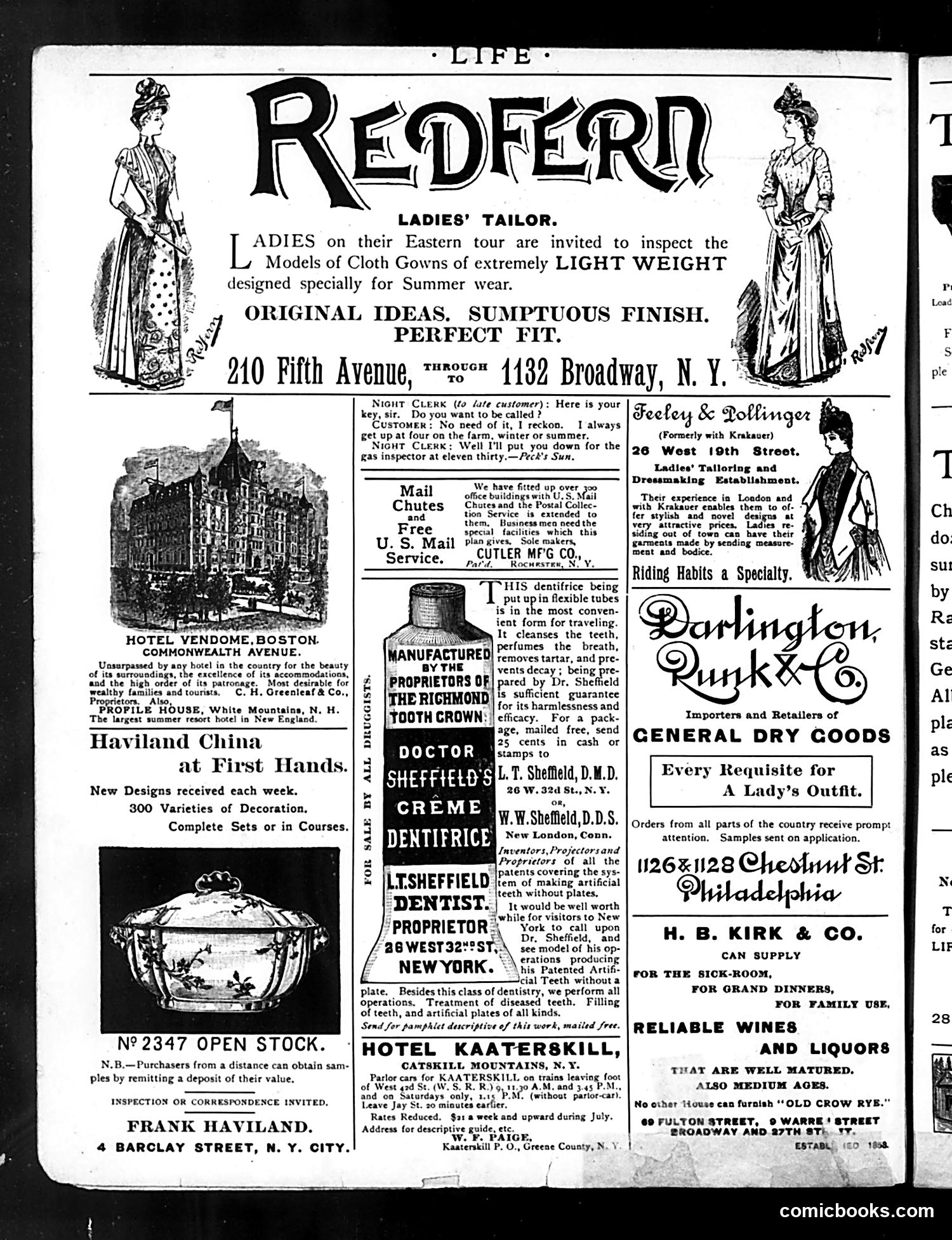
This page is primarily **advertisements**, not political satire or cartooning. It's from an American magazine's commercial section featuring various businesses aimed at affluent, urban readers of the era. The single **joke/cartoon** appears in the small anecdote labeled "Night Clerk" — a brief humorous exchange between a hotel clerk and a farm customer. The farmer, accustomed to rising at 4 a.m. regardless of circumstances, tells the clerk not to bother calling him. The clerk responds by placing him on the wake-up list for "the gas inspector at eleven-thirty" — meaning the customer will sleep so late he'll still be asleep when someone arrives to inspect the gas. It's mild rural-versus-city humor mocking the farmer's early-rising habits. The rest of the page consists of ads for ladies' tailors, china, dental services, mail chutes, and hotels—commercial content typical of Life magazine's revenue model.
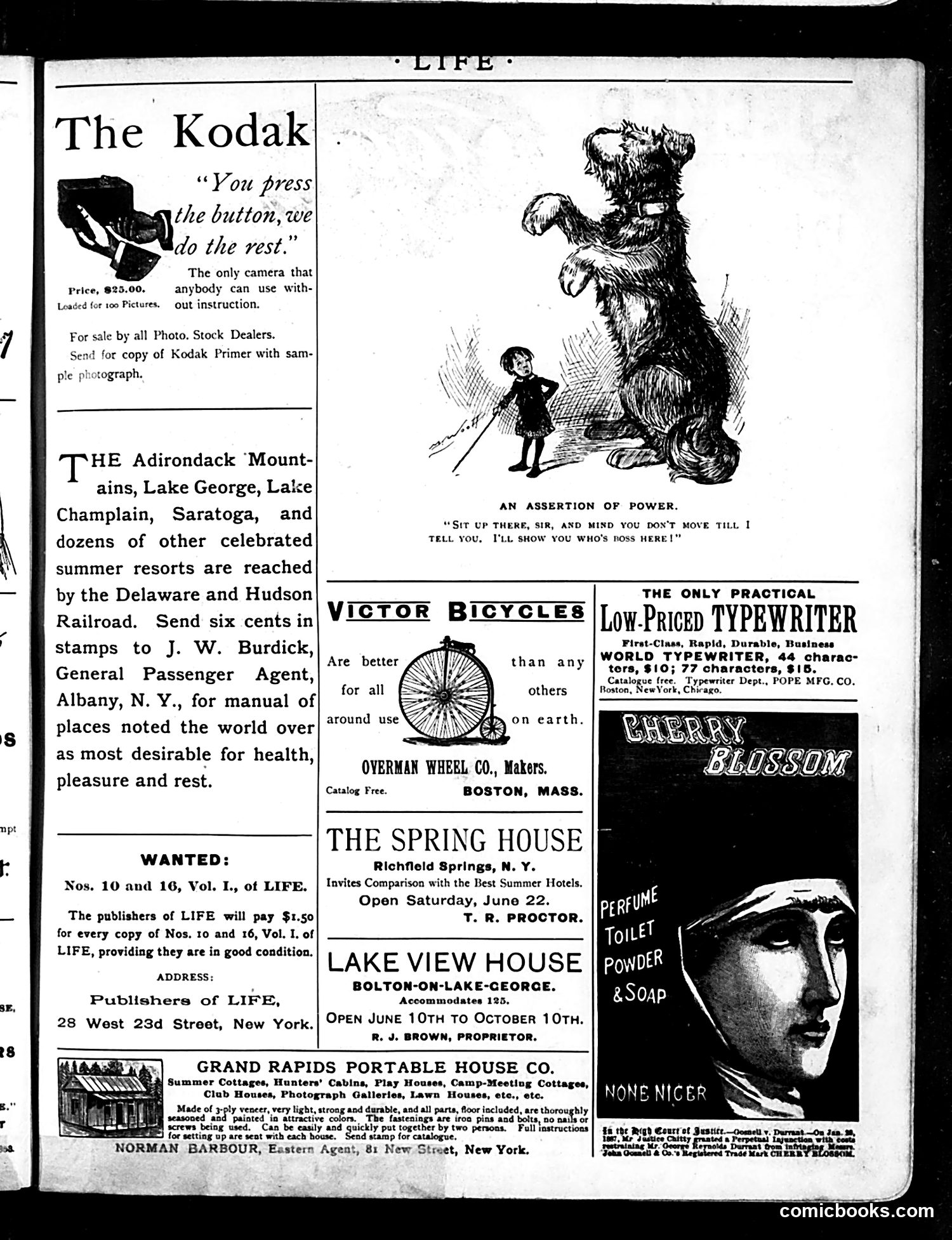
This single cartoon depicts a small child standing before a large, aggressive dog rearing up on its hind legs. The caption reads: "Sit up there, sir, and mind you don't move till I tell you. I'll show you who's boss here!" The humor is ironic: the child attempts to dominate the dog through verbal commands and posturing, but the visual disparity makes clear the child is entirely outmatched and in genuine danger. The joke satirizes human pretension—specifically, the tendency of the weak or powerless to assert dominance through bluster and threats rather than actual authority or ability. This likely reflects broader social commentary about false confidence or hollow authority claims common in the era, though the specific satirical target remains unclear from context alone. The page is primarily advertising (Kodak cameras, bicycles, typewriters, hotels, and portable houses).
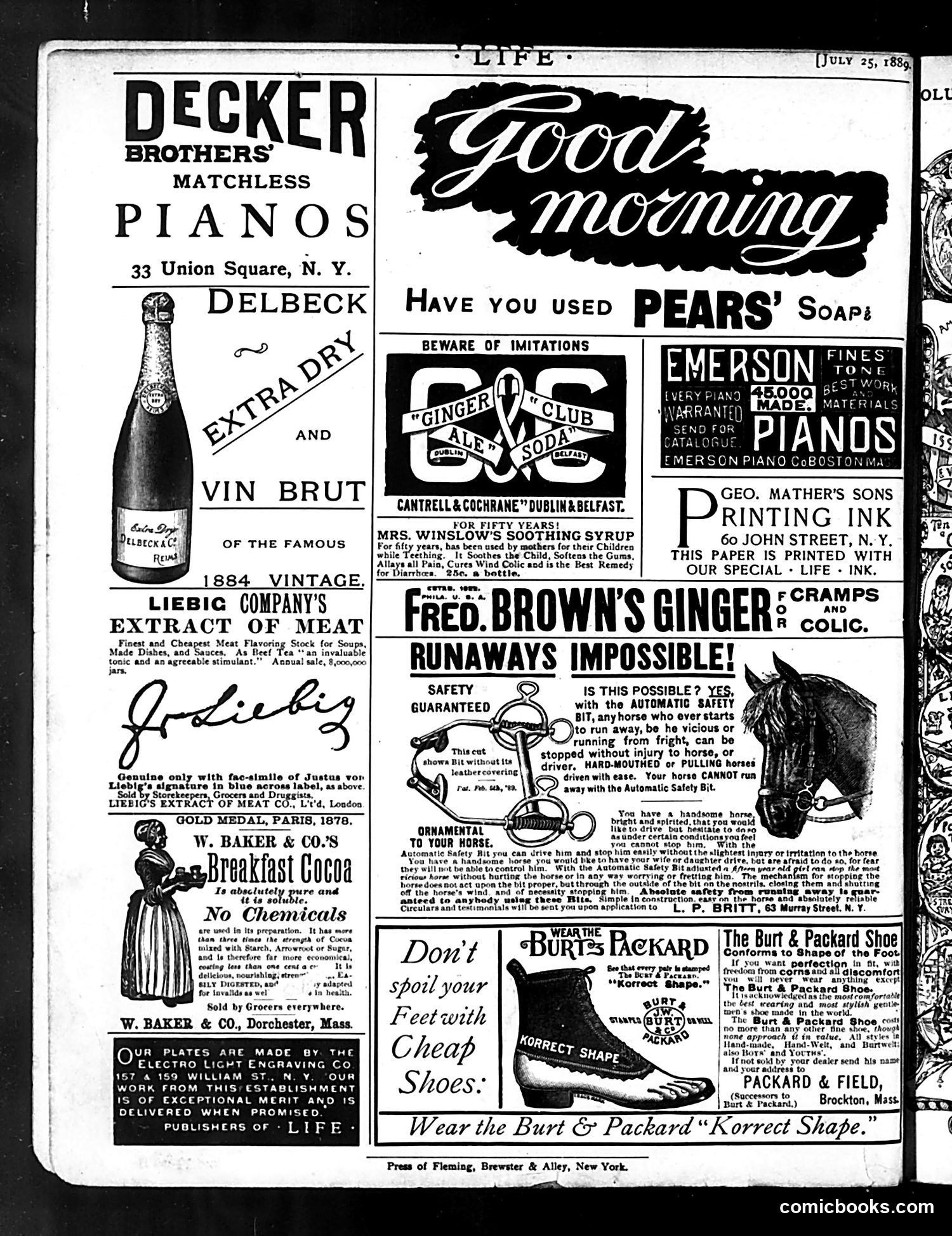
This is primarily an **advertising page** from Life magazine, not a political cartoon. It contains various Victorian-era product advertisements typical of the period. Notable ads include: - **Decker Brothers pianos** and champagne - **Liebig's Meat Extract** — a popular branded meat flavoring, sold globally (8 million jars annually) - **W. Baker & Co. Breakfast Cocoa** — emphasizing it contains "no chemicals" - **Pears' Soap** — warning against counterfeits - **Mrs. Winslow's Soothing Syrup** — a children's remedy (contains opiates, though not disclosed) - **Automatic Safety Bit** — a horse control device marketed to prevent runaways - **Burt & Packard Shoes** — emphasizing correct foot shape The page reflects late-19th-century consumer culture, with manufacturers claiming medical/safety benefits and warning against imitations—common practices before modern FDA regulation and consumer protection laws.