
Life, 1889-07-25 · page 10 of 16
Life — July 25, 1889 — page 10: what you’re looking at
What you’re looking at
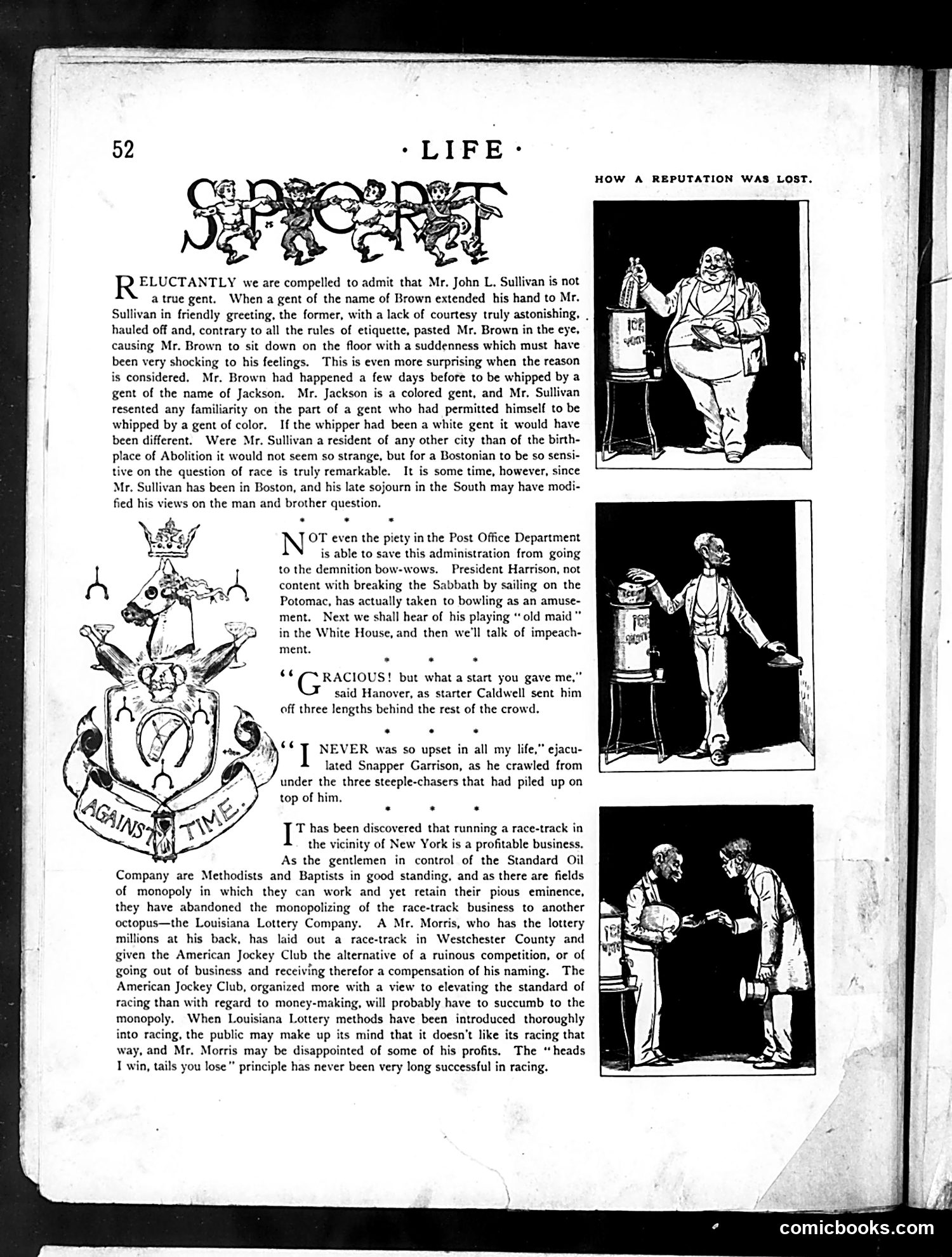
This three-panel cartoon satirizes racial etiquette violations in the late 19th century. The accompanying text describes Mr. John L. Sullivan being embarrassed when he extended his hand in greeting to a Mr. Brown—apparently a Black gentleman—which violated contemporary social conventions. The cartoons mock Sullivan's loss of reputation for this breach. The text references Mr. Jackson, "a colored gent," whom Sullivan had previously allowed to whip him, suggesting Sullivan's inconsistent racial attitudes. The satire targets Northern hypocrisy: Sullivan is a Bostonian (from an abolitionist city) yet enforces strict racial segregation in social interactions. The piece ridicules upper-class pretense and the absurd social rules governing race relations during this era.
📄 Transcribed text from this page (OCR, searchable)
Machine-transcribed from the original scan — historical spelling and the odd misread are preserved.
ELUCTANTLY we are compelled to admit that Mr. John L, Sullivan is not atrue gent. When a gent of the name of Brown extended his hand to Mr. Sullivan in friendly greeting, the former, with a lack of courtesy truly astonishing, . hauled off and, contrary to all the rules of etiquette, pasted Mr. Brown in the eye, causing Mr. Brown to sit down on the floor with a suddenness which must have been very shocking to his feelings. This is even more surprising when the reason is considered. Mr. Brown had happened a few days before to be whipped by a gent of the name of Jackson. Mr. Jackson is a colored gent, and Mr. Sullivan resented any familiarity on the part of a gent who had permitted himself to be whipped by a gent of color. If the whipper had been a white gent it would have been different. Were Mr. Sullivan a resident of any other city than of the birth- place of Abolition it would not seem so strange, but for a Bostonian to be so sensi- tive on the question of race is truly remarkable. It is some time, however, since Mr. Sullivan has been in Boston, and his late sojourn in the South may have modi- fied his views on the man and brother question. OT even the piety in the Post Office Department is able to save this administration from going to the demnition bow-wows. President Harrison, not content with breaking the Sabbath by sailing on the Potomac, has actually taken to bowling as an amuse- ment. Next we shall hear of his playing “old maid” in the White House, and then we'll talk of impeach- ment. os RACIOUS! but what a start you gave me,” said Hanover, as starter Caldwell sent him off three lengths behind the rest of the crowd. 67 NEVER was so upset in all my life,” ejacu- lated Snapper Garrison, as he crawled from under the three steeple-chasers that had piled up on top of him. . . * T has been discovered that running a race-track in the vicinity of New York is a profitable business. As the gentlemen in control of the Standard Oil Company are Methodists and Baptists in good standing, and as there are fields of monopoly in which they can work and yet retain their pious eminence, they have abandoned the monopolizing of the race-track business to another octopus—the Louisiana Lottery Company. A Mr. Morris, who has the lottery millions at his back, has laid out a race-track in Westchester County and given the American Jockey Club the alternative of a ruinous competition, or of going out of business and receiving therefor a compensation of his naming. The American Jockey Club, organized more with a view to elevating the standard of racing than with regard to money-making, will probably have to succumb to the monopoly. When Louisiana Lottery methods have been introduced thoroughly into racing, the public may make up its mind that it doesn’t like its racing that way, and Mr. Morris may be disappointed of some of his profits. The ‘heads I win, tails you lose” principle has never been very long successful in racing. HOW A REPUTATION WAS LOST. comicbooks.com