
Life, 1889-07-25 · page 4 of 16
Life — July 25, 1889 — page 4: what you’re looking at
What you’re looking at
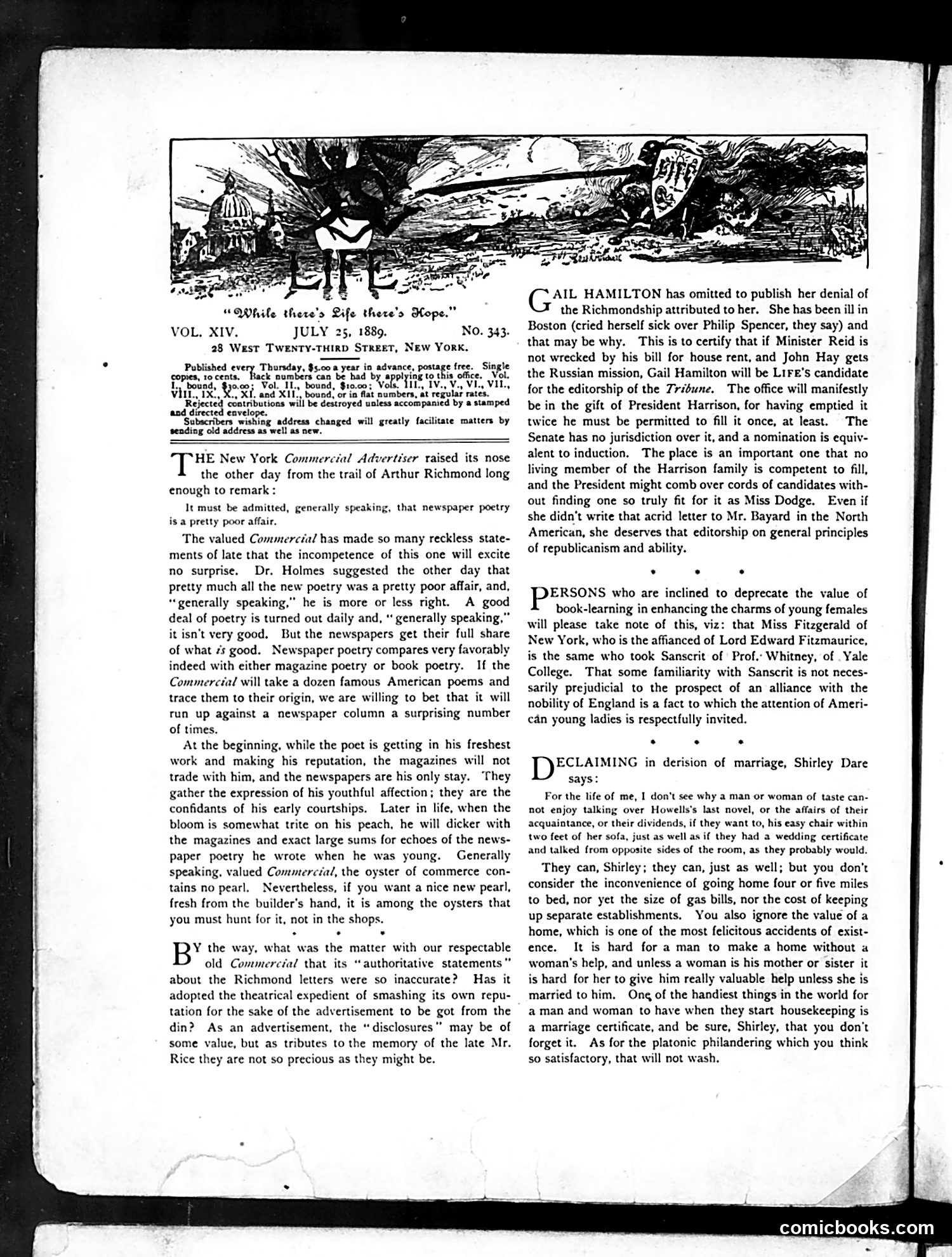
The page contains editorial commentary rather than a political cartoon. The masthead identifies this as Vol. XIV, July 25, 1889, published at 23 West Twenty-third Street, New York. The editors discuss newspaper poetry quality, criticizing the *Commercial Advertiser*'s inconsistent claims about Arthur Richmond's literary merit. They argue newspapers generally publish mediocre verse while magazines preserve better poetry. The right column addresses Gail Hamilton's denial of involvement in the "Richmondship" controversy and discusses her candidacy for editorship of the *Tribune* under President Harrison. A separate item mocks women's book-learning, specifically Miss Fitzgerald's Sanskrit studies at Yale. The final section presents Shirley Dare's commentary on marriage and domestic life. The content is primarily satirical social commentary rather than visual satire.
📄 Transcribed text from this page (OCR, searchable)
Machine-transcribed from the original scan — historical spelling and the odd misread are preserved.
“While there's Life there’s Hope.” VOL, XIV. JULY 25, 1889. No. 343. 28 West TWENTY-THIRD STREET, New York. Published every Thursday, $5.00 a year in advance, postage free. Single copies, ro cents. Back numbers can be bad by applying to this office. Vol. 1, bound, $30.00; Vol. II., bound, $10.00; Vols. IIL, 1V., V.. VI-, VII, VIL, 1X), X., X12, and XII, bound, or in flat numbers, at regular rates. Rejected contributions will be destroyed ualess accompanied by a stamped and directed envelope. Subscribers wishing address changed will greatly facilitate matters by sending old address as well as new. HE New York Commercial Advertiser raised its nose the other day from the trail of Arthur Richmond long enough to remark : It must be admitted, generally speaking, that newspaper poetry is a pretty poor affair. The valued Commercial has made so many reckless state- ments of late that the incompetence of this one will excite no surprise. Dr. Holmes suggested the other day that pretty much all the new poetry was a pretty poor affair, and, “generally speaking,” he is more or less right. A good deal of poetry is turned out daily and, “ generally speaking,” it isn't very good. But the newspapers get their full share of what zs good. Newspaper poetry compares very favorably indeed with either magazine poetry or book poetry. If the Commercial will take a dozen famous American poems and trace them to their origin, we are willing to bet that it will run up against a newspaper column a surprising number of times. At the beginning, while the poet is getting in his freshest work and making his reputation, the magazines will not trade with him, and the newspapers are his only stay. “They gather the expression of his youthful affection; they are the confidants of his early courtships. Later in life, when the bloom is somewhat trite on his peach, he will dicker with the magazines and exact large sums for echoes of the news- paper poetry he wrote when he was young. Generally speaking, valued Commercéal, the oyster of commerce con- tains no pearl. Nevertheless, if you want a nice new pearl, fresh from the builder's hand, it is among the oysters that you must hunt for it, not in the shops. Y the way, what was the matter with our respectable old Commercial that its “authoritative statements” about the Richmond letters were so inaccurate? Has it adopted the theatrical expedient of smashing its own repu- tation for the sake of the advertisement to be got from the din? As an advertisement, the “disclosures” may be of some value, but as tributes to the memory of the late Mr. Rice they are not so precious as they might be. Gat HAMILTON has omitted to publish her denial of the Richmondship attributed to her. She has been ill in Boston (cried herself sick over Philip Spencer, they say) and that may be why. This is to certify that if Minister Reid is not wrecked by his bill for house rent, and John Hay gets the Russian mission, Gail Hamilton will be Lire’s candidate for the editorship of the 7r#éune. The office will manifestly be in the gift of President Harrison, for having emptied it twice he must be permitted to fill it once, at least. The Senate has no jurisdiction over it, and a nomination is equiv- alent to induction. The place is an important one that no living member of the Harrison family is competent to fill, and the President might comb over cords of candidates with- out finding one so truly fit for it as Miss Dodge. Even if she didn’t write that acrid letter to Mr. Bayard in the North American, she deserves that editorship on general principles of republicanism and ability. . . . ERSONS who are inclined to deprecate the value of book-learning in enhancing the charms of young females will please take note of this, viz: that Miss Fitzgerald of New York, who is the affianced of Lord Edward Fitzmaurice, is the same who took Sanscrit of Prof. Whitney, of Yale College. That some familiarity with Sanscrit is not neces- sarily prejudicial to the prospect of an alliance with the nobility of England is a fact to which the attention of Ameri- can young ladies is respectfully invited. . . . ECLAIMING in derision of marriage, Shirley Dare says: For the life of me, I don't see why a man or woman of taste can- not enjoy talking over Howells's last novel, or the affairs of their acquaintance, or their dividends, if they want to, his easy chair within two feet of her sofa, just as well as if they had a wedding certificate and talked from opposite sides of the room, as they probably would. They can, Shirley; they can, just as well; but you don’t consider the inconvenience of going home four or five miles to bed, nor yet the size of gas bills, nor the cost of keeping up separate establishments. You also ignore the value of a home, which is one of the most felicitous accidents of exist- ence. It is hard for a man to make a home without a woman's help, and unless a woman is his mother or sister it is hard for her to give him really valuable help unless she is married to him. Ong of the handiest things in the world for aman and woman to have when they start housekeeping is a marriage certificate, and be sure, Shirley, that you don’t forget it. As for the platonic philandering which you think so satisfactory, that will not wash. comicbooks.com