
A complete issue · 16 pages · 1889
Life — July 11, 1889
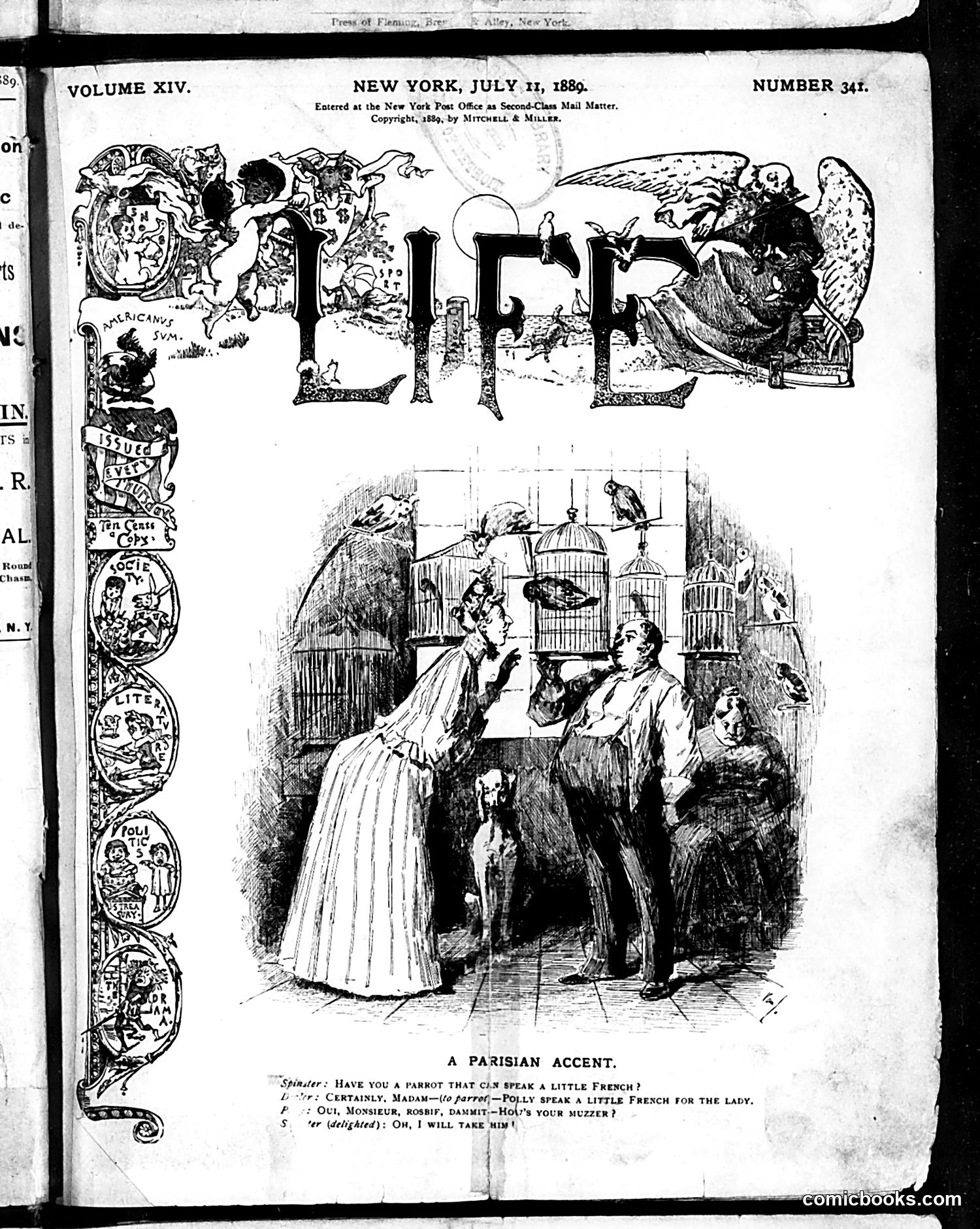
This cartoon satirizes social pretension and the fashion for French culture among wealthy Americans. A well-dressed woman arrives at what appears to be a wealthy household with a parrot, claiming it speaks French. She pitches the bird to the male head of household as a status symbol—a way for his lady to practice "a little French." The joke hinges on dual meaning: "Polly speak a little French" references both the parrot's ability and a euphemistic suggestion about the woman herself. The punchline—"Oh, I will take him!"—suggests the man is interested in more than just the bird's linguistic talents. The satire mocks nouveau-riche American aspirations to European sophistication while playing on period assumptions about French morality and the commodification of both birds and women as luxury accessories.
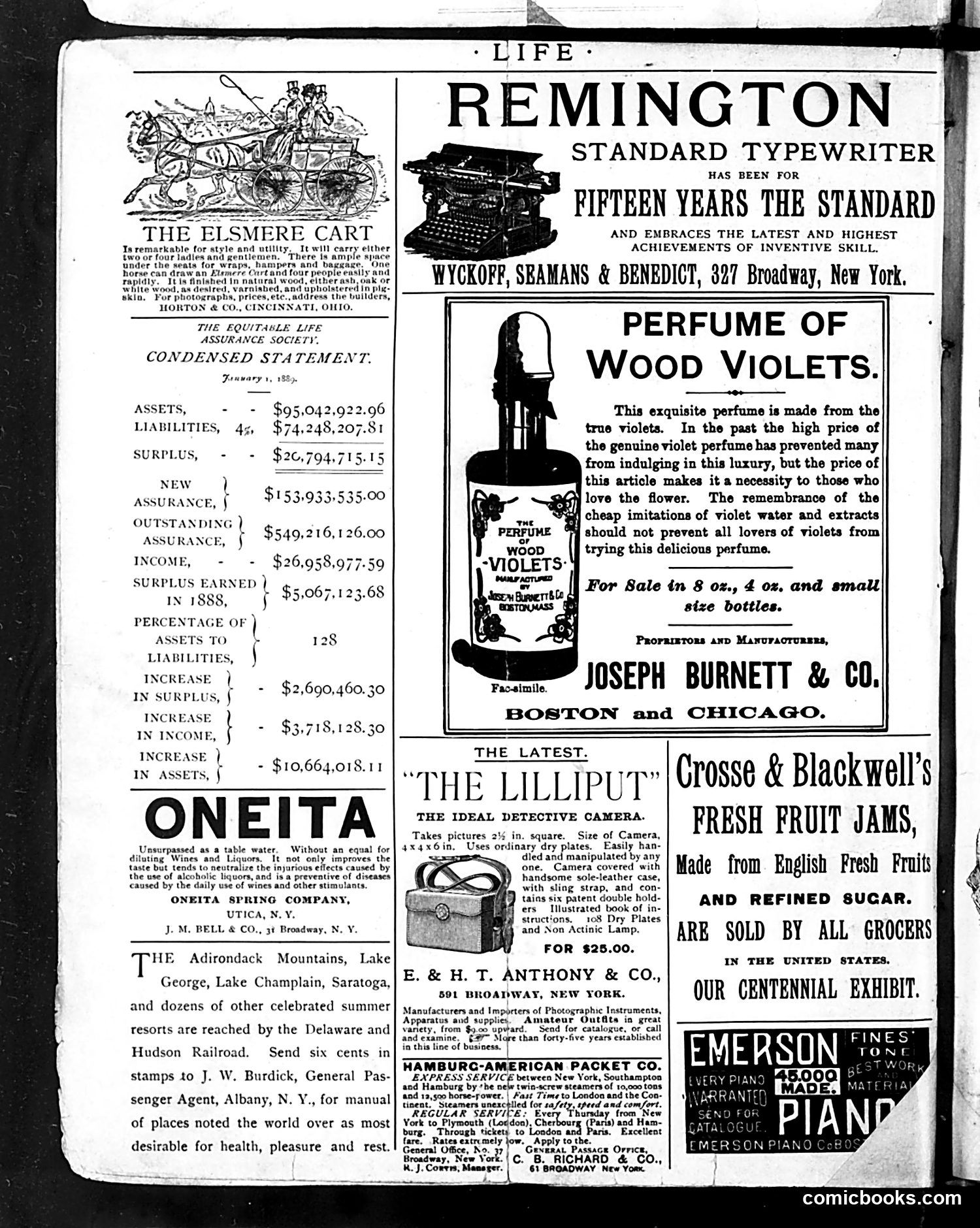
This page is primarily **advertising**, not political satire. It contains seven distinct product advertisements from circa 1889: 1. **The Elsmere Cart** - a carriage manufacturer 2. **Equitable Life Assurance Society** - financial statement 3. **Remington Standard Typewriter** - office equipment 4. **Perfume of Wood Violets** - fragrance by Joseph Burnett & Co. 5. **Oneita Spring Company** - bottled water 6. **The Lilliput Detective Camera** - photography equipment 7. Various other products (jams, pianos, railroad travel) The page includes one small illustration of the Adirondack Mountains promoting tourist travel via Delaware and Hudson Railroad. There is **no political cartoon or satirical content** evident. This represents typical late-19th-century *Life* magazine space dedicated to commercial advertisements.
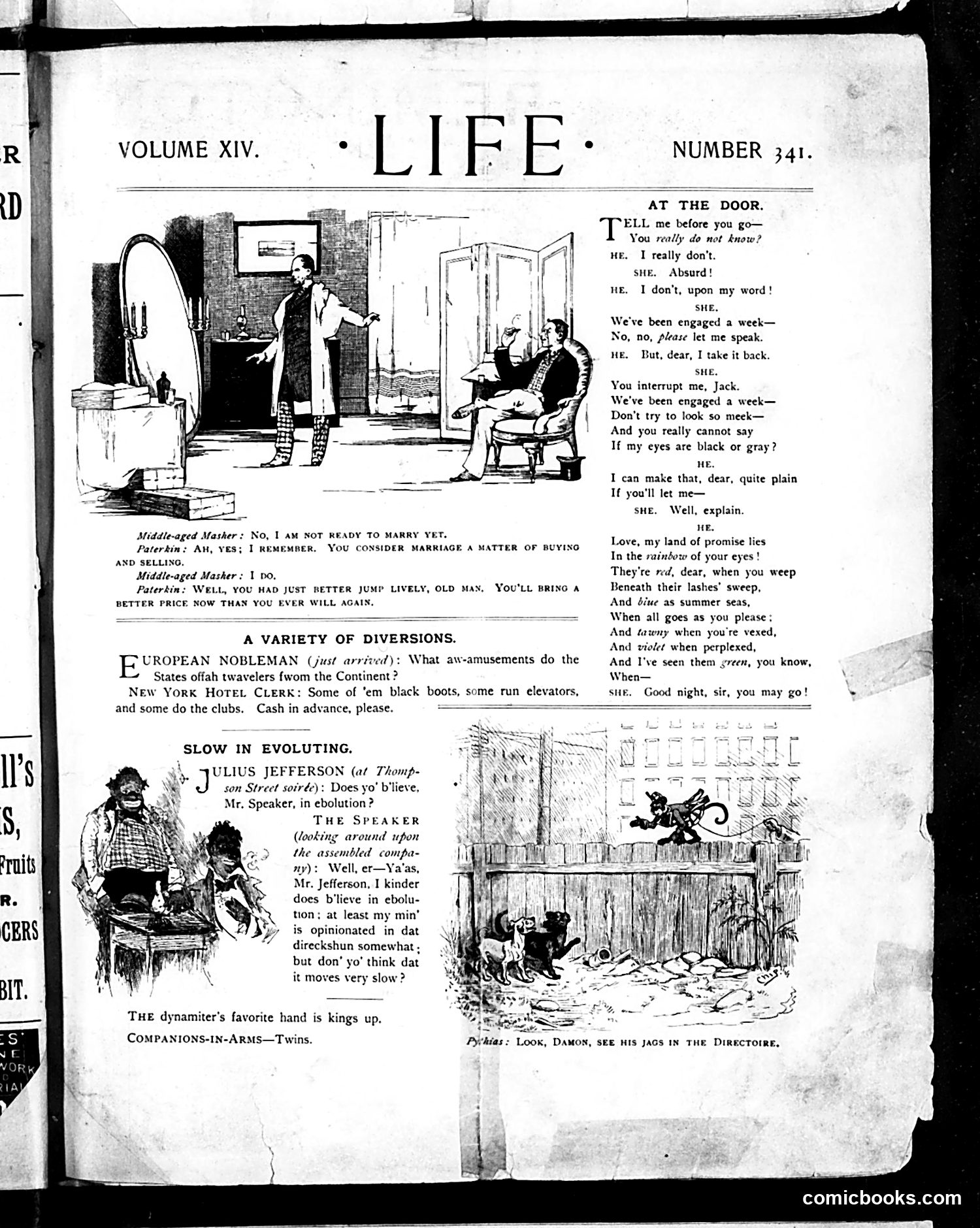
This page contains three satirical pieces: **"At the Door"** depicts a domestic quarrel where a man and woman discuss their week-long engagement. The woman accuses the man of not looking at her and questions whether he can even distinguish her eye color—a jab at inattentiveness in relationships. **"A Variety of Diversions"** mocks European tourists in New York, satirizing their search for entertainment at hotels and clubs while seeking cash advances. **"Slow in Evolving"** features Julius Jefferson discussing whether evolution moves slowly, with a speaker presenting assembled company opinions. The caption suggests skepticism about evolutionary theory's pace. The bottom cartoon shows dogs and appears to reference a "Directoire" (likely a fashion reference). The humor relies on period-specific social commentary about courtship, tourism, and scientific debate.
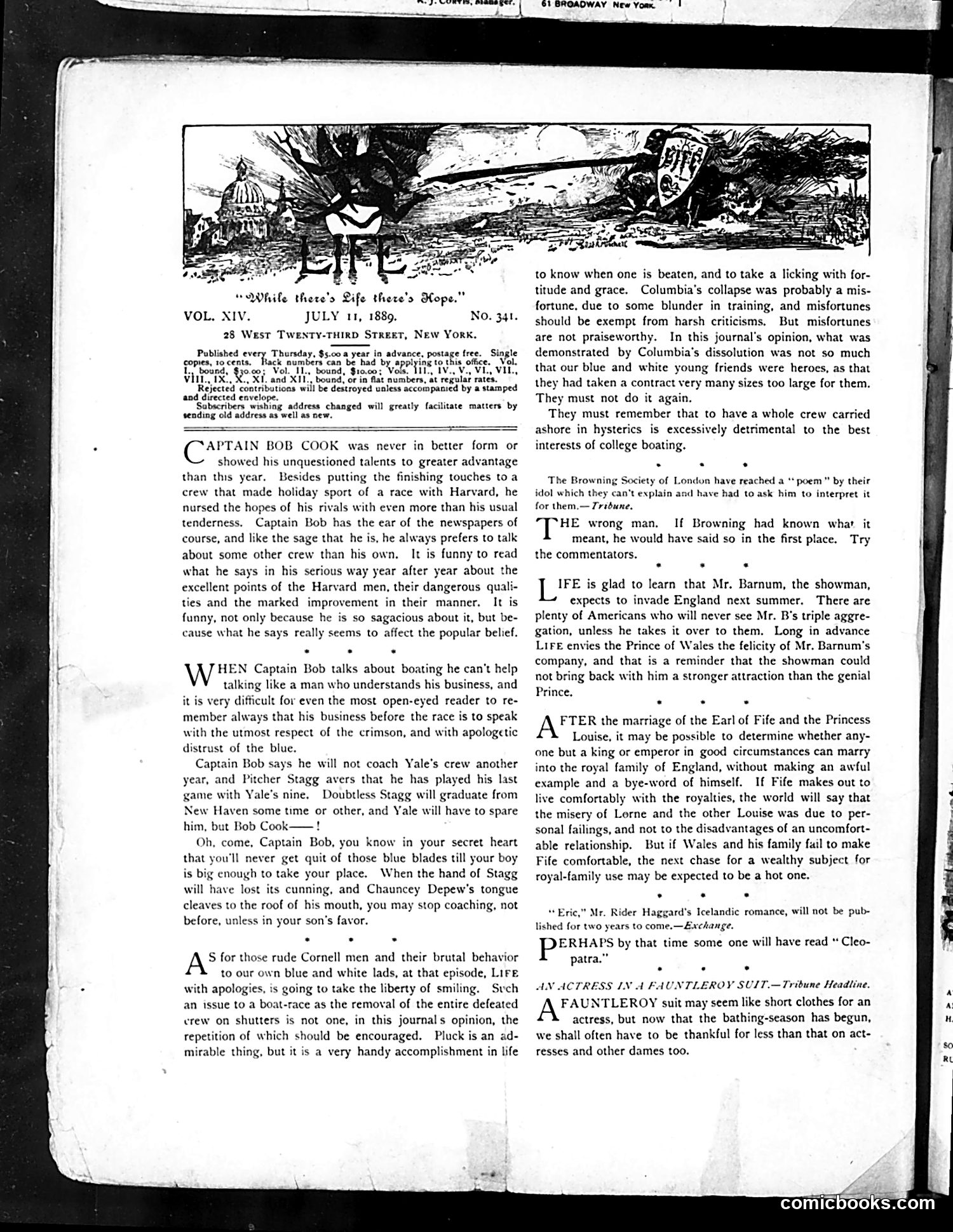
The masthead illustration depicts a classical figure beneath a tree, likely representing "Life" or wisdom, overlooking a landscape with buildings—establishing the magazine's satirical perspective. The text primarily comprises editorial commentary on contemporary topics rather than cartoon satire. Key references include: - **Captain Bob Cook**: Praised for coaching Harvard's rowing crew and discussing Yale competition - **Cornell crew misconduct**: Criticized for "brutal behavior" and crew members acting as "shutters" (covering windows during an incident) - **Mr. Barnum**: The showman's planned England invasion is discussed - **Earl of Fife's marriage**: Commentary on royal family propriety The page functions as *opinion journalism* using satire and moral judgment rather than visual caricature to critique social behavior among elite institutions and figures.
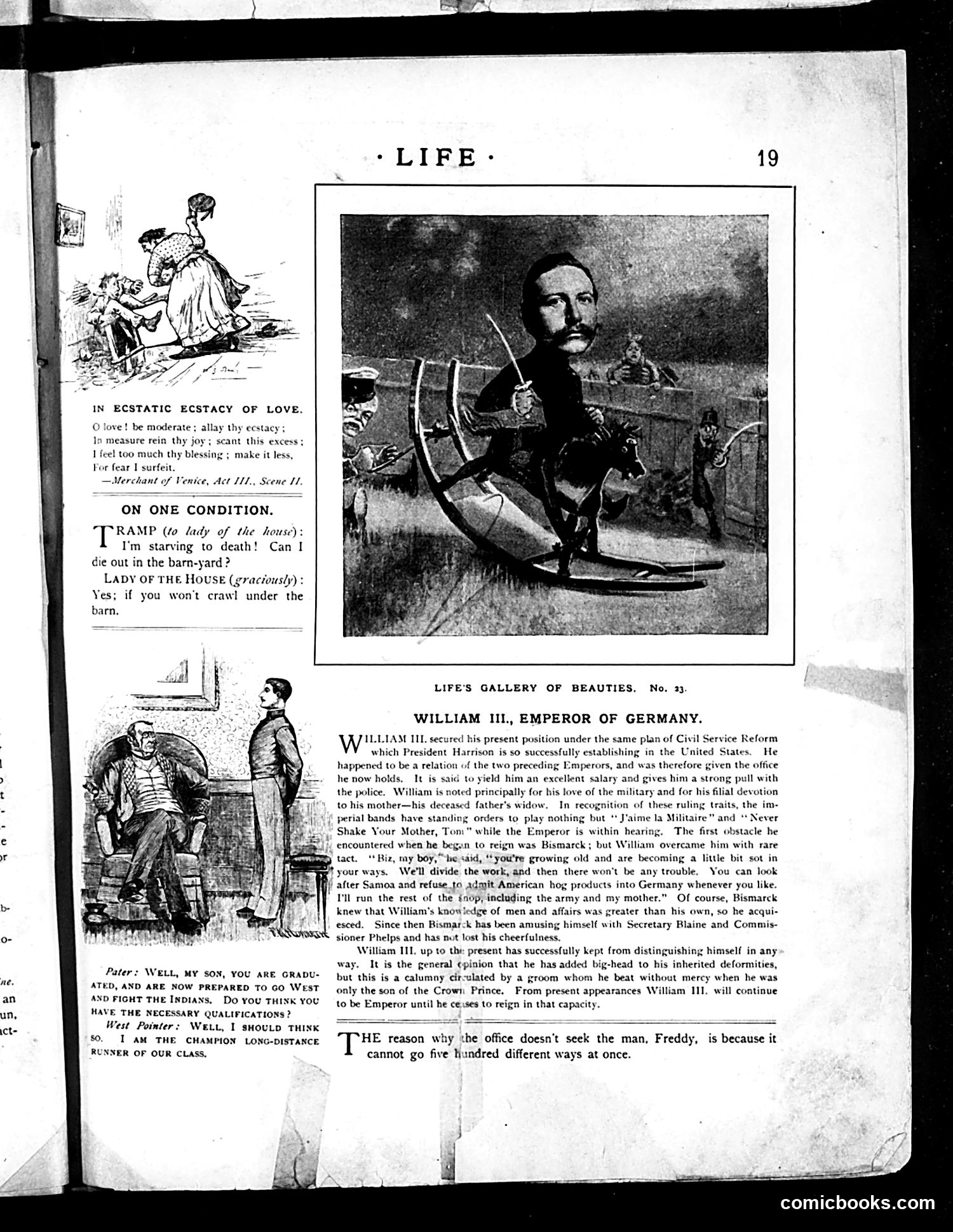
This page satirizes **William III, Emperor of Germany** (Kaiser Wilhelm II). The main portrait shows him in military dress with distinctive upturned mustache. The satire focuses on his political position: William secured his post through nepotism—being related to preceding emperors—rather than merit. Life mocks his devotion to military matters and his filial duty to his mother (the deceased emperor's widow). The accompanying dialogue joke presents William as politically weak, unable to act independently. A father boasts his son is a "champion long-distance runner," but the punchline suggests William cannot make decisions without seeking approval—he's politically constrained despite his imperial title. This reflects American skepticism toward German imperial authority during the early 1900s.
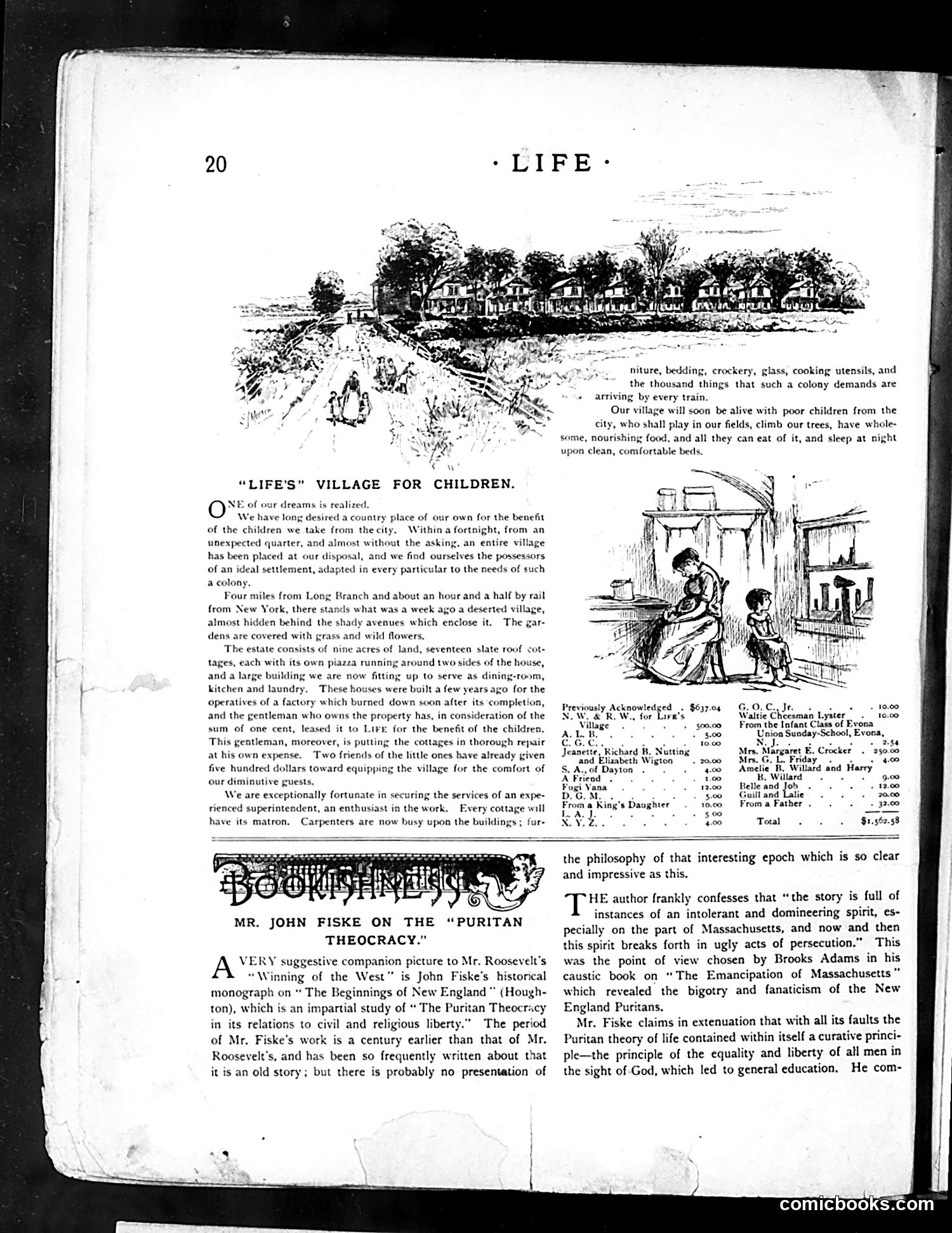
This page primarily contains **editorial content rather than political satire**. The main feature is "'Life's' Village for Children"—a description of an actual charitable settlement being established near Long Branch, New Jersey, to provide poor urban children with rural living, fresh air, and education. The secondary section discusses **"Mr. John Fiske on the 'Puritan Theocracy'"**—an intellectual critique of Puritan religious beliefs and their historical influence. The author (likely Brooks Adams, based on context) argues that Puritan doctrine, while containing some merit regarding equality before God, was fundamentally intolerant and bigoted, particularly in Massachusetts. This is primarily **serious journalism and social commentary**, not satire or caricature. The page advocates for children's welfare reform while critiquing historical religious extremism.
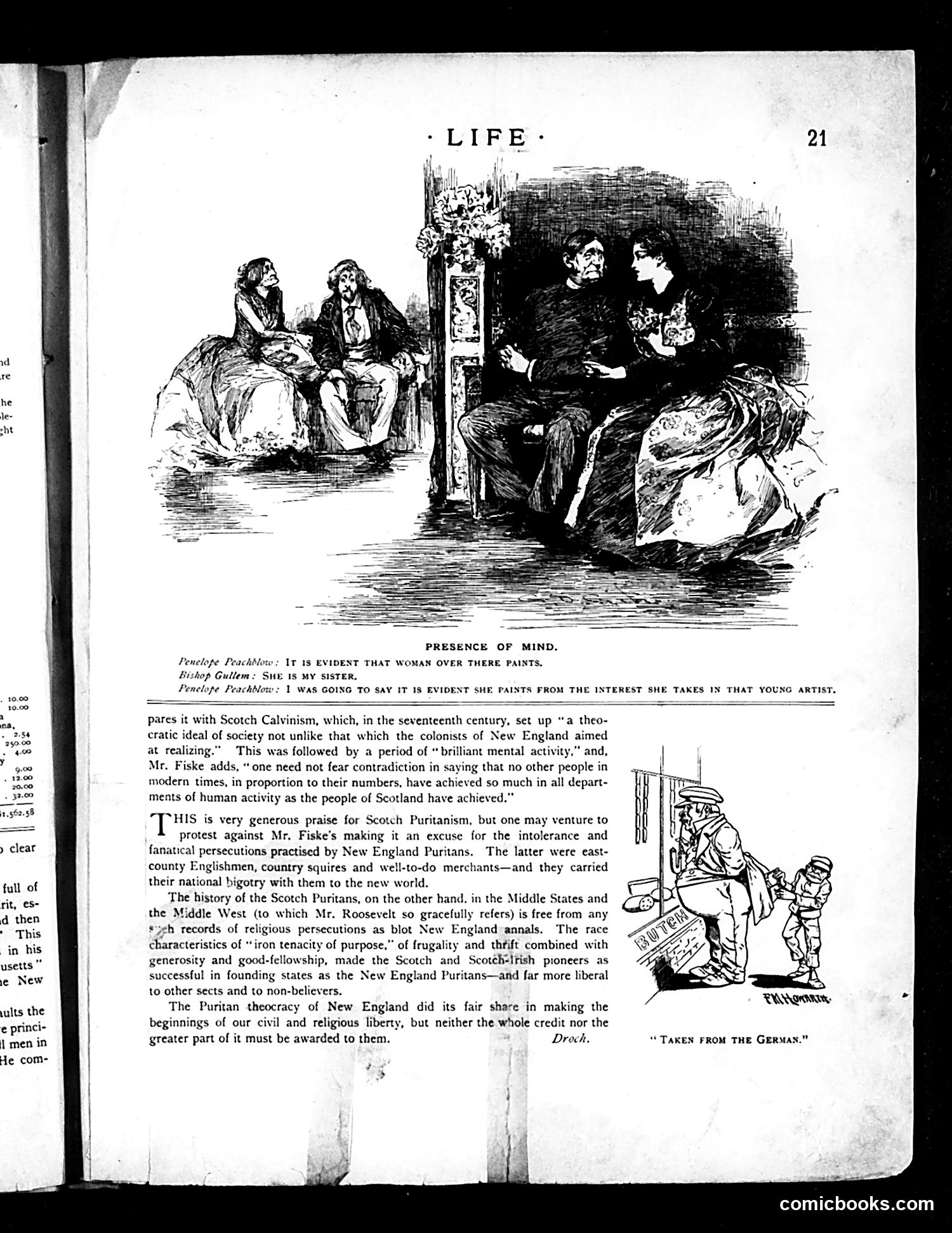
**Top Cartoon: "Presence of Mind"** This sketch depicts a social scene where a woman demonstrates her composure. The dialogue identifies her as Penelope Peachblow, with Bishop Gallen stating "She is my sister," and Penelope Peachblow responding that she paints from interest in a young artist. The satire targets upper-class women who justify their social behavior through claims of artistic or intellectual pursuits—a common excuse for unconventional conduct in Victorian/Edwardian society. **Bottom Cartoon: "Takes from the German"** This illustration appears to mock German cultural or behavioral traits through caricature, though specific historical context is unclear from the visible image alone. **Text Content** The article discusses Scottish Puritanism versus New England Puritanism, contrasting their social influence and religious practices in colonial America, with particular critique of New England Puritans' severity.
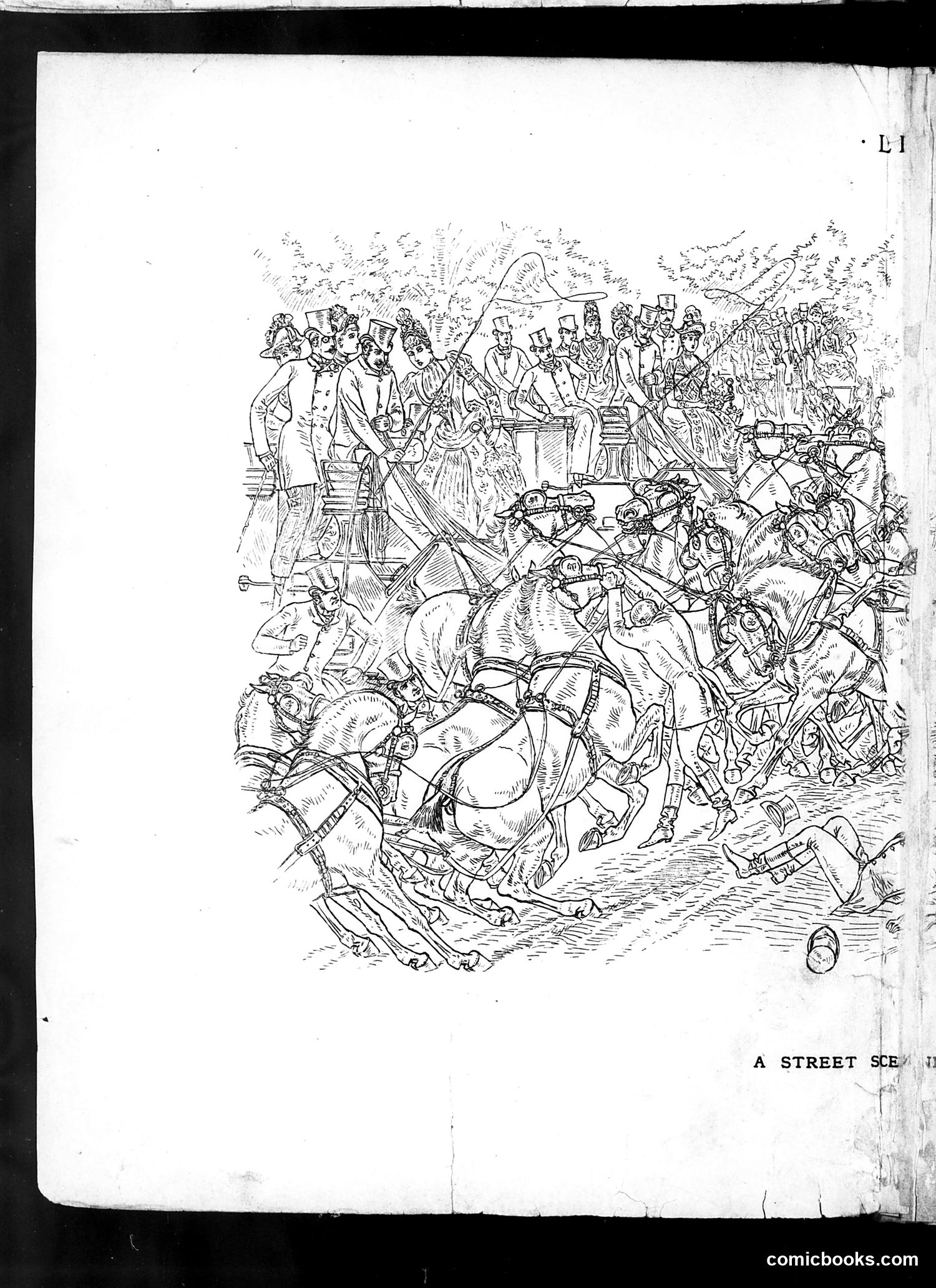
This engraving depicts a chaotic urban street confrontation. The caption reads "A STREET SCENE," suggesting it illustrates a contemporary social incident. The composition shows mounted cavalry or police officers on horseback charging into a crowd of civilians. The mounted figures appear aggressive, while civilians scatter and fall. The detailed rendering emphasizes the violence and disorder of the moment. Without additional context from the magazine's date or surrounding articles, the specific historical event remains unclear. However, the imagery is characteristic of Life magazine's satirical commentary on labor unrest, political demonstrations, or crowd control incidents that were common subjects in American satirical journalism. The engraving's style and composition suggest this critiques official/police response to civilian protest or gathering.
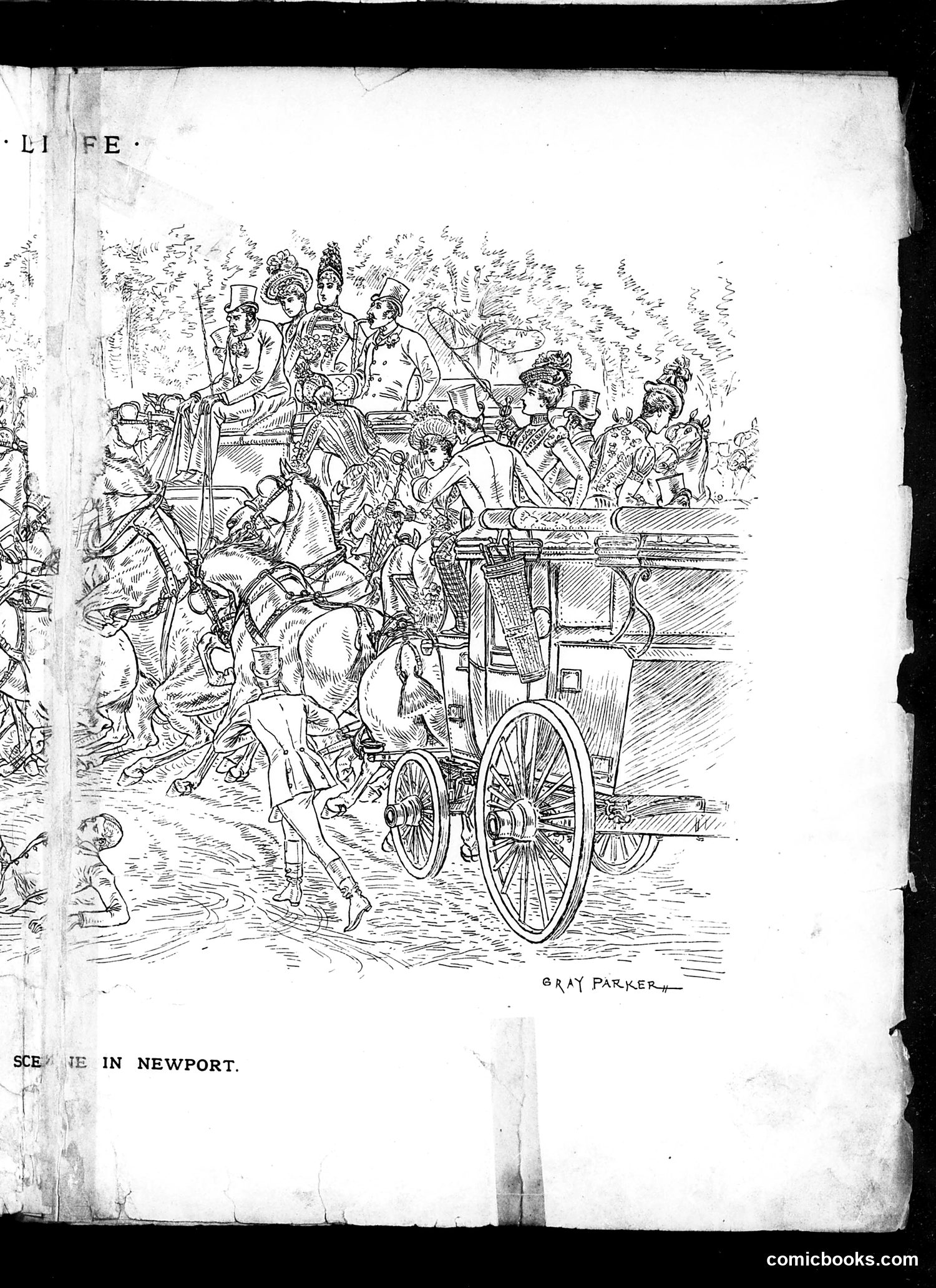
This illustration by Gray Parker depicts a wealthy social gathering in Newport, Rhode Island—the era's premier seaside resort for America's elite. The cartoon satirizes the ostentatious display of wealth and rigid class hierarchy among the ultra-rich. The central figures appear to be aristocratic socialites in elaborate dress and headwear, positioned prominently in carriages and on platforms. The composition emphasizes their elevated status literally and figuratively. Surrounding them are servants, attendants, and working-class figures in subordinate positions, highlighting the stark social divisions of the Gilded Age. The satire targets Newport's reputation as a venue for conspicuous consumption, where the wealthy gathered to flaunt their status through fashion, carriages, and elaborate social rituals. The exaggerated costumes and theatrical arrangement mock the artificiality and pretension of high society.
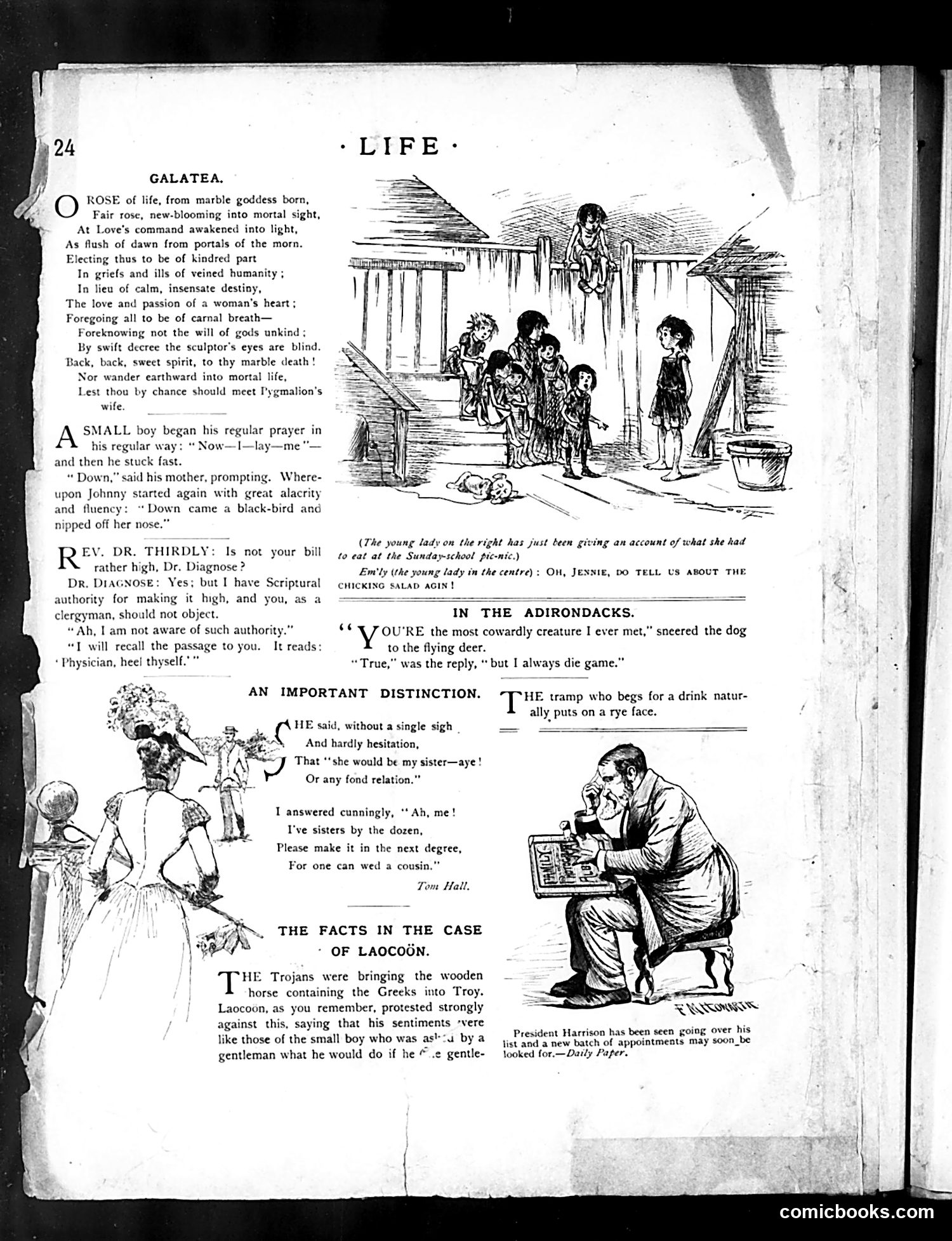
This page contains several humor pieces typical of early 20th-century *Life* magazine satire: **"Galatea"** is a poem about awakening to life, illustrated with a domestic scene of children and adults. **"Rev. Dr. Thirdly"** mocks a clergyman for charging excessive fees while citing scripture about physician's payment—satire on hypocritical clergy profiting from religious authority. **"An Important Distinction"** jokes about a woman suggesting her sister marry a suitor "in the next degree," implying marriage to a cousin instead—playing on contemporary attitudes toward proper social matching. **"The Facts in the Case of Laocoon"** references the classical Trojan priest, humorously reframing his legendary suffering as merely expressing political sentiments a gentleman wouldn't voice aloud—satire on social propriety and class-based speech restrictions. The illustration of a man studying chess appears unrelated to the surrounding text, likely advertising chess instruction or entertainment.
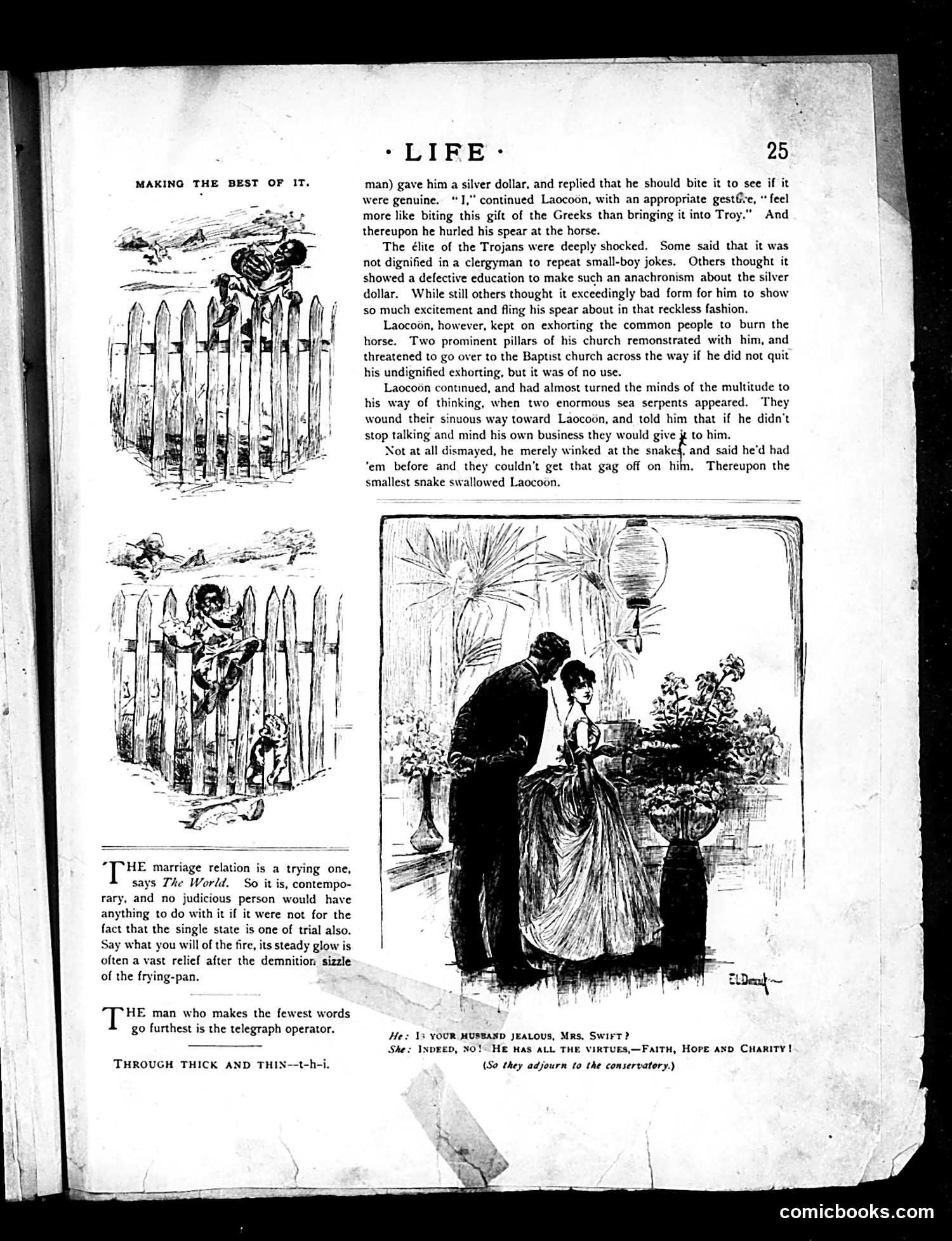
This page from *Life* magazine contains humorous sketches and satirical commentary on social manners. The main narrative concerns "Laocoon," a clergyman who becomes the subject of ridicule when given a silver dollar as a gift. He's mocked by the "elite of the Trojans" (society's upper class) for examining the coin too literally—checking if it's genuine by biting it, an outdated or lower-class behavior. The satire targets pretentious social attitudes: those who consider practical verification "defective education" represent snobbish elitism judging working-class customs. The accompanying illustration shows a couple in an interior setting, captioning concerns about marital jealousy and female virtue—typical Victorian-era anxieties about marriage and propriety reflected in *Life*'s regular commentary on domestic relations.
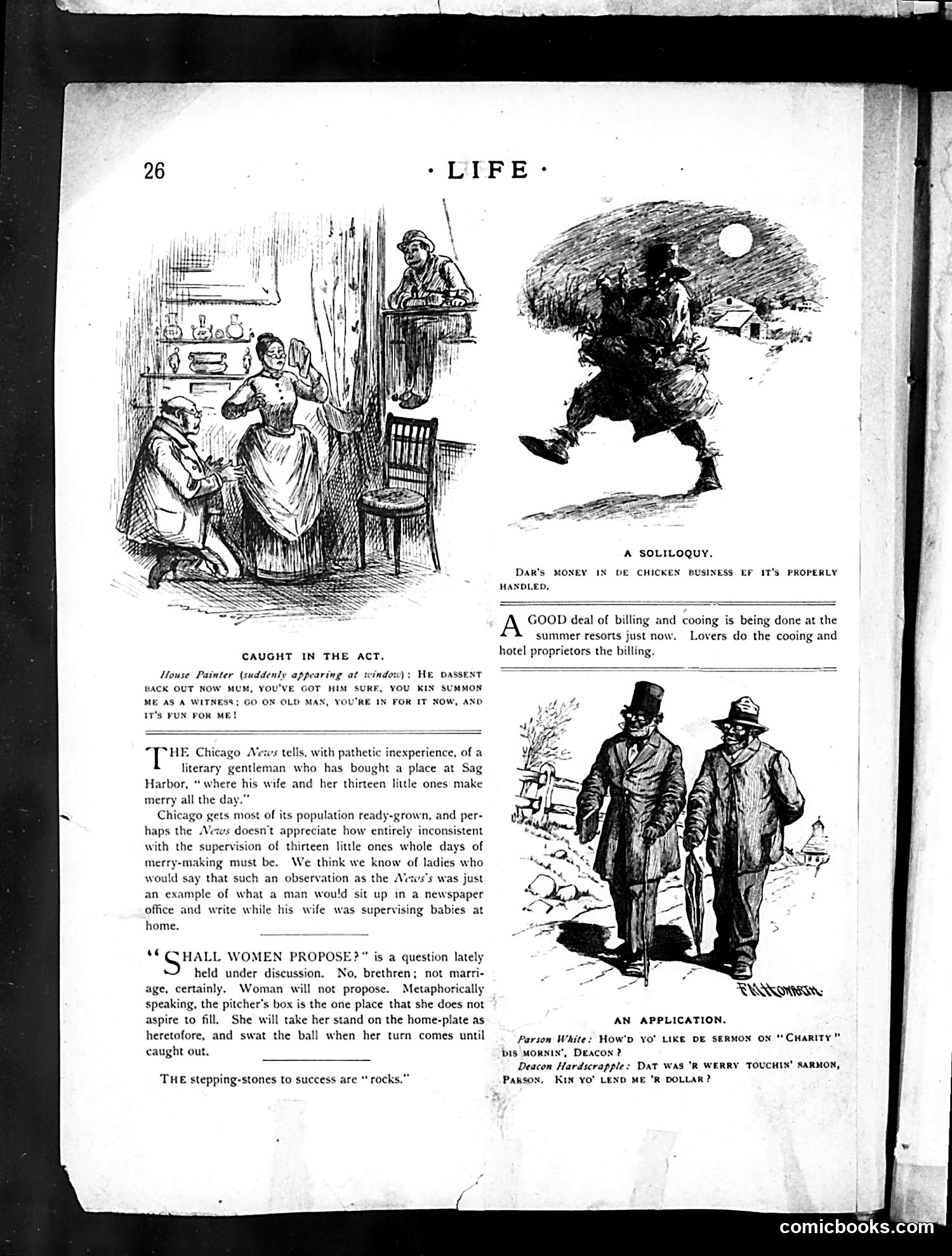
This page contains three separate satirical pieces typical of early 20th-century American humor: **"Caught in the Act"**: A domestic dispute cartoon where a house painter witnesses a couple arguing and offers to testify against the husband, suggesting marital conflicts were common entertainment fodder. **Chicago News critique**: Satirizes a newspaper's naive reporting about a literary gentleman with thirteen children at Sag Harbor who supposedly spends days in "merry-making." The satire mocks male journalists who romanticize domestic life while their own wives manage household chaos—pointing to gender hypocrisy. **Women and Proposals**: Argues women won't propose marriage, using baseball metaphor: women stay at "home-plate" rather than take the pitcher's box, meaning they maintain traditional domestic roles. **"A Soliloquy"** and **"An Application"**: Brief dialect jokes featuring African American characters in stereotypical servant roles, with humor based on financial hardship and religious hypocrisy (the deacon won't donate despite praising a charity sermon). The page reflects period attitudes toward gender roles, class, and racial caricature common to early Life magazine.
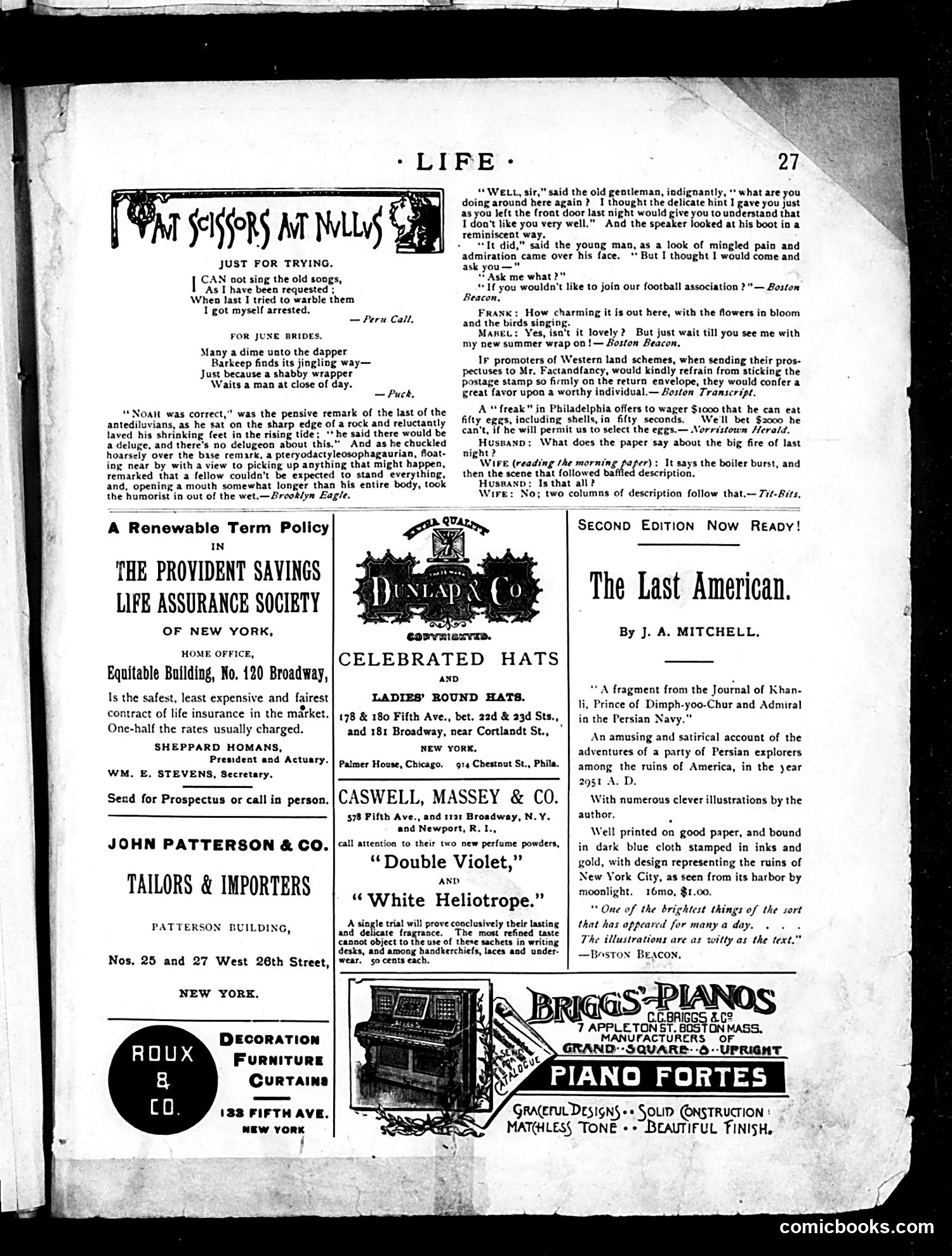
This page from *Life* magazine consists primarily of **short humorous verses and anecdotes** rather than political cartoons. The content satirizes everyday American social situations through brief, witty observations: **Key satirical pieces:** - A poet arrested for singing old songs (mocking sentimental nostalgia) - A joke about men visiting bars because of romantic rejection - A prehistoric creature eating someone who made a bad pun (literal "dark humor") - A young suitor trying to join his girlfriend's father's football club after being kicked out - A woman bragging about her new summer wrap - A man complaining about postage stamps on land-scheme prospectuses The humor targets **common urban social anxieties**: romantic courtship rituals, materialism, newspaper sensationalism, and the absurdities of modern life. The page also advertises *The Last American*, a satirical book by J.A. Mitchell about Persian explorers discovering America's ruins—likely social commentary on American decline or excess. Most content is **lighthearted social satire** rather than political—poking fun at middle-class manners and pretensions.
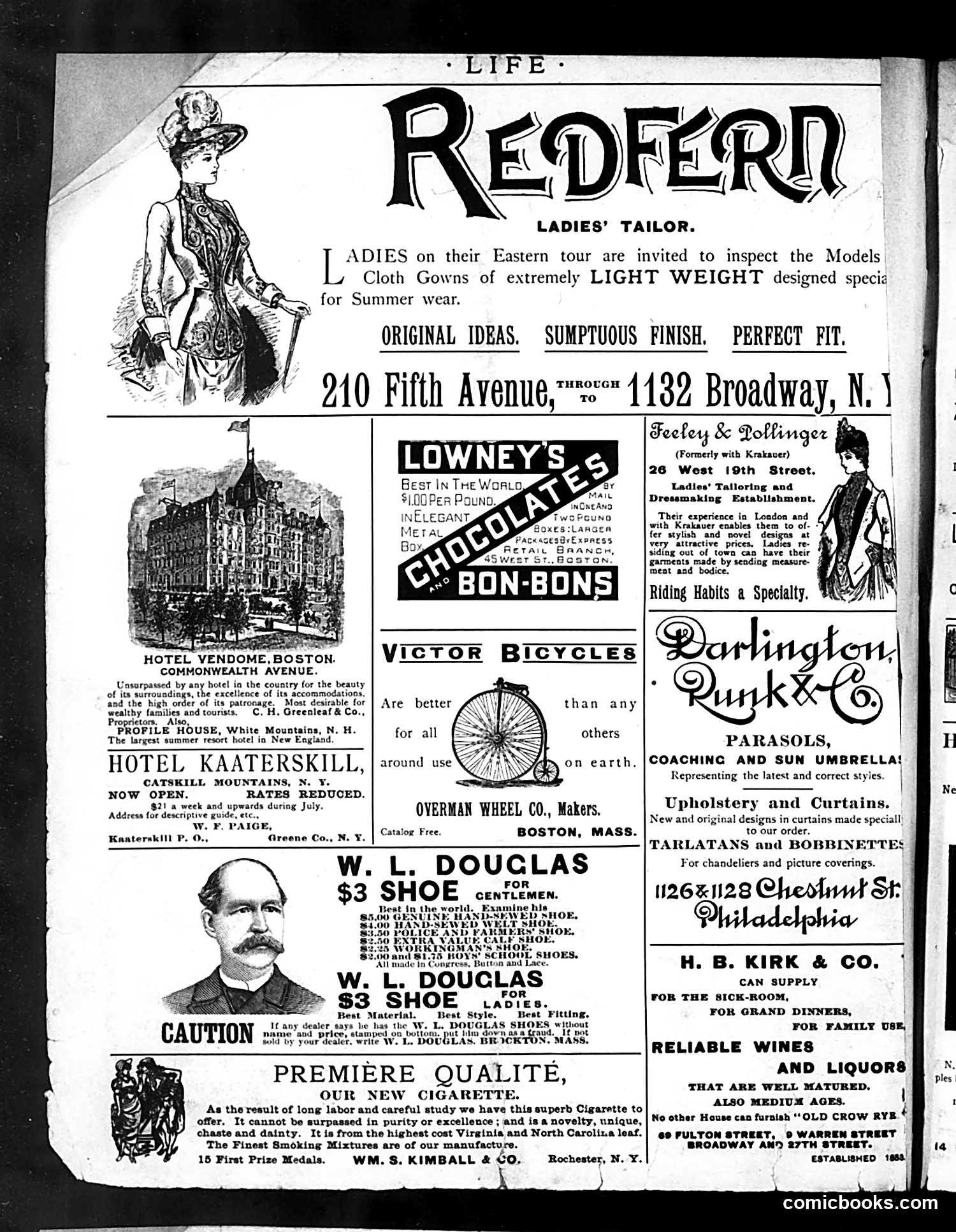
This is primarily an **advertising page**, not a satirical cartoon. It contains various commercial advertisements from the 1890s-early 1900s aimed at upper-class readers. **Key advertisements include:** - **Redfern**: A ladies' tailor offering lightweight summer gowns - **Hotel advertisements**: Vendome (Boston), Profile House (White Mountains), and Kaaterskill (Catskills)—luxury resorts for wealthy tourists - **Victor Bicycles and Overman Wheel Co.**: Competing bicycle manufacturers - **W.L. Douglas $3 Shoe**: Budget footwear for gentlemen - **Lowney's Chocolates and Bon-Bons** - **Premiere Qualité Cigarettes**: Premium tobacco product - **Various luxury services**: Women's tailoring, parasols, wines, and liquors The page reflects the commercial culture and consumer aspirations of the Gilded Age, targeting affluent Americans with leisure time and disposable income. No political satire is evident—this is simply a revenue-generating advertisement section.
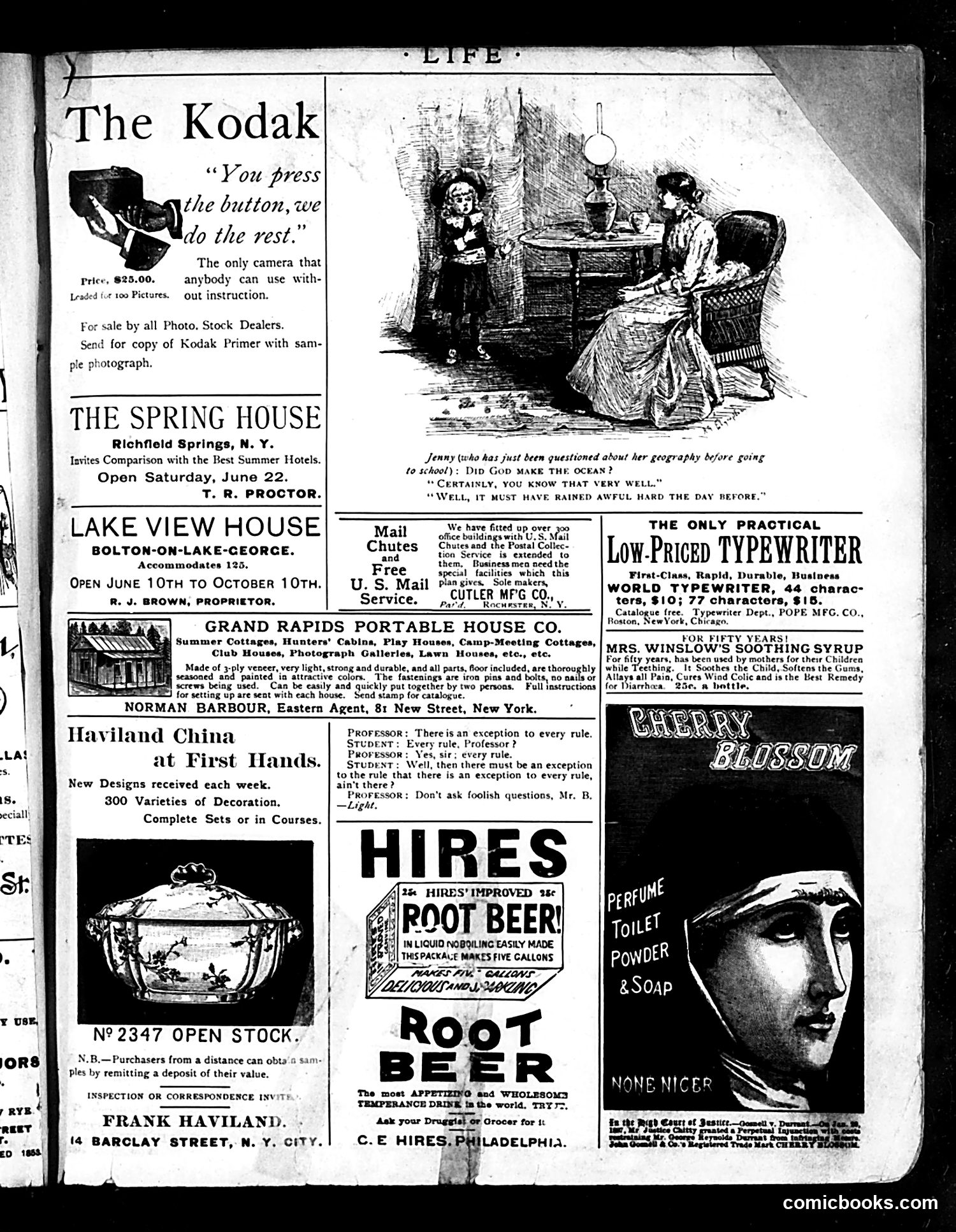
This page is primarily **advertisements** with one small cartoon joke. The main illustrated cartoon shows a girl named Jenny being questioned about geography before school. When asked "Did God make the ocean?" she replies that it must have rained very hard the day before—a child's literal, innocent misunderstanding of how oceans form. The joke relies on the contrast between adult knowledge and childish logic: Jenny takes the question literally and applies simple cause-and-effect reasoning (rain makes water) rather than understanding geological or theological explanations. This type of "innocent child logic" humor was popular in early 20th-century publications. The rest of the page consists of period advertisements for cameras (Kodak), summer hotels, portable houses, china, typewriters, and patent medicines (Mrs. Winslow's Soothing Syrup, Hires Root Beer)—typical commercial content for *Life* magazine of this era.
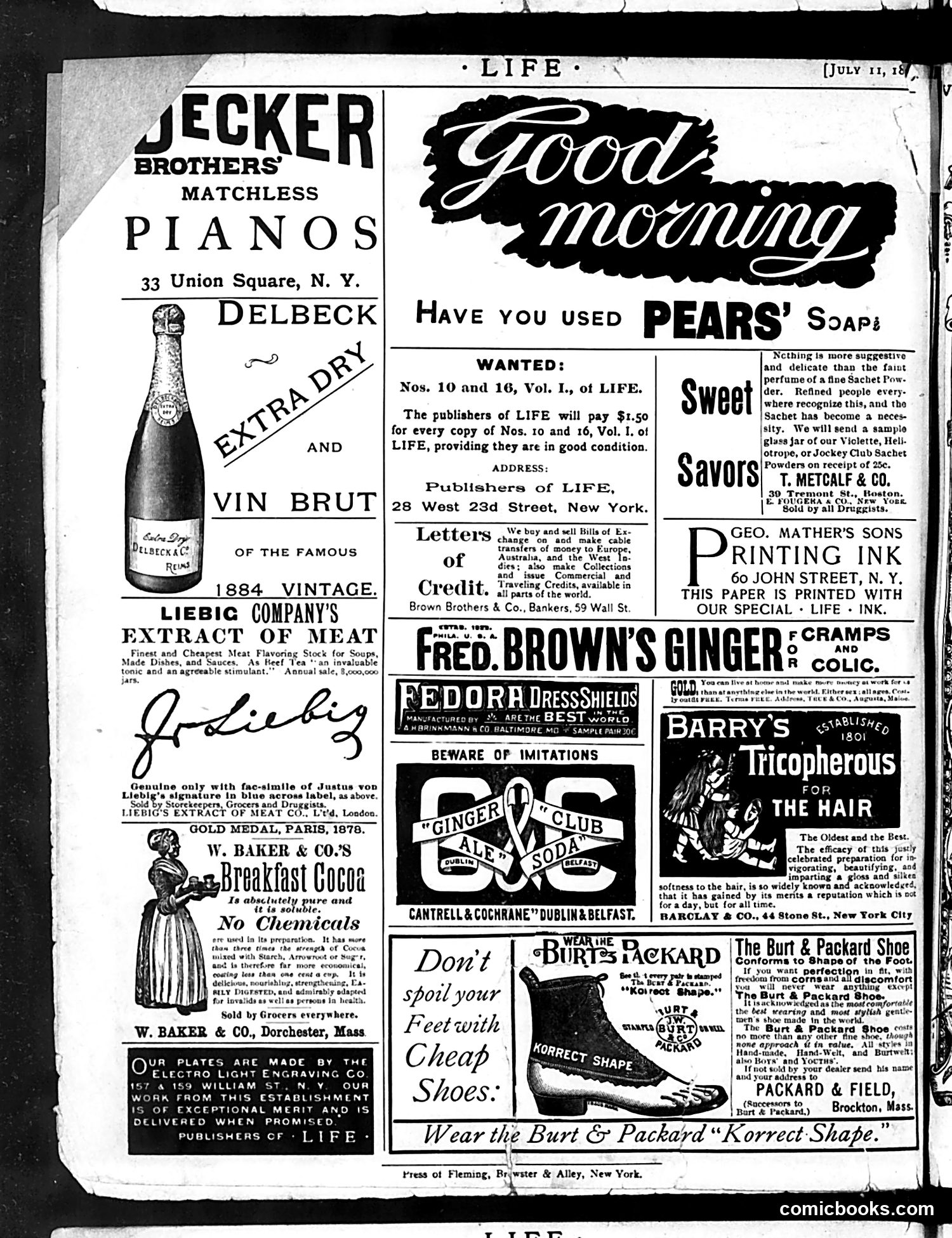
This is a Life magazine page from July 11, 1891 consisting almost entirely of period advertisements with minimal editorial content. The only non-ad text is a small "Wanted" notice seeking back issues (Nos. 10 and 16, Vol. 1) of Life for $1.50 each. The ads promote typical late-Victorian consumer goods: Delbeck pianos, Liebig's meat extract (with Justus von Liebig's signature for authenticity), Pears' soap and sachet powders, W. Baker & Co. cocoa, Fred. Brown's ginger ale, Barry's Tricopherous hair tonic, and Burt & Packard shoes. A banking house (Brown Brothers & Co.) also advertises financial services. There is no cartoon or satirical content visible on this page—it functions as a straightforward advertising vehicle for Life magazine's revenue. The page demonstrates how 19th-century magazines financed themselves through paid advertisements.