
Life, 1889-07-11 · page 7 of 16
Life — July 11, 1889 — page 7: what you’re looking at
What you’re looking at
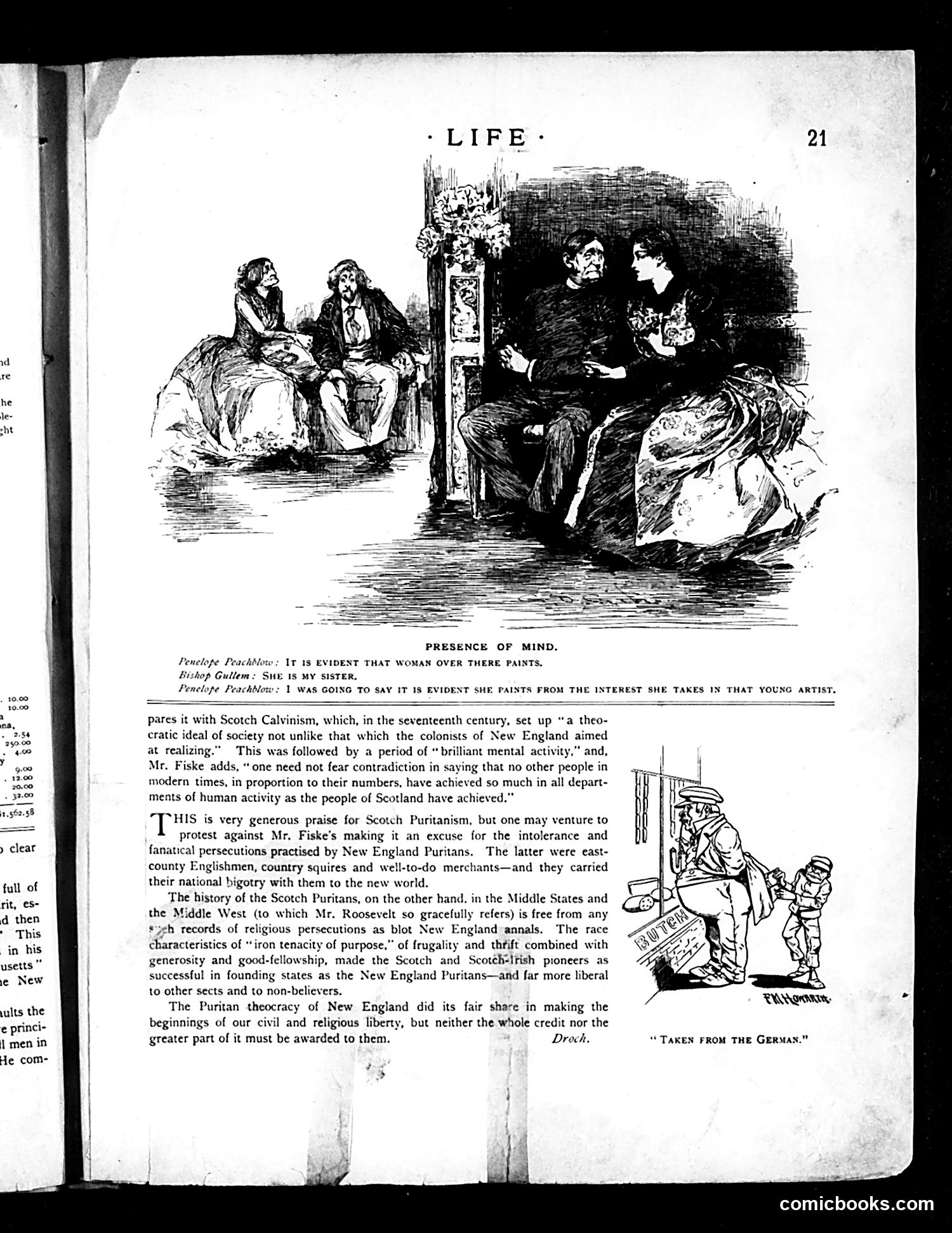
**Top Cartoon: "Presence of Mind"** This sketch depicts a social scene where a woman demonstrates her composure. The dialogue identifies her as Penelope Peachblow, with Bishop Gallen stating "She is my sister," and Penelope Peachblow responding that she paints from interest in a young artist. The satire targets upper-class women who justify their social behavior through claims of artistic or intellectual pursuits—a common excuse for unconventional conduct in Victorian/Edwardian society. **Bottom Cartoon: "Takes from the German"** This illustration appears to mock German cultural or behavioral traits through caricature, though specific historical context is unclear from the visible image alone. **Text Content** The article discusses Scottish Puritanism versus New England Puritanism, contrasting their social influence and religious practices in colonial America, with particular critique of New England Puritans' severity.
📄 Transcribed text from this page (OCR, searchable)
Machine-transcribed from the original scan — historical spelling and the odd misread are preserved.
» clear full of rit, eS- d then ' This in his usetts” e New wults the e princi- | men in He com- PRESENCE OF MIND. Penelope Peachblow : WV 1S EVIDENT THAT WOMAN OVER THERE PAINTS, Bishop Gullem: SWE 13 MY SISTER, Penelope Peachblor I WAS GOING TO SAY IT 18 EVIDENT SHE PAINTS FROM THE INTEREST SHE TAKES IN THAT YOUNG ARTIST. pares it with Scotch Calvinism, which, in the seventeenth century, set up “a theo- cratic ideal of society not unlike that which the colonists of New England aimed at realizing.” This was followed by a period of “brilliant mental activity,” and, Mr. Fiske adds, “one need not fear contradiction in saying that no other people in modern times, in proportion to their numbers, have achieved so much in all depart- ments of human activity as the people of Scotland have achieved.” ‘T2 is very generous praise for Scotch Puritanism, but one may venture to protest against Mr. Fiske’s making it an excuse for the intolerance and fanatical persecutions practised by New England Puritans. The latter were east- county Englishmen, country squires and well-to-do merchants—and they carried their national bigotry with them to the new world. The history of the Scotch Puritans, on the other hand, in the Middle States and the Middle West (to which Mr. Roosevelt so gracefully refers) is free from any sh records of religious persecutions as blot New England annals. The race characteristics of “iron tenacity of purpose,” of frugality and thrift combined with generosity and good-fcllowship, made the Scotch and Scotéh-ltish pioneers as successful in founding states as the New England Puritans—and far more liberal to other sects and to non-believers. The Puritan theocracy of New England did its fair share in making the beginnings of our civil and religious liberty, but neither the whole credit nor the greater part of it must be awarded to them. Droch. “TAKEN FROM THE GERMAN.” comicbooks.com