
Life, 1889-07-11 · page 6 of 16
Life — July 11, 1889 — page 6: what you’re looking at
What you’re looking at
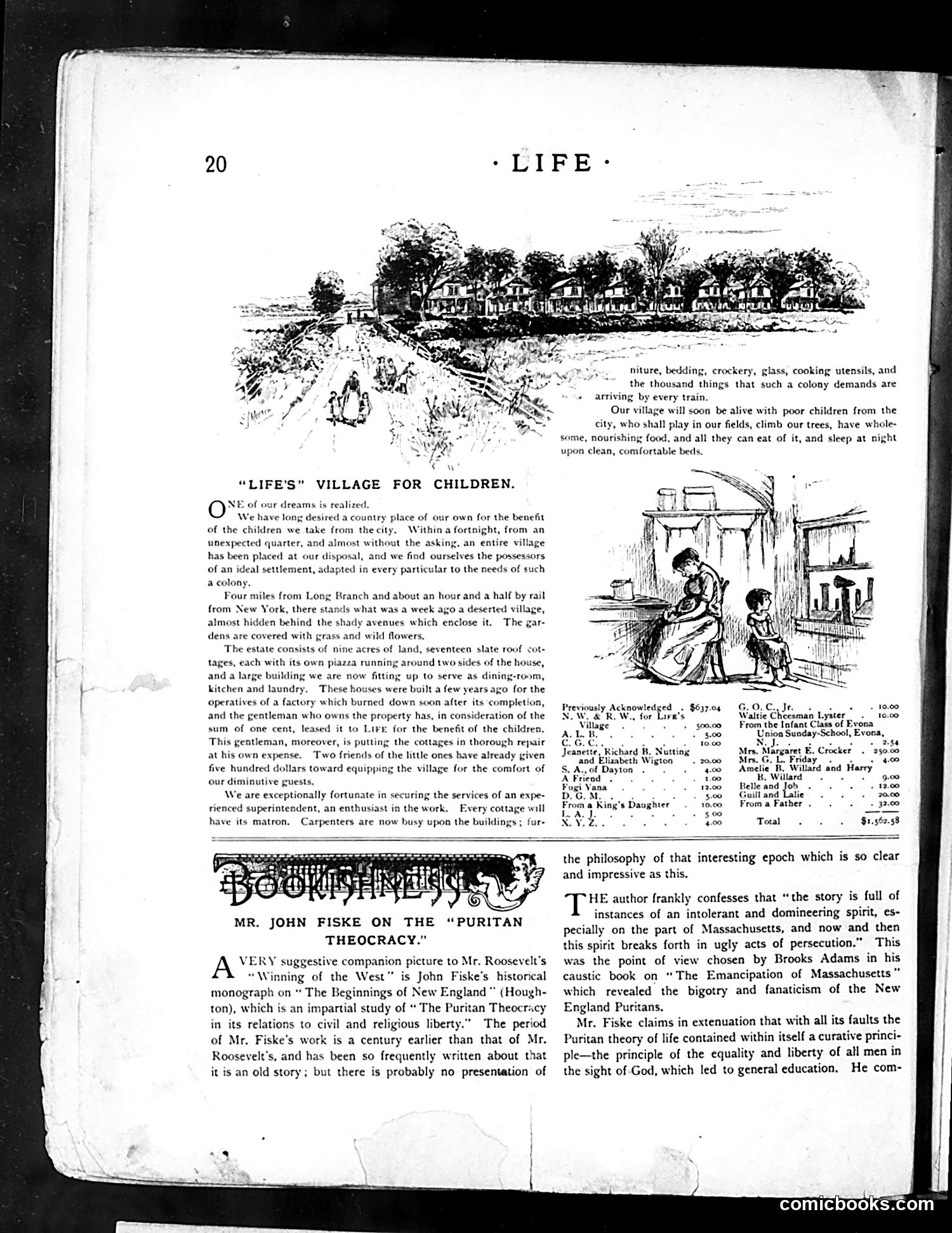
This page primarily contains **editorial content rather than political satire**. The main feature is "'Life's' Village for Children"—a description of an actual charitable settlement being established near Long Branch, New Jersey, to provide poor urban children with rural living, fresh air, and education. The secondary section discusses **"Mr. John Fiske on the 'Puritan Theocracy'"**—an intellectual critique of Puritan religious beliefs and their historical influence. The author (likely Brooks Adams, based on context) argues that Puritan doctrine, while containing some merit regarding equality before God, was fundamentally intolerant and bigoted, particularly in Massachusetts. This is primarily **serious journalism and social commentary**, not satire or caricature. The page advocates for children's welfare reform while critiquing historical religious extremism.
📄 Transcribed text from this page (OCR, searchable)
Machine-transcribed from the original scan — historical spelling and the odd misread are preserved.
“LIFE'’S” VILLAGE FOR CHILDREN. NE of our dreams is realized. We have long desired a country place of our own for the benefit of the children we take from thecity. Within a fortnight, from an unexpected quarter, and almost without the asking, an entire village has been placed at our disposal, and we find ourselves the possessors of an ideal settlement, adapted in every particular to the needs of such a colony. Four miles from Long Branch and about an hour and a half by rail from New York, there stands what was a week ago a deserted village, almost hidden behind the shady avenues which enclose it, The gar- dens are covered with grass and wild flowers. The estate consists of nine acres of land, seventeen slate roof cot- tages, each with its own piazza running around two sides of the house, and a large building we are now fitting up to serve as dining-room, kitchen and laundry. These h It a few years ago for the operatives of a factory which burned down soon after its completion, and the gentleman who owns the property has, in consideration of the sum of one cent, leased it to Lire for the benefit of the children, This gentleman, moreover, is putting the cottages in thorough repair at his own expense, Two friends of the little ones have already given five hundred dollars toward equipping the village for the comfort of our diminutive guests. es were We are exceptionally fortunate in securing the services of an expe- rienced superintendent, an enthusiast in the work. Every cottage will have its matron. Carpenters are now busy upon the buildings; fure niture, bedding, crockery, glass, cooking utensils, and the thousand things that such a colony demands are arriving by every train. Our village will soon be alive with poor children from the city, who shall play in our fields, climb our trees, have whole- some, nourishing food, and all they can eat of it, and sleep at night upon clean, comfortable beds. Previously Acknowledged A 4 & R.W., for ; Richard B. gare Elizabeth Wig + 30. L. Friday. of Dayton . ‘ B. Willard and Harry E 2 B. Willard. : Helle and Job Guill and Lalie From a Father . Total. MR. JOHN FISKE ON THE THEOCRACY.” “PURITAN A VERY suggestive companion picture to Mr. Roosevelt's Winning of the West" is John Fiske’s histoncal monograph on “ The Beginnings of New England ” (Hough- ton), which is an impartial study of “ The Puritan Theocracy in its relations to civil and religious liberty.” The period of Mr. Fiske’s work is a century earlier than that of Mr. Roosevelt's, and has been so frequently written about that it is an old story; but there is probably no presentation of the philosophy of that interesting epoch which is so clear and impressive as this. HE author frankly confesses that “the story is full of instances of an intolerant and domineering spirit, es- pecially on the part of Massachusetts, and now and then this spirit breaks forth in ugly acts of persecution.” This was the point of view chosen by Brooks Adams in his caustic book on “The Emancipation of Massachusetts” which revealed the bigotry and fanaticism of the New England Puritans. Mr. Fiske claims in extenuation that with all its faults the Puritan theory of life contained within itself a curative princi- ple—the principle of the equality and liberty of all men in the sight of.God, which led to general education, He com- comicbooks.com