
A complete issue · 20 pages · 1889
Life — June 6, 1889
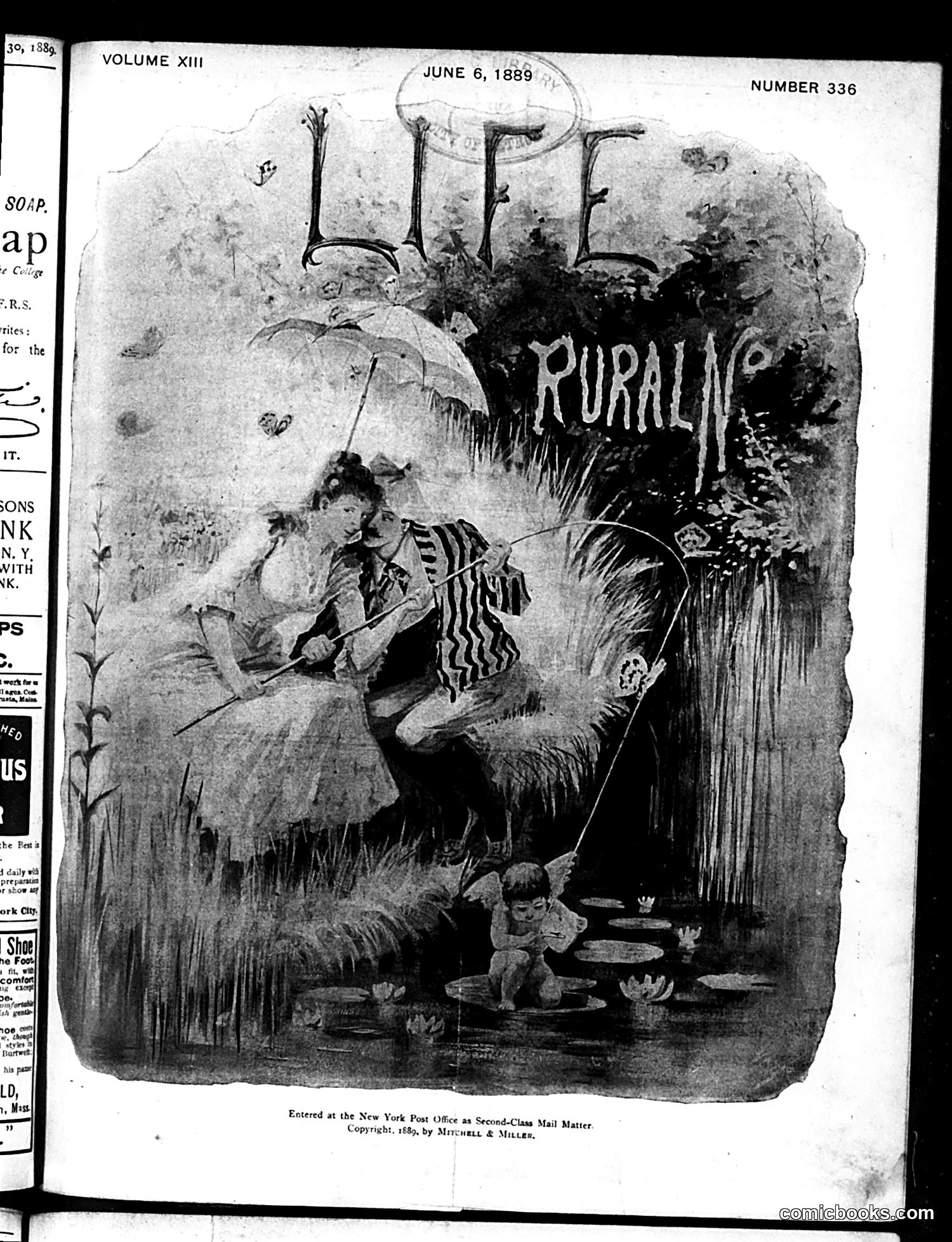
This satirical illustration depicts a rural scene with "LIFE" displayed prominently at the top. The image shows what appears to be a woman in a striped dress sitting outdoors in a rustic setting with tall grass and reeds. A cherub or baby figure appears in the lower portion. The cartoon seems to satirize idealized notions of rural or pastoral life. The title "RURAL LIFE" and the somewhat exaggerated, romanticized depiction—complete with cherubs—suggest the illustration is mocking sentimental, overly-idealized representations of country living that were common in late 19th-century popular culture and literature. The specific social commentary or political target remains unclear from the image alone, though it likely critiques contemporary attitudes toward rural versus urban existence.
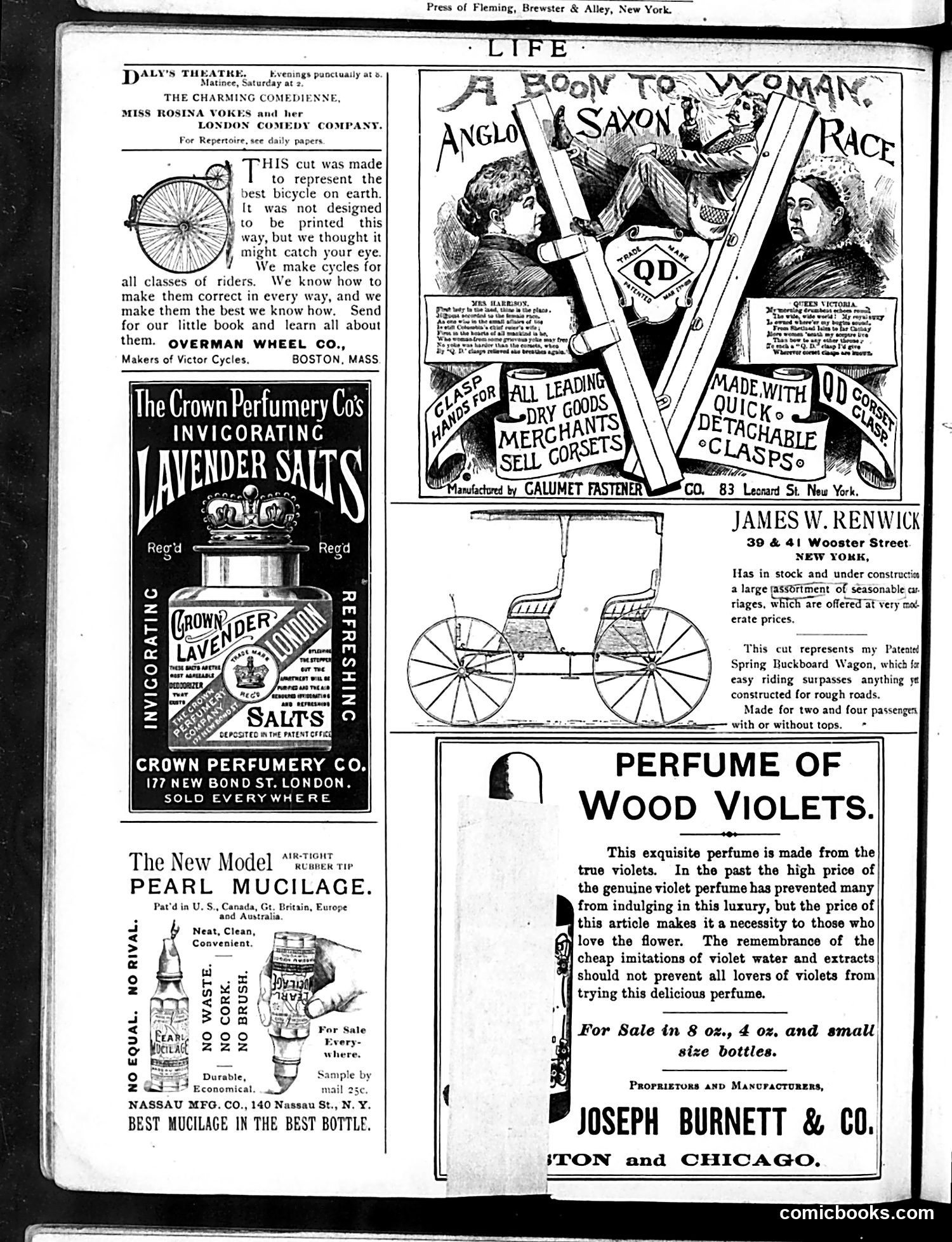
This page is primarily **advertising**, not political satire. The main cartoon titled "A Boon to Woman: Anglo Saxon Race" (center) appears to be a product advertisement for corset clasps made by the Calumet Fastener Company. The cartoon depicts two women examining the clasp mechanism, with the "OD" brand name visible. The satire, if any, is implicit: the ad presents a trivial fastening device as a major advancement for women, using grandiose language ("Boon," "Anglo Saxon Race") to mock both the product's actual significance and period advertising's inflated claims about women's needs. The remaining content consists of standard product advertisements for bicycles, perfume, mucilage, and lavender salts—representative of early 20th-century magazine commercialism.
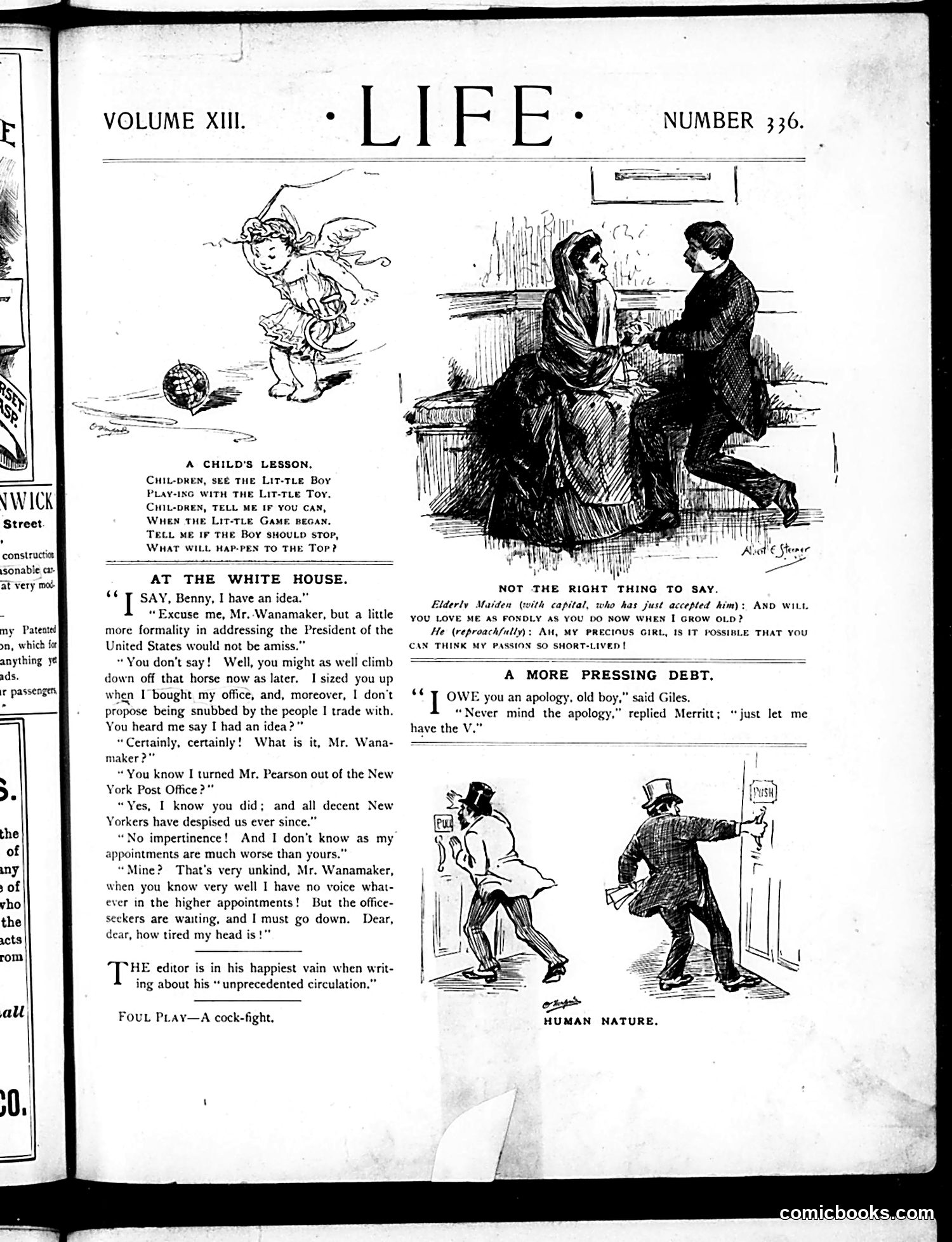
This page contains several satirical pieces typical of early 20th-century American humor: **"At the White House"** depicts a conversation where someone named Benny proposes that the U.S. President adopt "more formality" in office conduct. The joke appears to mock political pretension and bureaucratic concern with appearances. **"Not the Right Thing to Say"** satirizes social hypocrisy—an older man warns against expressing passionate feelings to a young woman, fearing it suggests he won't live long. **"A More Pressing Debt"** shows a brief comic exchange about apologies and debts. **"Human Nature"** (bottom cartoon) depicts two men exchanging papers, likely satirizing human behavior or office politics. The overall tone reflects LIFE's characteristic social satire of American manners, politics, and human behavior.
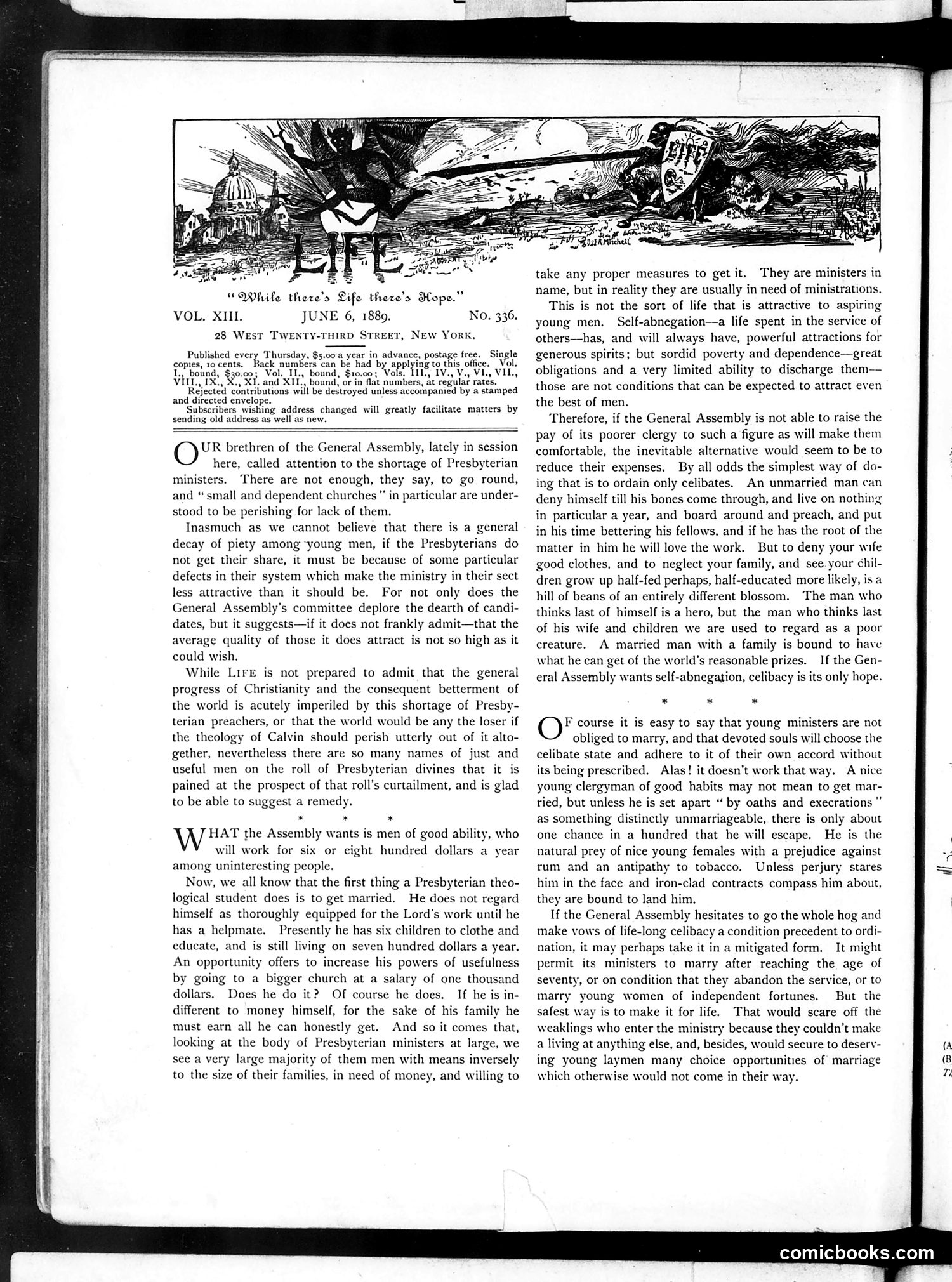
The masthead illustration depicts an allegorical figure of "Life" presiding over a landscape. The accompanying article criticizes Presbyterian Church leadership for failing to adequately compensate clergy, arguing this shortage of funds forces ministers into poverty despite their education and importance. The satire targets the General Assembly's hypocrisy: they call for moral leadership from ministers yet pay them so poorly that only desperate men accept the positions. The piece argues underpaid clergy cannot maintain families or homes befitting their station, and sarcastically suggests the Assembly should either raise salaries or permit ministers to marry wealthy women—implying financial desperation drives matrimonial choices rather than genuine calling. The broader critique addresses class anxieties in late-19th-century America regarding professional respectability and economic security.
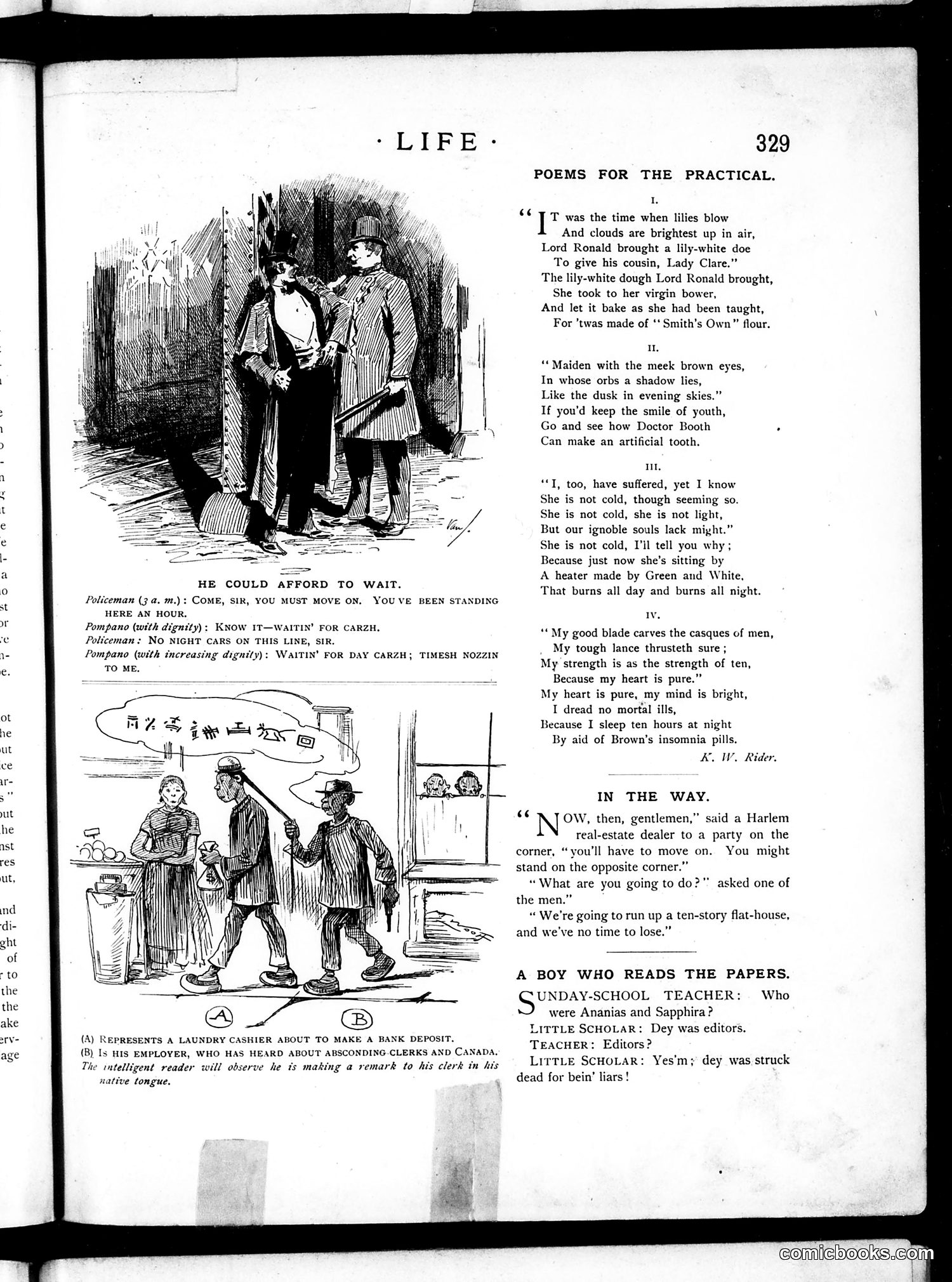
This page contains **satirical poetry and humorous sketches** rather than political cartoons. The top cartoon "He Could Afford to Wait" depicts a policeman stopping two well-dressed men, with dialogue about moving along. The satire appears to mock **class privilege**—the implication being that wealthier individuals could casually ignore police orders that would be enforced against poorer citizens. The lower cartoon shows a laundry cashier and employer discussing "absconding clerks and Canada," suggesting commentary on **labor disputes or employee theft** as a contemporary social problem. The page primarily features light verse ("Poems for the Practical") and a humorous dialogue called "A Boy Who Reads the Papers," poking fun at Sunday-school lessons. The overall tone is gentle social satire rather than hard-hitting political commentary.
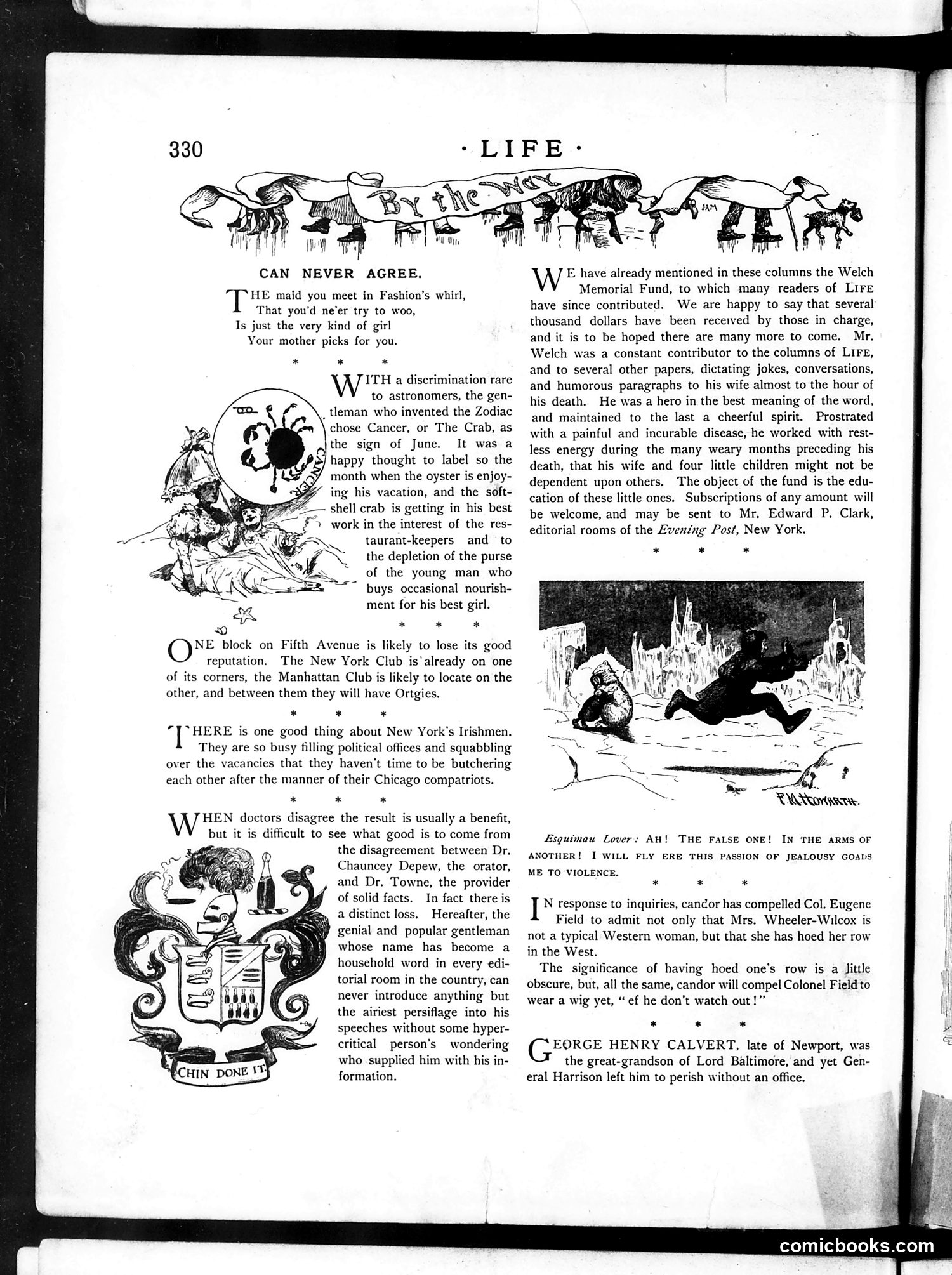
This page contains several humorous social commentaries typical of early Life magazine satire: **"Can Never Agree"** (left column): A poem mocking romantic disagreements between couples, illustrated with a zodiac-themed drawing showing Cancer/The Crab—chosen because oyster season coincides with this sign. The joke plays on the crab as a metaphor for romantic irritability. **Right column content**: References to the Welch Memorial Fund (supporting a deceased Life contributor's family), New York's Fifth Avenue reputation, and Irish-American political activity in New York City. **"Chin Done It"** (bottom left): A heraldic coat of arms, likely satirizing pretentious genealogy claims or inventing humorous false pedigrees—common Life satire targets. The overall tone reflects turn-of-century American urban humor and class commentary.
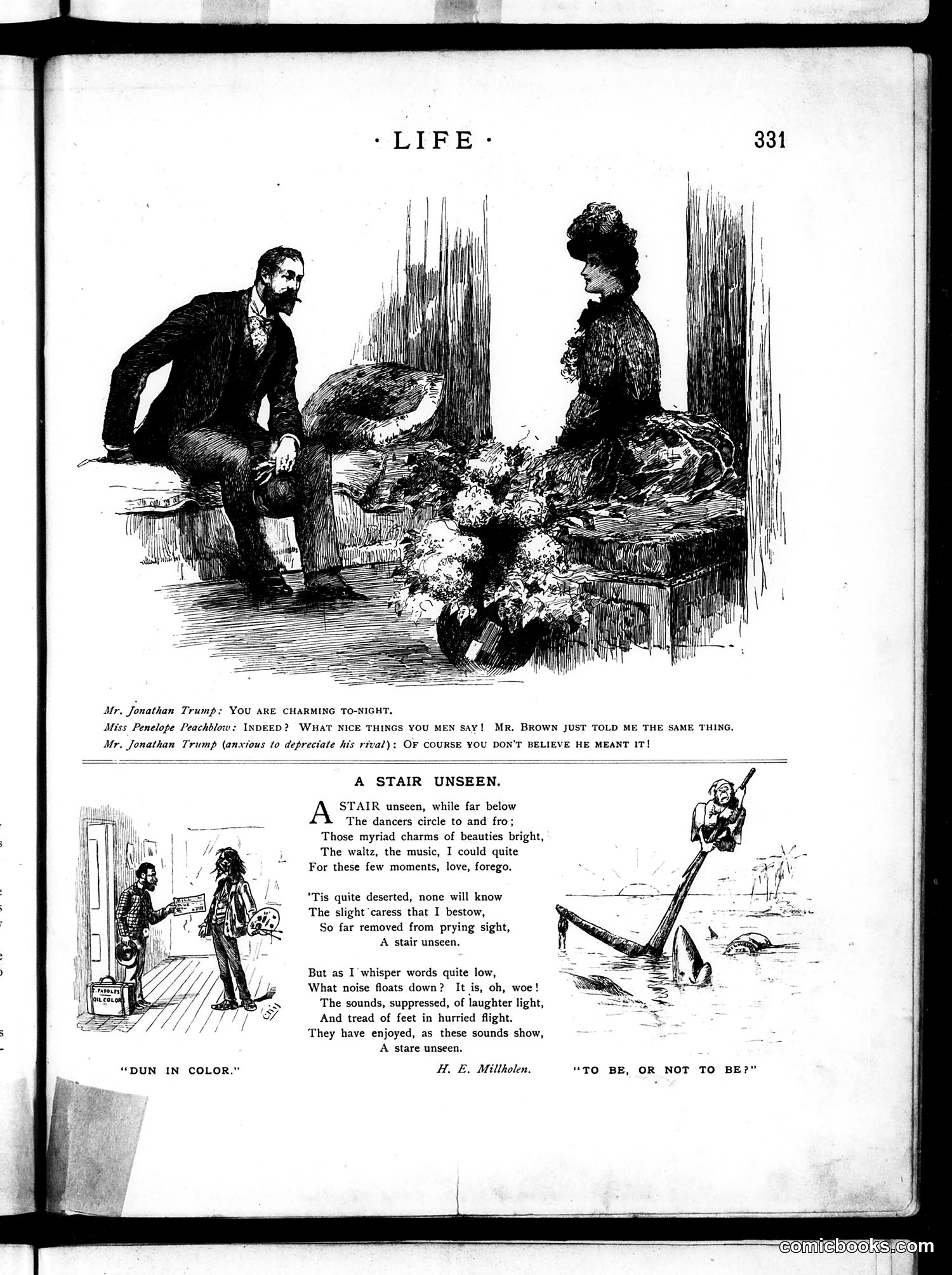
The top cartoon depicts a social scene with three figures examining flowers. Mr. Jonathan Trump compliments the scene to Miss Penelope Peachblow, who notes that "Mr. Brown just told me the same thing." Trump responds indignantly that Brown couldn't have meant it sincerely. This appears to be satirizing superficial social flattery and vanity—the humor lies in Trump's offense that his compliment isn't original, suggesting his self-regard expects uniqueness in praise. The satire targets shallow upper-class social conventions where identical compliments are mechanically exchanged. Below, "A Stair Unseen" is a romantic poem by H.E. Miltholen about secret lovers meeting away from public view. The accompanying illustrations are unrelated sketches labeled "Dun in Color" and "To Be, or Not to Be?"—likely different editorial content rather than commentary.
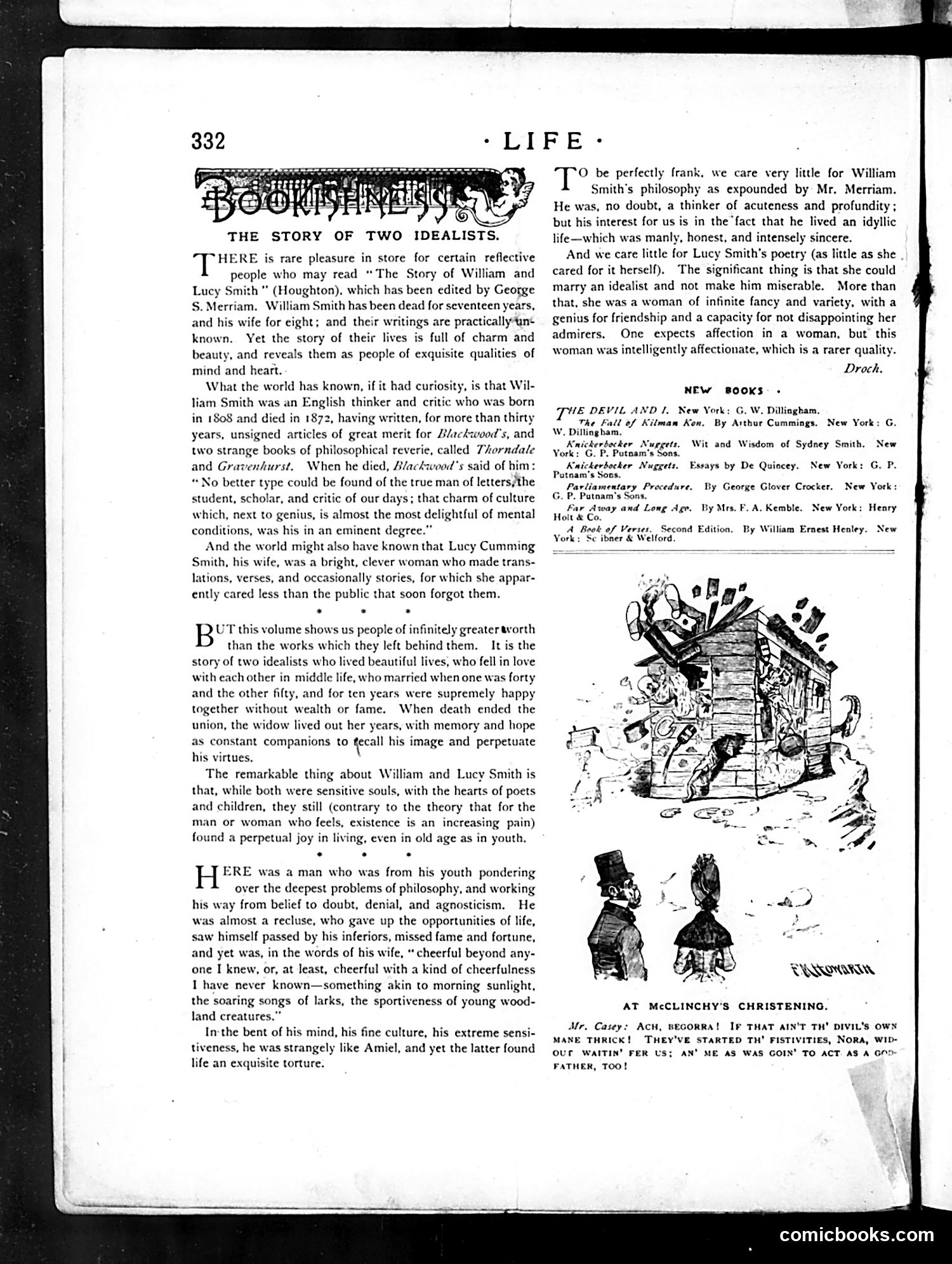
This page reviews a biography of William Smith (1808-1872), an English philosopher and critic, and his wife Lucy Smith. The text praises their lives as "two idealists" who achieved happiness through intellectual companionship rather than wealth or fame. The small illustration at bottom shows a scene labeled "At McClinchy's Christening," depicting what appears to be a social gathering with period dress. The caption's dialect humor—"Ach, begorra! If that ain't th' devil's own name thricks!"—suggests Irish characters commenting on the event, likely reflecting 19th-century American attitudes toward Irish immigrants through stereotypical speech patterns and comedy. The page emphasizes the Smiths' philosophical pursuits and emotional fulfillment over material success, a romantic ideal common to Life's cultural criticism.
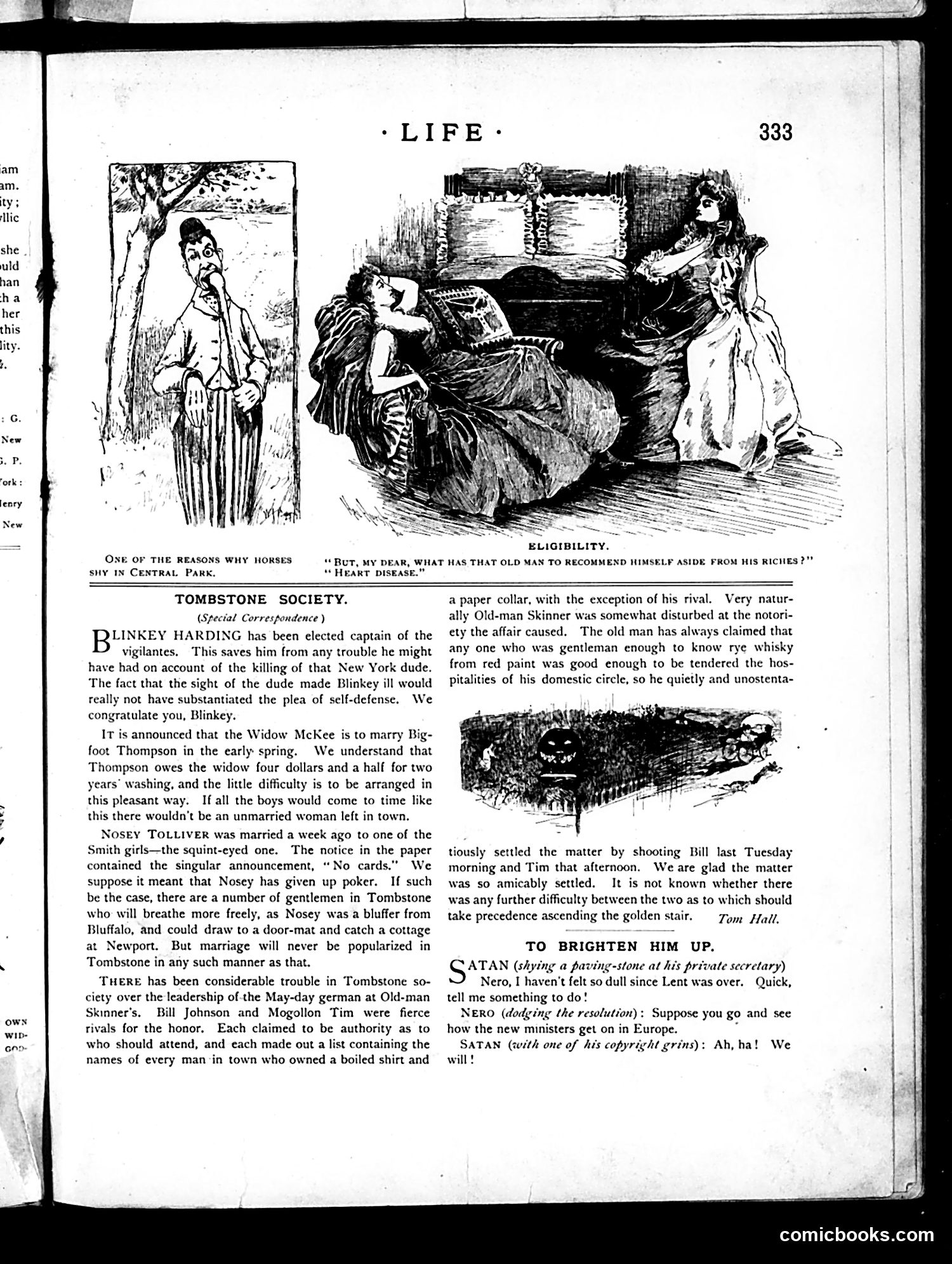
**Top Cartoon: "Eligibility"** A wealthy older man, lounging on a bed, asks a young woman: "But, my dear, what has that old man to recommend himself aside from his riches? Heart disease." This satirizes marriages of convenience between wealthy older men and younger women, mocking the suitor's only real qualification as his money, while suggesting his poor health makes him an unappealing match otherwise. **"Tombstone Society" Section** This gossip column reports on local scandals in Tombstone, Arizona, including a German immigrant's killing, the Widow McKee's impending marriage, and a dispute over boiled-shirt ownership among rival May-day celebrants. The tone is satirical, poking fun at small-town social pretensions and petty rivalries.
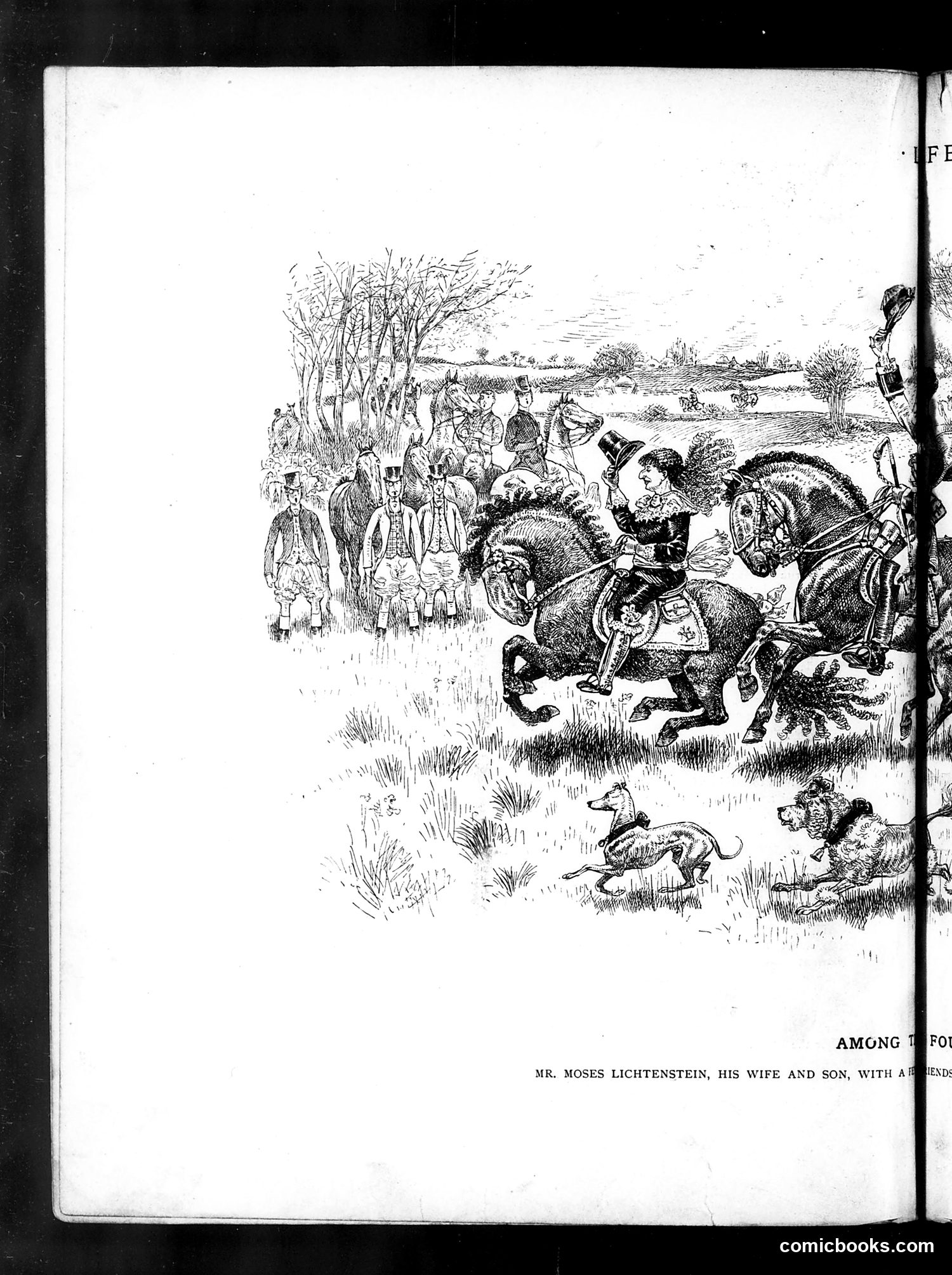
This illustration depicts **Mr. Moses Lichtenstein, his wife and son, with a friend** (per the caption), shown riding horses in a countryside scene while observing a group of people gathered by trees near water. The satire appears to target **Jewish figures in late 19th/early 20th-century America**, using caricature to mock them. The wealthy family on horseback—depicted with exaggerated features—contrasts with the rural laborers or common people on foot, suggesting commentary on Jewish wealth, assimilation, or social pretension. The specific context and satirical point remain unclear without additional historical information about when this appeared and what current events it referenced. Life magazine's satirical approach often employed ethnic caricature, which reflects the prejudices of its era.
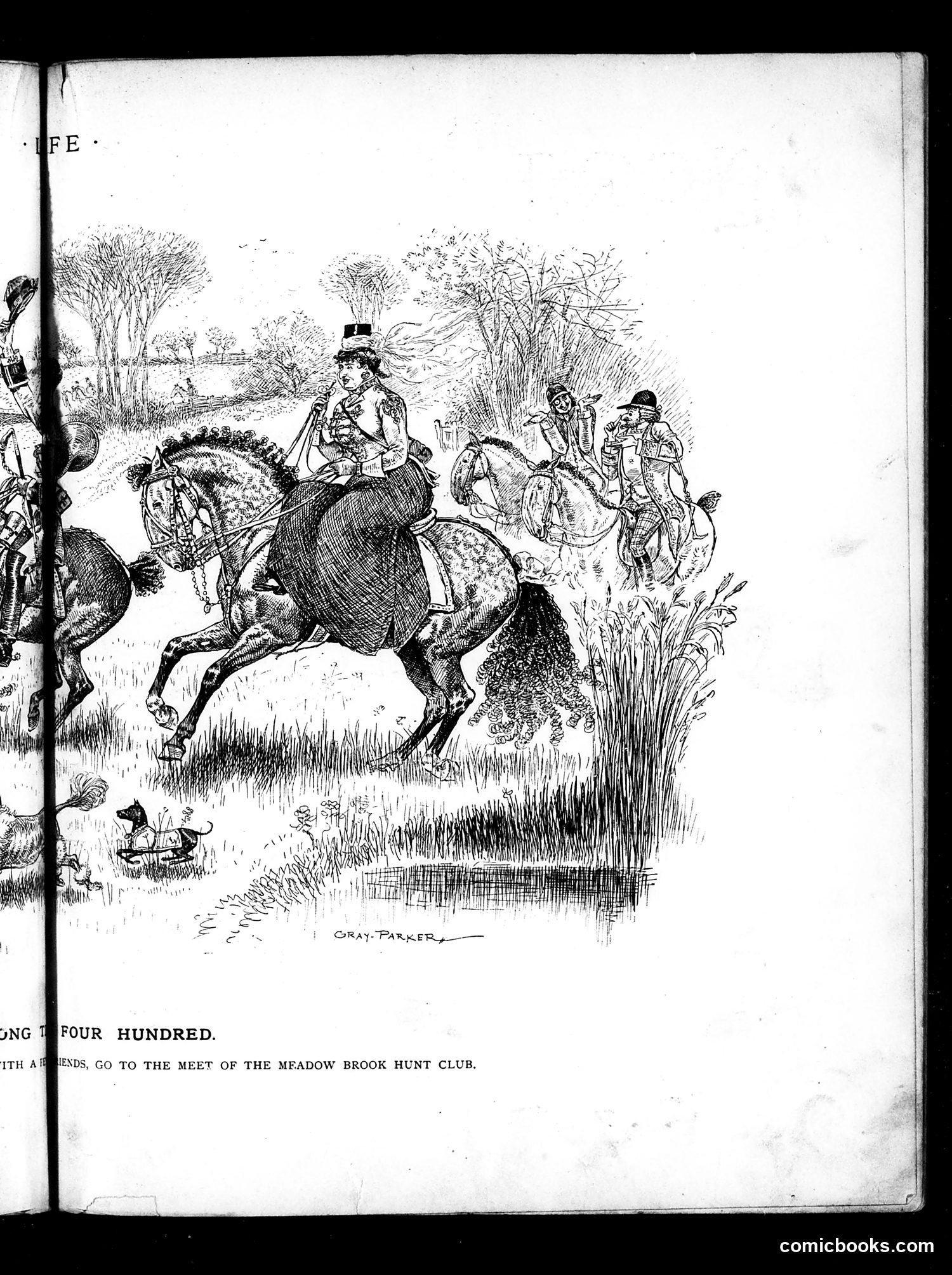
This illustration by Gray Parker depicts a fox hunt scene. The central figure is a woman in riding attire on horseback, wearing a top hat, riding sidesaddle—the standard for Victorian-era female riders. She's shown prominently among male hunters on a country estate, with hunting dogs and countryside scenery visible. The caption reads "FOUR HUNDRED" and references "THE MEET OF THE MEADOW BROOK HUNT CLUB," identifying this as depicting elite fox-hunting society. The satire likely comments on the wealthy upper-class social rituals of the era, or possibly the woman's prominent participation in traditionally male-dominated sporting activities. Without additional context about the specific 1890s-1900s social moment, the precise satirical target remains unclear, though the emphasis on fashionable wealth and leisure is evident.
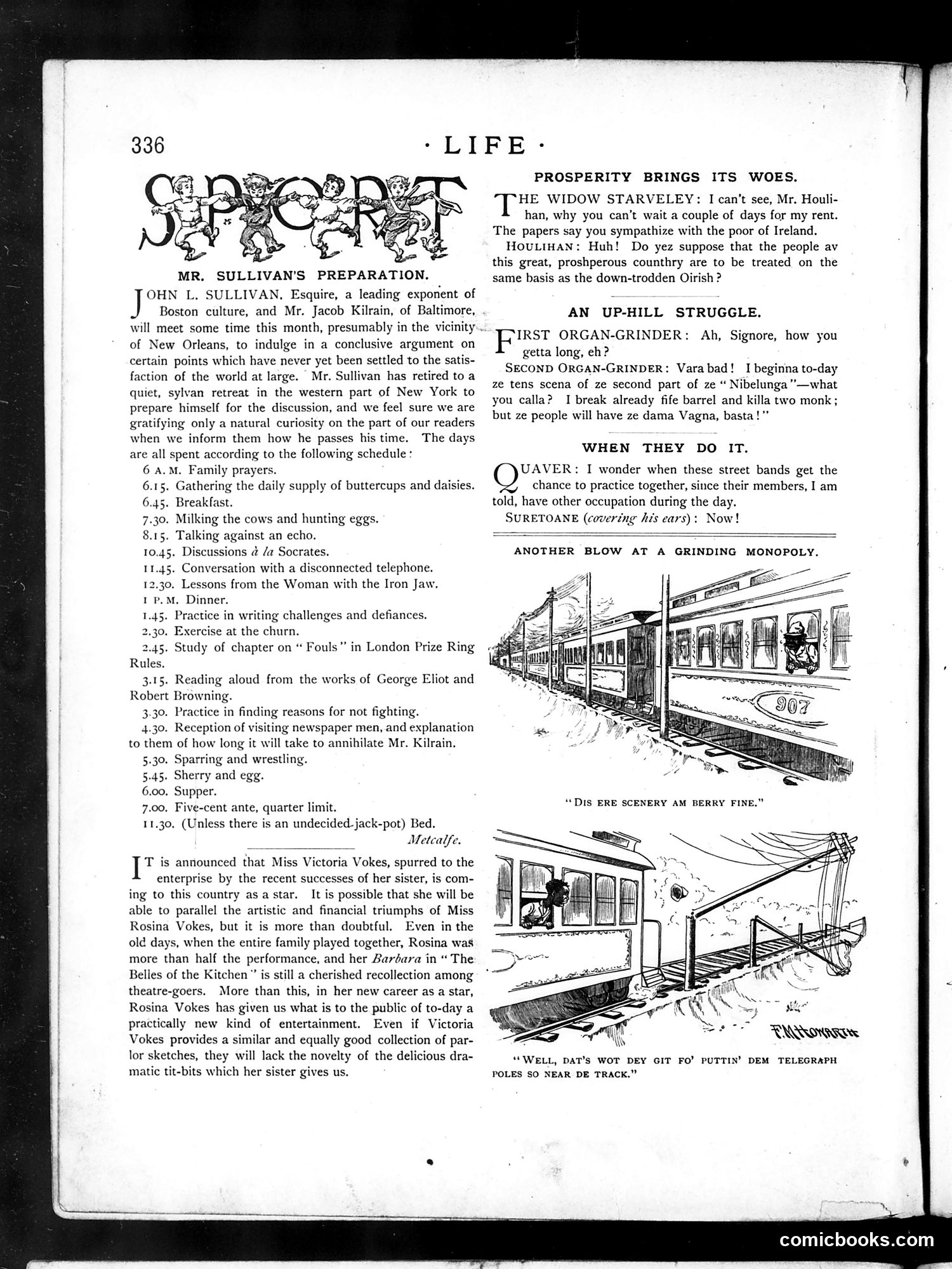
This page contains multiple satirical pieces mocking contemporary figures and social issues: **Sullivan's Preparation**: The main article ridicules boxer John L. Sullivan's training routine before a planned fight with Jacob Kilrain. The humor lies in the absurdly genteel, un-athletic activities listed (gathering daisies, milking cows, reading George Eliot)—presenting Sullivan as an intellectual rather than a fighter, likely mocking his pretensions to "Boston culture" despite being a professional boxer. **The cartoons** address labor and class issues: one depicts an Irish landlord refusing rent to a poor widow while claiming sympathy for Ireland; another shows organ-grinders complaining about monopolies and street obstacles. **Victoria Vokes paragraph**: This discusses an actress following her sister Rosina's theatrical success, questioning whether Victoria can replicate that achievement. The overall tone is that of 1880s American satirical journalism—mixing celebrity gossip, labor criticism, and ethnic humor (Irish and Italian stereotypes present).
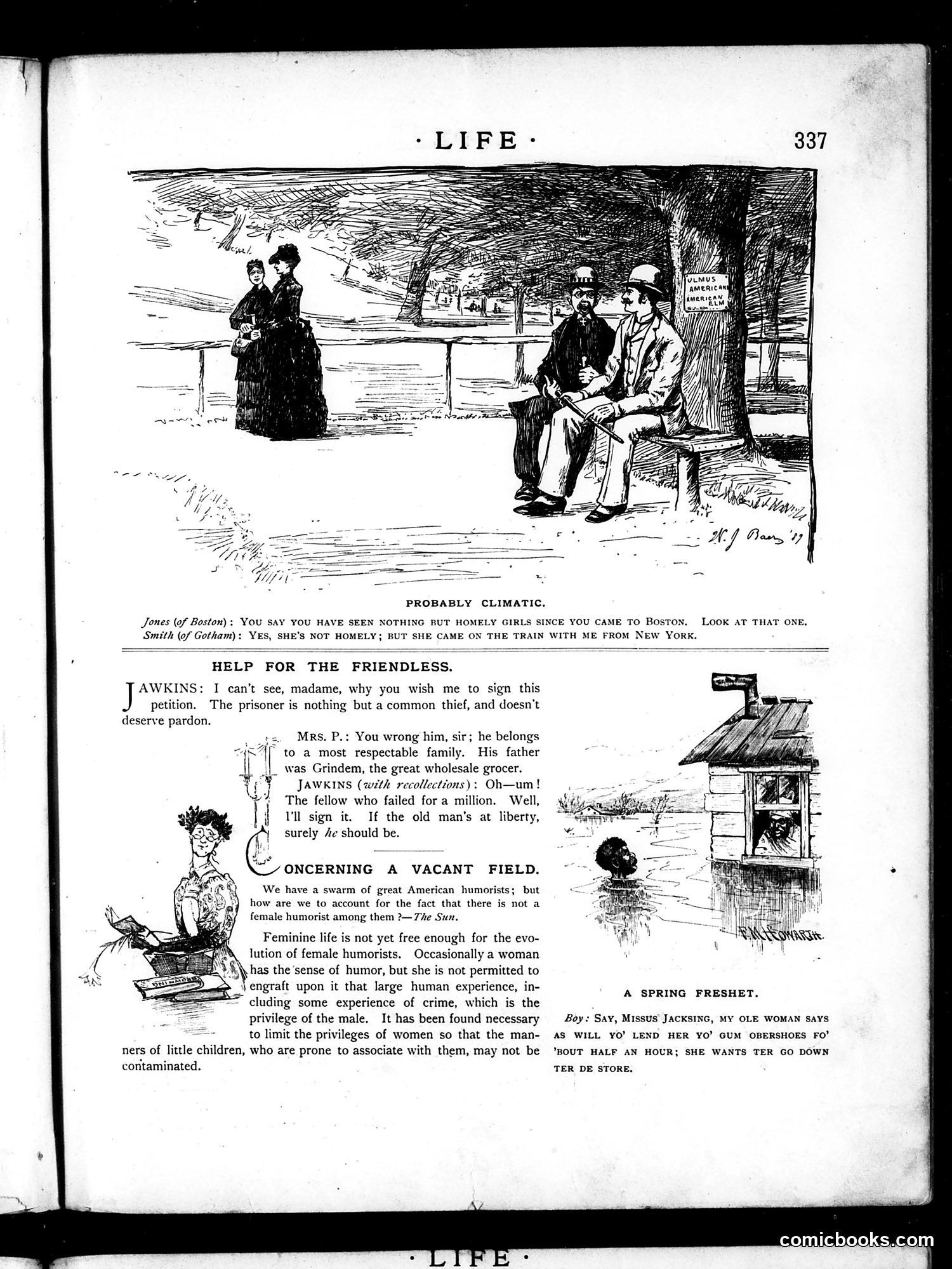
This page contains three satirical pieces typical of 1880s-90s Life magazine: **"Probably Climatic"**: A New York businessman mocks Boston for having only homely women, then realizes the attractive woman he noticed came from New York on the train—suggesting New York women are superior, implying Boston's "homeliness" is environmental rather than genetic. The joke plays on regional rivalries. **"Help for the Friendless"**: A man refuses to sign a petition for a imprisoned thief until learning the prisoner's father was Grindem, a wealthy grocer who "failed for a million" (went bankrupt). He immediately agrees to sign, satirizing how the wealthy receive mercy through social connections while the poor face justice—the father's financial ruin is deemed reason enough to pardon the son's criminality. **"Concerning a Vacant Field"**: An editorial comment critiquing why America lacks female humorists, arguing women lack the freedom to develop humor because they haven't experienced crime or rough human experience, and must be "limited" to protect children's morality. This is satirizing Victorian restrictions on women.
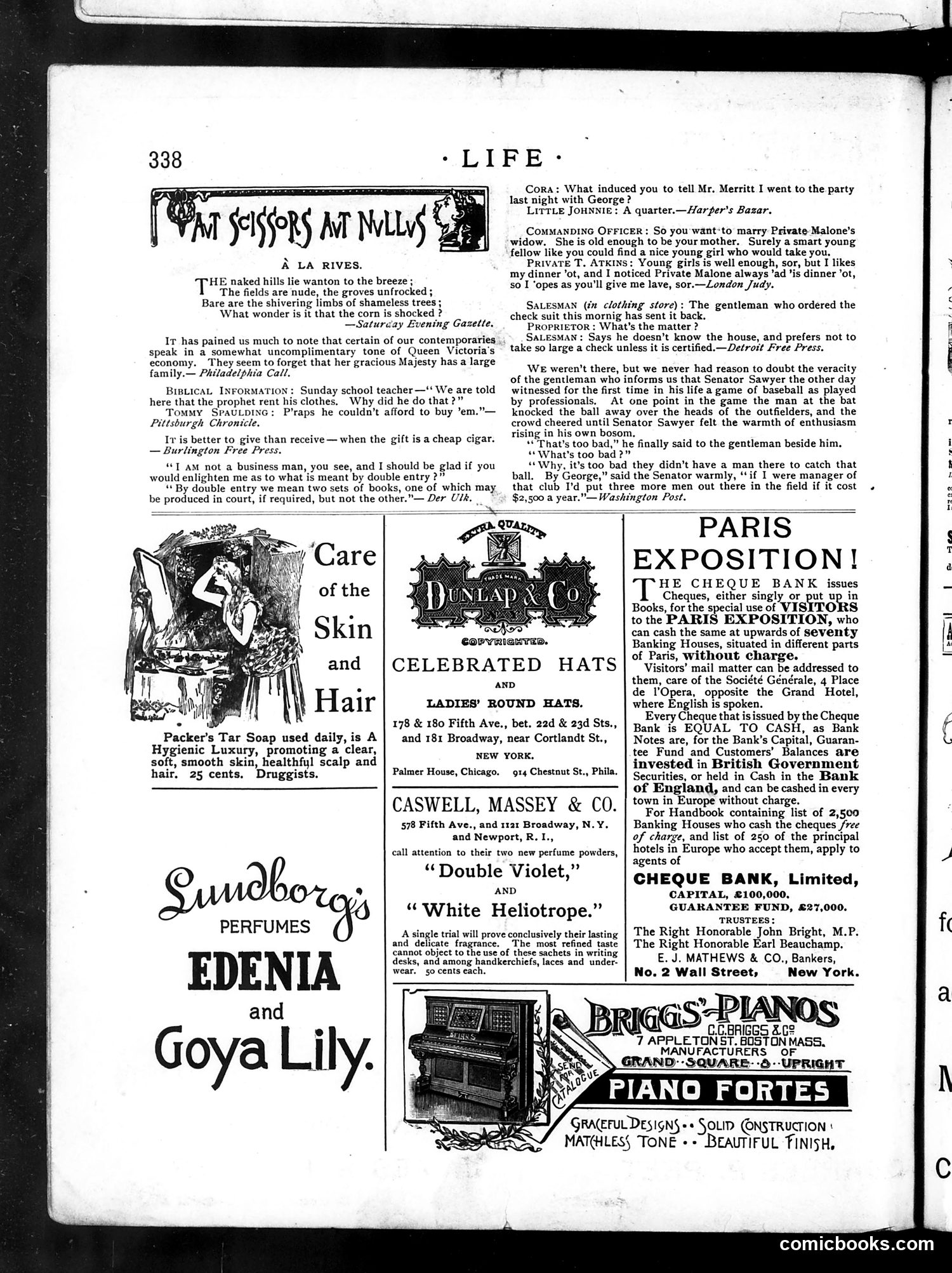
This page is primarily a **collection of brief humorous anecdotes and advertisements** rather than political cartoons. The jokes are genteel, Victorian-era humor typical of Life magazine's satirical content. **Key humor pieces:** - A poem mocking Queen Victoria's "economy" (frugality), sarcastically suggesting her large family justifies it - A Sunday school joke about a prophet rending clothes—a child misunderstands as financial inability - Multiple short jokes about double-entry bookkeeping, marrying widows for practical reasons (hot dinners), and Senator Sawyer's naïveté about baseball **The Senator Sawyer anecdote** appears most substantial—it mocks a politician unfamiliar with baseball, suggesting he'd wastefully overspend on players to prevent errors, illustrating aristocratic ignorance of common American sport. The page is otherwise dominated by **period advertisements** for perfumes, hats, pianos, and notably a "Cheque Bank" for Paris Exposition visitors—reflecting the cosmopolitan, upper-class readership Life targeted.
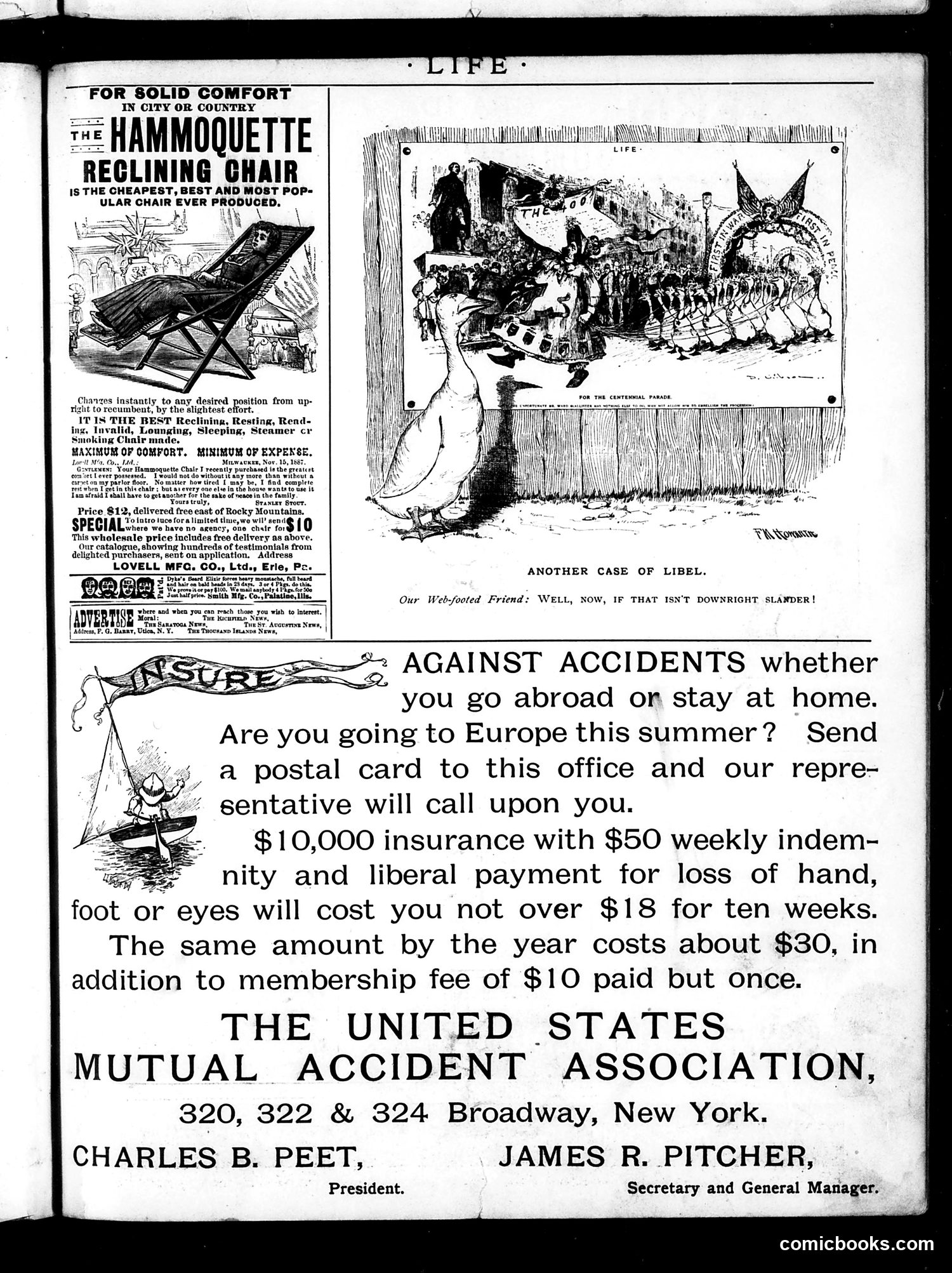
This small cartoon satirizes legal disputes over alleged defamation. A duck (labeled "Our Web-footed Friend") protests indignantly that being called "web-footed"—a literal, biological fact about ducks—constitutes "downright slander." The joke targets the absurdity of frivolous libel claims: the duck objects to accurate description of its own nature as though it were insulting. This likely comments on contemporary lawsuits where plaintiffs sued over factual statements, claiming injury to reputation. The cartoon mocks both the litigious culture and the circular logic of those who deny observable truth. It's a brief, pointed jab at legal overreach disguised as defense of honor.
This page is **primarily advertising**, not a satirical cartoon. It's a typical late 19th-century magazine layout featuring commercial advertisements for upscale goods and services aimed at wealthy readers. The advertisements showcase period fashion and luxury items: Redfern's summer clothing sale (high-end dresses, coats, hats), silk importers, tailoring services, wine merchants, trunks and luggage, and pianos. The Hotel Vendome and Profile House ads target affluent travelers. The single editorial element is the footer moral: **"Insure in The Travelers,"** a straightforward insurance company advertisement presented as advice. There are no political cartoons, caricatures, or satirical commentary visible. This reflects Life magazine's dual nature as both satirical periodical and society publication for the wealthy class—this particular page serves the latter function, advertising goods to the magazine's upscale readership.
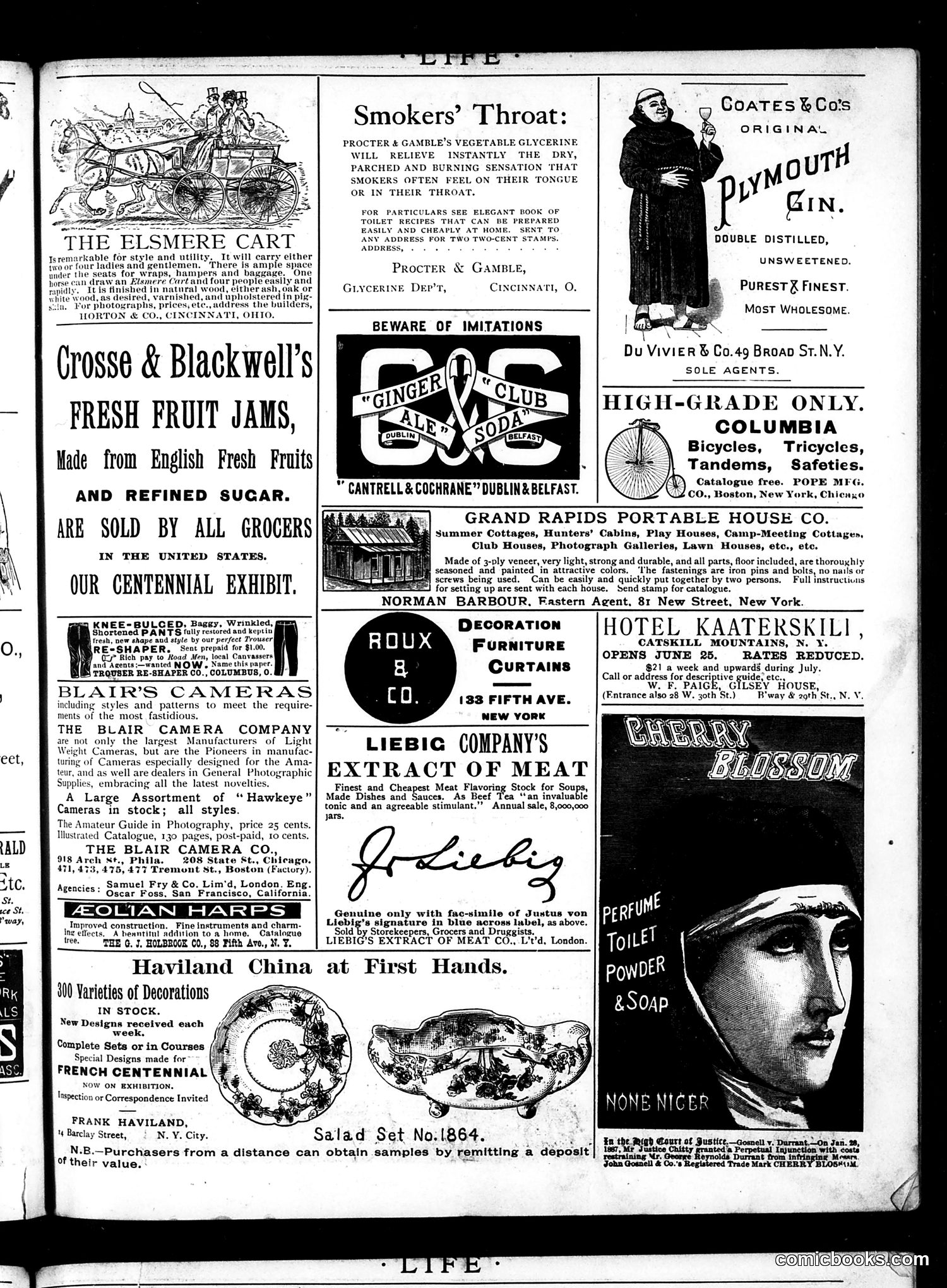
This page is primarily composed of late-19th-century advertisements, not editorial cartoons or satirical content. The ads showcase consumer products and services typical of the era: Procter & Gamble's glycerine for smokers' sore throats, Crosse & Blackwell's jams, Liebig's meat extract, Blair cameras, Haviland china, and Columbia bicycles. There's also promotional material for hotels, furniture, and various home remedies. One notable ad warns "BEWARE OF IMITATIONS" regarding "Ginger Ale" products, suggesting counterfeit goods were common concerns. The only visual element approaching satire appears to be the "None Nicer" perfume advertisement featuring a woman's profile—typical belle époque advertising imagery without overt political or social commentary. This appears to be a typical advertising-heavy page from *Life* magazine, likely from the 1880s-1890s, reflecting consumer culture and product promotion rather than satirical editorial content.
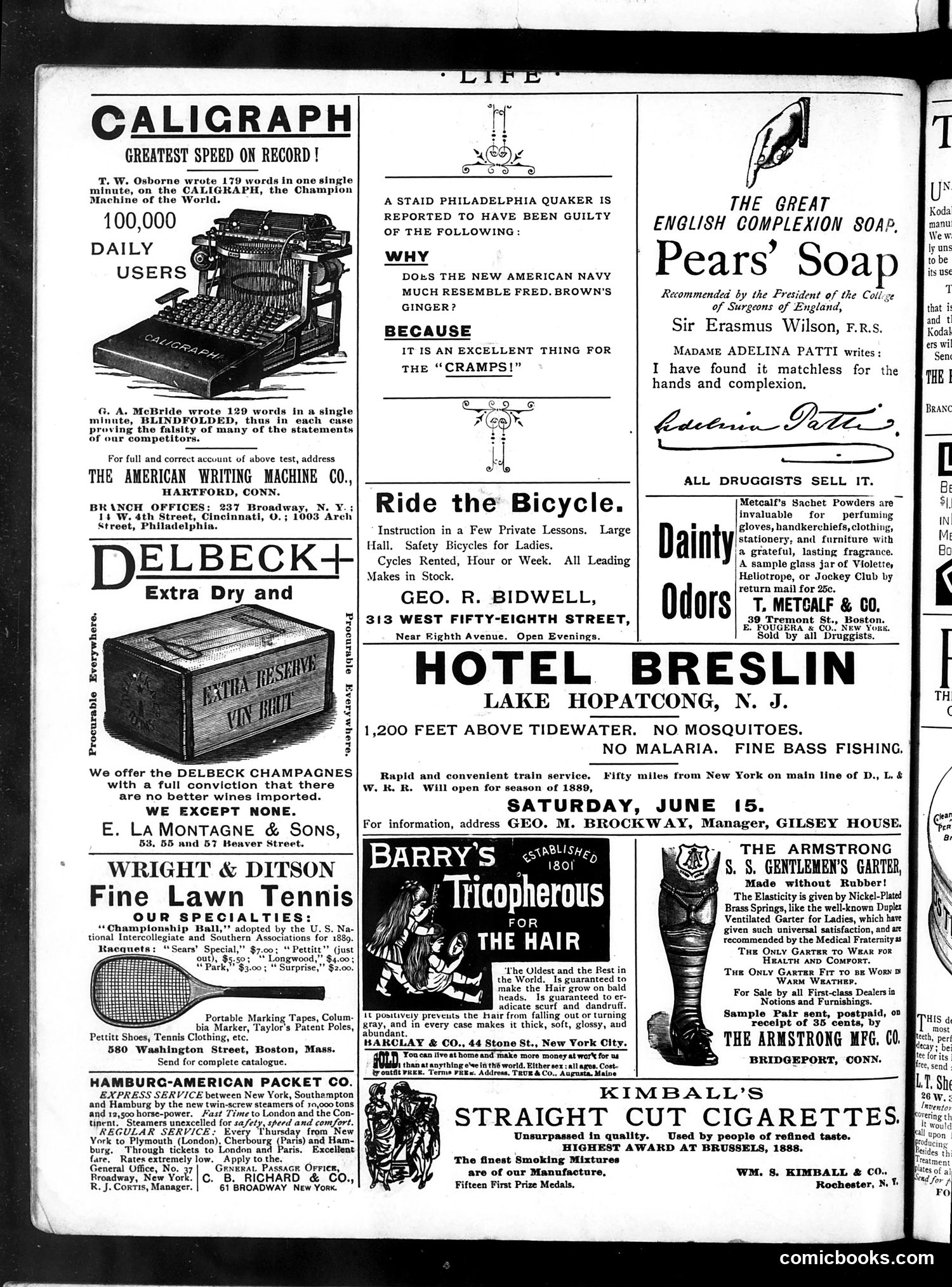
This is a Life magazine page from 1889 (dated June 15), but it consists almost entirely of **commercial advertisements** rather than editorial content or satirical cartoons. The only identifiable humor is a brief riddle midpage: "Why does the new American Navy much resemble Fred. Brown's Ginger? Because it is an excellent thing for the 'Cramps!'" This appears to mock the Cramp Shipbuilding Company (likely a major Navy contractor) by suggesting the Navy causes them financial distress—a pun on "cramps" as discomfort. The rest of the page advertises typewriters (Caligraph), champagne, lawn tennis equipment, steamship service, bicycles, soaps, hair products, and resort hotels. While these ads reveal consumer interests of the era, they contain no political satire or cultural commentary beyond typical period marketing.
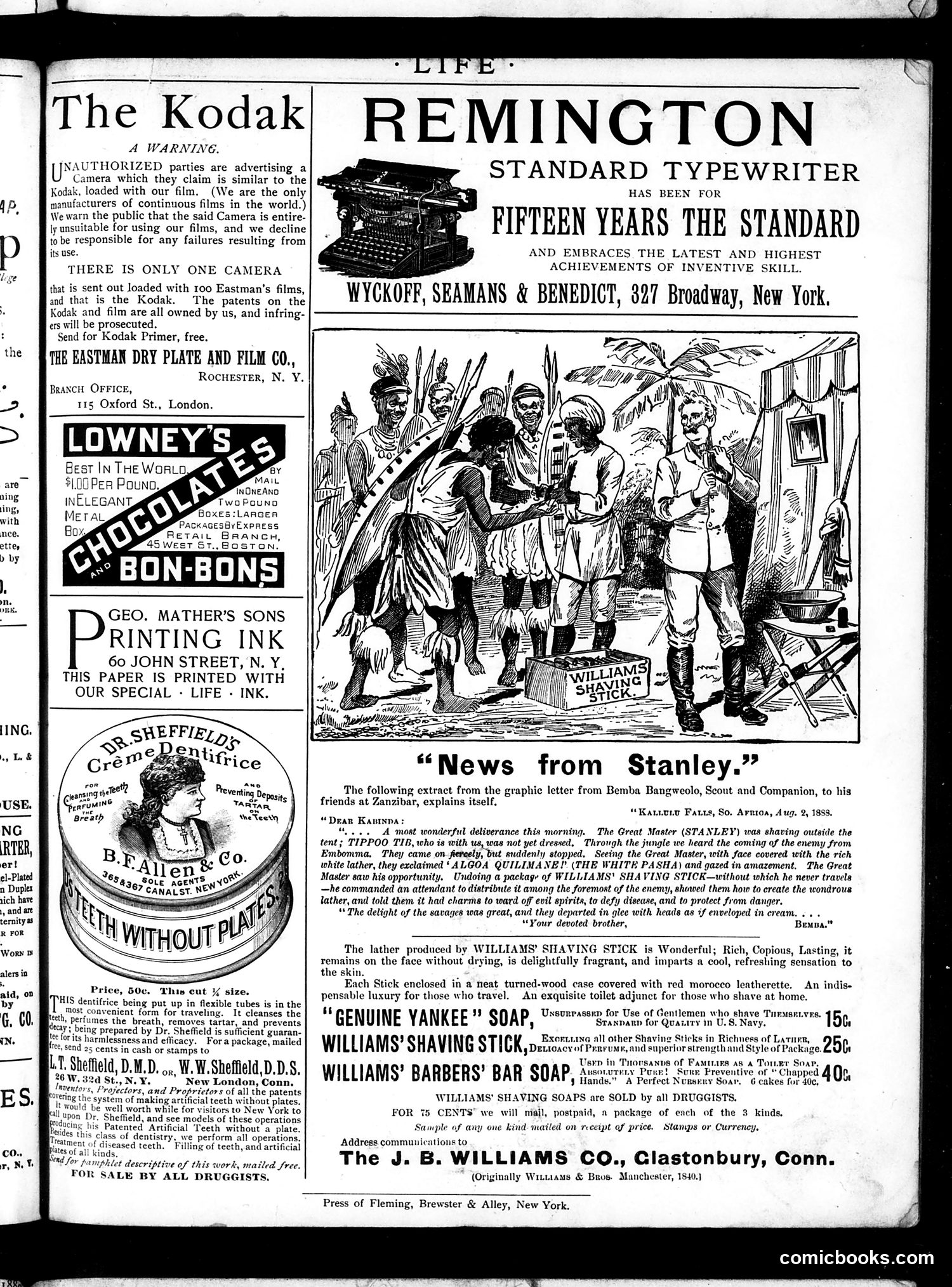
This page features a satirical advertisement exploiting the fame of explorer Henry Morton Stanley's 1888 African expedition. The illustrated scene depicts Stanley (identifiable as "the Great Master") shaving in the jungle while encountering hostile forces from Embomma. The joke centers on an absurd claim: Stanley's Williams' Shaving Stick allegedly pacifies attacking warriors through its superior lather quality. The fictional letter from "Bemba Bangweolo" suggests the enemy becomes so fascinated by the shaving product's properties that they abandon their assault and depart peacefully, treating the shaving stick as a magical charm. This is period advertising satire—Life magazine's humor targets both colonial adventure narratives and consumer product marketing. It mocks Victorian-era advertisements' grandiose claims by suggesting a mere toiletry could resolve genuine mortal danger through vanity and wonder at Western goods. The satire works because it exaggerates real advertising tropes while exploiting Stanley's contemporary celebrity status.
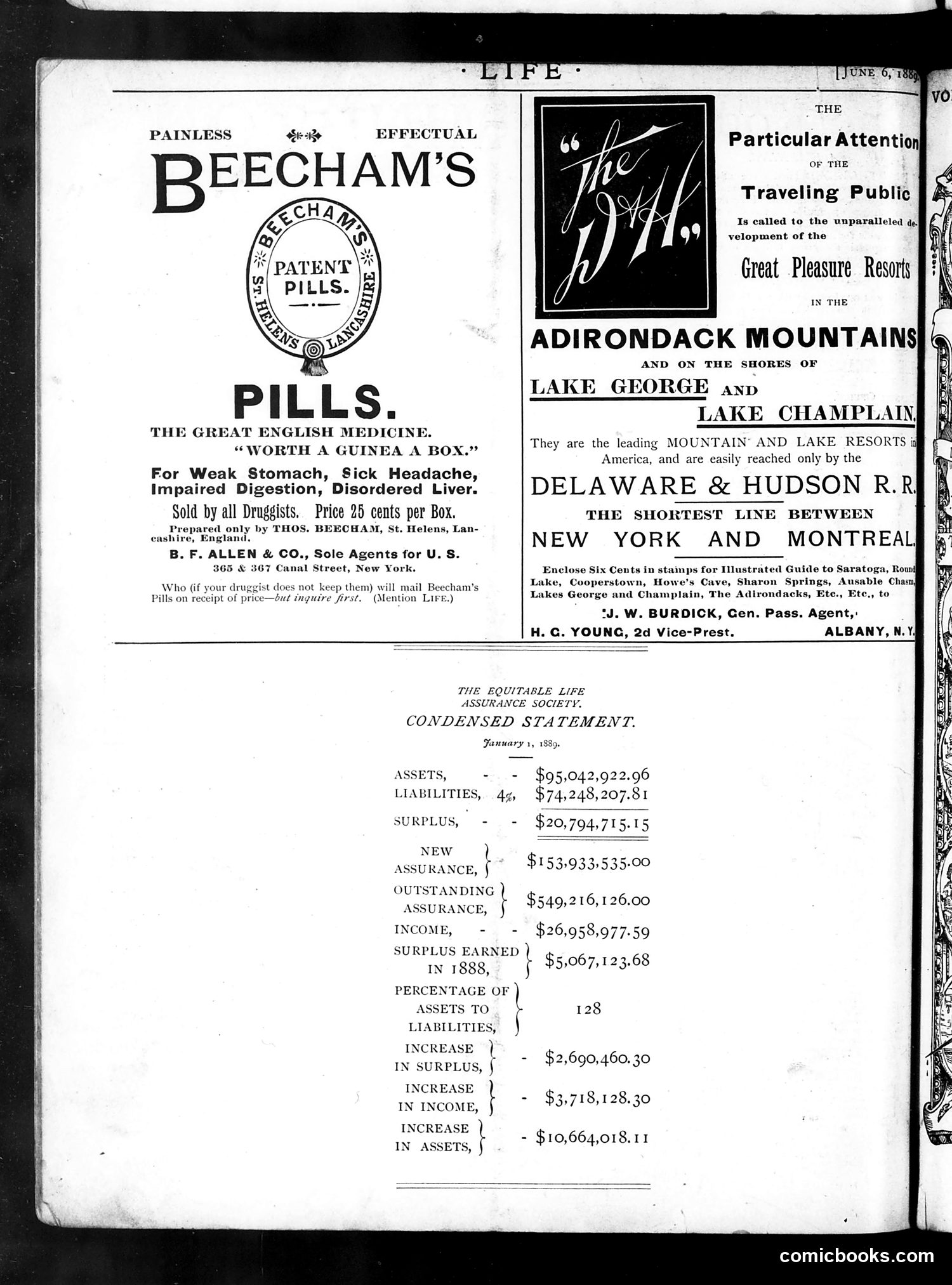
This page consists entirely of **period advertising and financial statements**, not editorial cartoons or satire. The content includes: 1. **Beecham's Pills advertisement** — a patent medicine claiming to cure weak stomach, sick headache, and digestive issues. The "worth a guinea a box" phrase suggests British origins; Beecham's was a real, long-established English remedy. 2. **Adirondack Mountains resort advertisement** — promoting leisure destinations in upstate New York (Lake George, Lake Champlain) accessible via the Delaware & Hudson Railroad. 3. **Equitable Life Assurance Society financial statement** — a January 1, 1889 condensed report showing assets, liabilities, and income figures for the insurance company. There are no identifiable political cartoons, satirical figures, or caricatures present. This appears to be a standard advertising and business information page from *Life* magazine's June 6, 1889 issue.