
Life, 1889-06-06 · page 8 of 20
Life — June 6, 1889 — page 8: what you’re looking at
What you’re looking at
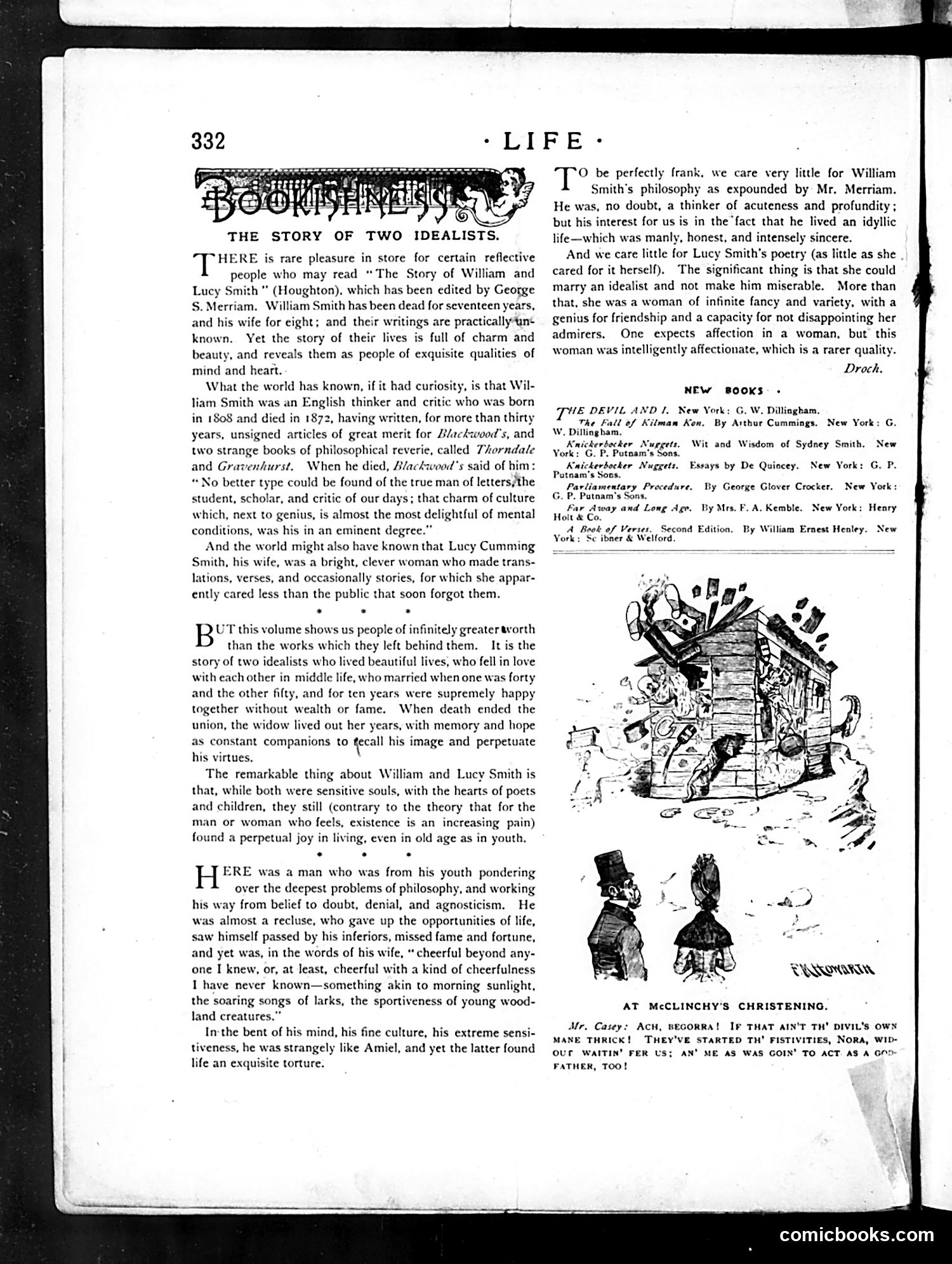
This page reviews a biography of William Smith (1808-1872), an English philosopher and critic, and his wife Lucy Smith. The text praises their lives as "two idealists" who achieved happiness through intellectual companionship rather than wealth or fame. The small illustration at bottom shows a scene labeled "At McClinchy's Christening," depicting what appears to be a social gathering with period dress. The caption's dialect humor—"Ach, begorra! If that ain't th' devil's own name thricks!"—suggests Irish characters commenting on the event, likely reflecting 19th-century American attitudes toward Irish immigrants through stereotypical speech patterns and comedy. The page emphasizes the Smiths' philosophical pursuits and emotional fulfillment over material success, a romantic ideal common to Life's cultural criticism.
📄 Transcribed text from this page (OCR, searchable)
Machine-transcribed from the original scan — historical spelling and the odd misread are preserved.
- LIFE: THE STORY OF TWO IDEALISTS. HERE is rare pleasure in store for certain reflective people who may read “The Story of William and Lucy Smith " (Houghton), which has been edited by George S. Merriam. William Smith has been dead for seventeen years, and his wife for eight; and their writings are practicallytunt known. Yet the story of their lives is full of charm and beauty, and reveals them as people of exquisite qualities of mind and heart. What the world has known, if it had curiosity, is that Wil- liam Smith was an English thinker and critic who was born in 1808 and died in 1872, having written, for more than thirty years, unsigned articles of great merit for Blackwood's, and two strange books of philosophical reverie, called Thorndale and Gravenhurst. When he died, Blackzwood's said of bim: “No better type could be found of the true man of letters/the student, scholar, and critic of our days; that charm of culture which, next to genius, is almost the most delightful of mental conditions, was his in an eminent degree.” And the world might also have known that Lucy Cumming Smith, his wife, was a bright, clever woman who made trans- lations, verses, and occasionally stories, for which she appar- ently cared less than the public that soon forgot them. B T this volume shows us people of infinitely greater avorth than the works which they left behind them. It is the story of two idealists who lived beautiful lives, who fell in love with each other in middle life, who married when one was forty and the other fifty, and for ten years were supremely happy together without wealth or fame. When death ended the union, the widow lived out her years, with memory and hope as constant companions to fecall his image and perpetuate his virtues, The remarkable thing about William and Lucy Smith is that, while both were sensitive souls, with the hearts of poets and children, they still (contrary to the theory that for the man or woman who feels, existence is an increasing pain) found a perpetual joy in living, even in old age as in youth. ERE was a man who was from his youth pondering over the deepest problems of philosophy, and working ‘ay from belief to doubt, denial, and agnosticism. He almost a recluse, who gave up the opportunities of life, saw himself passed by his inferiors, missed fame and fortune, and yet was, in the words of his wife, “ cheerful beyond any- one I knew, or, at least, cheerful with a kind of cheerfulness I have never known—something akin to morning sunlight, the soaring songs of larks, the sportiveness of young wood- land creatures.” Inthe bent of his mind, his fine culture, his extreme sensi- tiveness, he was strangely like Amiel, and yet the latter found life an exquisite torture. O be perfectly frank, we care very little for William Smith's philosophy as expounded by Mr. Merriam. He was, no doubt, a thinker of acuteness and profundity ; but his interest for us is in the “fact that he lived an idyllic life—which was manly, honest, and intensely sincere. And we care little for Lucy Smith's poetry (as little as she cared for it herself), The significant thing is that she could marry an idealist and not make him miserable. More than that, she was a woman of infinite fancy and variety, with a genius for friendship and a capacity for not disappointing her admirers. One expects affection in a woman, but this woman was intelligently affectionate, which is a rarer quality. Droch. NEW B00KS: - THE DEVIL AND I. New York: G.W. Dillingham. The Fall of Kitmam Ken. By Arthur Cummings. New York: G. W. Dillingham. Knickerbocker Nuggets, Wit and Wisdom of Sydney Smith. New York: G. P. Putnam's Sons. Knickerbocker Nuggets. Essays by De Quincey. New York: G. P. Potnam’s Sons. Parliamentary Procedure. Dy George Glover Crocker. New York: G. P. Pataam's Sons, Far Away and Long Age. By Mes. FA. Kemble. New York: Henry Holt & Co. A Book of Verses. Second Edition. By William Ernest Henley. New York: Sc ibner & Welford. AT McCLINCHY’S CHRISTENING. Mr, Casey: ACM, BEGORRA! IF THAT AIN'T TH’ DIVIL's OWN MANE THRICK! THEY'VE STARTED TH’ FISTIVITIES, NORA, WID- OUP WAITIN’ FER US; AN’ ME AS WAS GOIN’ TO ACT AS A GOD FATHER, TOO! comicbooks.com