
Life, 1889-06-06 · page 4 of 20
Life — June 6, 1889 — page 4: what you’re looking at
What you’re looking at
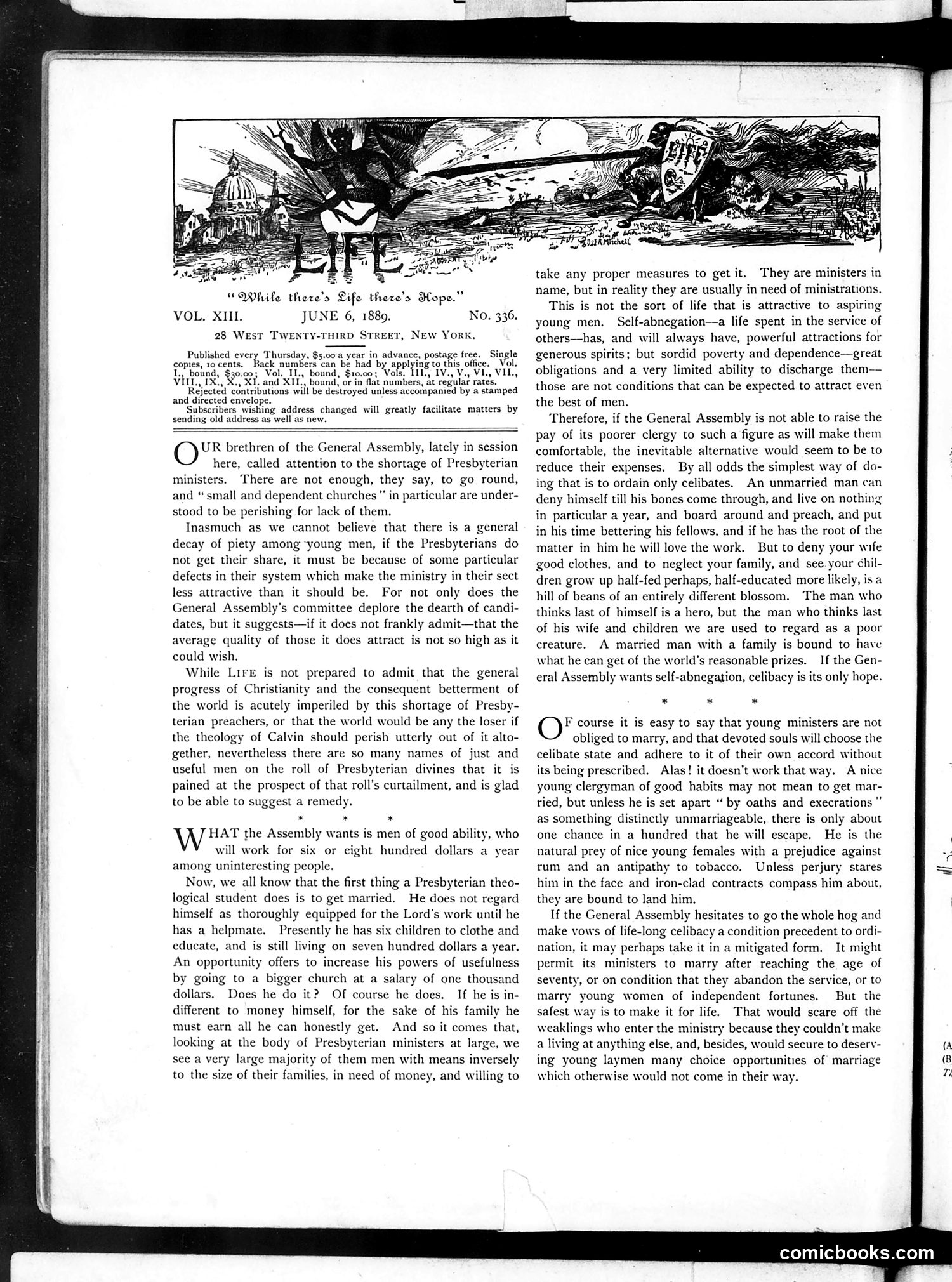
The masthead illustration depicts an allegorical figure of "Life" presiding over a landscape. The accompanying article criticizes Presbyterian Church leadership for failing to adequately compensate clergy, arguing this shortage of funds forces ministers into poverty despite their education and importance. The satire targets the General Assembly's hypocrisy: they call for moral leadership from ministers yet pay them so poorly that only desperate men accept the positions. The piece argues underpaid clergy cannot maintain families or homes befitting their station, and sarcastically suggests the Assembly should either raise salaries or permit ministers to marry wealthy women—implying financial desperation drives matrimonial choices rather than genuine calling. The broader critique addresses class anxieties in late-19th-century America regarding professional respectability and economic security.
📄 Transcribed text from this page (OCR, searchable)
Machine-transcribed from the original scan — historical spelling and the odd misread are preserved.
“While there's Life there’s Hope.” VOL, XIII. JUNE 6, 1889. No. 336. 28 West TWENTY-THIRD STREET, NEW YORK. Published every ‘Thursday, $5.00 a year in advance, postage free. | Single eae rocents. Ba spends $30-205 Vel. ck numbers can be had by applying to this office, Vol « bound, $10.00; Vols, IIL, 1V., V., VI, VIL, EF and XTi bound! cr an tak namberss at regulat rates. Rejected contributions will be destroyed unless accompanied by a stamped and directed envelope. Subscribers wishing address changed will greatly facilitate matters by sending old address as well as new. UR brethren of the General Assembly, lately in session here, called attention to the shortage of Presbyterian ministers. There are not enough, they say, to go round, and “small and dependent churches” in particular are under- stood to be perishing for lack of them. Inasmuch as we cannot believe that there is a general decay of piety among young men, if the Presbyterians do not get their share, it must be because of some particular defects in their system which make the ministry in their sect less attractive than it should be. For not only does the General Assembly's committee deplore the dearth of candi- dates, but it suggests—if it does not frankly admit—that the average quality of those it does attract is not so high as it could wish. While Lire is not prepared to admit that the general progress of Christianity and the consequent betterment of the world is acutely imperiled by this shortage of Presby- terian preachers, or that the world would be any the loser if the theology of Calvin should perish utterly out of it alto- gether, nevertheless there are so many names of just and useful men on the roll of Presbyterian divines that it is pained at the prospect of that roll’s curtailment, and is glad to be able to suggest a remedy. * * * HAT the Assembly wants is men of good ability, who will work for six or eight hundred dollars a year among uninteresting people. Now, we all know that the first thing a Presbyterian theo- logical student does is to get married. He does not regard himself as thoroughly equipped for the Lord's work until he has a helpmate. Presently he has six children to clothe and educate, and is still living on seven hundred dollars a year. An opportunity offers to increase his powers of usefulness by going to a bigger church at a salary of one thousand dollars. Does he do it? Of course he does. If he is in- different to money himself, for the sake of his family he must earn all he can honestly get. And so it comes that, looking at the body of Presbyterian ministers at large, we see a very large majority of them men with means inversely to the size of their families, in need of money, and willing to take any proper measures to get it. They are ministers in name, but in reality they are usually in need of ministrations. This is not the sort of life that is attractive to aspiring young men. Self-abnegation—a life spent in the service of others—has, and will always have, powerful attractions for generous spirits; but sordid poverty and dependence—great obligations and a very limited ability to discharge them— those are not conditions that can be expected to attract even the best of men. Therefore, if the General Assembly is not able to raise the pay of its poorer clergy to such a figure as will make them comfortable, the inevitable alternative would seem to be to reduce their expenses. By all odds the simplest way of do- ing that is to ordain only celibates. An unmarried man can deny himself till his bones come through, and live on nothing in particular a year, and board around and preach, and put in his time bettering his fellows, and if he has the root of the matter in him he will love the work. But to deny your wife good clothes, and to neglect your family, and see.your chil- dren grow up half-fed perhaps, half-educated more likely, is a hill of beans of an entirely different blossom. The man who thinks last of himself is a hero, but the man who thinks last of his wife and children we are used to regard as a poor creature. A married man with a family is bound to have what he can get of the world’s reasonable prizes. If the Gen- eral Assembly wants self-abnegation, celibacy is its only hope. * * * O * course it is easy to say that young ministers are not obliged to marry, and that devoted souls will choose the celibate state and adhere to it of their own accord without its being prescribed. Alas! it doesn’t work that way. A nice young clergyman of good habits may not mean to get mar- ried, but unless he is set apart “ by oaths and execrations ” as something distinctly unmarriageable, there is only about one chance in a hundred that he will escape. He is the natural prey of nice young females with a prejudice against rum and an antipathy to tobacco. Unless perjury stares him in the face and iron-clad contracts compass him about, they are bound to land him. If the General Assembly hesitates to go the whole hog and make vows of life-long celibacy a condition precedent to ordi- nation, it may perhaps take it in a mitigated form. It might permit its ministers to marry after reaching the age of seventy, or on condition that they abandon the service, or to marry young women of independent fortunes. But the safest way is to make it for life. That would scare off the weaklings who enter the ministry because they couldn't make a living at anything else, and, besides, would secure to deserv- ing young laymen many choice opportunities of marriage which otherwise would not come in their way. comicbooks.com