
A complete issue · 20 pages · 1889
Life — May 30, 1889
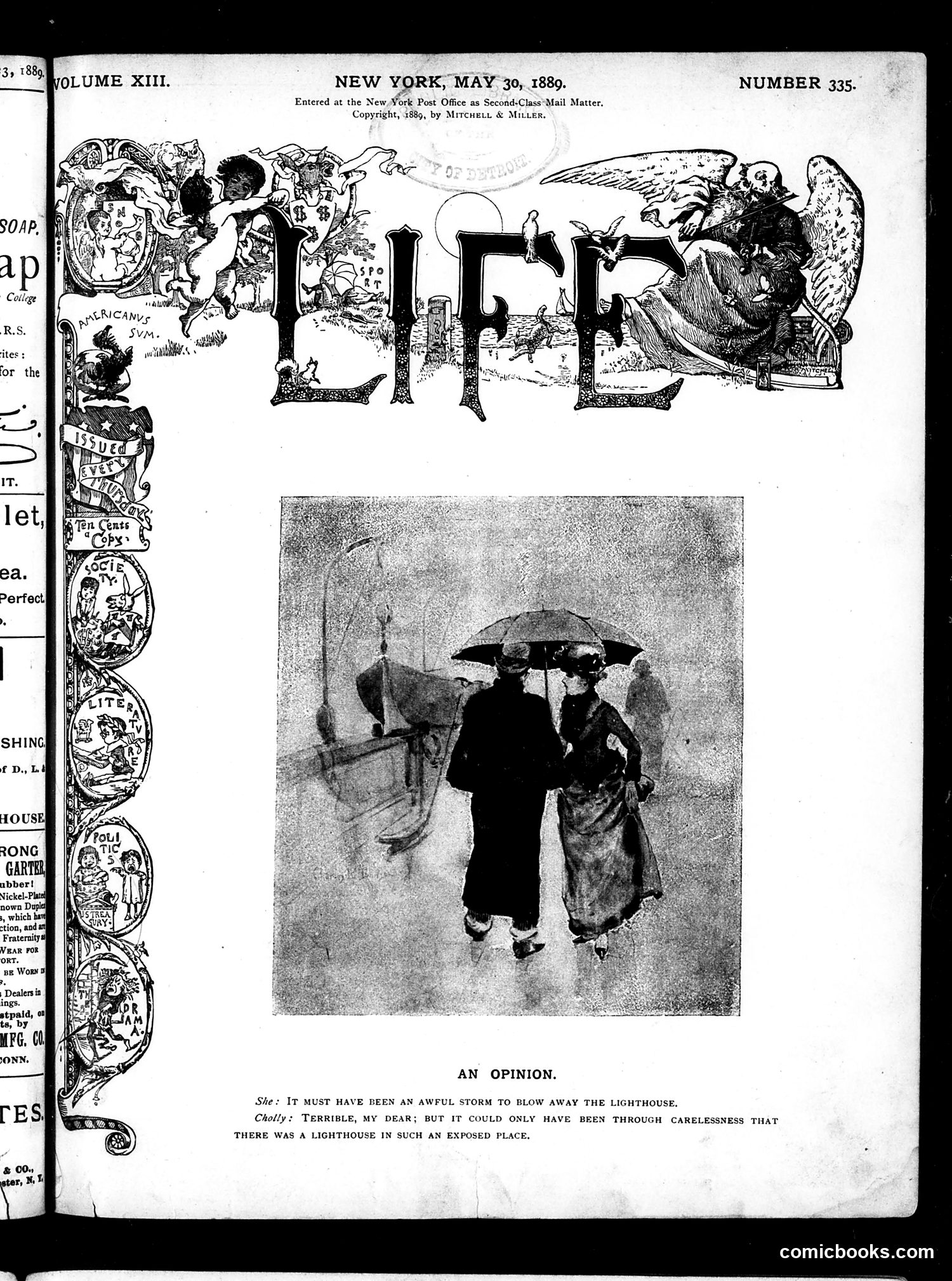
This page contains a visual joke about a lighthouse disaster. The photograph shows two figures with an umbrella in heavy rain or storm conditions. Below, a brief comedic dialogue appears: **She:** "It must have been an awful storm to blow away the lighthouse." **Charley:** "Terrible, my dear; but it could only have been through carelessness that there was a lighthouse in such an exposed place." The satire mocks absurd reasoning—Charley's suggestion that a lighthouse shouldn't be built in an exposed location is nonsensical, since lighthouses *must* be positioned on dangerous coasts to warn ships. The joke ridicules backwards thinking: blaming the placement of a safety structure rather than acknowledging genuine storm danger. The caption "AN OPINION" emphasizes the foolishness of this illogical commentary.
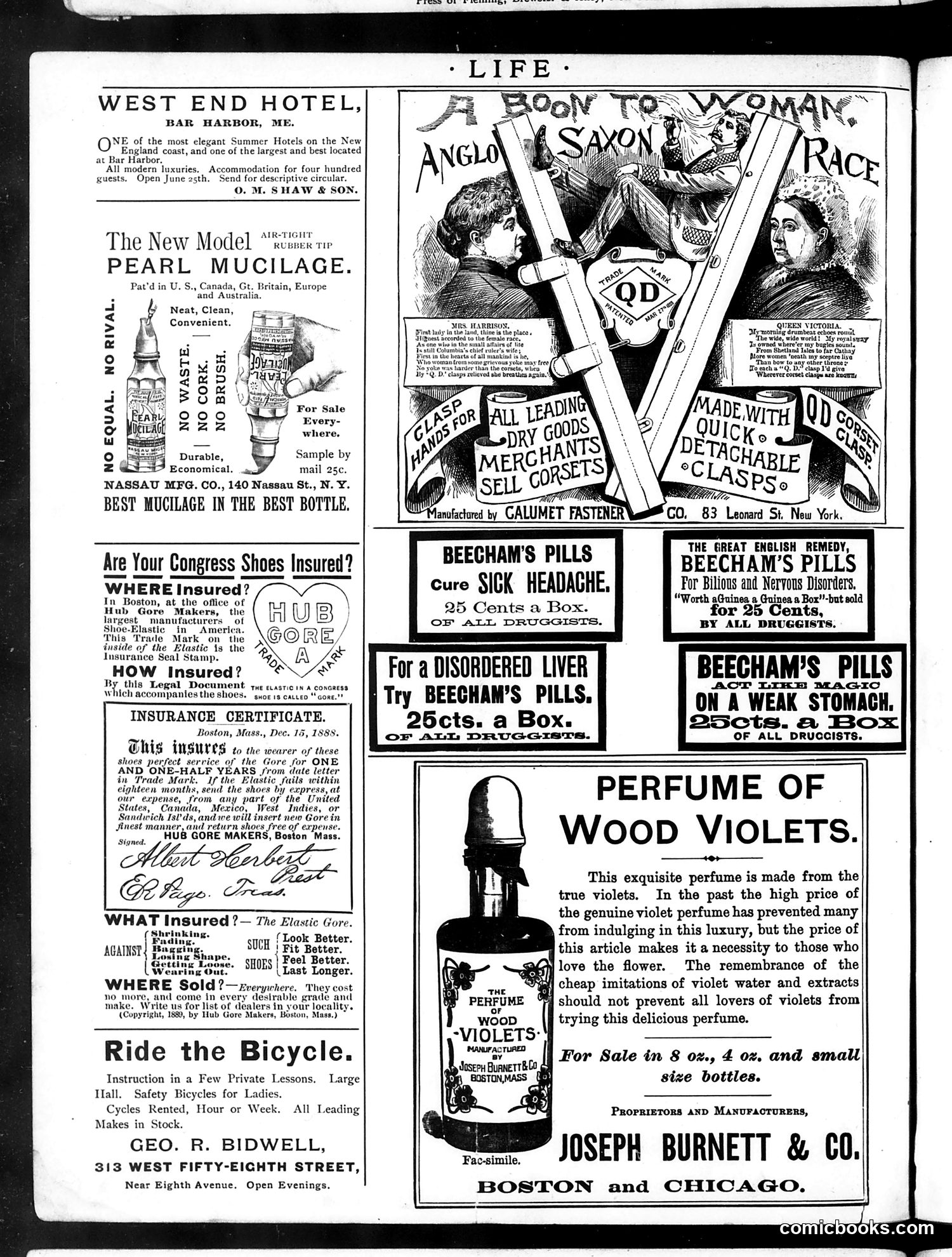
This satirical cartoon mocks the marketing of corsets as a supposed benefit to women. The image shows two women with exaggerated facial features labeled "Mrs. Harrison" and "Queen Victoria," appearing distressed or constrained within a large corset frame. The cartoon's title sarcastically suggests corsets are a "boon" (blessing) to women, while visually depicting them as instruments of confinement and discomfort. The prominent advertisement below for "quick detachable clasps" emphasizes corsets' mechanical complexity. The satire targets both the corset industry's false claims about women's welfare and possibly reflects late-19th-century feminist critique of restrictive fashion. The reference to Harrison and Victoria likely connects to contemporary political figures, though the specific context remains unclear without additional historical information.
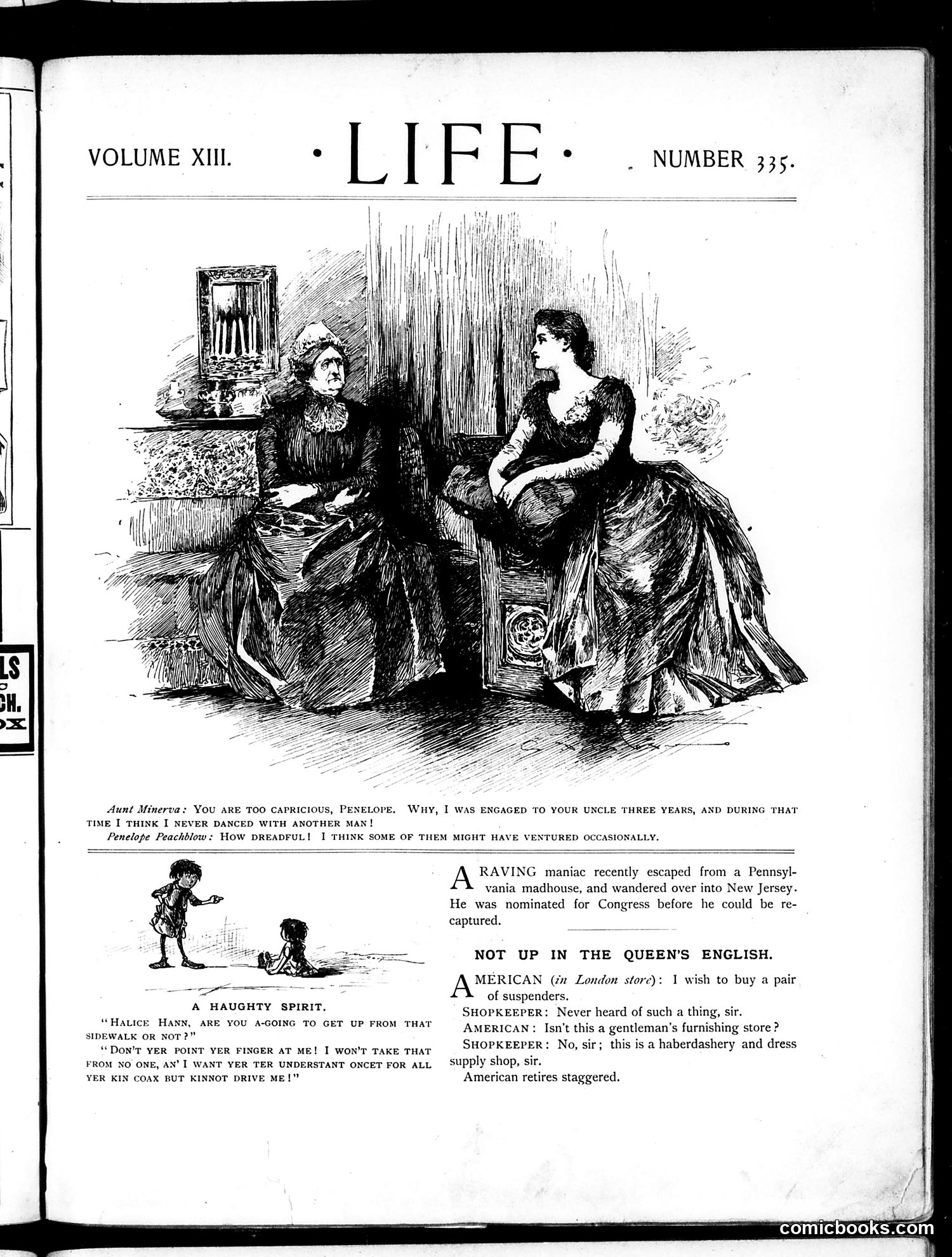
This page contains two separate satirical pieces: **Top cartoon:** Two women discuss an engagement. The older woman (Aunt Minerva) accuses the younger (Penelope) of being too flirtatious, claiming during her own three-year engagement she "never danced with another man." Penelope responds that some of those dances "might have ventured occasionally"—a joke about the aunt's own past conduct contradicting her prim moralizing. The satire targets Victorian hypocrisy regarding female propriety and courtship. **Bottom section:** A brief joke about an American tourist in London attempting to buy "suspenders" at a haberdashery. The shopkeeper's confusion reveals the transatlantic vocabulary difference—Americans say "suspenders" for what the British call "braces." The humor derives from the American's embarrassment upon learning he's in a women's clothing shop. Both pieces reflect late-19th/early-20th century social attitudes about propriety and cultural differences.
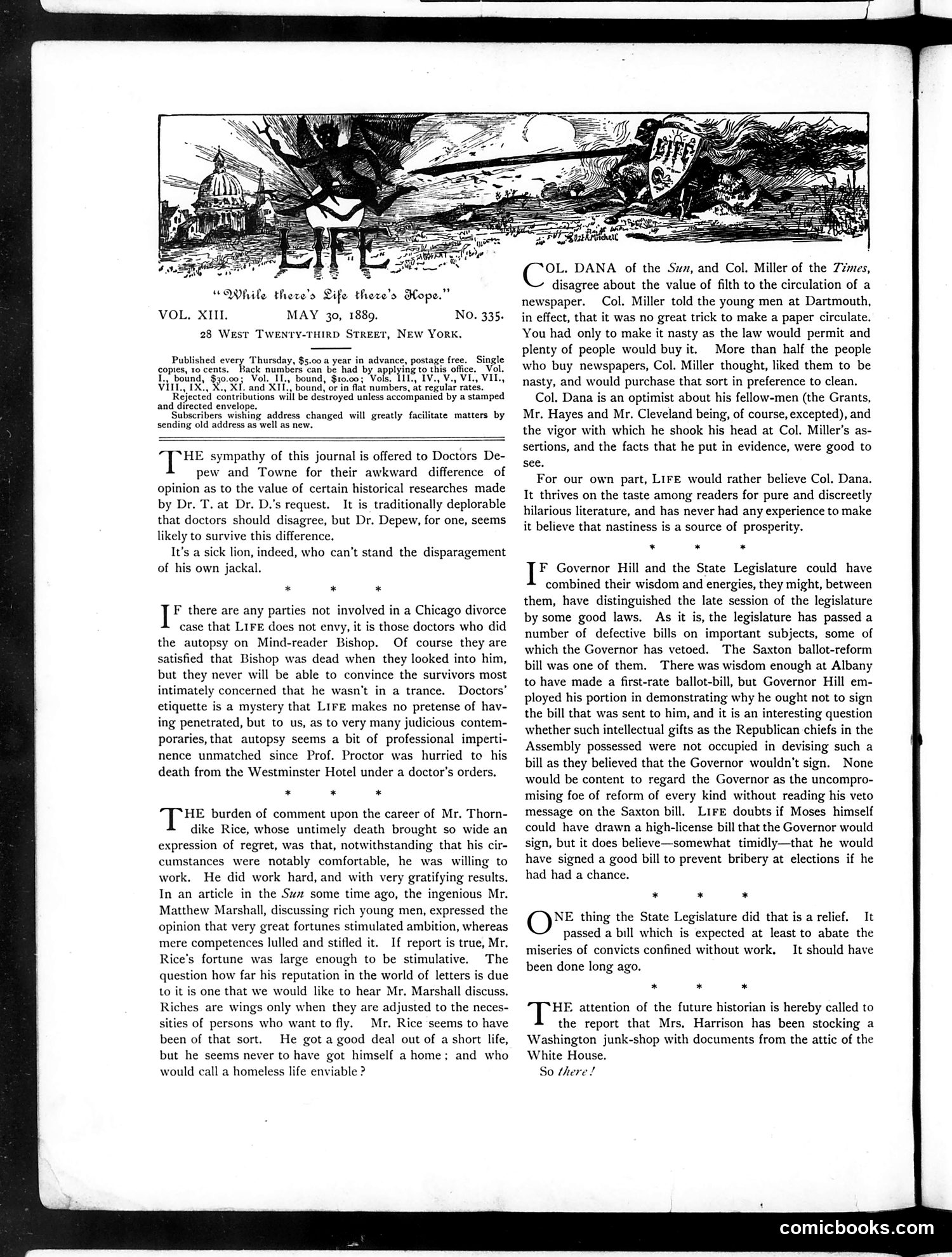
The masthead cartoon depicts Death as a skeletal figure with a scythe, standing over a barren landscape while a newspaper office burns in the background. The caption reads "While there's Life there's Hope." The cartoon satirizes a dispute between Col. Dana (editor of the *Sun*) and Col. Miller (editor of the *Times*) regarding whether "filth" helps newspaper circulation. Miller argues sensationalism increases readership; Dana counters that nastiness drives away readers. The image appears to mock both editors' competing philosophies about journalistic standards and circulation tactics during the 1880s competitive newspaper era. Life takes Dana's side, suggesting that while scandalous content may boost sales temporarily, quality journalism better serves readers long-term.
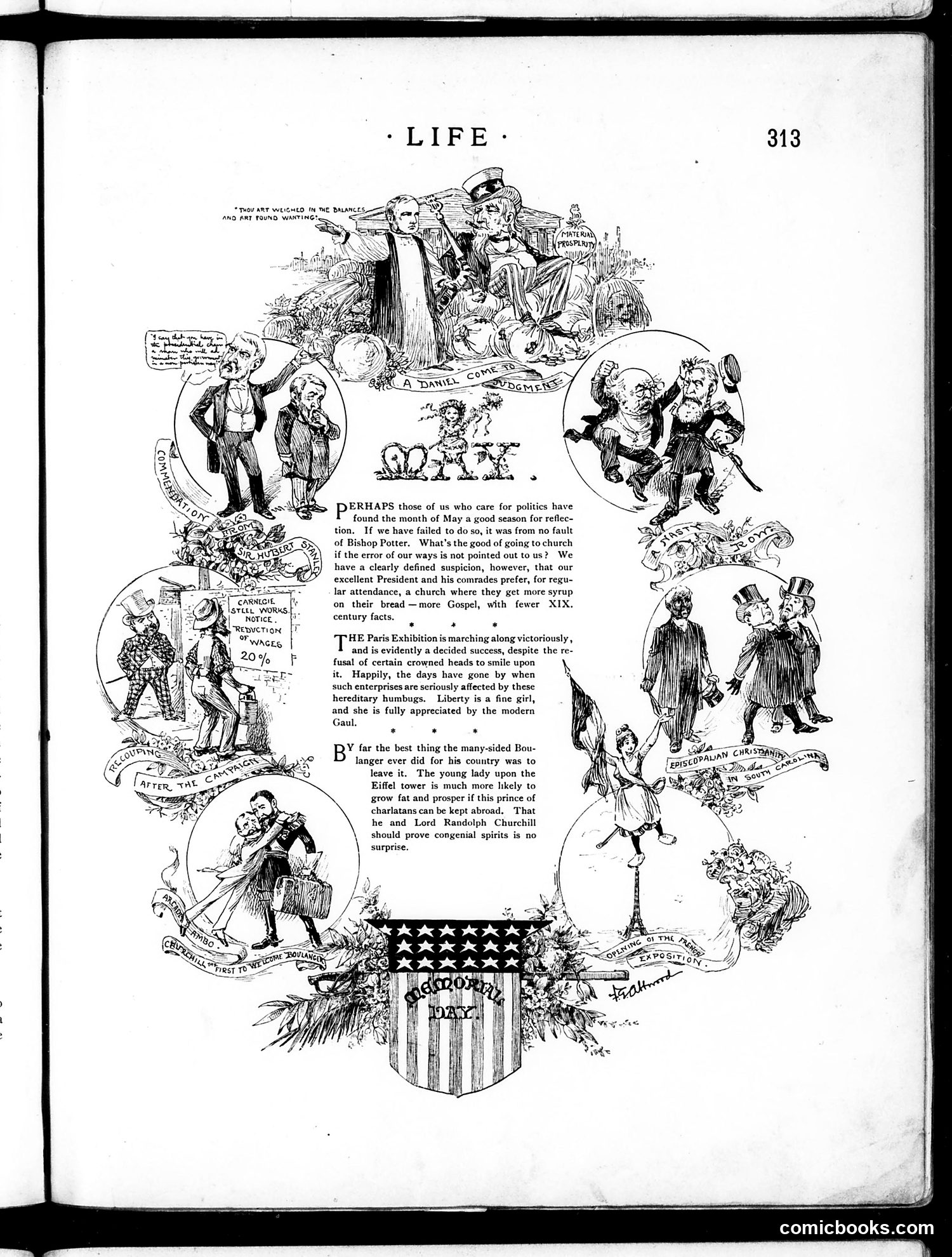
This page satirizes American political and social issues around the turn of the 20th century. The central shield marked "Memorial Day" anchors multiple vignettes mocking various figures and institutions. The text references **Bishop Potter** and criticisms of the President's church attendance, suggesting debates over executive piety. References to the **Paris Exhibition** indicate contemporary international affairs. The cartoons appear to ridicule political hypocrisy—officials and notable figures engaging in activities contradicting their public personas. Specific figures are caricatured around the margins with labels that remain partially legible, though precise identifications require clearer resolution. The overall message critiques governmental and religious establishment figures as inauthentic or self-serving—typical of Life's progressive satirical approach during this era.
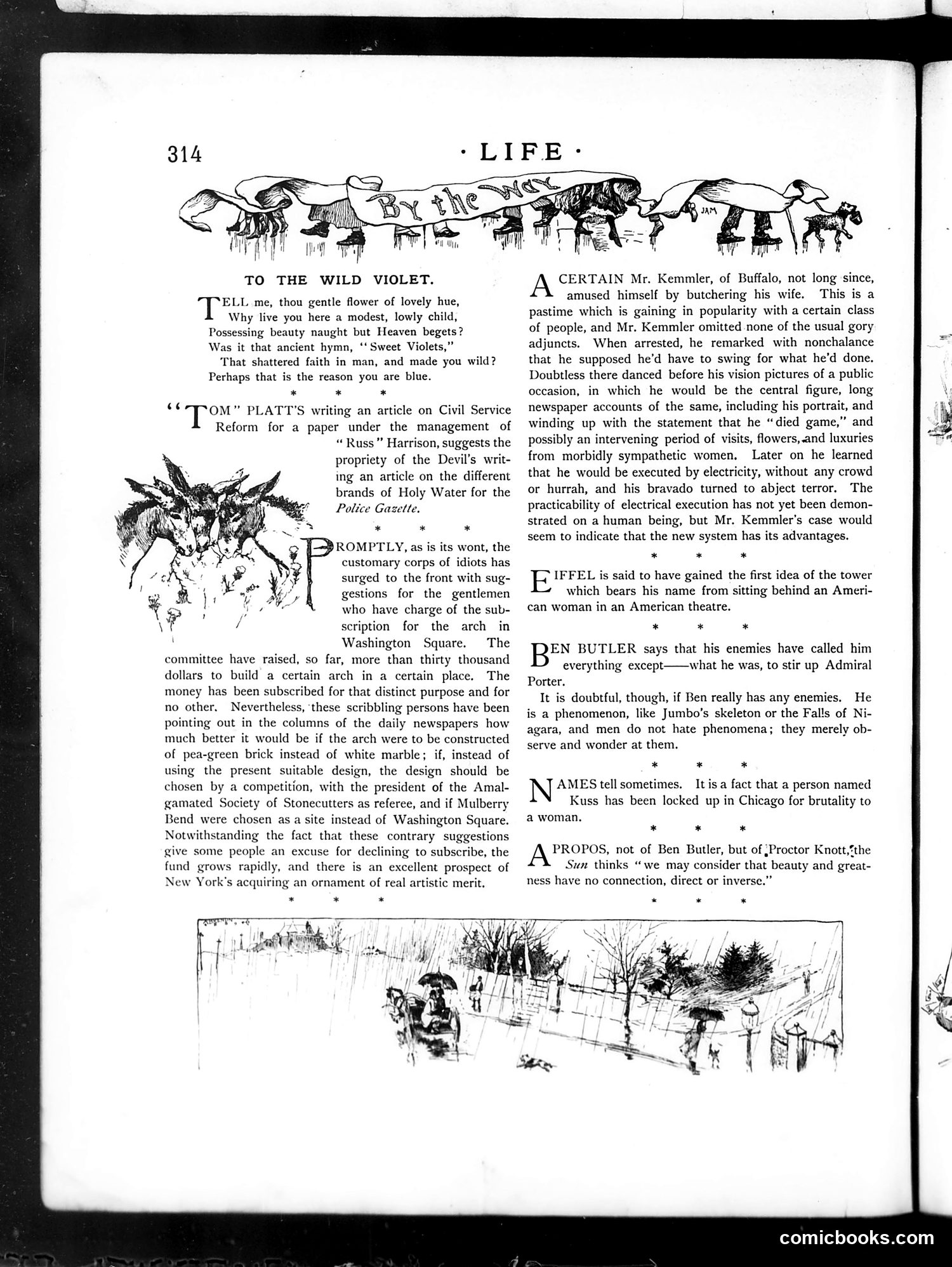
This page contains several short satirical items rather than a single cartoon. The main pieces mock contemporary figures and trends: **"To the Wild Violet"** appears to be a poem mocking modest, humble people—possibly a jab at affected sentimentality. **Tom Platt's Civil Service Reform article** is criticized as hypocrisy, with the illustration showing a grotesque face, suggesting editorial mockery of the proposed policy. **The arch in Washington Square** item satirizes wealthy donors' vanity—mocking suggestions that it be built from pea-green brick or designed by committee rather than merit. **Brief gossip items** about Mr. Kemmler (execution by electricity), Eiffel, Ben Butler, and others use humor to comment on public figures and contemporary scandals. The tone is characteristic of *Life* magazine's satirical approach to politics and society.
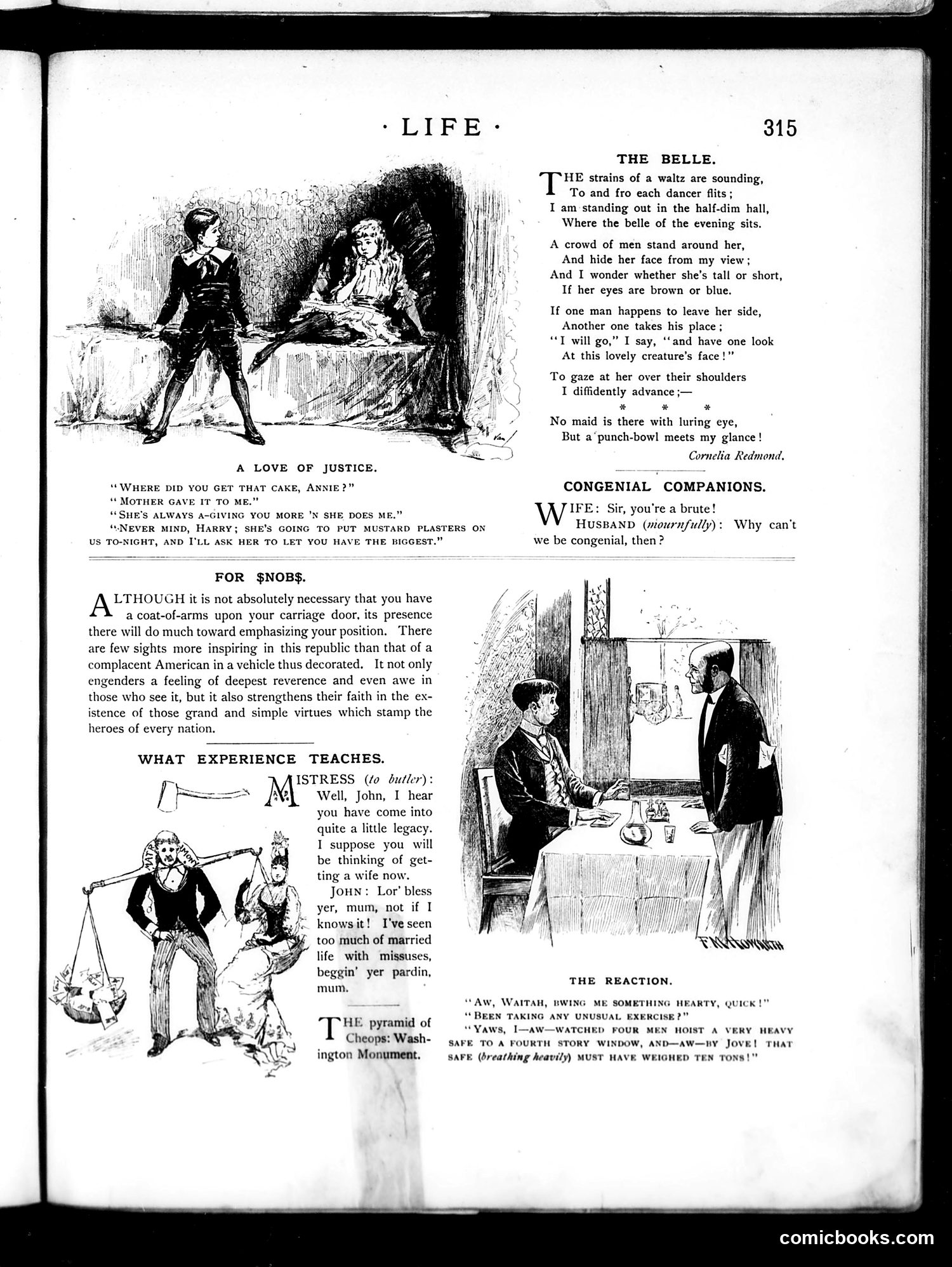
This page contains several unrelated satirical pieces typical of the era: **"The Belle"** is a poem about a young woman at a ball, written by Corchia Redmond, expressing a suitor's interest in glimpsing her face. **"A Love of Justice"** is a brief comic dialogue where characters discuss a cake, with innuendo about a wife's generosity. **"For Snobs"** argues that coat-of-arms on carriages signify social position and inspire reverence, though this seems ironic given the republican American context. **"What Experience Teaches"** depicts a conversation between a mistress and butler about marriage, with the butler expressing skepticism based on observing unhappy marriages. **"The Reaction"** is a humorous anecdote about men hoisting a safe through a window, with commentary about the weight. The cartoons are lighthearted domestic and social humor typical of early 20th-century satirical magazines.
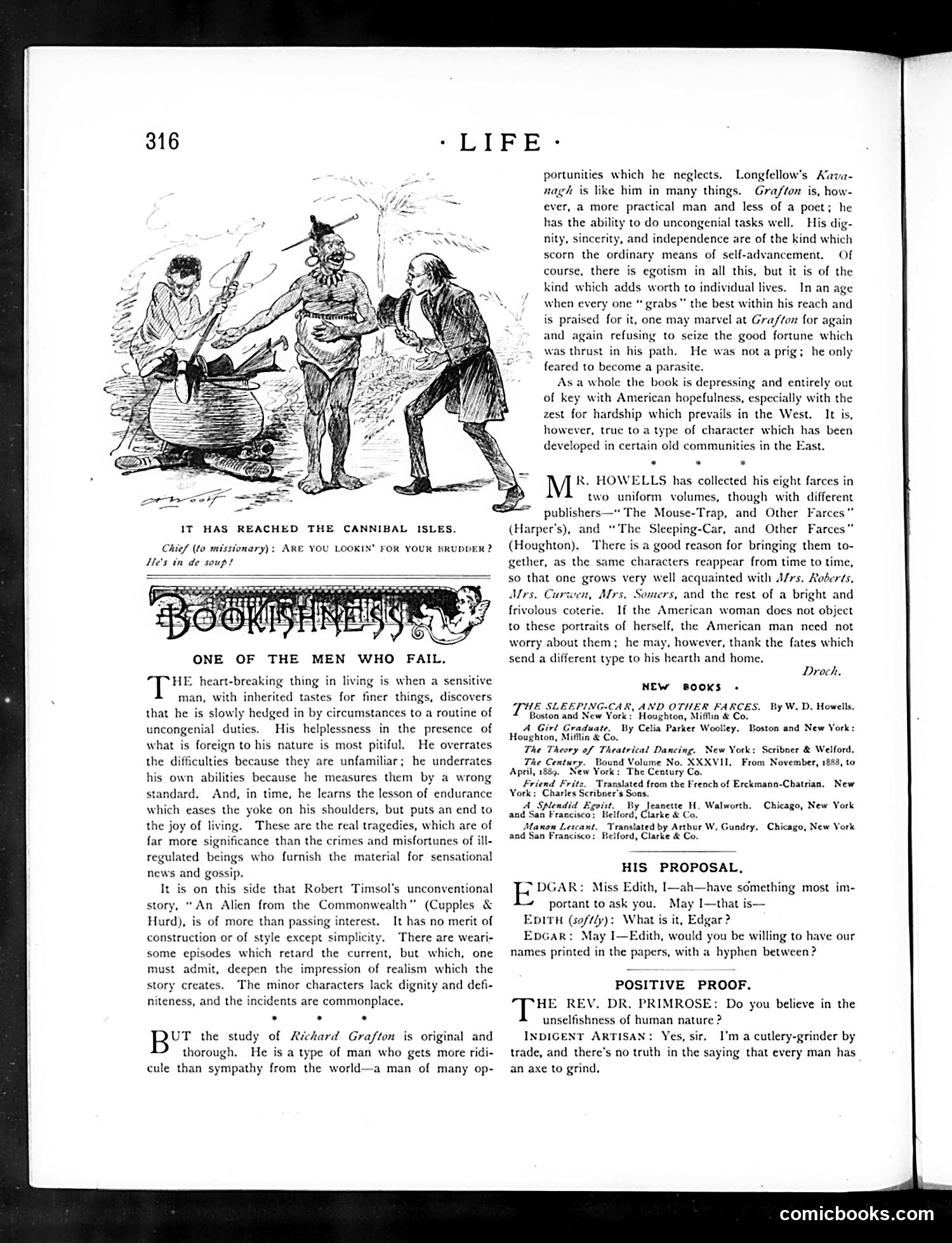
The main cartoon shows three figures labeled "IT HAS REACHED THE CANNIBAL ISLES" with a colonial-era chief asking "ARE YOU LOOKIN' FOR YOUR BLUNDER? HE'S IN DE SOUP?" This is a satirical commentary on American expansion and imperialism. The "cannibal isles" reference plays on Victorian-era stereotypes about Pacific islanders. The joke appears to target American business or political figures—someone's "blunder" has literally reached remote locations, suggesting American mistakes or scandals have global reach despite efforts to contain them. The cartoon reflects turn-of-the-century anxieties about American colonial ventures and the spread of American influence (and misadventures) worldwide. The crude dialect reflects period racist conventions in American humor.
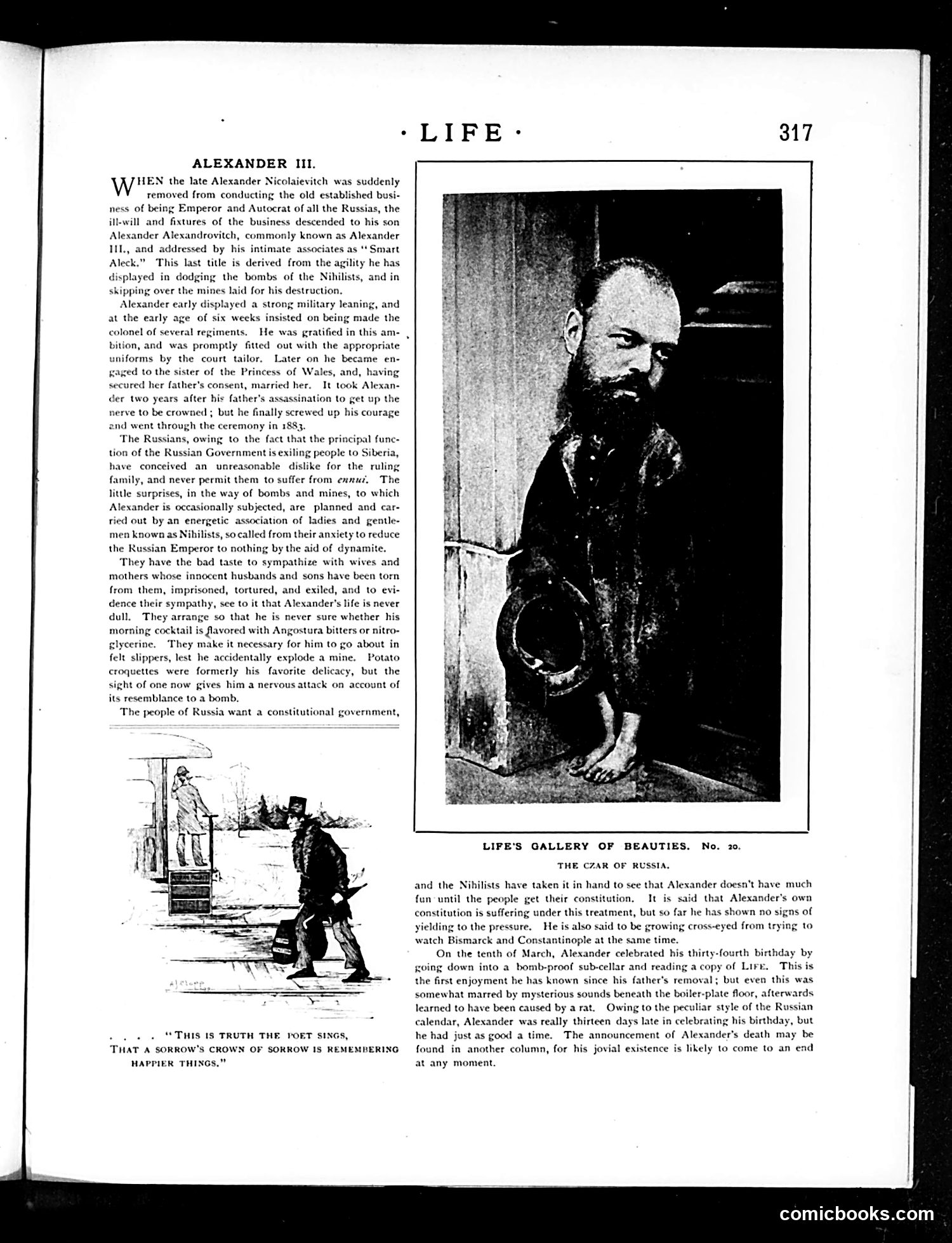
This page discusses **Alexander III of Russia** ("Tsar Alexander"), focusing on his repressive governance and the dangers he faces. The large photograph shows Alexander III in military dress. The accompanying cartoon (lower left) depicts a figure on what appears to be a platform or gallows, illustrating the text's discussion of Russian political violence and assassination attempts. The caption quotes: "That a sorrow's crown of sorrow is remembering happier things." The article criticizes Alexander III's autocratic rule, his exile of political prisoners to Siberia, and the constant threat of bombs and mines used by revolutionaries against him. It notes the irony that while Russians desire constitutional government, the Nihilists (revolutionary terrorists) have made Alexander's life perpetually dangerous—even his birthday celebration is shadowed by fear of assassination.
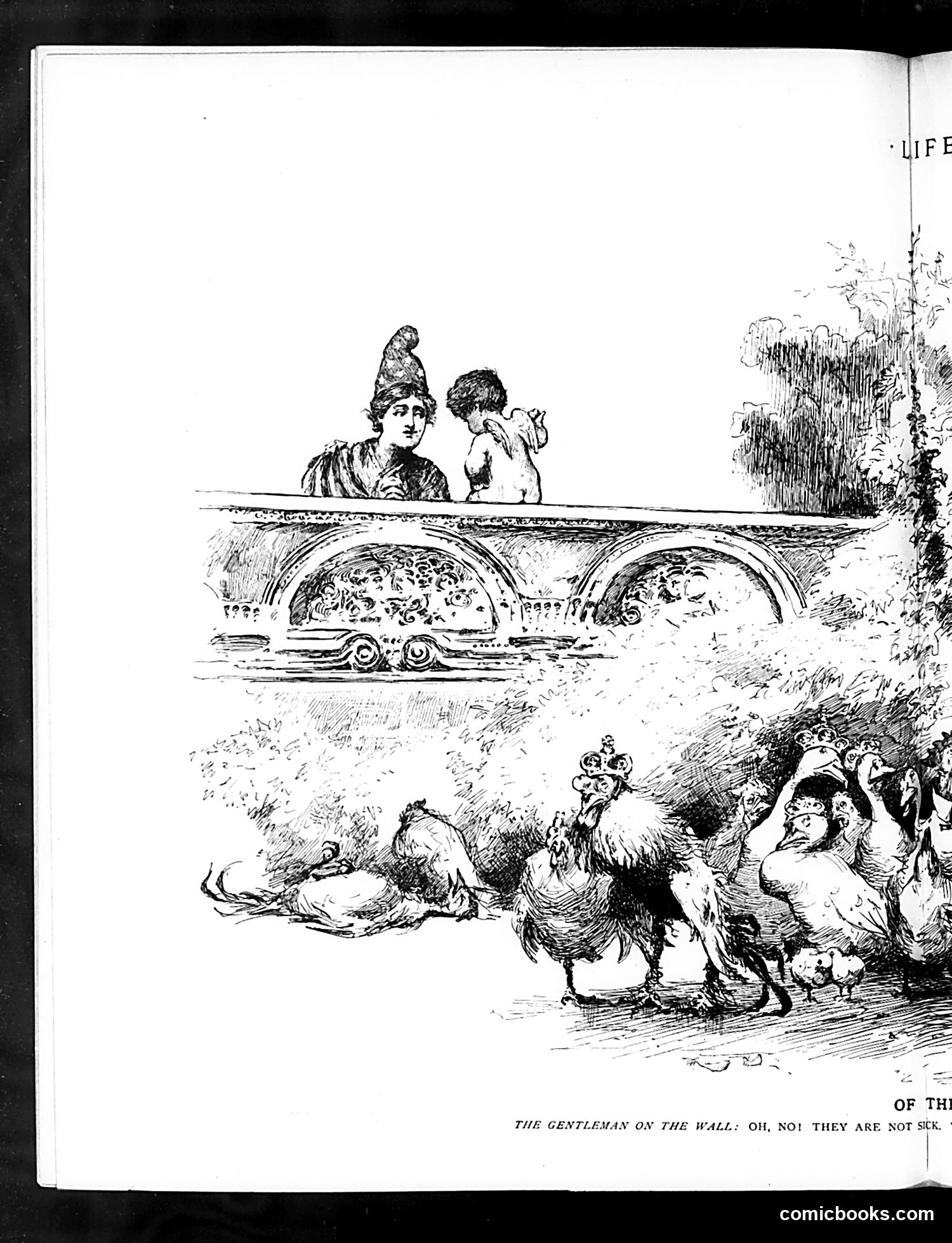
This illustration appears to be a satirical scene from Life magazine. The caption reads: "THE GENTLEMAN ON THE WALL: OH, NO! THEY ARE NOT SICK." The cartoon depicts a woman and child observing from atop a brick wall/bridge, while below a group of animals (appearing to be goats or similar creatures) gather. The "gentleman on the wall" seems to be making an assurance to the woman about the animals' condition—they're not sick, despite their unusual behavior or appearance. The satire likely comments on class perceptions or social assumptions. The well-dressed figures observing from above, separated by the wall, contrast with the animals below, suggesting commentary on how the upper classes might misinterpret or misjudge the conditions or nature of those they observe from a distance. The humor derives from the gentleman's need to reassure the woman that appearances are deceiving.
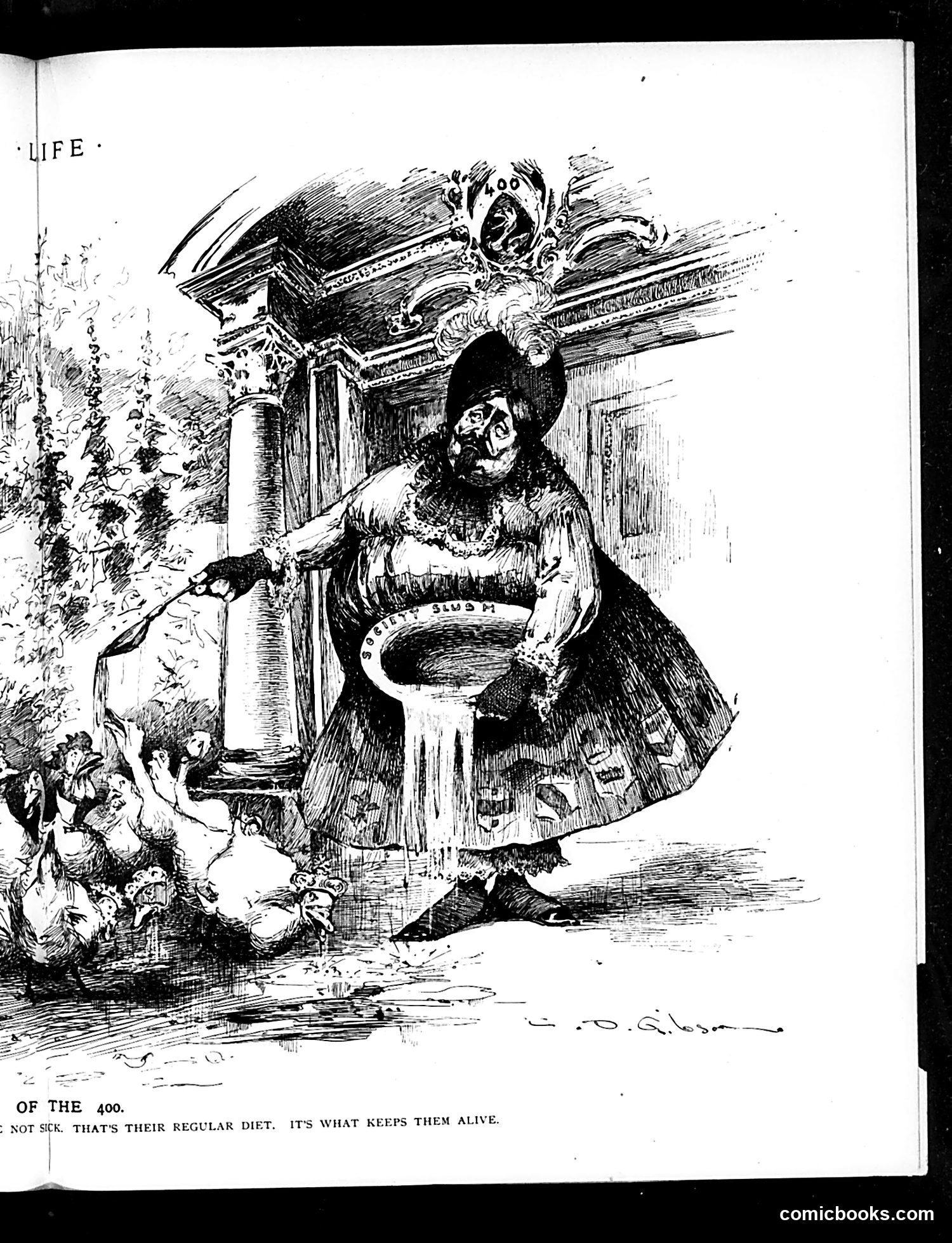
This satirical cartoon from *Life* magazine depicts a figure in Victorian dress operating a water pump labeled "400" while standing over what appears to be a pile of refuse or corpses. The visible text reads: "NOT SICK. THAT'S THEIR REGULAR DIET. IT'S WHAT KEEPS THEM ALIVE." The cartoon appears to be social commentary on poverty and living conditions, likely referencing the "400"—a term for New York's wealthy elite. The satire suggests that the impoverished masses survive on contaminated water and poor sanitation, which the cartoonist presents as deliberately maintained by the wealthy class to keep lower classes subdued or dependent. Without the publication date visible, the specific historical context remains unclear, though the Victorian aesthetic suggests late 19th-century commentary on class inequality and urban public health.
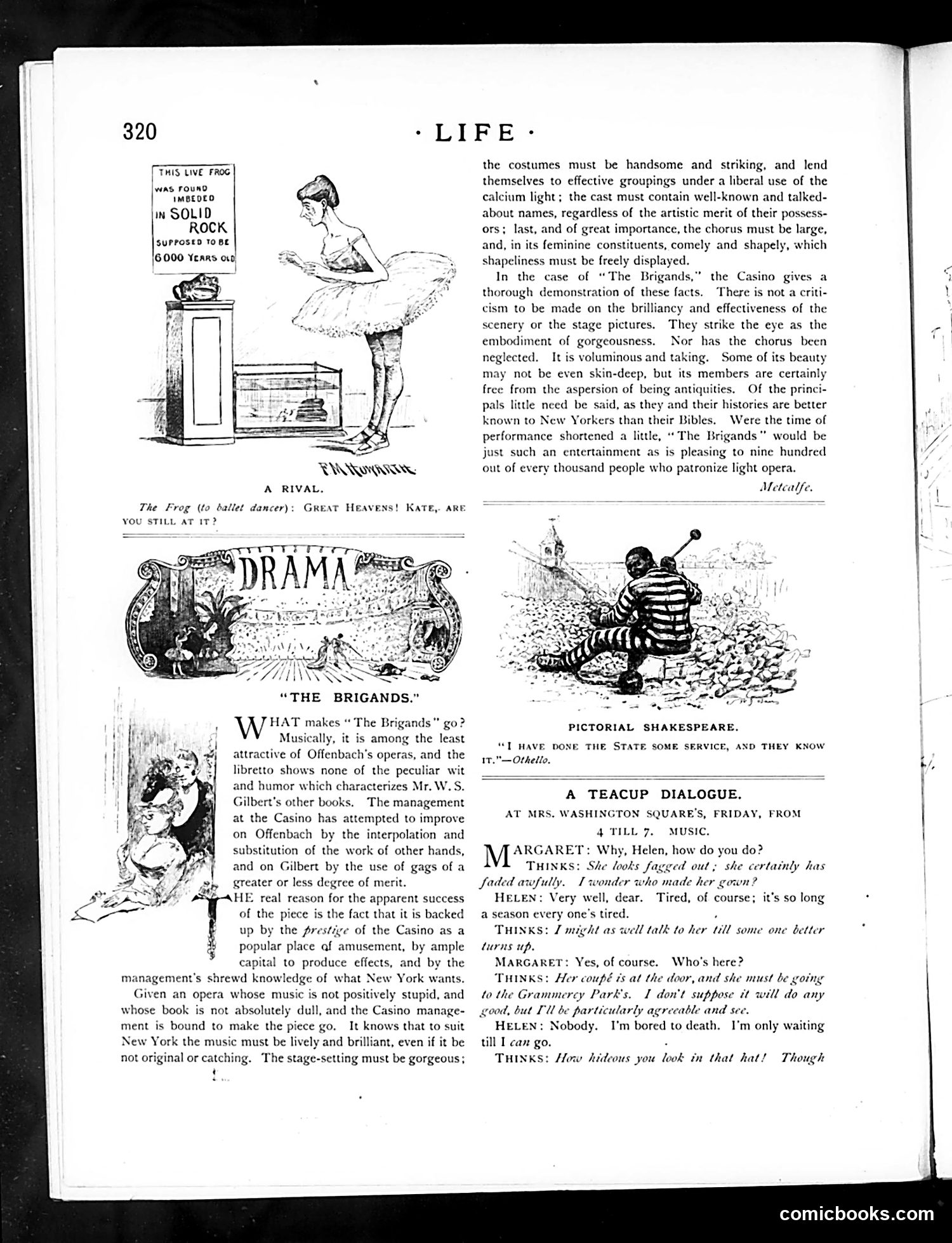
This *Life* magazine page contains satirical commentary on contemporary entertainment and social rituals. **Top cartoon ("A Rival")**: A frog embedded in rock for "6000 years" addresses a ballet dancer, suggesting she's been performing the same role endlessly—equating her stasis with geological time. It's a jab at repetitive theater work. **"The Brigands" review**: Critiques Offenbach's opera production at the Casino theater. The satire is frank: the show succeeds not through artistic merit but through management's cynical formula—lavish sets, attractive female chorus members displayed for their appearance ("shapeliness must be freely displayed"), and celebrity casting regardless of talent. The critic mocks New York audiences for accepting spectacle over substance. **"Teacup Dialogue"**: Satirizes superficial high-society conversation. The text contrasts spoken pleasantries with characters' actual contemptuous thoughts—Margaret judges Helen's appearance and dress, while both are bored and eager to leave. It exposes the hypocrisy of polite social gatherings. Overall, the page mocks entertainment industry cynicism and upper-class social pretense.
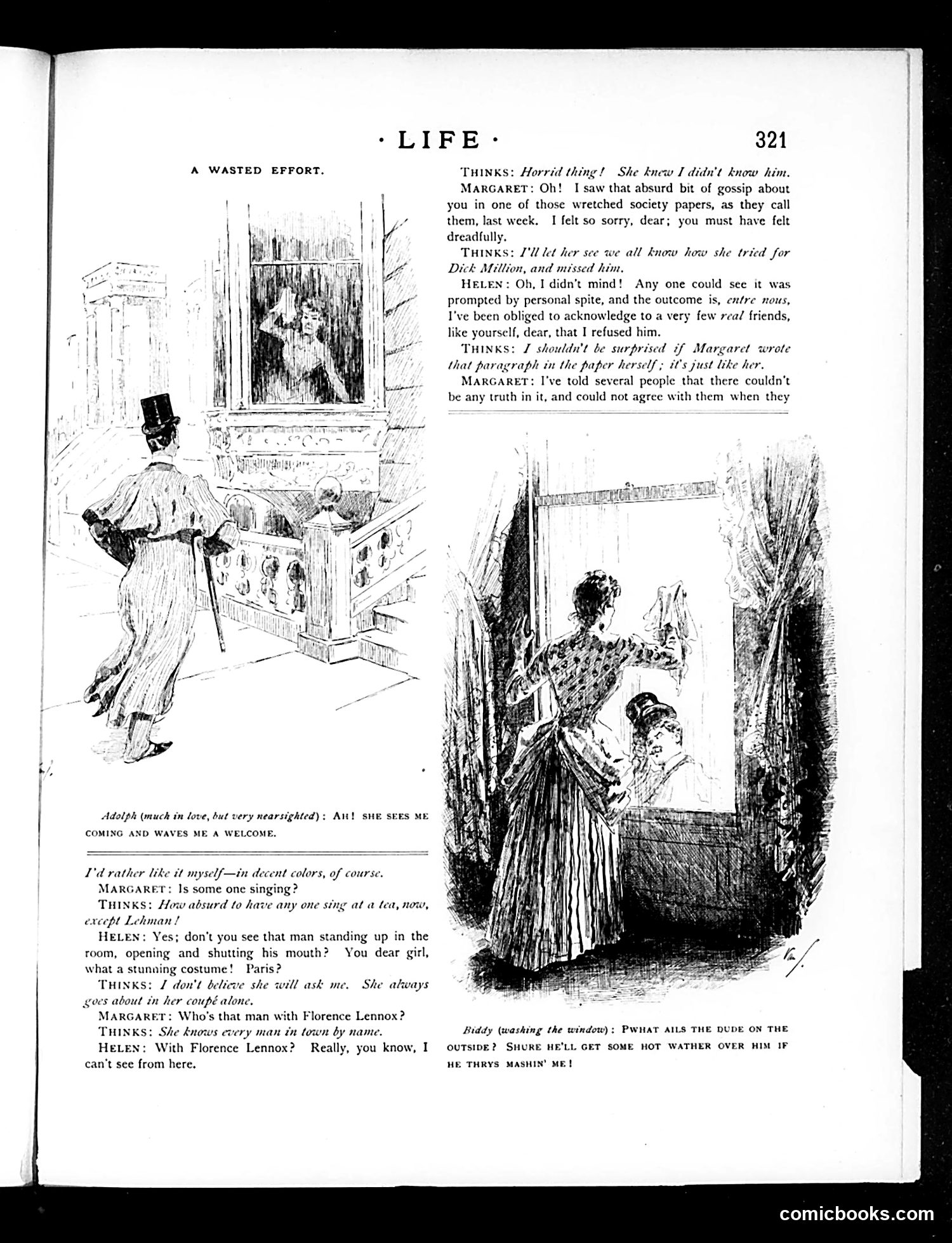
This page satirizes the duplicity and cattiness of upper-class women in society. Two wealthy women, Margaret and Helen, discuss gossip about Helen supposedly pursuing a man named "Dick Million" (the name itself mocking wealth-obsession). Each woman's internal thoughts reveal their true opinions contradict their spoken pleasantries—Margaret suspects Helen wrote the gossip herself, while Helen suspects Margaret started it. Meanwhile, "Adolph," a nearsighted wealthy man, misinterprets Helen's wave as romantic interest when she's actually greeting someone else. The humor centers on the gap between polite social performance and catty reality. A secondary joke shows "Biddy," a working-class housemaid, observing a fashionable man ("dude") outside attempting to flirt with her—she threatens to throw hot water on him if he persists ("mashin'"). The satire targets both upper-class hypocrisy and the class divide in romantic pursuits.
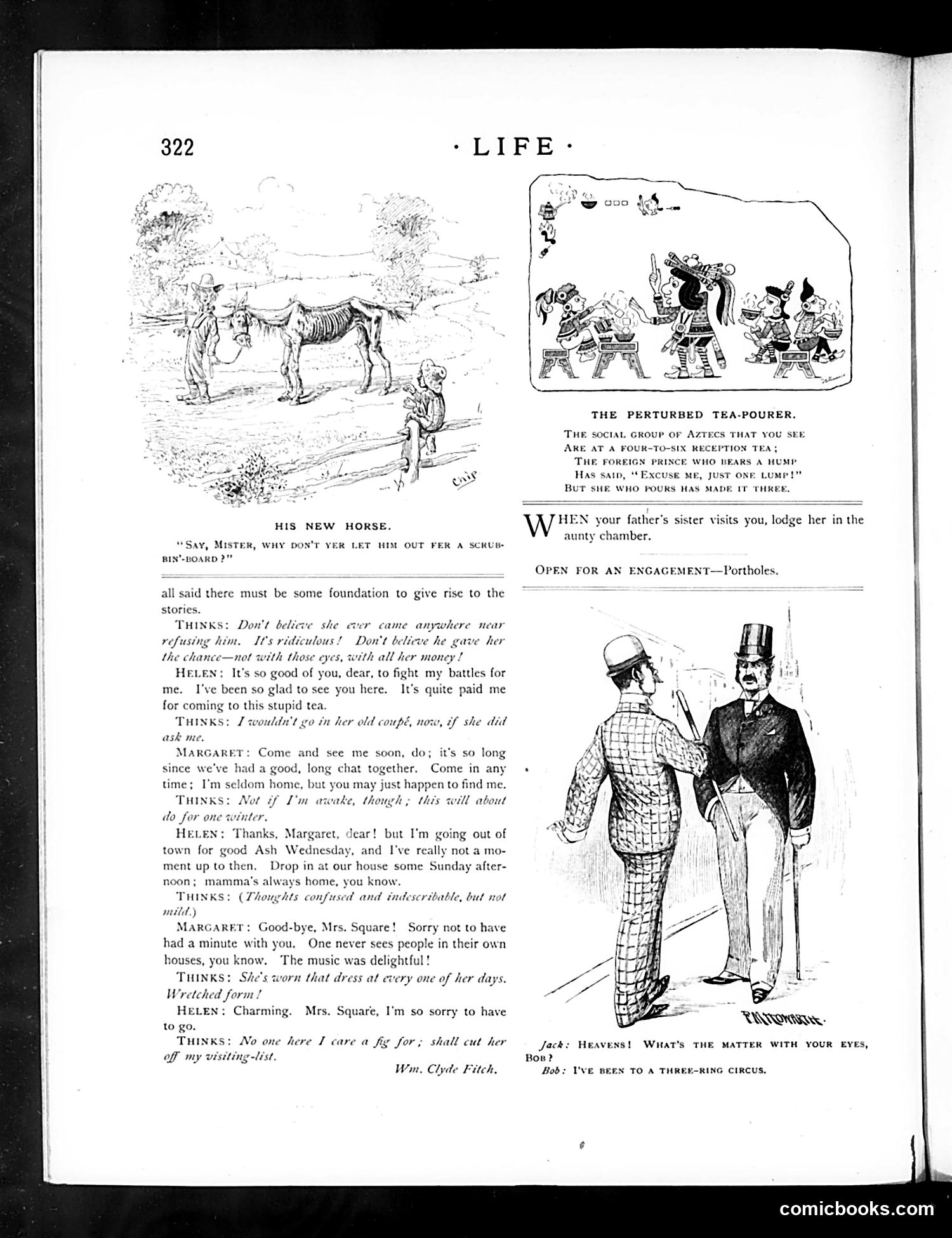
This page contains two satirical pieces about upper-class social hypocrisy, likely from early 20th-century Life magazine. **"His New Horse"** mocks wealthy women's false courtesy. Two women exchange pleasantries at a tea party—one inviting the other to visit—but their internal thoughts reveal contempt. Each mentally dismisses the other as unfashionable and unwelcome, while maintaining saccharine politeness aloud. The satire targets the performative nature of aristocratic social etiquette. **"The Perturbed Tea-Pourer"** uses absurdist humor about an Aztec-themed reception tea (likely referencing popular "exotic" costume parties of the era). The joke appears to concern a haughty foreign prince who requests "one lump" of sugar but the tea-pourer deliberately adds three—a subtle act of servant rebellion against pretentious guests. Both pieces satirize class pretension and the gap between public manners and private contempt among the wealthy elite.
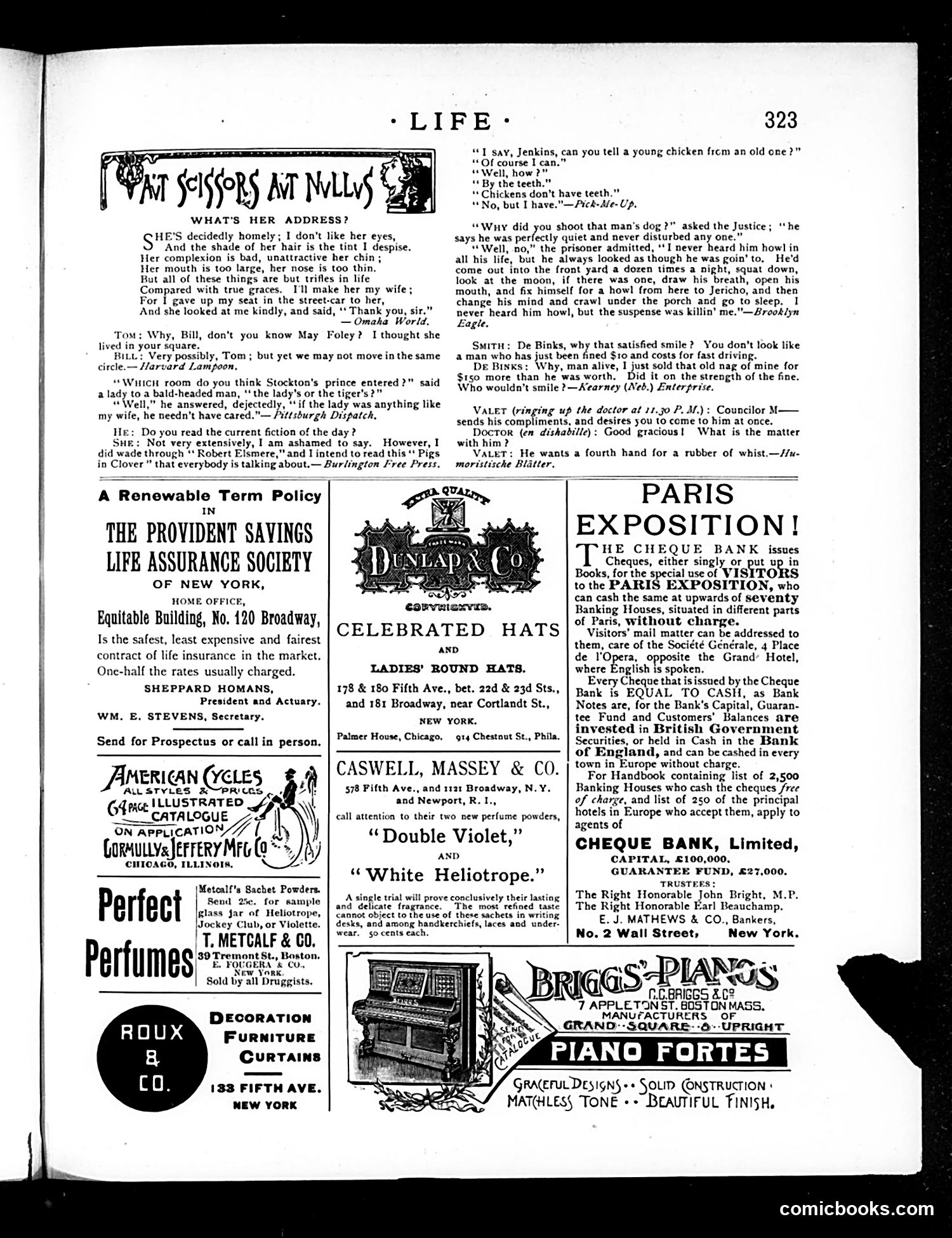
This page is primarily **advertising with comic filler content** — typical of Life magazine's format. The cartoons are brief, joke-based humor pieces rather than political satire. The main comic sketches mock social pretension and everyday absurdities: - A man courts an unattractive woman solely because she thanked him for giving up his streetcar seat — satirizing shallow courtship logic - A dialogue about class barriers ("May Foley") poking fun at social stratification - A prisoner admits shooting a dog not for actual harm but from **anxiety about what it *might* do** — absurdist humor about preemptive action - A doctor summoned at 11:30 PM discovers his patient merely needs a fourth hand for **whist (card game)** — mocking medical emergencies that are really social inconveniences The remainder is **period advertisements** for hats, perfumes, pianos, life insurance, and bicycles — standard turn-of-the-century commerce with no satirical content.
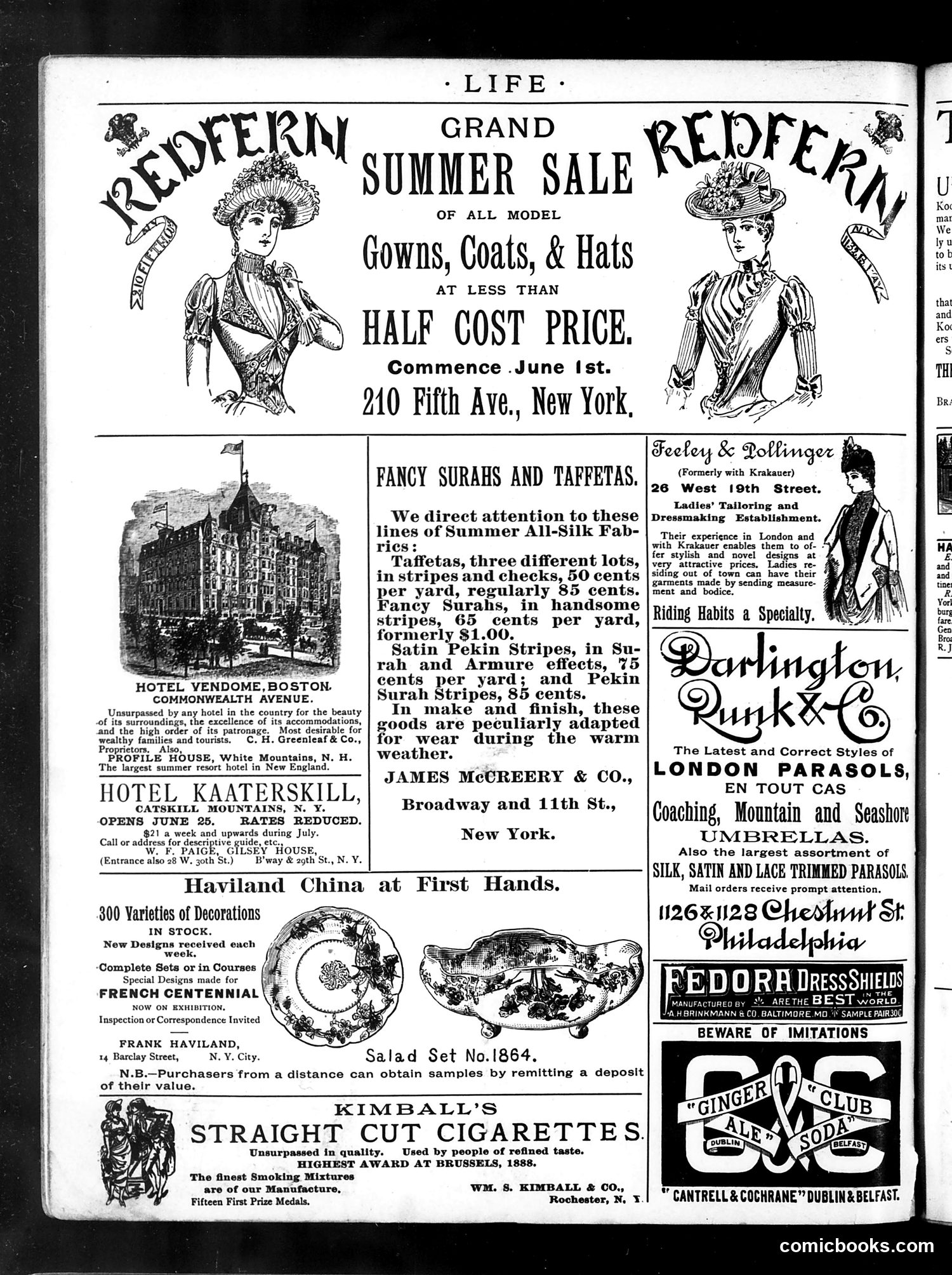
This is primarily a **commercial advertising page** from Life magazine, not a political cartoon or satirical piece. The page consists entirely of late 19th-century advertisements for luxury goods and services. The ads feature: - **High-end fashion retail** (Redfern's summer clothing sale, James McCreery & Co., ladies' tailoring) - **Upscale hotels** (Hotel Vendome in Boston, Hotel Kaaterskill in the Catskills) - **Fine dining items** (Haviland china, salad sets) - **Luxury accessories** (London parasols, riding habits) - **Premium cigarettes** (Kimball's brand) The illustrations show fashionably dressed women in elaborate Edwardian attire with decorative hats and fitted garments typical of the 1880s-90s era. **There is no satire or political commentary.** This page reflects the magazine's business model of targeting wealthy urban readers with advertisements for expensive consumer goods, hotels, and services.
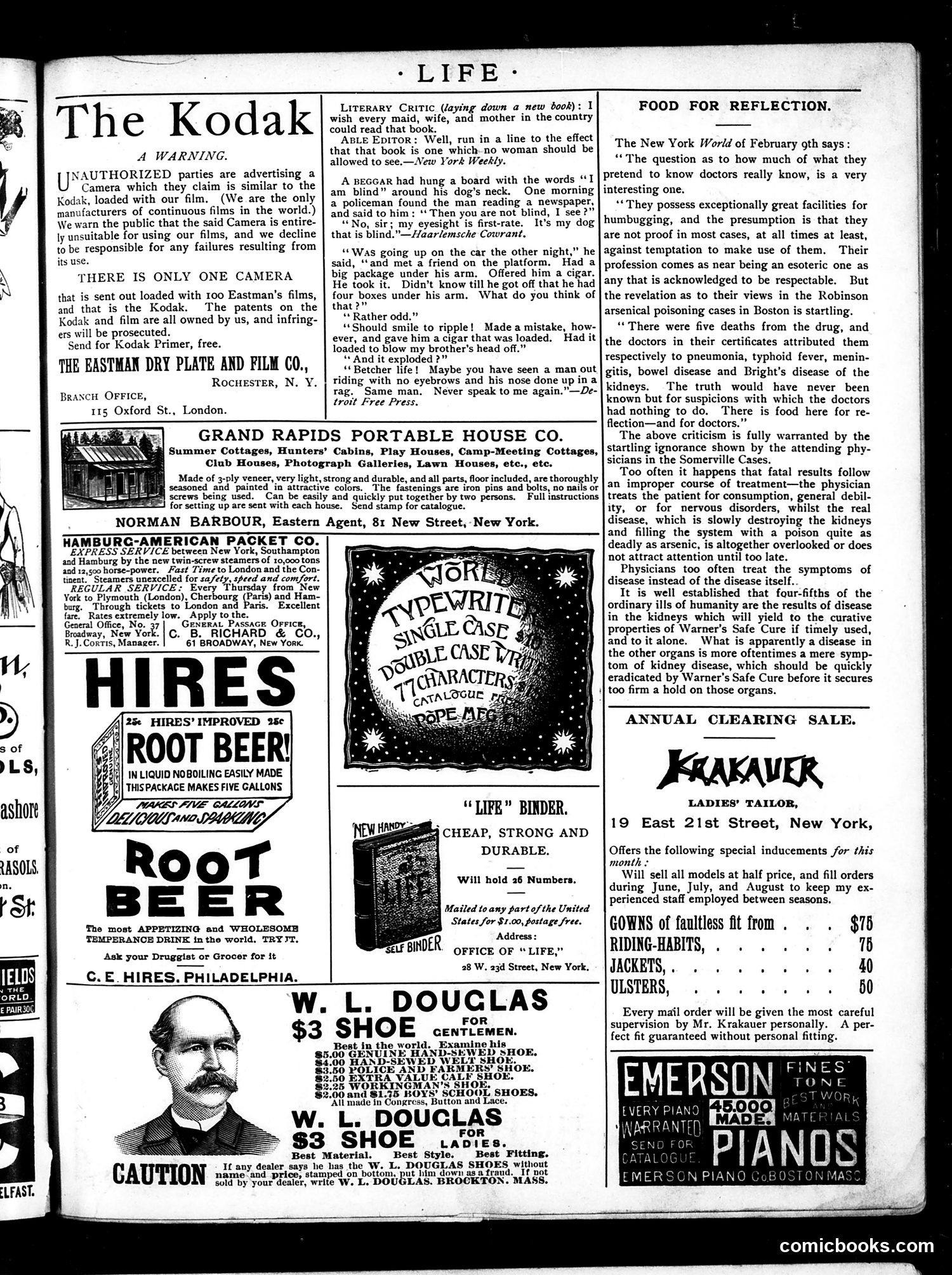
This page is primarily **advertising and brief humor snippets**, not political satire. The substantive content includes: **The humor pieces** are three short anecdotes appearing under "LITERARY CRITIC" and elsewhere—jokes about a blind beggar who can read, and a man whose loaded cigar explodes, injuring his face. These rely on wordplay and ironic reversals typical of period humor magazines. **The Kodak warning** is a corporate notice defending their camera monopoly and threatening patent litigation against competitors—reflecting turn-of-century industrial competition. **The advertisements** dominate: shoes, root beer, portable houses, steamship lines, pianos, and clothing. These reveal period consumer goods and marketing practices. There is **no visible political cartoon** on this page. The page functions as standard magazine content mixing brief comedic text with commercial advertisements targeting middle-class readers circa 1890s-1900s.
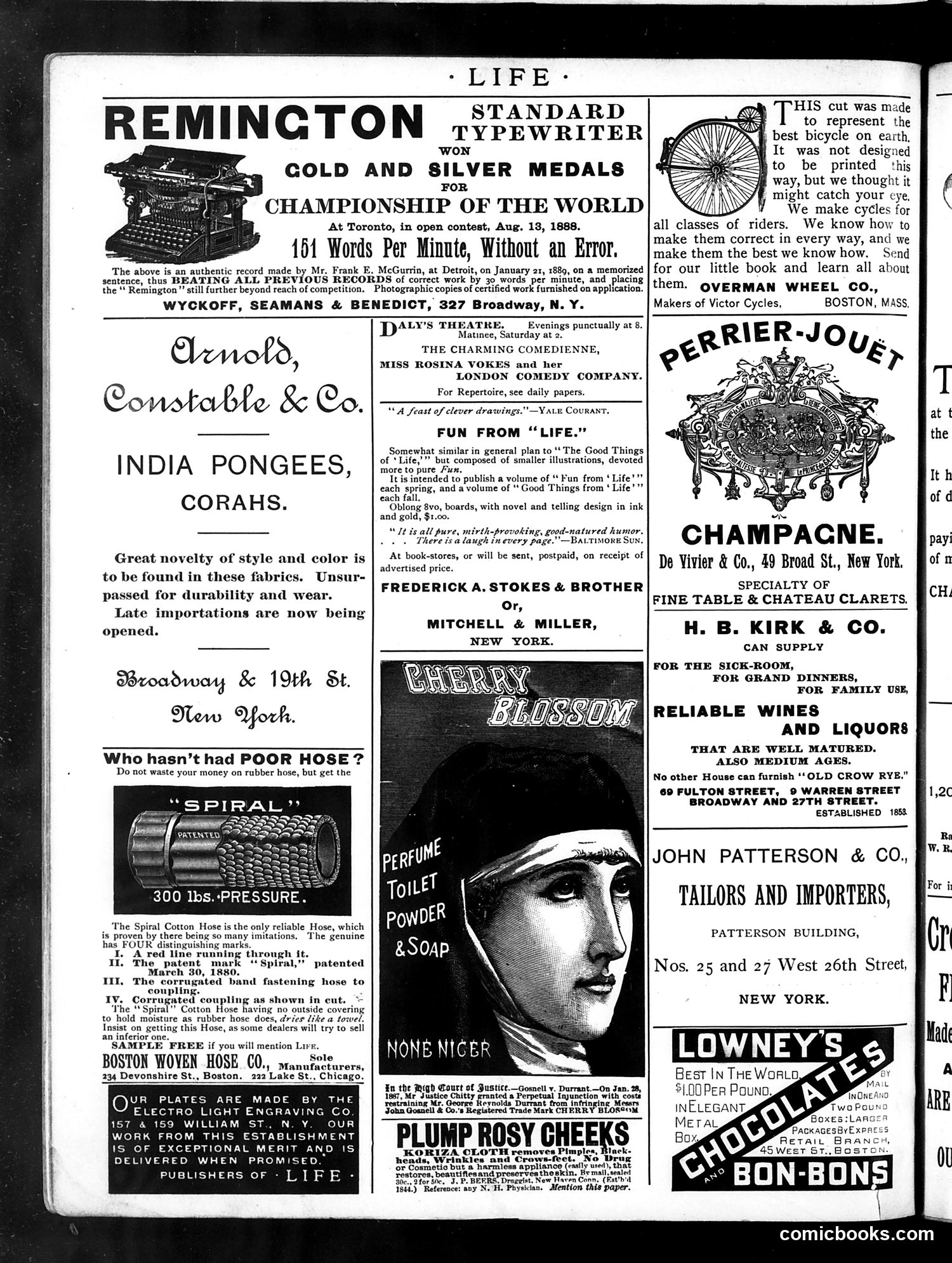
This is primarily an **advertising page** from Life magazine (late 1880s), with minimal editorial cartoon content. The page features various product advertisements typical of the era. The notable elements are: **Remington Typewriter ad** (top): Celebrates a speed-typing championship—151 words per minute without error—demonstrating the Remington's superiority in the competitive nascent typewriter market. **"Plump Rosy Cheeks" ad** (bottom center): Advertises a cosmetic product (Koriza Cloth) for removing facial blemishes, reflecting Victorian beauty standards emphasizing full cheeks and clear skin. **Overman Wheel Company ad** (right): Features a bicycle illustration, noting the humorous disclaimer that the image's unconventional angle wasn't intentional but might catch readers' eyes—early advertising self-awareness. Other ads promote luxury goods (champagne, fine wines, tailoring, cosmetics, hose) targeting wealthy readers. The page reflects Gilded Age consumer culture and emerging technologies like typewriters and bicycles.
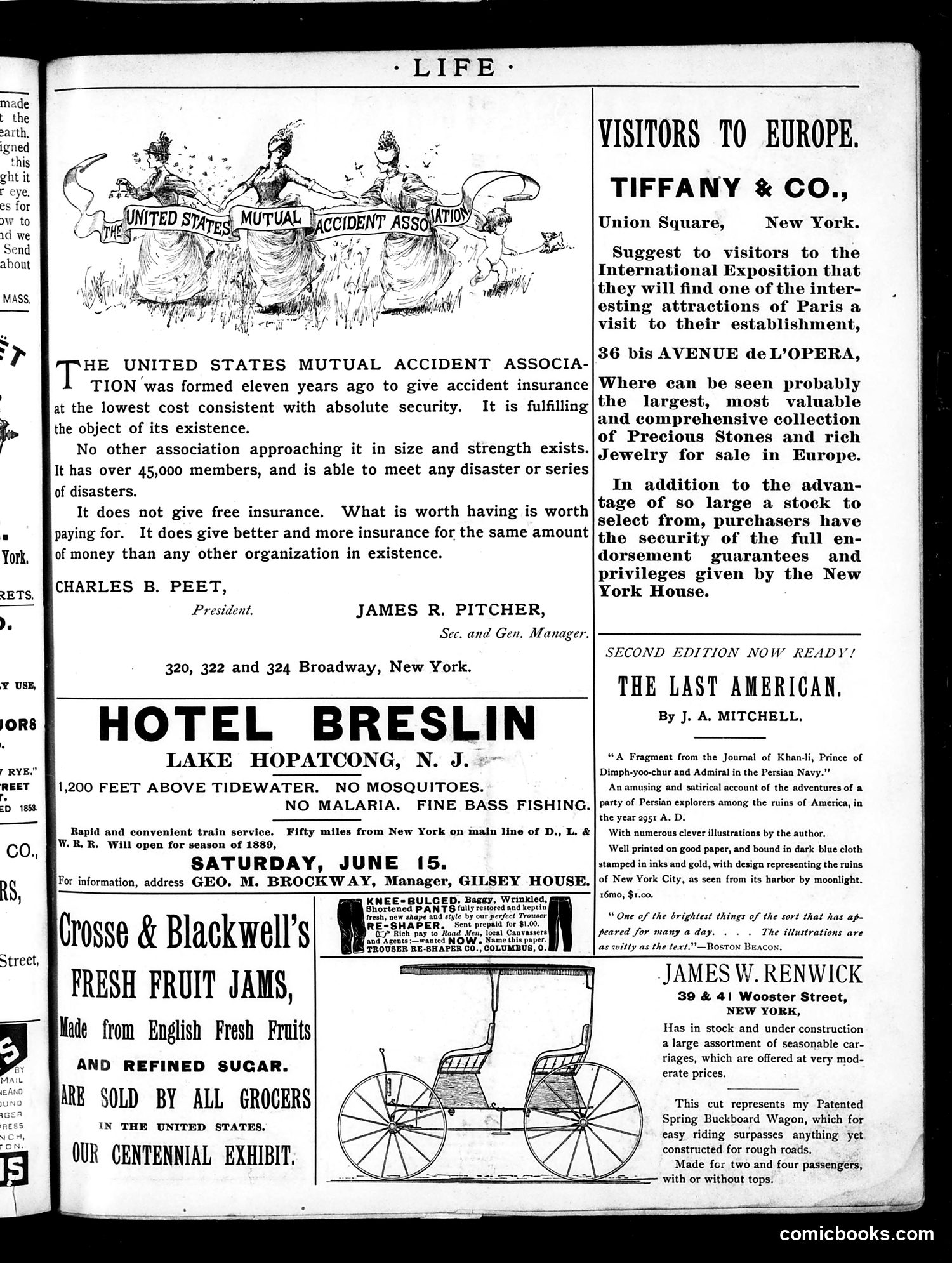
This page is primarily **advertisements** with one satirical element. The main visual is a decorative header showing three allegorical female figures representing "The United States," "Mutual," and "Accident Association"—personifications typical of 19th-century commercial imagery. The satire appears in **"The Last American"** book advertisement. The premise—Persian explorers discovering ruins of America in 2951 A.D.—suggests American decline or collapse. This likely reflects contemporary anxieties about the nation's future, possibly referencing economic instability, industrial conflict, or social upheaval of the 1880s. The joke inverts typical American superiority narratives: rather than Americans exploring exotic lands, future foreigners explore our ruins. The remaining content comprises standard advertisements for insurance, hotels, jewelry, jams, and carriages—typical Life magazine filler reflecting 1880s consumer culture.
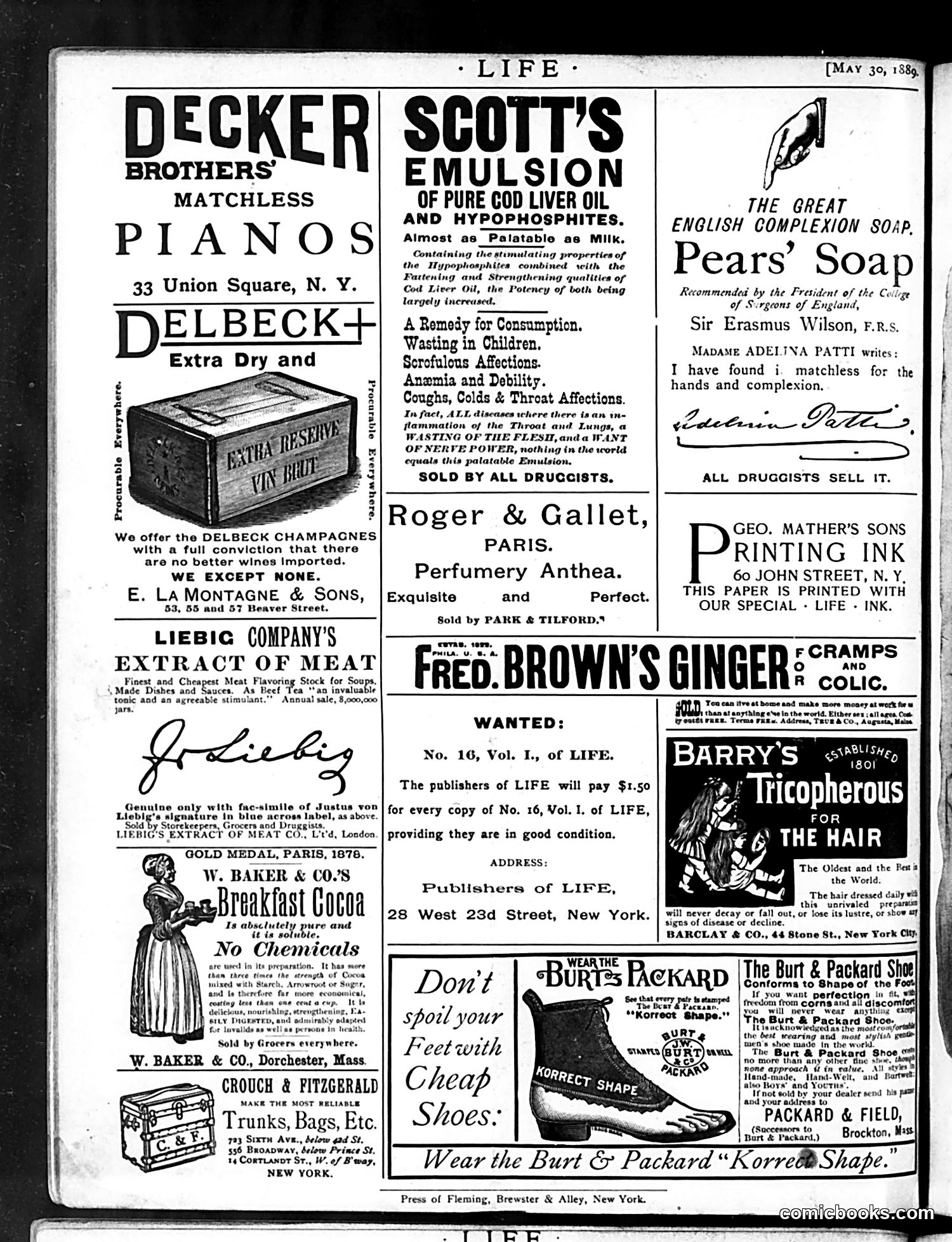
This is primarily an **advertisement page** from Life magazine's early period, not a satirical cartoon. The page features various product ads typical of late 19th-century American commerce: **Notable ads include:** - Piano and champagne sellers (luxury goods for wealthy readers) - Patent medicines: Scott's Emulsion (cod liver oil for consumption and wasting diseases), Brown's Ginger for digestive complaints - Toiletries: Pears' Soap (endorsed by a famous opera singer, Adelina Patti) and Barry's hair product - Practical goods: shoes, trunks, cocoa, meat extract **One notable element:** Life itself solicits readers to send in early copies of the magazine (No. 16, Vol. I), offering $1.50 each—suggesting the publication was already building a collectible status. The ads reflect period medical understanding (Scott's Emulsion genuinely treated tuberculosis symptoms) and marketing tactics emphasizing celebrity endorsements and scientific-sounding claims. This was typical Life magazine content: satirical cartoons alternated with commercial advertising.