
Life, 1889-05-30 · page 8 of 20
Life — May 30, 1889 — page 8: what you’re looking at
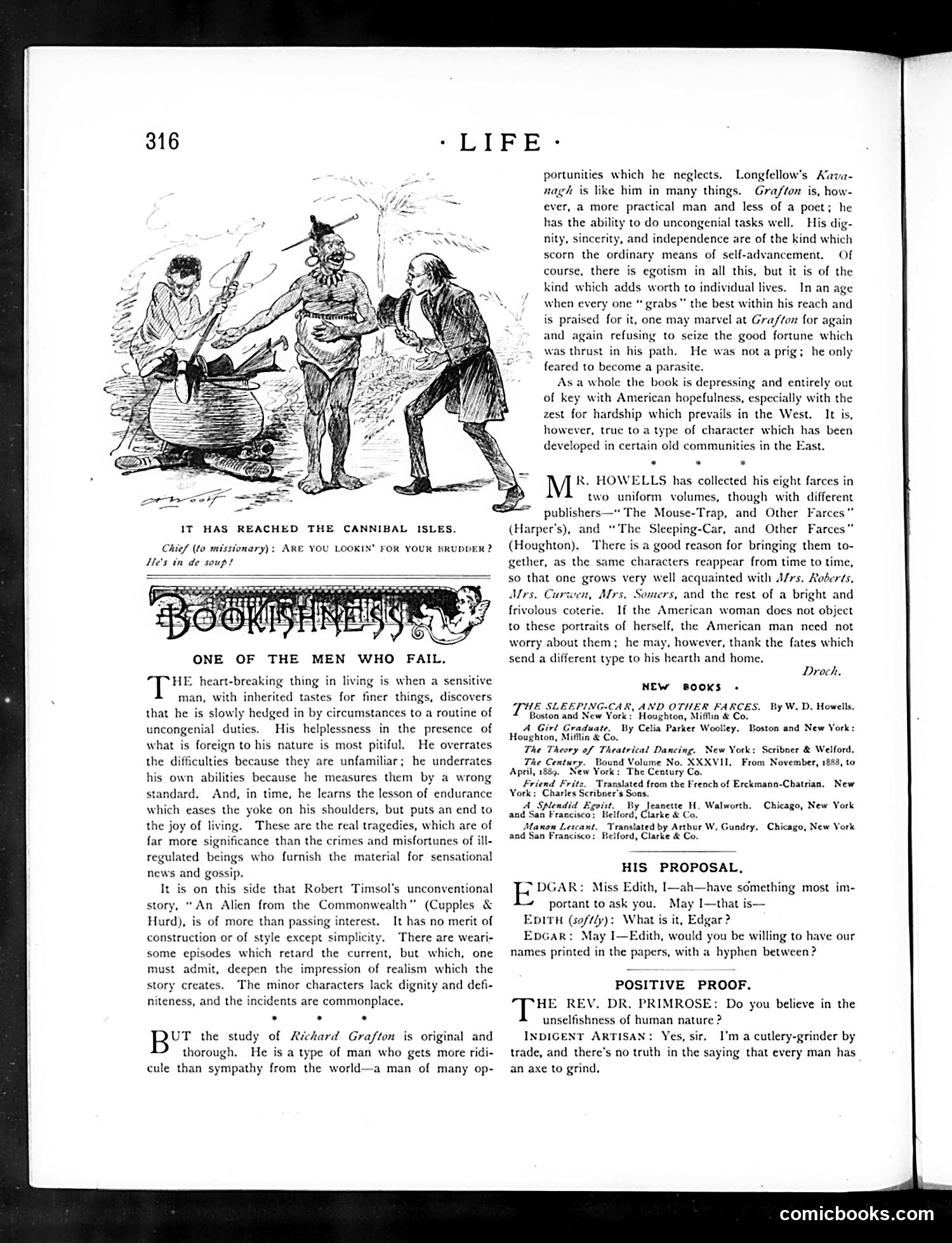
What you’re looking at
The main cartoon shows three figures labeled "IT HAS REACHED THE CANNIBAL ISLES" with a colonial-era chief asking "ARE YOU LOOKIN' FOR YOUR BLUNDER? HE'S IN DE SOUP?" This is a satirical commentary on American expansion and imperialism. The "cannibal isles" reference plays on Victorian-era stereotypes about Pacific islanders. The joke appears to target American business or political figures—someone's "blunder" has literally reached remote locations, suggesting American mistakes or scandals have global reach despite efforts to contain them. The cartoon reflects turn-of-the-century anxieties about American colonial ventures and the spread of American influence (and misadventures) worldwide. The crude dialect reflects period racist conventions in American humor.
📄 Transcribed text from this page (OCR, searchable)
Machine-transcribed from the original scan — historical spelling and the odd misread are preserved.
- LIFE > IT HAS REACHED THE CANNIBAL ISLES. Chief (to missionary): ARE YOU LOOKIN’ FOR YOUR BRUDDER ? He's in de soup? ONE OF THE MEN WHO FAIL. = heart-breaking thing in living is when a sensitive n, with inherited tastes for finer things, discovers that he is slowly hedged in by circumstances to a routine of uncongenial duties. His helplessness in the presence of what is foreign to his nature is most pitiful. He overrates the difficulties because they are unfamiliar; he underrates his own abilities because he measures them by a wrong standard. And, in time, he learns the lesson of endurance which eases the yoke on his shoulders, but puts an end to the joy of living. These are the real tragedies, which are of far more significance than the crimes and misfortunes of ill- regulated beings who furnish the material for sensational news and gossip. It is on this side that Robert Timsol’s unconventional story, “An Alien from the Commonwealth” (Cupples & Hurd), is of more than passing interest. It has no merit of construction or of style except simplicity. There are weari- some episodes which retard the current, but which, one must admit, deepen the impression of realism which the story creates. The minor characters lack dignity and defi- niteness, and the incidents are commonplace. . . . B JT the study of Richard Grafton is original and thorough. He is a type of man who gets more ridi- cule than sympathy from the world—a man of many op- portunities which he neglects. Longfellow’s Kava- nagh is like him in many things. Grafton is, how- ever, a more practical man and less of a poet; he has the ability to do uncongenial tasks well. His dig- nity, sincerity, and independence are of the kind which scorn the ordinary means of self-advancement. Of course, there is egotism in all this, but it is of the kind which adds worth to individual li In an age when every one “ grabs" the best within his reach and is praised for it, one may marvel at Grafton for again and again refusing to seize the good fortune which was thrust in his path. He was nota prig; he only feared to become a parasite. As a whole the book is depressing and entirely out of key with American hopefulness, especially with the zest for hardship which prevails in the West. It is, however, true to a type of character which has been developed in certain old communities in the East. R. HOWELLS has collected his eight farces in two uniform volumes, though with different publishers—“ The Mouse-Trap, and Other Farces” (Harper's), and ‘The Sleeping-Car, and Other Farces” (Houghton). ‘There is a good reason for bringing them to- gether, as the same characters reappear from time to time, so that one grows very well acquainted with A/7s. Roberts, Mrs. Curwen, Mrs. Somers, and the rest of a bright and frivolous coterie. If the American woman does not object to these portraits of herself, the American man need not worry about them; he m however, thank the fates which send a different type to his hearth and home. Droch, NEW BOOKS - THE SLEEPING-CAR, AND OTHER FARCES. Boston and New York :' Houghton, Mifflin & Co. A Girl Graduate, By Celia Parker Woolley. Houghton, Mifllin & Co. The Theory of Theatrical Dancing. New York: Scribner & Welford. The Century. Bound Volume No. XXXVII, From November, 1888, to April, 188. New York: The Century Friend Frits. Translated from the French of Erckmann-Chatrian. York: Charles Scribner's Sons. A Splendid Egoist, By Jeanette H. Walworth. and San Francisco: Belford, Clarke & Co. fanon Lescant. Translated by Arthur W. Gundry. Chicago, New York and San Francisco: Belford, Clarke & Co. By W. D, Howells. Boston and New York: New Chicago, New Vork HIS PROPOSAL. DGAR: Miss Edith, [—ah—have something most im- portant to ask you. May I—that is— EDITH (softly): What is it, Edgar ? EpGarR: May I—Edith, would you be willing to have our names printed in the papers, with a hyphen between? POSITIVE PROOF. HE REV. DR. PRIMROSE: Do you believe in the unselfishness of human nature ? INDIGENT ARTISAN: Yes, sir. I'm a cutlery-grinder by trade, and there's no truth in the saying that every man has an axe to grind, comicbooks.com