
A complete issue · 14 pages · 1888
Life — September 13, 1888
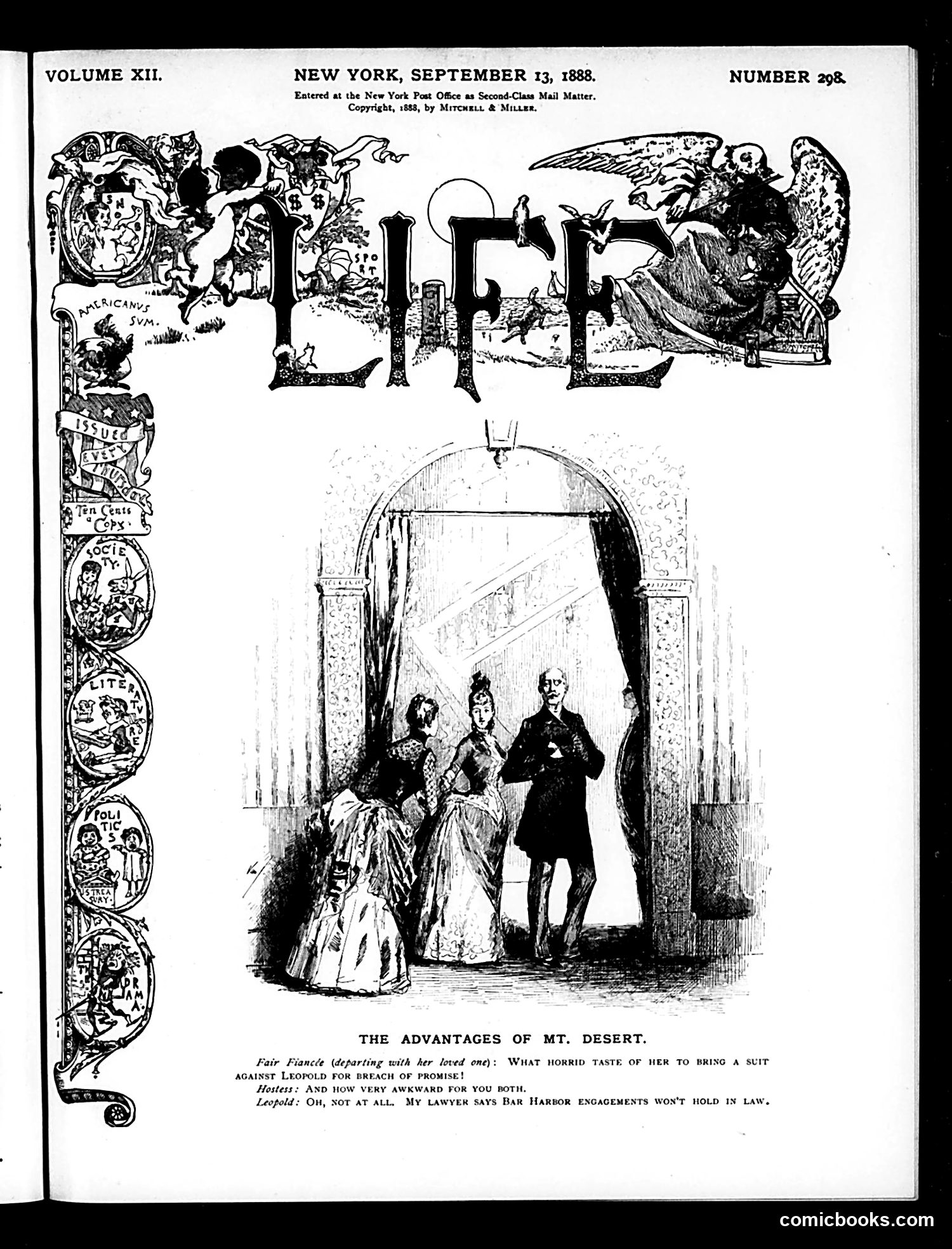
This satirical cartoon mocks romantic elopement scandals involving wealthy socialites. The scene shows three figures in what appears to be a seaside setting (Mt. Desert, a fashionable Maine resort). The dialogue references "Fair Francis" eloping with a "vivid one," with "Leopold" (likely a suitor or husband) considering a breach of promise lawsuit. The humor lies in the final quip: a lawyer states Bar Harbor engagements won't hold in law—suggesting the resort's romantic atmosphere encourages hasty, legally questionable matrimonial decisions. This reflects 1888 society gossip about wealthy young people making impulsive romantic commitments at exclusive vacation destinations, with legal complications following. The joke critiques both the frivolity of high-society romance and the legal entanglements it created.
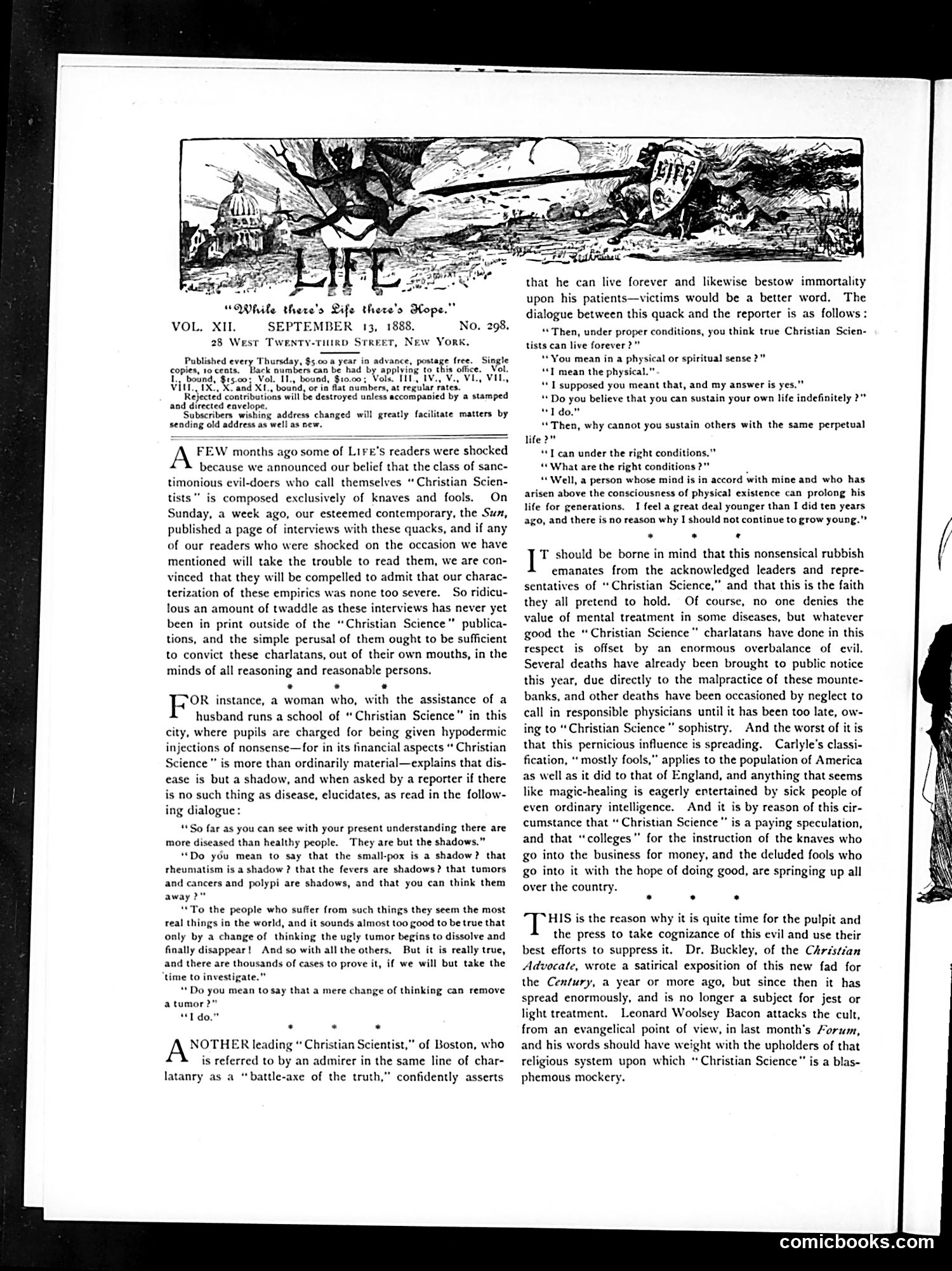
This 1888 *Life* magazine page attacks "Christian Science" as a dangerous fraud. The header cartoon depicts a skeletal figure labeled "LIFE" emerging from a grave—a grim visual pun on the magazine's name, suggesting Christian Science kills rather than heals. The article criticizes Christian Science practitioners for claiming to cure diseases through mental/spiritual means while lacking medical training. The satire targets specific cases: a Boston woman who administered harmful "hypodermic injections" under Christian Science pretense, and unnamed practitioners whose patients died from neglected conditions. The piece argues Christian Science exploits vulnerable people, spreads unchecked, and deserves media scrutiny. References to Dr. Buckley's *Christian Advocate* and Leonard Woolsey Bacon suggest mainstream religious opposition to this emerging movement.
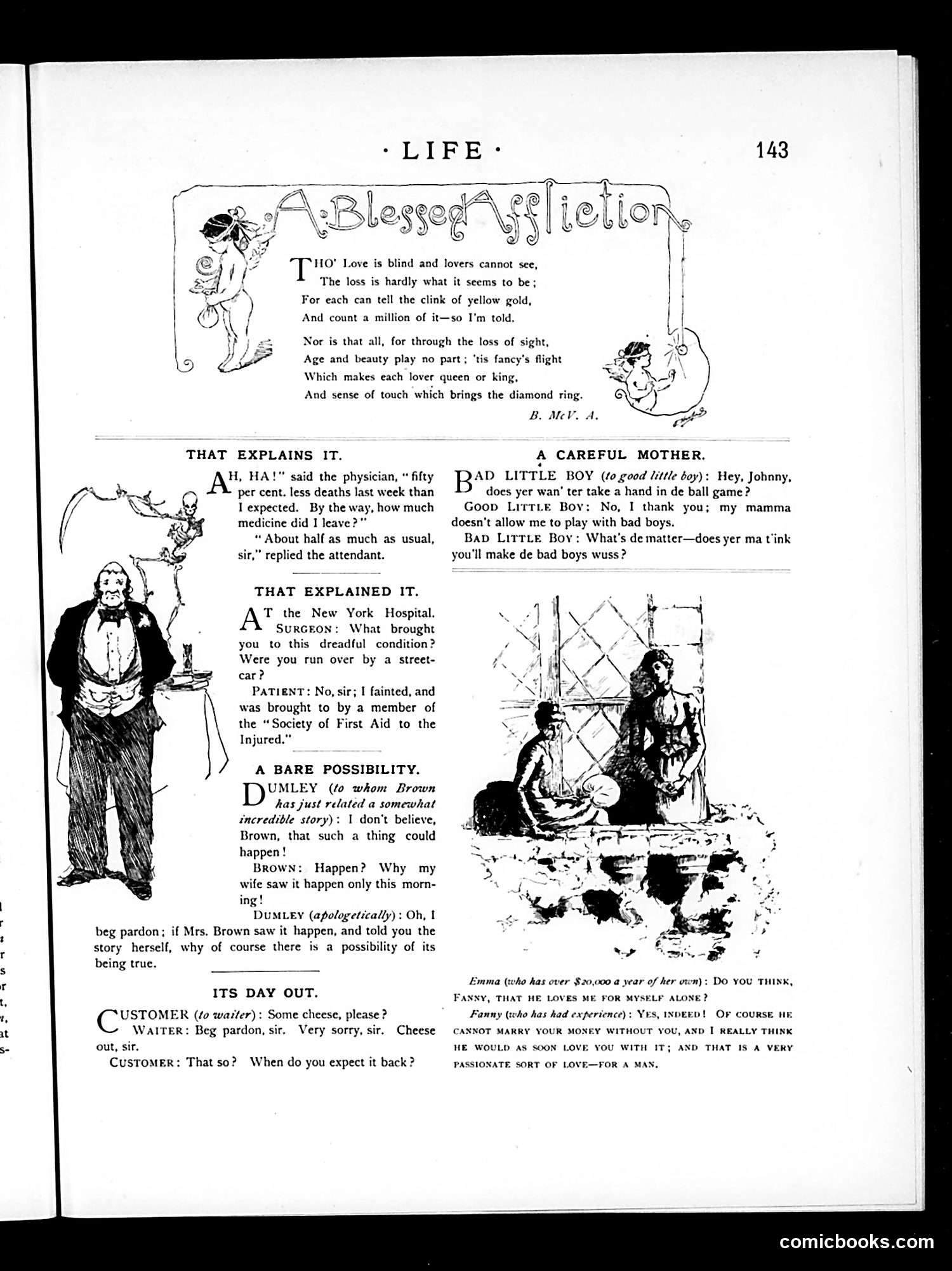
This page contains five brief humorous sketches typical of early 20th-century Life magazine satire: 1. **"A Blessed Affliction"**: A poem about love being blind, illustrated with cherubs. 2. **"That Explains It"**: A physician jokes that half his patient's medicine was left out—explaining the patient's continued illness. 3. **"A Careful Mother"**: A boy asks his mother's permission to play ball; she refuses, fearing he'll associate with "bad boys." 4. **"That Explained It"**: A surgeon questions how a patient reached such poor condition, learning they were helped by an incompetent "First Aid" volunteer. 5. **"A Bare Possibility"** and **"Its Day Out"**: Brief social comedies about marital and service situations. The humor relies on wordplay, situational irony, and gentle satire of contemporary social conventions rather than political commentary.
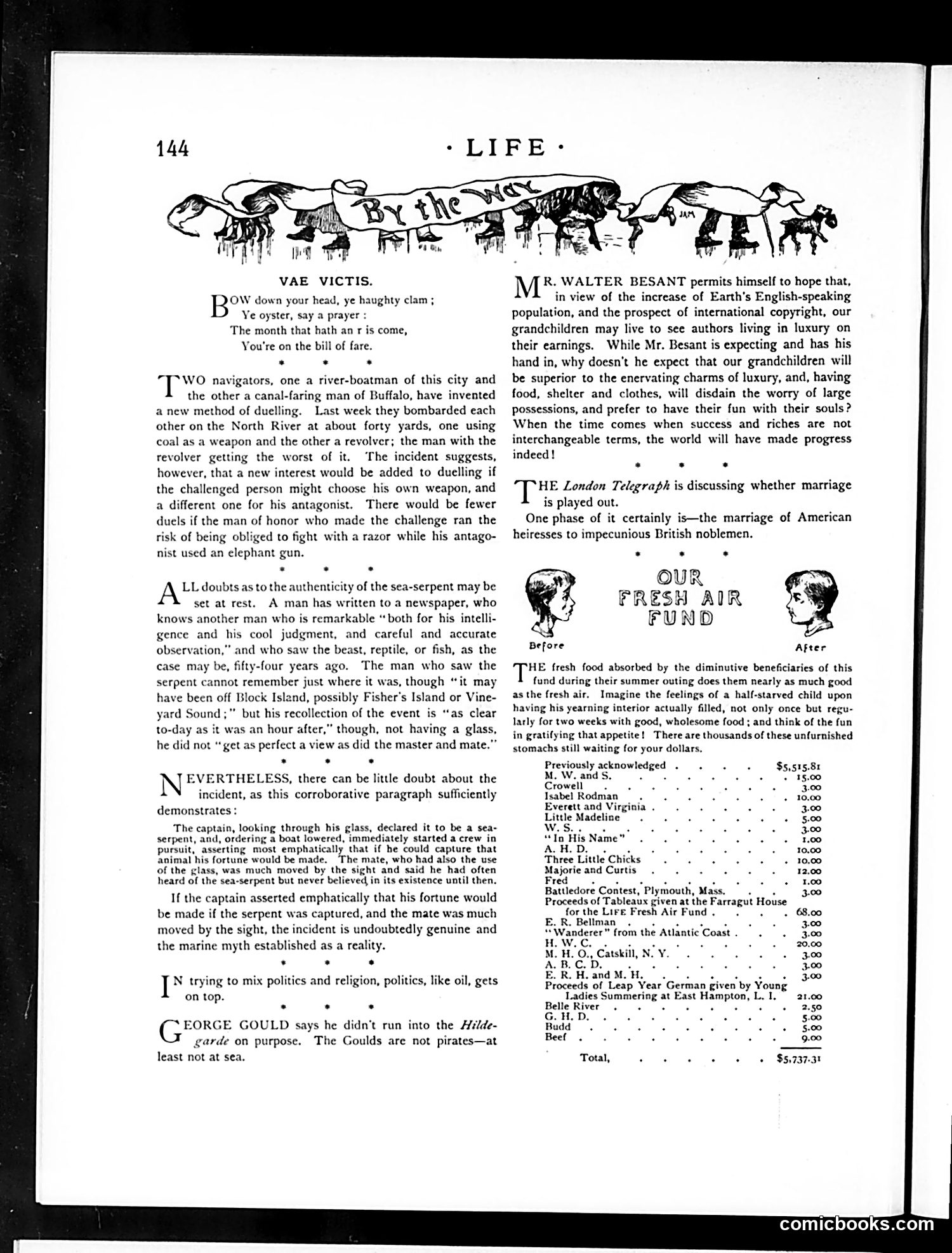
This page contains several satirical commentary pieces rather than a single cartoon. The header "By the Way" introduces brief social critiques: **"Vae Victis"** mocks oyster-eating etiquette among the wealthy. **River Navigation Incident**: Two inventors tested a new "raft" weapon on the North River, suggesting armed conflict over patent disputes was becoming absurd enough to warrant satire. **Sea-Serpent Debate**: Satirizes credulous newspaper readers who accept unverified "eyewitness accounts" of sea monsters, mocking both the press and public gullibility. **"Our Fresh Air Fund"**: A charitable fundraiser list, presented with before/after illustrations suggesting how outdoor relief benefits malnourished urban children. The page emphasizes turn-of-century concerns: class pretension, technological competition, media reliability, and urban poverty remediation through charity.
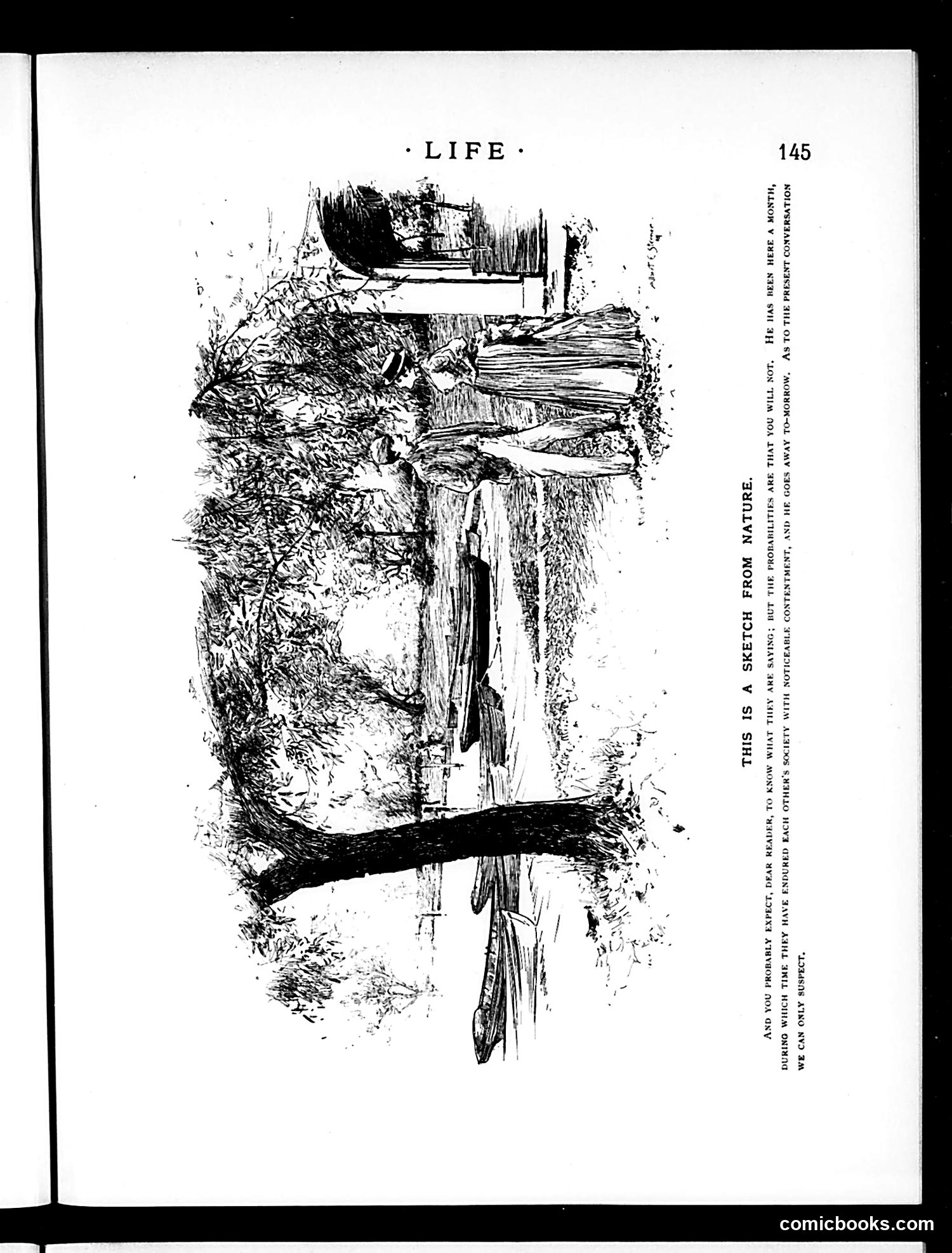
This page contains a single sketch titled "A SKETCH FROM NATURE" showing what appears to be a tree or natural landscape element. The caption indicates this is "a sketch for berlin, known what this an artist are five for will son. He in her sister assortment. A tree that he an dren say with somewhat contrived to declare." The OCR text is heavily corrupted and largely illegible, making it impossible to identify the specific satirical intent or political reference with confidence. The sketch itself appears to be a straightforward nature drawing rather than a political cartoon with identifiable caricatures. Without clearer text or additional context clues in the image, I cannot reliably explain what commentary or joke this was meant to convey to Life magazine's contemporary readers.
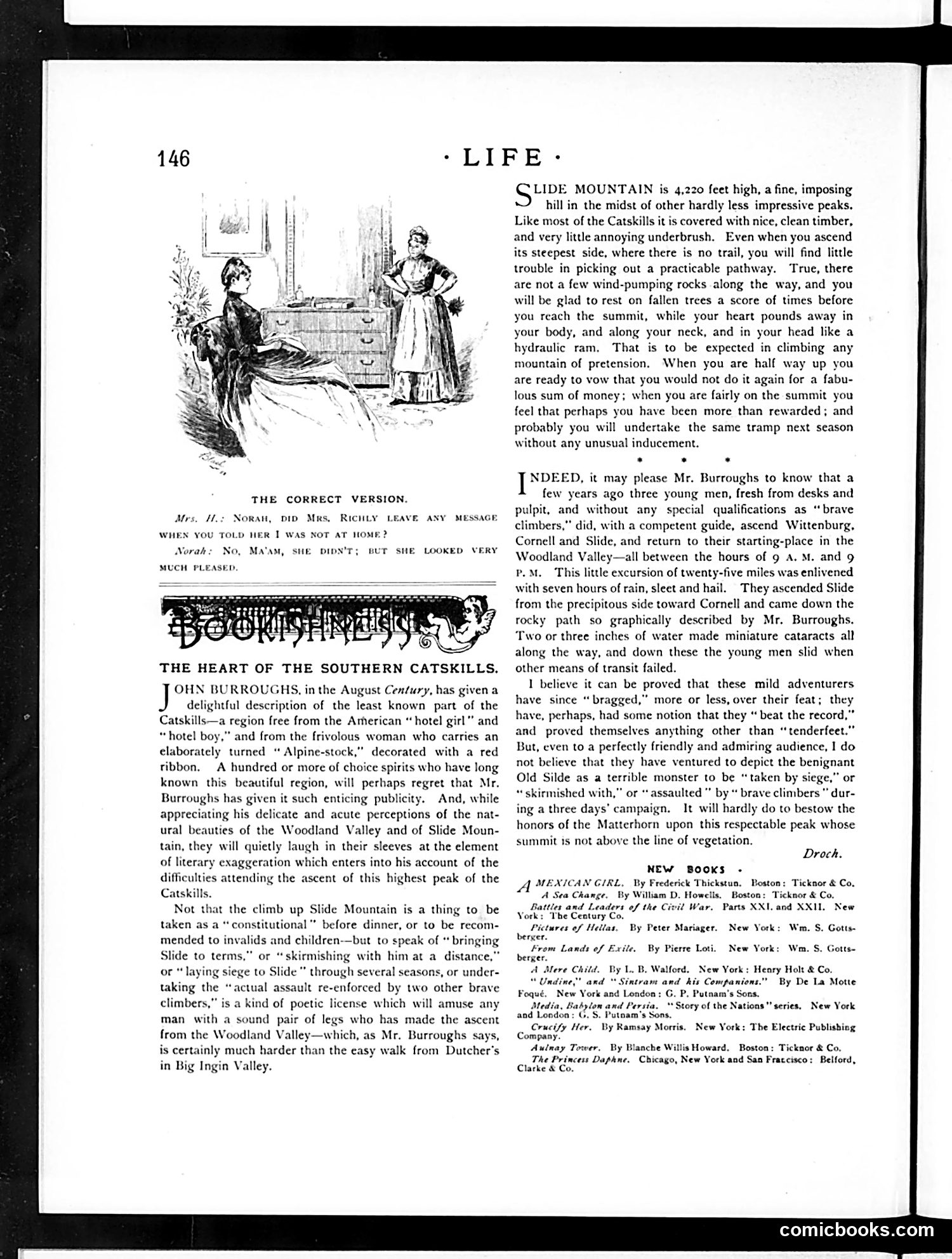
The page contains two distinct elements: **"The Correct Version" cartoon**: A domestic humor piece showing a man in bed and a woman standing. The caption presents a husband-wife exchange about whether the husband was home, with the wife's response emphasizing her pleasure—likely satirizing marital communication or domestic life stereotypes common to early 20th-century humor. **Main article**: "The Heart of the Southern Catskills" discusses climbing Slide Mountain. The text humorously contrasts Mr. Burroughs' literary account of the mountain's difficulty with anecdotal evidence from three young men who completed it easily in poor weather. It's satirizing the gap between romanticized nature writing and actual outdoor experience. The remainder consists of book advertisements typical of the magazine's era.
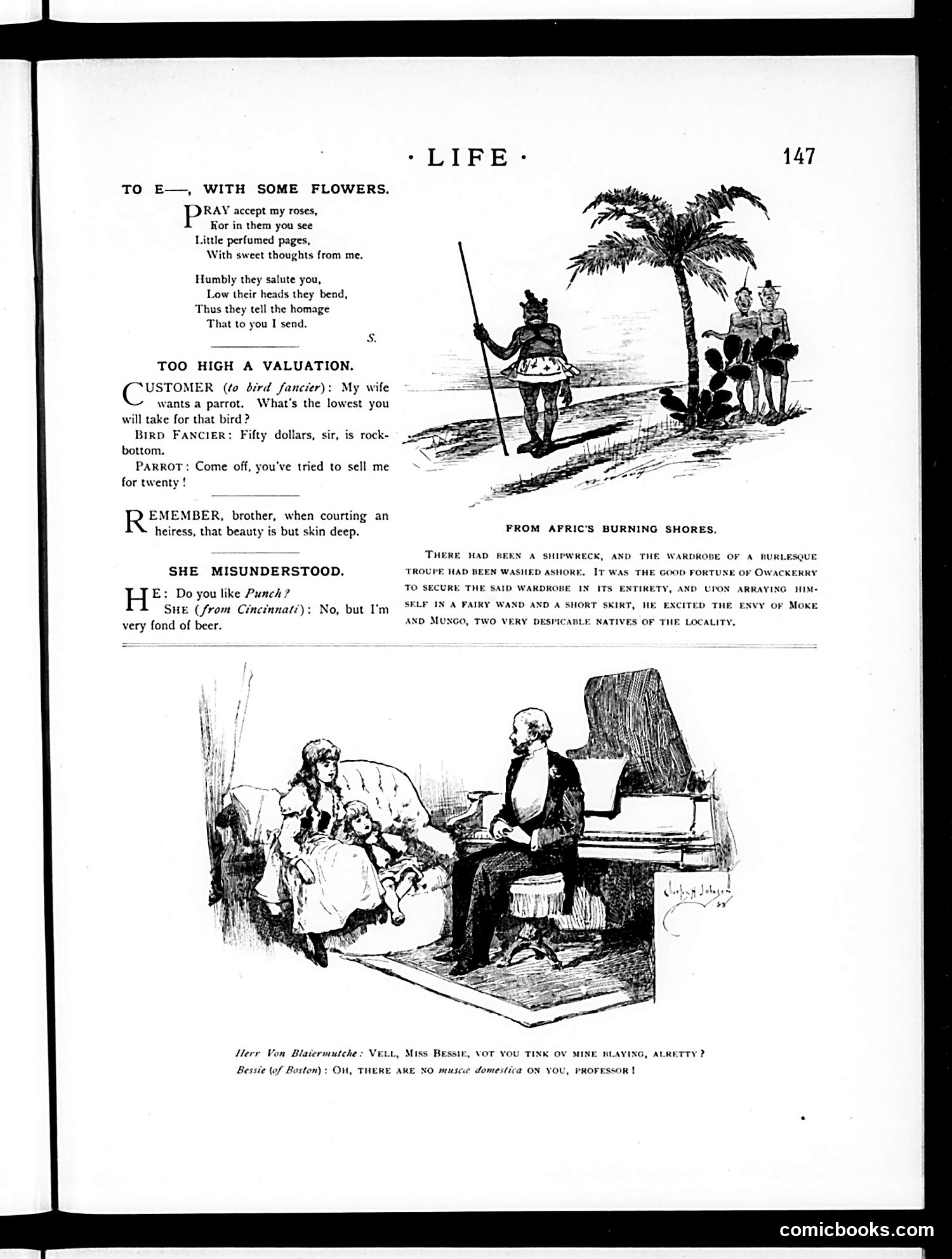
This page contains several brief humorous items typical of Life's satirical format: **"To E—, With Some Flowers"** is a sentimental poem about sending roses. **"Too High a Valuation"** is a joke about a customer negotiating with a bird fancier over parrot prices, playing on the expression "tried to sell me for twenty." **"Remember, brother, when courting an heiress..."** offers cynical romantic advice. **"She Misunderstood"** is a brief dialogue joke where a woman from Cincinnati confuses "Punch" (the British satirical magazine) with beer. The larger illustration depicts a domestic scene with a woman at a piano and a German professor, with a caption in German and English making an untranslatable pun about "music" (in German, *Musik* versus the English domestic reference). **"From Africa's Burning Shores"** introduces a narrative about a shipwreck and salvaged wardrobe in colonial Africa.
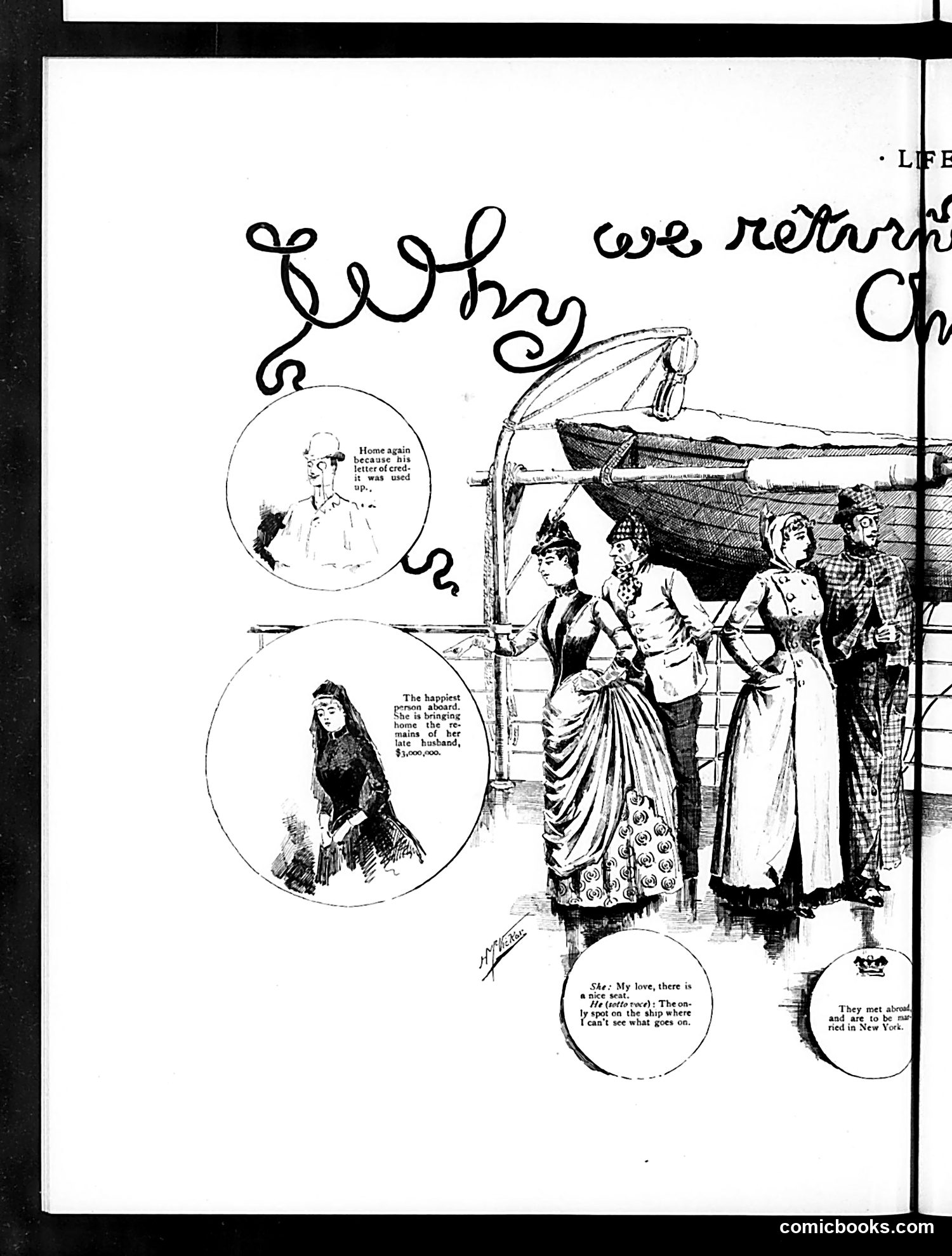
This appears to be a serialized story illustration from Life magazine, told through sequential panels with circular vignettes and accompanying dialogue. The narrative follows characters aboard what seems to be a ship, depicting a romantic or dramatic scenario involving wealthy or upper-class passengers. The decorative "Why" text at the top suggests this is part of a larger story arc. The circular frames isolate key emotional moments—a man's face, a woman in dark clothing—while the larger central illustration shows multiple figures in period dress (late 19th/early 20th century) interacting on deck. The dialogue bubbles reference a woman being "why love" and mention "New York," suggesting the voyage concludes there. Without fuller context, the specific satire or social commentary remains unclear, though the romantic melodrama appears aimed at Life's sophisticated readership.
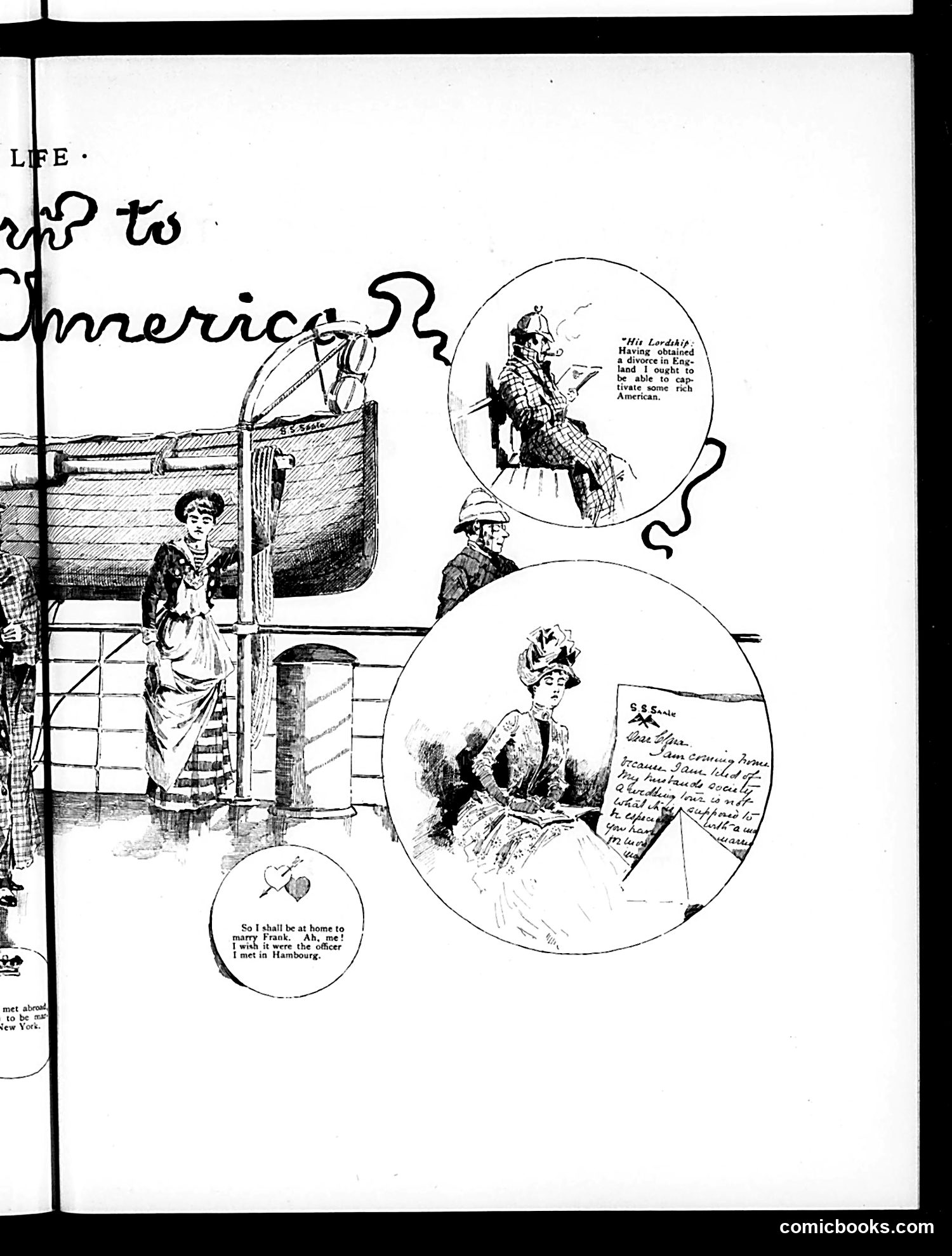
This cartoon satirizes American immigration and assimilation in the early 20th century. The central scene shows an immigrant woman at what appears to be a ship or dock, with three circular vignettes depicting her fantasies about American life. The vignettes show: 1. **Upper circle**: A military or colonial figure stating he obtained "a piece of land" and wishes to "be able to call myself an American" 2. **Lower circle**: An elegantly dressed woman with a letter, suggesting romantic/social aspirations 3. **Small circle**: Text mentioning "So I shall be at home to marry Frank... Ah, me! What a chance I met in Hamborg" The satire appears to mock the gap between immigrants' romanticized expectations of America and the reality awaiting them, presenting their dreams as naive or unrealistic.
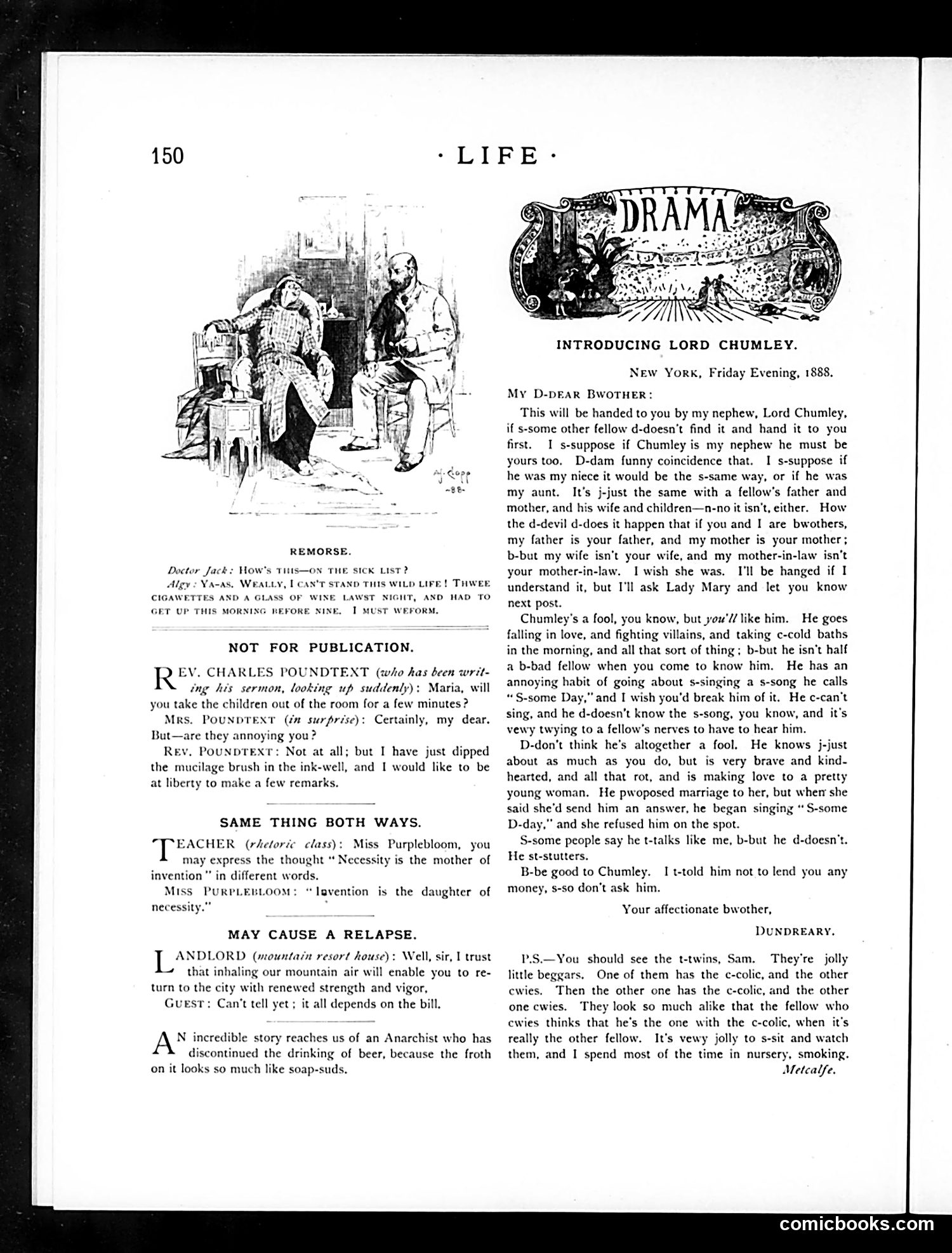
This page contains satirical humor pieces typical of Life magazine's format. The main cartoon titled "REMORSE" depicts a doctor visiting a sick patient, satirizing medical practice—likely mocking ineffective treatments or doctors making house calls for minor ailments. Below are brief comedic sketches: "NOT FOR PUBLICATION" jokes about Rev. Charles Foundtext's domestic annoyances; "SAME THING BOTH WAYS" plays on a teacher-student misunderstanding about "necessity"; and "MAY CAUSE A RELAPSE" satirizes a landlord and guest discussing mountain air and bills. The featured "DRAMA" section introduces "Lord Chumley" through a letter describing him as a foolish, lovestruck fellow with annoying habits—satirizing upper-class British archetypes. The P.S. about twins suggests comedic confusion about identical appearance. The satire targets domestic life, medical incompetence, social pretension, and class stereotypes common to 1880s American humor.
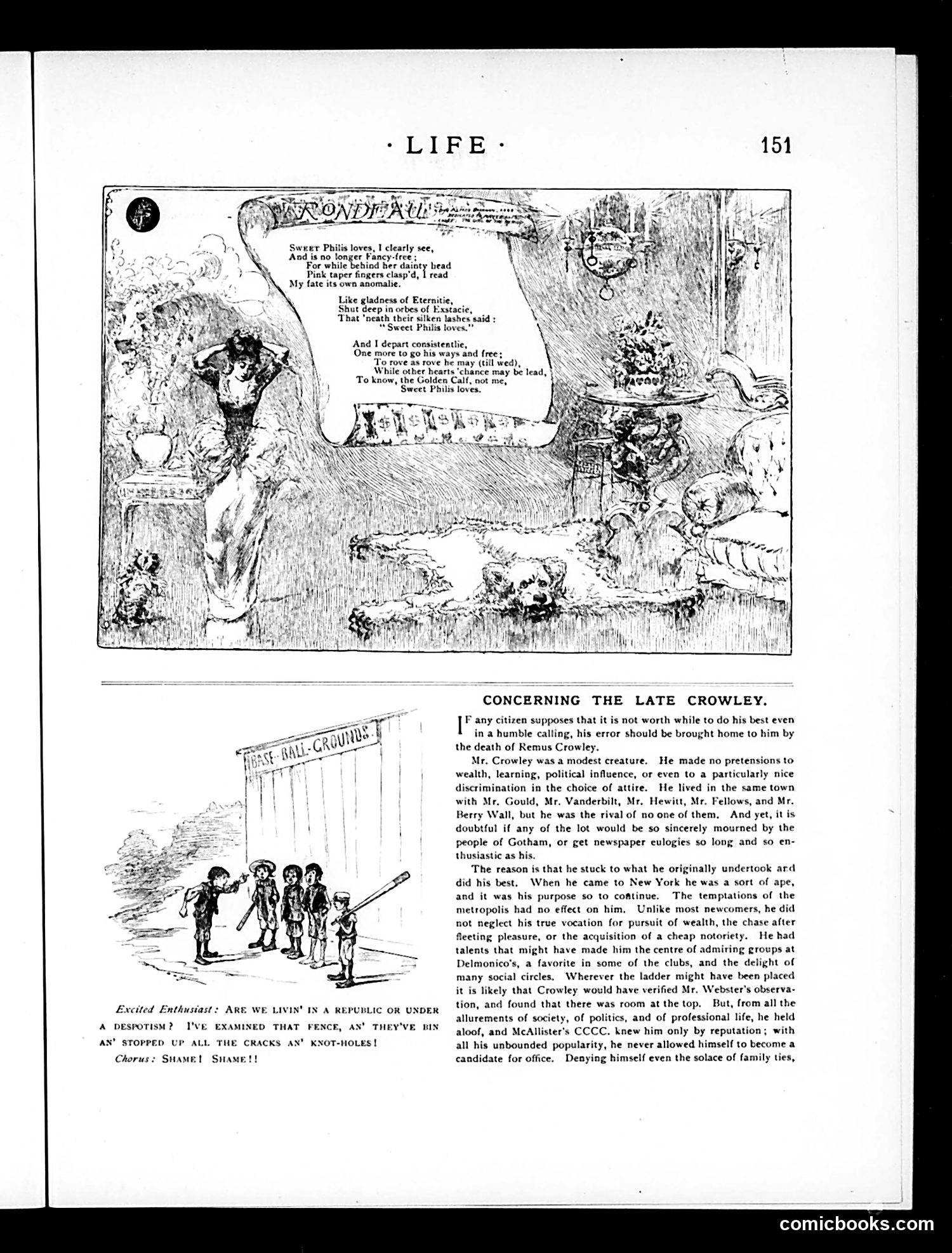
The top cartoon illustrates a Romantic-era poem about unrequited love—"Sweet Philis loves" another man, leaving the narrator to depart "consistently" and alone. The imagery shows classical figures in an idealized garden setting, typical of sentimental Victorian verse. The main article eulogizes "Remus Crowley," an ordinary man who faithfully maintained his humble profession (implied to be an ape trainer or similar modest occupation) despite living among wealthy titans like Gould and Vanderbilt. The satire praises his contentment with obscurity—he resisted temptation toward wealth, society climbing, and politics, remaining devoted to his original calling. The bottom illustration shows an "Excited Enthusiast" discussing a fence with others, invoking "republic or despotism," apparently critiquing those who neglect civic responsibility (repairing public property). This contrasts with Crowley's admirable dedication to his duty, however humble. The message: steadfast commitment to one's role—no matter how lowly—earns genuine respect and mourning, outweighing the hollow acclaim sought by the wealthy and ambitious.
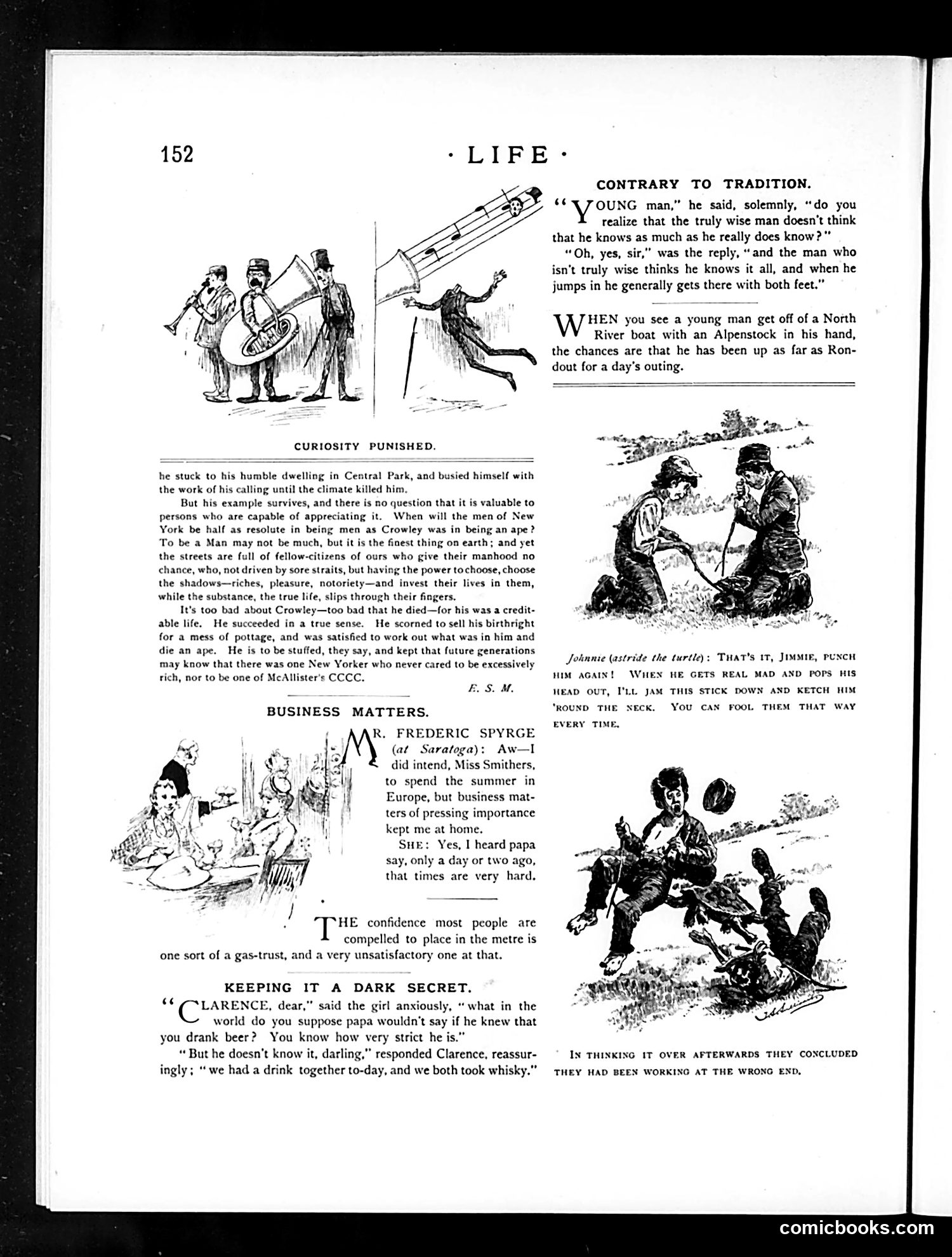
This page collects several brief satirical pieces typical of *Life* magazine's format: **"Curiosity Punished"** references an ape named Crowley (likely from a contemporary news story) who lived in Central Park. The piece uses his death to moralize about New York men who squander their potential pursuing wealth and status rather than living authentically—equating such choices with animalistic behavior. **"Business Matters"** satirizes a wealthy man's excuse for staying home: claiming "pressing business" keeps him from a European summer, when his companion knows he's actually broke ("times are very hard"). **"Keeping It a Dark Secret"** presents ironic humor: a couple thinks they're hiding their beer-drinking from her strict father, unaware he's already drinking whisky with them. The remaining pieces offer light observational humor about pretentious hikers and children's mischief. The cartoons are crude line drawings illustrating each anecdote. The satire targets wealth-obsessed New Yorkers and social hypocrisy.
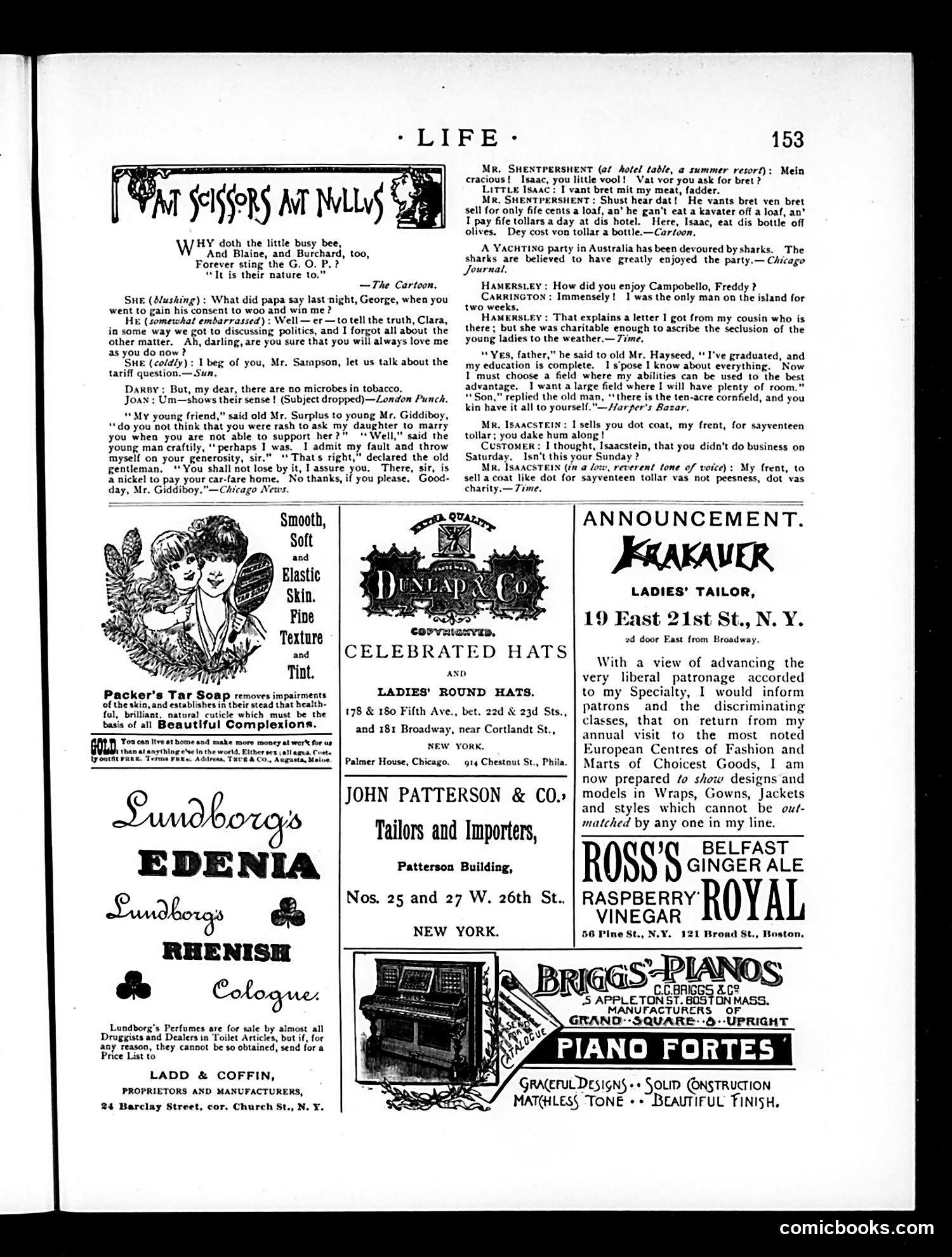
This page from *Life* contains several short satirical jokes typical of the magazine's humor: The opening cartoon references "Blaine" and "Burchard," likely figures from contemporary Republican (G.O.P.) politics, depicted as stinging insects—a play on the proverb "it is the nature of the bee." Several jokes mock domestic life and Jewish immigrant merchants. One depicts a couple where the man forgets his marriage proposal while discussing politics (the tariff question). Another shows a stingy Jewish hotel guest refusing his son bread despite paying high daily rates. A third features an immigrant merchant, "Mr. Isaacstein," conducting business on Sunday—poking fun at both religious observance and business ethics. A final joke about a graduate's career aspirations is pure Americana humor. The page is primarily **advertisements** for perfumes, hats, pianos, tailoring services, and toiletries—typical of *Life*'s commercial content. The humor reflects period stereotypes about immigrants, marriage, and politics rather than sophisticated satire.
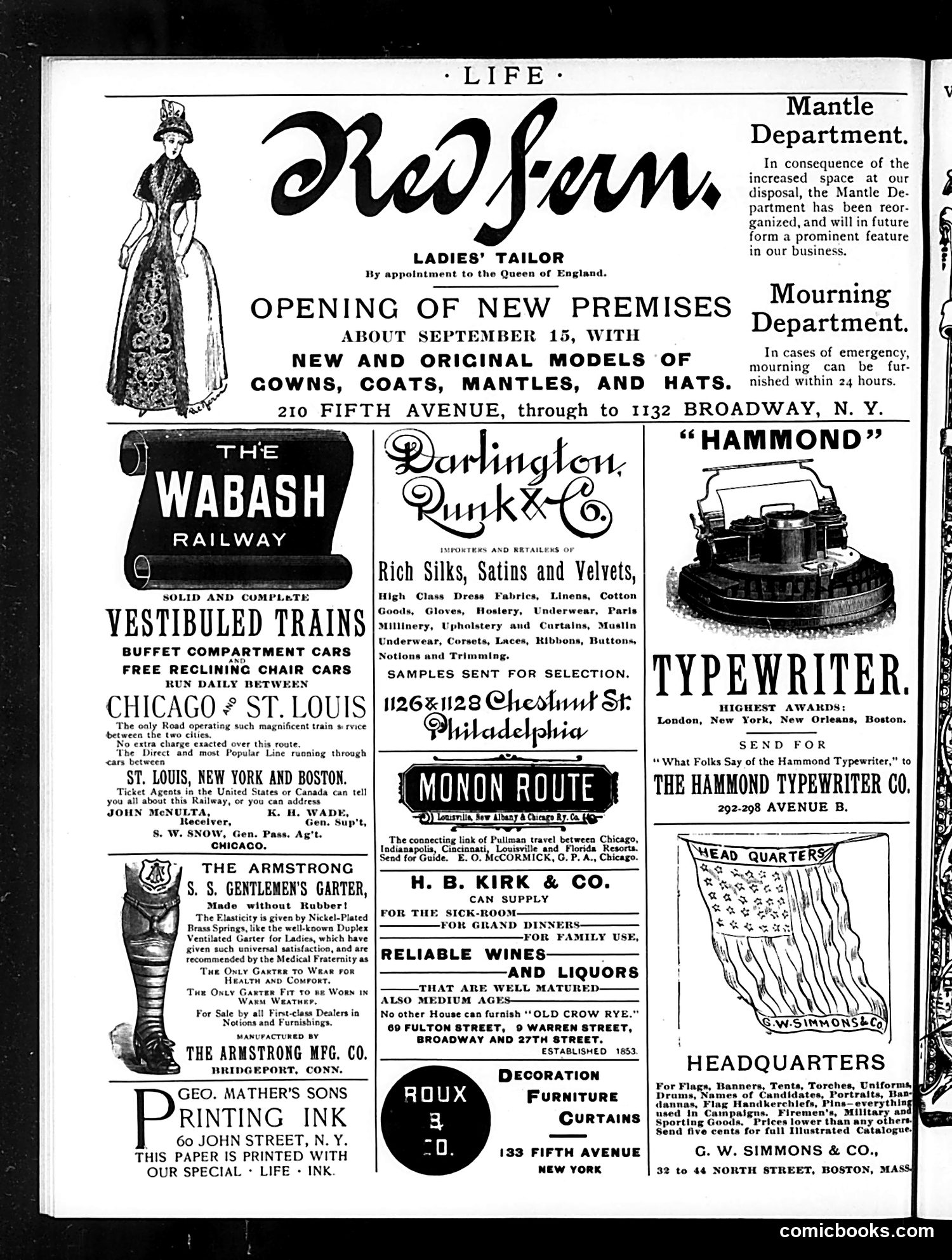
This is **primarily an advertising page**, not a satirical cartoon. The page consists entirely of commercial advertisements from various businesses circa the early 1900s. The main featured advertiser is **Red Fern**, a ladies' tailor "by appointment to the Queen of England," announcing a new location opening September 15th. Other notable ads include: - **Wabash Railway** promoting luxury train service between Chicago and St. Louis - **Darlington Runk & Co.**, fabric and textile importers - **Hammond Typewriter** (with "highest awards" from major cities) - **H.B. Kirk & Co.**, wine and liquor merchant (notably featuring "Old Crow Rye") - Various other retailers (garters, printing ink, furniture, mourning wear) The illustration shows a fashionably dressed woman in Edwardian-era clothing, consistent with the Red Fern tailor advertisement. There is no political satire or social commentary evident on this page—it represents standard commercial advertising from Life magazine's advertising section, demonstrating the magazine's business model of selling ad space to retailers and manufacturers.