
A complete issue · 14 pages · 1888
Life — August 2, 1888
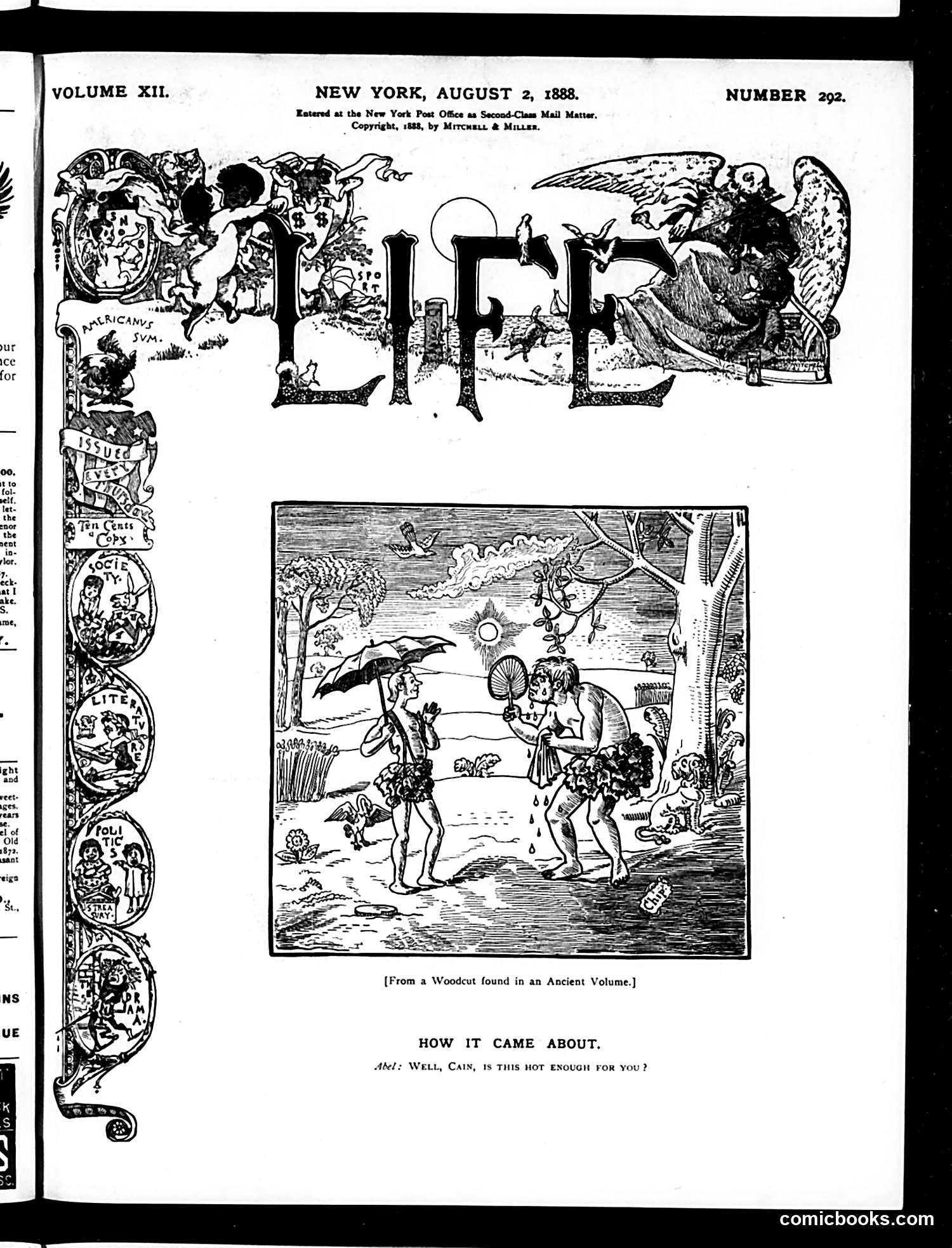
This page features a woodcut-style illustration depicting a scene of nudity and apparent distress, with the caption "HOW IT CAME ABOUT" followed by dialogue: "And! WELL, CAIN, IS THIS HOT ENOUGH FOR YOU?" The reference to Cain suggests a biblical allusion, likely to the story of Adam and Eve's expulsion from Eden. The "hot" reference appears to be a pun, possibly alluding to hell or divine punishment. However, without clearer context about contemporary 1888 events or political figures this might reference, the exact satirical target remains unclear. The woodcut's classical style and nude figures suggest it's meant as humorous social or moral commentary, but the specific point of the satire is difficult to determine from the image alone.
The page contains an editorial essay titled "LIFE" criticizing a young criminal called a "rascal" who committed railroad sabotage and theft. The text discusses broader concerns about wealthy financiers and businessmen who betray public trust through dishonest practices, comparing their moral corruption to that of common criminals. The editorial also critiques "the sporting fraternity" and political betting practices, suggesting Republicans and Democrats both engage in wagering on election outcomes. The author questions whether wealthy elites truly deserve public respect when their business methods involve deception and exploitation. The illustration at the top appears decorative rather than directly illustrating specific figures. This is primarily a moral/political commentary on class hypocrisy and business ethics during the Gilded Age.
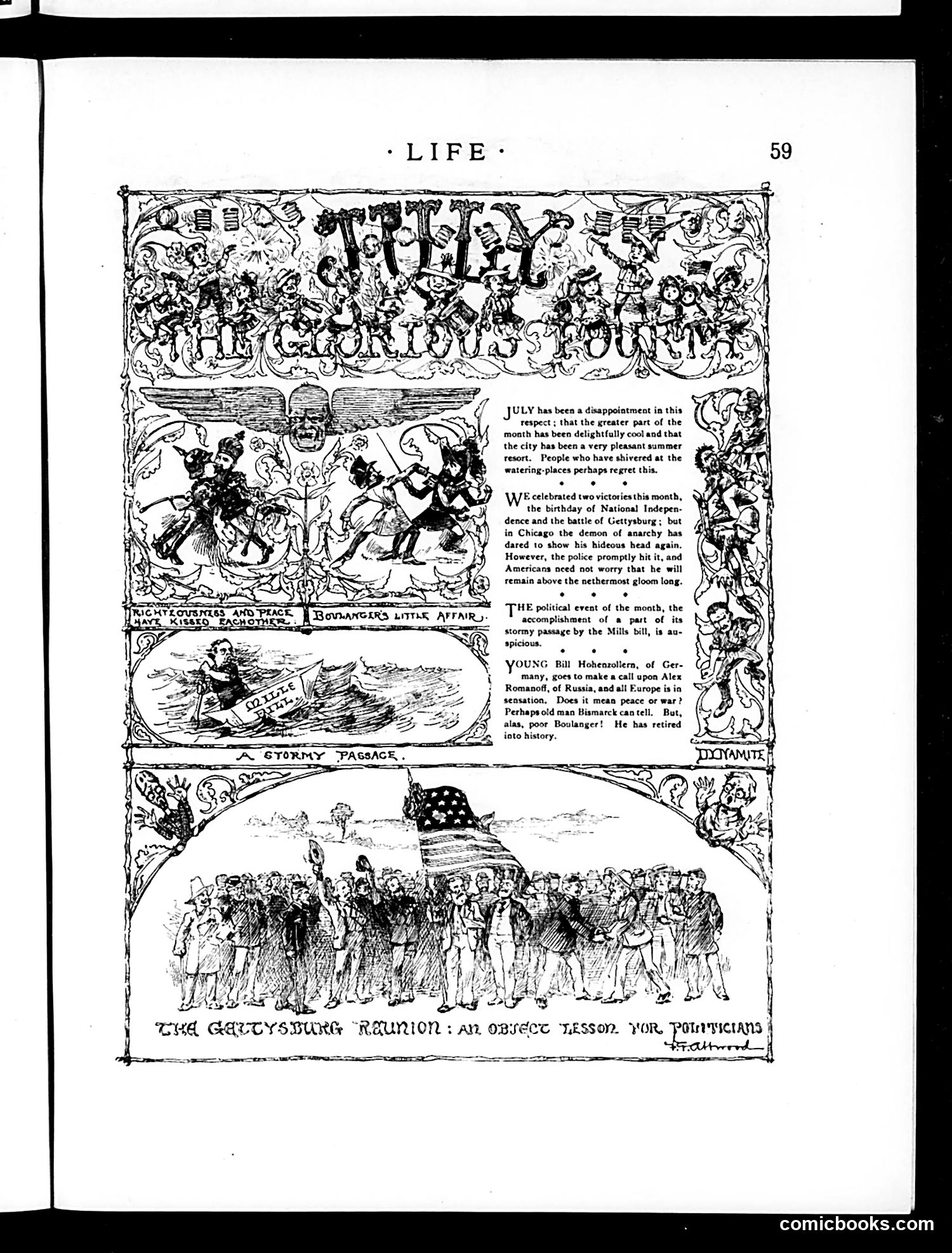
This page contains three satirical illustrations about July events. The top section celebrates Independence Day and the Battle of Gettysburg, but sarcastically notes Chicago anarchists displayed a "hideous head" and warns Americans not to worry about threats to the nation—clearly mocking domestic radical movements. The middle section references "Young Bill Hohensollern" (the German Kaiser) calling on Tsar Alexander of Russia, questioning whether this signals peace or war, and referencing Otto von Bismarck's role in history—contemporary concern about European power dynamics. The bottom illustration, "The Gettysburg Reunion," shows politicians gathered under an American flag, captioned as "an object lesson for politicians"—likely satirizing how politicians exploit or misuse the Civil War's memory for political gain.
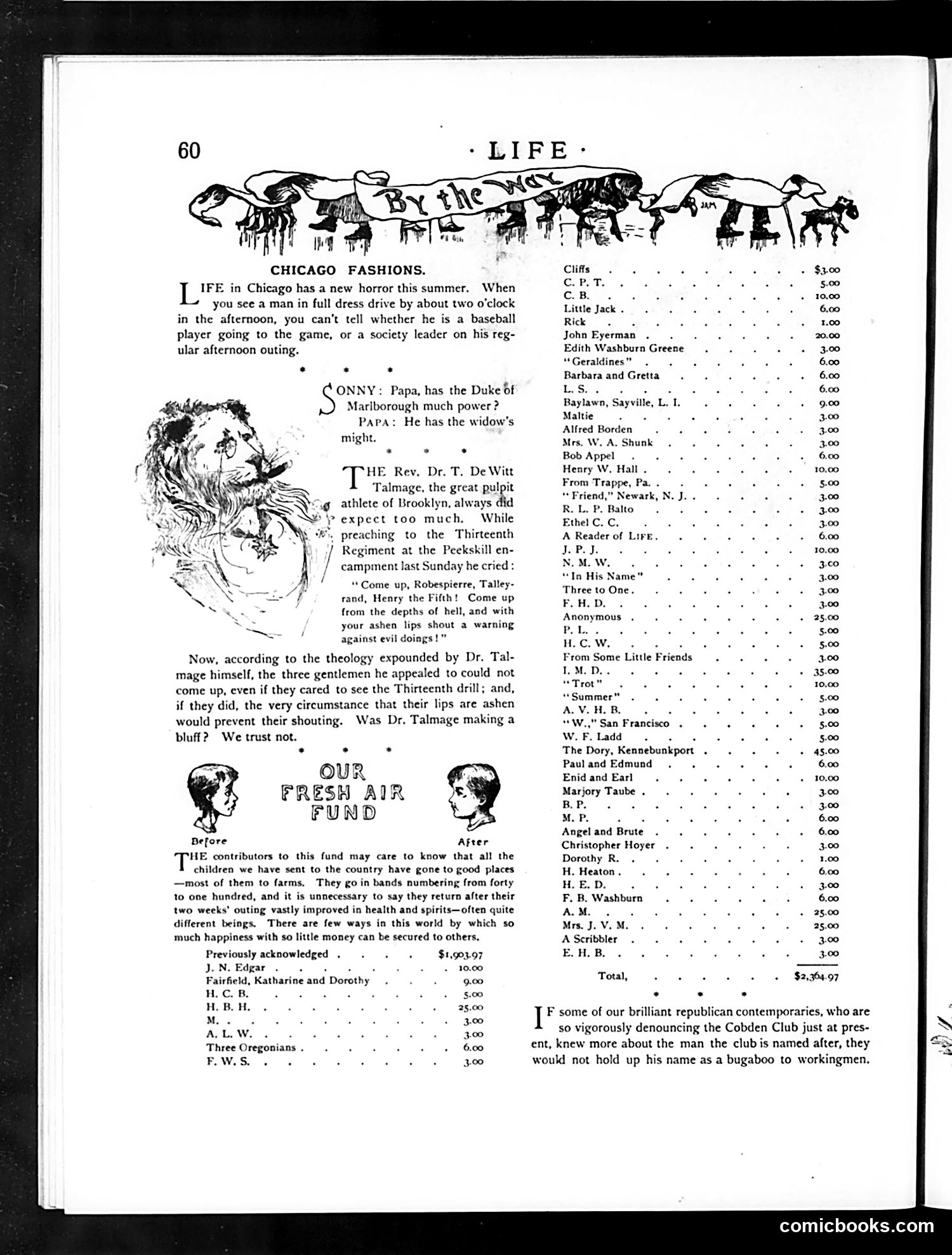
This page contains two main sections: **"Chicago Fashions"** satirizes summer dress codes in Chicago. The satirical dialogue mocks the impracticality of formal attire in summer heat—a man can't tell if someone in full dress is attending a baseball game or a society event at 2 PM. **"Our Fresh Air Fund"** documents charitable donations for sending urban children to the countryside for health benefits. The list shows contributions ranging from $0.60 to $25.00 from various donors and organizations. The caricatured head sketch appears unrelated to the text directly below it. The page primarily functions as a humor column with charitable fundraising information rather than political satire. The humor targets social conventions and Chicago's summer weather rather than specific political figures or events.
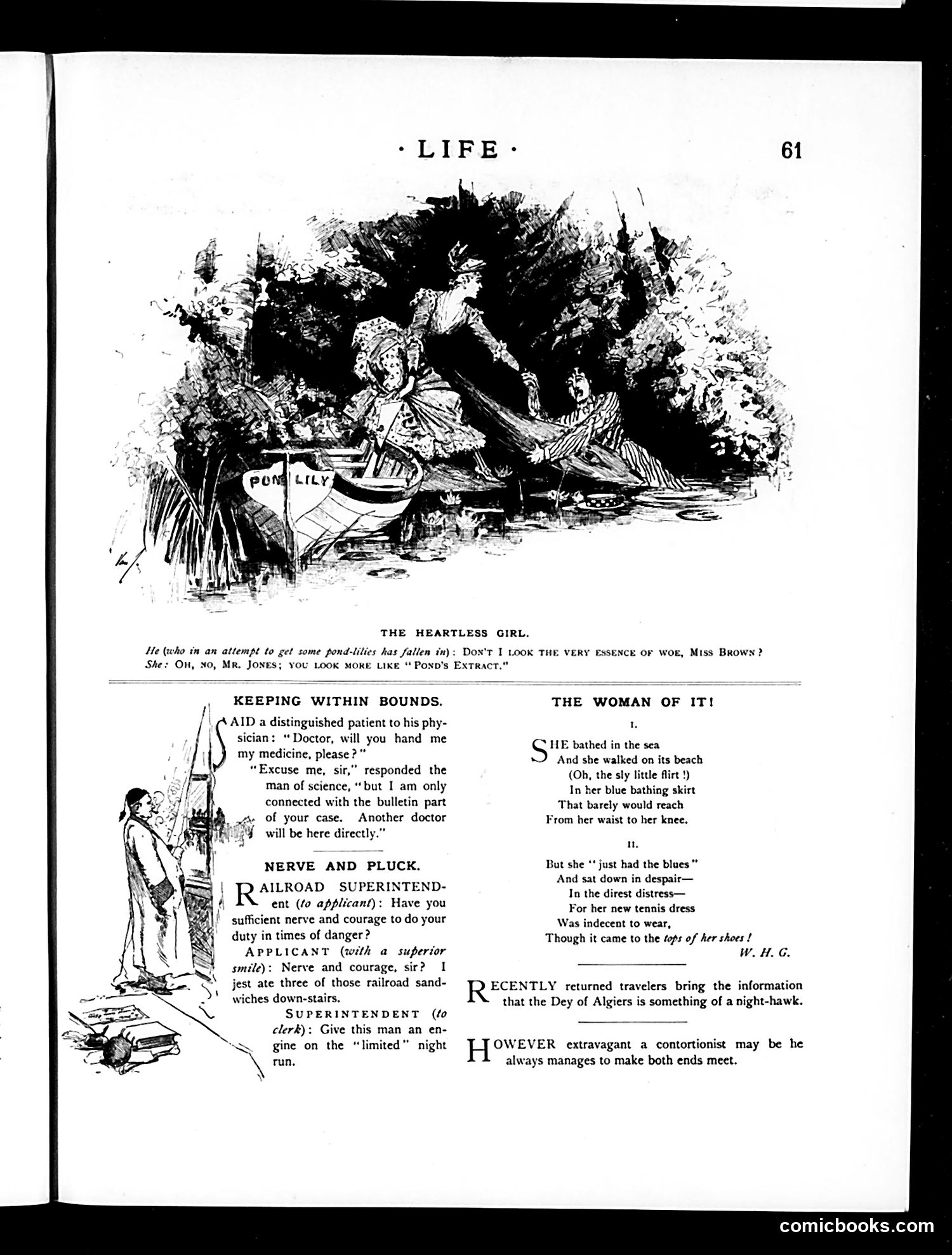
**"The Heartless Girl"** cartoon shows a woman in a boat labeled "POND LILY" with a man who has fallen in. The joke references Pond's Extract, a popular patent medicine of the era. The man asks if she looks like "woe" while she responds she looks more like "Pond's Extract"—a pun suggesting her composure is unnaturally perfect despite his predicament. The remaining page contains humorous dialogues ("Keeping Within Bounds," "Nerve and Pluck") and a poem "The Woman of It!" about a woman in a bathing suit concerned only about her shoes getting wet. These are typical early-20th-century Life magazine fare: light social satire targeting consumer products, gender relations, and fashion vanity, with no apparent political content.
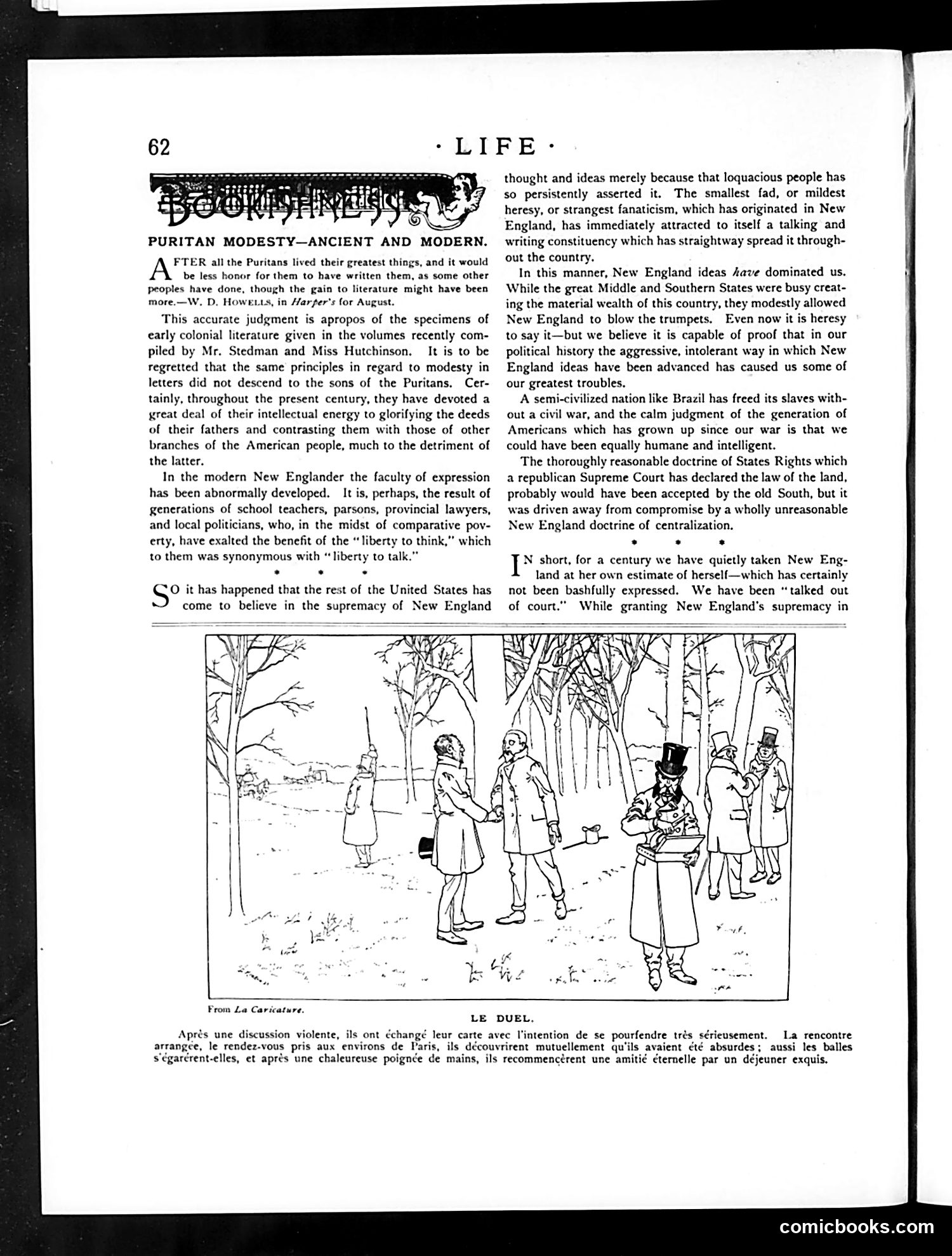
This cartoon from *Life* magazine satirizes a formal duel taking place in a wooded setting. The image shows two men in top hats and formal coats facing off while onlookers observe—a scene depicting what appears to be a gentlemanly dispute resolved through violence. The accompanying article discusses Puritan modesty and New England's intellectual influence on American politics and culture. The caption references "La Caricature," a French satirical publication, suggesting this cartoon critiques dueling as an outdated, European-style method of settling disputes—particularly relevant to American audiences who prided themselves on rational, civilized governance rather than aristocratic violence. The satire likely mocks the absurdity of educated men resorting to such barbaric practices.
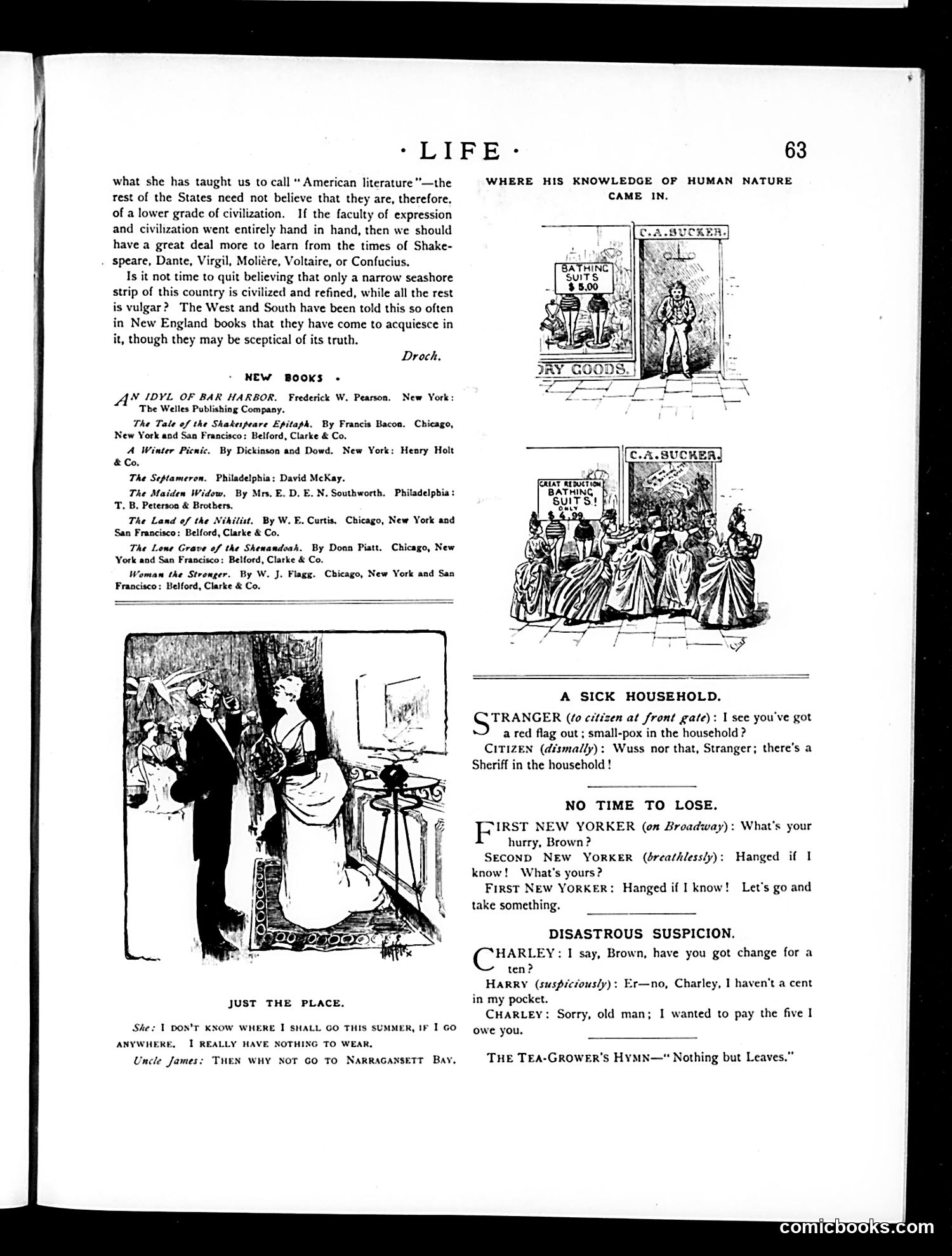
This page contains several brief satirical dialogues and illustrations typical of Life's humor section. **"A Sick Household"** jokes about a quarantined home with smallpox—the citizen claims a "Sheriff in the household" rather than acknowledging the disease. **"No Time to Lose"** depicts two New Yorkers rushing to steal something, using "hanged" as dark humor about their criminal intentions. **"Disastrous Suspicion"** presents a misunderstanding where Harry hasn't a cent in his pocket, making Charley suspicious he's being cheated out of five dollars owed. **"Just the Place"** shows a woman and Uncle James joking about needing a summer wardrobe—she suggests Narragansett Bay (implying swimming/minimal clothing). The bottom section advertises new books, listing titles and publishers. The cartoons are simple line drawings typical of early 20th-century satirical magazines.
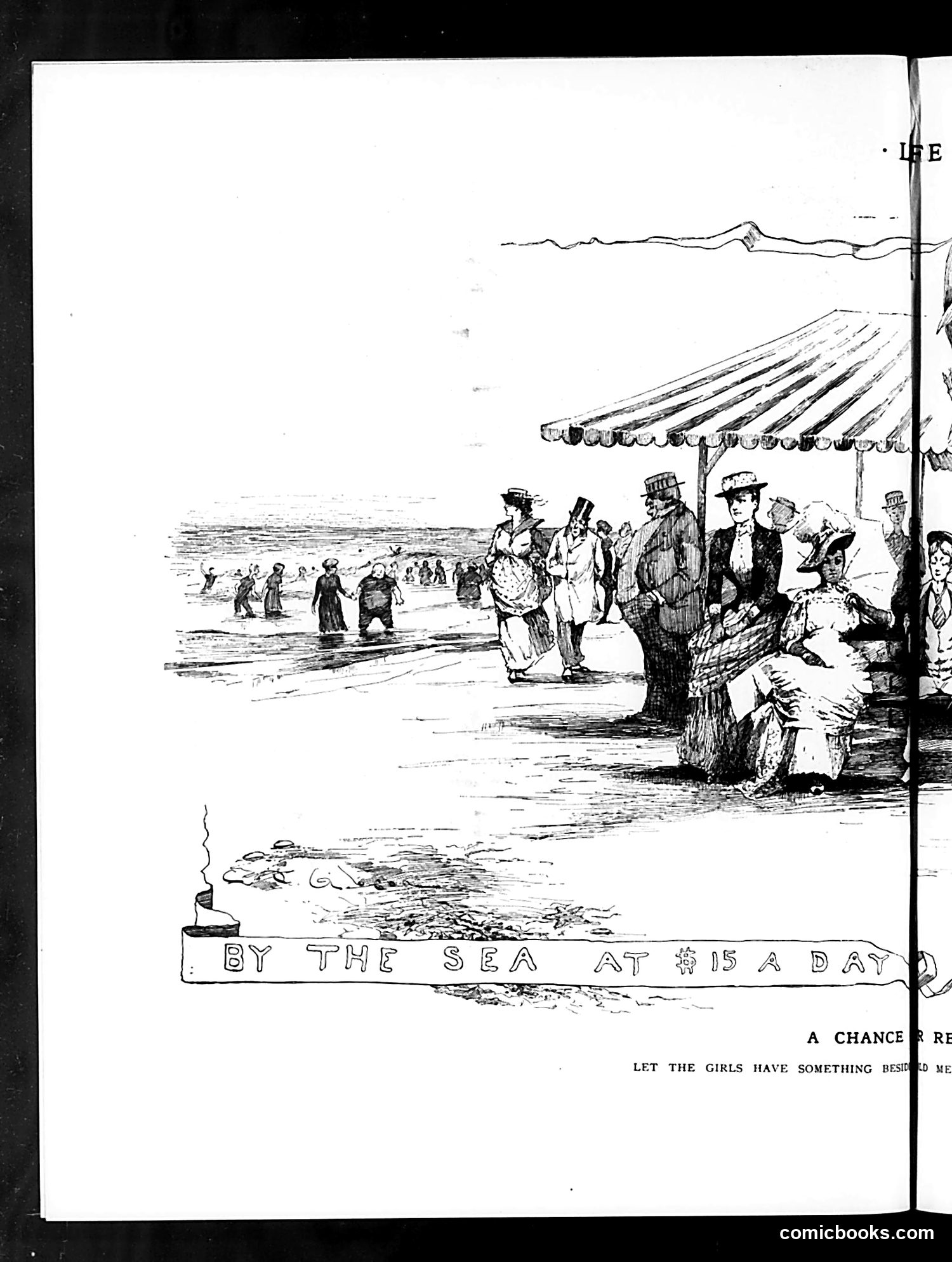
This appears to be a satirical illustration about beach vacation costs in early 20th-century America. The caption "BY THE SEA AT $15 A DAY" and partial text "A CHANCE / LEFT THE GIRLS HAVE SOMETHING BESIDE ME" suggest commentary on the expense of seaside leisure. The sketch depicts well-dressed Victorian/Edwardian-era figures under a beach pavilion or tent, with swimmers visible in the water and crowds on the shore. The satire likely mocks either: - The high cost of fashionable beach resorts for middle-class families - The conspicuous consumption and social posturing of beachgoers - Gender dynamics regarding vacation expenses The specific figures are unclear, but the formal dress and crowded conditions emphasize the commercialized nature of leisure activities during this period.
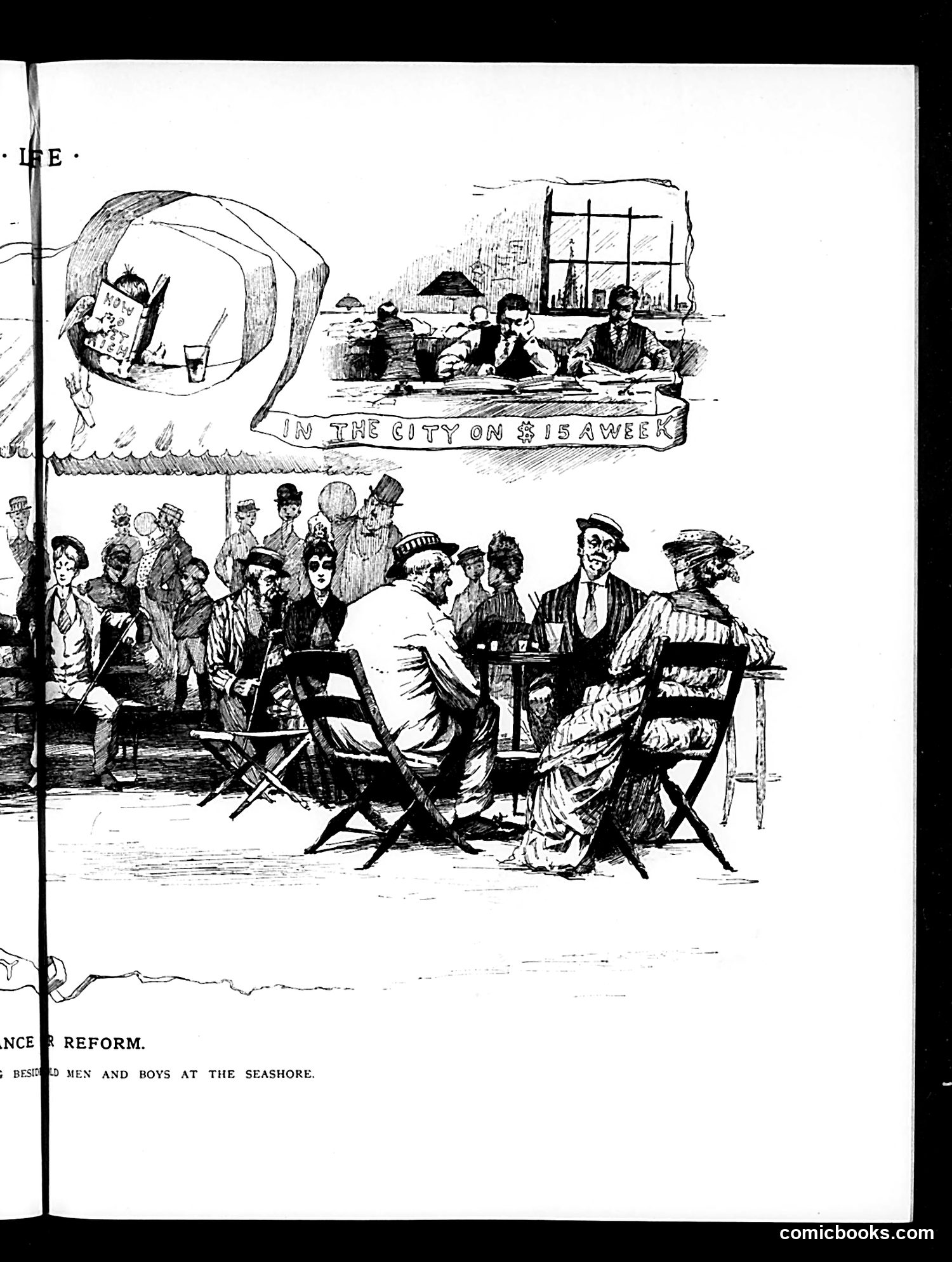
This page depicts social reform efforts targeting destitute urban populations. The top panel shows "In the City on $15 a Week"—satirizing the impossibility of surviving on minimal wages while officials discuss poverty indoors. The lower panel illustrates "Rescue Reform" efforts at the seashore, where well-dressed philanthropists and charity workers interact with poorly dressed men and boys. The satire critiques the gap between reform rhetoric and reality: wealthy reformers conduct charitable activities as observers while the poor remain dependent on charity rather than receiving fair wages or structural change. The cartoon suggests that seaside "rescue" programs are performative gestures that don't address root economic problems—people cannot actually live on $15 weekly, no matter how much charity they receive.
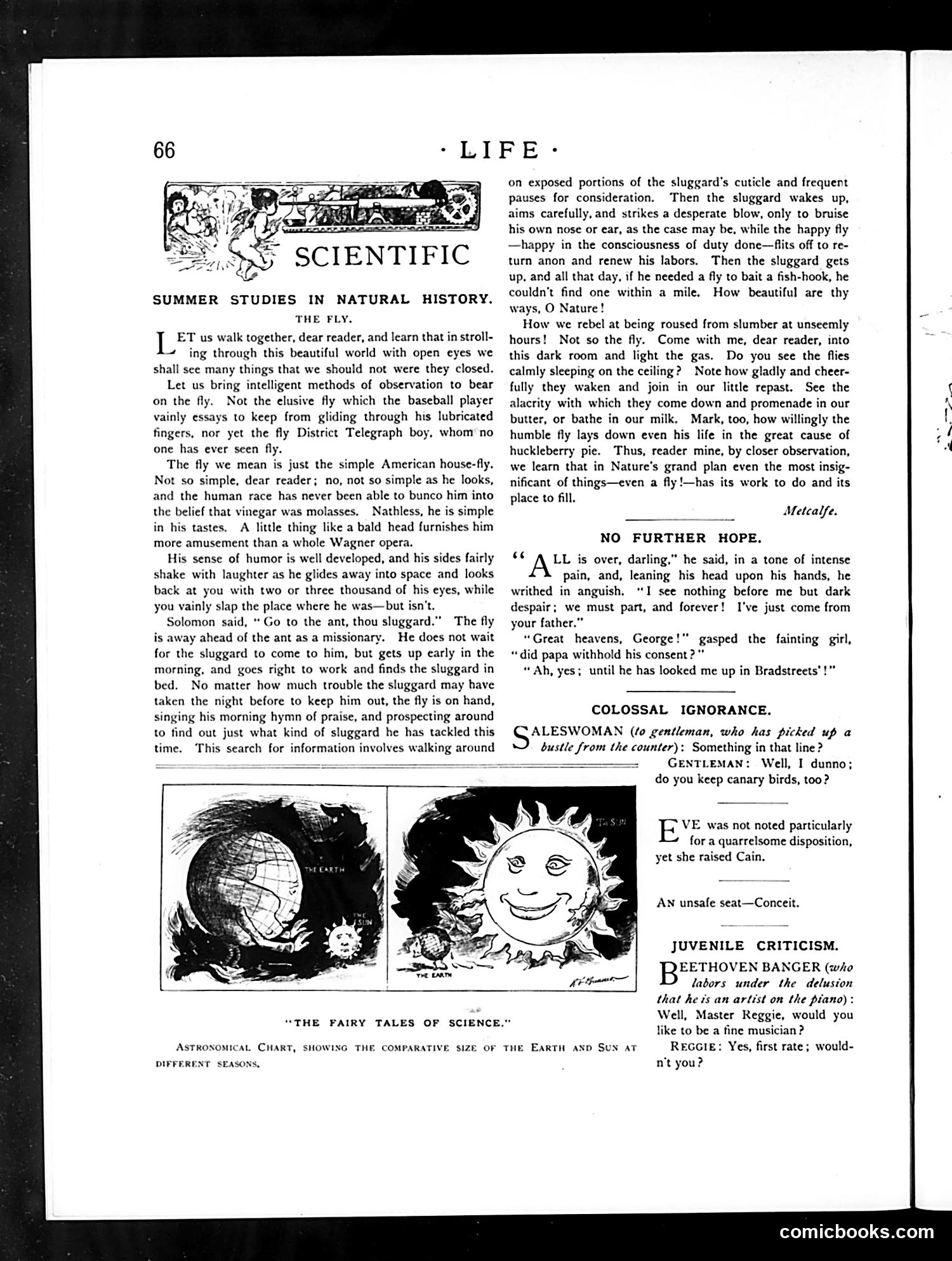
This page contains three distinct satirical sections: 1. **"Summer Studies in Natural History: The Fly"** — A lengthy essay humorously elevating the common housefly to serious scientific study, mocking both grandiose natural philosophy and human pretension by finding profound lessons in insect behavior. 2. **"The Fairy Tales of Science"** — An illustration captioned with an astronomical chart showing Earth and Sun at different seasons, likely satirizing how science popularization oversimplifies or romanticizes complex phenomena. 3. **Short joke sections** ("No Further Hope," "Colossal Ignorance," "Juvenile Criticism") — Brief comedic dialogues poking fun at specific character types: distressed lovers, ignorant socialites, and precocious children. These represent typical Life magazine humor conventions of the era. The overall effect mocks both scientific pretension and social pretentiousness through witty wordplay and gentle ridicule.
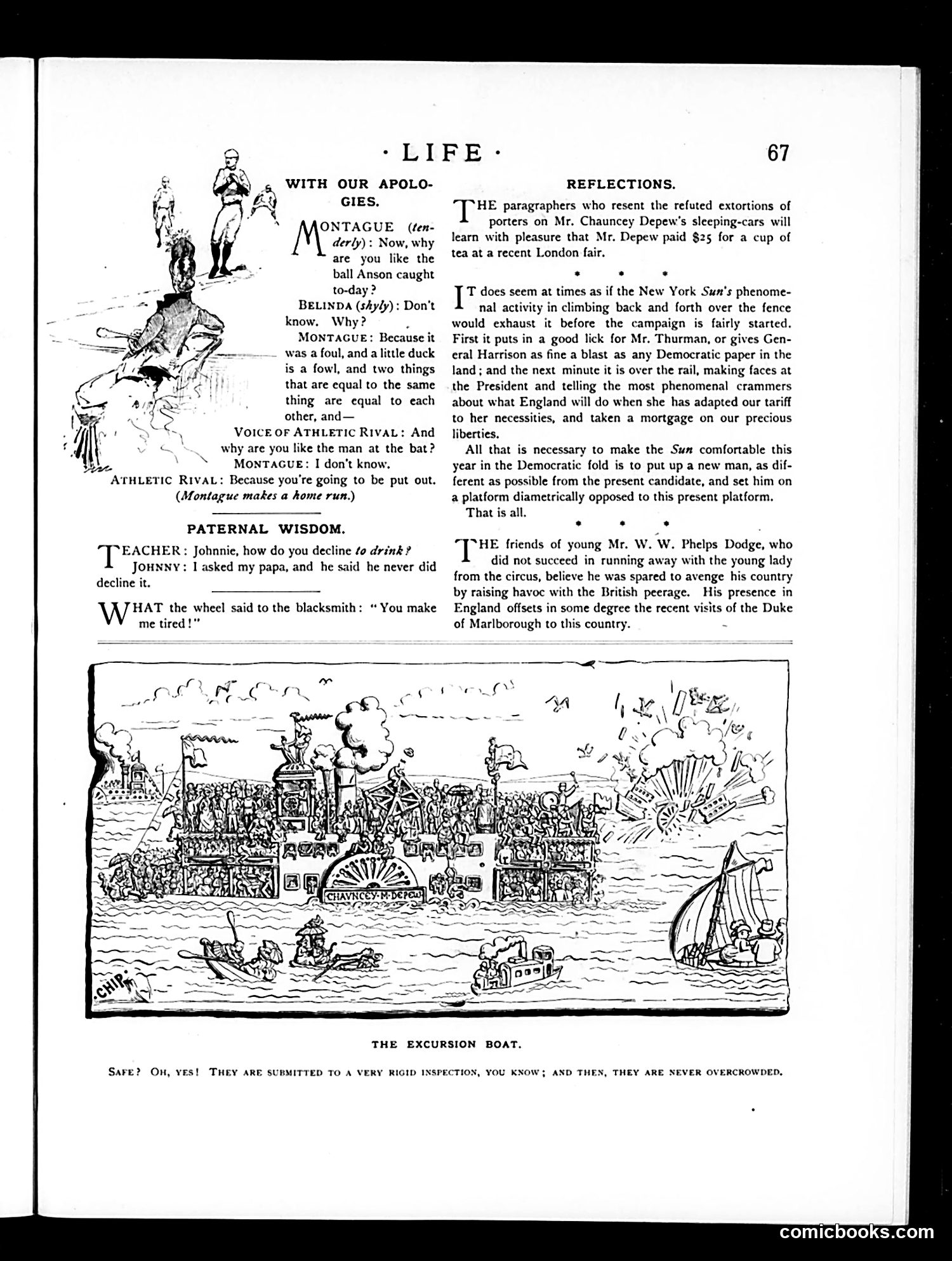
This page contains three distinct satirical pieces: **The Montague/Belinda dialogue** jokes about a clumsy romantic line—a young man attempts logic-based wordplay to impress a woman, then gets interrupted by a rival who threatens to "put him out" (baseball imagery). The humor lies in the overwrought reasoning for a simple flirtation. **"Paternal Wisdom"** is a joke about alcohol: a father claims he never "declines" drinking—meaning he never refuses it, turning a grammar lesson into commentary on his drinking habits. **The Reflections section** contains political commentary referencing 1888 election figures (Chauncey Depew, General Harrison, Thurman) and criticizes the New York Sun's inconsistent editorial positions, calling it unprincipled and willing to abandon its Democratic candidate if a better option appeared. **The Excursion Boat illustration** satirizes safety claims about crowded pleasure boats, with the caption ironically asserting they're "never overcrowded" despite the clearly packed vessel depicted. The overall tone mocks contemporary politics, romance conventions, and public safety hypocrisy.
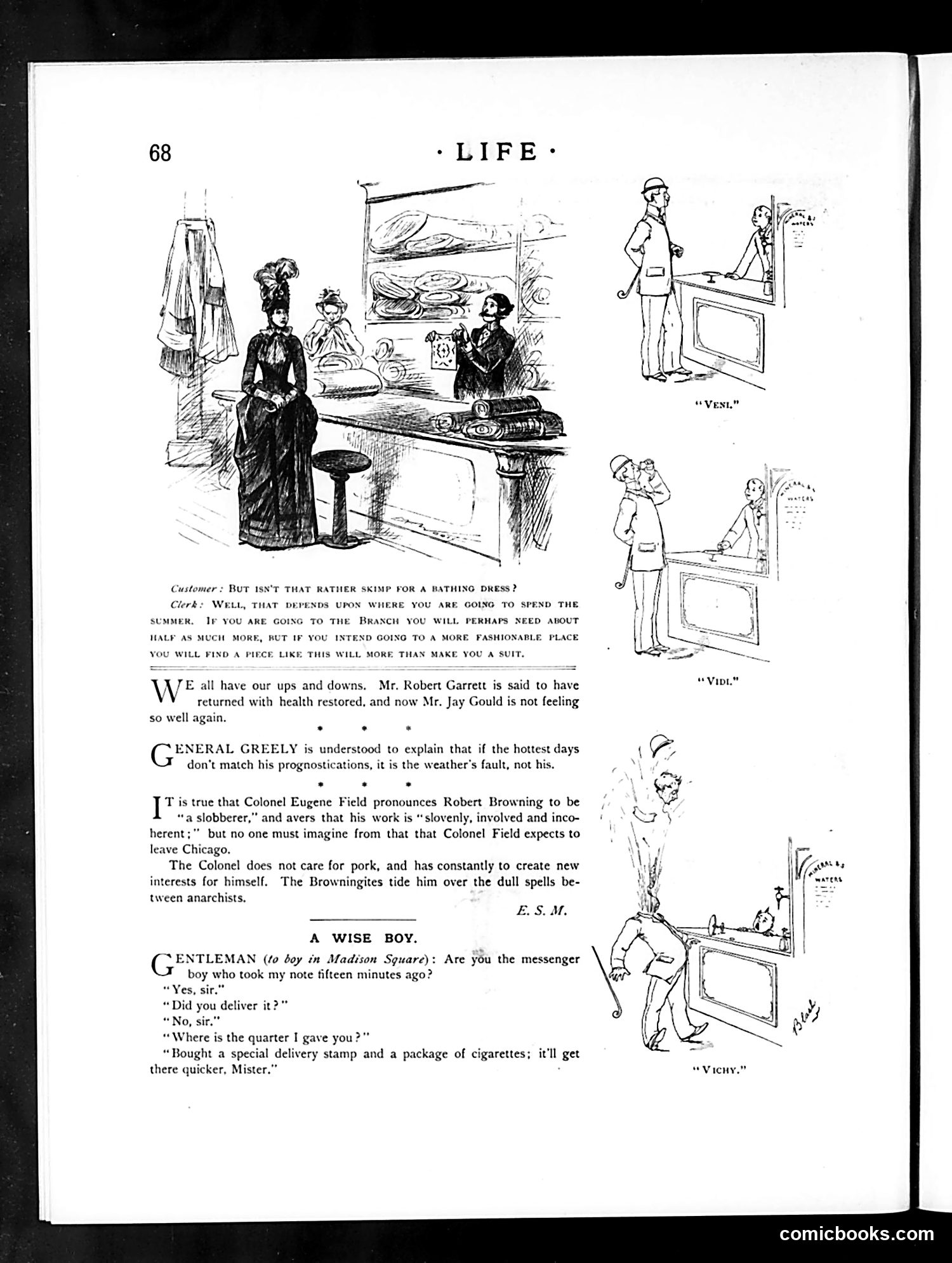
This page contains several satirical short pieces typical of Life's humor format: **Main cartoon**: A shop clerk sells a woman an absurdly tiny bathing dress, justifying the skimpiness by noting that fashionable resort areas require less fabric than modest destinations—satirizing how beachwear standards varied by social class and location. **Brief gossip items** mock contemporary figures: Robert Garrett (likely the wealthy railroad heir), Jay Gould (the notorious industrialist), General Greely (Arctic explorer), and Colonel Eugene Field (Chicago literary figure) for various pretensions or contradictions. **"A Wise Boy" joke**: A messenger boy admits he spent the sender's quarter on cigarettes and delivery stamps instead of delivering the note, claiming this speeds delivery—absurd logic that satirizes youthful con-artistry. The page represents Life's signature blend of visual and textual satire targeting wealth, vanity, and social pretension among the Gilded Age elite and urban middle class.
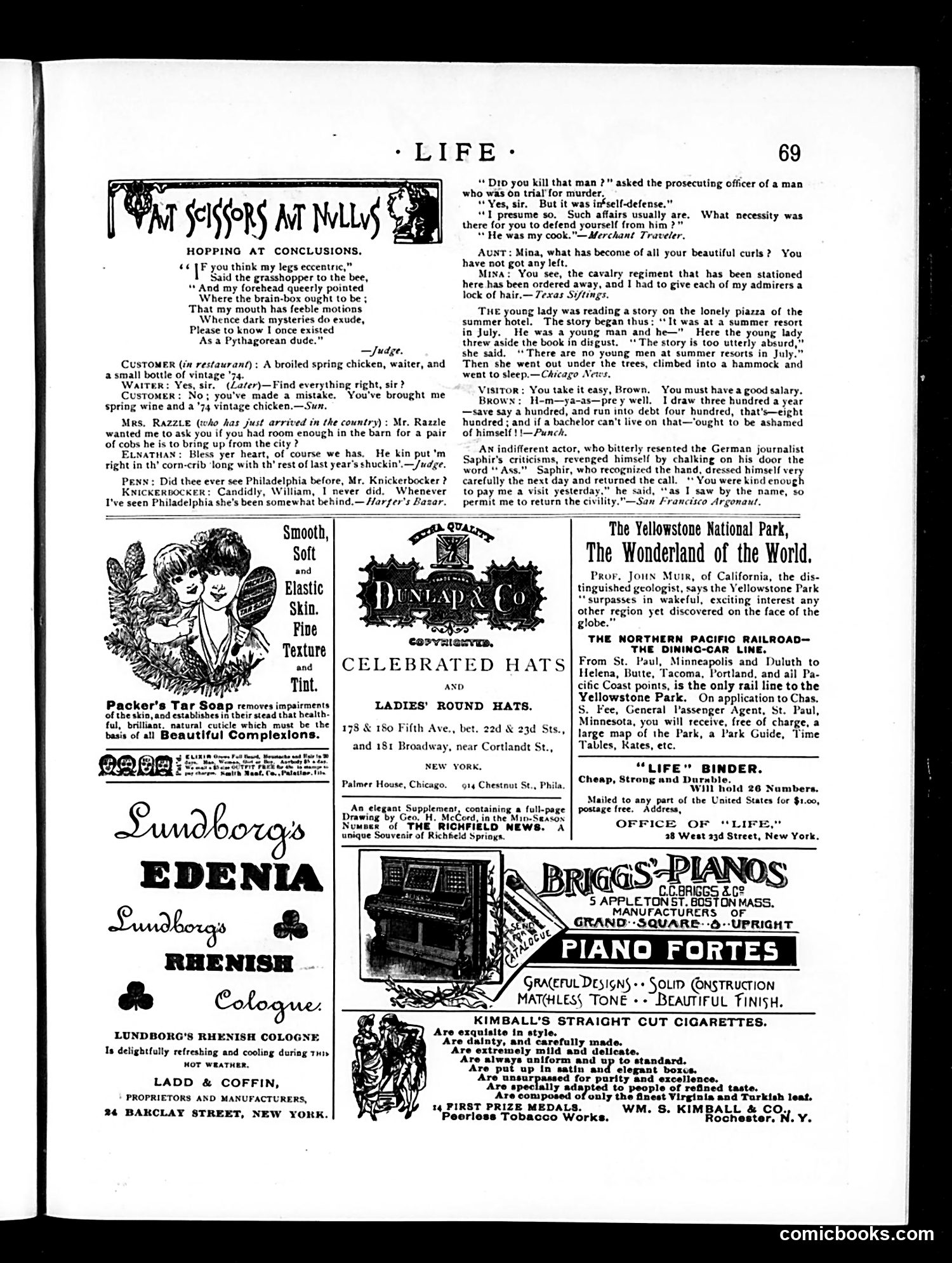
This page is primarily **advertising with scattered humor items** rather than political cartoons. The main content consists of brief joke columns typical of the era's satirical magazines. The humor pieces are light social satire: a grasshopper justifying its odd appearance by claiming past-life reincarnation; restaurant and rural mishaps involving mistaken orders; and observations about courtship and human nature. One notable item jokes that a young woman at a summer resort abandons a romantic novel as unrealistic because "there are no young men at summer resorts in July"—poking fun at the social segregation of leisure activities. The page's bulk consists of **product advertisements**: Packer's Tar Soap (promising beautiful skin), Lundborg's cologne and perfume, celebrated hats, Briggs pianos, and Kimball cigarettes. There's also promotional material for Yellowstone National Park and a Northern Pacific Railroad dining car service. The cartoons and jokes reflect everyday American social anxieties and absurdities circa 1890s rather than specific political events. No identifiable political figures or major historical references appear.
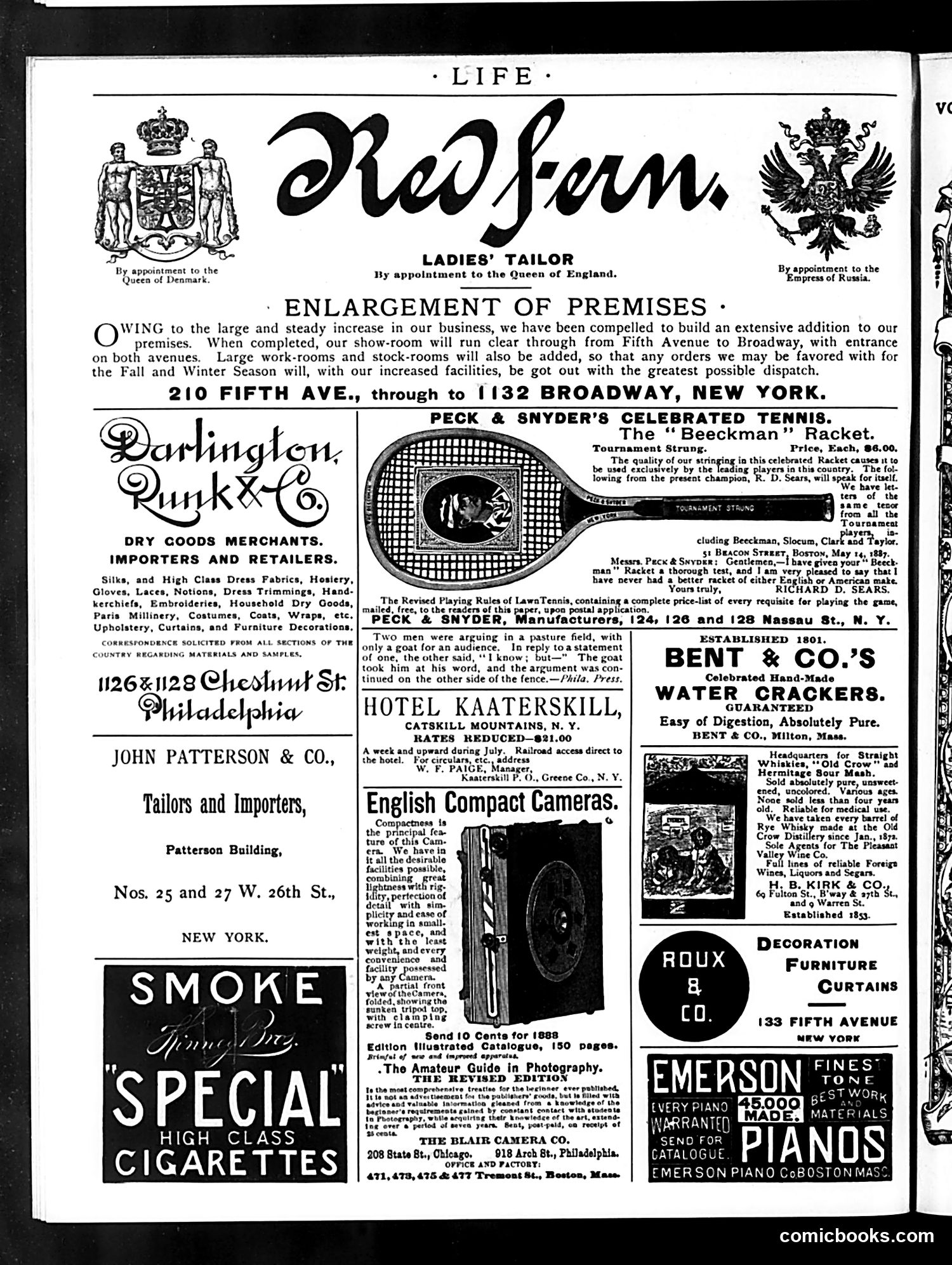
This page is primarily **advertising**, not satirical content. The dominant feature is Red Fern's announcement of their ladies' tailoring business expansion from Fifth Avenue to Broadway in New York. The only potential cartoon/satire appears to be a brief joke about **two men arguing in a pasture field with only a goat as audience**. When one man says "I know; but—" the goat interrupts him, and "the argument was continued on the other side of the fence." This is a mild pun: the goat literally "butted in" (a play on "but"). The humor relies on the double meaning of "butt" (headbutt) and the interruption phrase. The rest of the page consists of advertisements for dry goods merchants, tailors, cameras, tennis rackets, whiskey, crackers, pianos, and furniture—typical commercial content for a magazine of this era (circa 1880s-90s based on design and references).