
Life, 1888-08-02 · page 2 of 14
Life — August 2, 1888 — page 2: what you’re looking at
What you’re looking at
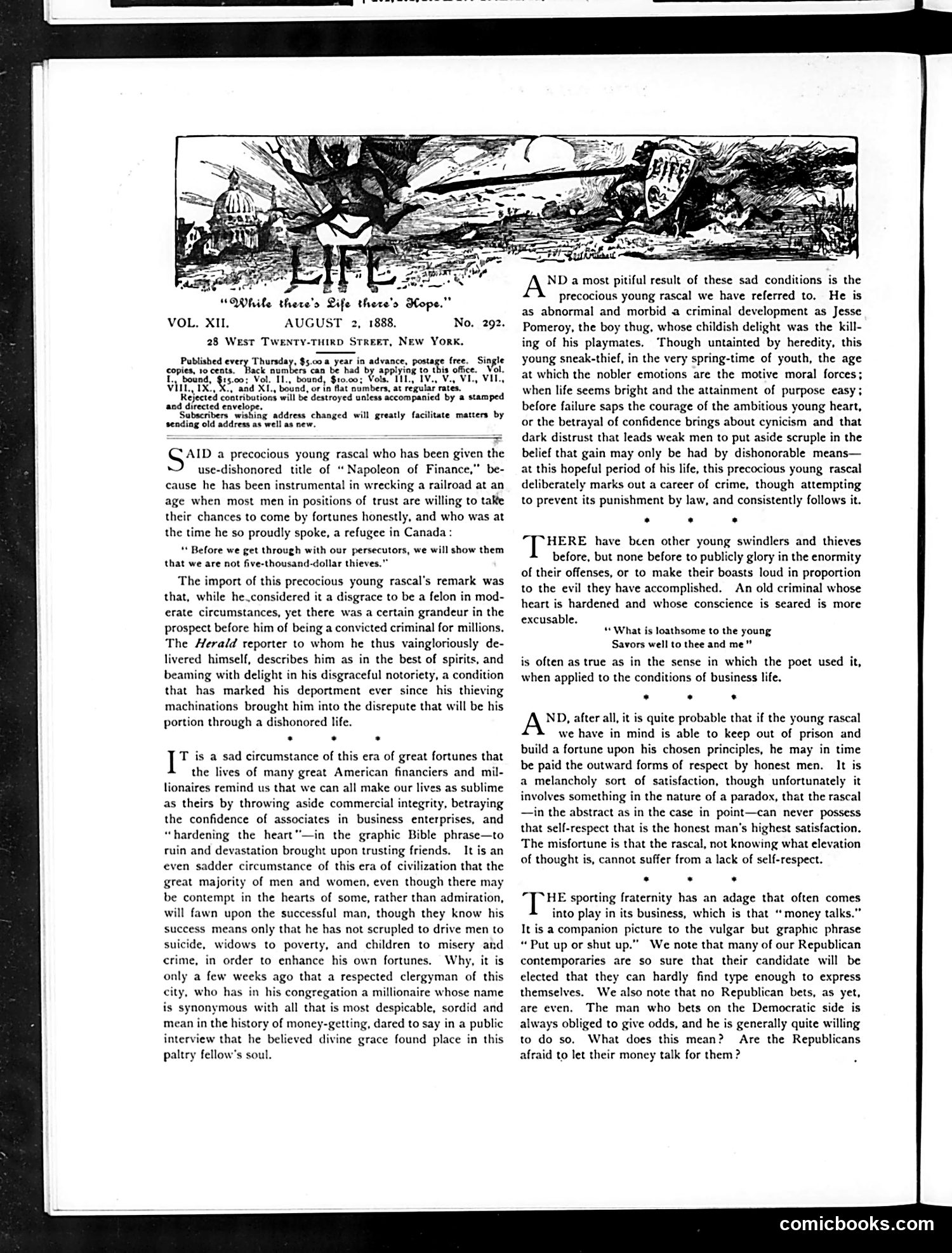
The page contains an editorial essay titled "LIFE" criticizing a young criminal called a "rascal" who committed railroad sabotage and theft. The text discusses broader concerns about wealthy financiers and businessmen who betray public trust through dishonest practices, comparing their moral corruption to that of common criminals. The editorial also critiques "the sporting fraternity" and political betting practices, suggesting Republicans and Democrats both engage in wagering on election outcomes. The author questions whether wealthy elites truly deserve public respect when their business methods involve deception and exploitation. The illustration at the top appears decorative rather than directly illustrating specific figures. This is primarily a moral/political commentary on class hypocrisy and business ethics during the Gilded Age.
📄 Transcribed text from this page (OCR, searchable)
Machine-transcribed from the original scan — historical spelling and the odd misread are preserved.
VOL. XII. AUGUST 2, 1888. No. 292. 28 West TWENTY-THIRD STREET, New York. Published every Thursday, $5.00. year in advance, postage free. Single copies, ro cents. Back numbers can be had by applying to this office. Vol. L., bound, $15.00; Vol. I1., bound, $10.00; Vols. IIL, IV., V., VI, VIL, VIL, 1X!, X.. and XI., bound, or in fat numbers, at regular rates. Rejected contributions will be destroyed unless accompanied by a stamped and directed envelope. Subscribers wishing address changed will greatly facilitate matters by sending old address as well as new. SAP a precocious young rascal who has been given the use-dishonored title of “Napoleon of Finance,” be- cause he has been instrumental in wrecking a railroad at an age when most men in positions of trust are willing to take their chances to come by fortunes honestly, and who was at the time he so proudly spoke, a refugee in Canada : " Before we get through with our persecutors, we will show them that we are not five-thousand-dollar thieves.” The import of this precocious young rascal’s remark was that, while he.considered it a disgrace to be a felon in mod- erate circumstances, yet there was a certain grandeur in the prospect before him of being a convicted criminal for millions. The Herald reporter to whom he thus vaingloriously de- livered himself, describes him as in the best of spirits, and beaming with delight in his disgraceful notoriety, a condition that has marked his deportment ever since his thieving machinations brought him into the disrepute that will be his portion through a dishonored life. . . . T is a sad circumstance of this era of great fortunes that the lives of many great American financiers and mil- lionaires remind us that we can all make our lives as sublime as theirs by throwing aside commercial integrity, betraying the confidence of associates in business enterprises, and “hardening the heart"—in the graphic Bible phrase—to ruin and devastation brought upon trusting friends. It is an even sadder circumstance of this era of civilization that the great majority of men and women, even though there may be contempt in the hearts of some, rather than admiration, will fawn upon the successful man, though they know his success means only that he has not scrupled to drive men to suicide, widows to poverty, and children to misery and crime, in order to enhance his own fortunes. Why, it is only a few weeks ago that a respected clergyman of this city, who has in his congregation a millionaire whose name nonymous with all that is most despicable, sordid and mean in the history of money-getting, dared to say in a public interview that he believed divine grace found place in this paltry fellow’s soul. Aw a most pitiful result of these sad conditions is the precocious young rascal we have referred to. He is as abnormal and morbid a criminal development as Jesse Pomeroy, the boy thug, whose childish delight was the kill- ing of his playmates, Though untainted by heredity, this young sneak-thief, in the very spring-time of youth, the age at which the nobler emotions are the motive moral forces; when life seems bright and the attainment of purpose easy; before failure saps the courage of the ambitious young heart, or the betrayal of confidence brings about cynicism and that dark distrust that leads weak men to put aside scruple in the belief that gain may only be had by dishonorable means— at this hopeful period of his life, this precocious young rascal deliberately marks out a career of crime, though attempting to prevent its punishment by law, and consistently follows it. . . . “T HERE have been other young swindlers and thieves before, but none before to publicly glory in the enormity of their offenses, or to make their boasts loud in proportion to the evil they have accomplished. An old criminal whose heart is hardened and whose conscience is seared is more excusable. “What is loathsome to the young Savors well to thee and me” is often as true as in the sense in which the poet used it, when applied to the conditions of business life. . . . D, after all, it is quite probable that if the young rascal we have in mind is able to keep out of prison and build a fortune upon his chosen principles, he may in time be paid the outward forms of respect by honest men. It is a melancholy sort of satisfaction, though unfortunately it involves something in the nature of a paradox, that the rascal —in the abstract as in the case in point—can never possess that self-respect that is the honest man’s highest satisfaction. The misfortune is that the rascal, not knowing what elevation of thought is, cannot suffer from a lack of self-respect. "THE sporting fraternity has an adage that often comes into play in its business, which is that “ money talk: It is a companion picture to the vulgar but graphic phrase “ Put up or shut up.” We note that many of our Republican contemporaries are so sure that their candidate will be elected that they can hardly find type enough to express themselves. We also note that no Republican bets, as yet, are even. The man who bets on the Democratic side is always obliged to give odds, and he is generally quite willing to do so. What does this mean? Are the Republicans afraid to let their money talk for them? comicbooks.com