
A complete issue · 16 pages · 1888
Life — February 2, 1888
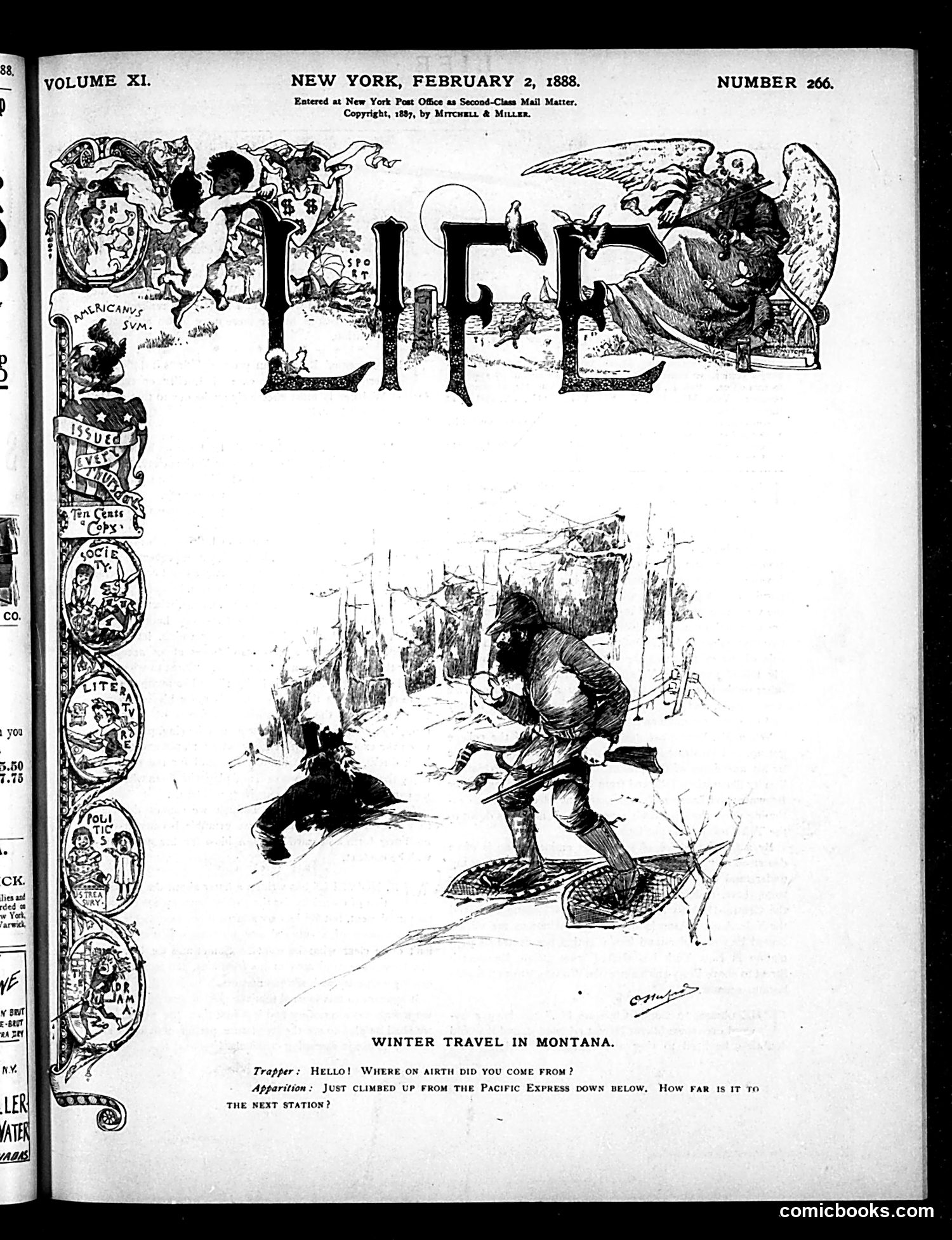
This cartoon satirizes the hardships of winter travel in Montana during the 1880s. The illustration shows a man who has apparently fallen from a train, crawling through deep snow toward a distant station. The dialogue reveals the joke: A trapper asks the arrival "Where on earth did you come from?" The man responds that he "just climbed up from the Pacific Express down below"—implying the train derailed or he fell from it—and asks how far to the next station. The satire mocks the dangerous, inadequate railroad service and brutal winter conditions in Montana at that time. The cartoon portrays frontier travel as comically perilous, with passengers literally crawling through snowdrifts between distant stations.
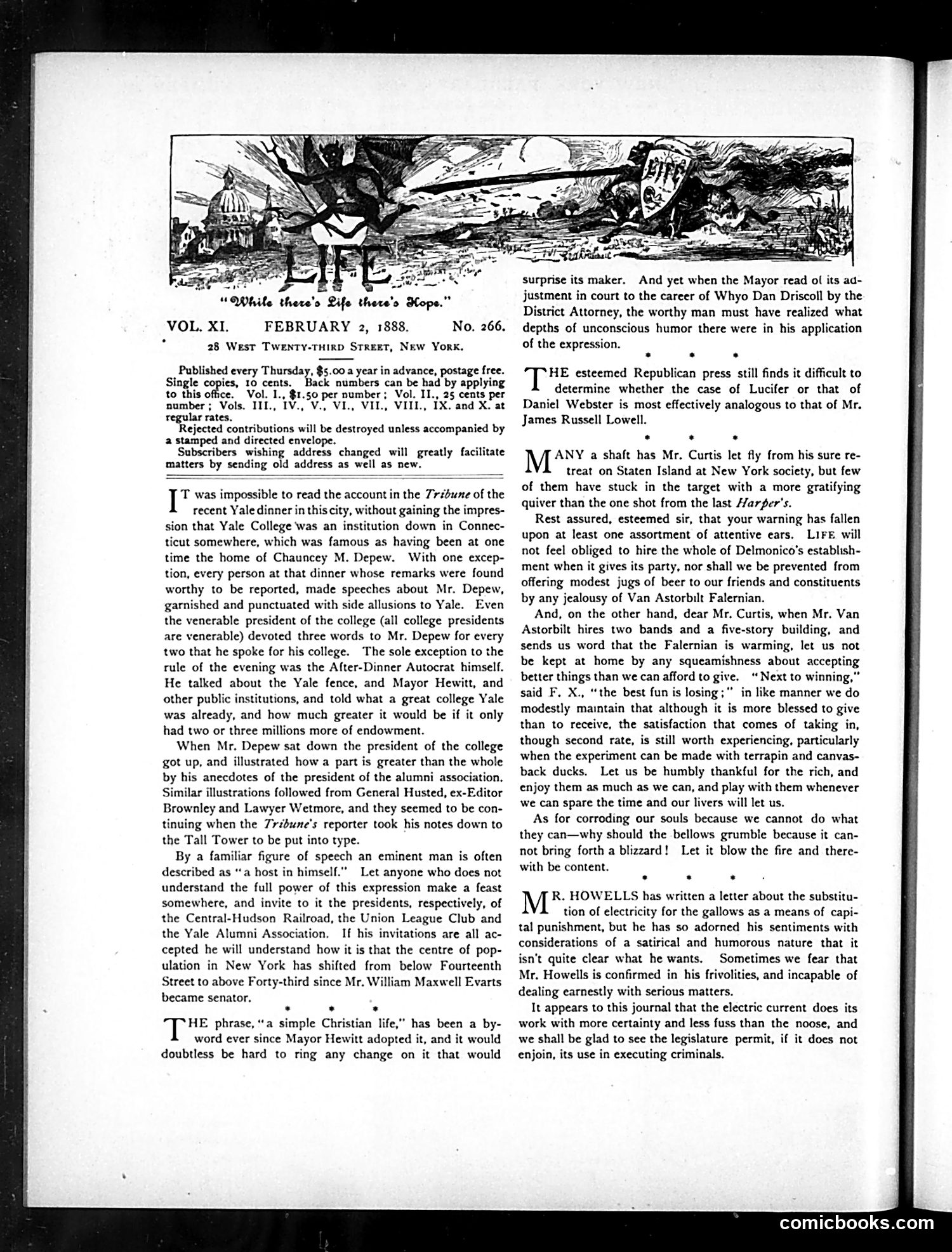
The masthead cartoon depicts a figure in formal dress seated beneath a large tree, with a cityscape and moon in the background. The accompanying text references Yale College, Mayor Hewitt, and a recent Yale dinner in New York, discussing remarks made by college President (whose name appears garbled in OCR). The satire critiques a phrase adopted by Mayor Hewitt: "a simple Christian life." The editors mock how this expression, while noble-sounding, has become so overused that it's lost meaning—likening it to a "host in himself," suggesting anyone claiming to live such a life should prove it through substantive action rather than mere words. The cartoon appears to illustrate this theme of empty rhetoric versus authentic living, though the specific figure remains unclear from the image alone.
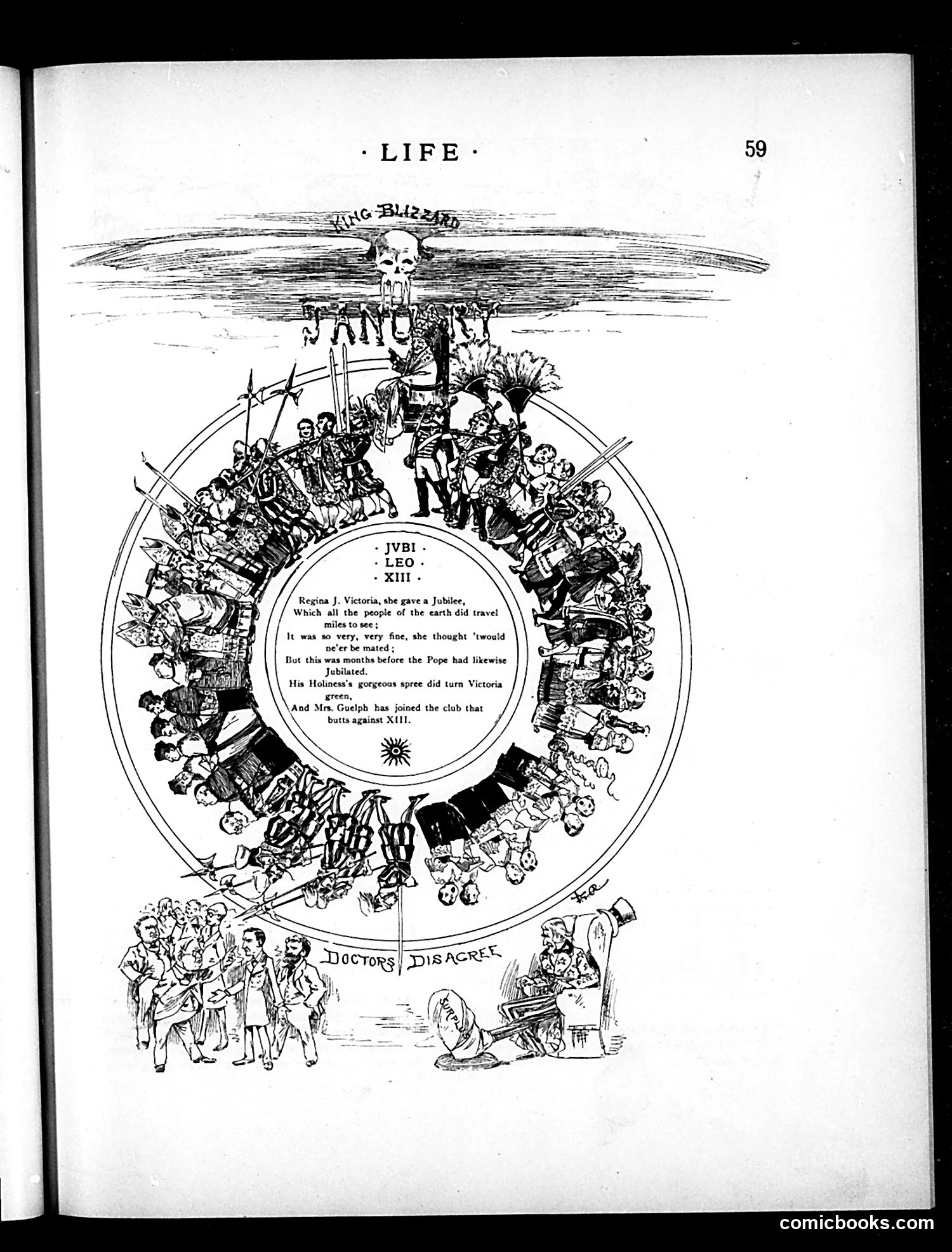
This satirical illustration depicts a circular zodiac-style arrangement of figures surrounding a central text about Queen Victoria's Jubilee celebration. The page references a major historical event where Victoria held a jubilee "which all the people of the earth did travel miles to see." The text mentions the Pope had recently made a similar jubilee announcement, and notes that "Mrs. Guelph has joined the club that butts against XIII" (Roman numeral 13, likely referring to Pope Leo XIII). The circular composition arranges various social types and celebrities around this central event, with "Doctors Disagree" captioned at the bottom—suggesting satirical commentary on public reaction to Victoria's celebration. The dense, intricate cartooning style was typical of Life's detailed political satire of the 1890s.
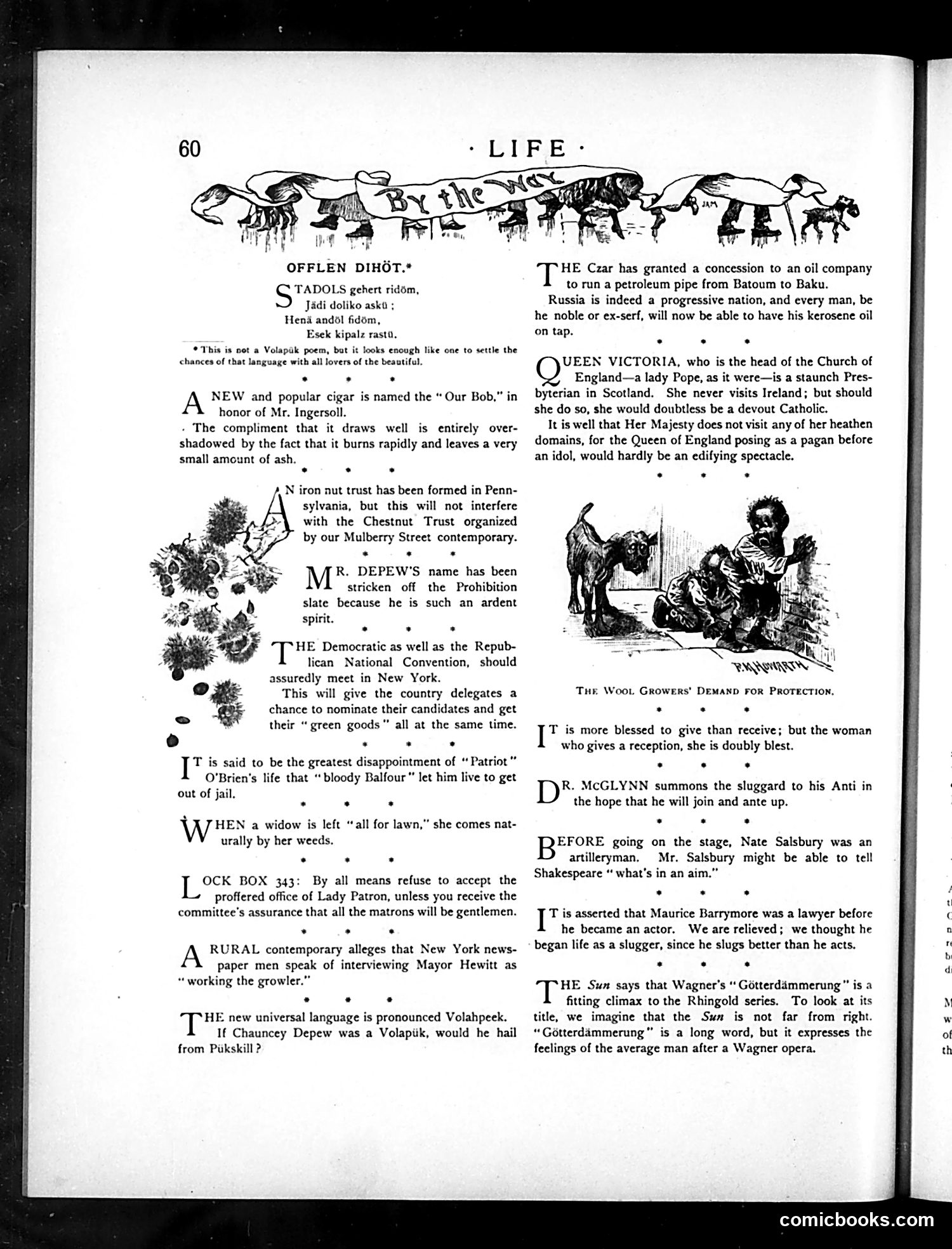
This page contains satirical commentary rather than political cartoons. The visible illustration depicts "The Wool Growers' Demand for Protection"—showing a goat and figure, likely satirizing agricultural protectionist lobbying. The text snippets mock various contemporary figures and issues: - Queen Victoria's religious sectarianism - A cigar named "Our Bob" - Pennsylvania's iron trust - Prohibitionist "Depew" - Political conventions in New York - An Irish politician named "Patriot" O'Brien - References to actors Maurice Barrymore and Nate Salsbury - Wagner's opera "Götterdämmerung" The page exemplifies Life's approach: sharp, gossipy commentary targeting politicians, clergy, business figures, and entertainers. Without specific dates or clearer context, precise identifications remain uncertain, though the tone consistently mocks pretension and hypocrisy.
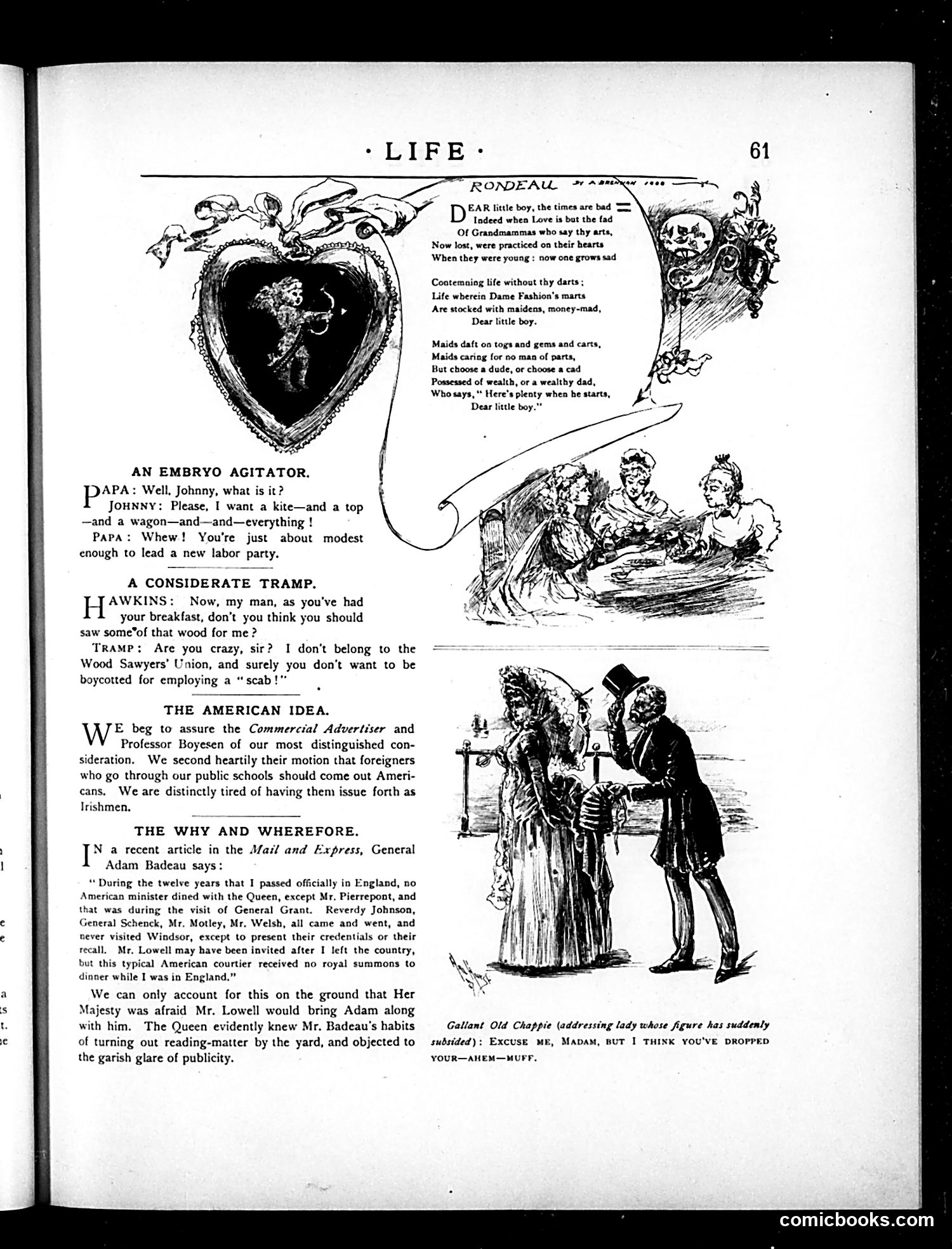
This page contains several satirical pieces: **"An Embryo Agitator"** mocks a child asking his father for toys—a kite, top, wagon—which the father dismisses as insufficient for "a new labor party," suggesting the boy is being groomed as a labor activist. **"A Considerate Tramp"** jokes about union protectionism: a tramp refuses wood from a man because he doesn't belong to the Wood Sawyers' Union and fears being "boycotted for employing a 'scab.'" **"The American Idea"** criticizes foreign-born public school teachers, asserting Americans are "tired of having them issue forth as Irishmen." **"The Why and Wherefore"** references General Adam Badeau's account of American ministers avoiding Queen Victoria during his diplomatic service, attributing this to fears about public criticism. The illustrations satirize labor unions, immigration, and diplomatic propriety circa late 19th century.
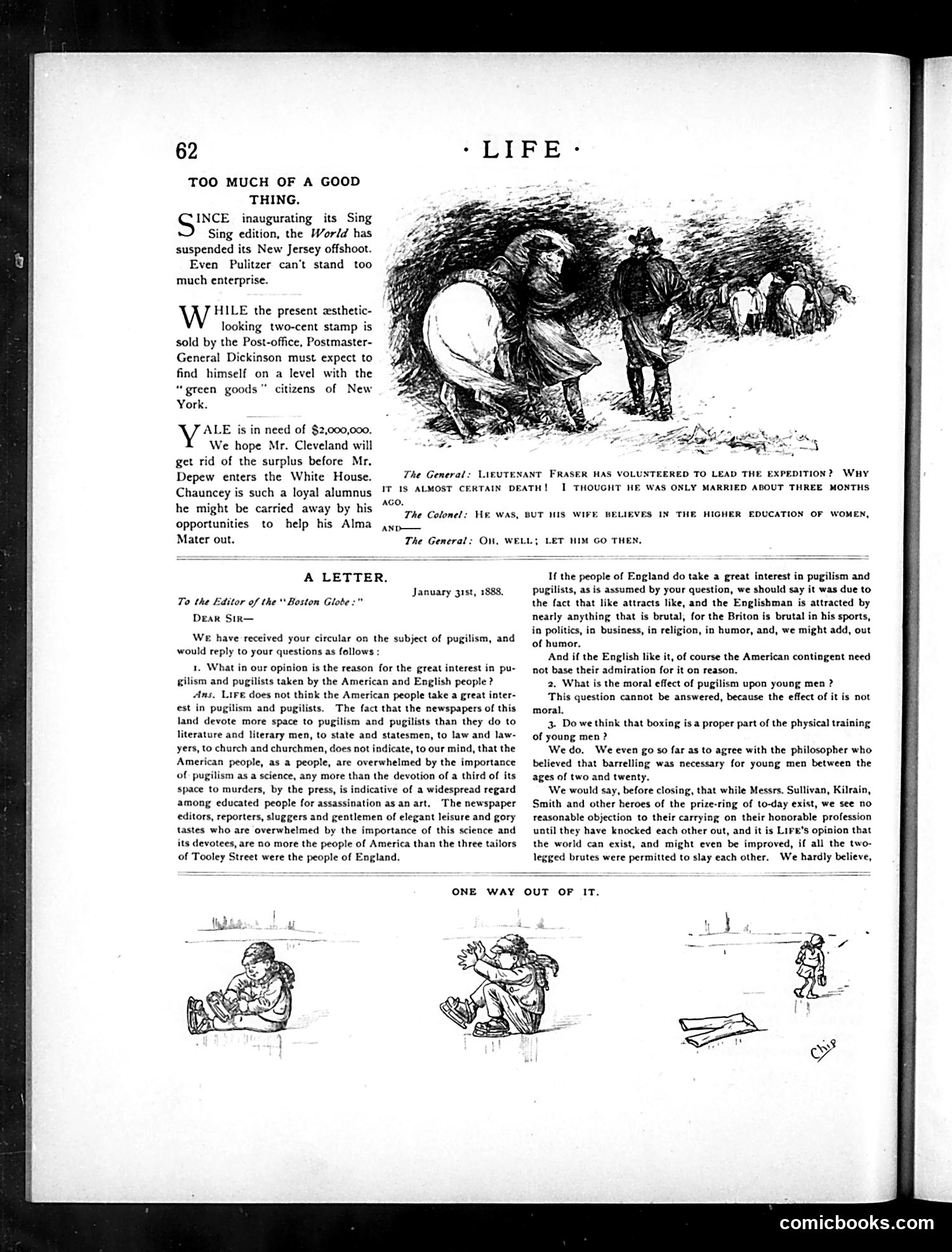
**Top Section ("Too Much of a Good Thing"):** This satirizes the *World* newspaper's excessive coverage of boxing and pugilism. The General and Colonel figures discuss a military expedition, with the General noting a Lieutenant volunteered to lead it—but the Colonel suspects the General only cares about this because he's distracted by reading about boxing. The satire critiques how newspapers devoted disproportionate space to pugilism over serious issues. **Letter Section:** A Boston Globe reader asks why Americans are so interested in boxing. The response argues that unlike England, America's newspapers give excessive coverage to boxing, murders, and sensational journalism rather than literature and serious matters—indicating boxing's popularity reflects poor editorial judgment. **Bottom ("One Way Out of It"):** Humorous sketches showing what appears to be a child's solution to avoiding boxing-related problems, likely satirizing the sport's reach into youth culture.
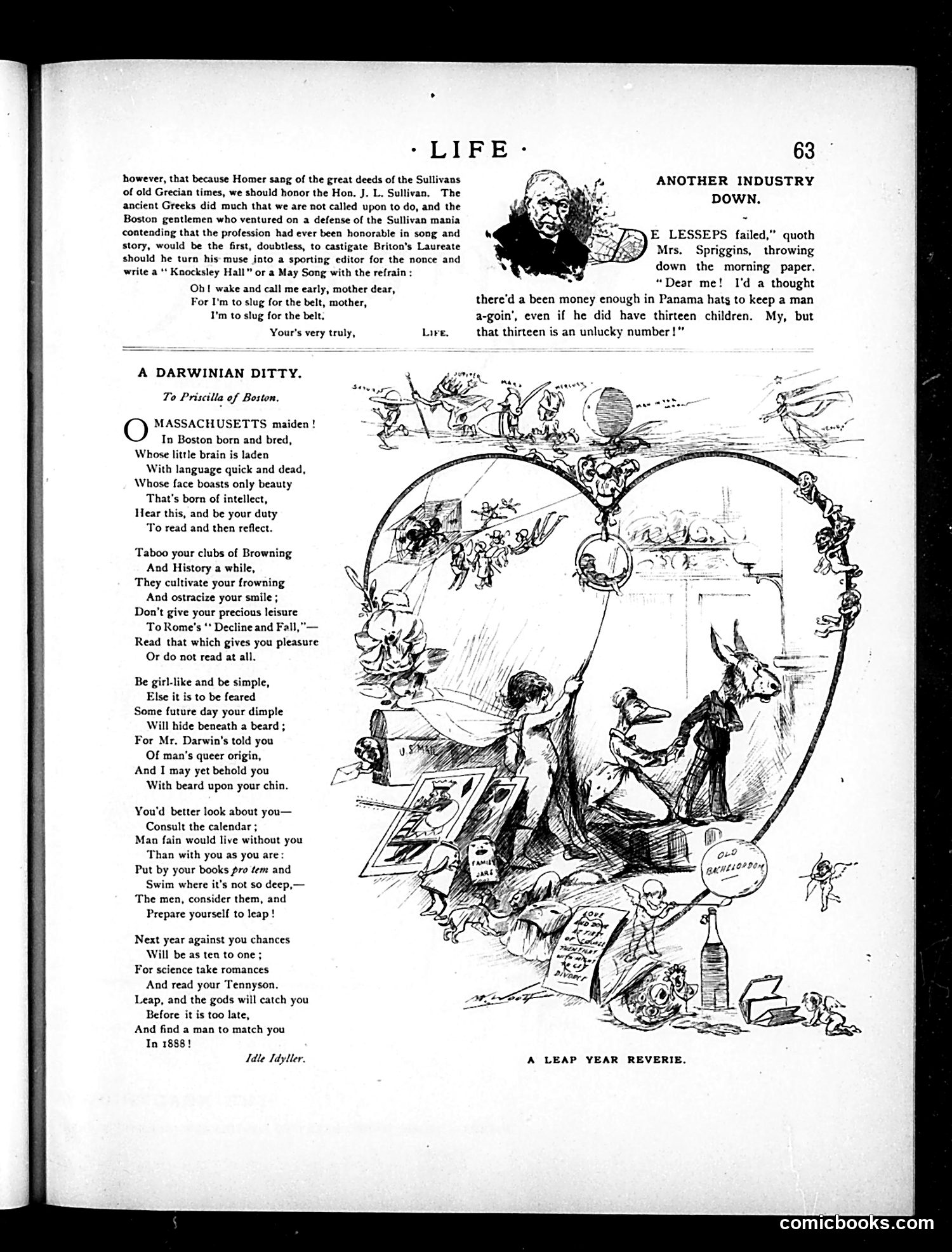
**"Another Industry Down"** (top): Mrs. Spriggins laments that Panama hats—traditionally worn by men—won't keep a man employed even if he had thirteen children. This satirizes economic anxieties about male employment and supports the implicit complaint that women's economic independence is destabilizing traditional family structures. **"A Darwinian Ditty"** (left): A poem mocking Massachusetts women, attributed to Idle Idyller. It ridicules educated Boston women for studying Darwin's evolution theory and encourages them toward domestic roles ("find a man to match you / In 1888!"). The satire targets women's intellectual ambitions as unnatural and unfeminine. **"A Leap Year Reverie"** (right): An elaborate cartoon showing gender-role confusion in an 1888 leap year, when tradition allowed women to propose to men—depicted here as chaotic and absurd.
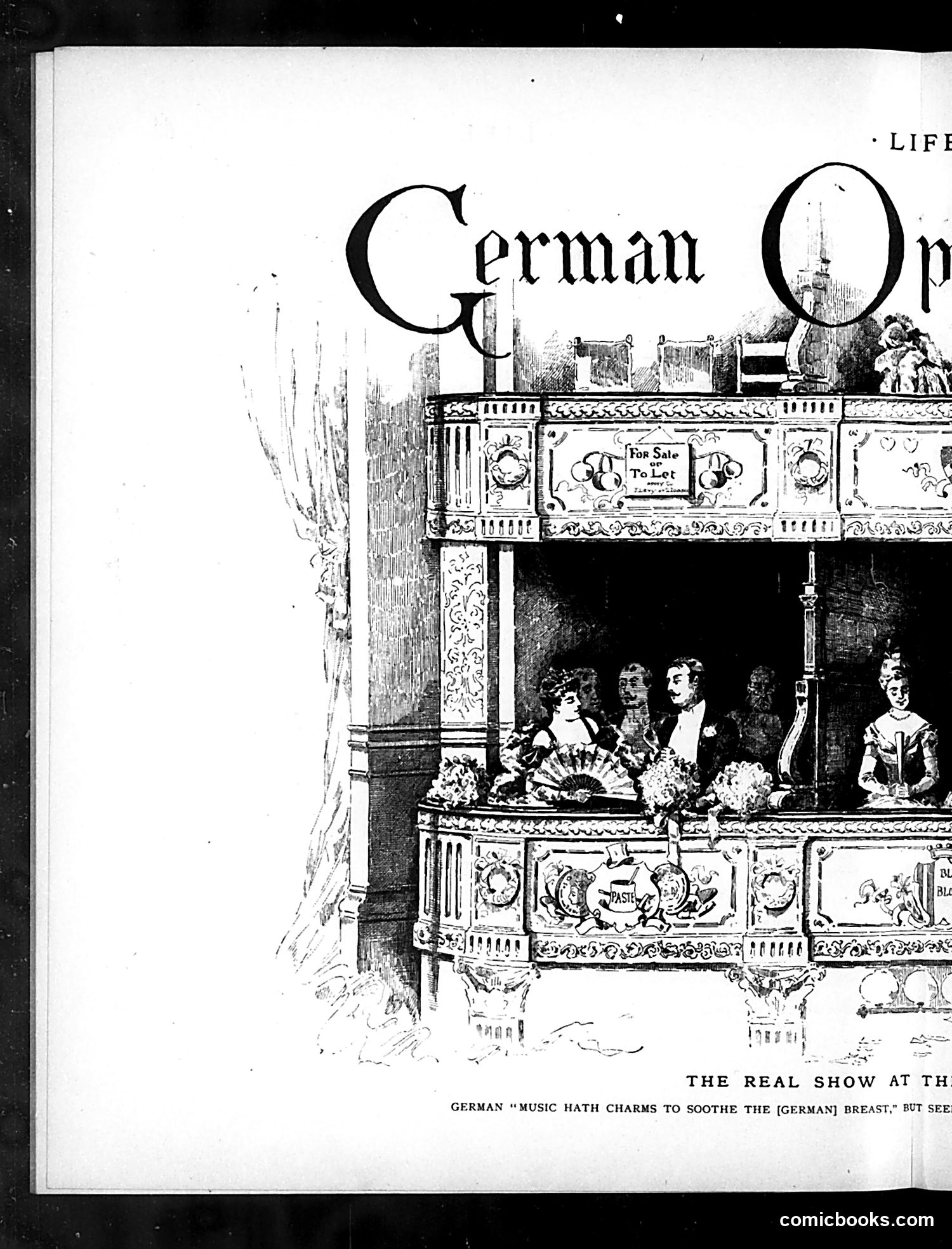
This is a satirical illustration from *Life* magazine titled "German Op[era]" (heading partially visible). The image depicts an ornate theater box with elegantly dressed German opera patrons observing a performance below. The caption reads: "THE REAL SHOW AT TH[E OPERA]—GERMAN 'MUSIC HATH CHARMS TO SOOTHE THE [GERMAN] BREAST,' BUT SEE[...]" The satire targets German high society and opera culture. The joke appears to suggest that the "real show" isn't the opera performance itself, but rather the spectacle of the wealthy German audience members displaying themselves in their finery in the theater box—their fashionable clothing, jewelry, and social posturing constitute the actual entertainment. The caption's incomplete final phrase likely delivered the punchline about what observers actually watch at German opera.
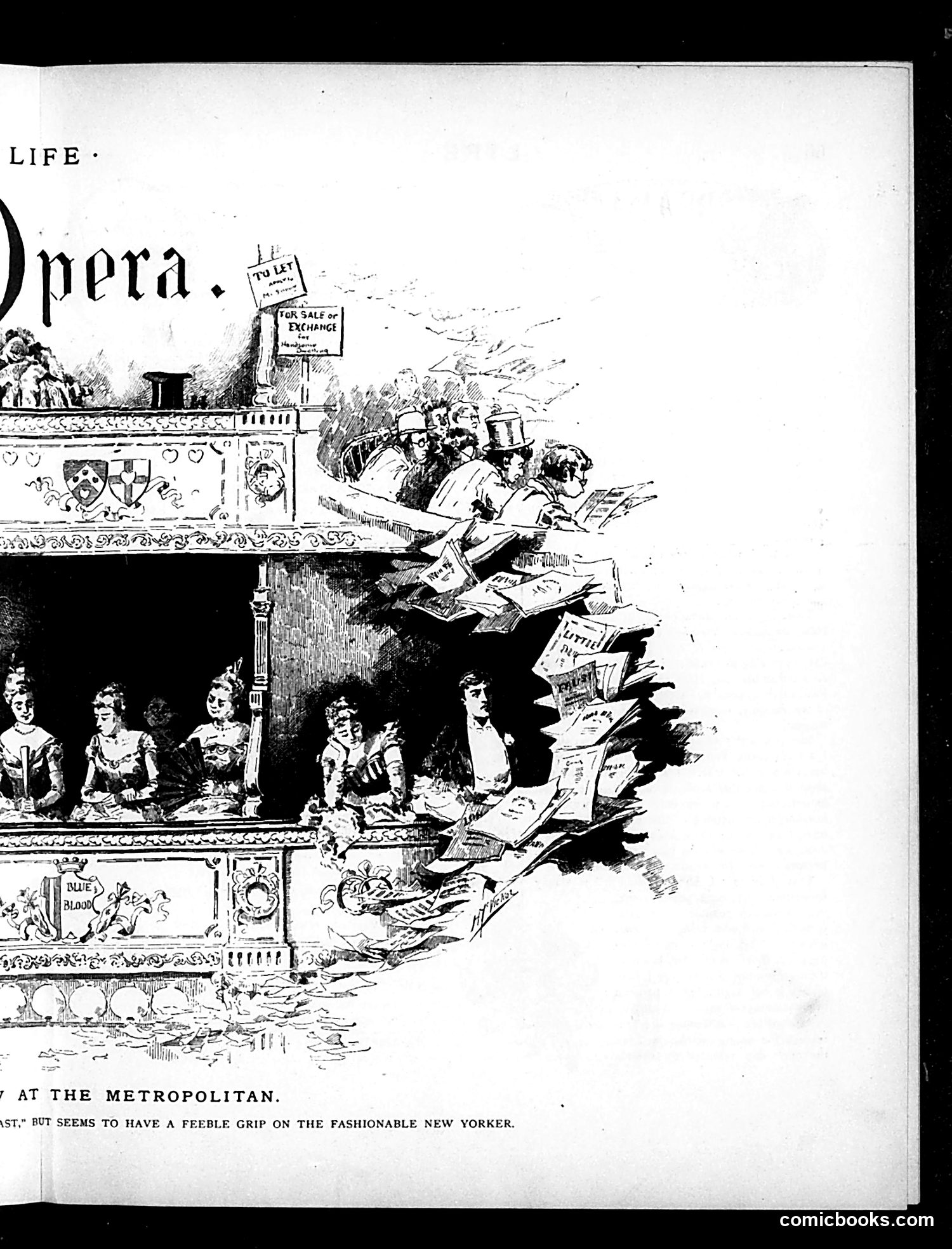
This is a satirical cartoon about opera at the Metropolitan Opera House in New York. The image depicts an ornate opera house with two tiers of well-dressed audience members. The upper tier shows performers/staff, while the lower tier shows fashionable patrons. Signs reading "FOR SALE or EXCHANGE" appear on the building, suggesting the opera company or its box seats are being marketed or traded like commodities. The caption states the opera "but seems to have a feeble grip on the fashionable new yorker," indicating the satire: that despite opera's prestige and the Metropolitan's prominence, it struggled to maintain genuine appeal among wealthy New York society. The cartoon mocks how opera attendance was more about social display and commerce than authentic cultural appreciation among the city's elite.
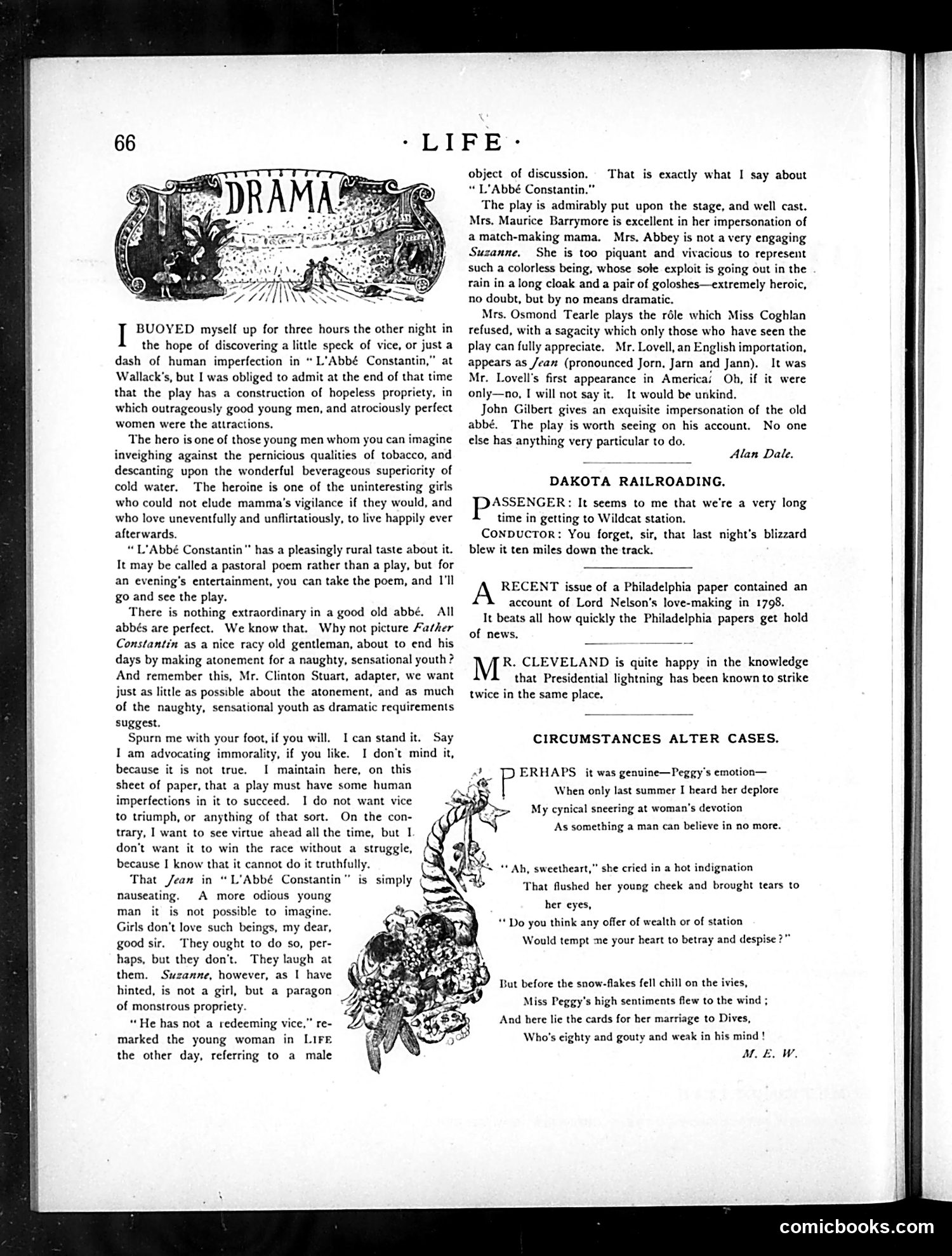
This page contains theatrical and social commentary rather than political cartoons. The main content includes: **"L'Abbé Constantin" review**: A drama critique discussing a stage play about an elderly abbé (Catholic priest). The reviewer critiques the heroine "Suzanne" as too vivacious and the character "Jean" as nauseatingly pious—advocating that plays should portray human imperfection rather than idealized virtue. **Supporting items**: Brief satirical notes about railroad delays and Presidential lightning strikes. **Illustration**: A decorative sketch accompanying "Circumstances Alter Cases," a poem about a woman (Peggy) who rejects a suitor when his fortune declines, marrying a wealthy but feeble man instead—mocking mercenary marriage attitudes. The page primarily offers social satire of theatrical conventions and romantic hypocrisy rather than political commentary.
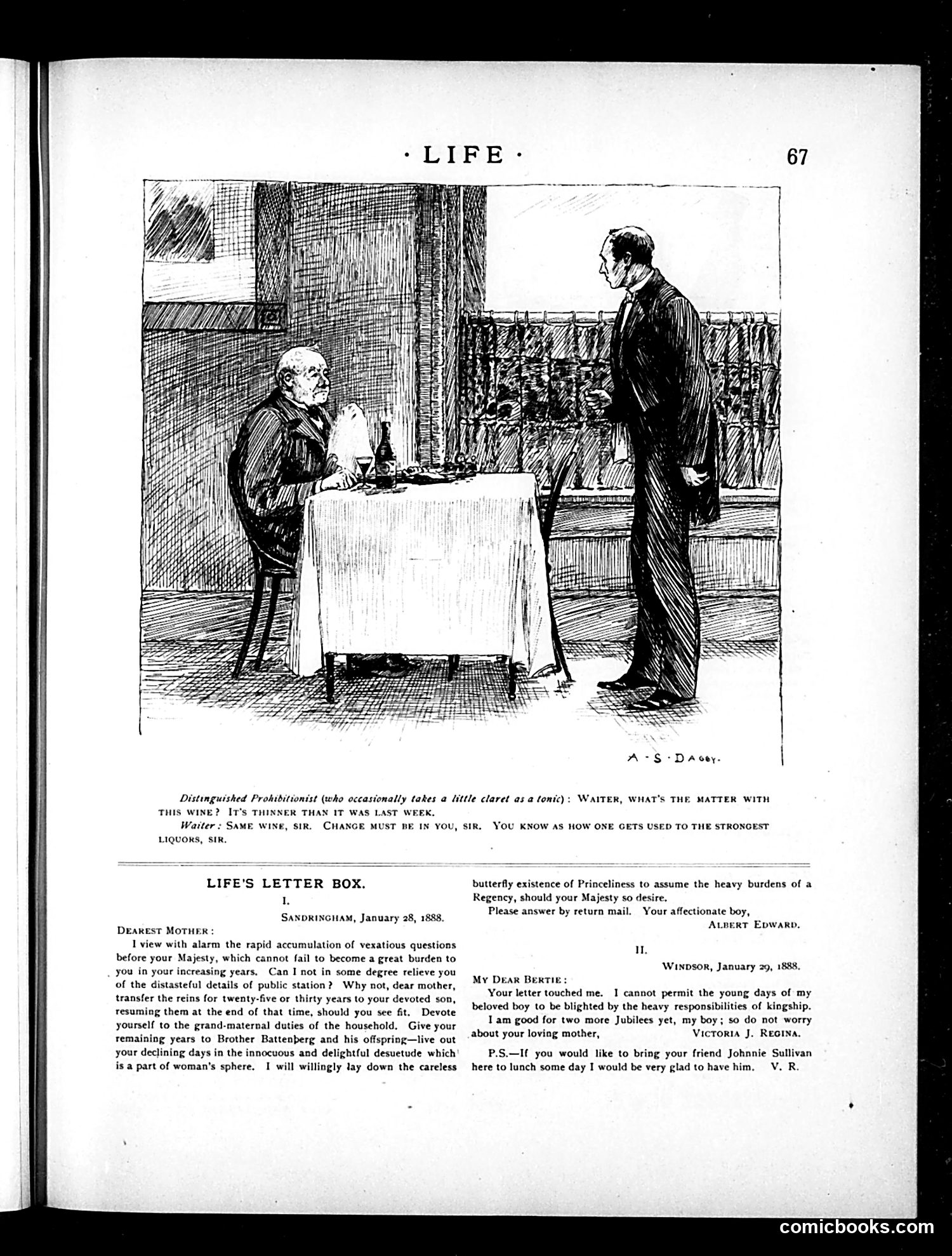
This 1888 *Life* page contains two satirical pieces about British royalty. **The cartoon** (top) depicts a distinguished prohibitionist complaining to a waiter that wine has weakened since last week. The waiter replies that it's the same wine—the drinker has simply grown accustomed to strong liquor. The satire mocks temperance advocates as hypocrites who claim moral superiority while secretly tolerating or enjoying alcohol. **"Life's Letter Box"** (below) is a fake correspondence between Prince Albert Edward (the future King Edward VII, heir to Queen Victoria) and Queen Victoria herself. Bertie writes requesting a 25-30 year regency so Victoria can retire to domestic life. Victoria's reply witheringly refuses, claiming she's good for "two more Jubilees yet" and won't surrender power to her son. The satire mocks the aging queen's grip on power and hints at tension between Victoria and her impatient heir—a real historical tension of the period.
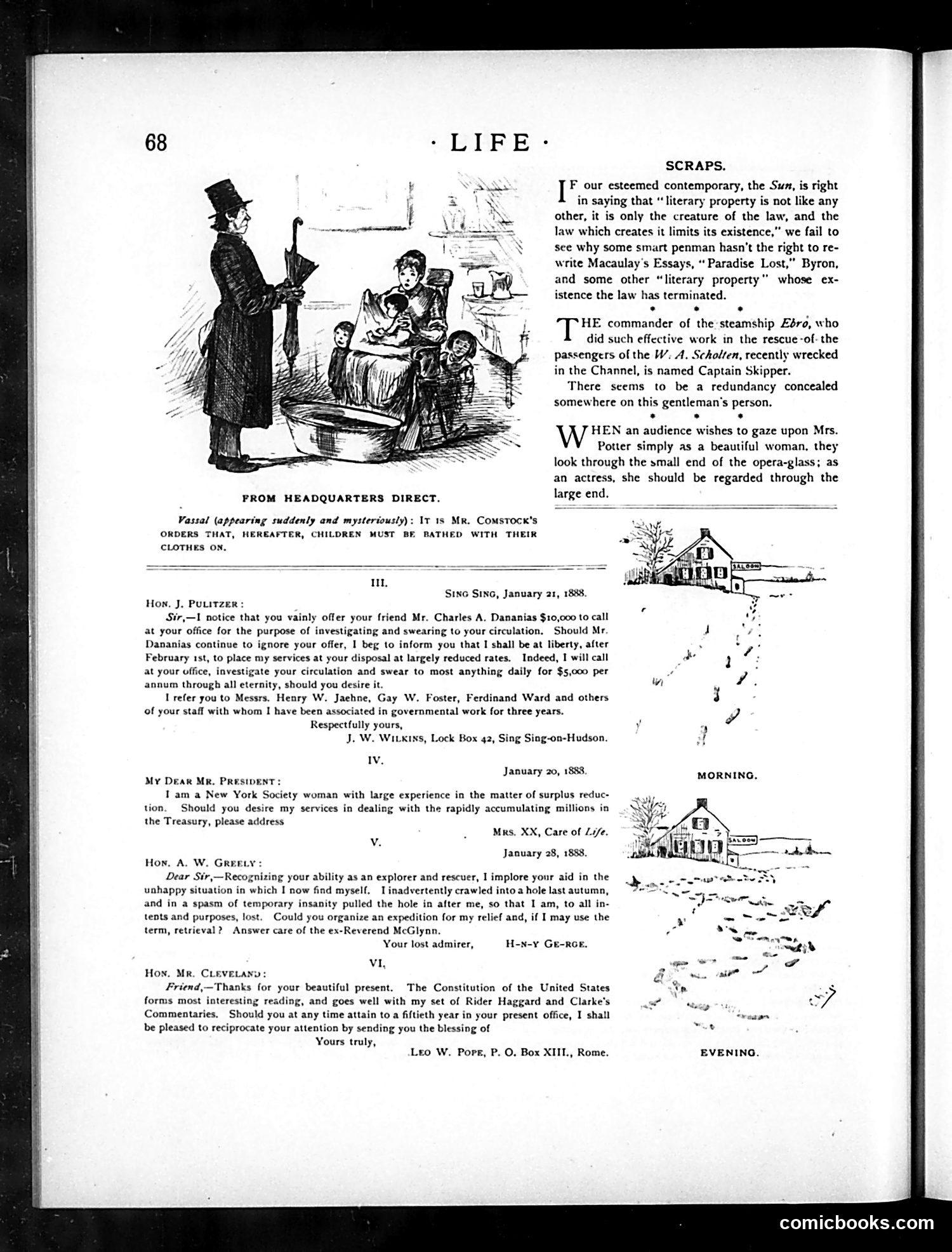
This page contains several short satirical pieces mocking contemporary figures and issues: **Main cartoon**: Shows a Victorian gentleman presenting a bathing edict from "Mr. Comstock"—likely Anthony Comstock, the notorious anti-vice crusader—mandating children be bathed fully clothed. The satire ridicules Comstock's extreme prudishness. **Text scraps** include mock letters from: - A Sing Sing prisoner offering to investigate newspaper circulation fraud cheaper than honest brokers - A society woman offering to "reduce" Treasury surplus (satirizing government waste) - Someone stuck in a hole requesting explorer A.W. Greely's rescue - A correspondent thanking Cleveland for a Constitution, treating it like light fiction The humor relies on absurdist logic, mocking real controversies: Comstock's censorship crusade, newspaper circulation dishonesty, government corruption, and political figures' perceived incompetence. Modern readers need context on Comstock's actual influence to appreciate the satire's bite.
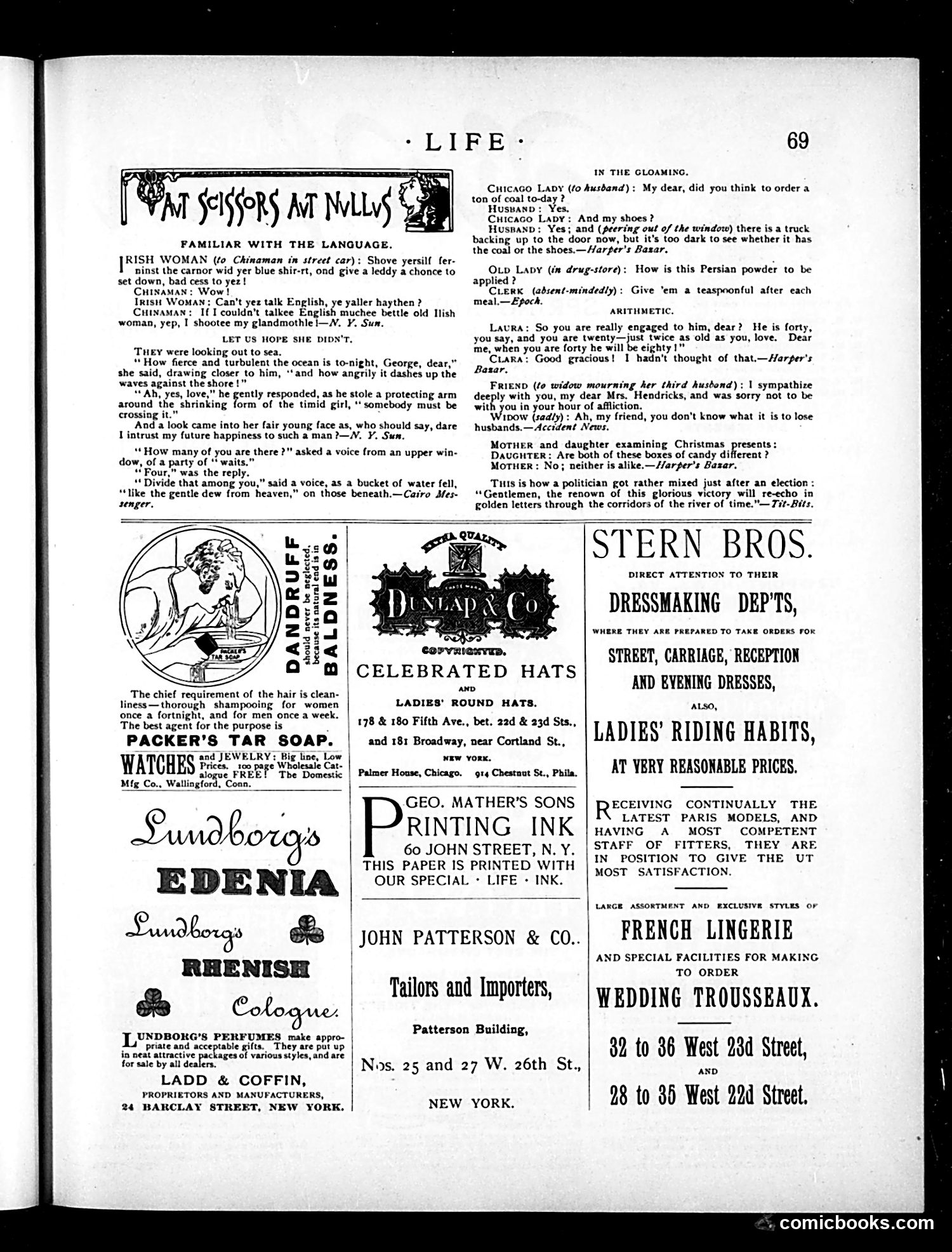
This page is primarily composed of **short humorous anecdotes** from Life magazine, interspersed with period advertisements. The jokes reflect common social tensions of the era: 1. **Xenophobic humor**: The opening cartoon mocks a Chinese immigrant's English and immigrant stereotypes, depicting prejudice against Asian workers. 2. **Gender/class dynamics**: "In the Gloaming" features a wife managing domestic duties (coal, shoes), reflecting women's domestic roles and expectations. 3. **Arithmetic/courtship satire**: A young woman engaged to a man forty years her senior doesn't realize the age gap will worsen—satirizing marriages motivated by financial security rather than love equality. 4. **Widow joke**: A widow who has lost three husbands shows shocking emotional detachment, implying serial marriages or mercenary behavior. 5. **Political satire**: A politician's incoherent victory speech mocks political rhetoric as meaningless verbosity ("corridors of the river of time"). The advertisements—for soaps, perfumes, hats, and clothing—are typical period marketing emphasizing appearance and propriety.
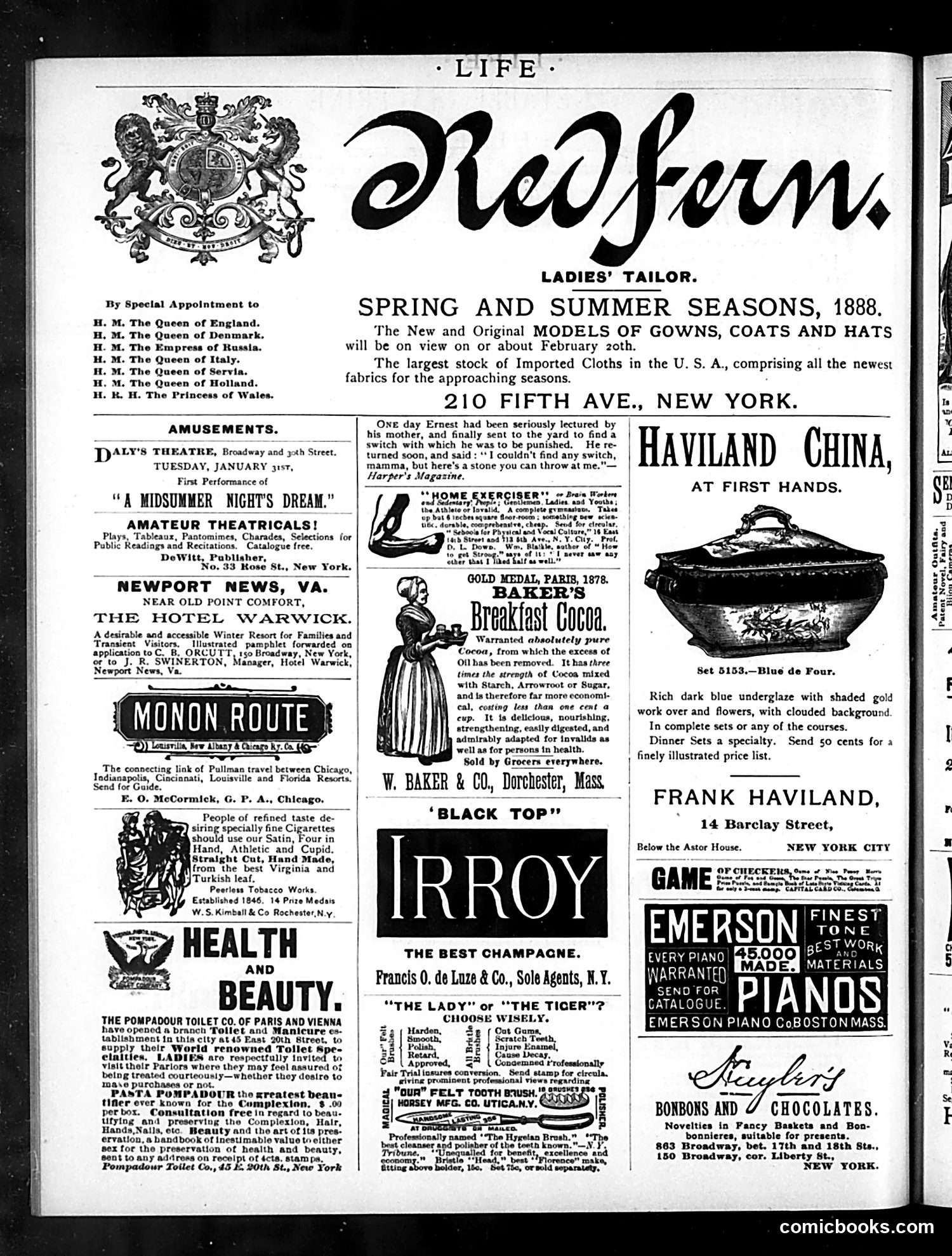
This is primarily an **advertising page** with minimal satirical content, typical of Life magazine's business model in 1888. The page features: - **Red Fern's advertisement** (top): A ladies' tailor claiming royal patronage from Queen Victoria, the Empress of Russia, and other European royalty. This reflects the 1880s trend of American businesses leveraging European prestige. - **"Ernest" anecdote**: A brief humorous story about a boy searching for a switch for his own punishment and offering a stone instead—gentle domestic humor rather than political satire. - **Surrounding ads**: Baker's Cocoa, champagne, pianos, china, chocolates—marketing luxury goods to Life's affluent readership. The page demonstrates how 19th-century magazines blended editorial content with revenue-generating advertisements, with no clear distinction between them. There is no significant political satire or caricature visible—it's essentially a classified advertising section with one light humorous anecdote.
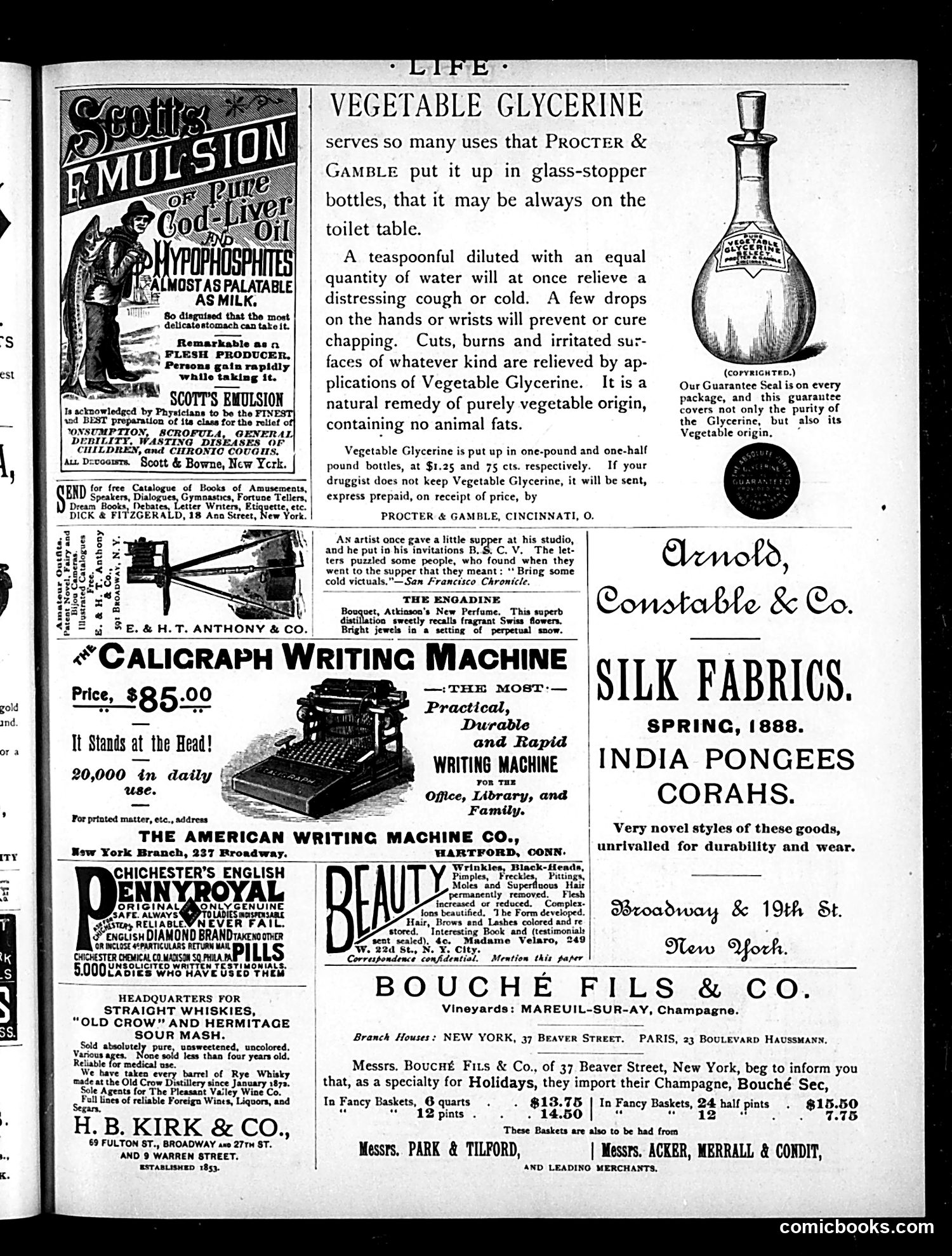
This is not a satirical cartoon page but rather a **magazine advertising section** from Life's Spring 1888 issue. The page contains product advertisements for: - **Vegetable Glycerine** (Procter & Gamble) — marketed as a cure-all for coughs, chapping, burns - **Scott's Emulsion** — a cod-liver oil remedy - **The Caligraph Writing Machine** — a typewriter - **Paxine powder** — for skin conditions - **Whiskey brands** (Old Crow, Hermitage) - **Silk fabrics and champagne** There is one **brief humorous anecdote** about an artist's dinner invitation using the cryptic abbreviation "B.S.C.V." (meaning "Bring Some Cold Victuals"). The page reflects **1880s commercial culture** and patent medicine marketing, where unregulated products made sweeping health claims. The elaborate advertisements and their tone are themselves period curiosities, but this isn't satirical content—it's the magazine's revenue base.
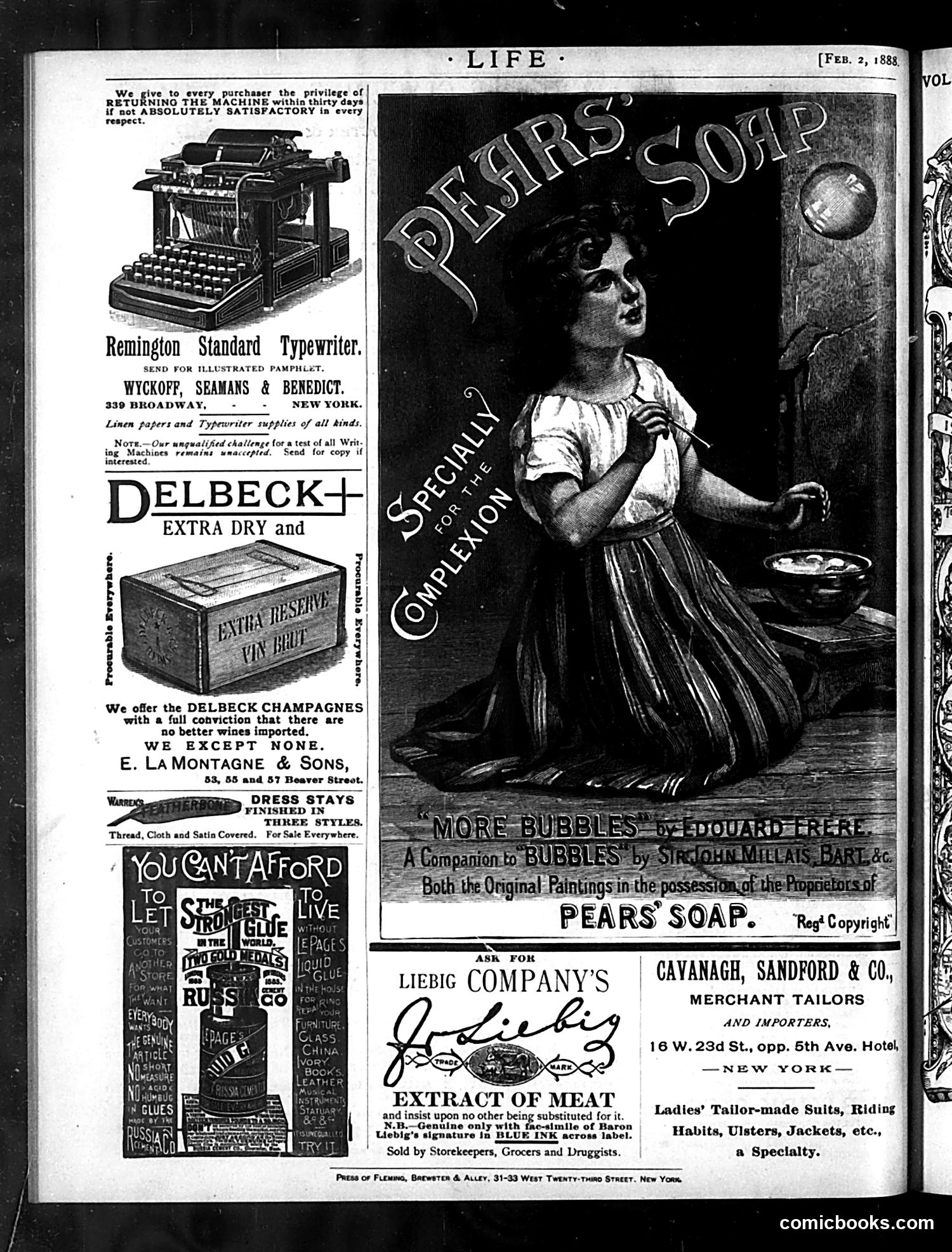
This page is primarily **advertising**, not satire or political commentary. The dominant image is a **Pears' Soap advertisement** featuring a classical-style illustration of a woman gazing upward while holding soap, with text referencing "Bubbles" and claiming connection to paintings by Sir John Millais. The left side contains period product advertisements: the **Remington Standard Typewriter**, **Delbeck Champagne**, dress stays, and **Liebig Company's Extract of Meat**. The bottom advertises **Cavanagh, Sandford & Co.**, merchant tailors in New York. The only potentially satirical element is the small **"You Can't Afford to Live"** advertisement using ironic text-art, suggesting commentary on cost of living—though its specific target remains unclear from this image alone. Otherwise, this reflects late-19th-century magazine design: pages mixing commercial advertisements with editorial content to fund publication.